This document describes various traditional storage structures used for agricultural products in India. It discusses structures like kothis, bukharis, mud kothis, and mudas. Improved structures include Pusa bins and brick/cement bins. Permanent structures include sheds and vertical/squat silos. Specific traditional structures covered include kothis, bamboo structures, bins, rectangular bins, random storage in plastic bags, stone kothis, jars, wooden boxes, baskets, and wooden boxes. The document provides details on the materials, locations, and capacities of these various traditional grain storage structures.
Defines storage in agriculture as interim phases between processor and consumer, and types of structures.
Explains various types of traditional storage structures like Morai, Bukhari, Mud kothi, Muda, Kuthla, and others. Covers various storage structures like Kothi, bamboo, bin (Pib), and rectangular bins with their capacities.
Discusses random grain stores in plastic bags and stone made kothi, highlighting their uses and capacities.
Describes jar and wooden box (Sanduk) storage solutions, including typical capacities and materials.
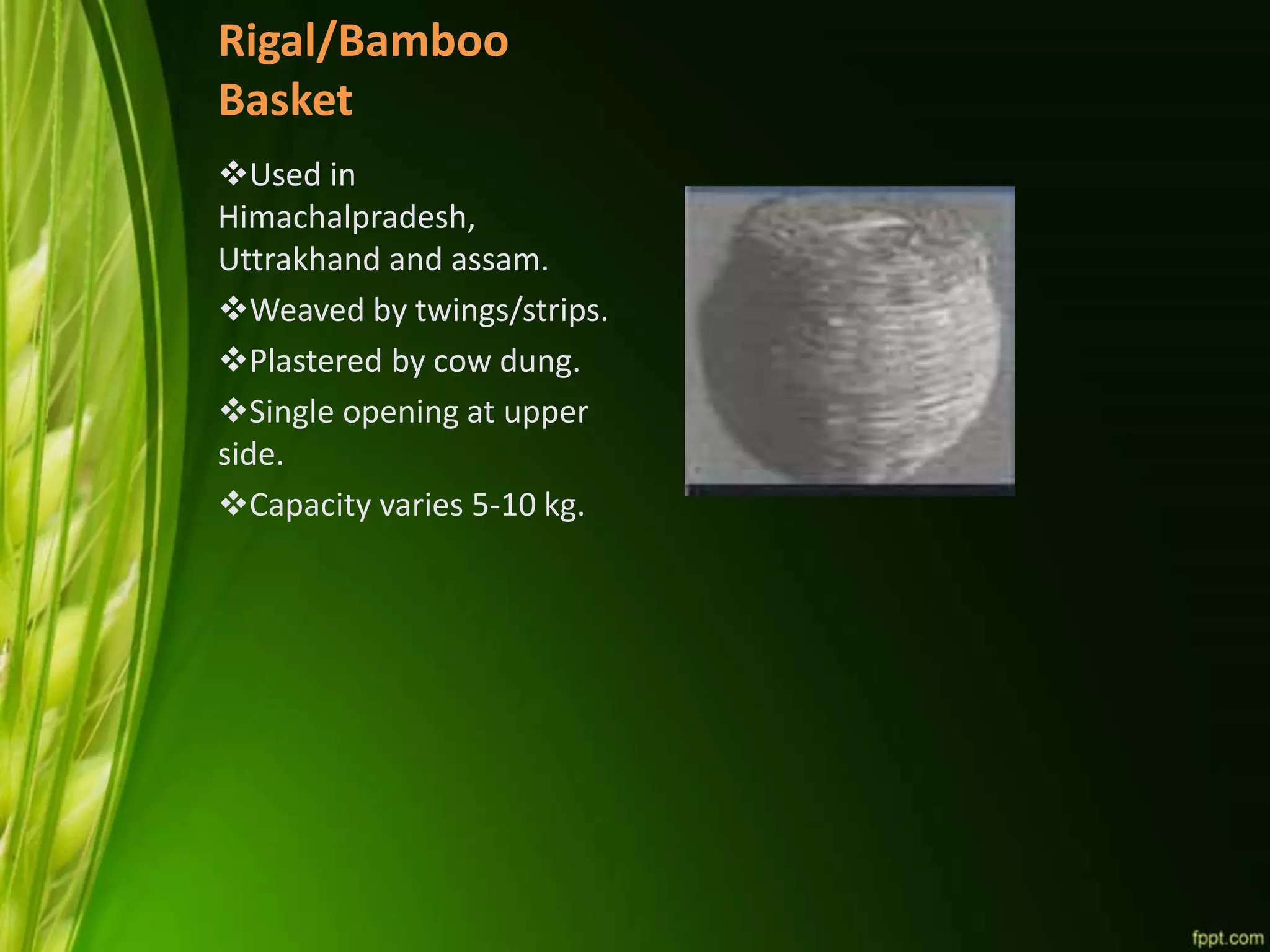
Outlines Rigal/Bamboo baskets and various storage structures like Kothi, Mataka, and bamboo mud structures.
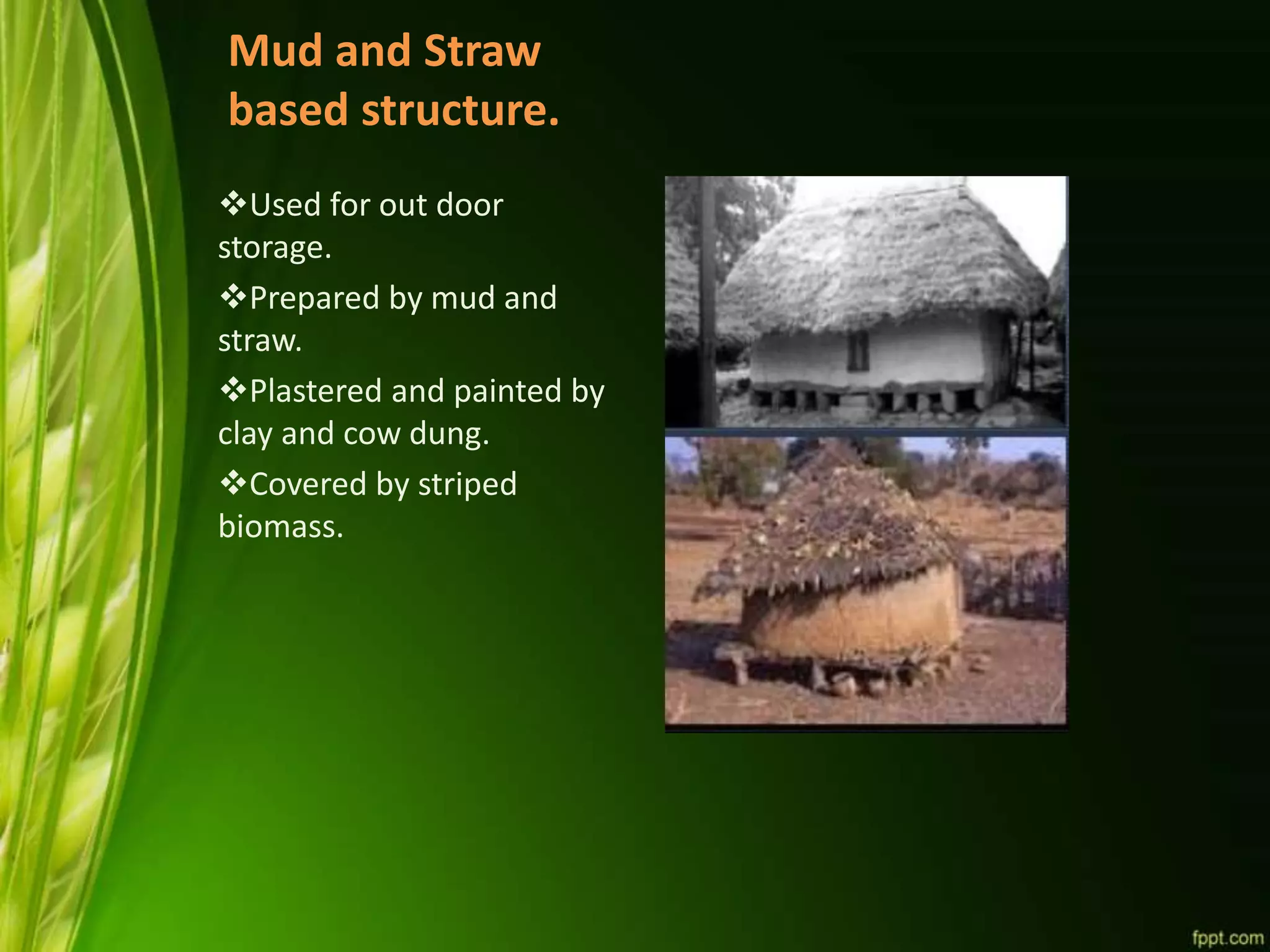
Discusses mud and straw based structures crafted for outdoor grain storage.
What do youmean by storage?
• Storage is an interim and a repeated phase during
transit to agricultural products from processor to
consumer.
• Agricultural products need to be stored from one
harvest to next thus, demanding additional carry
over as safeguard against a following crop of low
yield or poor quality, against speculation in price and
market demand or against shortage and families.
3.
Types of storagestructures
Traditional storage structures
• Morai type storage structures
• Bukhari
• Mud kothi
• Muda
• Kanaj
• Kuthla
Some of thestorage structures that we will learn
Kothi
Bamboo made grain storage structure
Bin (Pib)
Rectangular bin
Random grain stores in plastic bags
Stone made kothi
Jar
Wooden box
Rigal/Bamboo basket
Wooden box (Sanduk)
7.
Wooden storagestructure
Mataka
Mud and straw base storage structure
Bamboo and mud storage structure
8.
Kothi
This is knownas kothi
type grain storage
structure.
It was used for storing
the grain in older days.
It was mainly used for
storing Maize,
Wheat,Paddy and Bajra.
Now a days it is not
used.
Its capacity is varies from
15 to 20kg.
Find from petlad.
9.
Bamboo made
grain storage
structure
Itis found at chosla
village of Dahod district.
It is made bamboo.
It is mainly used as
randomly.
Mainly used for storing
Maize and other local
production.
Capacity is varies from
30 to 40kg.
Other larger size
structures are also
available.
10.
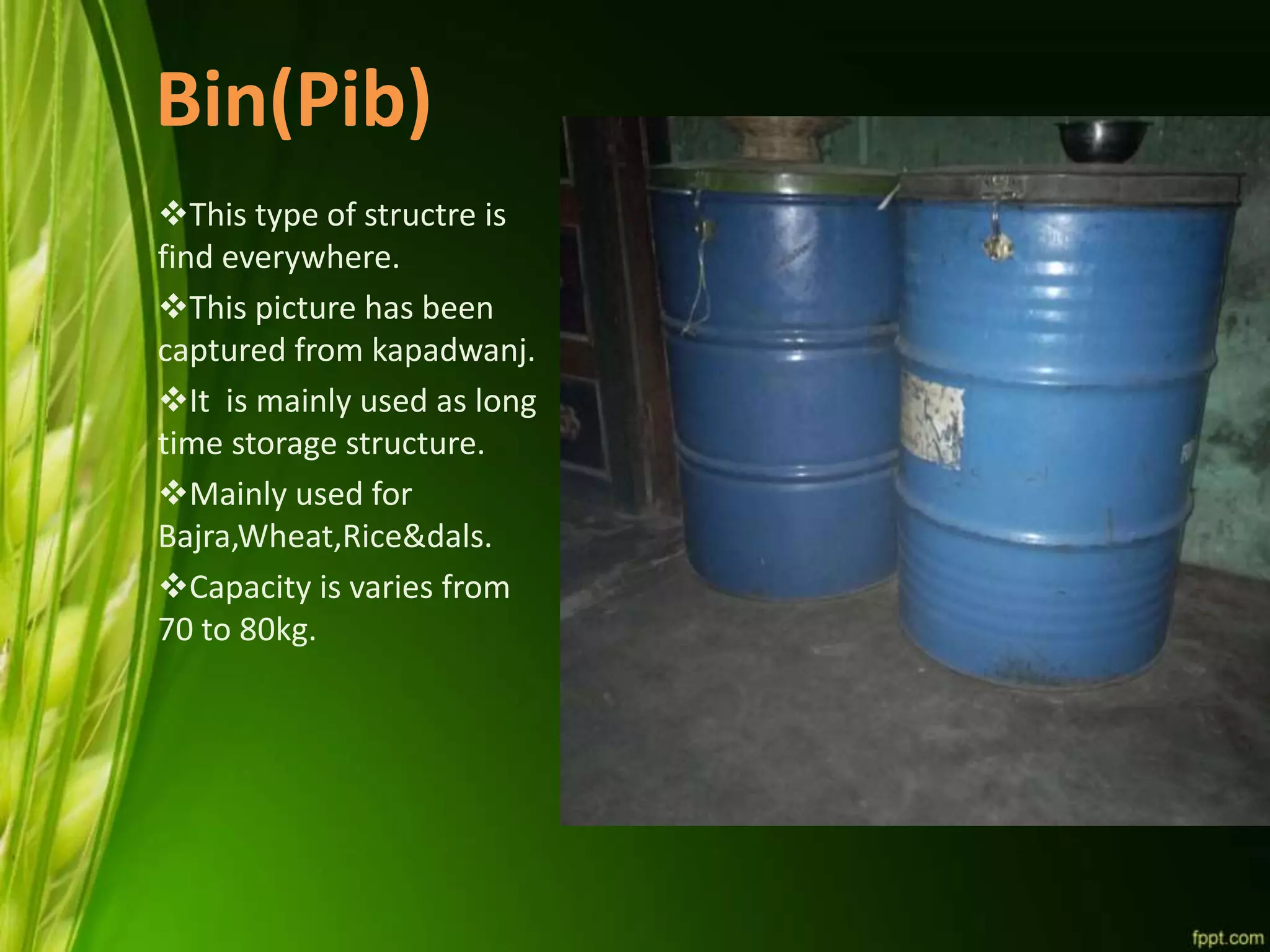
Bin(Pib)
This type ofstructre is
find everywhere.
This picture has been
captured from kapadwanj.
It is mainly used as long
time storage structure.
Mainly used for
Bajra,Wheat,Rice&dals.
Capacity is varies from
70 to 80kg.
11.
Rectangular Bin.
Itis also most
commonly used grain
storage structure.
It generally comes in
different capacity.
Mainly used for storing
grains like
Bajra,Wheat,different
types of pulses etc.
Capacity generally varies
from 10 to 50kg.
It is mainly used for long
term grain storge.
12.
Random grain stores
inplastic bags.
Most commonly type of
grain storage method.
In this type of structure
some fixed quantity of
grains are store in plastic
bags and put the bags on
one another.
This type of storage
occurs mainly at the corner
of the room,Hall and large
Godown.
Bag capacity generally
varies between 5 to 50kg.
Picture has captured
from unja.
13.
Stone made kothi
Ithas found at vana(
surendranagar).
It was built from stones.
It was used for storing
grains in small quantity.
Used for Storing
Bajra,Wheat&Rice.
Capacity is varies from 8
to 10kg.
Mainly they are come
from rectangular or Square
shape.
14.
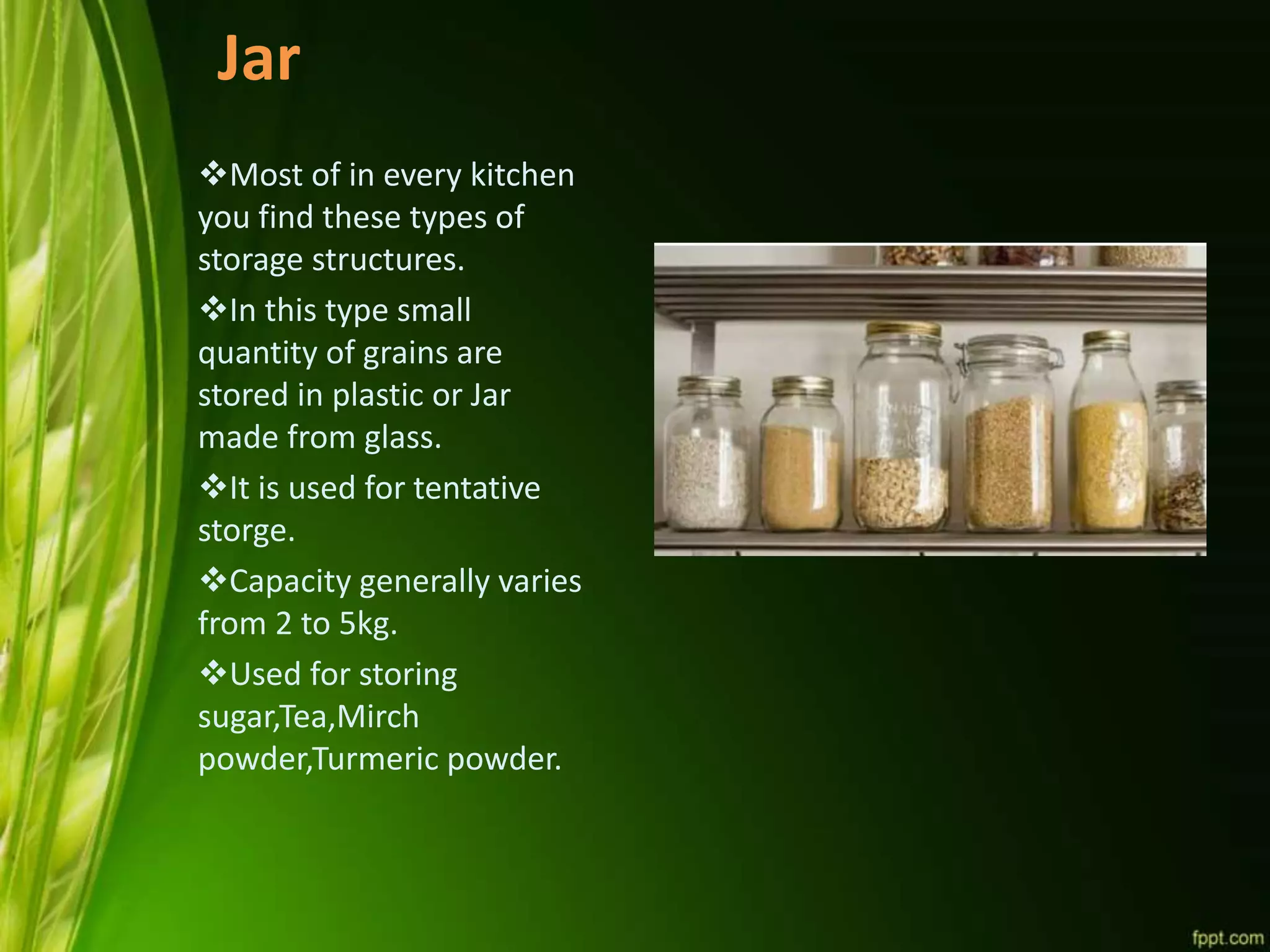
Jar
Most of inevery kitchen
you find these types of
storage structures.
In this type small
quantity of grains are
stored in plastic or Jar
made from glass.
It is used for tentative
storge.
Capacity generally varies
from 2 to 5kg.
Used for storing
sugar,Tea,Mirch
powder,Turmeric powder.
15.
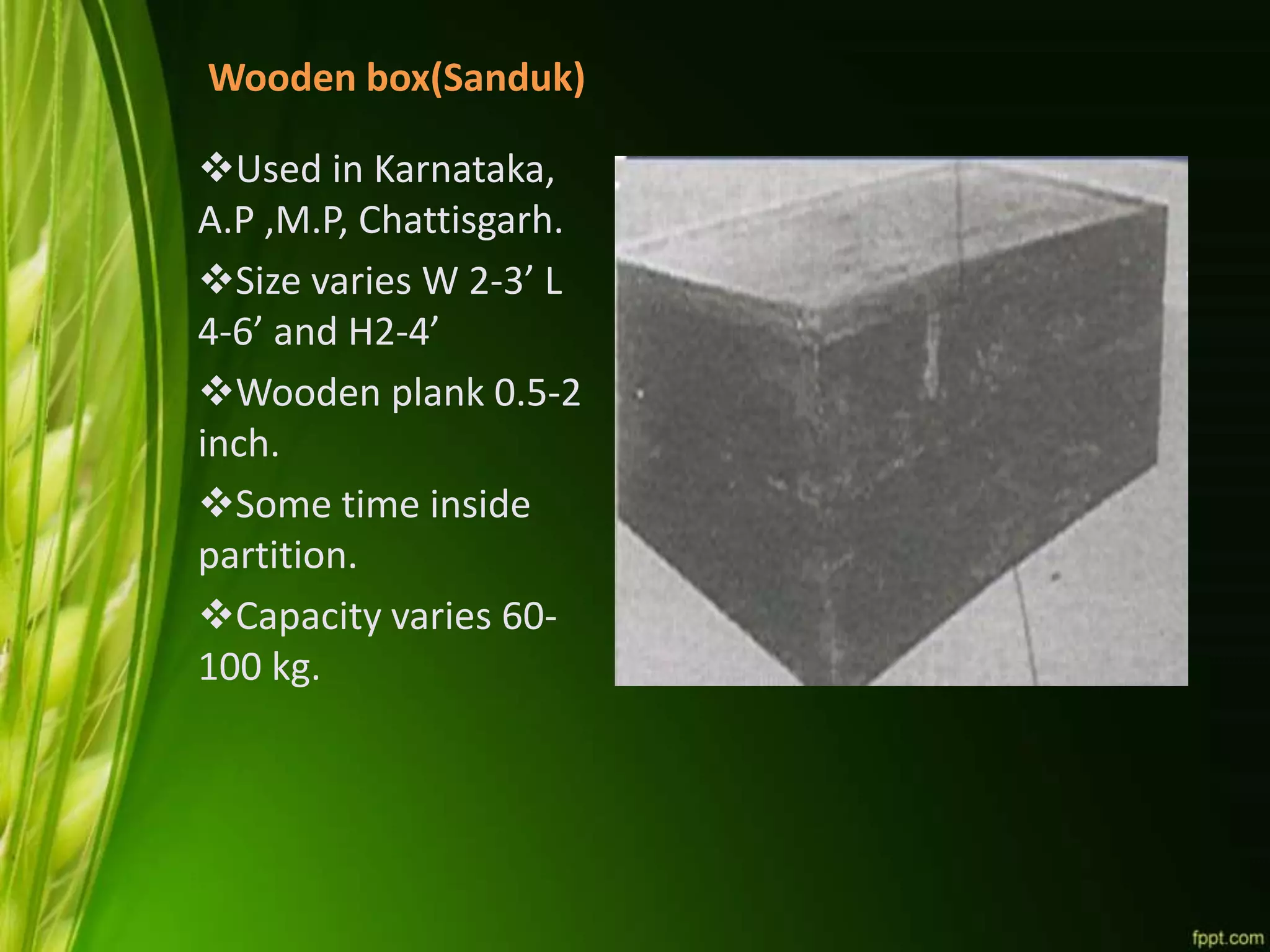
Wooden box(Sanduk)
Used inKarnataka,
A.P ,M.P, Chattisgarh.
Size varies W 2-3’ L
4-6’ and H2-4’
Wooden plank 0.5-2
inch.
Some time inside
partition.
Capacity varies 60-
100 kg.
Wooden storage
structure
Used inhilly and cold
areas called “Bakhars”.
Size 8’*6’
Small outlets to avoid
moisture exposure in the
store while , drawing
grains.
Provision for Locking.
18.
Kothi.
Uttarakhand, Rajasthan
and Himachalpradesh.
Made with clay, wheat
straw and cow dung.
Plastered and painted by
Clay and cow dung.
Wall thickness about 2-
4inches.
An opening at upper side
of Kothi for filling the grains.
The opening is made of
same materials.
After filling the grains it is
plastered and painted with
pest made of clay and cow
dung.
19.
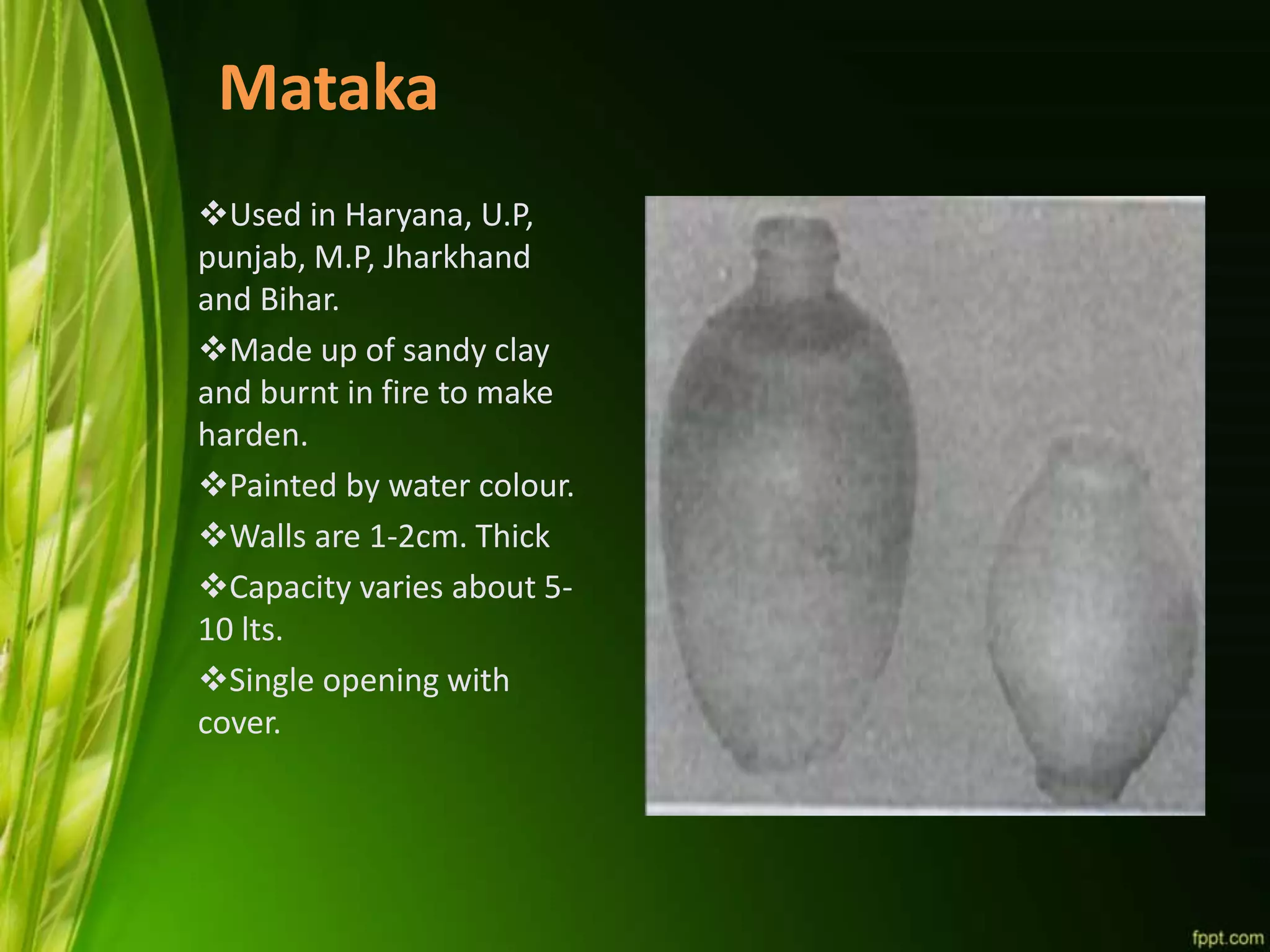
Mataka
Used in Haryana,U.P,
punjab, M.P, Jharkhand
and Bihar.
Made up of sandy clay
and burnt in fire to make
harden.
Painted by water colour.
Walls are 1-2cm. Thick
Capacity varies about 5-
10 lts.
Single opening with
cover.
20.
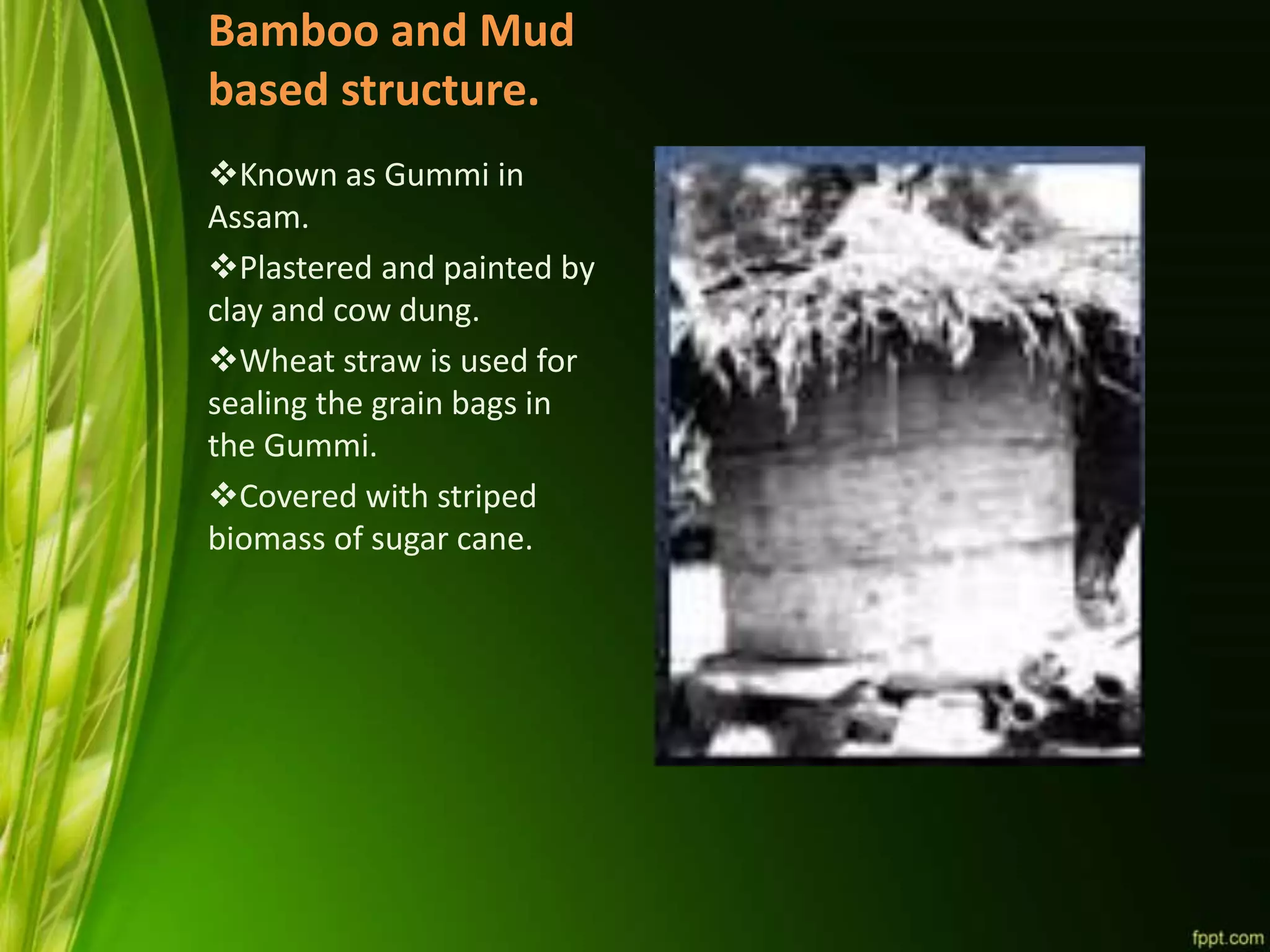
Bamboo and Mud
basedstructure.
Known as Gummi in
Assam.
Plastered and painted by
clay and cow dung.
Wheat straw is used for
sealing the grain bags in
the Gummi.
Covered with striped
biomass of sugar cane.
21.
Mud and Straw
basedstructure.
Used for out door
storage.
Prepared by mud and
straw.
Plastered and painted by
clay and cow dung.
Covered by striped
biomass.