By
 Meenakshy Minood
   Grade 8 Igcse
In the developed world biomass is becoming more
   important for dual applications such as heat and
   power generation.
Biomass is a clean renewable energy resource derived
   from the waste of various human and natural
   activities.
It excludes organic material which has been transformed
   by geological processes into substances such as coal or
   petroleum.
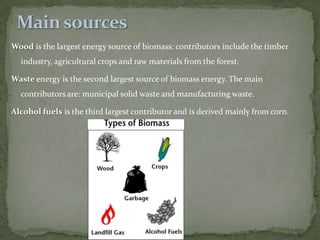
Wood is the largest energy source of biomass: contributors include the timber
  industry, agricultural crops and raw materials from the forest.

Waste energy is the second largest source of biomass energy. The main
  contributors are: municipal solid waste and manufacturing waste.

Alcohol fuels is the third largest contributor and is derived mainly from corn.
Any source can be used to fuel biomass energy
 production. We can use rubbish, animal manure,
 woodchips, seaweed, corn stalks and other wastes.
Biomass is matter usually thought of as garbage.
 Some of the sources are just lying around: dead trees,
 left-over crops, woodchips, sawdust from lumber
 mills, even used tires and livestock manure will do.
In California, USA, more than 60 million tons of energy
sources for biomass energy are collected each year. If all these
sources were used to create biomass energy, California could
make up to 2000 megawatts of electricity. That is enough to
make electricity for about 2 million homes.
Providing electricity is not the major advantage of waste-to-energy plants
  that generate electricity. It actually costs more to generate electricity at a
  waste-to-energy plant than it does at a coal, nuclear, or hydropower
  plant.
The major advantage of burning waste is that it reduces the amount of
  garbage we bury in landfills. Waste-to-energy plants dispose of the waste
  of 40 million people.
The average American produces more than 1,600 pounds of waste a year. If
  all this waste were land filled, it would take more than two cubic yards of
  landfill space. That's the volume of a box 3 feet long, 3 feet wide, and 6
  feet high. If that waste were burned, the ash residue would fit into a box
  3 feet long, 3 feet wide, but only 9 inches high.

Solid Waste Incinerators Simply Dispose of Waste
There also are solid waste incinerators that simply burn trash. They don't
  use the heat energy to make steam or electricity.
Between waste-to-energy plants and solid waste incinerators, the United
  States burns 14% of its solid waste.
 The harnessing of energy from biological mass
  (biomass) is a simple process. The waste wood and other
  sources are gathered in big trucks. The waste is then
  transported to a biomass plant. Here, the waste is fed
  into furnaces where it is burned. The heat created is used
  to boil water and the energy from the steam is used to
  rotate turbines and generators.
 The second method, through which energy is created, is
  called Landfill Gas. When garbage is burned or is
  allowed to decompose it gives off methane gas. Pipelines
  are put into the landfills (pits in which garbage is
  burned) and the methane gas is collected. It is then used
  to make energy in power plants.
 The use of biomass can help reduce Global Warming.
 Plants use and store carbon dioxide (CO2) when they
 grow. When it burns or decomposes, it releases the
 CO2. Replanting plants, crops or trees etc. ensures that
 the C02 is reused. If the plants are not replanted the
 biomass will disrupt the natural carbon equilibrium
 and thus continue to contribute towards Global
 Warming.
In rural India biomass is used for cooking and agricultural
  growth. It has been very useful for village households that own
  cattle. Through a simple process the cattle dung is used to produce
  a gas which is then used as fuel for cooking. The surplus dung is
  used as manure.
The use of sugarcane to produce electricity is increasingly being
  used in Indian sugar mills. After the juice has been extracted from
  the sugarcanes, the leftover pulp - bagasse - is sold to power
  plants. Here, the bagasse is burned. The energy produced is then
  provided to the sugar mills.
Biomass power plants are becoming very popular. Using resources
  that are easily available makes the production of energy
  efficient and reliable.
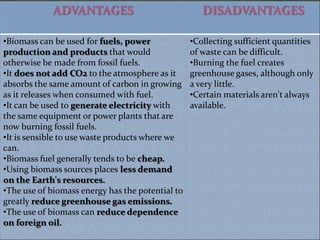
ADVANTAGES                              DISADVANTAGES

•Biomass can be used for fuels, power             •Collecting sufficient quantities
production and products that would                of waste can be difficult.
otherwise be made from fossil fuels.              •Burning the fuel creates
•It does not add CO2 to the atmosphere as it      greenhouse gases, although only
absorbs the same amount of carbon in growing      a very little.
as it releases when consumed with fuel.           •Certain materials aren't always
•It can be used to generate electricity with      available.
the same equipment or power plants that are
now burning fossil fuels.
•It is sensible to use waste products where we
can.
•Biomass fuel generally tends to be cheap.
•Using biomass sources places less demand
on the Earth's resources.
•The use of biomass energy has the potential to
greatly reduce greenhouse gas emissions.
•The use of biomass can reduce dependence
on foreign oil.

Biomass

  • 1.
    By Meenakshy Minood Grade 8 Igcse
  • 2.
    In the developedworld biomass is becoming more important for dual applications such as heat and power generation. Biomass is a clean renewable energy resource derived from the waste of various human and natural activities. It excludes organic material which has been transformed by geological processes into substances such as coal or petroleum.
  • 3.
    Wood is thelargest energy source of biomass: contributors include the timber industry, agricultural crops and raw materials from the forest. Waste energy is the second largest source of biomass energy. The main contributors are: municipal solid waste and manufacturing waste. Alcohol fuels is the third largest contributor and is derived mainly from corn.
  • 4.
    Any source canbe used to fuel biomass energy production. We can use rubbish, animal manure, woodchips, seaweed, corn stalks and other wastes. Biomass is matter usually thought of as garbage. Some of the sources are just lying around: dead trees, left-over crops, woodchips, sawdust from lumber mills, even used tires and livestock manure will do. In California, USA, more than 60 million tons of energy sources for biomass energy are collected each year. If all these sources were used to create biomass energy, California could make up to 2000 megawatts of electricity. That is enough to make electricity for about 2 million homes.
  • 5.
    Providing electricity isnot the major advantage of waste-to-energy plants that generate electricity. It actually costs more to generate electricity at a waste-to-energy plant than it does at a coal, nuclear, or hydropower plant. The major advantage of burning waste is that it reduces the amount of garbage we bury in landfills. Waste-to-energy plants dispose of the waste of 40 million people. The average American produces more than 1,600 pounds of waste a year. If all this waste were land filled, it would take more than two cubic yards of landfill space. That's the volume of a box 3 feet long, 3 feet wide, and 6 feet high. If that waste were burned, the ash residue would fit into a box 3 feet long, 3 feet wide, but only 9 inches high. Solid Waste Incinerators Simply Dispose of Waste There also are solid waste incinerators that simply burn trash. They don't use the heat energy to make steam or electricity. Between waste-to-energy plants and solid waste incinerators, the United States burns 14% of its solid waste.
  • 6.
     The harnessingof energy from biological mass (biomass) is a simple process. The waste wood and other sources are gathered in big trucks. The waste is then transported to a biomass plant. Here, the waste is fed into furnaces where it is burned. The heat created is used to boil water and the energy from the steam is used to rotate turbines and generators.  The second method, through which energy is created, is called Landfill Gas. When garbage is burned or is allowed to decompose it gives off methane gas. Pipelines are put into the landfills (pits in which garbage is burned) and the methane gas is collected. It is then used to make energy in power plants.
  • 8.
     The useof biomass can help reduce Global Warming. Plants use and store carbon dioxide (CO2) when they grow. When it burns or decomposes, it releases the CO2. Replanting plants, crops or trees etc. ensures that the C02 is reused. If the plants are not replanted the biomass will disrupt the natural carbon equilibrium and thus continue to contribute towards Global Warming.
  • 10.
    In rural Indiabiomass is used for cooking and agricultural growth. It has been very useful for village households that own cattle. Through a simple process the cattle dung is used to produce a gas which is then used as fuel for cooking. The surplus dung is used as manure. The use of sugarcane to produce electricity is increasingly being used in Indian sugar mills. After the juice has been extracted from the sugarcanes, the leftover pulp - bagasse - is sold to power plants. Here, the bagasse is burned. The energy produced is then provided to the sugar mills. Biomass power plants are becoming very popular. Using resources that are easily available makes the production of energy efficient and reliable.
  • 11.
    ADVANTAGES DISADVANTAGES •Biomass can be used for fuels, power •Collecting sufficient quantities production and products that would of waste can be difficult. otherwise be made from fossil fuels. •Burning the fuel creates •It does not add CO2 to the atmosphere as it greenhouse gases, although only absorbs the same amount of carbon in growing a very little. as it releases when consumed with fuel. •Certain materials aren't always •It can be used to generate electricity with available. the same equipment or power plants that are now burning fossil fuels. •It is sensible to use waste products where we can. •Biomass fuel generally tends to be cheap. •Using biomass sources places less demand on the Earth's resources. •The use of biomass energy has the potential to greatly reduce greenhouse gas emissions. •The use of biomass can reduce dependence on foreign oil.