The Abacus
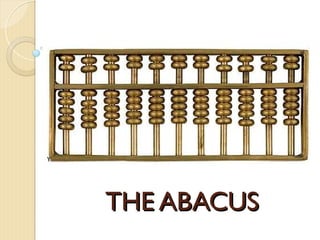
The Abacus
About 5,000 years ago, Chinese
merchants started using the abacus or
suan pan in business transactions.
A device made up of rods of sliding beads
mounted on a frame.
Use to make counting easier and faster.
It is considered the first computer.
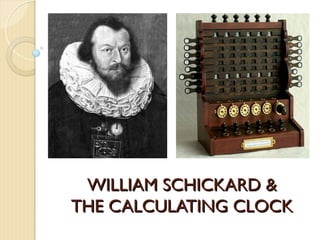
WILLIAM SCHICKARD &
WILLIAMSCHICKARD &
THE CALCULATING CLOCK
THE CALCULATING CLOCK
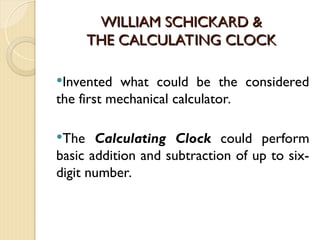
Invented what could be the considered
the first mechanical calculator.
The Calculating Clock could perform
basic addition and subtraction of up to six-
digit number.
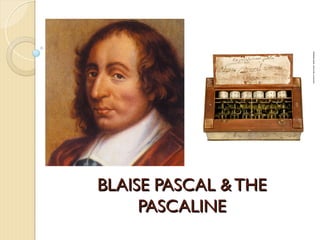
BLAISE PASCAL &THE
BLAISE PASCAL & THE
PASCALINE
PASCALINE
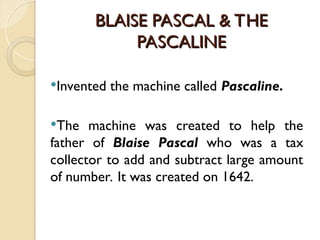
Invented the machine called Pascaline.
The machine was created to help the
father of Blaise Pascal who was a tax
collector to add and subtract large amount
of number. It was created on 1642.
GOTTFRIED WILHELM LEIBNITZ
GOTTFRIEDWILHELM LEIBNITZ
& THE STEPPED RECKONER
& THE STEPPED RECKONER
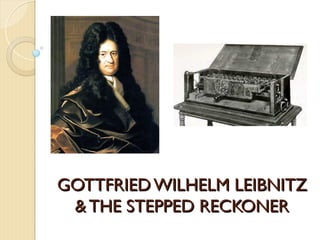
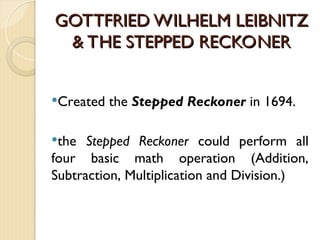
Created the Stepped Reckoner in 1694.
the Stepped Reckoner could perform all
four basic math operation (Addition,
Subtraction, Multiplication and Division.)
11.
CHARLES XAVIER THOMASDE
CHARLES XAVIER THOMAS DE
COLMAR & THE ARITHMOMETER
COLMAR & THE ARITHMOMETER
12.
CHARLES XAVIER THOMASDE COLMAR
CHARLES XAVIER THOMAS DE COLMAR
& THE ARITHMOMETER
& THE ARITHMOMETER
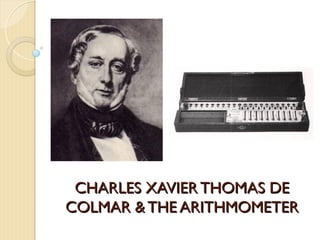
Created the Arithmometer in 1820.
A machine capable of performing the four
basic math operations in a simple and
reliable way.
The machine was so successful that even
for one hundred years, the machine was
still being sold.
13.
CHARLES BABBAGE ANDLADY ADA
CHARLES BABBAGE AND LADY ADA
AUGUSTA LOVELACE & THE
AUGUSTA LOVELACE & THE
DIFFERENCE ENGINE
DIFFERENCE ENGINE
14.
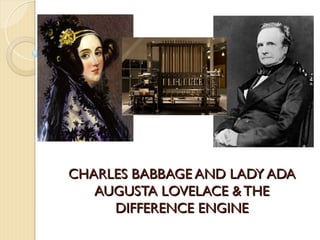
CHARLES BABBAGE
CHARLES BABBAGE
Considered a "father of the computer“
LADY ADA AUGUSTA LOVELACE
LADY ADA AUGUSTA LOVELACE
Regarded as the world’s first computer
programmer.
15.
THE DIFFERENCE ENGINE
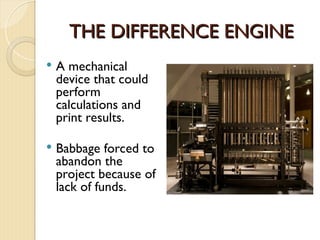
THEDIFFERENCE ENGINE
A mechanical
device that could
perform
calculations and
print results.
Babbage forced to
abandon the
project because of
lack of funds.
16.
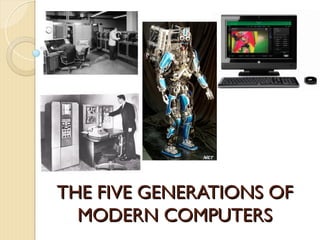
THE FIVE GENERATIONSOF
THE FIVE GENERATIONS OF
MODERN COMPUTERS
MODERN COMPUTERS
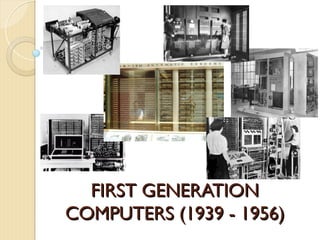
FIRST GENERATION COMPUTERS
FIRSTGENERATION COMPUTERS
Used Vacuum Tubes and Magnetic Drums
for data storage.
Programs were specifically built to help the
computers do the task for which they were
manufactured.
Machine language was the only language 1st
generation computer “understood” or
accepted, making them difficult to program.
Computers were bulky
Commercial production is difficult and
costly.
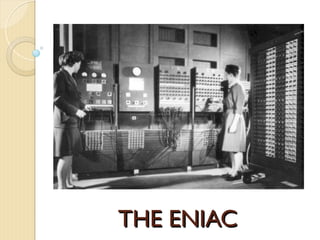
THE ENIAC
THE ENIAC
Alsoknown as Electronic Numerical
Integrator and Computer (ENIAC).
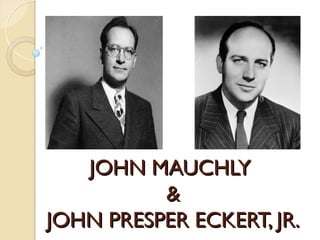
Designed in 1945 by John Presper
Eckert, Jr. and John Mauchly.
This computer was used by the US
Army.
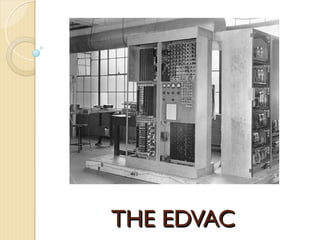
THE EDVAC
THE EDVAC
Alsoknown as Electronic Discrete
Variable Automatic Computer
(EDVAC).
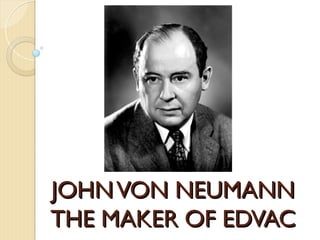
Designed in 1945 by John Von
Neumann.
This computer had a memory that
could hold both data & a stored
program.
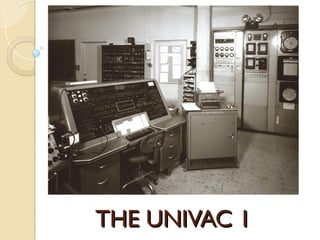
THE UNIVAC 1
THEUNIVAC 1
Also known as Universal Automatic
Computer 1(UNIVAC 1).
Built in 1951 by Remington Rand.
This was the first commercial
computer to feature a magnetic tape
storage system.
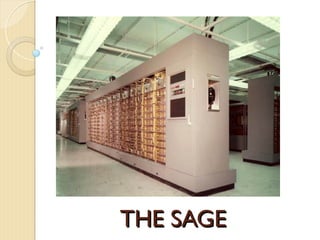
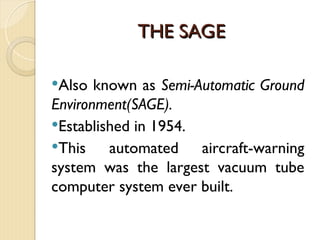
THE SAGE
THE SAGE
Alsoknown as Semi-Automatic Ground
Environment(SAGE).
Established in 1954.
This automated aircraft-warning
system was the largest vacuum tube
computer system ever built.
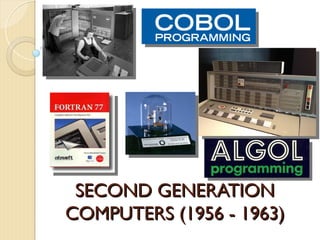
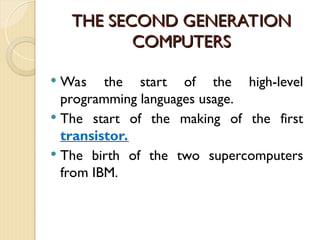
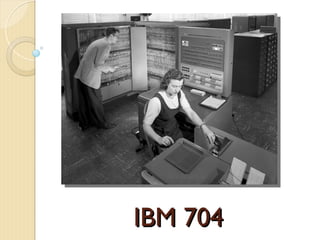
THE SECOND GENERATION
THESECOND GENERATION
COMPUTERS
COMPUTERS
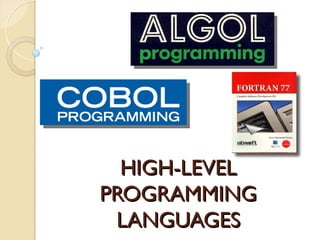
Was the start of the high-level
programming languages usage.
The start of the making of the first
transistor.
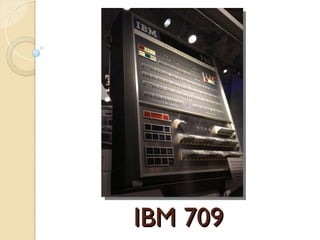
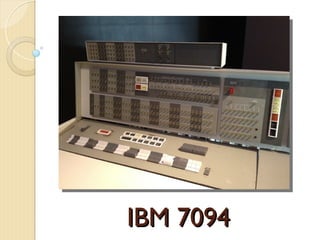
The birth of the two supercomputers
from IBM.
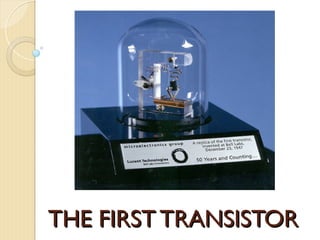
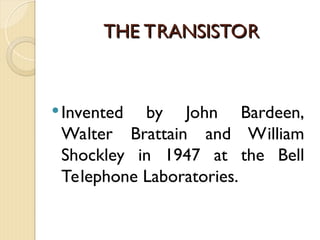
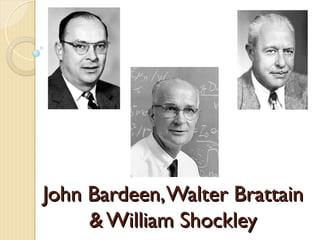
THE TRANSISTOR
THE TRANSISTOR
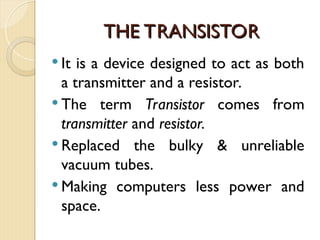
It is a device designed to act as both
a transmitter and a resistor.
The term Transistor comes from
transmitter and resistor.
Replaced the bulky & unreliable
vacuum tubes.
Making computers less power and
space.
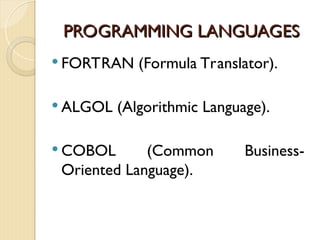
PROGRAMMING LANGUAGES
PROGRAMMING LANGUAGES
Replace long, difficult machine
language with words, sentences and
mathematical formulas.
Making easier to program a
computer.
Computers are becoming more
accessible to government,
universities and businesses.
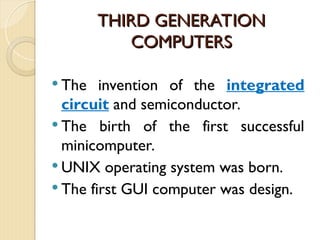
THIRD GENERATION
THIRD GENERATION
COMPUTERS
COMPUTERS
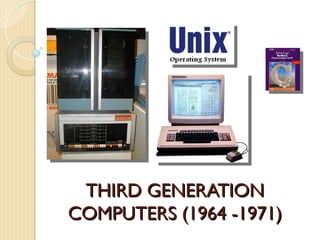
The invention of the integrated
circuit and semiconductor.
The birth of the first successful
minicomputer.
UNIX operating system was born.
The first GUI computer was design.
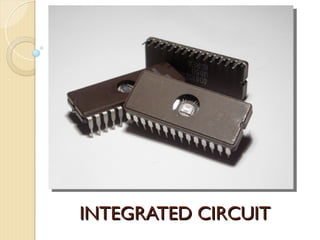
INTEGRATED CIRCUIT
INTEGRATED CIRCUIT
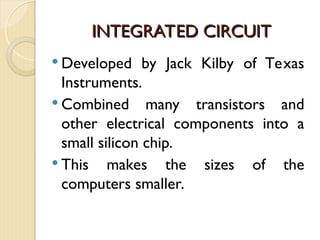
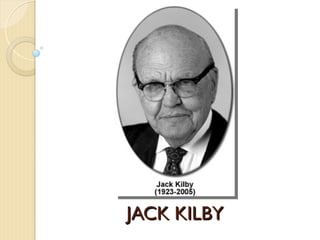
Developed by Jack Kilby of Texas
Instruments.
Combined many transistors and
other electrical components into a
small silicon chip.
This makes the sizes of the
computers smaller.
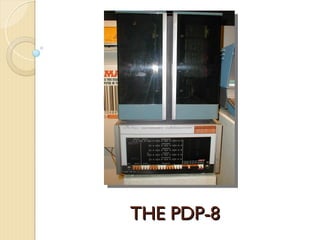
THE PDP-8
THE PDP-8
Developed in 1965.
The first computer to use integrated
circuits.
The first commercial successful
minicomputer because of its
reasonable cost, speed and small
size.
UNIX OPERATING SYSTEM
UNIXOPERATING SYSTEM
Developed in 1969 by Kenneth
Thompson and Dennis Ritchie of the
AT&T Bell Laboratories.
Capable of performing multiple task.
It was written in the C programming
language.
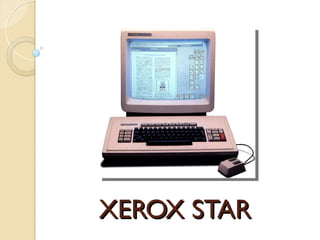
THE XEROX STAR
THEXEROX STAR
Designed by Xerox corporation in
1970
A Graphical User Interface (GUI)
computer.
It allows user to point and click at
icons making computers easier to
use..
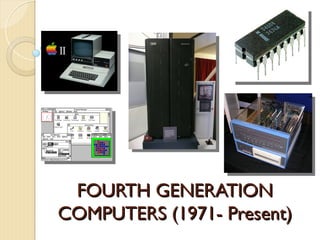
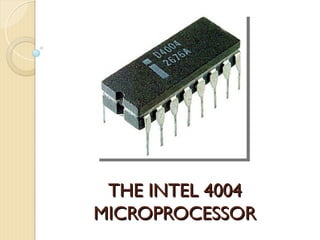
MICROPROCESSOR
MICROPROCESSOR
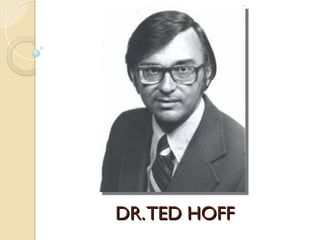
Developed byDr. Ted Hoff in 1971.
Also know as Intel 4004.
Can perform many input and output
operations.
Capable of reading and responding to
instructions stored on its memory.
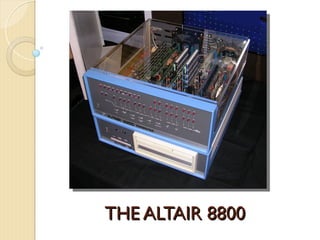
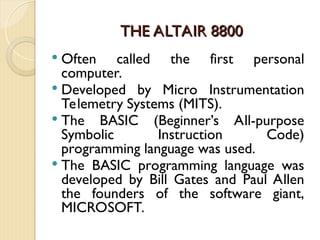
THE ALTAIR 8800
THEALTAIR 8800
Often called the first personal
computer.
Developed by Micro Instrumentation
Telemetry Systems (MITS).
The BASIC (Beginner’s All-purpose
Symbolic Instruction Code)
programming language was used.
The BASIC programming language was
developed by Bill Gates and Paul Allen
the founders of the software giant,
MICROSOFT.
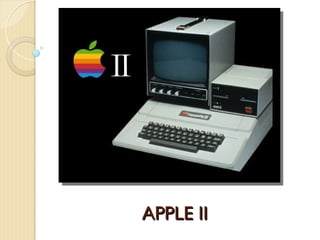
APPLE II
APPLE II
Introduced by Apple Computer in
1976.
Appealing to consumers because of
its software and well-written
manuals.
It can also be plugged into a standard
household outlet.
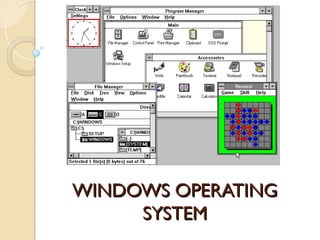
WINDOWS OPERATING SYSTEM
WINDOWSOPERATING SYSTEM
Introduced by Microsoft in 1985.
Microsoft continued to improve its
operating system.
Microsoft soon became the
dominating software company for
PC’s.
FIFTH GENERATION
FIFTH GENERATION
COMPUTERS
COMPUTERS
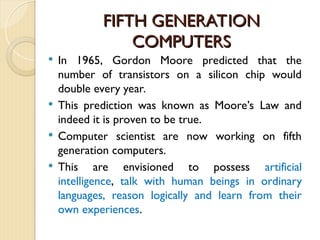
In 1965, Gordon Moore predicted that the
number of transistors on a silicon chip would
double every year.
This prediction was known as Moore’s Law and
indeed it is proven to be true.
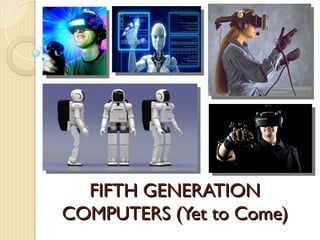
Computer scientist are now working on fifth
generation computers.
This are envisioned to possess artificial
intelligence, talk with human beings in ordinary
languages, reason logically and learn from their
own experiences.
BALLISTIC DEFLECTION
BALLISTIC DEFLECTION
TRANSISTORS(BDTs)
TRANSISTORS (BDTs)
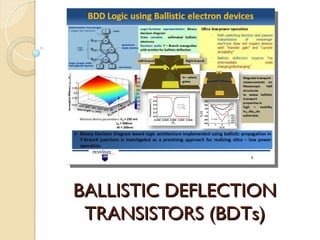
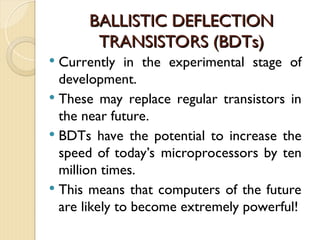
Currently in the experimental stage of
development.
These may replace regular transistors in
the near future.
BDTs have the potential to increase the
speed of today’s microprocessors by ten
million times.
This means that computers of the future
are likely to become extremely powerful!
VIRTUAL REALITY (VR)
VIRTUALREALITY (VR)
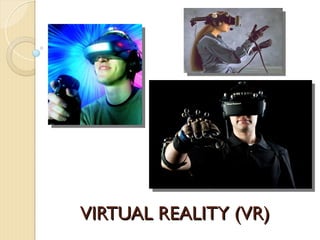
This type of technology allows users
to use all of their senses when
interacting with a computer.
The user feel as if he or she is
completely surrounded by an
artificial environment and he or she
can manipulate the objects in the
virtual world just like real objects.
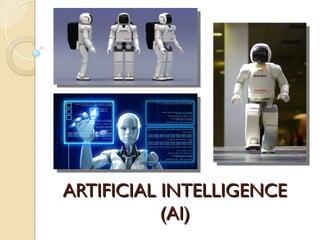
ARTIFICIAL INTELLIGENCE (AI)
ARTIFICIALINTELLIGENCE (AI)
This refers to making machines exhibit
human behavior and intelligence.
Scientist are still trying to make robots
that can speak and display common sense,
emotions and consciousness like human
beings.
AI robots are expected to be capable of
adapting the behaviors to surroundings
and to the demands of a certain situation.