WELCOME
TO MY PRESENTATION
NATIONAL INSTITITE OF TEXTILE ENGINEERING & RESEARCH(N
Submitted To
MD.Jahid Sarkar
lecturer
Dept. of
Fabric manufacturing engineering
NITER
PRESENTED BY
AZGOR HOSSAIN-140401078
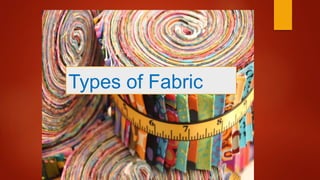
Types of Fabric
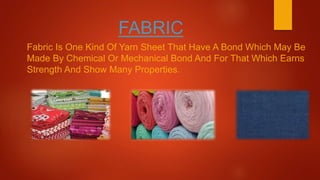
FABRIC
Fabric Is One Kind Of Yarn Sheet That Have A Bond Which May Be
Made By Chemical Or Mechanical Bond And For That Which Earns
Strength And Show Many Properties.
TYPES OF FABRIC
There are four types of fabric:
 Knitted fabric.
 Woven fabric.
 Non-woven fabric.
 Braid fabric.
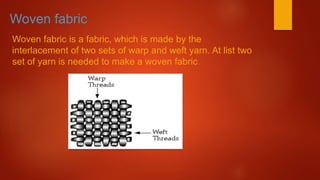
Woven fabric
Woven fabric is a fabric, which is made by the
interlacement of two sets of warp and weft yarn. At list two
set of yarn is needed to make a woven fabric.
Knitted fabric
When a fabric is made by interloping of one set of yarn is called knitted
fabric. At least one or one set of yarn is needed to make a knit fabric.
Classifications of Knit Fabric:
Basically knit fabrics are two types, those are-
 Weft knitted fabrics.
 Warp knitted fabrics.
All the above two types have discussed in the below:
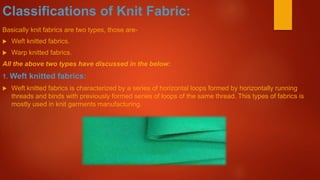
1. Weft knitted fabrics:
 Weft knitted fabrics is characterized by a series of horizontal loops formed by horizontally running
threads and binds with previously formed series of loops of the same thread. This types of fabrics is
mostly used in knit garments manufacturing.
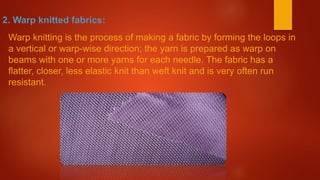
2. Warp knitted fabrics:
Warp knitting is the process of making a fabric by forming the loops in
a vertical or warp-wise direction; the yarn is prepared as warp on
beams with one or more yarns for each needle. The fabric has a
flatter, closer, less elastic knit than weft knit and is very often run
resistant.
Types of Fabric Used in Knit Garments
Manufacturing:
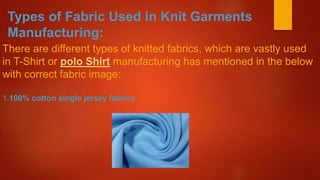
There are different types of knitted fabrics, which are vastly used
in T-Shirt or polo Shirt manufacturing has mentioned in the below
with correct fabric image:
1.100% cotton single jersey fabrics
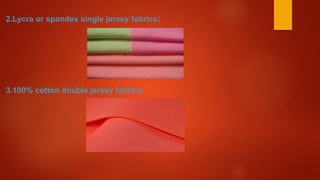
2.Lycra or spandex single jersey fabrics:
3.100% cotton double jersey fabrics:
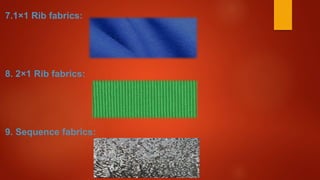
7.1×1 Rib fabrics:
8. 2×1 Rib fabrics:
9. Sequence fabrics:
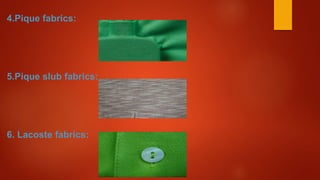
4.Pique fabrics:
5.Pique slub fabrics:
6. Lacoste fabrics:
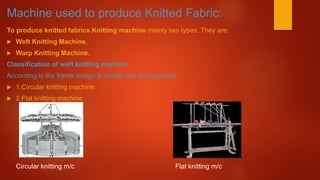
Machine used to produce Knitted Fabric:
To produce knitted fabrics Knitting machine mainly two types. They are:
 Weft Knitting Machine.
 Warp Knitting Machine.
Classification of weft knitting machine
According to the frame design & needle bed arrangement:
 1.Circular knitting machine.
 2.Flat knitting machine
Circular knitting m/c Flat knitting m/c
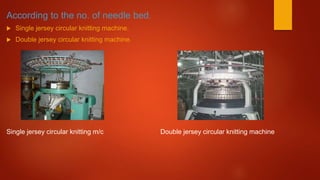
According to the no. of needle bed.
 Single jersey circular knitting machine.
 Double jersey circular knitting machine.
Single jersey circular knitting m/c Double jersey circular knitting machine
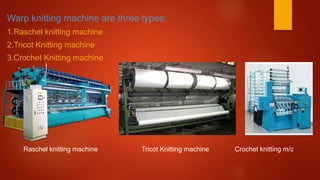
Warp knitting machine are three types:
1.Raschel knitting machine
2.Tricot Knitting machine
3.Crochet Knitting machine
Raschel knitting machine Tricot Knitting machine Crochet knitting m/c
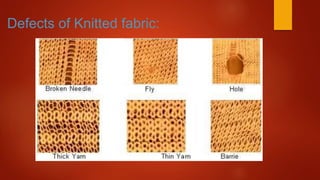
Defects of Knitted fabric:
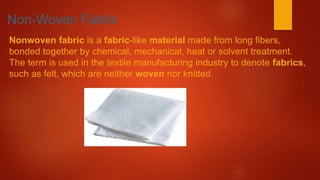
Non-Woven Fabric
Nonwoven fabric is a fabric-like material made from long fibers,
bonded together by chemical, mechanical, heat or solvent treatment.
The term is used in the textile manufacturing industry to denote fabrics,
such as felt, which are neither woven nor knitted.
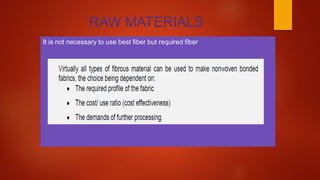
RAW MATERIALS
It is not necessary to use best fiber but required fiber
1. SPUNBOND PROCESS
2. MELT BLOWN PROCESS
3. WATER JET PROCESS
4. NEEDLE PUNCHED
According to process Non-Woven are classified as
bellow-
1. PLA(polymer Lactic Acid Nonwoven Fabric)
2. Flame Retardant
3. PTFE-coated (Polytetrafluoroethylene)
4. Anti-static
5. Anti-bacteria
 Absorbency
 Bacterial barrier
 Cushioning
 Filtering
 Flame retardancy
 Liquid repellency
 Resilience
 Softness
 Sterility
 Strength
 Stretch
 Wash ability
Agricultural coverings
Agricultural seed strips
Apparel linings
Automotive headliners
Automotive upholstery
Carpeting
Civil engineering fabrics
Civil engineering
Geo textiles
Disposable diapers
Envelopes
Filters
House wraps
Household & personal wipes
Hygiene products
Insulation
Labels
Laundry aids
Roofing
Sterile medical-use products
Tags
Upholstery
Wall coverings
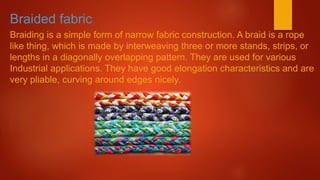
Braided fabric
Braiding is a simple form of narrow fabric construction. A braid is a rope
like thing, which is made by interweaving three or more stands, strips, or
lengths in a diagonally overlapping pattern. They are used for various
Industrial applications. They have good elongation characteristics and are
very pliable, curving around edges nicely.
Types Braid Fabrics
Braiding can be classified as two and three-dimensional braiding, two-
dimensional braid structure can be circular/round/tubular or flat braid .Three-
dimensional braiding is relatively new and was developed mainly for composite
structures. So, braids are divided into two types ,considered as two
dimensional.-
1.Circular/round braids
2.Flat braids
Main characteristics of braid fabric
 Yarn are interlaced both diagonally and lengthwise.
 Braid is stretchy and easily shaped.
 Flat or three-dimensional braid is used for trim and
industrial products
Application Of Braided Fabric
Braids are used in many industrial applications. Some of the common
applications are listed below:
 As fan blade containment in commercial aircrafts
 For energy-absorbing crash structures in Formula One racing cars
 As reinforcement for aircraft propellers and stator vanes in jet engines
 For building light weight frames and structures such as trusses
 For use in precise manufacture of composite parts
 Ideal reinforcement for drive shafts and torque transfer components, such as
flanged hubs
 For products with changing geometries like prosthetics and hockey sticks.
Types of fabric
Types of fabric

Types of fabric

  • 1.
    WELCOME TO MY PRESENTATION NATIONALINSTITITE OF TEXTILE ENGINEERING & RESEARCH(N
  • 2.
    Submitted To MD.Jahid Sarkar lecturer Dept.of Fabric manufacturing engineering NITER
  • 3.
  • 4.
  • 5.
    FABRIC Fabric Is OneKind Of Yarn Sheet That Have A Bond Which May Be Made By Chemical Or Mechanical Bond And For That Which Earns Strength And Show Many Properties.
  • 6.
    TYPES OF FABRIC Thereare four types of fabric:  Knitted fabric.  Woven fabric.  Non-woven fabric.  Braid fabric.
  • 7.
    Woven fabric Woven fabricis a fabric, which is made by the interlacement of two sets of warp and weft yarn. At list two set of yarn is needed to make a woven fabric.
  • 8.
    Knitted fabric When afabric is made by interloping of one set of yarn is called knitted fabric. At least one or one set of yarn is needed to make a knit fabric.
  • 9.
    Classifications of KnitFabric: Basically knit fabrics are two types, those are-  Weft knitted fabrics.  Warp knitted fabrics. All the above two types have discussed in the below: 1. Weft knitted fabrics:  Weft knitted fabrics is characterized by a series of horizontal loops formed by horizontally running threads and binds with previously formed series of loops of the same thread. This types of fabrics is mostly used in knit garments manufacturing.
  • 10.
    2. Warp knittedfabrics: Warp knitting is the process of making a fabric by forming the loops in a vertical or warp-wise direction; the yarn is prepared as warp on beams with one or more yarns for each needle. The fabric has a flatter, closer, less elastic knit than weft knit and is very often run resistant.
  • 11.
    Types of FabricUsed in Knit Garments Manufacturing: There are different types of knitted fabrics, which are vastly used in T-Shirt or polo Shirt manufacturing has mentioned in the below with correct fabric image: 1.100% cotton single jersey fabrics
  • 12.
    2.Lycra or spandexsingle jersey fabrics: 3.100% cotton double jersey fabrics:
  • 13.
    7.1×1 Rib fabrics: 8.2×1 Rib fabrics: 9. Sequence fabrics:
  • 14.
    4.Pique fabrics: 5.Pique slubfabrics: 6. Lacoste fabrics:
  • 15.
    Machine used toproduce Knitted Fabric: To produce knitted fabrics Knitting machine mainly two types. They are:  Weft Knitting Machine.  Warp Knitting Machine. Classification of weft knitting machine According to the frame design & needle bed arrangement:  1.Circular knitting machine.  2.Flat knitting machine Circular knitting m/c Flat knitting m/c
  • 16.
    According to theno. of needle bed.  Single jersey circular knitting machine.  Double jersey circular knitting machine. Single jersey circular knitting m/c Double jersey circular knitting machine
  • 17.
    Warp knitting machineare three types: 1.Raschel knitting machine 2.Tricot Knitting machine 3.Crochet Knitting machine Raschel knitting machine Tricot Knitting machine Crochet knitting m/c
  • 18.
  • 19.
    Non-Woven Fabric Nonwoven fabricis a fabric-like material made from long fibers, bonded together by chemical, mechanical, heat or solvent treatment. The term is used in the textile manufacturing industry to denote fabrics, such as felt, which are neither woven nor knitted.
  • 20.
    RAW MATERIALS It isnot necessary to use best fiber but required fiber
  • 21.
    1. SPUNBOND PROCESS 2.MELT BLOWN PROCESS 3. WATER JET PROCESS 4. NEEDLE PUNCHED According to process Non-Woven are classified as bellow-
  • 22.
    1. PLA(polymer LacticAcid Nonwoven Fabric) 2. Flame Retardant 3. PTFE-coated (Polytetrafluoroethylene) 4. Anti-static 5. Anti-bacteria
  • 23.
     Absorbency  Bacterialbarrier  Cushioning  Filtering  Flame retardancy  Liquid repellency  Resilience  Softness  Sterility  Strength  Stretch  Wash ability
  • 24.
    Agricultural coverings Agricultural seedstrips Apparel linings Automotive headliners Automotive upholstery Carpeting Civil engineering fabrics Civil engineering Geo textiles Disposable diapers Envelopes Filters House wraps Household & personal wipes Hygiene products Insulation Labels Laundry aids Roofing Sterile medical-use products Tags Upholstery Wall coverings
  • 25.
    Braided fabric Braiding isa simple form of narrow fabric construction. A braid is a rope like thing, which is made by interweaving three or more stands, strips, or lengths in a diagonally overlapping pattern. They are used for various Industrial applications. They have good elongation characteristics and are very pliable, curving around edges nicely.
  • 26.
    Types Braid Fabrics Braidingcan be classified as two and three-dimensional braiding, two- dimensional braid structure can be circular/round/tubular or flat braid .Three- dimensional braiding is relatively new and was developed mainly for composite structures. So, braids are divided into two types ,considered as two dimensional.- 1.Circular/round braids 2.Flat braids
  • 27.
    Main characteristics ofbraid fabric  Yarn are interlaced both diagonally and lengthwise.  Braid is stretchy and easily shaped.  Flat or three-dimensional braid is used for trim and industrial products
  • 28.
    Application Of BraidedFabric Braids are used in many industrial applications. Some of the common applications are listed below:  As fan blade containment in commercial aircrafts  For energy-absorbing crash structures in Formula One racing cars  As reinforcement for aircraft propellers and stator vanes in jet engines  For building light weight frames and structures such as trusses  For use in precise manufacture of composite parts  Ideal reinforcement for drive shafts and torque transfer components, such as flanged hubs  For products with changing geometries like prosthetics and hockey sticks.