FIBER ANALYSIS
FORENSIC SCIENCE
TABLE OF CONTENTS
 Introduction
 Textile Fibers
 Yarns
 Fabric Construction
 Woven Fabrics
 Knitted Fabrics
 Non-Woven Fabrics
 Fiber Characteristics Natural Fibers
 Manufactured Fibers
 Fiber Manufacture
 Microscopic Characteristics
 Optical Properties of Manufactured Fibers
 Polarized Light Microscopy
 Refractive Index
 Birefringence
 Fluorescence Microscopy
 Color in Textiles
 Color Perception
 Dyes and Pigments
 Color Assessment
 Chemical Properties
 Interpretations
 Summary
 Test Your Knowledge
INTRODUCTION
 Textile fibers are a ubiquitous type of evidence.
 They are "common" in the sense that textiles surround us in our homes, offices, and vehicles.
 We all move through a personal textile environment of clothing, cars, upholstery, things we touch, and
people we encounter.
 Fibers from textiles are constantly being shed and transferred to people, places, and things; some are
better "shedders," like fuzzy sweaters, than others-a tightly woven dress shirt.
 Textile fibers are also among the most neglected and undervalued kinds of forensic evidence.
 Fibers provide many qualitative and quantitative traits for comparison. Textile fibers are often produced
with specific end-use products in consideration and these end uses lead to a variety of discrete traits.
INTRODUCTION
 Color is another powerful discriminating characteristic About 7,000 commercial dyes and pigments are
used to color textiles.
 No one dye is used to create any particular color, and millions of shades of colors are possible in
textiles (Apsell, 1981).
 Applying statistical methods to trace evidence is difficult, however, because of a lack of frequency
data. Very often, even the company that made a particular fiber will not know how many products will
be formed from these fibers
 Attempts have been made to estimate the frequency of garments in populations; for example, according
to databases from Germany and England, 4 garments in 1,000,000 garments are woman's blouse made
of turquoise acetate fibers.
 Cases such as the Wayne Williams case in Atlanta, Georgia, or the OJ Simpson case in Los Angeles,
California, also show the usefulness of forensic textile fiber analysis in criminal investigations.
TEXTILES FIBERS
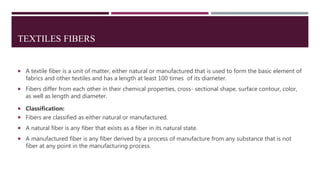
 A textile fiber is a unit of matter, either natural or manufactured that is used to form the basic element of
fabrics and other textiles and has a length at least 100 times of its diameter.
 Fibers differ from each other in their chemical properties, cross- sectional shape, surface contour, color,
as well as length and diameter.
 Classification:
 Fibers are classified as either natural or manufactured.
 A natural fiber is any fiber that exists as a fiber in its natural state.
 A manufactured fiber is any fiber derived by a process of manufacture from any substance that is not
fiber at any point in the manufacturing process.
TEXTILES FIBERS
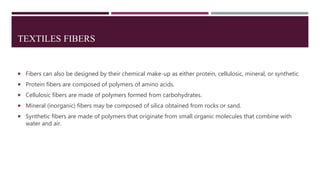
 Fibers can also be designed by their chemical make-up as either protein, cellulosic, mineral, or synthetic
 Protein fibers are composed of polymers of amino acids.
 Cellulosic fibers are made of polymers formed from carbohydrates.
 Mineral (inorganic) fibers may be composed of silica obtained from rocks or sand.
 Synthetic fibers are made of polymers that originate from small organic molecules that combine with
water and air.
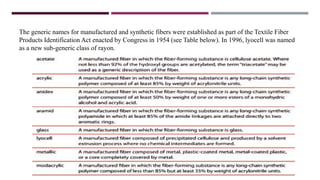
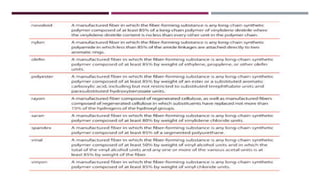
The generic names for manufactured and synthetic fibers were established as part of the Textile Fiber
Products Identification Act enacted by Congress in 1954 (see Table below). In 1996, lyocell was named
as a new sub-generic class of rayon.
TEXTILE FIBERS
 The diameter of textile fibers is relatively small, generally 0.0004 to 0.002 inch, or 11 to 50 um. Their
length can vary from about 7/8 inch (2.2 cm) to almost miles.
 Based on length, fibers are classified as either filament or staple fiber.
 Filaments are fibers having indefinite or extreme length such as silk or a manufactured fiber.
 Staple fibers are natural fibers (except silk) or cut lengths of filament typically being 7/8 inch to 8
inches (2.2 to 28.5 cm) in length.
 The size of natural fibers is usually given as a diameter measurement in micrometers.
 The size of silk and manufactured fibers is usually measured in denier in the( United States) or tex (in
other countries).
 Denier and tex are linear measurements based on weight per unit length.
TEXTILE FIBERS
 The denier is the weight( in grams) of 9000 meters of the material fibrous.
 Glass fibers are the only manufactured fibers that are not measured by denier.
 A one-denier nylon fiber is not equal in size to a one-denier rayon fiber because the fibers differ in
density.
 Tex is equal to the weight(in grams) of 1000 (one kilometer) of the material.
 To convert from tex to denier, divide the tex value by 0.1111; to convert from denier to tex, multiply the
denier value by 0.1111.
YARNS
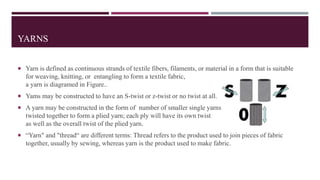
 Yarn is defined as continuous strands of textile fibers, filaments, or material in a form that is suitable
for weaving, knitting, or entangling to form a textile fabric,
a yarn is diagramed in Figure..
 Yams may be constructed to have an S-twist or z-twist or no twist at all.
 A yarn may be constructed in the form of number of smaller single yarns
twisted together to form a plied yarn; each ply will have its own twist
as well as the overall twist of the plied yarn.
 “Yarn" and "thread“ are different terms: Thread refers to the product used to join pieces of fabric
together, usually by sewing, whereas yarn is the product used to make fabric.
FABRIC CONSTRUCTION
 Fabric is a textile structure produced by interlacing yarns, fibers, or filaments with a considerable
surface area in relation to its thickness.
 The three major types of fabrics are woven, knitted, and non-woven.
 Woven Fabrics:
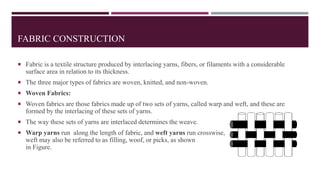
 Woven fabrics are those fabrics made up of two sets of yarns, called warp and weft, and these are
formed by the interlacing of these sets of yarns.
 The way these sets of yarns are interlaced determines the weave.
 Warp yarns run along the length of fabric, and weft yarns run crosswise,
weft may also be referred to as filling, woof, or picks, as shown
in Figure.
KNITTED FABRICS
 Knitted fabrics are formed of interlocking series of loops of one more yarns.
 Knitted Fabrics are divided in two major categories: warp knitting and weft knitting.
 In warp knits the yarns generally run lengthwise in the fabric, whereas in weft knits the yarns
generally run crosswise to the fabric.
 The basic components of a knit fabric are courses, which are rows of loops across the width of the
fabric, and wales, which are rows of loops along the length of the fabric.
 Unlike woven fabrics, in which warp and weft are made up of different sets of yarns, courses and wales
are formed by a single yarn.
 Non-Woven Fabrics:
 Non-woven fabrics are an assembly of textile fibers held together by mechanical interlocking, by fusing
of the fibers, or by bonding with a cementing medium.
 Felt is a good example, but a wide variety of non-woven construction methods is currently used and
other examples are bandage pads, automotive textiles, and medical fabrics.
FIBER CHARACTERISTICS
 The shapes of fibers relate to their identification.
 Characteristics are imparted to manufactured fibers according to end uses. Beyond fiber size and type
many other traits serve to differentiate textile fibers
 Crimp:
 Crimp is the waviness of a fiber expressed as crimps per unit length.
 Crimp may be two-dimensional or three-dimensional in nature. Some fibers are naturally crimped, like
wool, whereas others are more linear, such as silk.
 Crimp must be imparted to manufactured fibers.
FIBER CHARACTERISTICS
Color:
 Color is introduced to manufactured fibers with dyes or pigments, while natural fibers may be originally
white, off-white, or a shade of brown.
 Natural fibers may be bleached to remove any natural color, so they may be dyed more easily.
 The color may vary along a fiber due to different dye uptake or because the color has been printed onto
the fabric rather than dyed. All these traits should be noted
 Cross-sectional shape:
 It is defined as shape of an individual filament when cut at a right angle to its long axis,
 It is a critical characteristic of fiber analysis.
 Shapes for manufactured fibers vary by design, there are about 500 different cross- sections used for synthetic
fibers. The cross-section of plant or animal fibers may help the examiner in identifying the source
FIBER CHARACTERISTICS
 A fiber's length may be an clue of its desired end use.
 All natural fibers are staple fibers except silk.
 Manufactured fibers originate as filaments but may be cut to staple form,.
 All fibers, natural and manufactured, are chain like macromolecules called polymers, which are formed
by linking of hundreds or thousands of repeating chemical units called monomers.
NATURAL FIBERS
 The first textiles were formed of natural fibers.
 Currently, over half of the fibers produced annually are natural fibers, and the majority of these are
cotton.
 Sources of natural fibers are animals, plants, or minerals.
 Natural fibers are used in many products so, it is important for the forensic fiber examiner to have a
thorough knowledge of natural fibers and their significance in casework.
ANIMAL FIBERS
 Animal fibers come either from mammals (hairs) or from certain invertebrates, such as the silkworm.
 Animal fibers in textiles are most often from woot bearing animals, such as sheep and goats, or from
fur-bearing animals, like rabbits, mink, and fox.
 A comprehensive reference collection is important for animal hair identifications and comparisons.
 The microscopic anatomical structures of animal hairs are important to their identification.
PLANT FIBERS
 The three major sources for plant fibers are the seed, stem and leaf.
 Plant fibers are found in two principal forms:
 Technical fibers are used in cordage, sacks, mats, etc. and individual cells, as in fabrics or paper.
 The examination of technical fibers should include a search for internal structures, such as the lumen,
spiral vessels, crystals and cross-section.
 Technical fibers are mashed, fabrics teased apart and paper re-pulped for the examination of individual
cells.
 The relative thickness of the cell walls and the size, shape, and thickness of the lumen and cell length
should be noted.
 The most common plant fibers encountered in case work are cotton, flax, jute, hemp, ramie, sisal,
abaca, coir, and kapok.
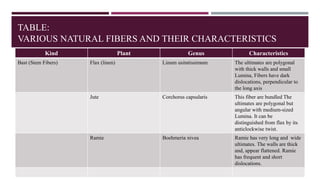
TABLE:
VARIOUS NATURAL FIBERS AND THEIR CHARACTERISTICS
Kind Plant Genus Characteristics
Bast (Stem Fibers) Flax (linen) Linum usitatissimum The ultimates are polygonal
with thick walls and small
Lumina, Fibers have dark
dislocations, perpendicular to
the long axis
Jute Corchorus capsularis This fiber are bundled The
ultimates are polygonal but
angular with medium-sized
Lumina. It can be
distinguished from flax by its
anticlockwise twist.
Ramie Boehmeria nivea Ramie has very long and wide
ultimates. The walls are thick
and, appear flattened. Ramie
has frequent and short
dislocations.
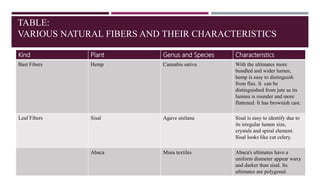
TABLE:
VARIOUS NATURAL FIBERS AND THEIR CHARACTERISTICS
Kind Plant Genus and Species Characteristics
Bast Fibers Hemp Cannabis sativa With the ultimates more
bundled and wider lumen,
hemp is easy to distinguish
from flax. It can be
distinguished from jute as its
lumina is rounder and more
flattened. It has brownish cast.
Leaf Fibers Sisal Agave sisilana Sisal is easy to identify due to
its irregular lumen size,
crystals and spiral element.
Sisal looks like cut celery.
Abaca Musa textiles Abaca's ultimates have a
uniform diameter appear waxy
and darker than sisal. Its
ultimates are polygonal.
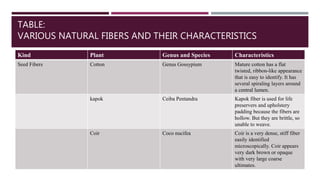
TABLE:
VARIOUS NATURAL FIBERS AND THEIR CHARACTERISTICS
Kind Plant Genus and Species Characteristics
Seed Fibers Cotton Genus Gossypium Mature cotton has a flat
twisted, ribbon-like appearance
that is easy to identify. It has
several spiraling layers around
a central lumen.
kapok Ceiba Pentandra Kapok fiber is used for life
preservers and upholstery
padding because the fibers are
hollow. But they are brittle, so
unable to weave.
Coir Coco nucifea Coir is a very dense, stiff fiber
easily identified
microscopically. Coir appears
very dark brown or opaque
with very large coarse
ultimates.
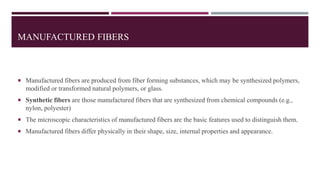
MANUFACTURED FIBERS
 Manufactured fibers are produced from fiber forming substances, which may be synthesized polymers,
modified or transformed natural polymers, or glass.
 Synthetic fibers are those manufactured fibers that are synthesized from chemical compounds (e.g.,
nylon, polyester)
 The microscopic characteristics of manufactured fibers are the basic features used to distinguish them.
 Manufactured fibers differ physically in their shape, size, internal properties and appearance.
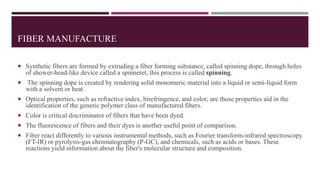
FIBER MANUFACTURE
 Synthetic fibers are formed by extruding a fiber forming substance, called spinning dope, through holes
of shower-head-like device called a spinneret, this process is called spinning.
 The spinning dope is created by rendering solid monomeric material into a liquid or semi-liquid form
with a solvent or heat .
 Optical properties, such as refractive index, birefringence, and color, are those properties aid in the
identification of the generic polymer class of manufactured fibers.
 Color is critical discriminator of fibers that have been dyed.
 The fluorescence of fibers and their dyes is another useful point of comparison.
 Fiber react differently to various instrumental methods, such as Fourier transform-infrared spectroscopy
(FT-IR) or pyrolysis-gas chromatography (P-GC), and chemicals, such as acids or bases. These
reactions yield information about the fiber's molecular structure and composition.
MICROSCOPIC CHARACTERISTICS
 A polarized light microscope is the primary tool for the identification and analysis of manufactured
fibers.
 Many characteristics of manufactured fibers can be examined by non-polarized light and these
characteristics provide a fast, direct, and accurate method for the discrimination of similar fibers.
 A comparison light microscope is required to confirm whether the known and the questioned fibers
accurately have the same microscopic characteristics.
 The cross-section is the shape of an individual fiber when cut at a right angle to its long axis. Shapes
for manufactured fibers vary with the desired end result.
 The particular cross-section may be indication of a fiber’s desired end use.
MICROSCOPIC CHARACTERISTICS
 Measurements of fiber's diameter depends on its cross-sectional shape.
 Manufactured fibers can be made in diameters from about 6 µm (so-called microfibers) up to a size of
spinneret holes.
 Natural fibers vary in diameter from cultivated silk (10-13µm) to sheep's wool (up to 40 µ more).
Delustrants:
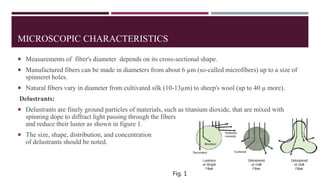
 Delustrants are finely ground particles of materials, such as titanium dioxide, that are mixed with
spinning dope to diffract light passing through the fibers
and reduce their luster as shown in figure 1.
 The size, shape, distribution, and concentration
of delustrants should be noted.
Fig. 1
OPTICAL PROPERTIES OD MANUFACTURED FIBERS
 The examination of the optical properties of manufactured fibers can yield a tremendous amount of information
about their chemistry, production, end use, and environment.
Polarized Light Microscopy:
 Polarized light microscopy is an easy, quick, and non-destructive method to determine the generic polymer class of
manufactured and synthetic textile fibers.
 The examination of fibers in polarized light provides valuable information about the production, finishing of the
fiber after spinning and characteristics that is used to discriminate between polymers.
Refractive Index:
 Fibers vary in shape but thicker in the center than near the edges. Thus, they act as crude lenses, either
concentrating or dispersing the light that passes through them.
 If a fiber has a higher refractive index than the medium, it acts as a converging lens, concentrating light within the
fiber.
 If the fiber has a lower refractive index than the medium, it acts as a diverging lens, diverg light from the fiber.
REFRACTIVE INDEX:
 In most fibers, the light rays only slightly converge or diverge and appear as a thin bright line, called the Becke line
at the interface between the fiber and the mounting medium.
 When a fiber is observed in microscope, the stage is moved down to increase working distance.
 If the fiber has a higher refractive index, the Becke line moves toward the fiber and if the medium has a higher index,
the Becke line moves toward the medium as the working distance is increased.
 The refractive indices of a fiber can be measured directly by placing the fiber in a number of liquids of specific
refractive indices until the refractive indices of the fiber and liquid are the same.
Birefringence
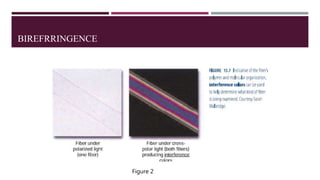
 One of the most distinctive traits of a fiber is its birefringence.
 The interference colors seen after crossing the polarizing filters give information about fiber nature ,orientation and
crystallinity(see figure 2)
 For the sake of comparison, most natural and synthetic fibers have birefringence from 0.001 to 18, but birefringence
as high as 2.0 or more has been reported for specialty fibers.
BIREFRRINGENCE
Figure 2
FLUORESCENCE MICROSCOPY
 Many dyes used to color textiles have fluorescent components, and their interaction to certain
wavelengths of light can be used to compare textile fibers..
 Fluorescence is process in which a substance is excited by specific wavelengths of light.
 A light of relatively short wavelength falls on a substance, and the substance absorbs and converts part
of light into heat.
 Most part of the light that is not absorbed by the substance is re-emitted, this is called "fluorescence.“
 The fluorescent light(emitted light) has lost some energy, and its wavelength is longer than source
light.
 It is important to note, some dye combination give fluorescence of particular intensity and color ,and
fibers dyed with same dye have same characteristics if they are not degraded by UV light or bleaching.
COLOR IN TEXTILES
 Color is one of the most important characteristics in a fiber comparison. Almost all manufacturing
industries are concerned with product appeared color. Color is one the most easy discriminator
 Color Perception:
 The perception of color by a human observer depends on many factors. such as genetics, age, and
environment.
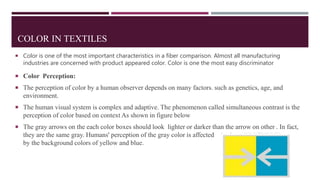
 The human visual system is complex and adaptive. The phenomenon called simultaneous contrast is the
perception of color based on context As shown in figure below
 The gray arrows on the each color boxes should look lighter or darker than the arrow on other . In fact,
they are the same gray. Humans' perception of the gray color is affected
by the background colors of yellow and blue.
COLOR IN TEXTILES
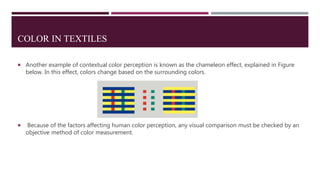
 Another example of contextual color perception is known as the chameleon effect, explained in Figure
below. In this effect, colors change based on the surrounding colors.
 Because of the factors affecting human color perception, any visual comparison must be checked by an
objective method of color measurement.
DYES AND PIGMENTS
 A dye is an organic chemical that is able to absorb and reflect certain wavelengths of visible light.
 Pigments are microscopic, water-insoluble particles that are either incorporated into the fiber at the
time of production or are bonded to the surface of the fiber by a resin.
 Very few textiles are colored with only one dye, and even a simple dye may have to go through many
steps to get end form.
 It is almost impossible to dye textiles in a continuous method i.e., dyeing is separate batch of process
 This color variability is very important in forensic fiber comparisons.
COLOR ASSESSMENT
 The three main methods of analyzing the color in fibers are visual examination. chemical analysis, and
instrumental analysis
 Visual Examination:
 The basic method is simple visual examination of single fibers by using a comparison microscope.
 Visual examination is quick, and comparison is an excellent screening technique. However, this method is
subjective and because of variations, it is not always a repeatable method.
 Moreover, the metameric colors also create problem. Metameric colors are those that appear to match
in one same lighting conditions but do not in another. Metamers are difficult to distinguish visually.
 Visual examination must be used in conjunction with an objective method.
CHEMICAL ANALYSIS
 Chemical analysis is a process in which dye is extracted and its chemistry is determined typically
through thin layer chromatography (TLC).
 Chemical analysis identify the type of dye or dyes used to color the fiber and may help to distinguish
metameric colors.
 It can be difficult to extract the dye from the fiber, however, because forensic samples typically are
small.
 Dye analysis is also a destructive method, make the fiber useless for further color analysis.
 Because very small fibers have little amount of dye in them, examiner may get weak or unclear
responses.
INSTRUMENTAL ANALYSIS
 Instrumental analysis have best advantages and the few weaknesses among all other methods
Instrumental readings are objective and repeatable.
 The results are quantitative, and the methods can be standardized.
 It is not destructive to the fiber, and the analysis may be repeated. Natural fibers may show
high variations due to different dye uptake.
 Microspectrophotometer(MSP):
 The microspectrophotometer (MSP) is an instrument used for the color measurement of individual
fibers. The MSP is a standard spectrophotometer with a microscope attached to focus on the sample.
 A spectrophotometer compares the amount of light passing through air with the amount of light
transmitted through or reflected off a sample.
 The ratio of these measurements indicates the percentage of light reflected or transmitted.
COLOR ASSESSMENT
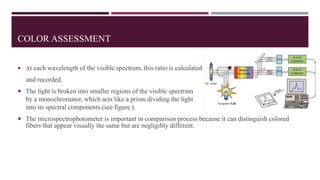
 At each wavelength of the visible spectrum, this ratio is calculated
and recorded.
 The light is broken into smaller regions of the visible spectrum
by a monochromator, which acts like a prism dividing the light
into its spectral components.(see figure ).
 The microspectrophotometer is important in comparison process because it can distinguish colored
fibers that appear visually the same but are negligibly different.
CHEMICAL PROPERTIES
 Chemical analysis of fibers not only confirm of the microscopic result, but also provide additional
information about the specific polymer type or that make up the fiber.
 For most of the generic polymer classes, various sub-classes exist that can help in discriminating
between optically similar fibers.
 Fourier transform infrared spectroscopy (FTIR) and pyrolysis. gas chromatography (PGC) are both
methods for determining the chemical structure of polymers.
 FTIR is the preferred method because it is not destructive of the fibers.
 Manufactured fibers also can be identified by their reaction to certain chemicals, this method was
popular before the introduction of instrumentation in crime laboratories.
CHEMICAL PROPERTIES
 Solubility schemes are destructive but can still be
effective way to confirm a manufactured fiber’
generic class.
 Solubility tests should be performed on both the
known and questioned fibers side by side either on a
spot plate or on a microscope slide with a cover slip
 There are numerous solubility schemes , and one
should be chosen with available chemicals,
equipment, and safety in mind. One scheme is
shown in figure
INTERPRETATION
 Numerous studies have shown that, other than white cotton indigo-dyed cotton (denim), and certain
types of black cotton, no fiber should be considered as being common.
 These studies include looking for specific fibers on a wide variety of clothing, cross checking fibers in
particular locations (movie theater seats, for example) and performing frequency studies.
 One study cross-checked fibers from twenty unrelated cases, looking for incidental positive
associations in over two million comparisons, no incidental positive associations were found.
 This makes fiber evidence very powerful in demonstrating associations
THE CASE: CROSS TRANSFER
 A woman comes home to find her house broken into and her daughter missing. As she frantically
checks the house for signs of her nine-year-old child, she sees a neighbor escaping the backyard
through a fence. A variety of things are missing, including beer and food from the refrigerator, but the
entire house is in disarray. When the police arrive, they search the house thoroughly and discover the
battered body of the daughter under a pile of clothing, beaten and stabbed to death. The police question
the neighbor, who had a history of criminal activity, including burglary and drug use.
 The neighbor allowed the police to search his home and told them he went to the front door of the
house, asked for a glass of water, became dizzy, fell, and the girl caught him; he then went home. One
of the officers found a beer can of the same brand that was stolen from the house: He touched it and it
was very cold. He found that odd because the man's utilities had been shut off for some time, and he
had no refrigeration. A further search turned up other items missing from the woman's house, including
jewelry in the bathroom with bloodstains on it. The neighbor was taken into custody and his clothing
collected as evidence.
CROSS HAIR TRANSFER
Numerous hairs and fibers were found to have been cross-transferred between the girl and the suspect in
the case. Items from the suspect found on the victim included:
 Blue rayon fibers from his pants on the victim's hands, under her fingernails, and on her shoes.
 More of the blue rayon fibers on the body bag used to transport the victim.
 Blue, gray, and beige polyester fibers from his poncho on her sweatshirt, hands, and under her
fingernails;
 More of the blue and gray polyester fibers on the fence between the two houses where the mother had
seen the neighbor running. Items from the victim found on the suspect not only demonstrated his
violent association with the girl but also contradicted the story he told the police.
CROSS TRANSFER
 Red cotton fibers from her sweatshirt were found on his poncho and shirt, as well as on bloody paper
towels in the suspect's bathroom trashcan.
 Brown head hairs exhibiting the same microscopic characteristics as the victim's were found on his
poncho, shirt, and in the trashcan debris.
 After a convincing prosecution, the jury deliberated for less than three hours before finding the
neighbor guilty.
 From Houck (2009)
SUMMARY
Fibers make good evidence for a number of reasons:
 They vary greatly, are easy to analyze, and they exist everywhere .
 Fibers have figured prominently in many high-profile cases and are researched extensively by forensic
and textile scientists alike.
 Textile fibers are among the most frequently encountered types of physical evidence.
 Color is one of the most underutilized traits of a textile fiber; the color of fibers should be analyzed
spectrally or chemically in any positive association.
 The combinations of characteristics make fibers very specific evidence: It is rare to find two fibers at
random that exhibit the same characteristics.

Fiber analysis

  • 1.
  • 2.
    TABLE OF CONTENTS Introduction  Textile Fibers  Yarns  Fabric Construction  Woven Fabrics  Knitted Fabrics  Non-Woven Fabrics  Fiber Characteristics Natural Fibers  Manufactured Fibers  Fiber Manufacture  Microscopic Characteristics  Optical Properties of Manufactured Fibers  Polarized Light Microscopy  Refractive Index  Birefringence  Fluorescence Microscopy  Color in Textiles  Color Perception  Dyes and Pigments  Color Assessment  Chemical Properties  Interpretations  Summary  Test Your Knowledge
  • 3.
    INTRODUCTION  Textile fibersare a ubiquitous type of evidence.  They are "common" in the sense that textiles surround us in our homes, offices, and vehicles.  We all move through a personal textile environment of clothing, cars, upholstery, things we touch, and people we encounter.  Fibers from textiles are constantly being shed and transferred to people, places, and things; some are better "shedders," like fuzzy sweaters, than others-a tightly woven dress shirt.  Textile fibers are also among the most neglected and undervalued kinds of forensic evidence.  Fibers provide many qualitative and quantitative traits for comparison. Textile fibers are often produced with specific end-use products in consideration and these end uses lead to a variety of discrete traits.
  • 4.
    INTRODUCTION  Color isanother powerful discriminating characteristic About 7,000 commercial dyes and pigments are used to color textiles.  No one dye is used to create any particular color, and millions of shades of colors are possible in textiles (Apsell, 1981).  Applying statistical methods to trace evidence is difficult, however, because of a lack of frequency data. Very often, even the company that made a particular fiber will not know how many products will be formed from these fibers  Attempts have been made to estimate the frequency of garments in populations; for example, according to databases from Germany and England, 4 garments in 1,000,000 garments are woman's blouse made of turquoise acetate fibers.  Cases such as the Wayne Williams case in Atlanta, Georgia, or the OJ Simpson case in Los Angeles, California, also show the usefulness of forensic textile fiber analysis in criminal investigations.
  • 5.
    TEXTILES FIBERS  Atextile fiber is a unit of matter, either natural or manufactured that is used to form the basic element of fabrics and other textiles and has a length at least 100 times of its diameter.  Fibers differ from each other in their chemical properties, cross- sectional shape, surface contour, color, as well as length and diameter.  Classification:  Fibers are classified as either natural or manufactured.  A natural fiber is any fiber that exists as a fiber in its natural state.  A manufactured fiber is any fiber derived by a process of manufacture from any substance that is not fiber at any point in the manufacturing process.
  • 6.
    TEXTILES FIBERS  Fiberscan also be designed by their chemical make-up as either protein, cellulosic, mineral, or synthetic  Protein fibers are composed of polymers of amino acids.  Cellulosic fibers are made of polymers formed from carbohydrates.  Mineral (inorganic) fibers may be composed of silica obtained from rocks or sand.  Synthetic fibers are made of polymers that originate from small organic molecules that combine with water and air.
  • 7.
    The generic namesfor manufactured and synthetic fibers were established as part of the Textile Fiber Products Identification Act enacted by Congress in 1954 (see Table below). In 1996, lyocell was named as a new sub-generic class of rayon.
  • 9.
    TEXTILE FIBERS  Thediameter of textile fibers is relatively small, generally 0.0004 to 0.002 inch, or 11 to 50 um. Their length can vary from about 7/8 inch (2.2 cm) to almost miles.  Based on length, fibers are classified as either filament or staple fiber.  Filaments are fibers having indefinite or extreme length such as silk or a manufactured fiber.  Staple fibers are natural fibers (except silk) or cut lengths of filament typically being 7/8 inch to 8 inches (2.2 to 28.5 cm) in length.  The size of natural fibers is usually given as a diameter measurement in micrometers.  The size of silk and manufactured fibers is usually measured in denier in the( United States) or tex (in other countries).  Denier and tex are linear measurements based on weight per unit length.
  • 10.
    TEXTILE FIBERS  Thedenier is the weight( in grams) of 9000 meters of the material fibrous.  Glass fibers are the only manufactured fibers that are not measured by denier.  A one-denier nylon fiber is not equal in size to a one-denier rayon fiber because the fibers differ in density.  Tex is equal to the weight(in grams) of 1000 (one kilometer) of the material.  To convert from tex to denier, divide the tex value by 0.1111; to convert from denier to tex, multiply the denier value by 0.1111.
  • 11.
    YARNS  Yarn isdefined as continuous strands of textile fibers, filaments, or material in a form that is suitable for weaving, knitting, or entangling to form a textile fabric, a yarn is diagramed in Figure..  Yams may be constructed to have an S-twist or z-twist or no twist at all.  A yarn may be constructed in the form of number of smaller single yarns twisted together to form a plied yarn; each ply will have its own twist as well as the overall twist of the plied yarn.  “Yarn" and "thread“ are different terms: Thread refers to the product used to join pieces of fabric together, usually by sewing, whereas yarn is the product used to make fabric.
  • 12.
    FABRIC CONSTRUCTION  Fabricis a textile structure produced by interlacing yarns, fibers, or filaments with a considerable surface area in relation to its thickness.  The three major types of fabrics are woven, knitted, and non-woven.  Woven Fabrics:  Woven fabrics are those fabrics made up of two sets of yarns, called warp and weft, and these are formed by the interlacing of these sets of yarns.  The way these sets of yarns are interlaced determines the weave.  Warp yarns run along the length of fabric, and weft yarns run crosswise, weft may also be referred to as filling, woof, or picks, as shown in Figure.
  • 13.
    KNITTED FABRICS  Knittedfabrics are formed of interlocking series of loops of one more yarns.  Knitted Fabrics are divided in two major categories: warp knitting and weft knitting.  In warp knits the yarns generally run lengthwise in the fabric, whereas in weft knits the yarns generally run crosswise to the fabric.  The basic components of a knit fabric are courses, which are rows of loops across the width of the fabric, and wales, which are rows of loops along the length of the fabric.  Unlike woven fabrics, in which warp and weft are made up of different sets of yarns, courses and wales are formed by a single yarn.  Non-Woven Fabrics:  Non-woven fabrics are an assembly of textile fibers held together by mechanical interlocking, by fusing of the fibers, or by bonding with a cementing medium.  Felt is a good example, but a wide variety of non-woven construction methods is currently used and other examples are bandage pads, automotive textiles, and medical fabrics.
  • 14.
    FIBER CHARACTERISTICS  Theshapes of fibers relate to their identification.  Characteristics are imparted to manufactured fibers according to end uses. Beyond fiber size and type many other traits serve to differentiate textile fibers  Crimp:  Crimp is the waviness of a fiber expressed as crimps per unit length.  Crimp may be two-dimensional or three-dimensional in nature. Some fibers are naturally crimped, like wool, whereas others are more linear, such as silk.  Crimp must be imparted to manufactured fibers.
  • 15.
    FIBER CHARACTERISTICS Color:  Coloris introduced to manufactured fibers with dyes or pigments, while natural fibers may be originally white, off-white, or a shade of brown.  Natural fibers may be bleached to remove any natural color, so they may be dyed more easily.  The color may vary along a fiber due to different dye uptake or because the color has been printed onto the fabric rather than dyed. All these traits should be noted  Cross-sectional shape:  It is defined as shape of an individual filament when cut at a right angle to its long axis,  It is a critical characteristic of fiber analysis.  Shapes for manufactured fibers vary by design, there are about 500 different cross- sections used for synthetic fibers. The cross-section of plant or animal fibers may help the examiner in identifying the source
  • 16.
    FIBER CHARACTERISTICS  Afiber's length may be an clue of its desired end use.  All natural fibers are staple fibers except silk.  Manufactured fibers originate as filaments but may be cut to staple form,.  All fibers, natural and manufactured, are chain like macromolecules called polymers, which are formed by linking of hundreds or thousands of repeating chemical units called monomers.
  • 17.
    NATURAL FIBERS  Thefirst textiles were formed of natural fibers.  Currently, over half of the fibers produced annually are natural fibers, and the majority of these are cotton.  Sources of natural fibers are animals, plants, or minerals.  Natural fibers are used in many products so, it is important for the forensic fiber examiner to have a thorough knowledge of natural fibers and their significance in casework.
  • 18.
    ANIMAL FIBERS  Animalfibers come either from mammals (hairs) or from certain invertebrates, such as the silkworm.  Animal fibers in textiles are most often from woot bearing animals, such as sheep and goats, or from fur-bearing animals, like rabbits, mink, and fox.  A comprehensive reference collection is important for animal hair identifications and comparisons.  The microscopic anatomical structures of animal hairs are important to their identification.
  • 19.
    PLANT FIBERS  Thethree major sources for plant fibers are the seed, stem and leaf.  Plant fibers are found in two principal forms:  Technical fibers are used in cordage, sacks, mats, etc. and individual cells, as in fabrics or paper.  The examination of technical fibers should include a search for internal structures, such as the lumen, spiral vessels, crystals and cross-section.  Technical fibers are mashed, fabrics teased apart and paper re-pulped for the examination of individual cells.  The relative thickness of the cell walls and the size, shape, and thickness of the lumen and cell length should be noted.  The most common plant fibers encountered in case work are cotton, flax, jute, hemp, ramie, sisal, abaca, coir, and kapok.
  • 20.
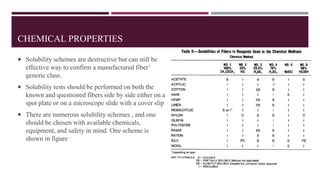
    TABLE: VARIOUS NATURAL FIBERSAND THEIR CHARACTERISTICS Kind Plant Genus Characteristics Bast (Stem Fibers) Flax (linen) Linum usitatissimum The ultimates are polygonal with thick walls and small Lumina, Fibers have dark dislocations, perpendicular to the long axis Jute Corchorus capsularis This fiber are bundled The ultimates are polygonal but angular with medium-sized Lumina. It can be distinguished from flax by its anticlockwise twist. Ramie Boehmeria nivea Ramie has very long and wide ultimates. The walls are thick and, appear flattened. Ramie has frequent and short dislocations.
  • 21.
    TABLE: VARIOUS NATURAL FIBERSAND THEIR CHARACTERISTICS Kind Plant Genus and Species Characteristics Bast Fibers Hemp Cannabis sativa With the ultimates more bundled and wider lumen, hemp is easy to distinguish from flax. It can be distinguished from jute as its lumina is rounder and more flattened. It has brownish cast. Leaf Fibers Sisal Agave sisilana Sisal is easy to identify due to its irregular lumen size, crystals and spiral element. Sisal looks like cut celery. Abaca Musa textiles Abaca's ultimates have a uniform diameter appear waxy and darker than sisal. Its ultimates are polygonal.
  • 22.
    TABLE: VARIOUS NATURAL FIBERSAND THEIR CHARACTERISTICS Kind Plant Genus and Species Characteristics Seed Fibers Cotton Genus Gossypium Mature cotton has a flat twisted, ribbon-like appearance that is easy to identify. It has several spiraling layers around a central lumen. kapok Ceiba Pentandra Kapok fiber is used for life preservers and upholstery padding because the fibers are hollow. But they are brittle, so unable to weave. Coir Coco nucifea Coir is a very dense, stiff fiber easily identified microscopically. Coir appears very dark brown or opaque with very large coarse ultimates.
  • 23.
    MANUFACTURED FIBERS  Manufacturedfibers are produced from fiber forming substances, which may be synthesized polymers, modified or transformed natural polymers, or glass.  Synthetic fibers are those manufactured fibers that are synthesized from chemical compounds (e.g., nylon, polyester)  The microscopic characteristics of manufactured fibers are the basic features used to distinguish them.  Manufactured fibers differ physically in their shape, size, internal properties and appearance.
  • 24.
    FIBER MANUFACTURE  Syntheticfibers are formed by extruding a fiber forming substance, called spinning dope, through holes of shower-head-like device called a spinneret, this process is called spinning.  The spinning dope is created by rendering solid monomeric material into a liquid or semi-liquid form with a solvent or heat .  Optical properties, such as refractive index, birefringence, and color, are those properties aid in the identification of the generic polymer class of manufactured fibers.  Color is critical discriminator of fibers that have been dyed.  The fluorescence of fibers and their dyes is another useful point of comparison.  Fiber react differently to various instrumental methods, such as Fourier transform-infrared spectroscopy (FT-IR) or pyrolysis-gas chromatography (P-GC), and chemicals, such as acids or bases. These reactions yield information about the fiber's molecular structure and composition.
  • 25.
    MICROSCOPIC CHARACTERISTICS  Apolarized light microscope is the primary tool for the identification and analysis of manufactured fibers.  Many characteristics of manufactured fibers can be examined by non-polarized light and these characteristics provide a fast, direct, and accurate method for the discrimination of similar fibers.  A comparison light microscope is required to confirm whether the known and the questioned fibers accurately have the same microscopic characteristics.  The cross-section is the shape of an individual fiber when cut at a right angle to its long axis. Shapes for manufactured fibers vary with the desired end result.  The particular cross-section may be indication of a fiber’s desired end use.
  • 26.
    MICROSCOPIC CHARACTERISTICS  Measurementsof fiber's diameter depends on its cross-sectional shape.  Manufactured fibers can be made in diameters from about 6 µm (so-called microfibers) up to a size of spinneret holes.  Natural fibers vary in diameter from cultivated silk (10-13µm) to sheep's wool (up to 40 µ more). Delustrants:  Delustrants are finely ground particles of materials, such as titanium dioxide, that are mixed with spinning dope to diffract light passing through the fibers and reduce their luster as shown in figure 1.  The size, shape, distribution, and concentration of delustrants should be noted. Fig. 1
  • 27.
    OPTICAL PROPERTIES ODMANUFACTURED FIBERS  The examination of the optical properties of manufactured fibers can yield a tremendous amount of information about their chemistry, production, end use, and environment. Polarized Light Microscopy:  Polarized light microscopy is an easy, quick, and non-destructive method to determine the generic polymer class of manufactured and synthetic textile fibers.  The examination of fibers in polarized light provides valuable information about the production, finishing of the fiber after spinning and characteristics that is used to discriminate between polymers. Refractive Index:  Fibers vary in shape but thicker in the center than near the edges. Thus, they act as crude lenses, either concentrating or dispersing the light that passes through them.  If a fiber has a higher refractive index than the medium, it acts as a converging lens, concentrating light within the fiber.  If the fiber has a lower refractive index than the medium, it acts as a diverging lens, diverg light from the fiber.
  • 28.
    REFRACTIVE INDEX:  Inmost fibers, the light rays only slightly converge or diverge and appear as a thin bright line, called the Becke line at the interface between the fiber and the mounting medium.  When a fiber is observed in microscope, the stage is moved down to increase working distance.  If the fiber has a higher refractive index, the Becke line moves toward the fiber and if the medium has a higher index, the Becke line moves toward the medium as the working distance is increased.  The refractive indices of a fiber can be measured directly by placing the fiber in a number of liquids of specific refractive indices until the refractive indices of the fiber and liquid are the same. Birefringence  One of the most distinctive traits of a fiber is its birefringence.  The interference colors seen after crossing the polarizing filters give information about fiber nature ,orientation and crystallinity(see figure 2)  For the sake of comparison, most natural and synthetic fibers have birefringence from 0.001 to 18, but birefringence as high as 2.0 or more has been reported for specialty fibers.
  • 29.
  • 30.
    FLUORESCENCE MICROSCOPY  Manydyes used to color textiles have fluorescent components, and their interaction to certain wavelengths of light can be used to compare textile fibers..  Fluorescence is process in which a substance is excited by specific wavelengths of light.  A light of relatively short wavelength falls on a substance, and the substance absorbs and converts part of light into heat.  Most part of the light that is not absorbed by the substance is re-emitted, this is called "fluorescence.“  The fluorescent light(emitted light) has lost some energy, and its wavelength is longer than source light.  It is important to note, some dye combination give fluorescence of particular intensity and color ,and fibers dyed with same dye have same characteristics if they are not degraded by UV light or bleaching.
  • 31.
    COLOR IN TEXTILES Color is one of the most important characteristics in a fiber comparison. Almost all manufacturing industries are concerned with product appeared color. Color is one the most easy discriminator  Color Perception:  The perception of color by a human observer depends on many factors. such as genetics, age, and environment.  The human visual system is complex and adaptive. The phenomenon called simultaneous contrast is the perception of color based on context As shown in figure below  The gray arrows on the each color boxes should look lighter or darker than the arrow on other . In fact, they are the same gray. Humans' perception of the gray color is affected by the background colors of yellow and blue.
  • 32.
    COLOR IN TEXTILES Another example of contextual color perception is known as the chameleon effect, explained in Figure below. In this effect, colors change based on the surrounding colors.  Because of the factors affecting human color perception, any visual comparison must be checked by an objective method of color measurement.
  • 33.
    DYES AND PIGMENTS A dye is an organic chemical that is able to absorb and reflect certain wavelengths of visible light.  Pigments are microscopic, water-insoluble particles that are either incorporated into the fiber at the time of production or are bonded to the surface of the fiber by a resin.  Very few textiles are colored with only one dye, and even a simple dye may have to go through many steps to get end form.  It is almost impossible to dye textiles in a continuous method i.e., dyeing is separate batch of process  This color variability is very important in forensic fiber comparisons.
  • 34.
    COLOR ASSESSMENT  Thethree main methods of analyzing the color in fibers are visual examination. chemical analysis, and instrumental analysis  Visual Examination:  The basic method is simple visual examination of single fibers by using a comparison microscope.  Visual examination is quick, and comparison is an excellent screening technique. However, this method is subjective and because of variations, it is not always a repeatable method.  Moreover, the metameric colors also create problem. Metameric colors are those that appear to match in one same lighting conditions but do not in another. Metamers are difficult to distinguish visually.  Visual examination must be used in conjunction with an objective method.
  • 35.
    CHEMICAL ANALYSIS  Chemicalanalysis is a process in which dye is extracted and its chemistry is determined typically through thin layer chromatography (TLC).  Chemical analysis identify the type of dye or dyes used to color the fiber and may help to distinguish metameric colors.  It can be difficult to extract the dye from the fiber, however, because forensic samples typically are small.  Dye analysis is also a destructive method, make the fiber useless for further color analysis.  Because very small fibers have little amount of dye in them, examiner may get weak or unclear responses.
  • 36.
    INSTRUMENTAL ANALYSIS  Instrumentalanalysis have best advantages and the few weaknesses among all other methods Instrumental readings are objective and repeatable.  The results are quantitative, and the methods can be standardized.  It is not destructive to the fiber, and the analysis may be repeated. Natural fibers may show high variations due to different dye uptake.  Microspectrophotometer(MSP):  The microspectrophotometer (MSP) is an instrument used for the color measurement of individual fibers. The MSP is a standard spectrophotometer with a microscope attached to focus on the sample.  A spectrophotometer compares the amount of light passing through air with the amount of light transmitted through or reflected off a sample.  The ratio of these measurements indicates the percentage of light reflected or transmitted.
  • 37.
    COLOR ASSESSMENT  Ateach wavelength of the visible spectrum, this ratio is calculated and recorded.  The light is broken into smaller regions of the visible spectrum by a monochromator, which acts like a prism dividing the light into its spectral components.(see figure ).  The microspectrophotometer is important in comparison process because it can distinguish colored fibers that appear visually the same but are negligibly different.
  • 38.
    CHEMICAL PROPERTIES  Chemicalanalysis of fibers not only confirm of the microscopic result, but also provide additional information about the specific polymer type or that make up the fiber.  For most of the generic polymer classes, various sub-classes exist that can help in discriminating between optically similar fibers.  Fourier transform infrared spectroscopy (FTIR) and pyrolysis. gas chromatography (PGC) are both methods for determining the chemical structure of polymers.  FTIR is the preferred method because it is not destructive of the fibers.  Manufactured fibers also can be identified by their reaction to certain chemicals, this method was popular before the introduction of instrumentation in crime laboratories.
  • 39.
    CHEMICAL PROPERTIES  Solubilityschemes are destructive but can still be effective way to confirm a manufactured fiber’ generic class.  Solubility tests should be performed on both the known and questioned fibers side by side either on a spot plate or on a microscope slide with a cover slip  There are numerous solubility schemes , and one should be chosen with available chemicals, equipment, and safety in mind. One scheme is shown in figure
  • 40.
    INTERPRETATION  Numerous studieshave shown that, other than white cotton indigo-dyed cotton (denim), and certain types of black cotton, no fiber should be considered as being common.  These studies include looking for specific fibers on a wide variety of clothing, cross checking fibers in particular locations (movie theater seats, for example) and performing frequency studies.  One study cross-checked fibers from twenty unrelated cases, looking for incidental positive associations in over two million comparisons, no incidental positive associations were found.  This makes fiber evidence very powerful in demonstrating associations
  • 41.
    THE CASE: CROSSTRANSFER  A woman comes home to find her house broken into and her daughter missing. As she frantically checks the house for signs of her nine-year-old child, she sees a neighbor escaping the backyard through a fence. A variety of things are missing, including beer and food from the refrigerator, but the entire house is in disarray. When the police arrive, they search the house thoroughly and discover the battered body of the daughter under a pile of clothing, beaten and stabbed to death. The police question the neighbor, who had a history of criminal activity, including burglary and drug use.  The neighbor allowed the police to search his home and told them he went to the front door of the house, asked for a glass of water, became dizzy, fell, and the girl caught him; he then went home. One of the officers found a beer can of the same brand that was stolen from the house: He touched it and it was very cold. He found that odd because the man's utilities had been shut off for some time, and he had no refrigeration. A further search turned up other items missing from the woman's house, including jewelry in the bathroom with bloodstains on it. The neighbor was taken into custody and his clothing collected as evidence.
  • 42.
    CROSS HAIR TRANSFER Numeroushairs and fibers were found to have been cross-transferred between the girl and the suspect in the case. Items from the suspect found on the victim included:  Blue rayon fibers from his pants on the victim's hands, under her fingernails, and on her shoes.  More of the blue rayon fibers on the body bag used to transport the victim.  Blue, gray, and beige polyester fibers from his poncho on her sweatshirt, hands, and under her fingernails;  More of the blue and gray polyester fibers on the fence between the two houses where the mother had seen the neighbor running. Items from the victim found on the suspect not only demonstrated his violent association with the girl but also contradicted the story he told the police.
  • 43.
    CROSS TRANSFER  Redcotton fibers from her sweatshirt were found on his poncho and shirt, as well as on bloody paper towels in the suspect's bathroom trashcan.  Brown head hairs exhibiting the same microscopic characteristics as the victim's were found on his poncho, shirt, and in the trashcan debris.  After a convincing prosecution, the jury deliberated for less than three hours before finding the neighbor guilty.  From Houck (2009)
  • 44.
    SUMMARY Fibers make goodevidence for a number of reasons:  They vary greatly, are easy to analyze, and they exist everywhere .  Fibers have figured prominently in many high-profile cases and are researched extensively by forensic and textile scientists alike.  Textile fibers are among the most frequently encountered types of physical evidence.  Color is one of the most underutilized traits of a textile fiber; the color of fibers should be analyzed spectrally or chemically in any positive association.  The combinations of characteristics make fibers very specific evidence: It is rare to find two fibers at random that exhibit the same characteristics.