Why Are We Here? 
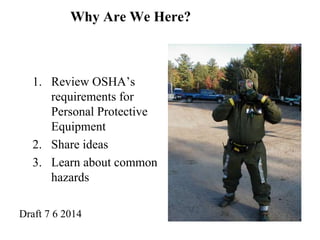
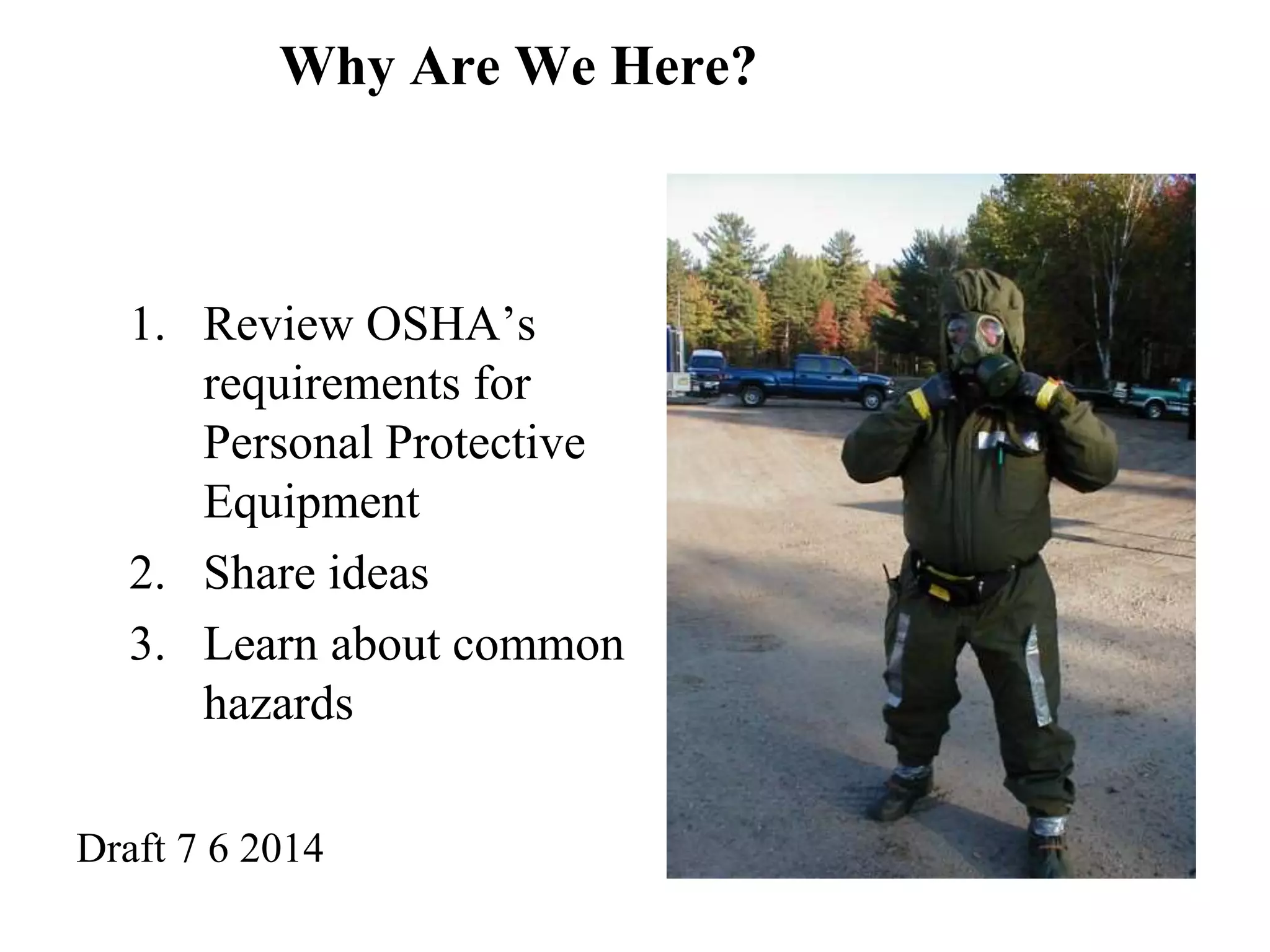
1. Review OSHA’s 
requirements for 
Personal Protective 
Equipment 
2. Share ideas 
3. Learn about common 
hazards 
Draft 7 6 2014
Apr 2013 
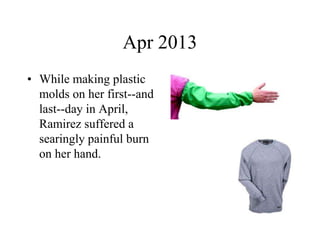
• While making plastic 
molds on her first--and 
last--day in April, 
Ramirez suffered a 
searingly painful burn 
on her hand.
Overview 
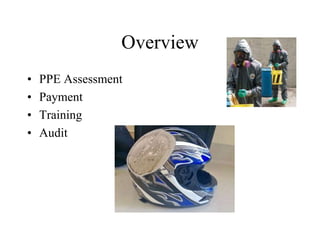
• PPE Assessment 
• Payment 
• Training 
• Audit
Objectives 
In this course, we will discuss: 
• General provisions 
• Hazard assessment 
• Basic hazard categories 
• Hazard sources 
• Personal protective equipment (PPE)
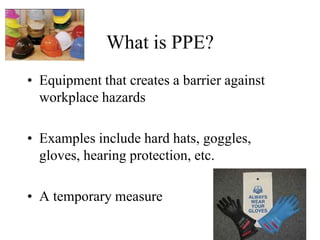
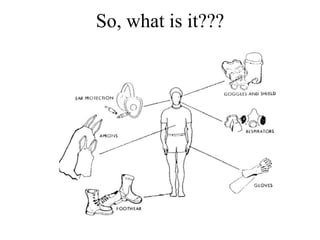
What is PPE? 
• Equipment that creates a barrier against 
workplace hazards 
• Examples include hard hats, goggles, 
gloves, hearing protection, etc. 
• A temporary measure
Accident 2010 
• Sodium Hydroxide Spill 
• Event Date: 01/14/2010 
• Employees noticed the sodium hydroxide tank was 
leaking. 
• David Weaver used several towels in an attempt to clean 
up the spill. 
• He was found by two other employees in the men's locker 
room sitting on a little bench. 
• He had received burns on his face and both arms. 
• Injury took place in the laundry department. 
• The sodium hydroxide is used as an additive for washing 
soiled/bloody laundry.
Most Cited 
• No written respirator 
program 
• No medical evaluation 
for respirator use 
• No PPE assessment 
certification 
• No PPE assessment 
conducted 
• No Eye Protection 
• No PPE used when 
hazard present 
• Voluntary use of 
respirators – App. D 
• No Respirator fit test. 
• Inadequate or no 
respirator training 
• No Hand Protection
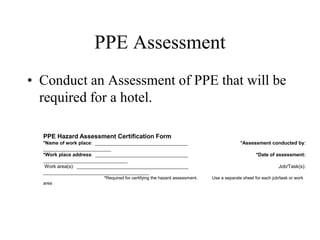
PPE Assessment 
• Conduct an Assessment of PPE that will be 
required for a hotel. 
PPE Hazard Assessment Certification Form 
*Name of work place: __________________________________ *Assessment conducted by: 
_________________________ 
*Work place address: __________________________________ *Date of assessment: 
_______________________________ 
Work area(s): _________________________________________ Job/Task(s): 
_______________________________________ 
*Required for certifying the hazard assessment. Use a separate sheet for each job/task or work 
area
Personal Protective Equipment 
• Definition: Devices used to protect an 
employees from injury or illness resulting 
from contact with chemical, radiological, 
physical, electrical, mechanical, or other 
workplace hazards (OSHA) 
• The need for PPE and the type of PPE used 
is based on hazard present; each situation 
must be evaluated independently
Payment 
• Employers pay for almost all 
personal protective equipment 
that is required by OSHA’s 
general industry standards. 
• Metatarsal foot protection; 
• Rubber boots with steel toes; 
• Non-prescription eye 
protection; 
• Hard hats/Bump Caps; 
• Hearing Protection; 
• Personal fall protection; and 
• Reflective work vests. 
• It does not require payment for 
uniforms, items worn to keep 
clean, or other items that are not 
PPE. 
• Sturdy work shoes; 
• Non-specialty slip-resistant, 
non-safety-toe footwear; 
• Items worn for patient safety 
and health, not employee safety 
and health; and 
• Uniforms, caps or other 
clothing worn solely to identify 
a person as an employee.
Some Caveats 
• PPE is used as a last resort 
• The use of PPE signifies that the hazard 
could not be controlled by other methods, 
such as: 
– administrative controls (i.e., shift rotation) 
– engineering or industrial hygiene controls
Back to the caveats... 
• The use of PPE signals that the hazard still 
exists in the workplace 
• Unprotected individuals in the same area 
will be exposed 
• Failure of PPE means that the worker will 
be exposed 
• PPE can be combined with other controls
So, what is it???
Head Protection 
• Hard Hats 
– Change or clean liner every year 
– New every 5 years 
– Marked with ANSI Z89
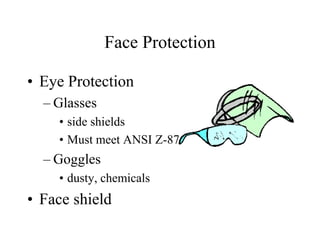
Face Protection 
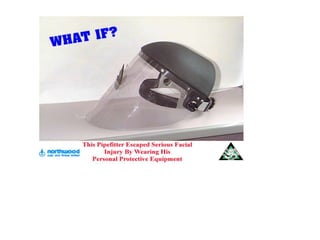
• Eye Protection 
– Glasses 
• side shields 
• Must meet ANSI Z-87 standard 
– Goggles 
• dusty, chemicals 
• Face shield
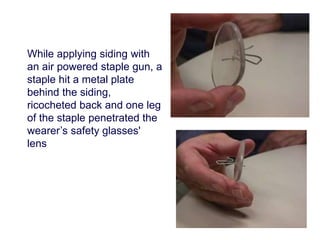
While applying siding with 
an air powered staple gun, a 
staple hit a metal plate 
behind the siding, 
ricocheted back and one leg 
of the staple penetrated the 
wearer’s safety glasses' 
lens
Eye and Face Protection 
• Eye and face protection equipment required by 
this Part shall meet the requirements specified in 
American National Standards Institute (ANSI), 
Z87.1-1989, Practice for Occupational and 
Education Eye and Face Protection. 
• Bungee cords are a common cause of severe eye 
injuries. Wear eye protection when using bungee 
cords. 
• According to Prevent Blindness America (PBA), 
an estimated 2.4 million eye injuries occur in the 
United States each year, and nearly 1 million 
Americans have lost some degree of eyesight 
from an eye injury
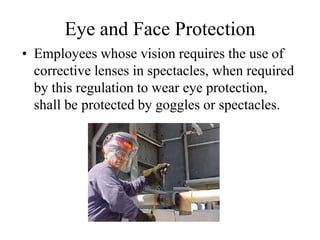
Eye and Face Protection 
• Employees whose vision requires the use of 
corrective lenses in spectacles, when required 
by this regulation to wear eye protection, 
shall be protected by goggles or spectacles.
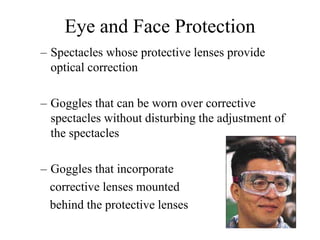
Eye and Face Protection 
– Spectacles whose protective lenses provide 
optical correction 
– Goggles that can be worn over corrective 
spectacles without disturbing the adjustment of 
the spectacles 
– Goggles that incorporate 
corrective lenses mounted 
behind the protective lenses
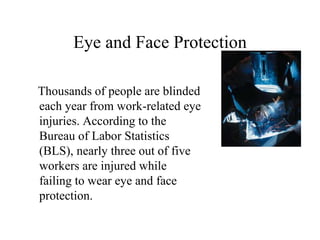
Eye and Face Protection 
Thousands of people are blinded 
each year from work-related eye 
injuries. According to the 
Bureau of Labor Statistics 
(BLS), nearly three out of five 
workers are injured while 
failing to wear eye and face 
protection.
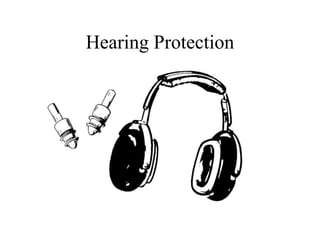
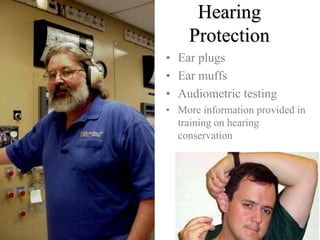
Hearing Protection
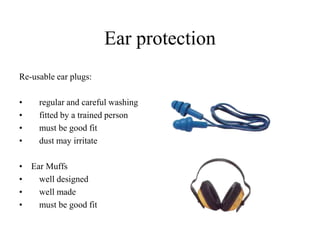
Ear protection 
Re-usable ear plugs: 
• regular and careful washing 
• fitted by a trained person 
• must be good fit 
• dust may irritate 
• Ear Muffs 
• well designed 
• well made 
• must be good fit
Hearing 
Protection 
• Ear plugs 
• Ear muffs 
• Audiometric testing 
• More information provided in 
training on hearing 
conservation
Hearing Protection Basics 
• Noise induced hearing loss can occur with 
exposures >90 dBA 
• A hearing conservation program becomes a 
requirement at exposures >85dBA 
• Higher levels of noise exposure have 
shorter allowable exposure times
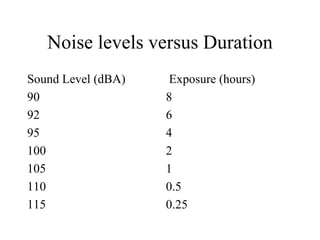
Noise levels versus Duration 
Sound Level (dBA) 
90 
92 
95 
100 
105 
110 
115 
Exposure (hours) 
8 
6 
4 
2 
1 
0.5 
0.25
Hearing Protection 
• Rule of Thumb - if you cannot carry on a 
conversation in a normal tone of voice with 
someone at arm’s length, you are likely near 
90dBA 
• All hearing protection devices should have 
a Noise Reduction Rating (NRR) = # of 
decibels they will reduce noise levels 
• Be conservative when using NRRs
A couple examples 
• Example 1 
– Ear plugs with NRR of 25 dBA 
– exposure = 105 dBA 
– 105 minus 25 = 80 dB therefore okay 
• Example 2 
– same plugs 
– exposure = 125 dBA 
– 125 minus 25 = 100 dB not acceptable; must be 
below 90 dB
Hearing Protection - Types 
• Ear Plugs - less expensive, disposable, good 
ones have fairly high NRRs - sometimes 
difficult to tell if employees are wearing 
them 
• Ear Muffs - more expensive, more durable, 
typically higher NRRs than plugs, more 
obvious 
• Can be used together in very high noise 
areas
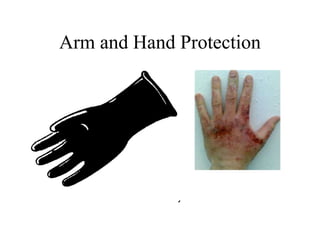
Arm and Hand Protection
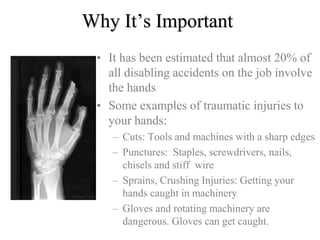
Why It’s Important 
• It has been estimated that almost 20% of 
all disabling accidents on the job involve 
the hands 
• Some examples of traumatic injuries to 
your hands: 
– Cuts: Tools and machines with a sharp edges 
– Punctures: Staples, screwdrivers, nails, 
chisels and stiff wire 
– Sprains, Crushing Injuries: Getting your 
hands caught in machinery 
– Gloves and rotating machinery are 
dangerous. Gloves can get caught.
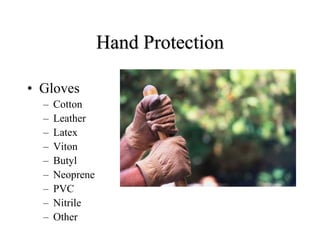
Hand Protection 
• Gloves 
– Cotton 
– Leather 
– Latex 
– Viton 
– Butyl 
– Neoprene 
– PVC 
– Nitrile 
– Other
Gloves - more caveats 
• No glove is good against all hazards; 
consult the glove manufacturer for glove 
selection chart 
• Gloves have a finite lifespan and must be 
periodically replaced 
• When donning gloves, examine them for 
signs of tears, cracks, holes and dry rot 
• Hands should always be washed after 
removing gloves
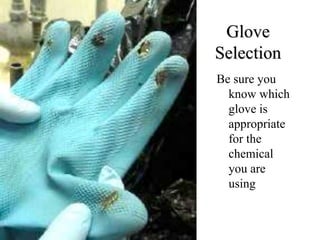
Glove 
Selection 
Be sure you 
know which 
glove is 
appropriate 
for the 
chemical 
you are 
using
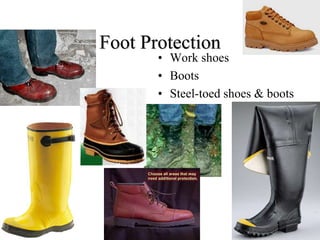
Foot Protection 
• Work shoes 
• Boots 
• Steel-toed shoes & boots
Safety Shoe 
Symbols 
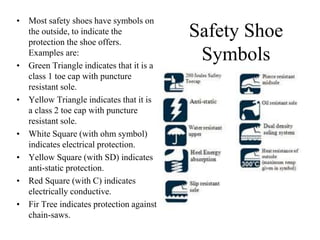
• Most safety shoes have symbols on 
the outside, to indicate the 
protection the shoe offers. 
Examples are: 
• Green Triangle indicates that it is a 
class 1 toe cap with puncture 
resistant sole. 
• Yellow Triangle indicates that it is 
a class 2 toe cap with puncture 
resistant sole. 
• White Square (with ohm symbol) 
indicates electrical protection. 
• Yellow Square (with SD) indicates 
anti-static protection. 
• Red Square (with C) indicates 
electrically conductive. 
• Fir Tree indicates protection against 
chain-saws.
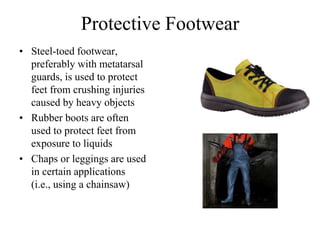
Protective Footwear 
• Steel-toed footwear, 
preferably with metatarsal 
guards, is used to protect 
feet from crushing injuries 
caused by heavy objects 
• Rubber boots are often 
used to protect feet from 
exposure to liquids 
• Chaps or leggings are used 
in certain applications 
(i.e., using a chainsaw)
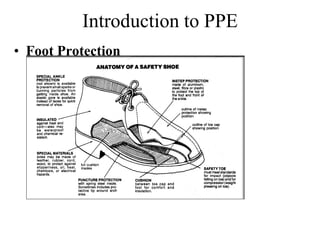
Introduction to PPE 
• Foot Protection
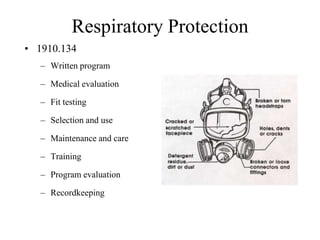
Respiratory Protection 
• 1910.134 
– Written program 
– Medical evaluation 
– Fit testing 
– Selection and use 
– Maintenance and care 
– Training 
– Program evaluation 
– Recordkeeping
Dust 
Any powder or dust including: 
• cement, wood, stone 
• silica, fillers, plaster, asbestos 
Any excess dust can be harmful, ranging from: 
• skin irritation 
to 
• respiratory problems 
Possible long-term health problems
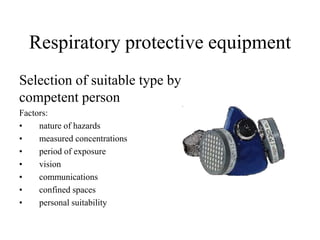
Respiratory protective equipment 
Selection of suitable type by 
competent person 
Factors: 
• nature of hazards 
• measured concentrations 
• period of exposure 
• vision 
• communications 
• confined spaces 
• personal suitability
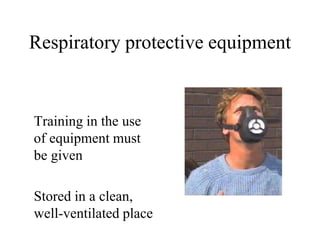
Respiratory protective equipment 
Training in the use 
of equipment must 
be given 
Stored in a clean, 
well-ventilated place
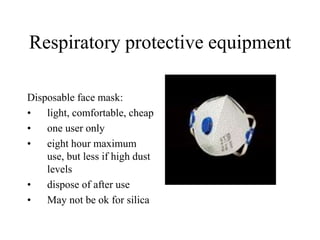
Respiratory protective equipment 
Disposable face mask: 
• light, comfortable, cheap 
• one user only 
• eight hour maximum 
use, but less if high dust 
levels 
• dispose of after use 
• May not be ok for silica
Respiratory protective equipment 
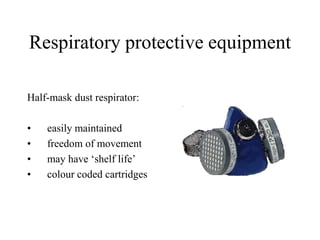
Half-mask dust respirator: 
• easily maintained 
• freedom of movement 
• may have ‘shelf life’ 
• colour coded cartridges
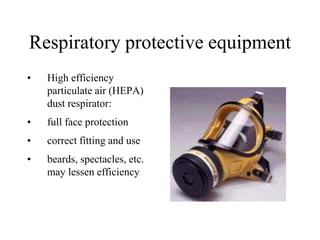
Respiratory protective equipment 
• High efficiency 
particulate air (HEPA) 
dust respirator: 
• full face protection 
• correct fitting and use 
• beards, spectacles, etc. 
may lessen efficiency
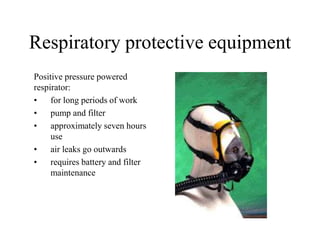
Respiratory protective equipment 
Positive pressure powered 
respirator: 
• for long periods of work 
• pump and filter 
• approximately seven hours 
use 
• air leaks go outwards 
• requires battery and filter 
maintenance
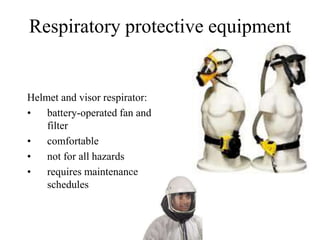
Respiratory protective equipment 
Helmet and visor respirator: 
• battery-operated fan and 
filter 
• comfortable 
• not for all hazards 
• requires maintenance 
schedules
Respiratory protective equipment 
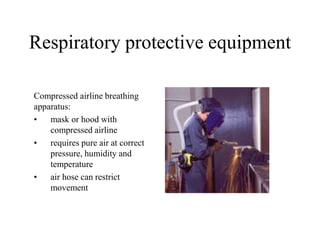
Compressed airline breathing 
apparatus: 
• mask or hood with 
compressed airline 
• requires pure air at correct 
pressure, humidity and 
temperature 
• air hose can restrict 
movement
Respiratory protective equipment 
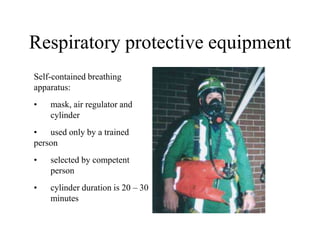
Self-contained breathing 
apparatus: 
• mask, air regulator and 
cylinder 
• used only by a trained 
person 
• selected by competent 
person 
• cylinder duration is 20 – 30 
minutes
Training Requirements 
• Training must be provided prior to use, unless acceptable 
training has been provided by another employer within the past 
12 months 
• Retraining is required annually, and when: 
– changes in the workplace or type of respirator render previous 
training obsolete 
– there are inadequacies in the employee’s knowledge or use 
– any other situation arises in which retraining appears necessary 
• The basic advisory information in Appendix D must be 
provided to employees who wear respirators when use is not 
required by this standard or by the employer
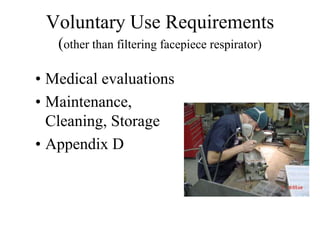
Voluntary Use Requirements 
(other than filtering facepiece respirator) 
• Medical evaluations 
• Maintenance, 
Cleaning, Storage 
• Appendix D
Voluntary Use Requirements 
(Filtering facepiece only) 
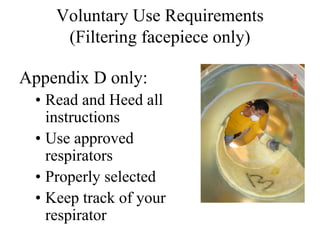
Appendix D only: 
• Read and Heed all 
instructions 
• Use approved 
respirators 
• Properly selected 
• Keep track of your 
respirator
Medical Evaluation Requirements 
• Evaluation completed prior to wearing 
respirator 
• Annually thereafter 
• Evaluation include information in Sections 
1 and 2, Part 1 Of Appendix C 
• Conducted by a physician or licensed health 
care professional
Medical Signs and Symptoms 
• The following are 
signs or symptoms 
that may prevent the 
use of a respirator: 
– Seizures 
– Claustrophobia 
– Asthma 
– Emphysema 
– Pneumonia 
– Collapsed Lung 
– Lung Cancer 
– Broken Ribs 
– Chest 
Injuries/Surgeries 
– Any other lung 
problems 
– Heart or Circulation 
problems 
– Anxiety
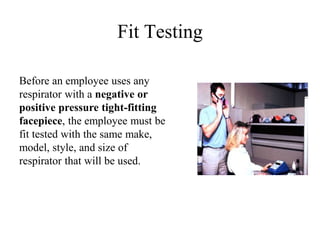
Fit Testing 
Before an employee uses any 
respirator with a negative or 
positive pressure tight-fitting 
facepiece, the employee must be 
fit tested with the same make, 
model, style, and size of 
respirator that will be used.
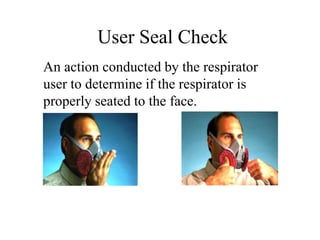
User Seal Check 
An action conducted by the respirator 
user to determine if the respirator is 
properly seated to the face. 
Positive Pressure 
Check 
Negative Pressure 
Check
Protection Factors 
• Protection Factor 
• Half-Face Respirator 10 x PEL 
• Full-Face Respirator 50 x PEL 
• Powered Air Respirator 100 x PEL 
• Air-line 100 x PEL
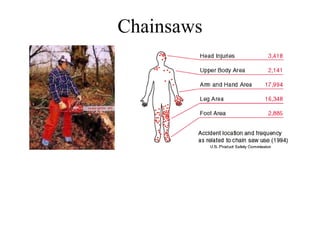
Chainsaws
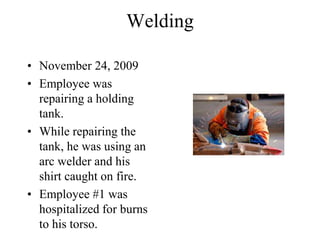
Welding 
• November 24, 2009 
• Employee was 
repairing a holding 
tank. 
• While repairing the 
tank, he was using an 
arc welder and his 
shirt caught on fire. 
• Employee #1 was 
hospitalized for burns 
to his torso.
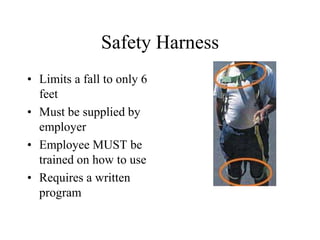
Safety Harness 
• Limits a fall to only 6 
feet 
• Must be supplied by 
employer 
• Employee MUST be 
trained on how to use 
• Requires a written 
program
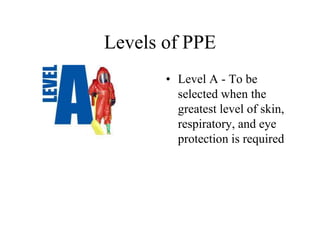
Levels of PPE 
• Level A - To be 
selected when the 
greatest level of skin, 
respiratory, and eye 
protection is required
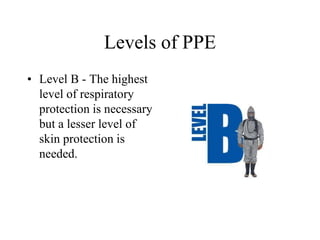
Levels of PPE 
• Level B - The highest 
level of respiratory 
protection is necessary 
but a lesser level of 
skin protection is 
needed.
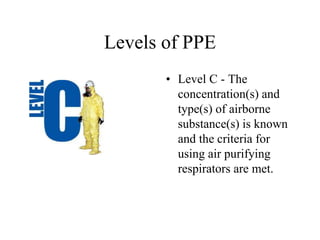
Levels of PPE 
• Level C - The 
concentration(s) and 
type(s) of airborne 
substance(s) is known 
and the criteria for 
using air purifying 
respirators are met.
Levels of PPE 
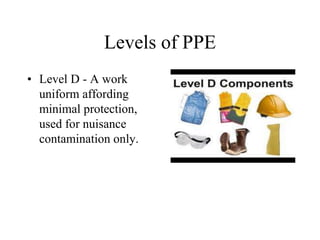
• Level D - A work 
uniform affording 
minimal protection, 
used for nuisance 
contamination only.
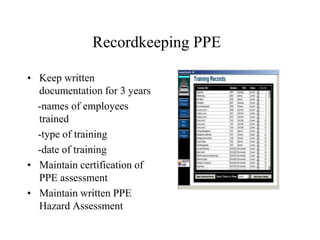
Recordkeeping PPE 
g 
• Keep written 
documentation for 3 years 
-names of employees 
trained 
-type of training 
-date of training 
• Maintain certification of 
PPE assessment 
• Maintain written PPE 
Hazard Assessment
VPP Company Selection of PPE 
• They use 
• JSA 
• Hazard Review Audits 
• SDSs 
• Discussion with the EHS Manager 
• SOPs
Questions ?

General Industry PPE 2014

  • 1.
    Why Are WeHere? 1. Review OSHA’s requirements for Personal Protective Equipment 2. Share ideas 3. Learn about common hazards Draft 7 6 2014
  • 2.
    Apr 2013 •While making plastic molds on her first--and last--day in April, Ramirez suffered a searingly painful burn on her hand.
  • 3.
    Overview • PPEAssessment • Payment • Training • Audit
  • 4.
    Objectives In thiscourse, we will discuss: • General provisions • Hazard assessment • Basic hazard categories • Hazard sources • Personal protective equipment (PPE)
  • 5.
    What is PPE? • Equipment that creates a barrier against workplace hazards • Examples include hard hats, goggles, gloves, hearing protection, etc. • A temporary measure
  • 6.
    Accident 2010 •Sodium Hydroxide Spill • Event Date: 01/14/2010 • Employees noticed the sodium hydroxide tank was leaking. • David Weaver used several towels in an attempt to clean up the spill. • He was found by two other employees in the men's locker room sitting on a little bench. • He had received burns on his face and both arms. • Injury took place in the laundry department. • The sodium hydroxide is used as an additive for washing soiled/bloody laundry.
  • 7.
    Most Cited •No written respirator program • No medical evaluation for respirator use • No PPE assessment certification • No PPE assessment conducted • No Eye Protection • No PPE used when hazard present • Voluntary use of respirators – App. D • No Respirator fit test. • Inadequate or no respirator training • No Hand Protection
  • 8.
    PPE Assessment •Conduct an Assessment of PPE that will be required for a hotel. PPE Hazard Assessment Certification Form *Name of work place: __________________________________ *Assessment conducted by: _________________________ *Work place address: __________________________________ *Date of assessment: _______________________________ Work area(s): _________________________________________ Job/Task(s): _______________________________________ *Required for certifying the hazard assessment. Use a separate sheet for each job/task or work area
  • 9.
    Personal Protective Equipment • Definition: Devices used to protect an employees from injury or illness resulting from contact with chemical, radiological, physical, electrical, mechanical, or other workplace hazards (OSHA) • The need for PPE and the type of PPE used is based on hazard present; each situation must be evaluated independently
  • 10.
    Payment • Employerspay for almost all personal protective equipment that is required by OSHA’s general industry standards. • Metatarsal foot protection; • Rubber boots with steel toes; • Non-prescription eye protection; • Hard hats/Bump Caps; • Hearing Protection; • Personal fall protection; and • Reflective work vests. • It does not require payment for uniforms, items worn to keep clean, or other items that are not PPE. • Sturdy work shoes; • Non-specialty slip-resistant, non-safety-toe footwear; • Items worn for patient safety and health, not employee safety and health; and • Uniforms, caps or other clothing worn solely to identify a person as an employee.
  • 11.
    Some Caveats •PPE is used as a last resort • The use of PPE signifies that the hazard could not be controlled by other methods, such as: – administrative controls (i.e., shift rotation) – engineering or industrial hygiene controls
  • 12.
    Back to thecaveats... • The use of PPE signals that the hazard still exists in the workplace • Unprotected individuals in the same area will be exposed • Failure of PPE means that the worker will be exposed • PPE can be combined with other controls
  • 13.
  • 14.
    Head Protection •Hard Hats – Change or clean liner every year – New every 5 years – Marked with ANSI Z89
  • 15.
    Face Protection •Eye Protection – Glasses • side shields • Must meet ANSI Z-87 standard – Goggles • dusty, chemicals • Face shield
  • 16.
    While applying sidingwith an air powered staple gun, a staple hit a metal plate behind the siding, ricocheted back and one leg of the staple penetrated the wearer’s safety glasses' lens
  • 18.
    Eye and FaceProtection • Eye and face protection equipment required by this Part shall meet the requirements specified in American National Standards Institute (ANSI), Z87.1-1989, Practice for Occupational and Education Eye and Face Protection. • Bungee cords are a common cause of severe eye injuries. Wear eye protection when using bungee cords. • According to Prevent Blindness America (PBA), an estimated 2.4 million eye injuries occur in the United States each year, and nearly 1 million Americans have lost some degree of eyesight from an eye injury
  • 19.
    Eye and FaceProtection • Employees whose vision requires the use of corrective lenses in spectacles, when required by this regulation to wear eye protection, shall be protected by goggles or spectacles.
  • 20.
    Eye and FaceProtection – Spectacles whose protective lenses provide optical correction – Goggles that can be worn over corrective spectacles without disturbing the adjustment of the spectacles – Goggles that incorporate corrective lenses mounted behind the protective lenses
  • 21.
    Eye and FaceProtection Thousands of people are blinded each year from work-related eye injuries. According to the Bureau of Labor Statistics (BLS), nearly three out of five workers are injured while failing to wear eye and face protection.
  • 22.
  • 23.
    Ear protection Re-usableear plugs: • regular and careful washing • fitted by a trained person • must be good fit • dust may irritate • Ear Muffs • well designed • well made • must be good fit
  • 24.
    Hearing Protection •Ear plugs • Ear muffs • Audiometric testing • More information provided in training on hearing conservation
  • 25.
    Hearing Protection Basics • Noise induced hearing loss can occur with exposures >90 dBA • A hearing conservation program becomes a requirement at exposures >85dBA • Higher levels of noise exposure have shorter allowable exposure times
  • 26.
    Noise levels versusDuration Sound Level (dBA) 90 92 95 100 105 110 115 Exposure (hours) 8 6 4 2 1 0.5 0.25
  • 27.
    Hearing Protection •Rule of Thumb - if you cannot carry on a conversation in a normal tone of voice with someone at arm’s length, you are likely near 90dBA • All hearing protection devices should have a Noise Reduction Rating (NRR) = # of decibels they will reduce noise levels • Be conservative when using NRRs
  • 28.
    A couple examples • Example 1 – Ear plugs with NRR of 25 dBA – exposure = 105 dBA – 105 minus 25 = 80 dB therefore okay • Example 2 – same plugs – exposure = 125 dBA – 125 minus 25 = 100 dB not acceptable; must be below 90 dB
  • 29.
    Hearing Protection -Types • Ear Plugs - less expensive, disposable, good ones have fairly high NRRs - sometimes difficult to tell if employees are wearing them • Ear Muffs - more expensive, more durable, typically higher NRRs than plugs, more obvious • Can be used together in very high noise areas
  • 30.
    Arm and HandProtection
  • 31.
    Why It’s Important • It has been estimated that almost 20% of all disabling accidents on the job involve the hands • Some examples of traumatic injuries to your hands: – Cuts: Tools and machines with a sharp edges – Punctures: Staples, screwdrivers, nails, chisels and stiff wire – Sprains, Crushing Injuries: Getting your hands caught in machinery – Gloves and rotating machinery are dangerous. Gloves can get caught.
  • 32.
    Hand Protection •Gloves – Cotton – Leather – Latex – Viton – Butyl – Neoprene – PVC – Nitrile – Other
  • 33.
    Gloves - morecaveats • No glove is good against all hazards; consult the glove manufacturer for glove selection chart • Gloves have a finite lifespan and must be periodically replaced • When donning gloves, examine them for signs of tears, cracks, holes and dry rot • Hands should always be washed after removing gloves
  • 34.
    Glove Selection Besure you know which glove is appropriate for the chemical you are using
  • 35.
    Foot Protection •Work shoes • Boots • Steel-toed shoes & boots
  • 36.
    Safety Shoe Symbols • Most safety shoes have symbols on the outside, to indicate the protection the shoe offers. Examples are: • Green Triangle indicates that it is a class 1 toe cap with puncture resistant sole. • Yellow Triangle indicates that it is a class 2 toe cap with puncture resistant sole. • White Square (with ohm symbol) indicates electrical protection. • Yellow Square (with SD) indicates anti-static protection. • Red Square (with C) indicates electrically conductive. • Fir Tree indicates protection against chain-saws.
  • 37.
    Protective Footwear •Steel-toed footwear, preferably with metatarsal guards, is used to protect feet from crushing injuries caused by heavy objects • Rubber boots are often used to protect feet from exposure to liquids • Chaps or leggings are used in certain applications (i.e., using a chainsaw)
  • 38.
    Introduction to PPE • Foot Protection
  • 39.
    Respiratory Protection •1910.134 – Written program – Medical evaluation – Fit testing – Selection and use – Maintenance and care – Training – Program evaluation – Recordkeeping
  • 40.
    Dust Any powderor dust including: • cement, wood, stone • silica, fillers, plaster, asbestos Any excess dust can be harmful, ranging from: • skin irritation to • respiratory problems Possible long-term health problems
  • 41.
    Respiratory protective equipment Selection of suitable type by competent person Factors: • nature of hazards • measured concentrations • period of exposure • vision • communications • confined spaces • personal suitability
  • 42.
    Respiratory protective equipment Training in the use of equipment must be given Stored in a clean, well-ventilated place
  • 43.
    Respiratory protective equipment Disposable face mask: • light, comfortable, cheap • one user only • eight hour maximum use, but less if high dust levels • dispose of after use • May not be ok for silica
  • 44.
    Respiratory protective equipment Half-mask dust respirator: • easily maintained • freedom of movement • may have ‘shelf life’ • colour coded cartridges
  • 45.
    Respiratory protective equipment • High efficiency particulate air (HEPA) dust respirator: • full face protection • correct fitting and use • beards, spectacles, etc. may lessen efficiency
  • 46.
    Respiratory protective equipment Positive pressure powered respirator: • for long periods of work • pump and filter • approximately seven hours use • air leaks go outwards • requires battery and filter maintenance
  • 47.
    Respiratory protective equipment Helmet and visor respirator: • battery-operated fan and filter • comfortable • not for all hazards • requires maintenance schedules
  • 48.
    Respiratory protective equipment Compressed airline breathing apparatus: • mask or hood with compressed airline • requires pure air at correct pressure, humidity and temperature • air hose can restrict movement
  • 49.
    Respiratory protective equipment Self-contained breathing apparatus: • mask, air regulator and cylinder • used only by a trained person • selected by competent person • cylinder duration is 20 – 30 minutes
  • 50.
    Training Requirements •Training must be provided prior to use, unless acceptable training has been provided by another employer within the past 12 months • Retraining is required annually, and when: – changes in the workplace or type of respirator render previous training obsolete – there are inadequacies in the employee’s knowledge or use – any other situation arises in which retraining appears necessary • The basic advisory information in Appendix D must be provided to employees who wear respirators when use is not required by this standard or by the employer
  • 51.
    Voluntary Use Requirements (other than filtering facepiece respirator) • Medical evaluations • Maintenance, Cleaning, Storage • Appendix D
  • 52.
    Voluntary Use Requirements (Filtering facepiece only) Appendix D only: • Read and Heed all instructions • Use approved respirators • Properly selected • Keep track of your respirator
  • 53.
    Medical Evaluation Requirements • Evaluation completed prior to wearing respirator • Annually thereafter • Evaluation include information in Sections 1 and 2, Part 1 Of Appendix C • Conducted by a physician or licensed health care professional
  • 54.
    Medical Signs andSymptoms • The following are signs or symptoms that may prevent the use of a respirator: – Seizures – Claustrophobia – Asthma – Emphysema – Pneumonia – Collapsed Lung – Lung Cancer – Broken Ribs – Chest Injuries/Surgeries – Any other lung problems – Heart or Circulation problems – Anxiety
  • 55.
    Fit Testing Beforean employee uses any respirator with a negative or positive pressure tight-fitting facepiece, the employee must be fit tested with the same make, model, style, and size of respirator that will be used.
  • 56.
    User Seal Check An action conducted by the respirator user to determine if the respirator is properly seated to the face. Positive Pressure Check Negative Pressure Check
  • 57.
    Protection Factors •Protection Factor • Half-Face Respirator 10 x PEL • Full-Face Respirator 50 x PEL • Powered Air Respirator 100 x PEL • Air-line 100 x PEL
  • 58.
  • 59.
    Welding • November24, 2009 • Employee was repairing a holding tank. • While repairing the tank, he was using an arc welder and his shirt caught on fire. • Employee #1 was hospitalized for burns to his torso.
  • 60.
    Safety Harness •Limits a fall to only 6 feet • Must be supplied by employer • Employee MUST be trained on how to use • Requires a written program
  • 61.
    Levels of PPE • Level A - To be selected when the greatest level of skin, respiratory, and eye protection is required
  • 62.
    Levels of PPE • Level B - The highest level of respiratory protection is necessary but a lesser level of skin protection is needed.
  • 63.
    Levels of PPE • Level C - The concentration(s) and type(s) of airborne substance(s) is known and the criteria for using air purifying respirators are met.
  • 64.
    Levels of PPE • Level D - A work uniform affording minimal protection, used for nuisance contamination only.
  • 65.
    Recordkeeping PPE g • Keep written documentation for 3 years -names of employees trained -type of training -date of training • Maintain certification of PPE assessment • Maintain written PPE Hazard Assessment
  • 66.
    VPP Company Selectionof PPE • They use • JSA • Hazard Review Audits • SDSs • Discussion with the EHS Manager • SOPs
  • 67.