Personal Protective Equipment in the Construction Industry 29 CFR 1926.95-106 Ronald up to hazard sources
Objectives In this course, we will discuss:  General provisions  Hazard assessment Basic hazard categories Hazard sources Personal protective equipment (PPE)
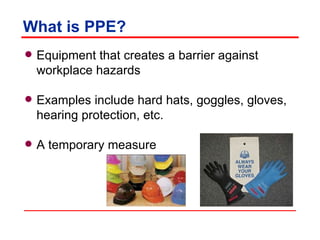
What is PPE? Equipment that creates a barrier against workplace hazards Examples include hard hats, goggles, gloves, hearing protection, etc. A temporary measure
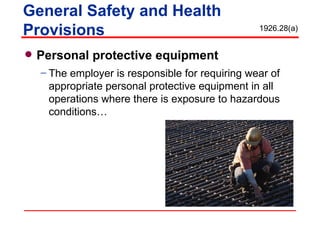
Personal protective equipment  The employer is responsible for requiring wear of appropriate personal protective equipment in all operations where there is exposure to hazardous conditions… General Safety and Health Provisions 1926.28(a)
Personal protective equipment Regulations governing the use, selection, and maintenance of personal protective and lifesaving equipment are described under subpart E of this part. General Safety and Health Provisions 1926.28(b)
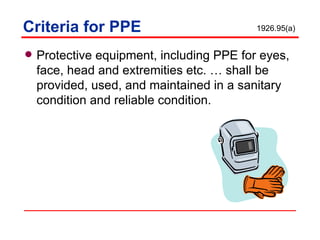
Criteria for PPE Protective equipment, including PPE for eyes, face, head and extremities etc. … shall be provided, used, and maintained in a sanitary condition and reliable condition. 1926.95(a)
Criteria for PPE Employee-owned equipment  Where employees provide their own protective equipment, the employer shall be responsible to assure its adequacy, including proper maintenance, and sanitation of such equipment. 1926.95(b)
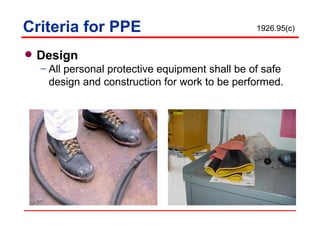
Criteria for PPE Design  All personal protective equipment shall be of safe design and construction for work to be performed. 1926.95(c)
Training Employer shall instruct each employee in the recognition and avoidance of unsafe conditions and the regulations applicable to his work environment to control or eliminate any hazards or other exposure to illness or injury. 1926.21(b)
Payment of PPE Except as noted, the protective equipment used to comply with this part, shall be provided by the employer at no cost to employees. 1926.95(d)(2) – (5)
Documentation Training records Fall protection training records Hearing conservation program Respiratory protection program
Hazard Assessment Is a multi-step process Must involve employees 1910.132(d)
Assessment Process Review injury/illness logs Involve managers and workers Review past records 1910.132(d)
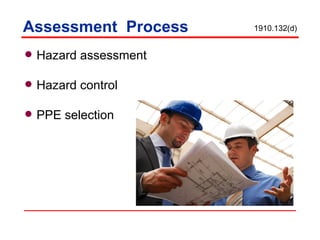
Assessment  Process Hazard assessment Hazard control PPE selection 1910.132(d)
Assessment  Process Use MSDS recommendations Must be job and area based Check basic hazard categories 1910.132(d)
Assessment  Process Document everything Evaluate the process Request free help Get NCDOL guidance 1910.132(d)
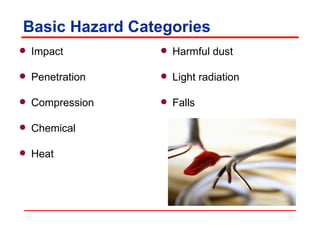
Basic Hazard Categories Impact Penetration Compression Chemical Heat Harmful dust Light radiation Falls
Hazard Sources Motion Temperature Chemical exposure Light radiation Elevation Sharp objects Rolling/pinching Electrical hazards Workplace layout Worker Location
Employer Requirements Conduct hazard assessment Insure adequacy of PPE Provide employee training Maintain written certification
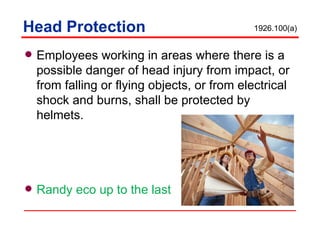
Head Protection Employees working in areas where there is a possible danger of head injury from impact, or from falling or flying objects, or from electrical shock and burns, shall be protected by helmets. Randy eco up to the last 1926.100(a)
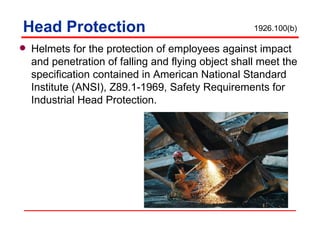
Head Protection Helmets for the protection of employees against impact and penetration of falling and flying object shall meet the specification contained in American National Standard Institute (ANSI), Z89.1-1969, Safety Requirements for Industrial Head Protection. 1926.100(b)
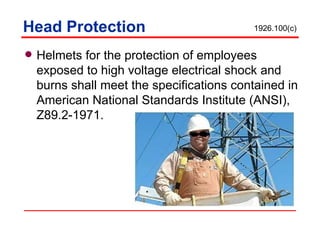
Head Protection Helmets for the protection of employees exposed to high voltage electrical shock and burns shall meet the specifications contained in American National Standards Institute (ANSI), Z89.2-1971. 1926.100(c)
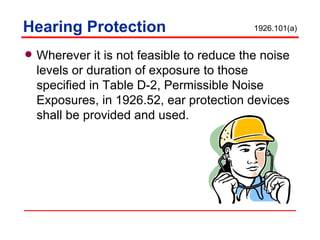
Hearing Protection Wherever it is not feasible to reduce the noise levels or duration of exposure to those specified in Table D-2, Permissible Noise Exposures, in 1926.52, ear protection devices shall be provided and used. 1926.101(a)
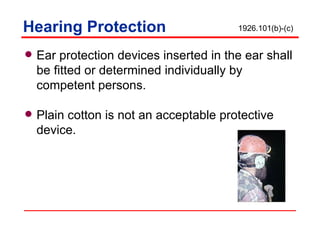
Hearing Protection Ear protection devices inserted in the ear shall be fitted or determined individually by  competent persons. Plain cotton is not an acceptable protective device. 1926.101(b)-(c)
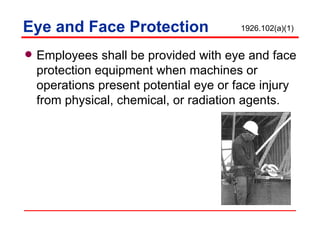
Eye and Face Protection Employees shall be provided with eye and face protection equipment when machines or operations present potential eye or face injury from physical, chemical, or radiation agents. 1926.102(a)(1)
Eye and Face Protection Eye and face protection equipment required by this Part shall meet the requirements specified in American National Standards Institute (ANSI), Z89.1-1968, Practice for Occupational and Education Eye and Face Protection. 1926.102(a)(2)
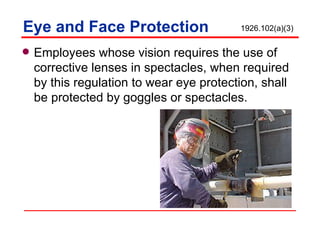
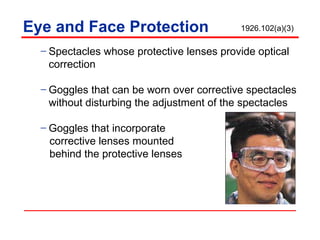
Eye and Face Protection Employees whose vision requires the use of corrective lenses in spectacles, when required by this regulation to wear eye protection, shall be protected by goggles or spectacles. 1926.102(a)(3)
Eye and Face Protection Spectacles whose protective lenses provide optical correction Goggles that can be worn over corrective spectacles without disturbing the adjustment of the spectacles Goggles that incorporate  corrective lenses mounted behind the protective lenses 1926.102(a)(3)
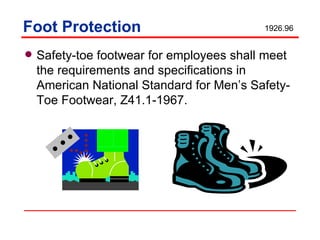
Foot Protection Safety-toe footwear for employees shall meet the requirements and specifications in American National Standard for Men’s Safety-Toe Footwear, Z41.1-1967. 1926.96
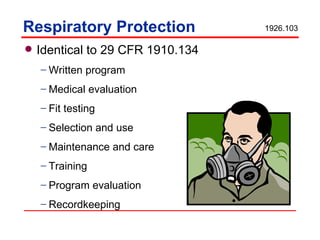
Respiratory Protection Identical to 29 CFR 1910.134 Written program Medical evaluation Fit testing Selection and use Maintenance and care Training Program evaluation Recordkeeping 1926.103
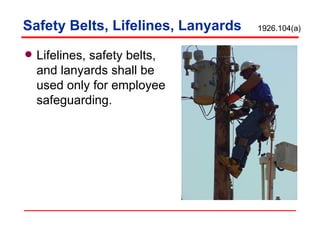
Safety Belts, Lifelines, Lanyards Lifelines, safety belts, and lanyards shall be used only for employee safeguarding.  1926.104(a)
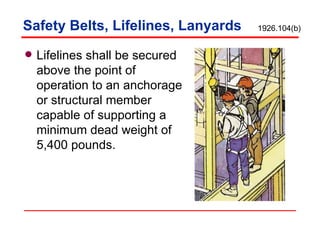
Safety Belts, Lifelines, Lanyards Lifelines shall be secured above the point of operation to an anchorage or structural member capable of supporting a minimum dead weight of 5,400 pounds. 1926.104(b)
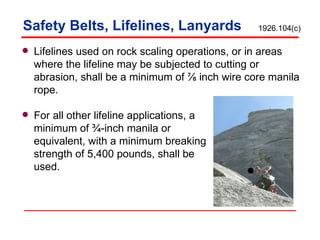
Safety Belts, Lifelines, Lanyards Lifelines used on rock scaling operations, or in areas where the lifeline may be subjected to cutting or abrasion, shall be a minimum of ⅞ inch wire core manila rope. For all other lifeline applications, a  minimum of ¾-inch manila or  equivalent, with a minimum breaking strength of 5,400 pounds, shall be  used. 1926.104(c)
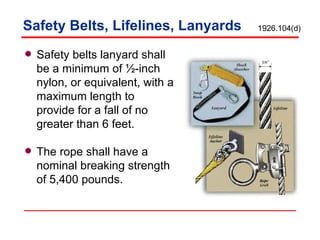
Safety Belts, Lifelines, Lanyards Safety belts lanyard shall be a minimum of ½-inch nylon, or equivalent, with a maximum length to provide for a fall of no greater than 6 feet.  The rope shall have a nominal breaking strength of 5,400 pounds. 1926.104(d)
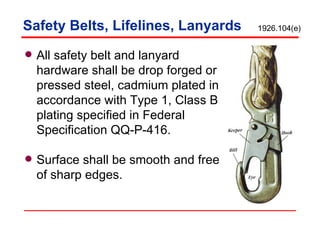
Safety Belts, Lifelines, Lanyards All safety belt and lanyard hardware shall be drop forged or pressed steel, cadmium plated in accordance with Type 1, Class B plating specified in Federal Specification QQ-P-416.  Surface shall be smooth and free of sharp edges. 1926.104(e)
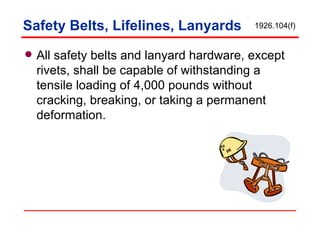
Safety Belts, Lifelines, Lanyards All safety belts and lanyard hardware, except rivets, shall be capable of withstanding a tensile loading of 4,000 pounds without cracking, breaking, or taking a permanent deformation. 1926.104(f)
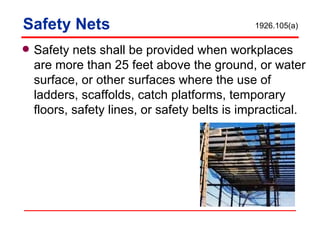
Safety Nets Safety nets shall be provided when workplaces are more than 25 feet above the ground, or water surface, or other surfaces where the use of ladders, scaffolds, catch platforms, temporary floors, safety lines, or safety belts is impractical. 1926.105(a)
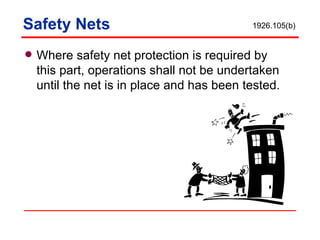
Safety Nets Where safety net protection is required by this part, operations shall not be undertaken until the net is in place and has been tested. 1926.105(b)
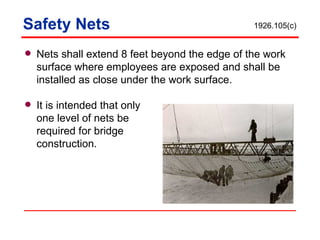
Safety Nets Nets shall extend 8 feet beyond the edge of the work surface where employees are exposed and shall be installed as close under the work surface. It is intended that only one level of nets be  required for bridge  construction. 1926.105(c)
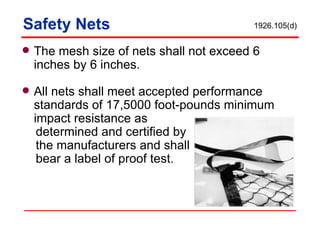
Safety Nets The mesh size of nets shall not exceed 6 inches by 6 inches.  All nets shall meet accepted performance standards of 17,5000 foot-pounds minimum impact resistance as  determined and certified by the manufacturers and shall bear a label of proof test. 1926.105(d)
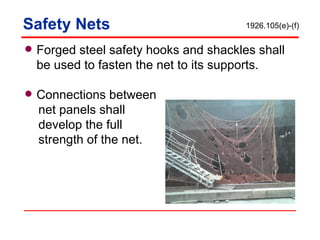
Safety Nets Forged steel safety hooks and shackles shall be used to fasten the net to its supports. Connections between net panels shall  develop the full  strength of the net. 1926.105(e)-(f)
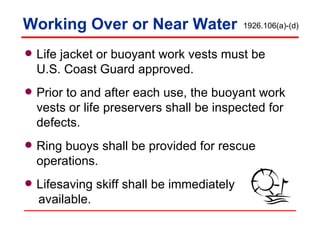
Working Over or Near Water Life jacket or buoyant work vests must be U.S. Coast Guard approved. Prior to and after each use, the buoyant work vests or life preservers shall be inspected for defects.  Ring buoys shall be provided for rescue operations. Lifesaving skiff shall be immediately  available. 1926.106(a)-(d)
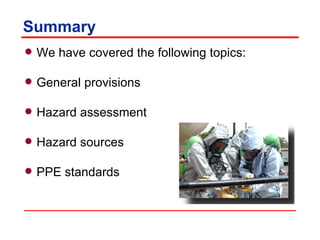
Summary We have covered the following topics: General provisions Hazard assessment Hazard sources PPE standards
Thank You For Attending! Final Questions?

Ppe report

  • 1.
    Personal Protective Equipmentin the Construction Industry 29 CFR 1926.95-106 Ronald up to hazard sources
  • 2.
    Objectives In thiscourse, we will discuss: General provisions Hazard assessment Basic hazard categories Hazard sources Personal protective equipment (PPE)
  • 3.
    What is PPE?Equipment that creates a barrier against workplace hazards Examples include hard hats, goggles, gloves, hearing protection, etc. A temporary measure
  • 4.
    Personal protective equipment The employer is responsible for requiring wear of appropriate personal protective equipment in all operations where there is exposure to hazardous conditions… General Safety and Health Provisions 1926.28(a)
  • 5.
    Personal protective equipmentRegulations governing the use, selection, and maintenance of personal protective and lifesaving equipment are described under subpart E of this part. General Safety and Health Provisions 1926.28(b)
  • 6.
    Criteria for PPEProtective equipment, including PPE for eyes, face, head and extremities etc. … shall be provided, used, and maintained in a sanitary condition and reliable condition. 1926.95(a)
  • 7.
    Criteria for PPEEmployee-owned equipment Where employees provide their own protective equipment, the employer shall be responsible to assure its adequacy, including proper maintenance, and sanitation of such equipment. 1926.95(b)
  • 8.
    Criteria for PPEDesign All personal protective equipment shall be of safe design and construction for work to be performed. 1926.95(c)
  • 9.
    Training Employer shallinstruct each employee in the recognition and avoidance of unsafe conditions and the regulations applicable to his work environment to control or eliminate any hazards or other exposure to illness or injury. 1926.21(b)
  • 10.
    Payment of PPEExcept as noted, the protective equipment used to comply with this part, shall be provided by the employer at no cost to employees. 1926.95(d)(2) – (5)
  • 11.
    Documentation Training recordsFall protection training records Hearing conservation program Respiratory protection program
  • 12.
    Hazard Assessment Isa multi-step process Must involve employees 1910.132(d)
  • 13.
    Assessment Process Reviewinjury/illness logs Involve managers and workers Review past records 1910.132(d)
  • 14.
    Assessment ProcessHazard assessment Hazard control PPE selection 1910.132(d)
  • 15.
    Assessment ProcessUse MSDS recommendations Must be job and area based Check basic hazard categories 1910.132(d)
  • 16.
    Assessment ProcessDocument everything Evaluate the process Request free help Get NCDOL guidance 1910.132(d)
  • 17.
    Basic Hazard CategoriesImpact Penetration Compression Chemical Heat Harmful dust Light radiation Falls
  • 18.
    Hazard Sources MotionTemperature Chemical exposure Light radiation Elevation Sharp objects Rolling/pinching Electrical hazards Workplace layout Worker Location
  • 19.
    Employer Requirements Conducthazard assessment Insure adequacy of PPE Provide employee training Maintain written certification
  • 20.
    Head Protection Employeesworking in areas where there is a possible danger of head injury from impact, or from falling or flying objects, or from electrical shock and burns, shall be protected by helmets. Randy eco up to the last 1926.100(a)
  • 21.
    Head Protection Helmetsfor the protection of employees against impact and penetration of falling and flying object shall meet the specification contained in American National Standard Institute (ANSI), Z89.1-1969, Safety Requirements for Industrial Head Protection. 1926.100(b)
  • 22.
    Head Protection Helmetsfor the protection of employees exposed to high voltage electrical shock and burns shall meet the specifications contained in American National Standards Institute (ANSI), Z89.2-1971. 1926.100(c)
  • 23.
    Hearing Protection Whereverit is not feasible to reduce the noise levels or duration of exposure to those specified in Table D-2, Permissible Noise Exposures, in 1926.52, ear protection devices shall be provided and used. 1926.101(a)
  • 24.
    Hearing Protection Earprotection devices inserted in the ear shall be fitted or determined individually by competent persons. Plain cotton is not an acceptable protective device. 1926.101(b)-(c)
  • 25.
    Eye and FaceProtection Employees shall be provided with eye and face protection equipment when machines or operations present potential eye or face injury from physical, chemical, or radiation agents. 1926.102(a)(1)
  • 26.
    Eye and FaceProtection Eye and face protection equipment required by this Part shall meet the requirements specified in American National Standards Institute (ANSI), Z89.1-1968, Practice for Occupational and Education Eye and Face Protection. 1926.102(a)(2)
  • 27.
    Eye and FaceProtection Employees whose vision requires the use of corrective lenses in spectacles, when required by this regulation to wear eye protection, shall be protected by goggles or spectacles. 1926.102(a)(3)
  • 28.
    Eye and FaceProtection Spectacles whose protective lenses provide optical correction Goggles that can be worn over corrective spectacles without disturbing the adjustment of the spectacles Goggles that incorporate corrective lenses mounted behind the protective lenses 1926.102(a)(3)
  • 29.
    Foot Protection Safety-toefootwear for employees shall meet the requirements and specifications in American National Standard for Men’s Safety-Toe Footwear, Z41.1-1967. 1926.96
  • 30.
    Respiratory Protection Identicalto 29 CFR 1910.134 Written program Medical evaluation Fit testing Selection and use Maintenance and care Training Program evaluation Recordkeeping 1926.103
  • 31.
    Safety Belts, Lifelines,Lanyards Lifelines, safety belts, and lanyards shall be used only for employee safeguarding. 1926.104(a)
  • 32.
    Safety Belts, Lifelines,Lanyards Lifelines shall be secured above the point of operation to an anchorage or structural member capable of supporting a minimum dead weight of 5,400 pounds. 1926.104(b)
  • 33.
    Safety Belts, Lifelines,Lanyards Lifelines used on rock scaling operations, or in areas where the lifeline may be subjected to cutting or abrasion, shall be a minimum of ⅞ inch wire core manila rope. For all other lifeline applications, a minimum of ¾-inch manila or equivalent, with a minimum breaking strength of 5,400 pounds, shall be used. 1926.104(c)
  • 34.
    Safety Belts, Lifelines,Lanyards Safety belts lanyard shall be a minimum of ½-inch nylon, or equivalent, with a maximum length to provide for a fall of no greater than 6 feet. The rope shall have a nominal breaking strength of 5,400 pounds. 1926.104(d)
  • 35.
    Safety Belts, Lifelines,Lanyards All safety belt and lanyard hardware shall be drop forged or pressed steel, cadmium plated in accordance with Type 1, Class B plating specified in Federal Specification QQ-P-416. Surface shall be smooth and free of sharp edges. 1926.104(e)
  • 36.
    Safety Belts, Lifelines,Lanyards All safety belts and lanyard hardware, except rivets, shall be capable of withstanding a tensile loading of 4,000 pounds without cracking, breaking, or taking a permanent deformation. 1926.104(f)
  • 37.
    Safety Nets Safetynets shall be provided when workplaces are more than 25 feet above the ground, or water surface, or other surfaces where the use of ladders, scaffolds, catch platforms, temporary floors, safety lines, or safety belts is impractical. 1926.105(a)
  • 38.
    Safety Nets Wheresafety net protection is required by this part, operations shall not be undertaken until the net is in place and has been tested. 1926.105(b)
  • 39.
    Safety Nets Netsshall extend 8 feet beyond the edge of the work surface where employees are exposed and shall be installed as close under the work surface. It is intended that only one level of nets be required for bridge construction. 1926.105(c)
  • 40.
    Safety Nets Themesh size of nets shall not exceed 6 inches by 6 inches. All nets shall meet accepted performance standards of 17,5000 foot-pounds minimum impact resistance as determined and certified by the manufacturers and shall bear a label of proof test. 1926.105(d)
  • 41.
    Safety Nets Forgedsteel safety hooks and shackles shall be used to fasten the net to its supports. Connections between net panels shall develop the full strength of the net. 1926.105(e)-(f)
  • 42.
    Working Over orNear Water Life jacket or buoyant work vests must be U.S. Coast Guard approved. Prior to and after each use, the buoyant work vests or life preservers shall be inspected for defects. Ring buoys shall be provided for rescue operations. Lifesaving skiff shall be immediately available. 1926.106(a)-(d)
  • 43.
    Summary We havecovered the following topics: General provisions Hazard assessment Hazard sources PPE standards
  • 44.
    Thank You ForAttending! Final Questions?

Editor's Notes

  • #2 The information in this presentation is provided voluntarily by the N.C. Department of Labor, Education Training and Technical Assistance Bureau as a public service and is made available in good faith. This presentation is designed to assist trainers conducting OSHA outreach training for workers. Since workers are the target audience, this presentation emphasizes hazard identification, avoidance, and control – not standards. No attempt has been made to treat the topic exhaustively. It is essential that trainers tailor their presentations to the needs and understanding of their audience. The information and advice provided on this Site and on Linked Sites is provided solely on the basis that users will be responsible for making their own assessment of the matters discussed herein and are advised to verify all relevant representations, statements, and information. This presentation is not a substitute for any of the provisions of the Occupational Safety and Health Act of North Carolina or for any standards issued by the N.C. Department of Labor. Mention of trade names, commercial products, or organizations does not imply endorsement by the N.C. Department of Labor.
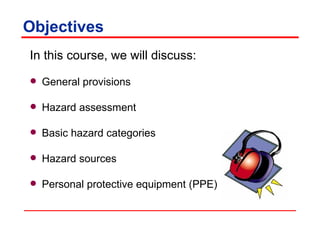
  • #3 Earmuff photo from OSHA
  • #4 Hardhat Photo from Utah OSHA; glove photo from OSHA
  • #5 Photo from MS Clip Art
  • #6 Illustrations from MS Clip Art
  • #7 Illustration from MS Clip Art
  • #8 Illustration & Photo from MS Clip Art
  • #9 Photos from OSHA
  • #10 Photo from MS Clip Art
  • #11 Illustration from MS Clip Art
  • #12 Illustration from MS Clip Art
  • #13 Illustration from MS Clip Art
  • #14 Illustration from MS Clip Art
  • #15 Photo from MS Clip Art
  • #16 Illustration from MS Clip Art
  • #17 Illustration from MS Clip Art
  • #18 Photo from MS Clip Art
  • #19 Illustration from MS Clip Art
  • #20 Photo from MS Clip Art
  • #21 Photo from MS Clip Art
  • #22 Photo from OSHA
  • #23 Photo from Tennessee Valley Authority
  • #24 Photo from MS Clip Art
  • #25 Photo from OSHA
  • #26 Photo from OSHA
  • #27 Illustration from MS Clip Art
  • #28 Photo from OSHA
  • #29 Photo from MS Clip Art
  • #30 Illustrations from MS Clip Art
  • #31 Illustration from MS Clip Art
  • #32 Photo from NCDOL OSH Division
  • #33 Illustration from the Centers for Disease Control
  • #34 Photo from U.S. Geological Survey
  • #35 Illustration from the Centers for Disease Control
  • #36 Illustration from the Centers for Disease Control
  • #37 Illustration from MS Clipart
  • #38 Photo from OSHA
  • #39 Illustration from MS Clip Art
  • #40 Photo from Library of Congress
  • #41 Photo from Consumer Product Safety Commission
  • #42 Photo from Washington OSHA
  • #43 Illustration from MS Clipart
  • #44 Photo from Los Alamos National Laboratories