Fire Safety 
John Newquist 
Draft 10 27 
2014
Sep 2014 
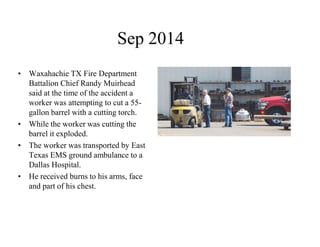
• Waxahachie TX Fire Department 
Battalion Chief Randy Muirhead 
said at the time of the accident a 
worker was attempting to cut a 55- 
gallon barrel with a cutting torch. 
• While the worker was cutting the 
barrel it exploded. 
• The worker was transported by East 
Texas EMS ground ambulance to a 
Dallas Hospital. 
• He received burns to his arms, face 
and part of his chest.
2013 
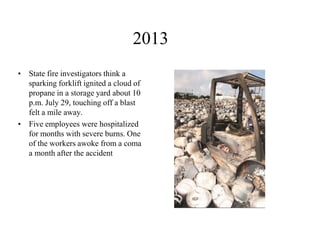
• State fire investigators think a 
sparking forklift ignited a cloud of 
propane in a storage yard about 10 
p.m. July 29, touching off a blast 
felt a mile away. 
• Five employees were hospitalized 
for months with severe burns. One 
of the workers awoke from a coma 
a month after the accident
August 2014 
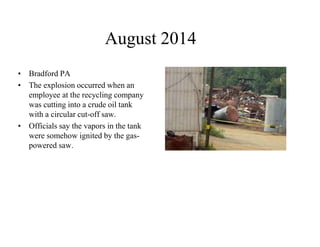
• Bradford PA 
• The explosion occurred when an 
employee at the recycling company 
was cutting into a crude oil tank 
with a circular cut-off saw. 
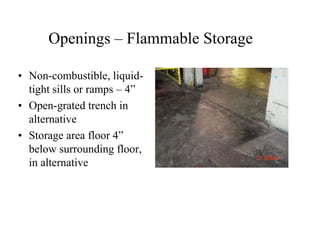
• Officials say the vapors in the tank 
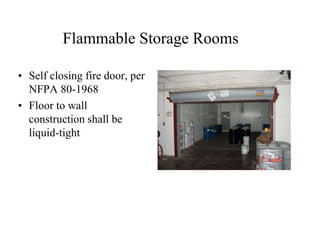
were somehow ignited by the gas-powered 
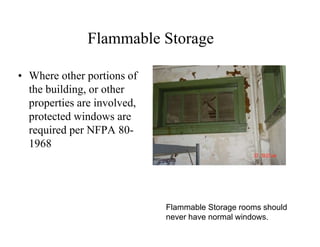
saw.
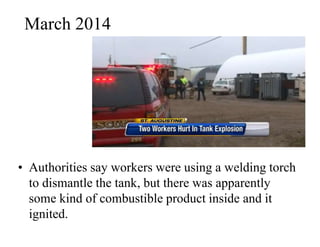
March 2014 
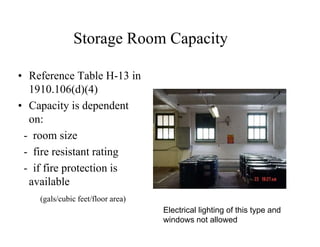
• Authorities say workers were using a welding torch 
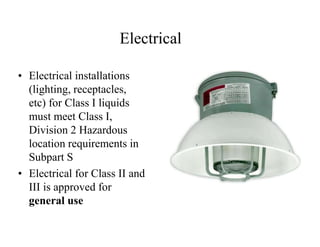
to dismantle the tank, but there was apparently 
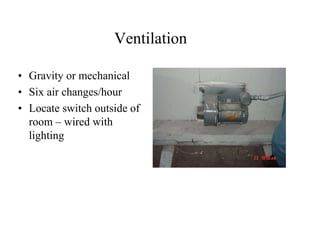
some kind of combustible product inside and it 
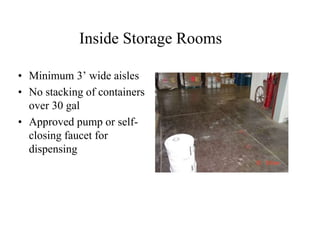
ignited.
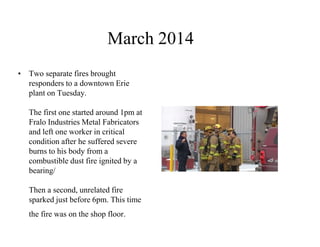
March 2014 
• Two separate fires brought 
responders to a downtown Erie 
plant on Tuesday. 
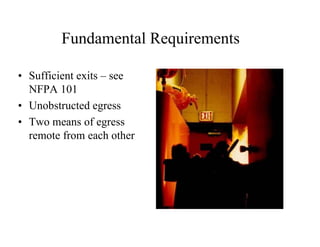
The first one started around 1pm at 
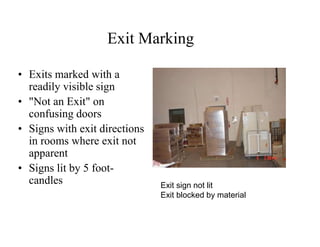
Fralo Industries Metal Fabricators 
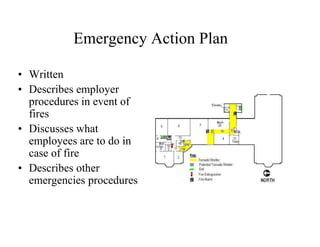
and left one worker in critical 
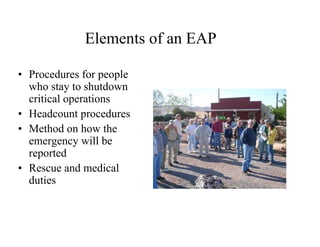
condition after he suffered severe 
burns to his body from a 
combustible dust fire ignited by a 
bearing/ 
Then a second, unrelated fire 
sparked just before 6pm. This time 
the fire was on the shop floor.
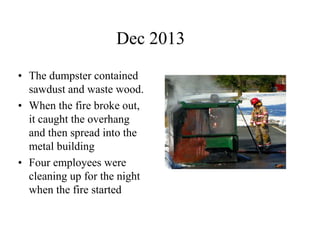
Dec 2013 
• The dumpster contained 
sawdust and waste wood. 
• When the fire broke out, 
it caught the overhang 
and then spread into the 
metal building 
• Four employees were 
cleaning up for the night 
when the fire started
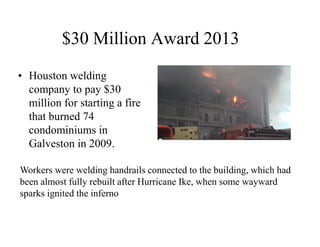
$30 Million Award 2013 
• Houston welding 
company to pay $30 
million for starting a fire 
that burned 74 
condominiums in 
Galveston in 2009. 
Workers were welding handrails connected to the building, which had 
been almost fully rebuilt after Hurricane Ike, when some wayward 
sparks ignited the inferno
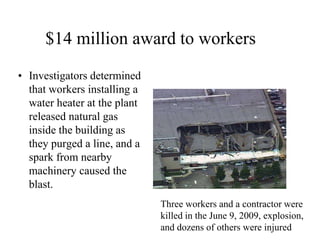
$14 million award to workers 
• Investigators determined 
that workers installing a 
water heater at the plant 
released natural gas 
inside the building as 
they purged a line, and a 
spark from nearby 
machinery caused the 
blast. 
Three workers and a contractor were 
killed in the June 9, 2009, explosion, 
and dozens of others were injured
Aug 2013 
• "Failing to evacuate workers during a natural gas 
leak shows a serious disregard for worker safety 
and health," said Chris Zortman, OSHA's area 
director in Milwaukee.
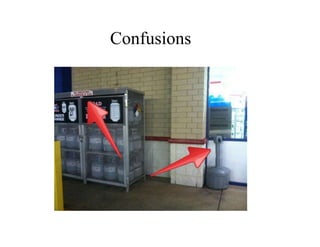
Confusions
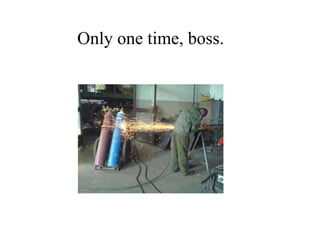
Only one time, boss.
2010 Fire Fatality 
• 05/11/2010 
• Employee was using a gas powered abrasive 
cutoff saw to cut open a 2000 gal. fuel tank 
which was above ground. 
• As he started to cut there was an ignition of 
vapors in the tank causing the end to be blown 
off killing him and igniting his truck which 
burned completely.
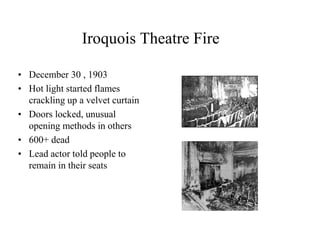
Iroquois Theatre Fire 
• December 30 , 1903 
• Hot light started flames 
crackling up a velvet curtain 
• Doors locked, unusual 
opening methods in others 
• 600+ dead 
• Lead actor told people to 
remain in their seats
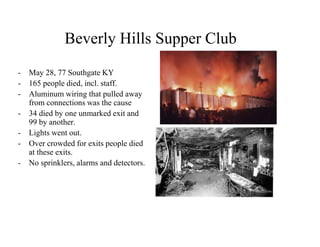
Beverly Hills Supper Club 
- May 28, 77 Southgate KY 
- 165 people died, incl. staff. 
- Aluminum wiring that pulled away 
from connections was the cause 
- 34 died by one unmarked exit and 
99 by another. 
- Lights went out. 
- Over crowded for exits people died 
at these exits. 
- No sprinklers, alarms and detectors.
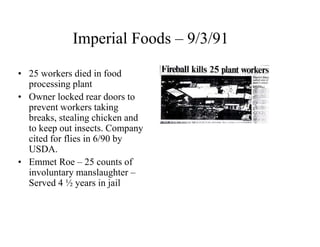
Imperial Foods – 9/3/91 
• 25 workers died in food 
processing plant 
• Owner locked rear doors to 
prevent workers taking 
breaks, stealing chicken and 
to keep out insects. Company 
cited for flies in 6/90 by 
USDA. 
• Emmet Roe – 25 counts of 
involuntary manslaughter – 
Served 4 ½ years in jail
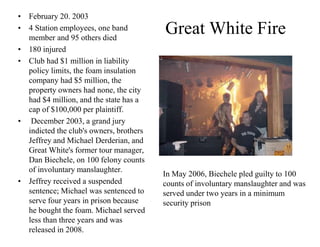
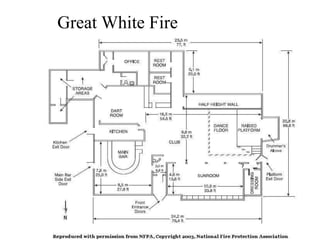
Great White Fire 
• February 20. 2003 
• 4 Station employees, one band 
member and 95 others died 
• 180 injured 
• Club had $1 million in liability 
policy limits, the foam insulation 
company had $5 million, the 
property owners had none, the city 
had $4 million, and the state has a 
cap of $100,000 per plaintiff. 
• December 2003, a grand jury 
indicted the club's owners, brothers 
Jeffrey and Michael Derderian, and 
Great White's former tour manager, 
Dan Biechele, on 100 felony counts 
of involuntary manslaughter. 
• Jeffrey received a suspended 
sentence; Michael was sentenced to 
serve four years in prison because 
he bought the foam. Michael served 
less than three years and was 
released in 2008. 
In May 2006, Biechele pled guilty to 100 
counts of involuntary manslaughter and was 
served under two years in a minimum 
security prison
Great White Fire
Aug 2013 
• "The employers' shocking decision to seal exit doors and block emergency 
exit routes to gain additional storage space placed the workers in great 
jeopardy," said Galen Lemke, director of OSHA's Honolulu Area Office, who 
said that the blocked exits could have devastating results in the event of an 
ammonia leak from piping located throughout the facility.
Fire Protection Most Cited 
• Fire extinguisher not 
accessible 
• Exits not marked with an 
EXIT sign. 
• No F.E. education 
program annually 
• F.E. Annual maintenance 
check not recorded 
• No training in F.E. use 
• No emergency action 
plan 
• Means of egress 
obstructed 
• No monthly F.E. 
inspection 
• Signs not posted along 
Exit travel 
• F.E. not in operable 
condition
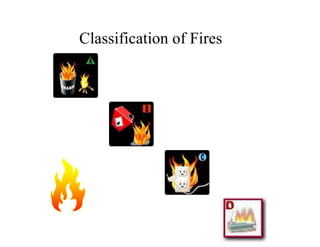
Classification of Fires
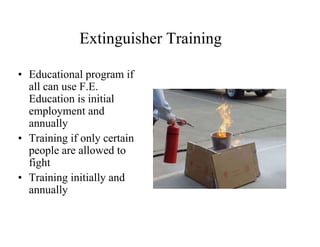
Extinguisher Training 
• Educational program if 
all can use F.E. 
Education is initial 
employment and 
annually 
• Training if only certain 
people are allowed to 
fight 
• Training initially and 
annually
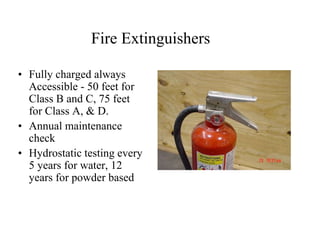
Fire Extinguishers 
• Fully charged always 
Accessible - 50 feet for 
Class B and C, 75 feet 
for Class A, & D. 
• Annual maintenance 
check 
• Hydrostatic testing every 
5 years for water, 12 
years for powder based
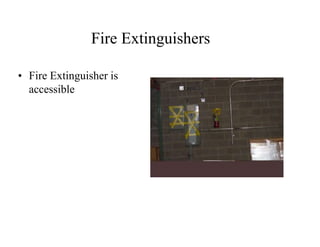
Fire Extinguishers 
• Fire Extinguisher is 
accessible
Fire Extinguishers 
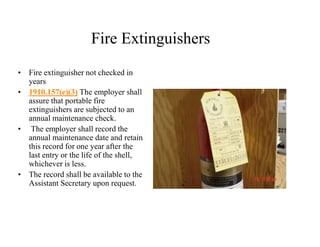
• Fire extinguisher not checked in 
years 
• 1910.157(e)(3) The employer shall 
assure that portable fire 
extinguishers are subjected to an 
annual maintenance check. 
• The employer shall record the 
annual maintenance date and retain 
this record for one year after the 
last entry or the life of the shell, 
whichever is less. 
• The record shall be available to the 
Assistant Secretary upon request.
Fire Extinguishers 
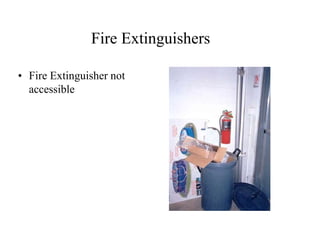
• Fire Extinguisher not 
accessible
Definitions 
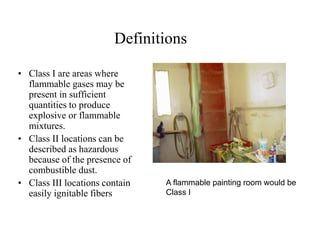
• Class I are areas where 
flammable gases may be 
present in sufficient 
quantities to produce 
explosive or flammable 
mixtures. 
• Class II locations can be 
described as hazardous 
because of the presence of 
combustible dust. 
• Class III locations contain 
easily ignitable fibers 
A flammable painting room would be 
Class I
Definitions 
• Combustible liquid means any liquid having 
a flash point at or above 100F 
• Flammable liquid means any liquid having a 
flash point below 100F 
• Class IA shall include liquids having flash 
points below 73F and having a boiling point 
below 100F 
• Class IB shall include liquids having flash 
points below 73F and having a boiling point 
at or above 100F 
• Class IC shall include liquids having flash 
points at or above 73F and a boiling point 
below 100F 
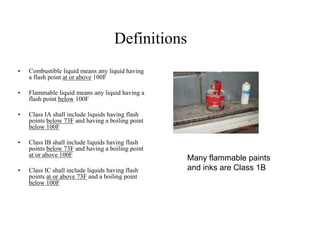
Many flammable paints 
and inks are Class 1B
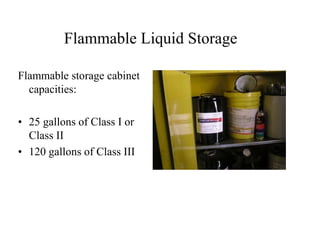
Flammable Liquid Storage 
Flammable storage cabinet 
capacities: 
• 25 gallons of Class I or 
Class II 
• 120 gallons of Class III
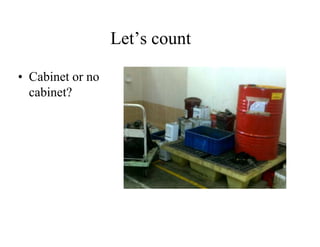
Let’s count 
• Cabinet or no 
cabinet?
Inside Storage Room Requirements 
• Fire resistant 
construction 
• Sprinklers 
• Raised sills or trench 
• Fire doors 
• Liquid tight (floor to 
wall) 
• Windows 
• Capacity ratings 
• Electrical 
• Ventilation 
• Storage requirements 
• Egress 
• Leak procedures 
• 29 CFR 1910.106(d)(4)
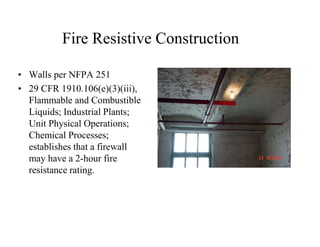
Fire Resistive Construction 
• Walls per NFPA 251 
• 29 CFR 1910.106(e)(3)(iii), 
Flammable and Combustible 
Liquids; Industrial Plants; 
Unit Physical Operations; 
Chemical Processes; 
establishes that a firewall 
may have a 2-hour fire 
resistance rating.
Openings – Flammable Storage 
• Non-combustible, liquid-tight 
sills or ramps – 4” 
• Open-grated trench in 
alternative 
• Storage area floor 4” 
below surrounding floor, 
in alternative
Flammable Storage Rooms 
• Self closing fire door, per 
NFPA 80-1968 
• Floor to wall 
construction shall be 
liquid-tight
Flammable Storage 
• Where other portions of 
the building, or other 
properties are involved, 
protected windows are 
required per NFPA 80- 
1968 
Flammable Storage rooms should 
never have normal windows.
Other Acceptable Methods 
• One inch nominal 
thickness of wood is 
acceptable for use in 
shelves, racks, floor 
overlays, etc
Storage Room Capacity 
• Reference Table H-13 in 
1910.106(d)(4) 
• Capacity is dependent 
on: 
- room size 
- fire resistant rating 
- if fire protection is 
available 
(gals/cubic feet/floor area) 
Electrical lighting of this type and 
windows not allowed
Electrical 
• Electrical installations 
(lighting, receptacles, 
etc) for Class I liquids 
must meet Class I, 
Division 2 Hazardous 
location requirements in 
Subpart S 
• Electrical for Class II and 
III is approved for 
general use
Ventilation 
• Gravity or mechanical 
• Six air changes/hour 
• Locate switch outside of 
room – wired with 
lighting
Inside Storage Rooms 
• Minimum 3’ wide aisles 
• No stacking of containers 
over 30 gal 
• Approved pump or self-closing 
faucet for 
dispensing
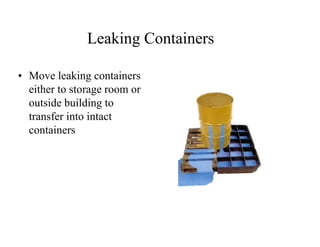
Leaking Containers 
• Move leaking containers 
either to storage room or 
outside building to 
transfer into intact 
containers
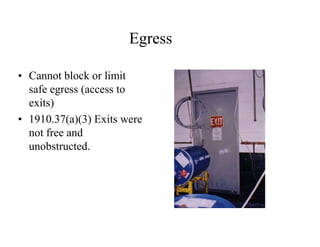
Egress 
• Cannot block or limit 
safe egress (access to 
exits) 
• 1910.37(a)(3) Exits were 
not free and 
unobstructed.
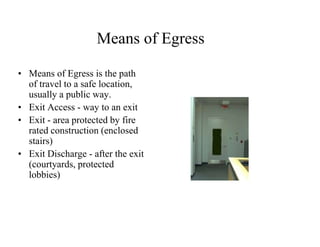
Means of Egress 
• Means of Egress is the path 
of travel to a safe location, 
usually a public way. 
• Exit Access - way to an exit 
• Exit - area protected by fire 
rated construction (enclosed 
stairs) 
• Exit Discharge - after the exit 
(courtyards, protected 
lobbies)
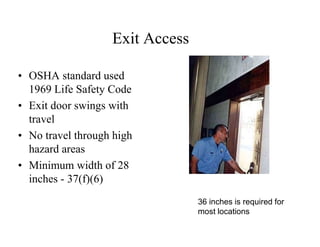
Exit Access 
• OSHA standard used 
1969 Life Safety Code 
• Exit door swings with 
travel 
• No travel through high 
hazard areas 
• Minimum width of 28 
inches - 37(f)(6) 
36 inches is required for 
most locations
Fundamental Requirements 
• Sufficient exits – see 
NFPA 101 
• Unobstructed egress 
• Two means of egress 
remote from each other
Exit Marking 
• Exits marked with a 
readily visible sign 
• "Not an Exit" on 
confusing doors 
• Signs with exit directions 
in rooms where exit not 
apparent 
• Signs lit by 5 foot-candles 
Exit sign not lit 
Exit blocked by material
Emergency Action Plan 
• Written 
• Describes employer 
procedures in event of 
fires 
• Discusses what 
employees are to do in 
case of fire 
• Describes other 
emergencies procedures
Elements of an EAP 
• Procedures for people 
who stay to shutdown 
critical operations 
• Headcount procedures 
• Method on how the 
emergency will be 
reported 
• Rescue and medical 
duties
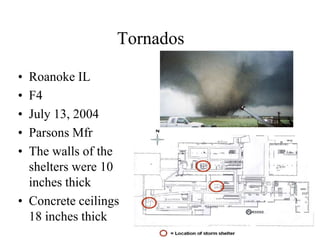
Tornados 
• Roanoke IL 
• F4 
• July 13, 2004 
• Parsons Mfr 
• The walls of the 
shelters were 10 
inches thick 
• Concrete ceilings 
18 inches thick
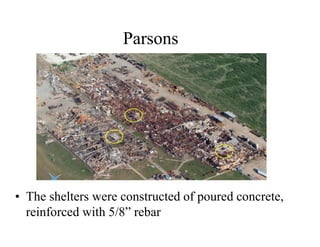
Parsons 
• The shelters were constructed of poured concrete, 
reinforced with 5/8” rebar
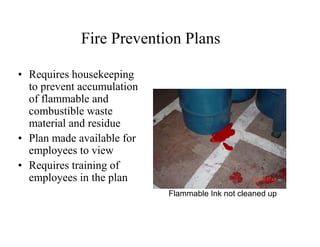
Fire Prevention Plans 
• Requires housekeeping 
to prevent accumulation 
of flammable and 
combustible waste 
material and residue 
• Plan made available for 
employees to view 
• Requires training of 
employees in the plan 
Flammable Ink not cleaned up
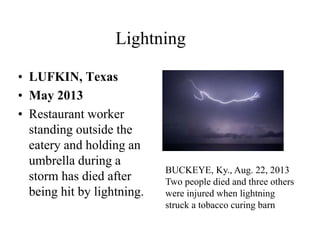
Lightning 
• LUFKIN, Texas 
• May 2013 
• Restaurant worker 
standing outside the 
eatery and holding an 
umbrella during a 
storm has died after 
being hit by lightning. 
BUCKEYE, Ky., Aug. 22, 2013 
Two people died and three others 
were injured when lightning 
struck a tobacco curing barn
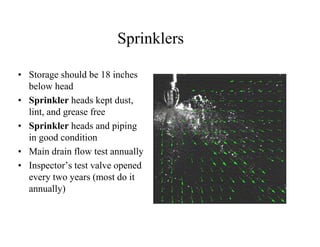
Sprinklers 
• Storage should be 18 inches 
below head 
• Sprinkler heads kept dust, 
lint, and grease free 
• Sprinkler heads and piping 
in good condition 
• Main drain flow test annually 
• Inspector’s test valve opened 
every two years (most do it 
annually)
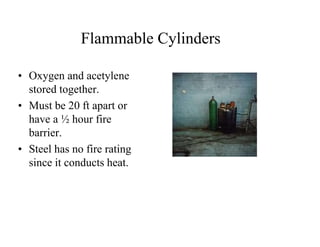
Flammable Cylinders 
• Oxygen and acetylene 
stored together. 
• Must be 20 ft apart or 
have a ½ hour fire 
barrier. 
• Steel has no fire rating 
since it conducts heat.
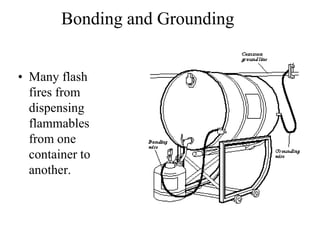
Bonding and Grounding 
• Many flash 
fires from 
dispensing 
flammables 
from one 
container to 
another.
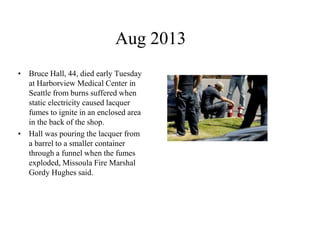
Aug 2013 
• Bruce Hall, 44, died early Tuesday 
at Harborview Medical Center in 
Seattle from burns suffered when 
static electricity caused lacquer 
fumes to ignite in an enclosed area 
in the back of the shop. 
• Hall was pouring the lacquer from 
a barrel to a smaller container 
through a funnel when the fumes 
exploded, Missoula Fire Marshal 
Gordy Hughes said.
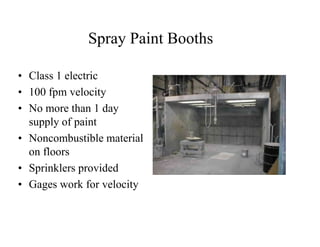
Spray Paint Booths 
• Class 1 electric 
• 100 fpm velocity 
• No more than 1 day 
supply of paint 
• Noncombustible material 
on floors 
• Sprinklers provided 
• Gages work for velocity
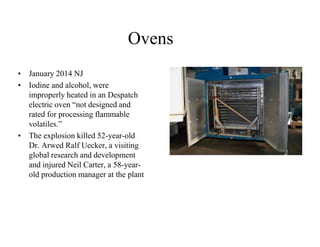
Ovens 
• January 2014 NJ 
• Iodine and alcohol, were 
improperly heated in an Despatch 
electric oven “not designed and 
rated for processing flammable 
volatiles.” 
• The explosion killed 52-year-old 
Dr. Arwed Ralf Uecker, a visiting 
global research and development 
and injured Neil Carter, a 58-year-old 
production manager at the plant
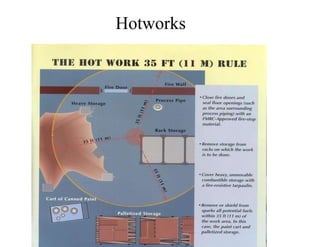
Hotworks
Quiz 
• A combustible liquid is identified 
by OSHA as one having a flash 
point at or above _____F 
• How often is fire extinguisher 
education done if required? 
_________________________ 
• Exits signs must be lit with ____ 
foot candles. 
• Exit access width is minimum of 
_____ inches per OSHA. 
• Over _____ gallons of a Class 1B 
requires a flammable liquid 
cabinet or flammable liquid 
storage room . 
• A velocity of _____ fpm is 
required in a paint spray booth.

General Industry Fire Safety SIOSH 2014

  • 1.
    Fire Safety JohnNewquist Draft 10 27 2014
  • 2.
    Sep 2014 •Waxahachie TX Fire Department Battalion Chief Randy Muirhead said at the time of the accident a worker was attempting to cut a 55- gallon barrel with a cutting torch. • While the worker was cutting the barrel it exploded. • The worker was transported by East Texas EMS ground ambulance to a Dallas Hospital. • He received burns to his arms, face and part of his chest.
  • 3.
    2013 • Statefire investigators think a sparking forklift ignited a cloud of propane in a storage yard about 10 p.m. July 29, touching off a blast felt a mile away. • Five employees were hospitalized for months with severe burns. One of the workers awoke from a coma a month after the accident
  • 4.
    August 2014 •Bradford PA • The explosion occurred when an employee at the recycling company was cutting into a crude oil tank with a circular cut-off saw. • Officials say the vapors in the tank were somehow ignited by the gas-powered saw.
  • 5.
    March 2014 •Authorities say workers were using a welding torch to dismantle the tank, but there was apparently some kind of combustible product inside and it ignited.
  • 6.
    March 2014 •Two separate fires brought responders to a downtown Erie plant on Tuesday. The first one started around 1pm at Fralo Industries Metal Fabricators and left one worker in critical condition after he suffered severe burns to his body from a combustible dust fire ignited by a bearing/ Then a second, unrelated fire sparked just before 6pm. This time the fire was on the shop floor.
  • 7.
    Dec 2013 •The dumpster contained sawdust and waste wood. • When the fire broke out, it caught the overhang and then spread into the metal building • Four employees were cleaning up for the night when the fire started
  • 8.
    $30 Million Award2013 • Houston welding company to pay $30 million for starting a fire that burned 74 condominiums in Galveston in 2009. Workers were welding handrails connected to the building, which had been almost fully rebuilt after Hurricane Ike, when some wayward sparks ignited the inferno
  • 9.
    $14 million awardto workers • Investigators determined that workers installing a water heater at the plant released natural gas inside the building as they purged a line, and a spark from nearby machinery caused the blast. Three workers and a contractor were killed in the June 9, 2009, explosion, and dozens of others were injured
  • 10.
    Aug 2013 •"Failing to evacuate workers during a natural gas leak shows a serious disregard for worker safety and health," said Chris Zortman, OSHA's area director in Milwaukee.
  • 11.
  • 12.
  • 13.
    2010 Fire Fatality • 05/11/2010 • Employee was using a gas powered abrasive cutoff saw to cut open a 2000 gal. fuel tank which was above ground. • As he started to cut there was an ignition of vapors in the tank causing the end to be blown off killing him and igniting his truck which burned completely.
  • 14.
    Iroquois Theatre Fire • December 30 , 1903 • Hot light started flames crackling up a velvet curtain • Doors locked, unusual opening methods in others • 600+ dead • Lead actor told people to remain in their seats
  • 15.
    Beverly Hills SupperClub - May 28, 77 Southgate KY - 165 people died, incl. staff. - Aluminum wiring that pulled away from connections was the cause - 34 died by one unmarked exit and 99 by another. - Lights went out. - Over crowded for exits people died at these exits. - No sprinklers, alarms and detectors.
  • 16.
    Imperial Foods –9/3/91 • 25 workers died in food processing plant • Owner locked rear doors to prevent workers taking breaks, stealing chicken and to keep out insects. Company cited for flies in 6/90 by USDA. • Emmet Roe – 25 counts of involuntary manslaughter – Served 4 ½ years in jail
  • 17.
    Great White Fire • February 20. 2003 • 4 Station employees, one band member and 95 others died • 180 injured • Club had $1 million in liability policy limits, the foam insulation company had $5 million, the property owners had none, the city had $4 million, and the state has a cap of $100,000 per plaintiff. • December 2003, a grand jury indicted the club's owners, brothers Jeffrey and Michael Derderian, and Great White's former tour manager, Dan Biechele, on 100 felony counts of involuntary manslaughter. • Jeffrey received a suspended sentence; Michael was sentenced to serve four years in prison because he bought the foam. Michael served less than three years and was released in 2008. In May 2006, Biechele pled guilty to 100 counts of involuntary manslaughter and was served under two years in a minimum security prison
  • 18.
  • 19.
    Aug 2013 •"The employers' shocking decision to seal exit doors and block emergency exit routes to gain additional storage space placed the workers in great jeopardy," said Galen Lemke, director of OSHA's Honolulu Area Office, who said that the blocked exits could have devastating results in the event of an ammonia leak from piping located throughout the facility.
  • 20.
    Fire Protection MostCited • Fire extinguisher not accessible • Exits not marked with an EXIT sign. • No F.E. education program annually • F.E. Annual maintenance check not recorded • No training in F.E. use • No emergency action plan • Means of egress obstructed • No monthly F.E. inspection • Signs not posted along Exit travel • F.E. not in operable condition
  • 21.
  • 22.
    Extinguisher Training •Educational program if all can use F.E. Education is initial employment and annually • Training if only certain people are allowed to fight • Training initially and annually
  • 23.
    Fire Extinguishers •Fully charged always Accessible - 50 feet for Class B and C, 75 feet for Class A, & D. • Annual maintenance check • Hydrostatic testing every 5 years for water, 12 years for powder based
  • 24.
    Fire Extinguishers •Fire Extinguisher is accessible
  • 25.
    Fire Extinguishers •Fire extinguisher not checked in years • 1910.157(e)(3) The employer shall assure that portable fire extinguishers are subjected to an annual maintenance check. • The employer shall record the annual maintenance date and retain this record for one year after the last entry or the life of the shell, whichever is less. • The record shall be available to the Assistant Secretary upon request.
  • 26.
    Fire Extinguishers •Fire Extinguisher not accessible
  • 27.
    Definitions • ClassI are areas where flammable gases may be present in sufficient quantities to produce explosive or flammable mixtures. • Class II locations can be described as hazardous because of the presence of combustible dust. • Class III locations contain easily ignitable fibers A flammable painting room would be Class I
  • 28.
    Definitions • Combustibleliquid means any liquid having a flash point at or above 100F • Flammable liquid means any liquid having a flash point below 100F • Class IA shall include liquids having flash points below 73F and having a boiling point below 100F • Class IB shall include liquids having flash points below 73F and having a boiling point at or above 100F • Class IC shall include liquids having flash points at or above 73F and a boiling point below 100F Many flammable paints and inks are Class 1B
  • 29.
    Flammable Liquid Storage Flammable storage cabinet capacities: • 25 gallons of Class I or Class II • 120 gallons of Class III
  • 30.
    Let’s count •Cabinet or no cabinet?
  • 31.
    Inside Storage RoomRequirements • Fire resistant construction • Sprinklers • Raised sills or trench • Fire doors • Liquid tight (floor to wall) • Windows • Capacity ratings • Electrical • Ventilation • Storage requirements • Egress • Leak procedures • 29 CFR 1910.106(d)(4)
  • 32.
    Fire Resistive Construction • Walls per NFPA 251 • 29 CFR 1910.106(e)(3)(iii), Flammable and Combustible Liquids; Industrial Plants; Unit Physical Operations; Chemical Processes; establishes that a firewall may have a 2-hour fire resistance rating.
  • 33.
    Openings – FlammableStorage • Non-combustible, liquid-tight sills or ramps – 4” • Open-grated trench in alternative • Storage area floor 4” below surrounding floor, in alternative
  • 34.
    Flammable Storage Rooms • Self closing fire door, per NFPA 80-1968 • Floor to wall construction shall be liquid-tight
  • 35.
    Flammable Storage •Where other portions of the building, or other properties are involved, protected windows are required per NFPA 80- 1968 Flammable Storage rooms should never have normal windows.
  • 36.
    Other Acceptable Methods • One inch nominal thickness of wood is acceptable for use in shelves, racks, floor overlays, etc
  • 37.
    Storage Room Capacity • Reference Table H-13 in 1910.106(d)(4) • Capacity is dependent on: - room size - fire resistant rating - if fire protection is available (gals/cubic feet/floor area) Electrical lighting of this type and windows not allowed
  • 38.
    Electrical • Electricalinstallations (lighting, receptacles, etc) for Class I liquids must meet Class I, Division 2 Hazardous location requirements in Subpart S • Electrical for Class II and III is approved for general use
  • 39.
    Ventilation • Gravityor mechanical • Six air changes/hour • Locate switch outside of room – wired with lighting
  • 40.
    Inside Storage Rooms • Minimum 3’ wide aisles • No stacking of containers over 30 gal • Approved pump or self-closing faucet for dispensing
  • 41.
    Leaking Containers •Move leaking containers either to storage room or outside building to transfer into intact containers
  • 42.
    Egress • Cannotblock or limit safe egress (access to exits) • 1910.37(a)(3) Exits were not free and unobstructed.
  • 43.
    Means of Egress • Means of Egress is the path of travel to a safe location, usually a public way. • Exit Access - way to an exit • Exit - area protected by fire rated construction (enclosed stairs) • Exit Discharge - after the exit (courtyards, protected lobbies)
  • 44.
    Exit Access •OSHA standard used 1969 Life Safety Code • Exit door swings with travel • No travel through high hazard areas • Minimum width of 28 inches - 37(f)(6) 36 inches is required for most locations
  • 45.
    Fundamental Requirements •Sufficient exits – see NFPA 101 • Unobstructed egress • Two means of egress remote from each other
  • 46.
    Exit Marking •Exits marked with a readily visible sign • "Not an Exit" on confusing doors • Signs with exit directions in rooms where exit not apparent • Signs lit by 5 foot-candles Exit sign not lit Exit blocked by material
  • 47.
    Emergency Action Plan • Written • Describes employer procedures in event of fires • Discusses what employees are to do in case of fire • Describes other emergencies procedures
  • 48.
    Elements of anEAP • Procedures for people who stay to shutdown critical operations • Headcount procedures • Method on how the emergency will be reported • Rescue and medical duties
  • 49.
    Tornados • RoanokeIL • F4 • July 13, 2004 • Parsons Mfr • The walls of the shelters were 10 inches thick • Concrete ceilings 18 inches thick
  • 50.
    Parsons • Theshelters were constructed of poured concrete, reinforced with 5/8” rebar
  • 51.
    Fire Prevention Plans • Requires housekeeping to prevent accumulation of flammable and combustible waste material and residue • Plan made available for employees to view • Requires training of employees in the plan Flammable Ink not cleaned up
  • 52.
    Lightning • LUFKIN,Texas • May 2013 • Restaurant worker standing outside the eatery and holding an umbrella during a storm has died after being hit by lightning. BUCKEYE, Ky., Aug. 22, 2013 Two people died and three others were injured when lightning struck a tobacco curing barn
  • 53.
    Sprinklers • Storageshould be 18 inches below head • Sprinkler heads kept dust, lint, and grease free • Sprinkler heads and piping in good condition • Main drain flow test annually • Inspector’s test valve opened every two years (most do it annually)
  • 54.
    Flammable Cylinders •Oxygen and acetylene stored together. • Must be 20 ft apart or have a ½ hour fire barrier. • Steel has no fire rating since it conducts heat.
  • 55.
    Bonding and Grounding • Many flash fires from dispensing flammables from one container to another.
  • 56.
    Aug 2013 •Bruce Hall, 44, died early Tuesday at Harborview Medical Center in Seattle from burns suffered when static electricity caused lacquer fumes to ignite in an enclosed area in the back of the shop. • Hall was pouring the lacquer from a barrel to a smaller container through a funnel when the fumes exploded, Missoula Fire Marshal Gordy Hughes said.
  • 57.
    Spray Paint Booths • Class 1 electric • 100 fpm velocity • No more than 1 day supply of paint • Noncombustible material on floors • Sprinklers provided • Gages work for velocity
  • 58.
    Ovens • January2014 NJ • Iodine and alcohol, were improperly heated in an Despatch electric oven “not designed and rated for processing flammable volatiles.” • The explosion killed 52-year-old Dr. Arwed Ralf Uecker, a visiting global research and development and injured Neil Carter, a 58-year-old production manager at the plant
  • 59.
  • 60.
    Quiz • Acombustible liquid is identified by OSHA as one having a flash point at or above _____F • How often is fire extinguisher education done if required? _________________________ • Exits signs must be lit with ____ foot candles. • Exit access width is minimum of _____ inches per OSHA. • Over _____ gallons of a Class 1B requires a flammable liquid cabinet or flammable liquid storage room . • A velocity of _____ fpm is required in a paint spray booth.