Subpart M, Fall Protection
• 1926.500, Scope, application,
and definitions applicable to this
subpart
• 1926.502, Fall protection
systems criteria and practices
• 1926.503, Training requirements
• Appendix
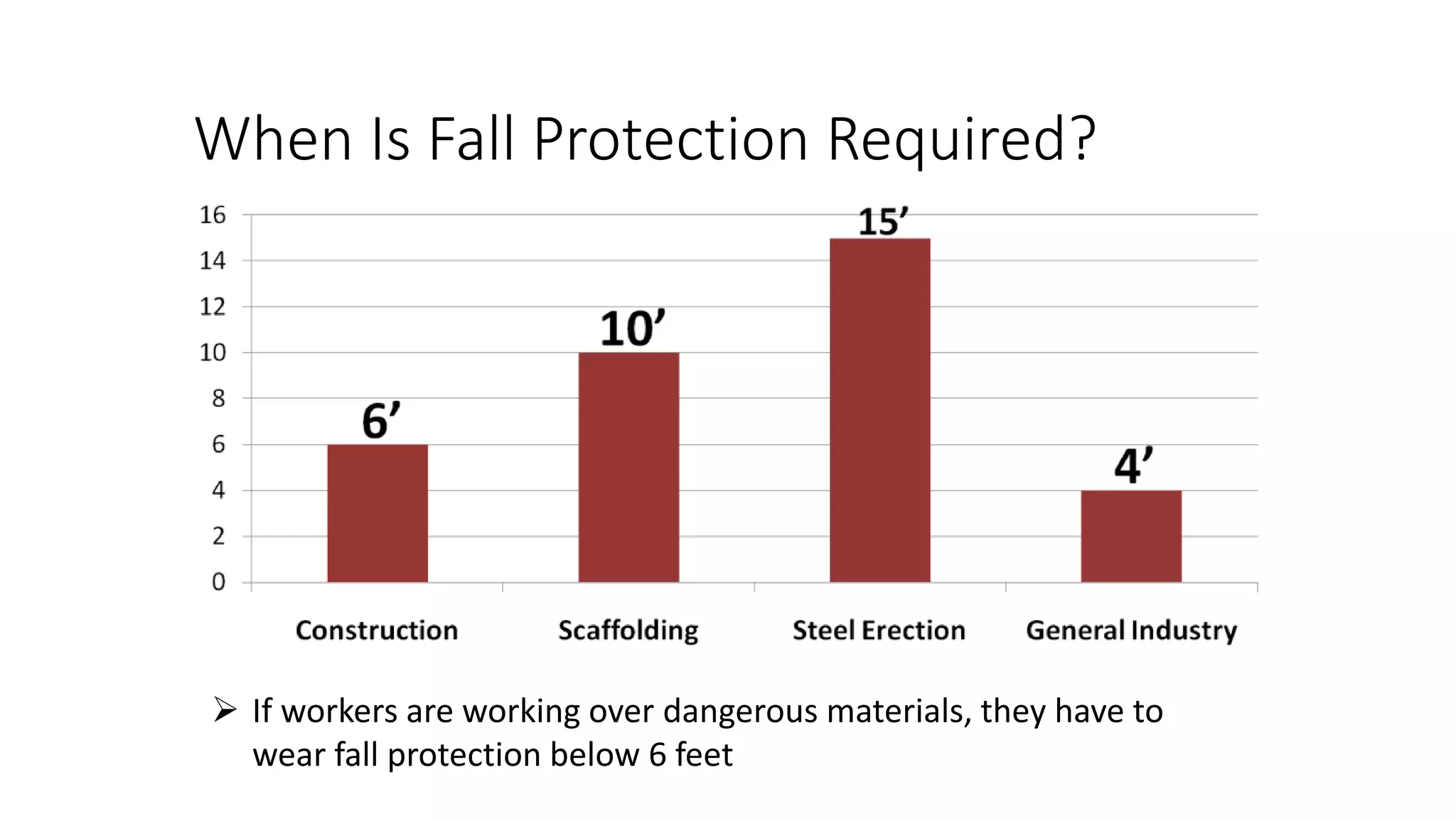
When Is Fall Protection Required?
 If workers are working over dangerous materials, they have to
wear fall protection below 6 feet
690
694
762
878
1145
1240
1351
1409
1585
4301
501(b)(10)
451(e)(1)
453(b)(2)(v)
451(g)(1)
100(a)
102(a)(1)
503(a)(1)
501(b)(1)
1053(b)(1)
501(b)(13)
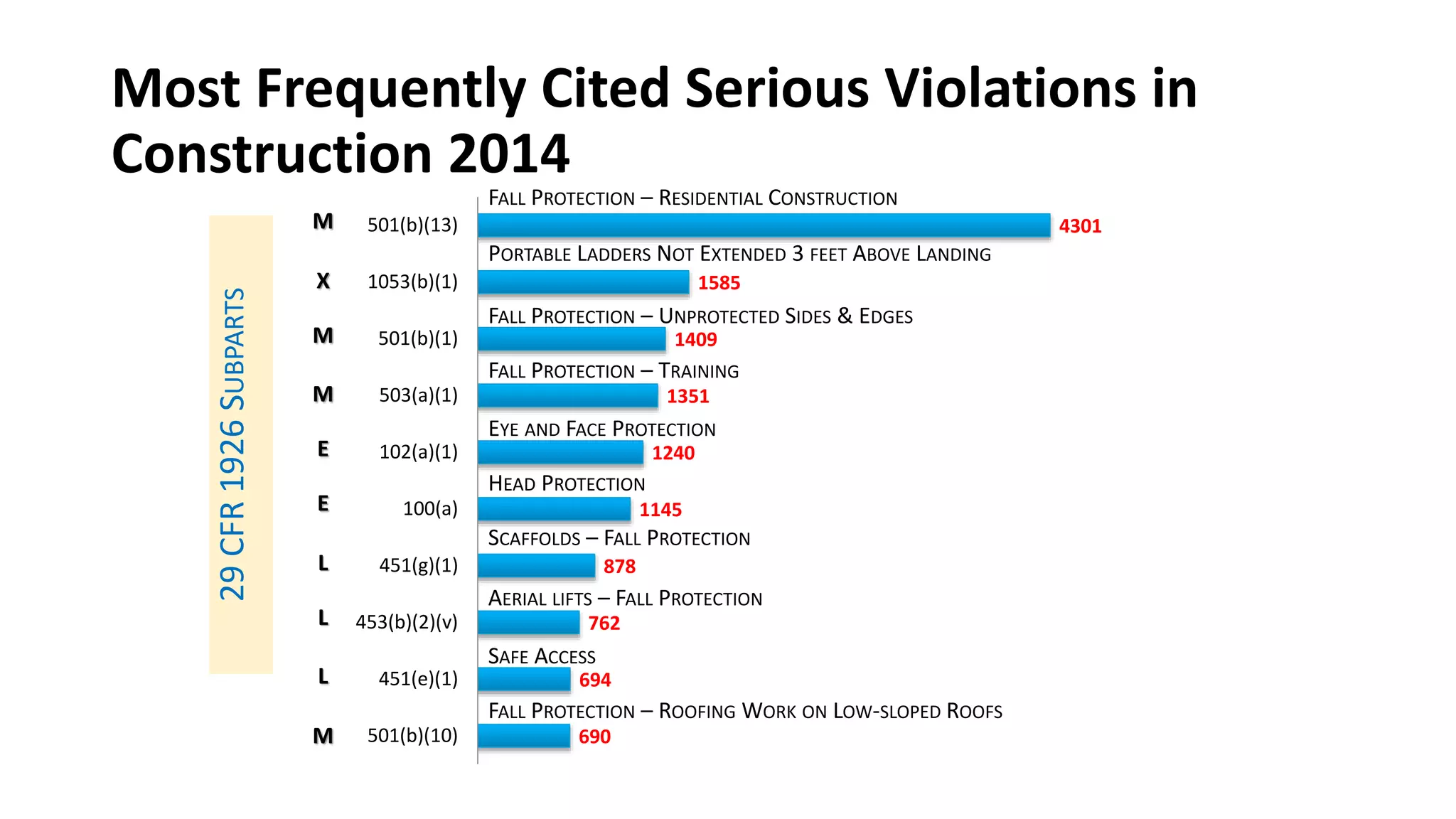
Most Frequently Cited Serious Violations in
Construction 2014
3
1926OverallMFC
FALL PROTECTION – RESIDENTIAL CONSTRUCTION
PORTABLE LADDERS NOT EXTENDED 3 FEET ABOVE LANDING
FALL PROTECTION – UNPROTECTED SIDES & EDGES
FALL PROTECTION – TRAINING
EYE AND FACE PROTECTION
HEAD PROTECTION
SCAFFOLDS – FALL PROTECTION
AERIAL LIFTS – FALL PROTECTION
SAFE ACCESS
FALL PROTECTION – ROOFING WORK ON LOW-SLOPED ROOFS
M
X
M
M
E
E
L
L
L
M
29CFR1926SUBPARTS
538
690
1351
1409
4301
501(b)(11)
501(b)(10)
503(a)(1)
501(b)(1)
501(b)(13)
Fall Protection [1926.500 – 503]
4
ROOFING WORK ON LOW-SLOPED ROOFS
ROOFING WORK ON STEEP ROOFS
RESIDENTIAL CONSTRUCTION
UNPROTECTED SIDES & EDGES
FALL HAZARD TRAINING
SUBPARTM
Scope and Application
• Exception: inspection,
investigation, or assessment of
workplace conditions
1926.500(a)(1)
Scope and Application
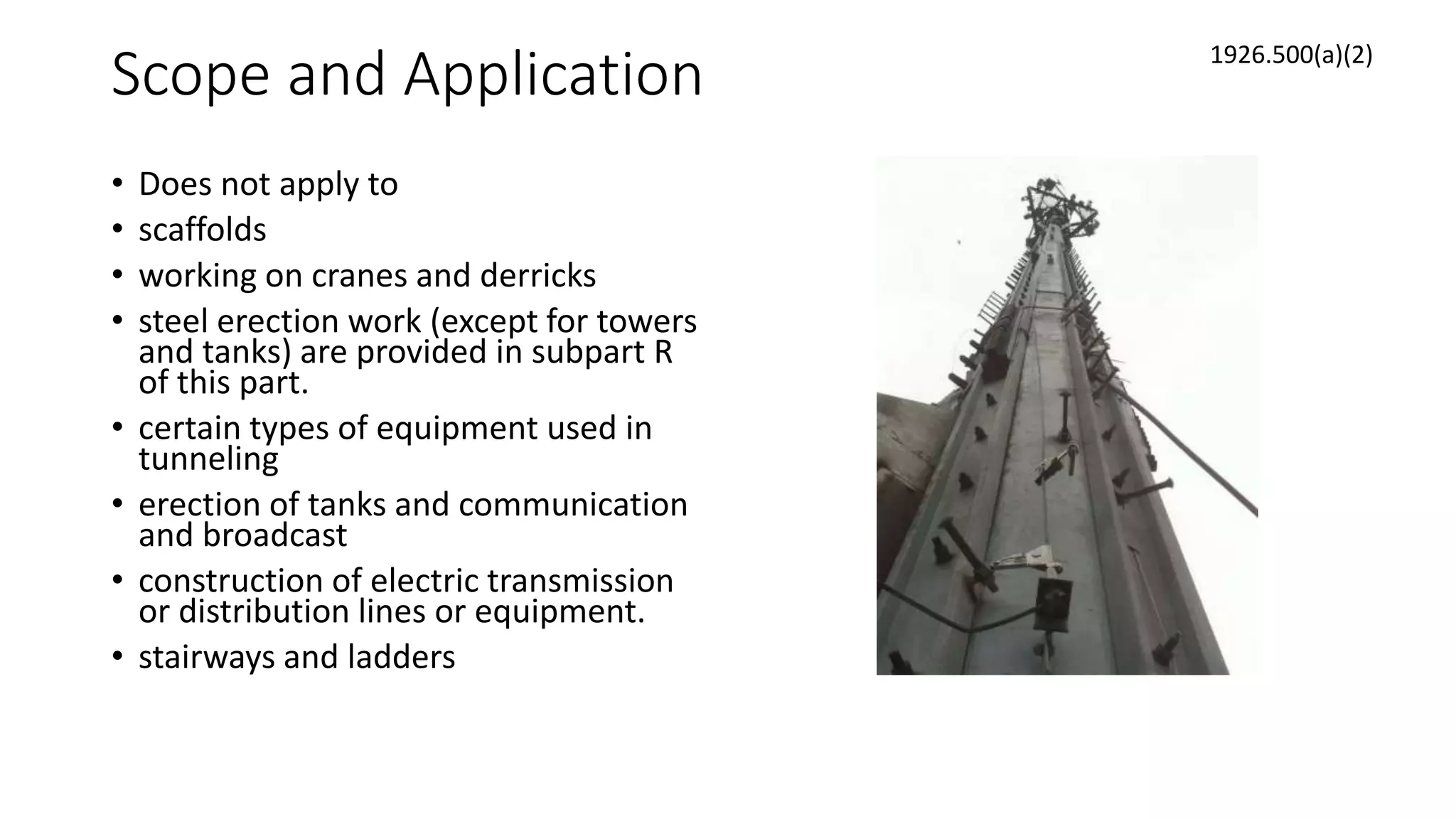
• Does not apply to
• scaffolds
• working on cranes and derricks
• steel erection work (except for towers
and tanks) are provided in subpart R
of this part.
• certain types of equipment used in
tunneling
• erection of tanks and communication
and broadcast
• construction of electric transmission
or distribution lines or equipment.
• stairways and ladders
1926.500(a)(2)
Definitions
• Anchorage
• secure point of attachment for
lifelines, lanyards or deceleration
devices
1926.500(b)
Definitions
• Body Belt
• strap with means both for
securing it about the waist
1926.500(b)
Definitions
• Body Harness
• straps which distribute the fall
arrest forces
1926.500(b)
Definitions
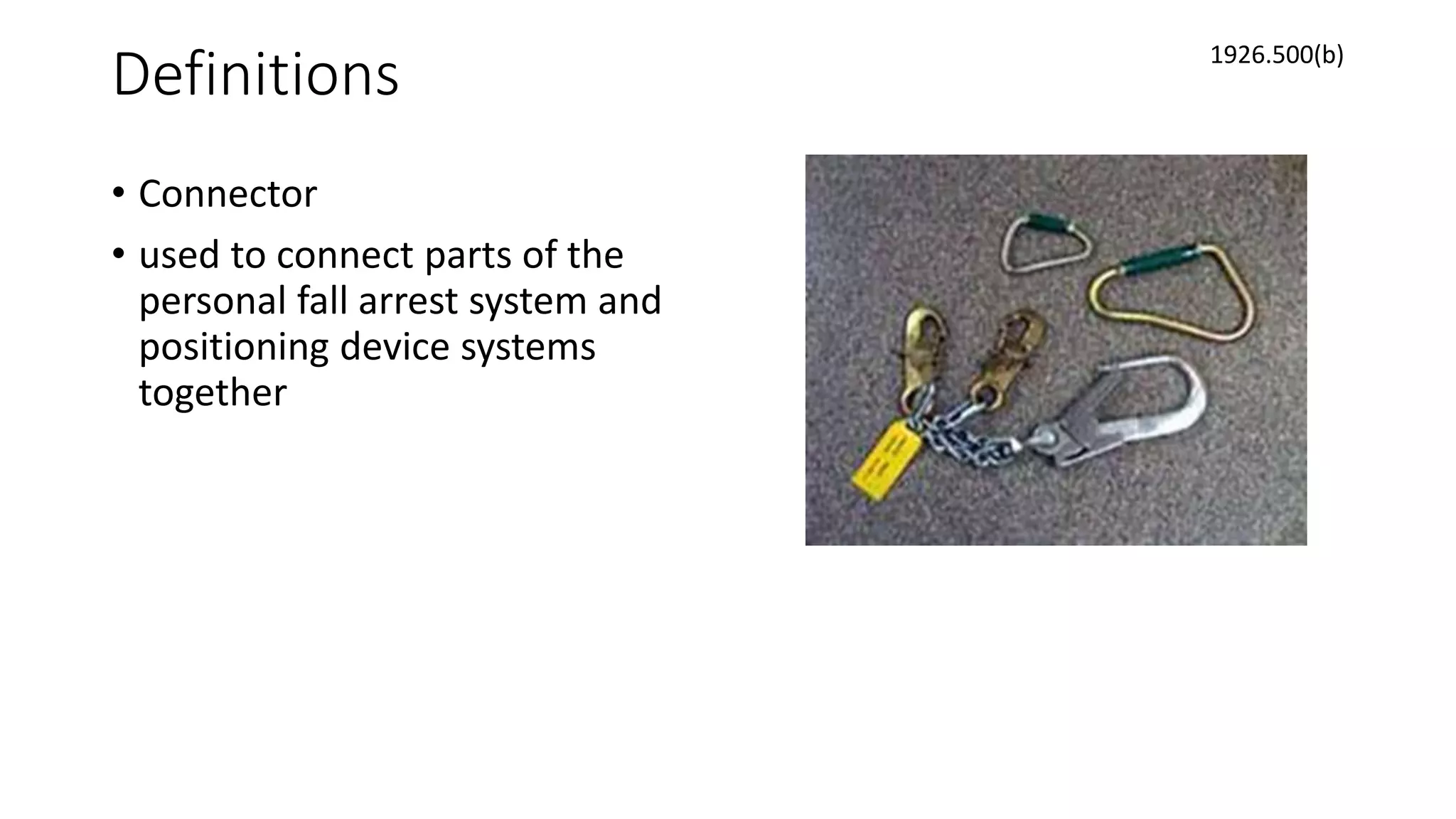
• Connector
• used to connect parts of the
personal fall arrest system and
positioning device systems
together
1926.500(b)
Definitions
• Controlled Access Zone
• area in which certain work (e.g.,
overhand bricklaying) may take
place
1926.500(b)
Definitions
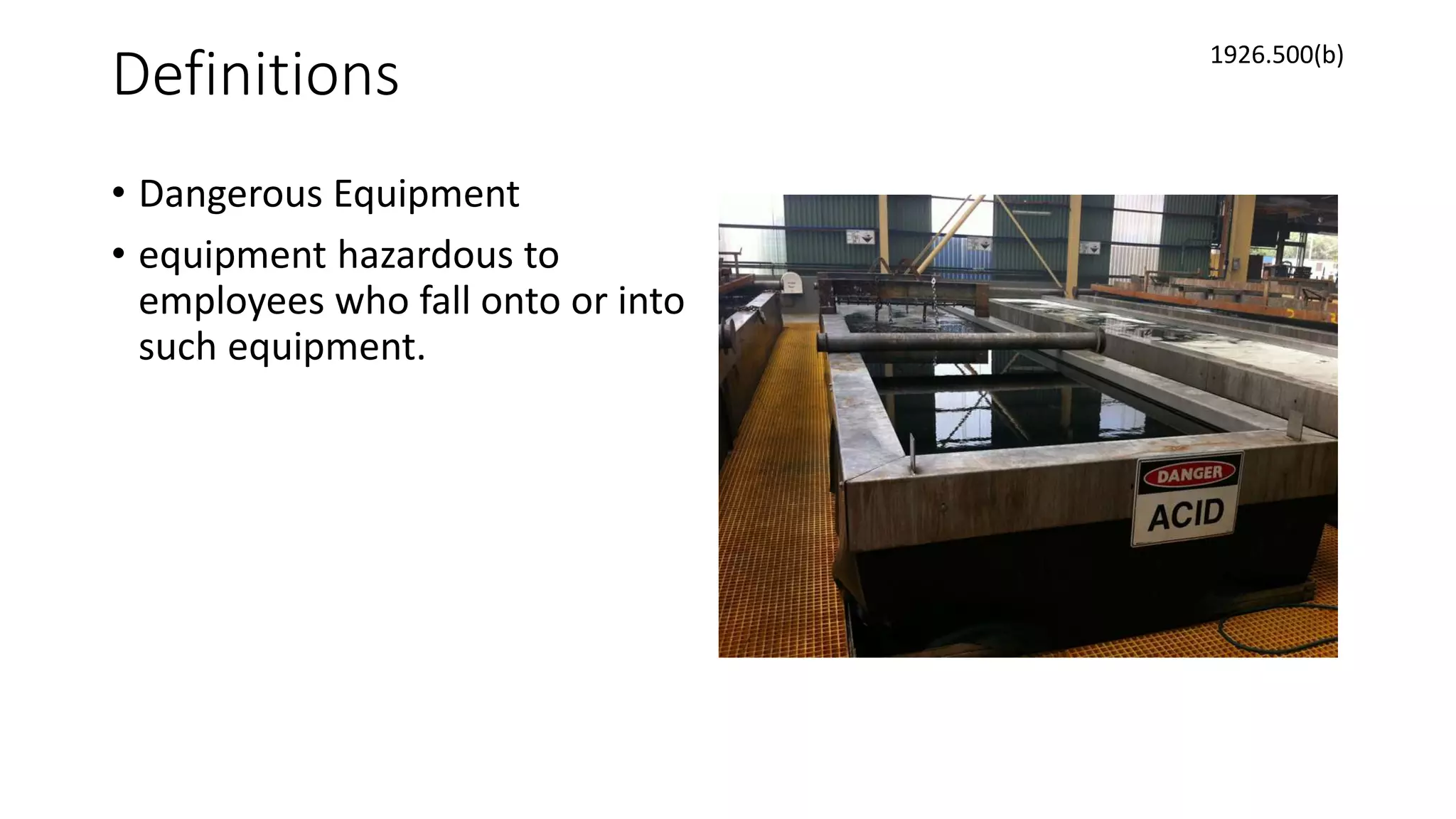
• Dangerous Equipment
• equipment hazardous to
employees who fall onto or into
such equipment.
1926.500(b)
Definitions
• Deceleration Device
• equipment that dissipates a
substantial amount of energy
during a fall arrest
1926.500(b)
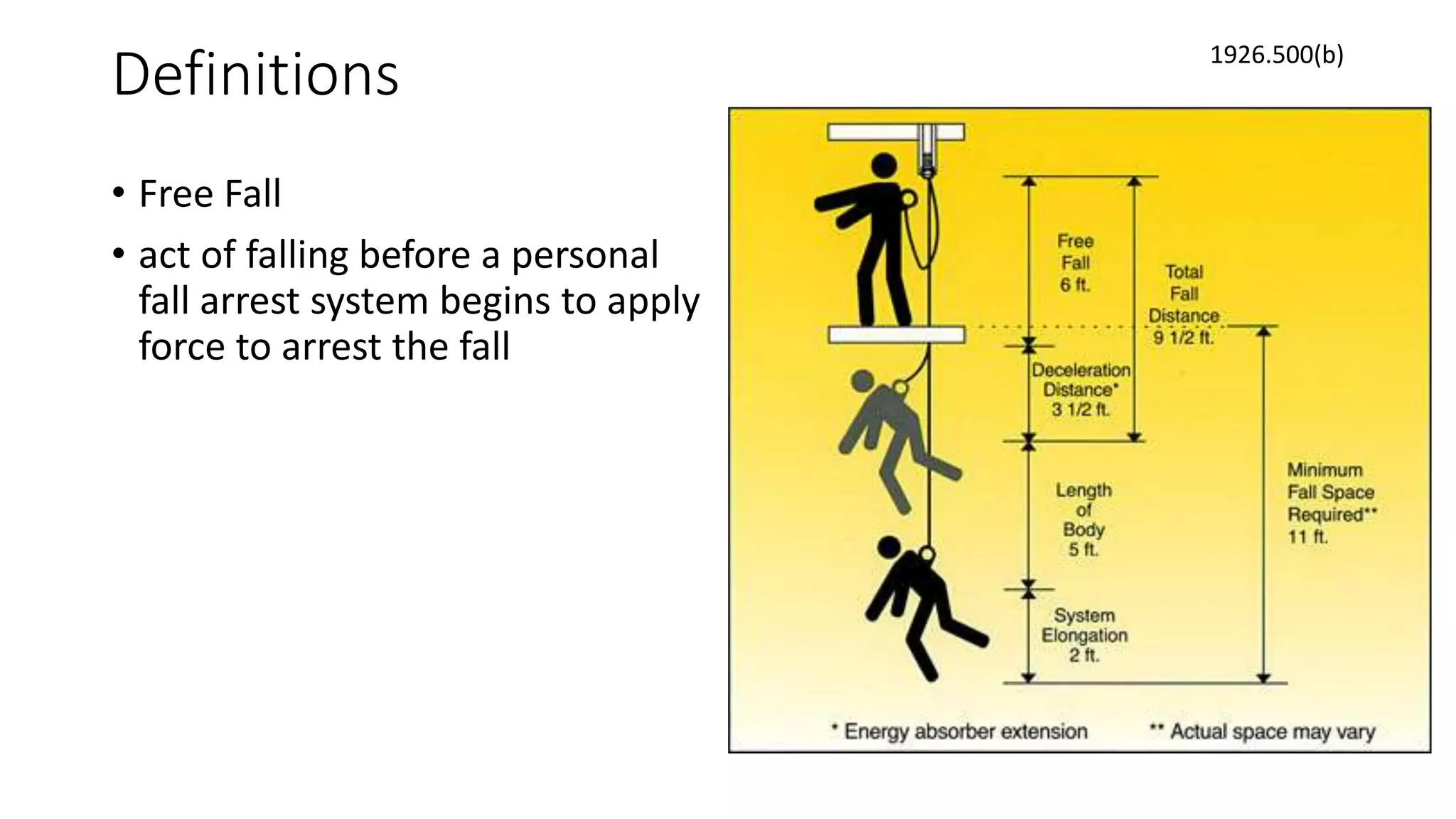
Definitions
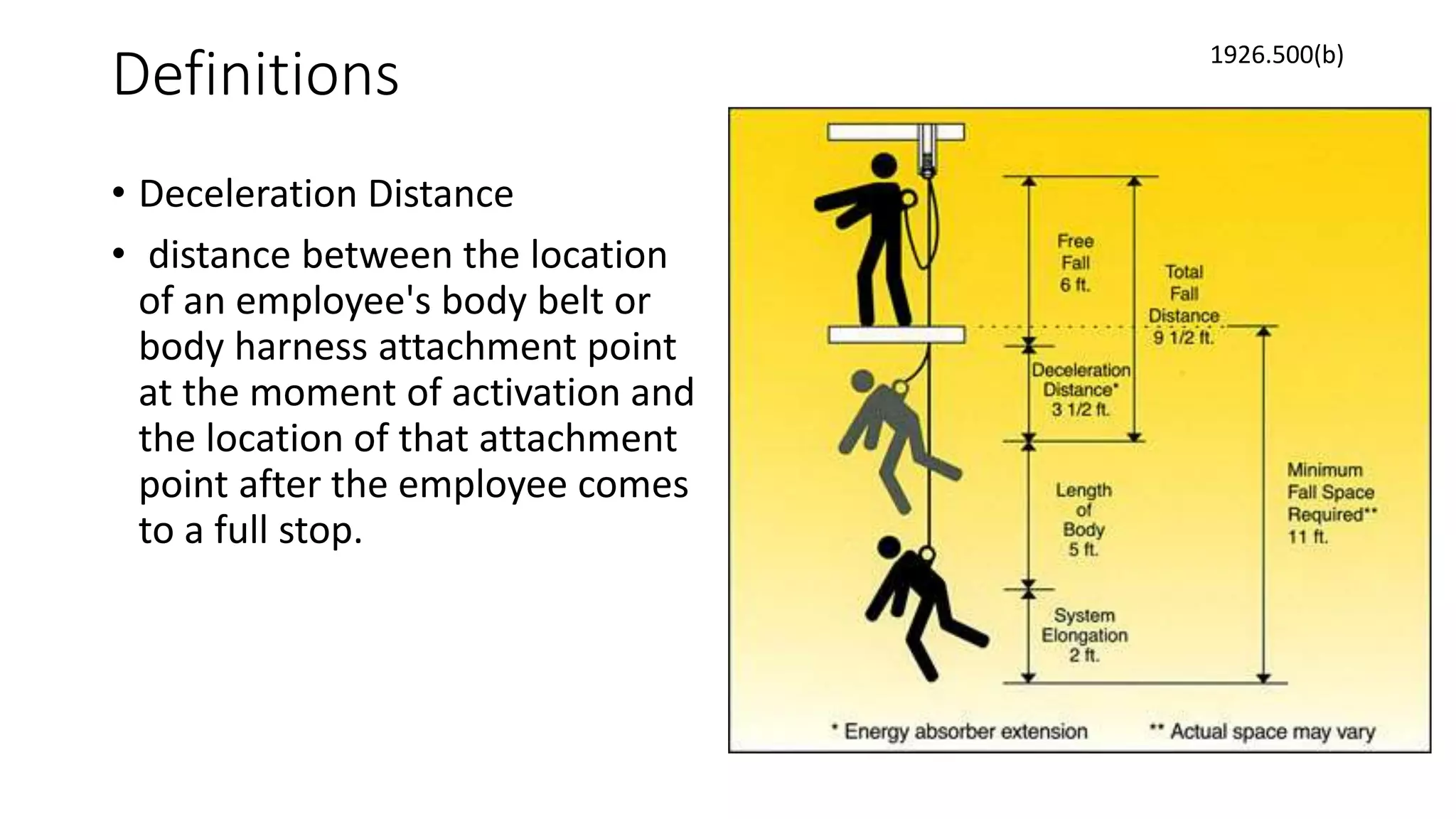
• Deceleration Distance
• distance between the location
of an employee's body belt or
body harness attachment point
at the moment of activation and
the location of that attachment
point after the employee comes
to a full stop.
1926.500(b)
Definitions
• Free Fall
• act of falling before a personal
fall arrest system begins to apply
force to arrest the fall
1926.500(b)
Definitions
• Guardrail system
• a barrier erected to prevent
employees from falling to lower
levels
1926.500(b)
Definitions
• Hole
• a gap or void 2 inches (5.1 cm)
or more in its least dimension
1926.500(b)
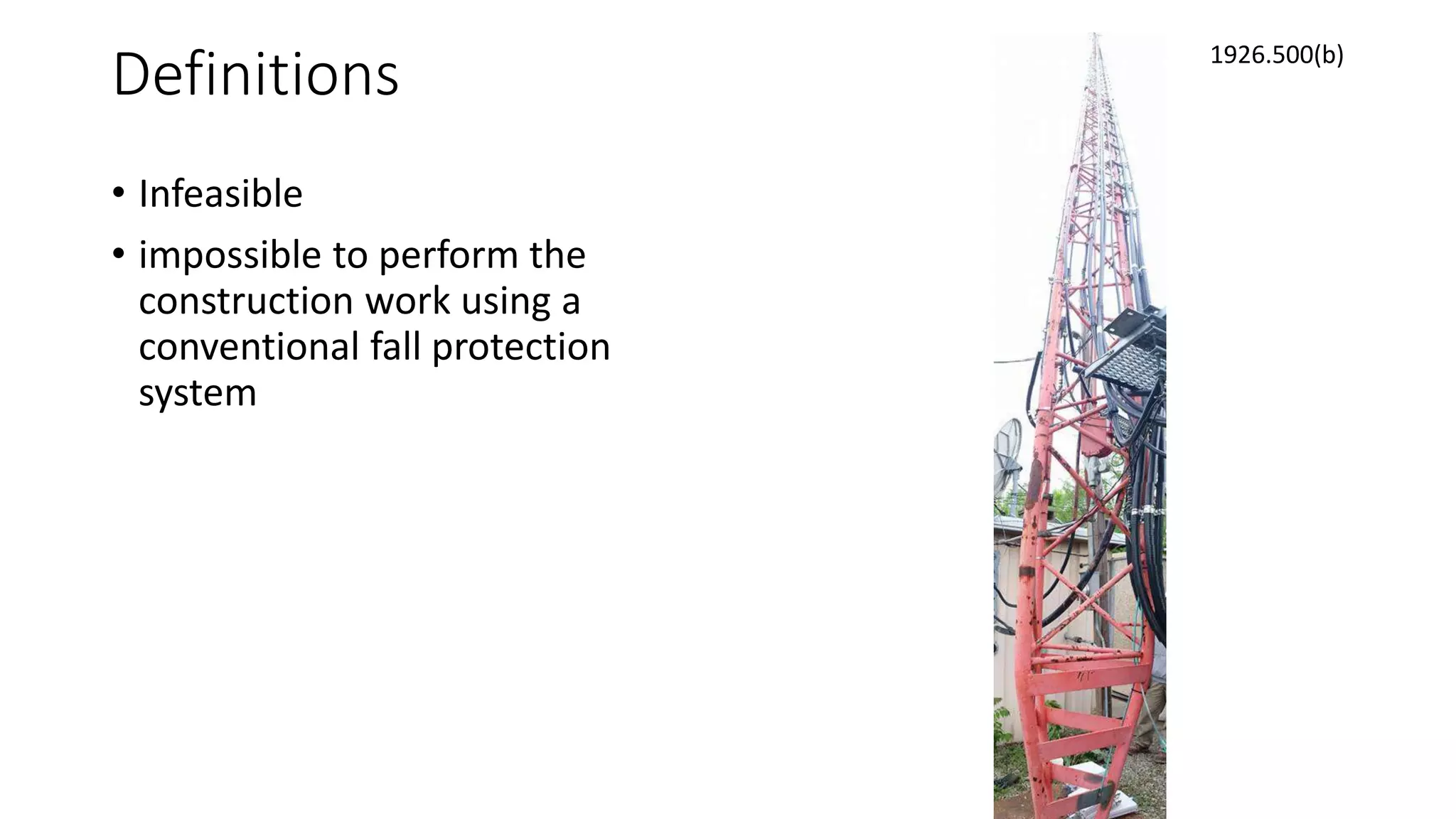
Definitions
• Infeasible
• impossible to perform the
construction work using a
conventional fall protection
system
1926.500(b)
Definitions
• Lanyard
• flexible line of rope, wire rope,
or strap which generally has a
connector at each end
1926.500(b)
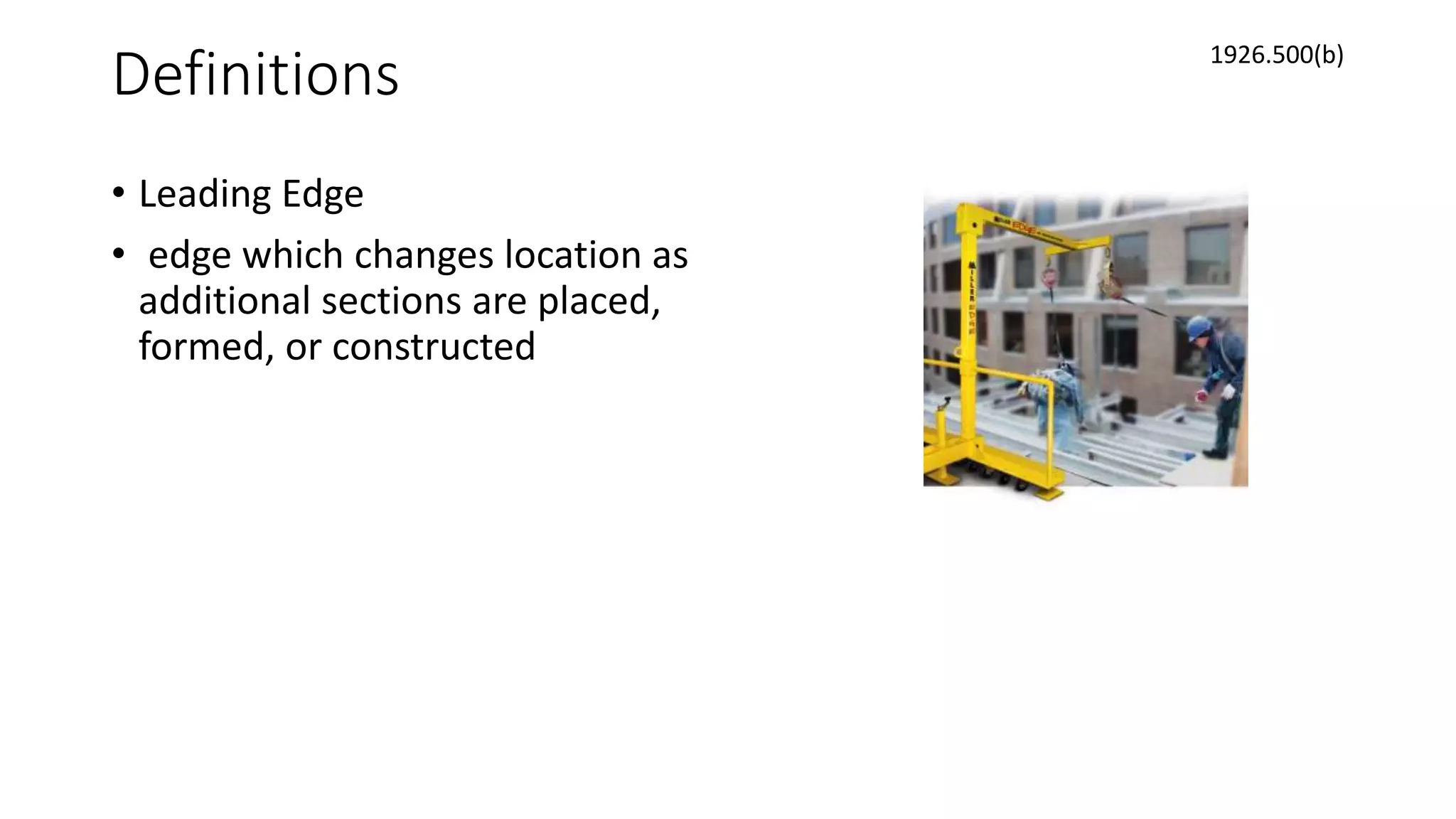
Definitions
• Leading Edge
• edge which changes location as
additional sections are placed,
formed, or constructed
1926.500(b)
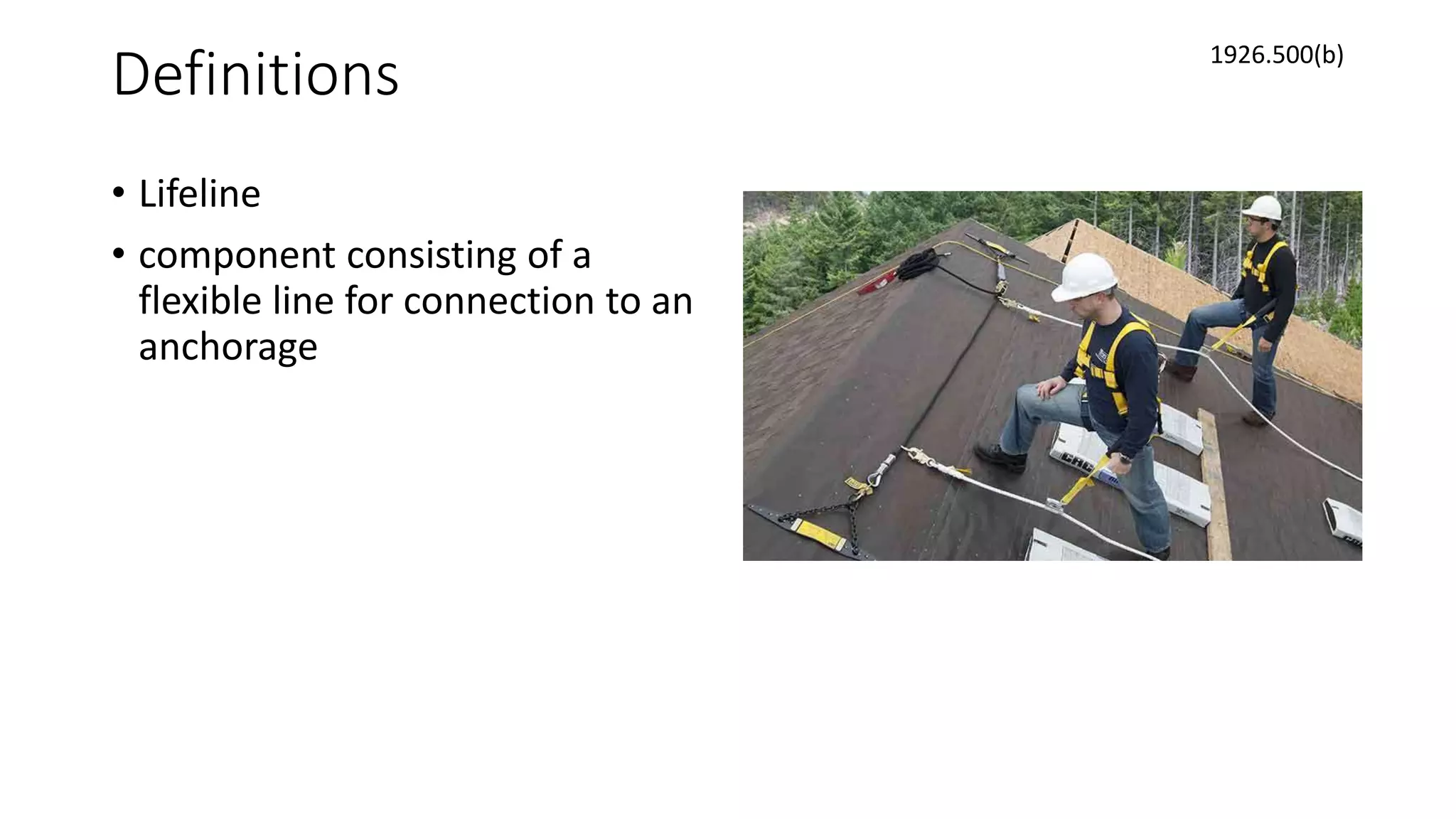
Definitions
• Lifeline
• component consisting of a
flexible line for connection to an
anchorage
1926.500(b)
Definitions
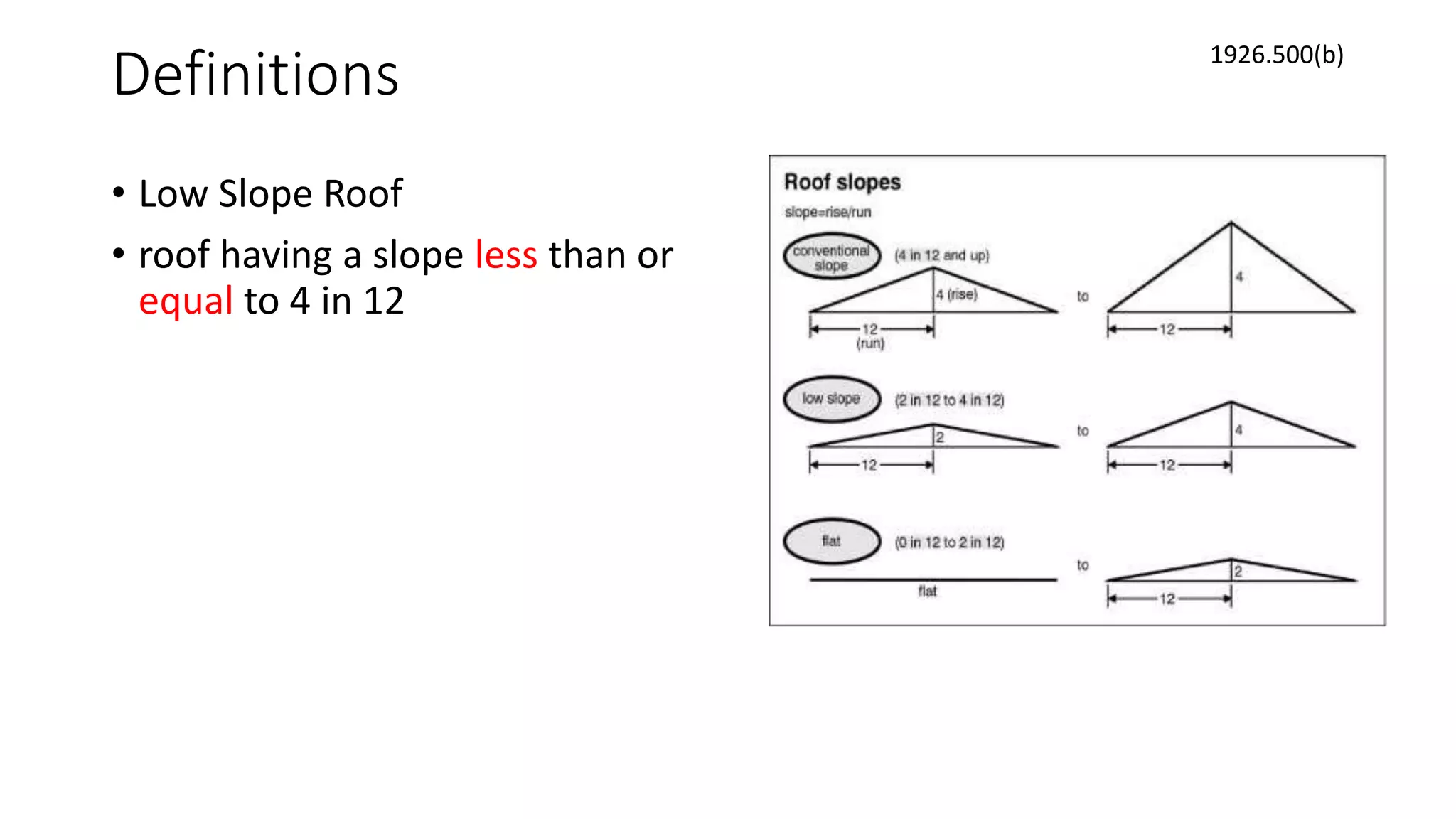
• Low Slope Roof
• roof having a slope less than or
equal to 4 in 12
1926.500(b)
Definitions
• Mechanical equipment
• motor or human propelled
wheeled equipment used for
roofing work, except
wheelbarrows and mopcarts
1926.500(b)
Definitions
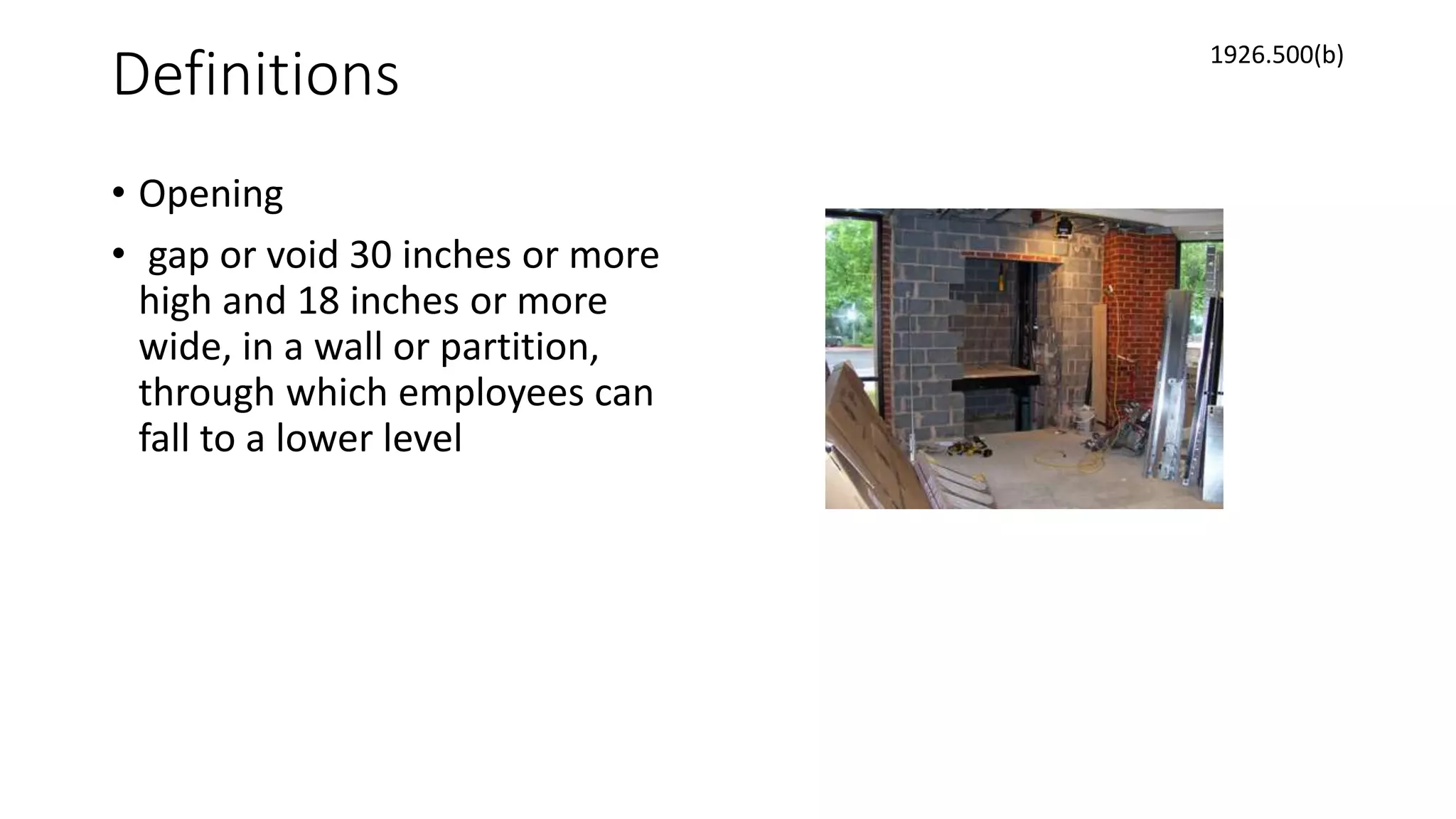
• Opening
• gap or void 30 inches or more
high and 18 inches or more
wide, in a wall or partition,
through which employees can
fall to a lower level
1926.500(b)
Definitions
• Fall Arrest System
• consists of an anchorage,
connectors, a body belt or body
harness
1926.500(b)
Definitions
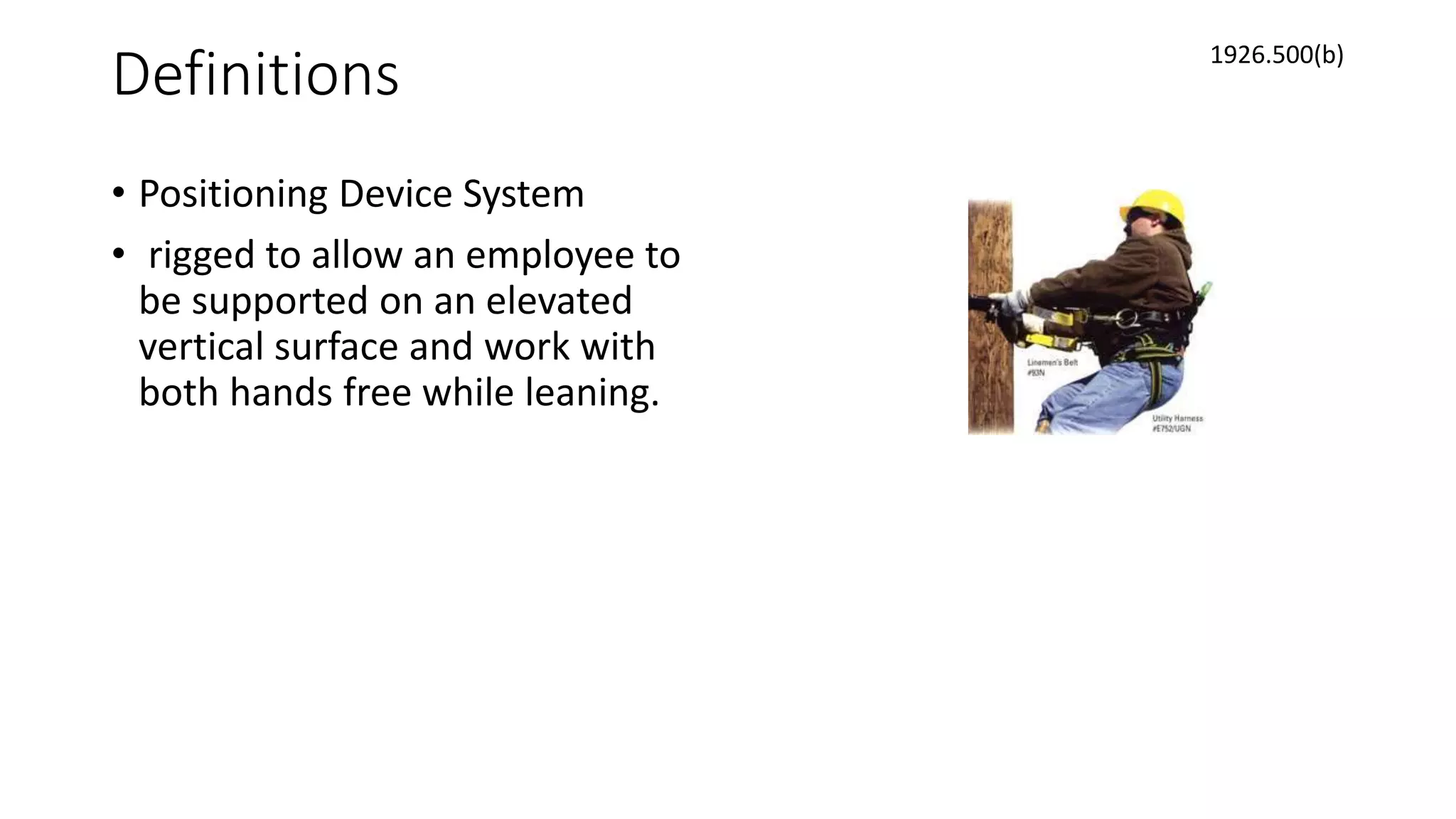
• Positioning Device System
• rigged to allow an employee to
be supported on an elevated
vertical surface and work with
both hands free while leaning.
1926.500(b)
Definitions
• Rope Grab
• deceleration device which
travels on a lifeline and
automatically, by friction,
engages the lifeline and locks so
as to arrest the fall of an
employee.
1926.500(b)
Definitions
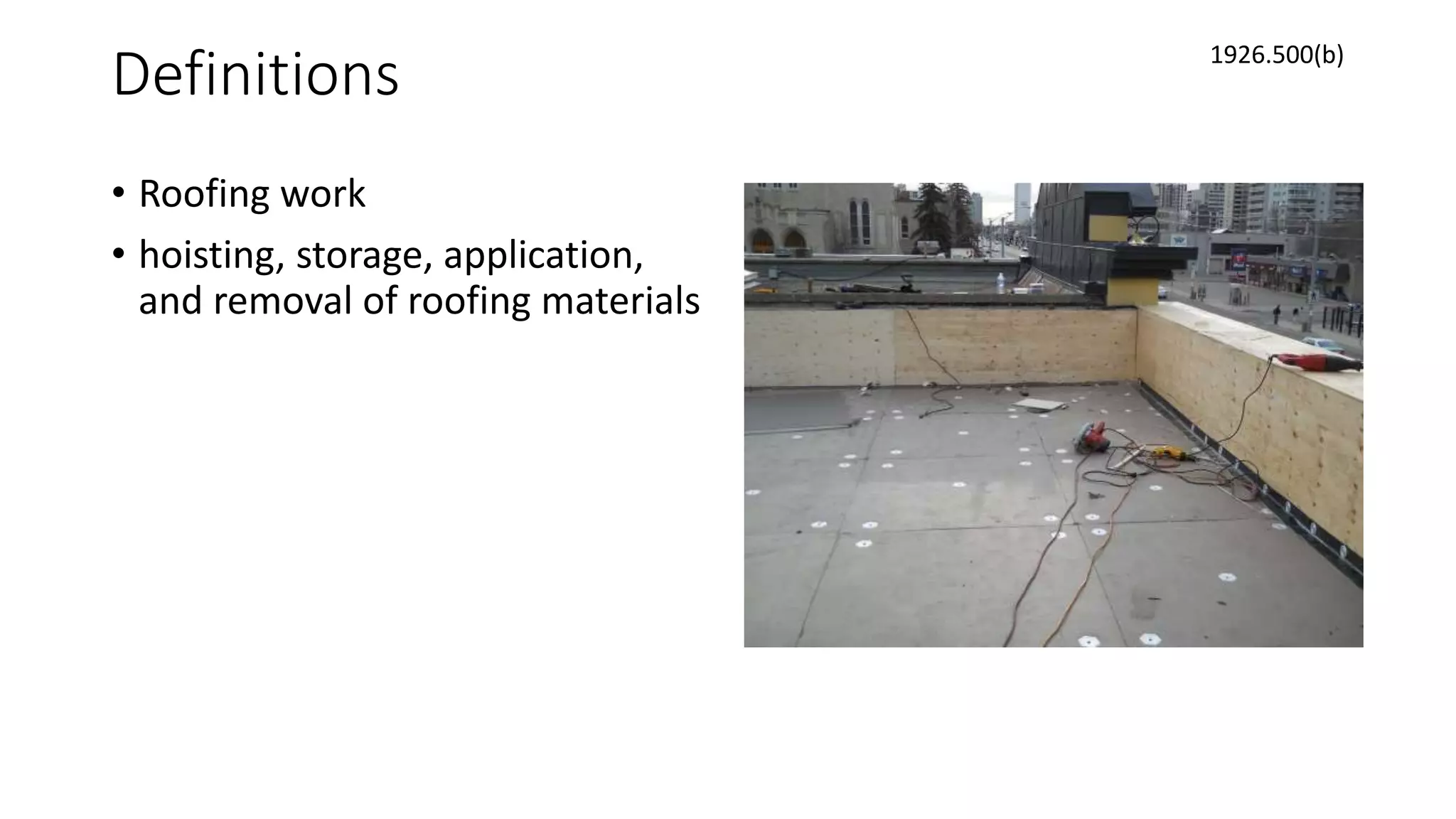
• Roofing work
• hoisting, storage, application,
and removal of roofing materials
1926.500(b)
Definitions
• Safety Monitoring System
• safety system in which a
competent person is responsible
for recognizing and warning
employees of fall hazards
1926.500(b)
Definitions
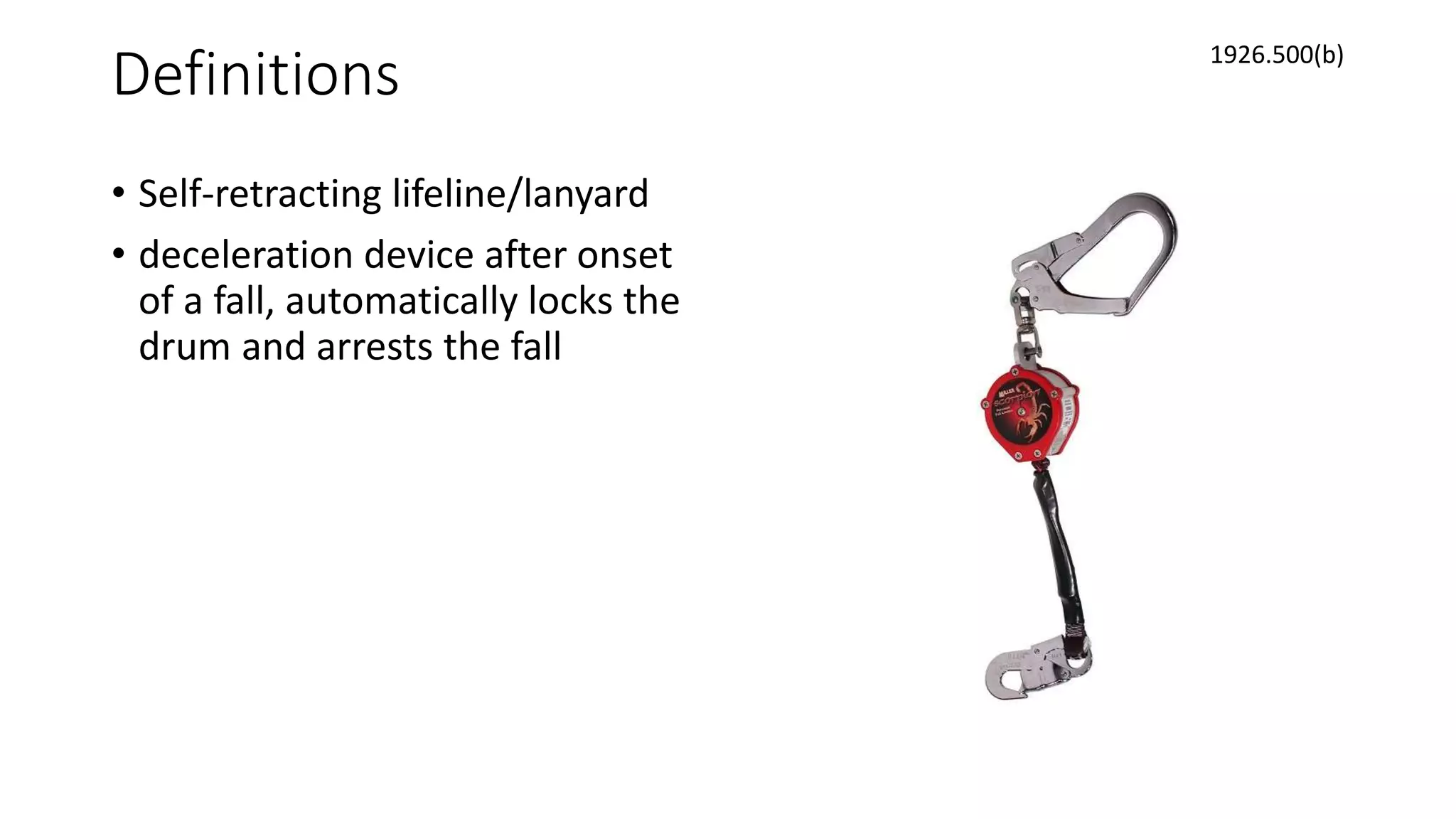
• Self-retracting lifeline/lanyard
• deceleration device after onset
of a fall, automatically locks the
drum and arrests the fall
1926.500(b)
Definitions
• Snaphook
• connector comprised of a hook-
shaped member with a normally
closed keeper
• Takes two actions to open
1926.500(b)
Definitions
• Steep Roof
• roof having a slope greater than
4 in 12
1926.500(b)
Definitions
• Toeboard
• low protective barrier that will
prevent the fall of materials and
equipment to lower levels and
provide protection from falls for
personnel
1926.500(b)
Definitions
• Unprotected side or edge
• means any side where there is
no wall or guardrail system at
least 39 inches high.
1926.500(b)
Definitions
• Walking Working surface
• surface, horizontal or vertical on
which an employee walks or
works
• not include ladders, vehicles, or
trailers
1926.500(b)
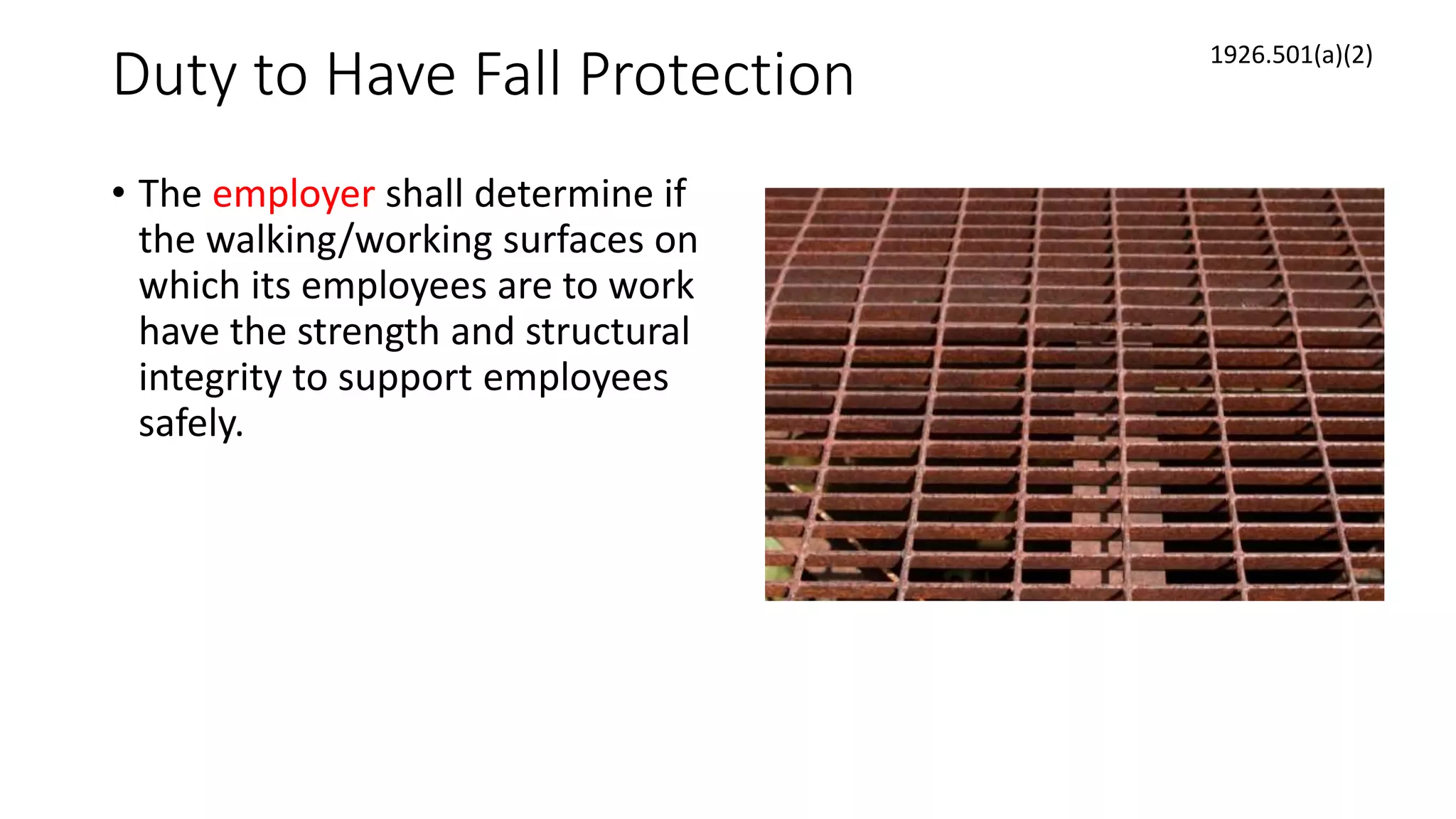
Duty to Have Fall Protection
• The employer shall determine if
the walking/working surfaces on
which its employees are to work
have the strength and structural
integrity to support employees
safely.
1926.501(a)(2)
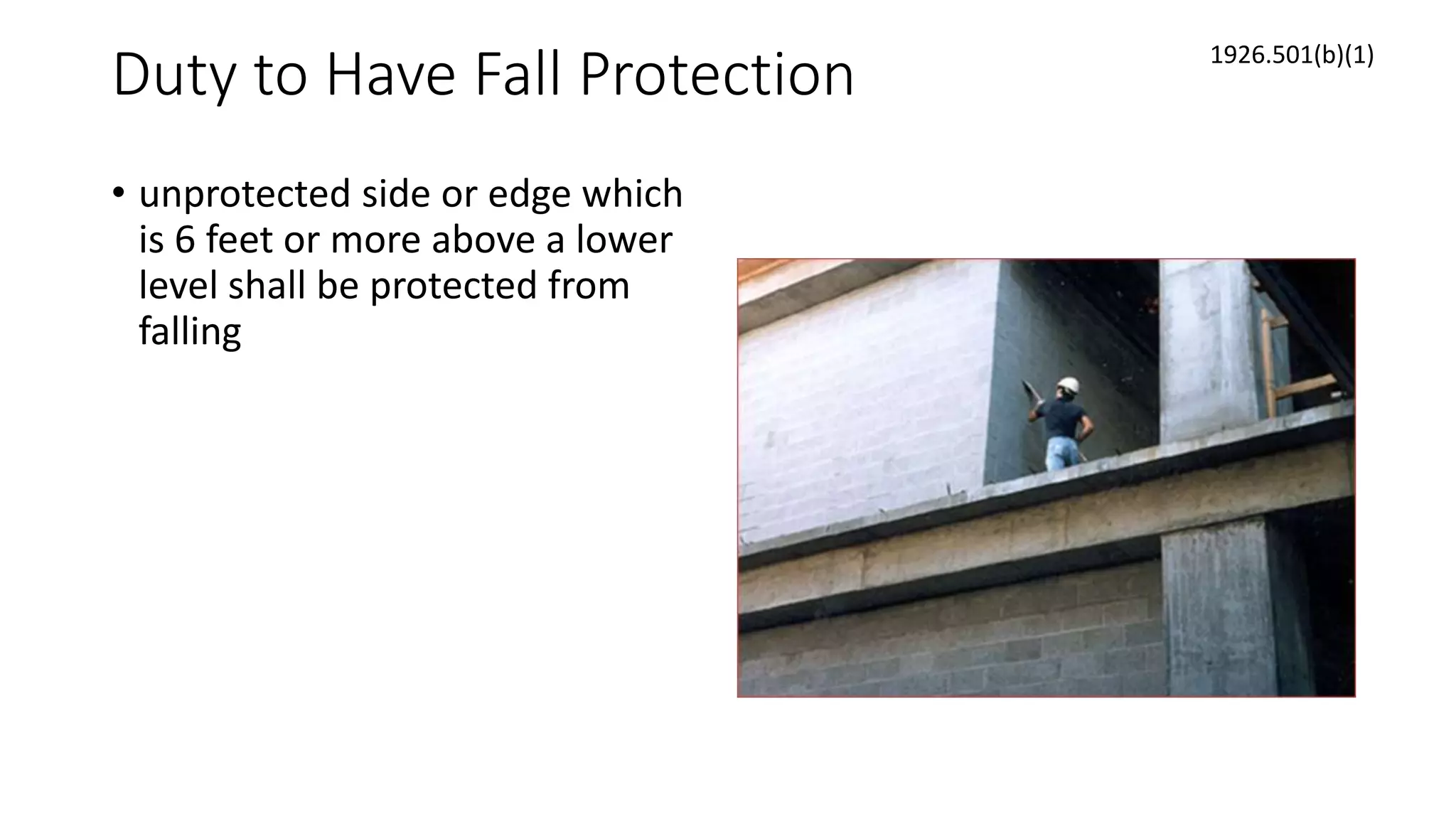
Duty to Have Fall Protection
• unprotected side or edge which
is 6 feet or more above a lower
level shall be protected from
falling
1926.501(b)(1)
Duty to Have Fall Protection
• leading edge 6 feet or more
above lower levels shall be
protected
1926.501(b)(2)(i)
Duty to Have Fall Protection
• employee in a hoist area shall be
protected from falling 6 feet or
more to lower levels
1926.501(b)(3)
Duty to Have Fall Protection
• protected from falling through
holes (including skylights) more
than 6 feet above lower levels
1926.501(b)(4)(i)
Duty to Have Fall Protection
• protected from tripping in or
stepping into or through holes
(including skylights) by covers
1926.501(b)(4)(ii)
Duty to Have Fall Protection
• protected from objects falling
through holes
1926.501(b)(4)(iii)
Duty to Have Fall Protection
• employee on the face of
formwork or reinforcing steel
shall be protected from falling 6
feet or more to lower levels
1926.501(b)(5)
Duty to Have Fall Protection
• employee on ramps, runways,
and other walkways shall be
protected from falling 6 feet or
more to lower levels
1926.501(b)(6)
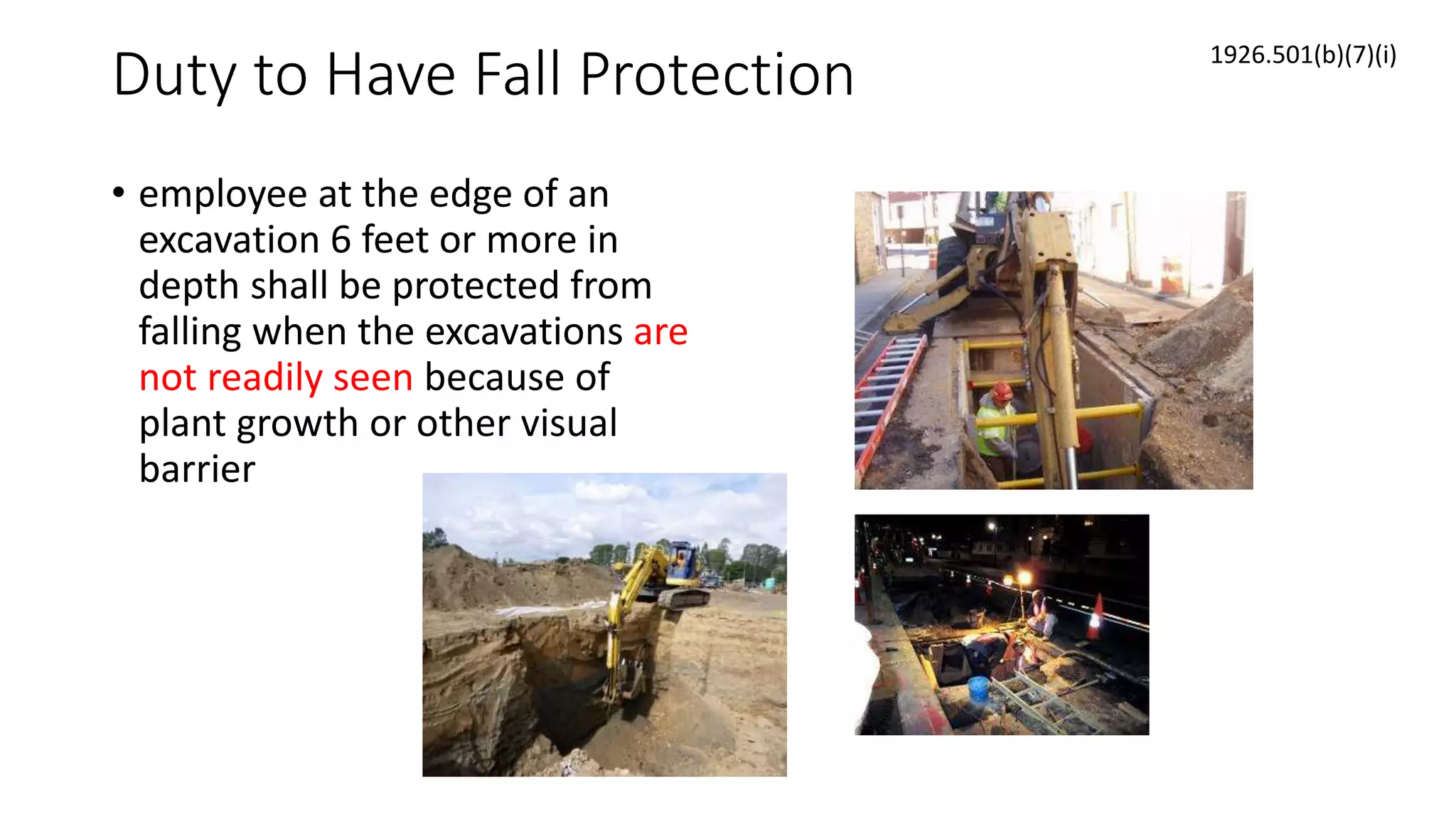
Duty to Have Fall Protection
• employee at the edge of an
excavation 6 feet or more in
depth shall be protected from
falling when the excavations are
not readily seen because of
plant growth or other visual
barrier
1926.501(b)(7)(i)
Duty to Have Fall Protection
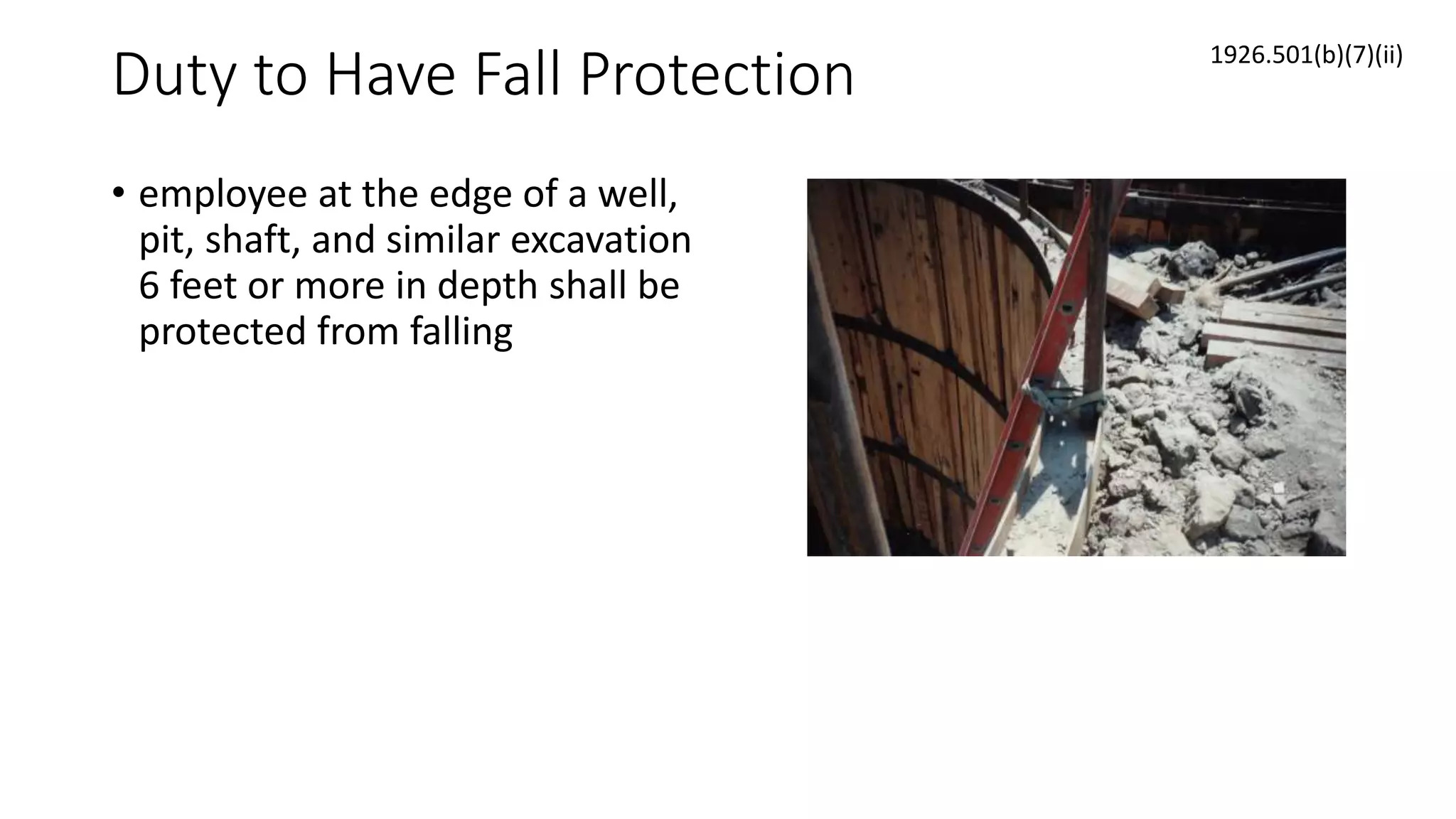
• employee at the edge of a well,
pit, shaft, and similar excavation
6 feet or more in depth shall be
protected from falling
1926.501(b)(7)(ii)
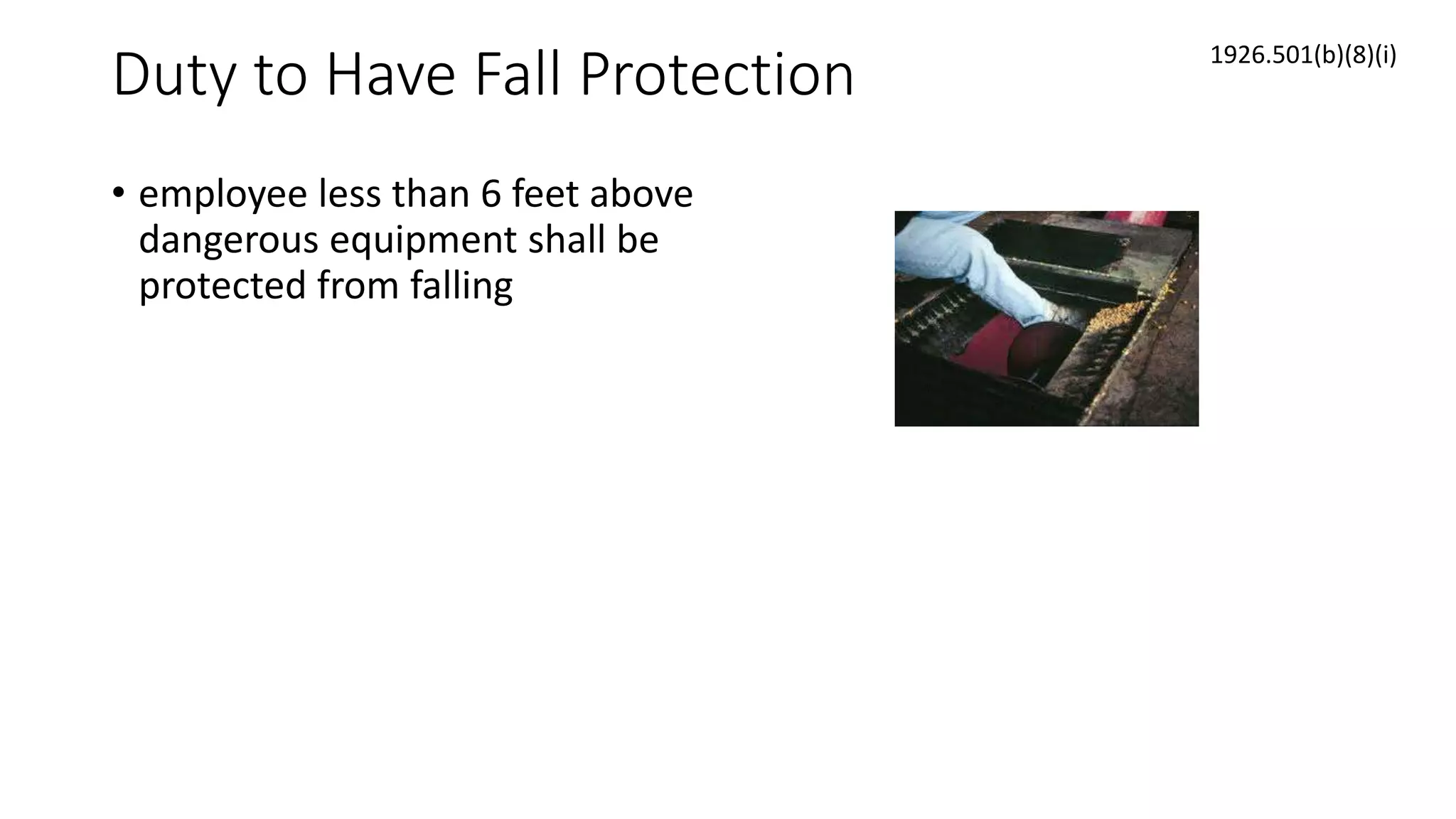
Duty to Have Fall Protection
• employee less than 6 feet above
dangerous equipment shall be
protected from falling
1926.501(b)(8)(i)
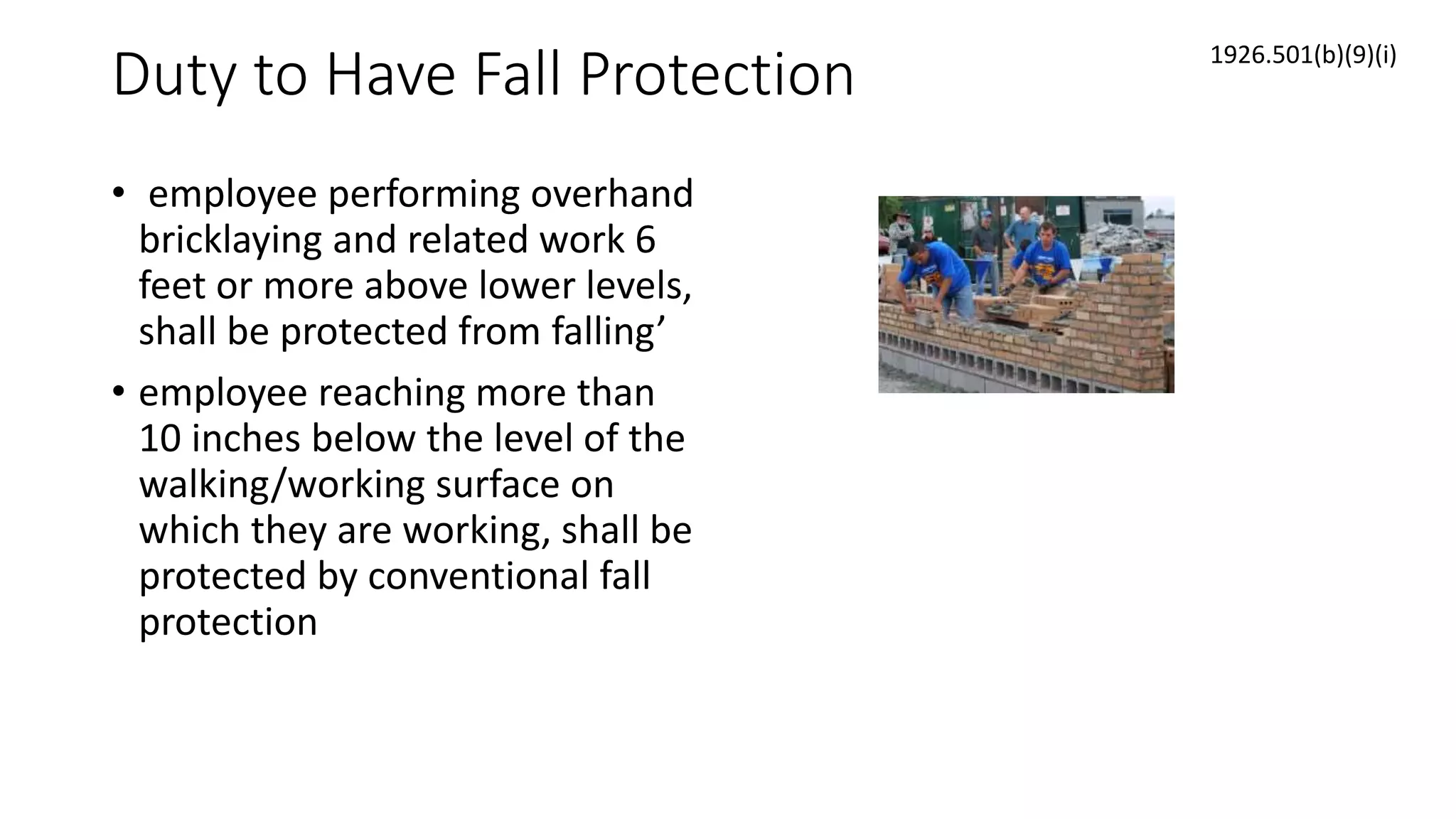
Duty to Have Fall Protection
• employee performing overhand
bricklaying and related work 6
feet or more above lower levels,
shall be protected from falling’
• employee reaching more than
10 inches below the level of the
walking/working surface on
which they are working, shall be
protected by conventional fall
protection
1926.501(b)(9)(i)
Duty to Have Fall Protection
• employee engaged in roofing activities on low-slope
roofs, with unprotected sides and edges 6 feet or
more above lower levels shall be protected from
falling
• Warning line system allowed
1926.501(b)(10)
Duty to Have Fall Protection
• Each employee on a steep roof
with unprotected sides and
edges 6 feet or more above
lower levels shall be protected
from falling
1926.501(b)(11)
Duty to Have Fall Protection
• employee engaged in the
erection of precast concrete
members who is 6 feet or more
above lower levels shall be
protected from falling
1926.501(b)(12)
Duty to Have Fall Protection
• employee engaged in residential
construction activities 6 feet or
more above lower levels shall be
protected
1926.501(b)(13)
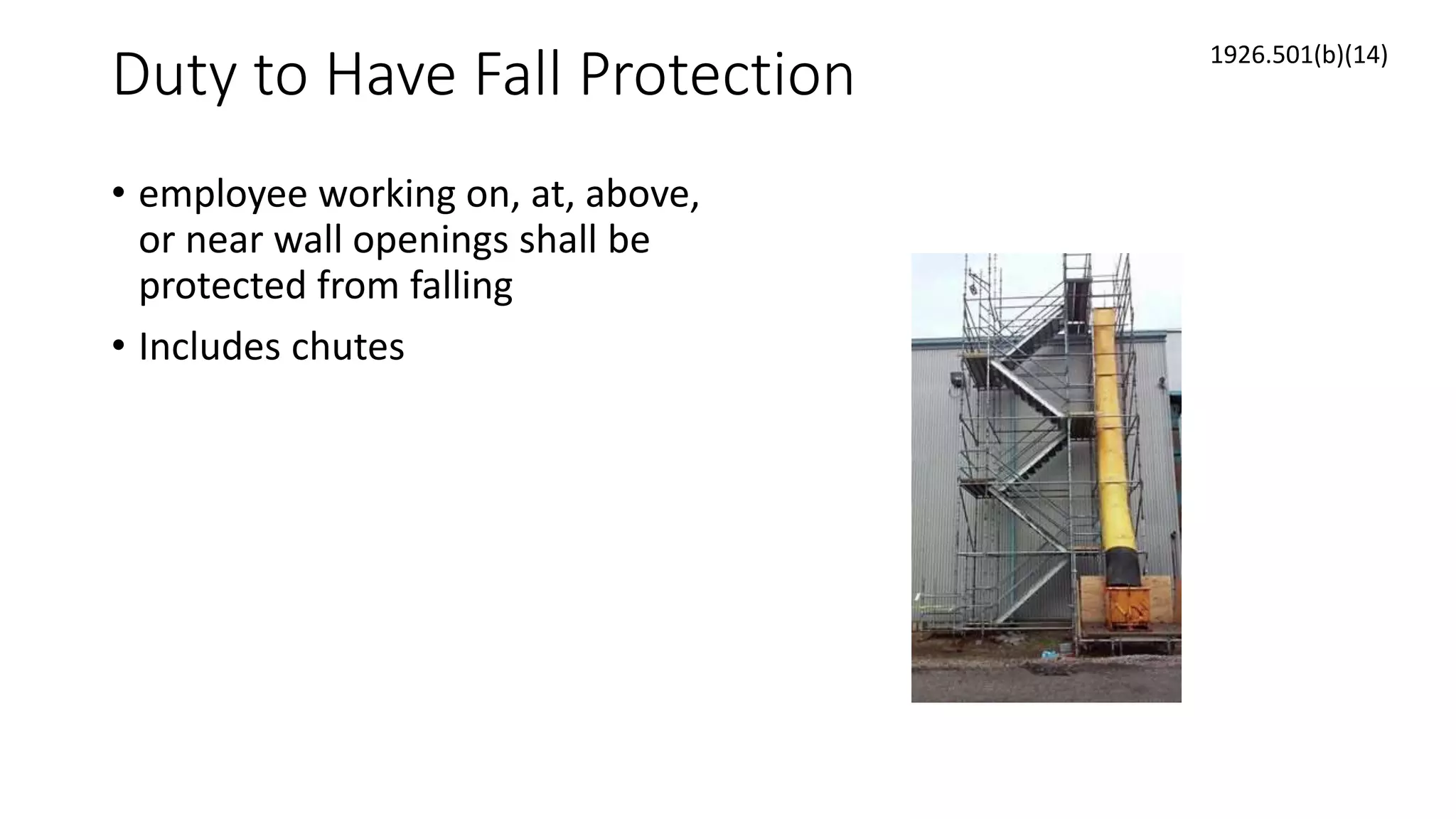
Duty to Have Fall Protection
• employee working on, at, above,
or near wall openings shall be
protected from falling
• Includes chutes
1926.501(b)(14)
Duty to Have Fall Protection
• Walking/working surfaces not
otherwise addressed
1926.501(b)(15)
Guardrail Systems
• Top Rail 42 inches +/- 3 inches
1926.502(b)(1)
Guardrail Systems
• Midrails installed between top
edge of guardrail and walking
working surface
1926.502(b)(2)(i)
Guardrail Systems
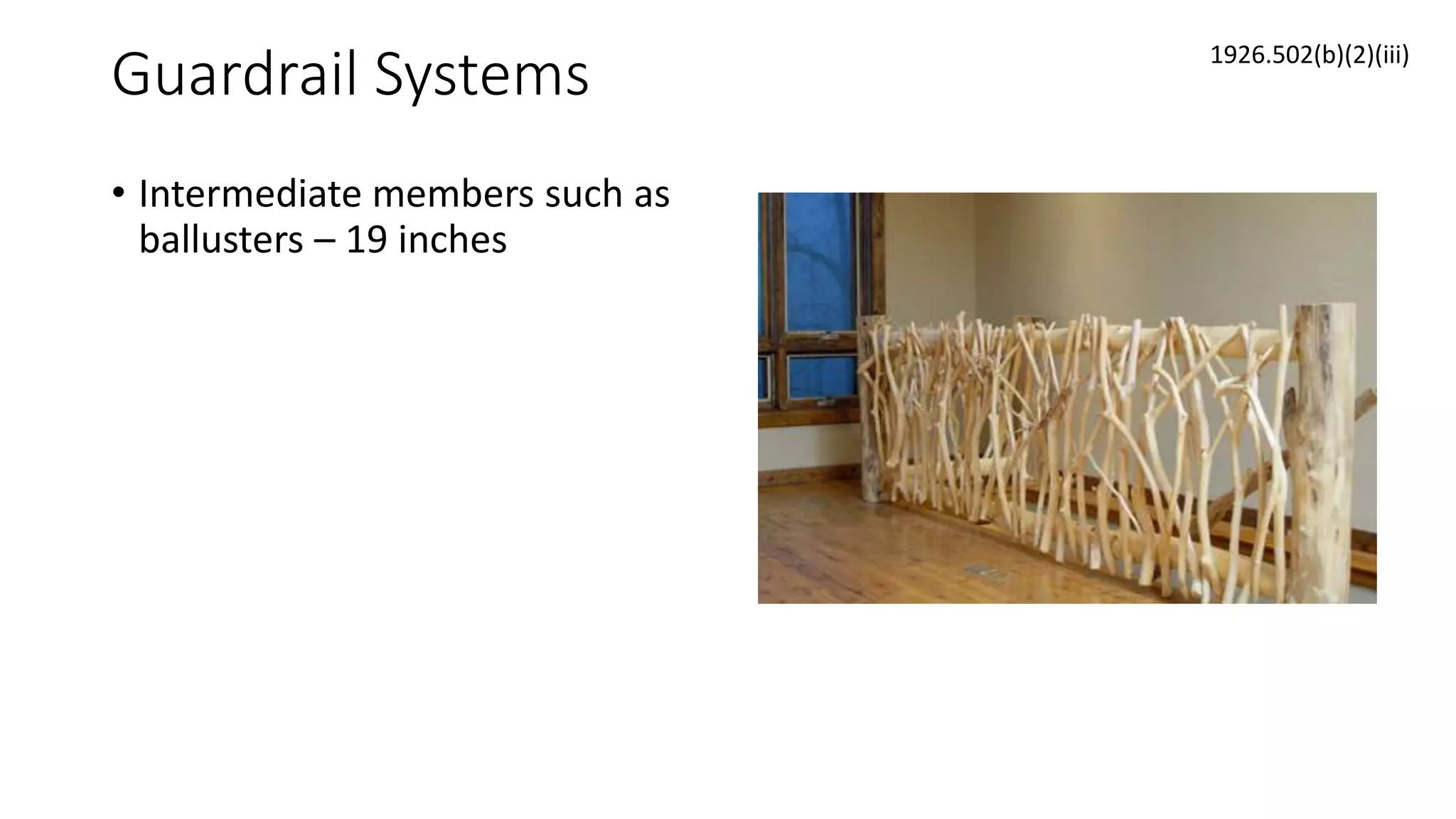
• Intermediate members such as
ballusters – 19 inches
1926.502(b)(2)(iii)
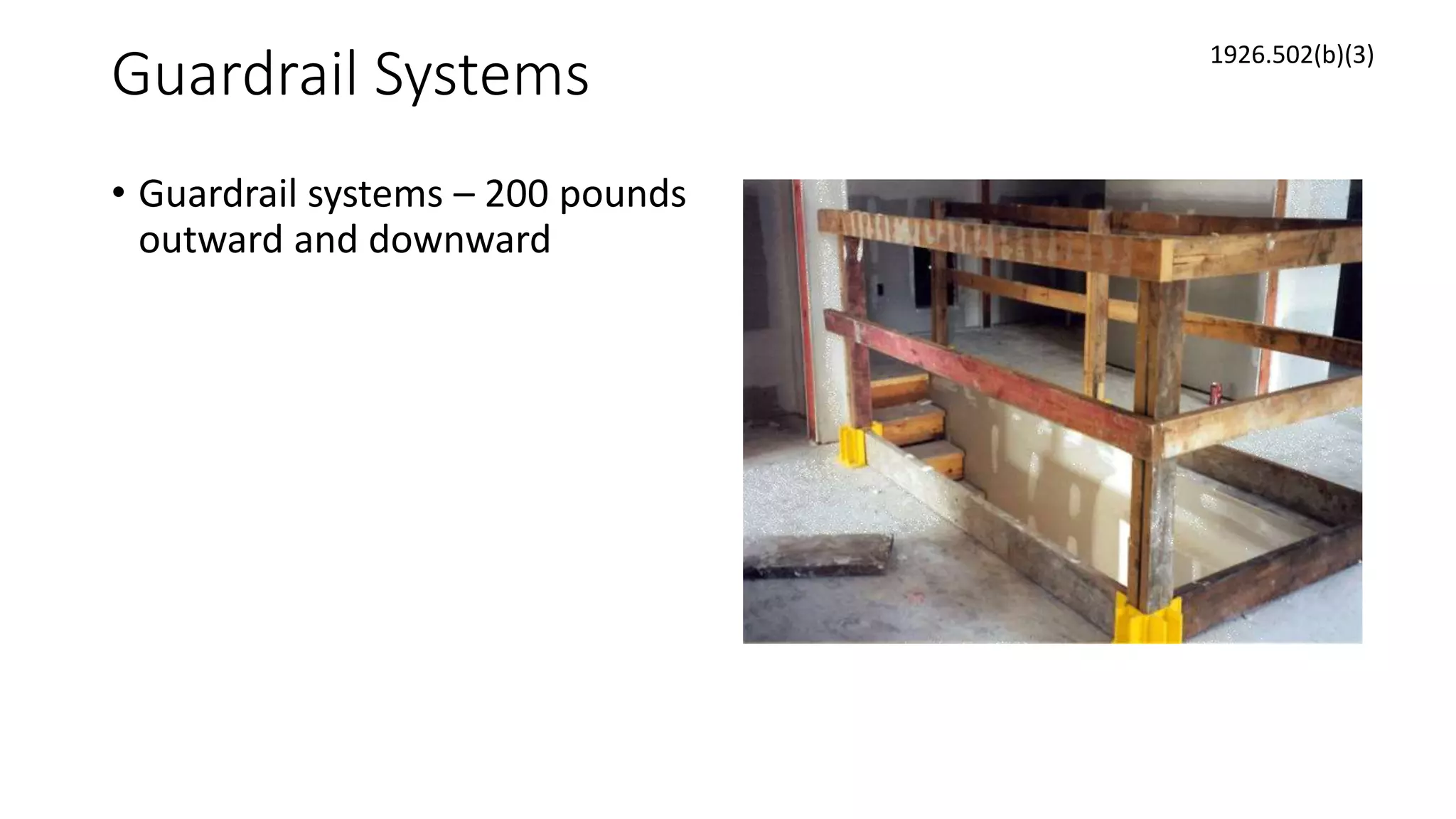
Guardrail Systems
• Guardrail systems – 200 pounds
outward and downward
1926.502(b)(3)
Guardrail Systems
• Midrails – 150 pounds outward
and downward
1926.502(b)(5)
Failure of a midrail
Guardrail Systems
• So surfaced to prevent injury to
an employee from puncture or
laceration
1926.502(b)(6)
Guardrail Systems
• The ends of top rails and midrails
shall not over hang the terminus
posts
1926.502(b)(7)
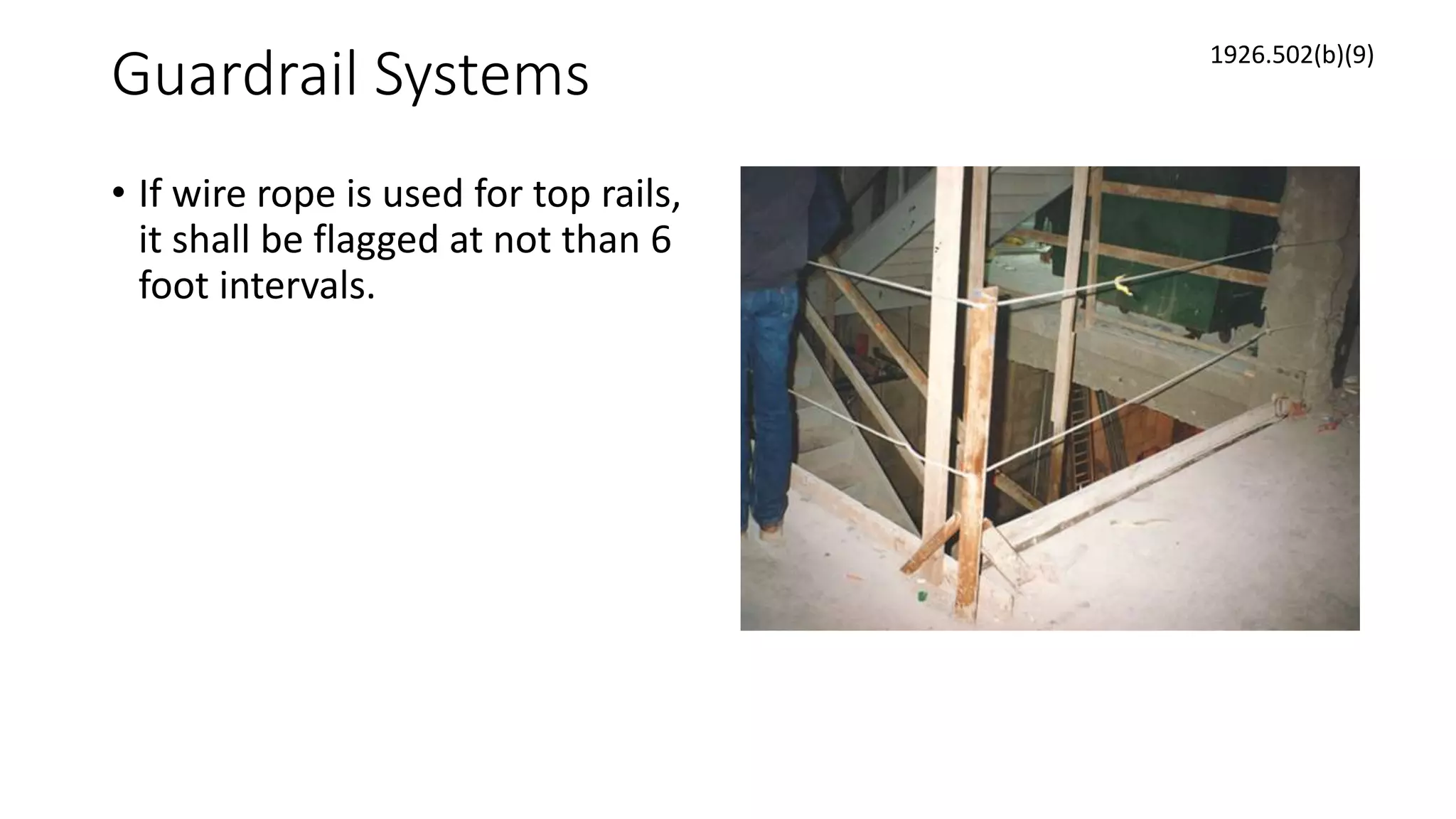
Guardrail Systems
• If wire rope is used for top rails,
it shall be flagged at not than 6
foot intervals.
1926.502(b)(9)
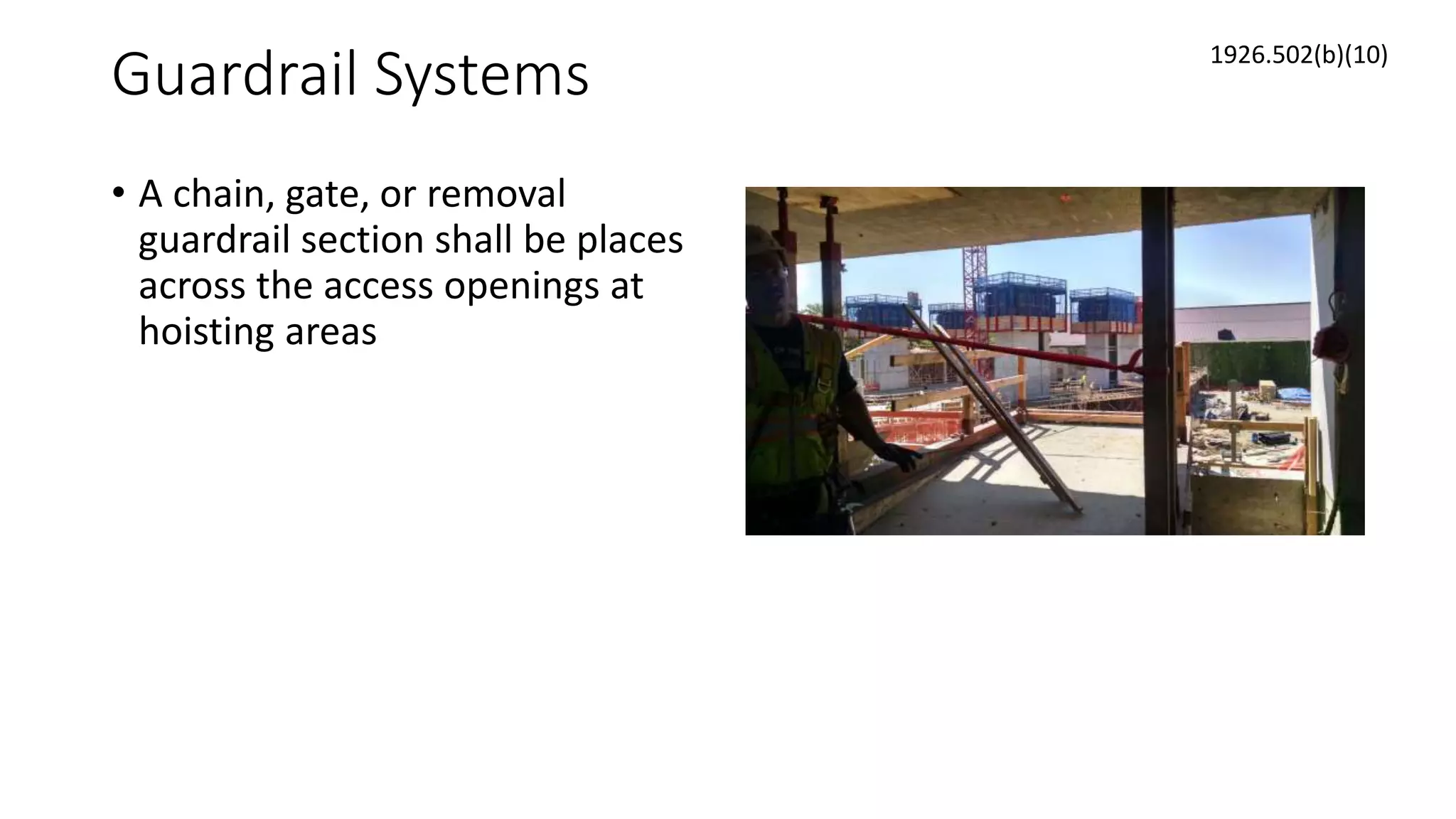
Guardrail Systems
• A chain, gate, or removal
guardrail section shall be places
across the access openings at
hoisting areas
1926.502(b)(10)
Guardrail Systems
• Ladderways or points of access
shall be provided with a gate or
offset
1926.502(b)(13)
No gate or offset
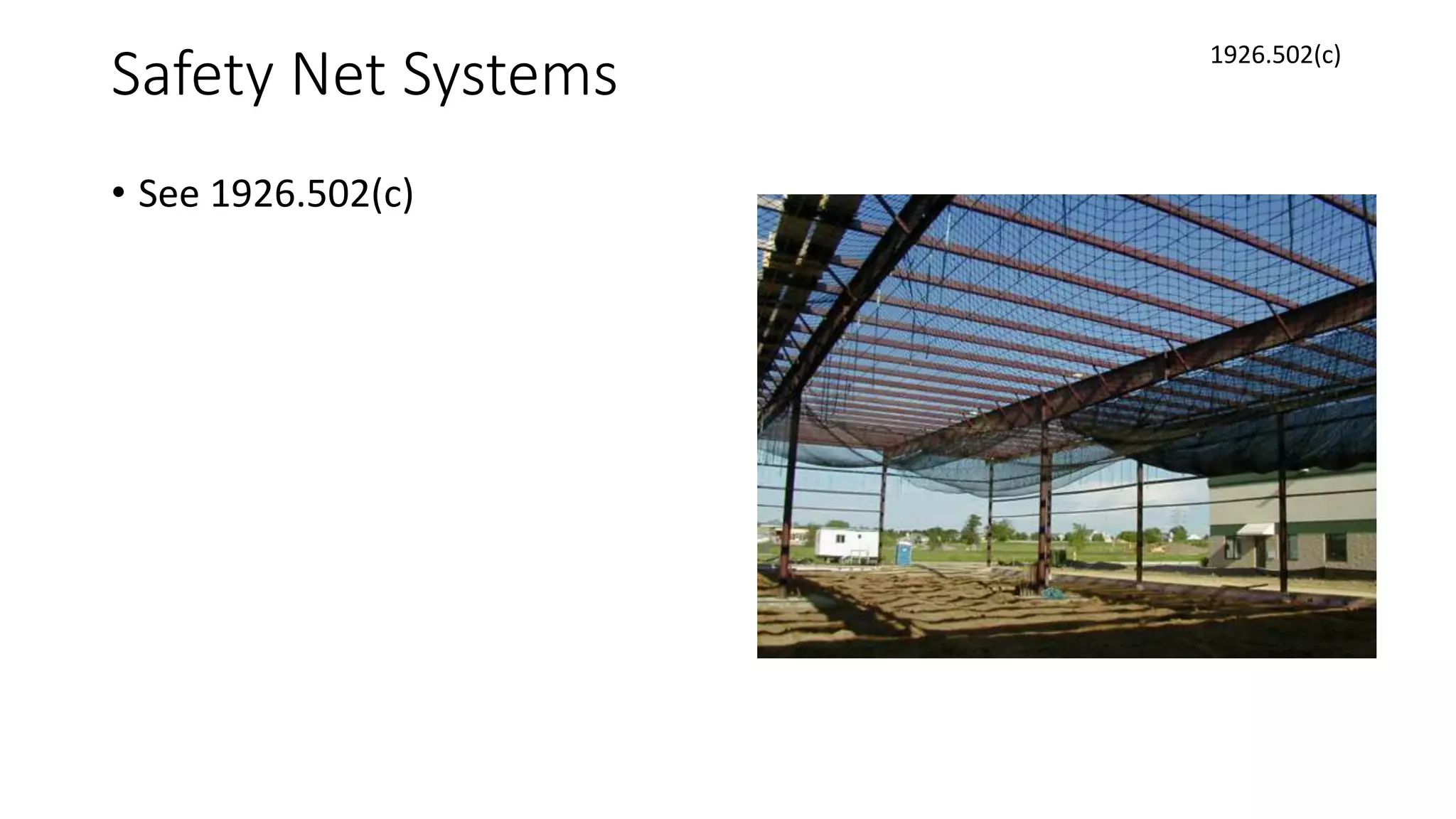
Safety Net Systems
• See 1926.502(c)
1926.502(c)
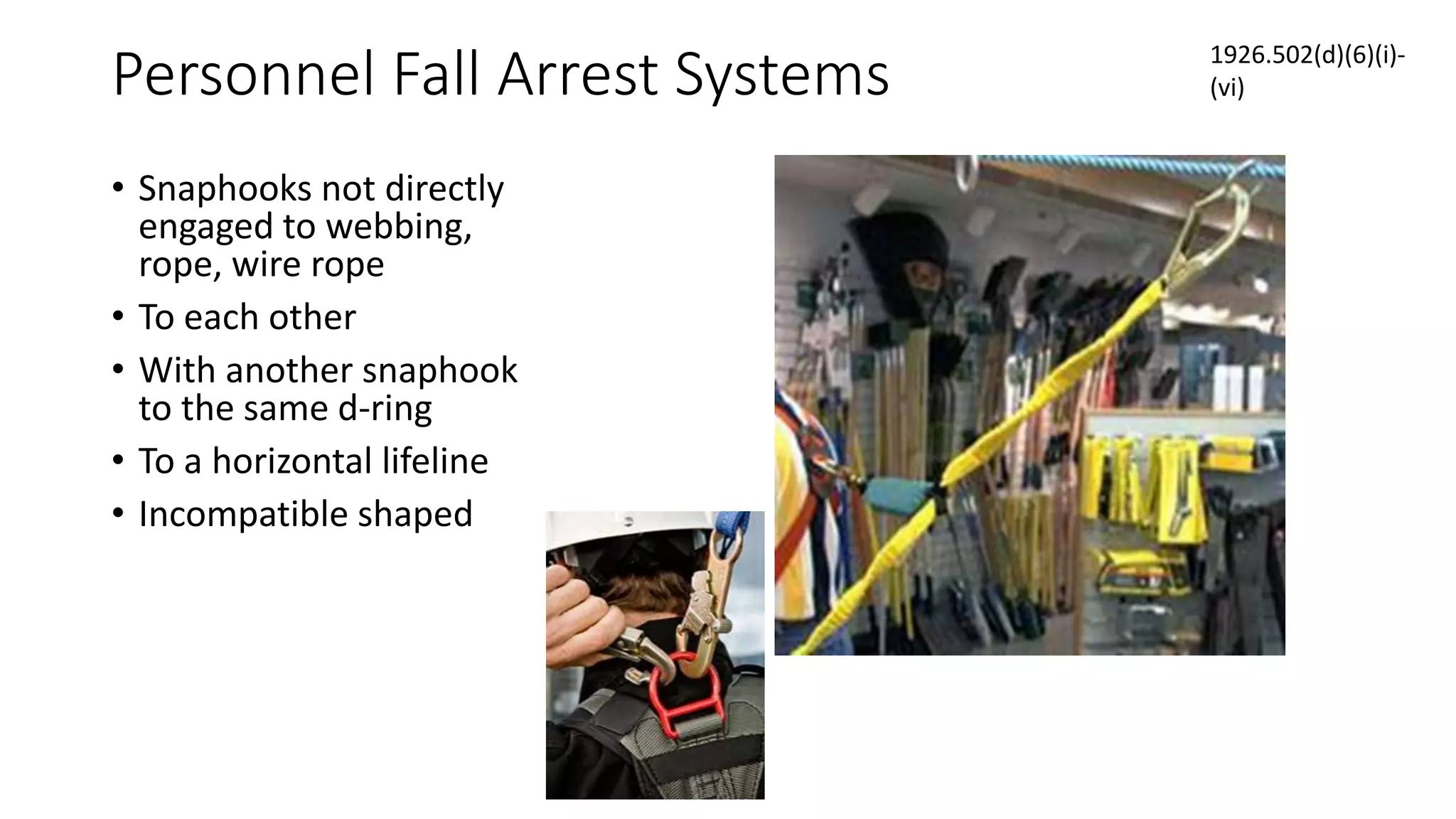
Personnel Fall Arrest Systems
• Snaphooks not directly
engaged to webbing,
rope, wire rope
• To each other
• With another snaphook
to the same d-ring
• To a horizontal lifeline
• Incompatible shaped
1926.502(d)(6)(i)-
(vi)
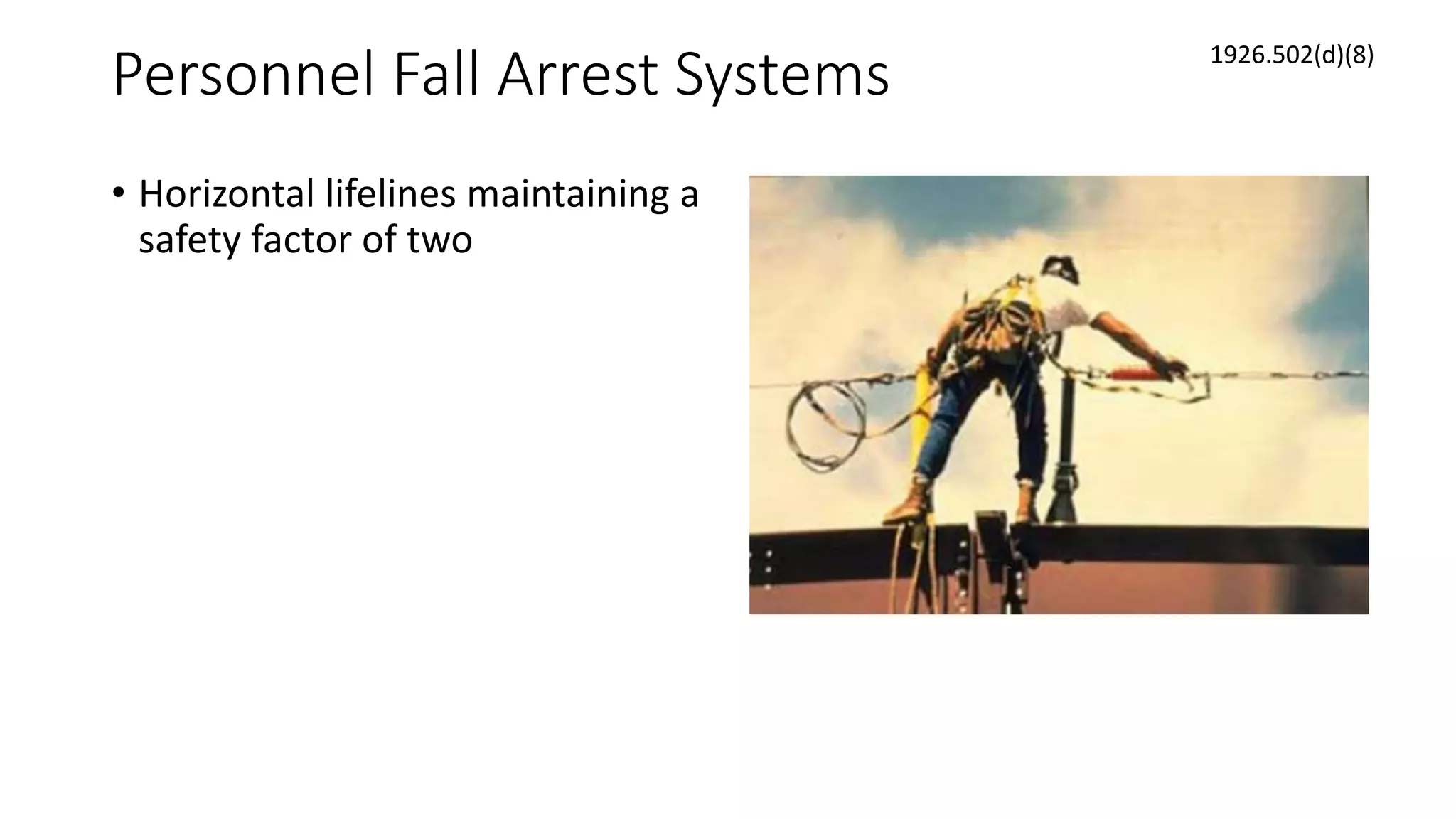
Personnel Fall Arrest Systems
• Horizontal lifelines maintaining a
safety factor of two
1926.502(d)(8)
Personnel Fall Arrest Systems
• Lanyards and lifelines shall have
a minimum braking strength of
5,000 pounds
1926.502(d)(9)
Personnel Fall Arrest Systems
• Lifelines shall protected from
being abraded
1926.502(d)(11)
Personnel Fall Arrest Systems
• Self-retracting lifelines and
lanyards which limit free fall to 2
feet shall be capable of
supporting 3,000 pounds
1926.502(d)(12)
Personnel Fall Arrest Systems
• Self-retracting lifelines and
lanyards which do not limit free
falls to 2 feet shall be capable of
supporting 5,000 pounds
1926.502(d)(13)
Personnel Fall Arrest Systems
• Anchorages independent from
equipment suspension
anchorages
1926.502(d)(14)
Personnel Fall Arrest Systems
• Anchorages 5,000 pounds or
maintain a safety factor of two
1926.502(d)(15)(i)
Personnel Fall Arrest Systems
• Limit fall arrest forces to 1800
pounds with a harness
1926.502(d)(16)(ii)
Personnel Fall Arrest Systems
• No free fall more than 6 feet nor
contract and lower level
1926.502(d)(16)(iii)
Personnel Fall Arrest Systems
• Limit maximum deceleration
distance to 3.5 feet
1926.502(d)(16)(iv)
Personnel Fall Arrest Systems
• Withstand twice the potential
impact energy of an employee
falling 6 feet or the free fall
distance permitted by the system.
1926.502(d)(16)(v)
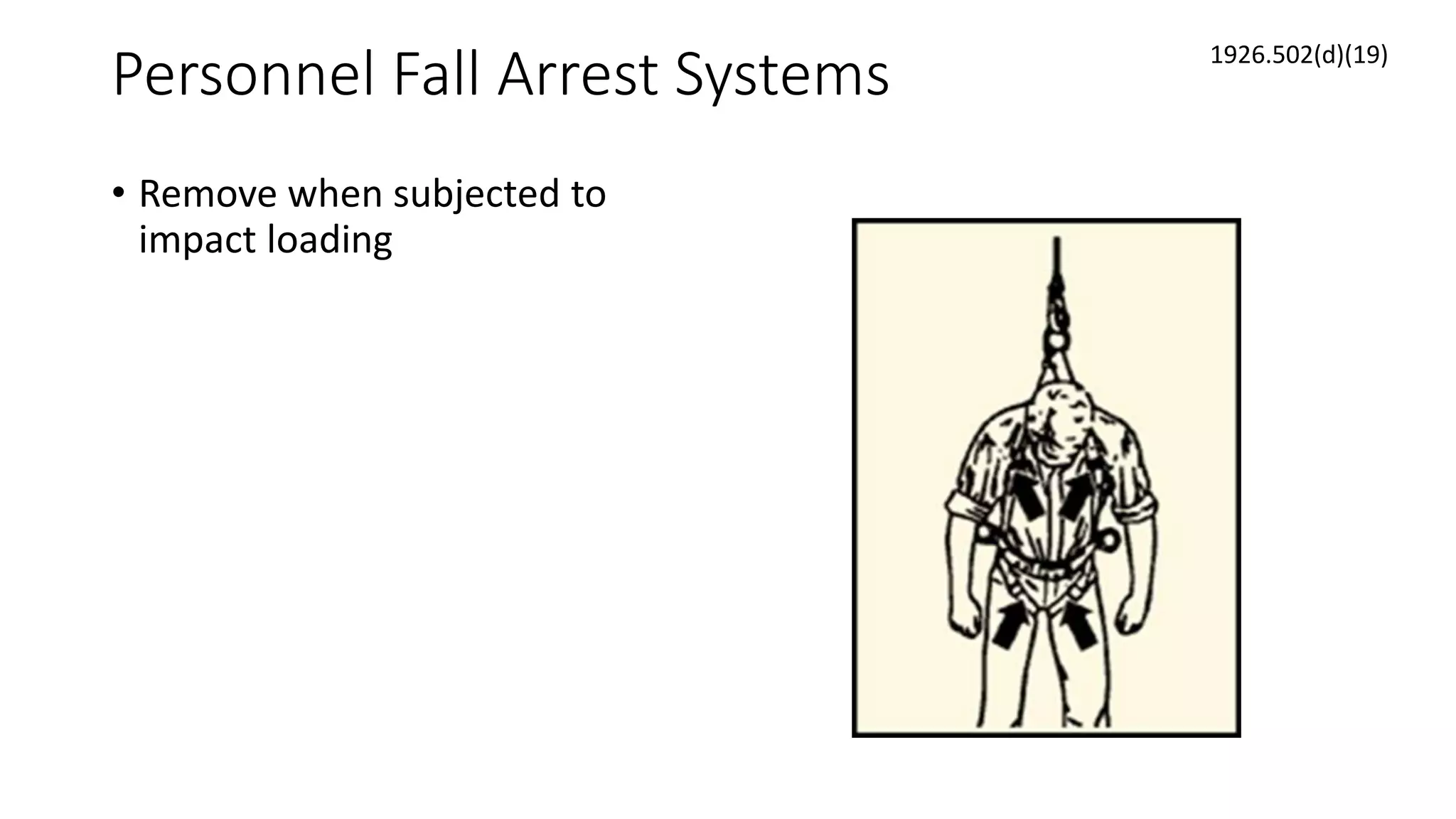
Personnel Fall Arrest Systems
• Remove when subjected to
impact loading
1926.502(d)(19)
Personnel Fall Arrest Systems
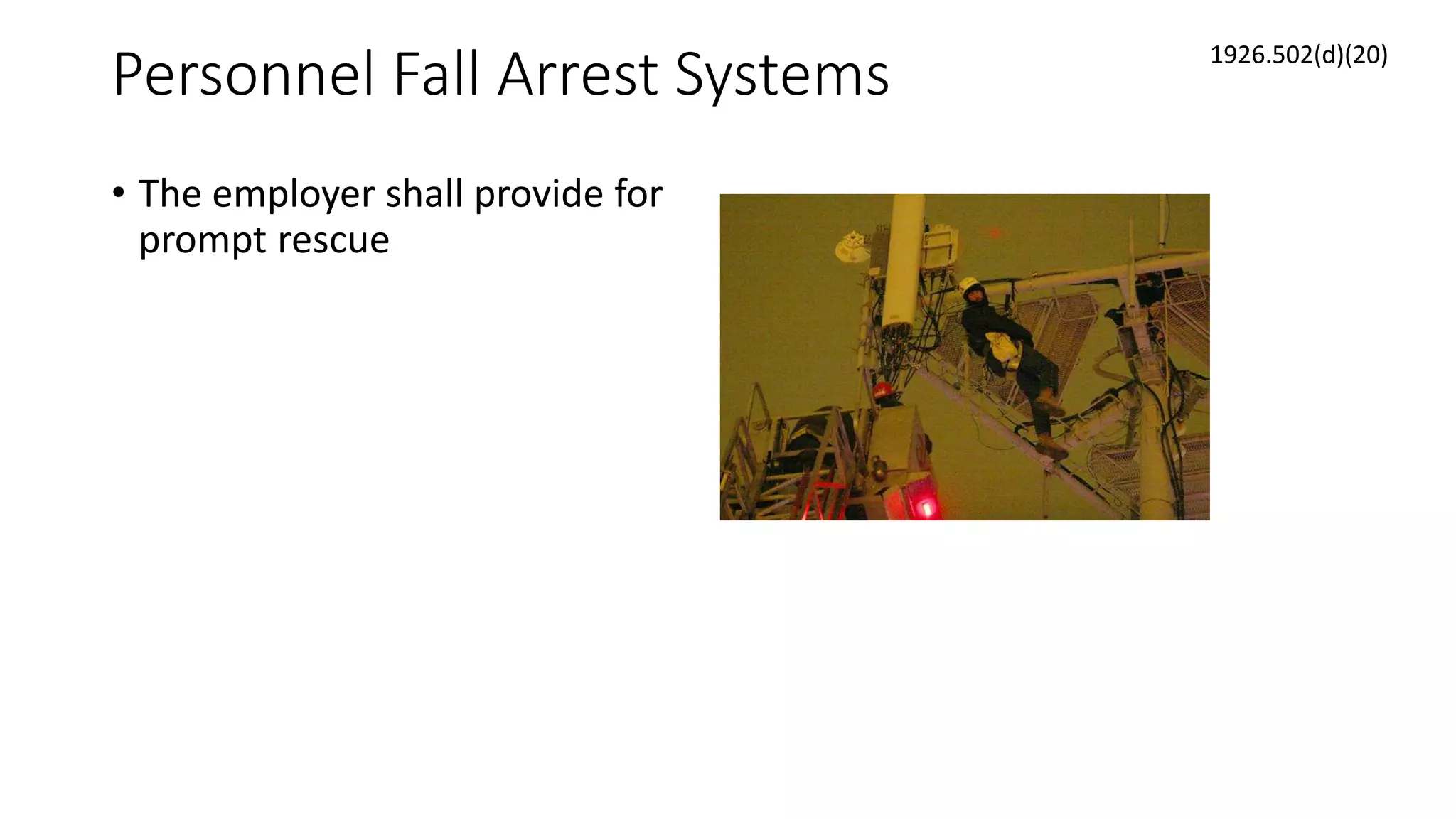
• The employer shall provide for
prompt rescue
1926.502(d)(20)
Personnel Fall Arrest Systems
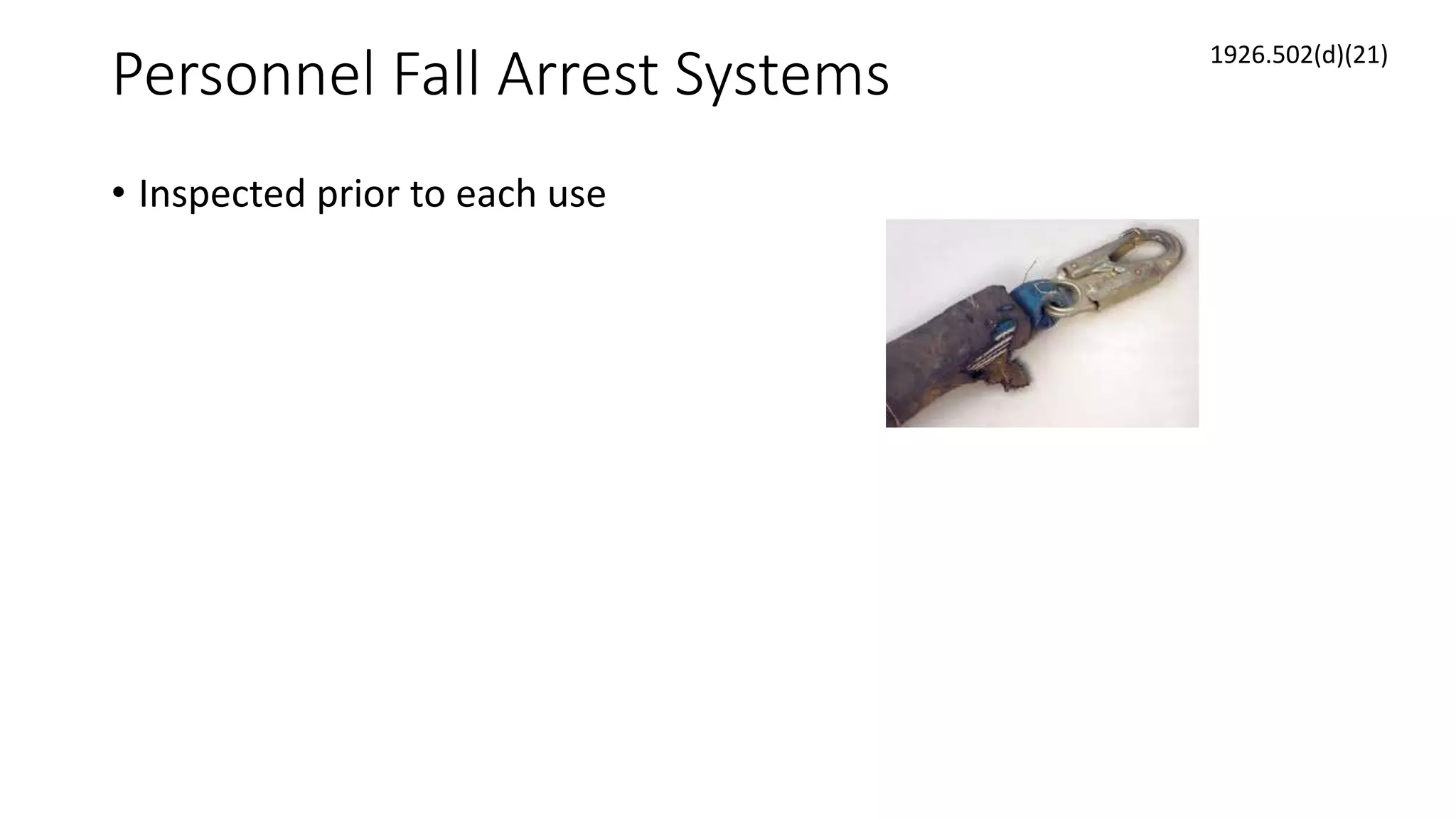
• Inspected prior to each use
1926.502(d)(21)
Personnel Fall Arrest Systems
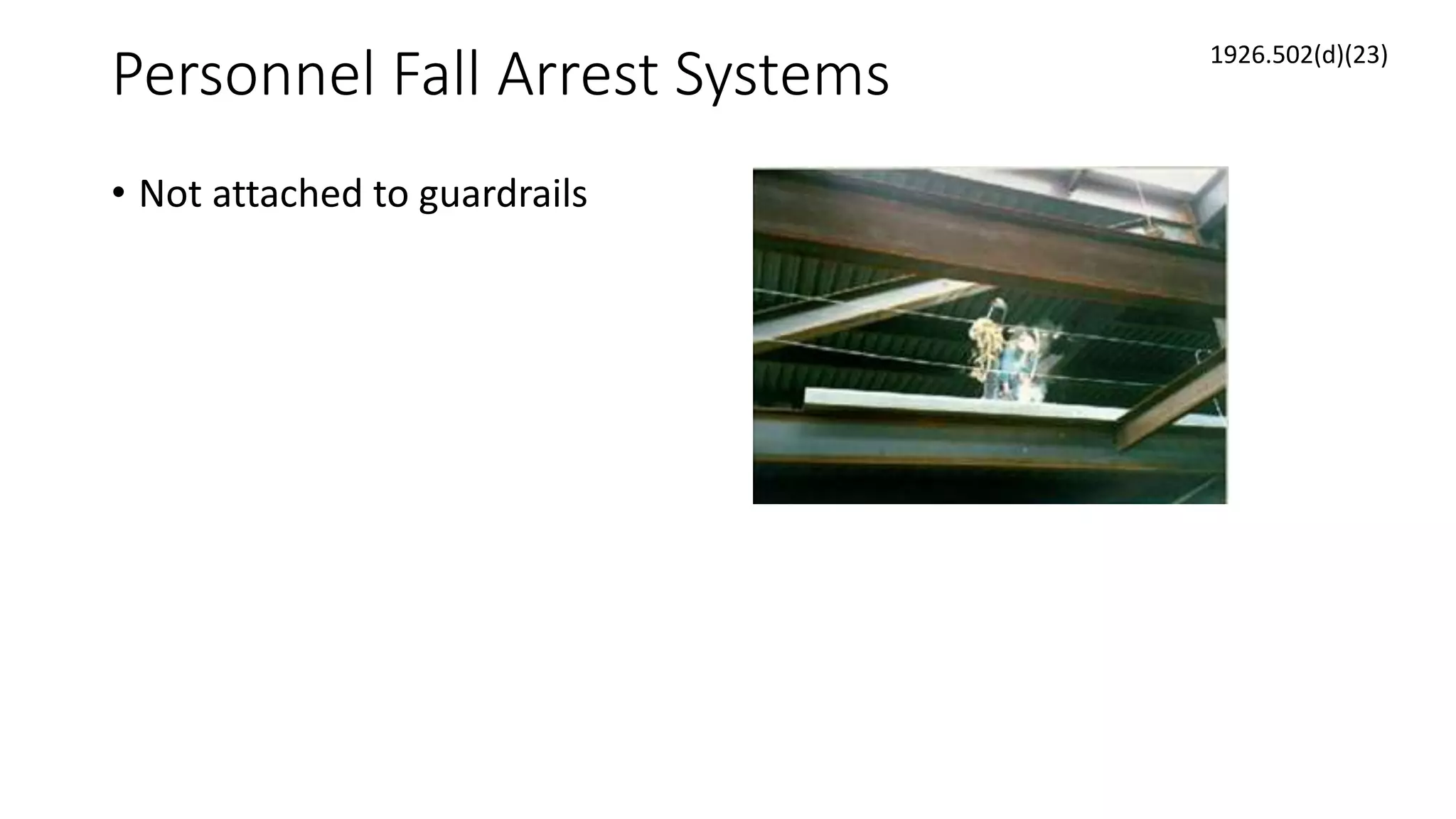
• Not attached to guardrails
1926.502(d)(23)
Personnel Fall Arrest Systems
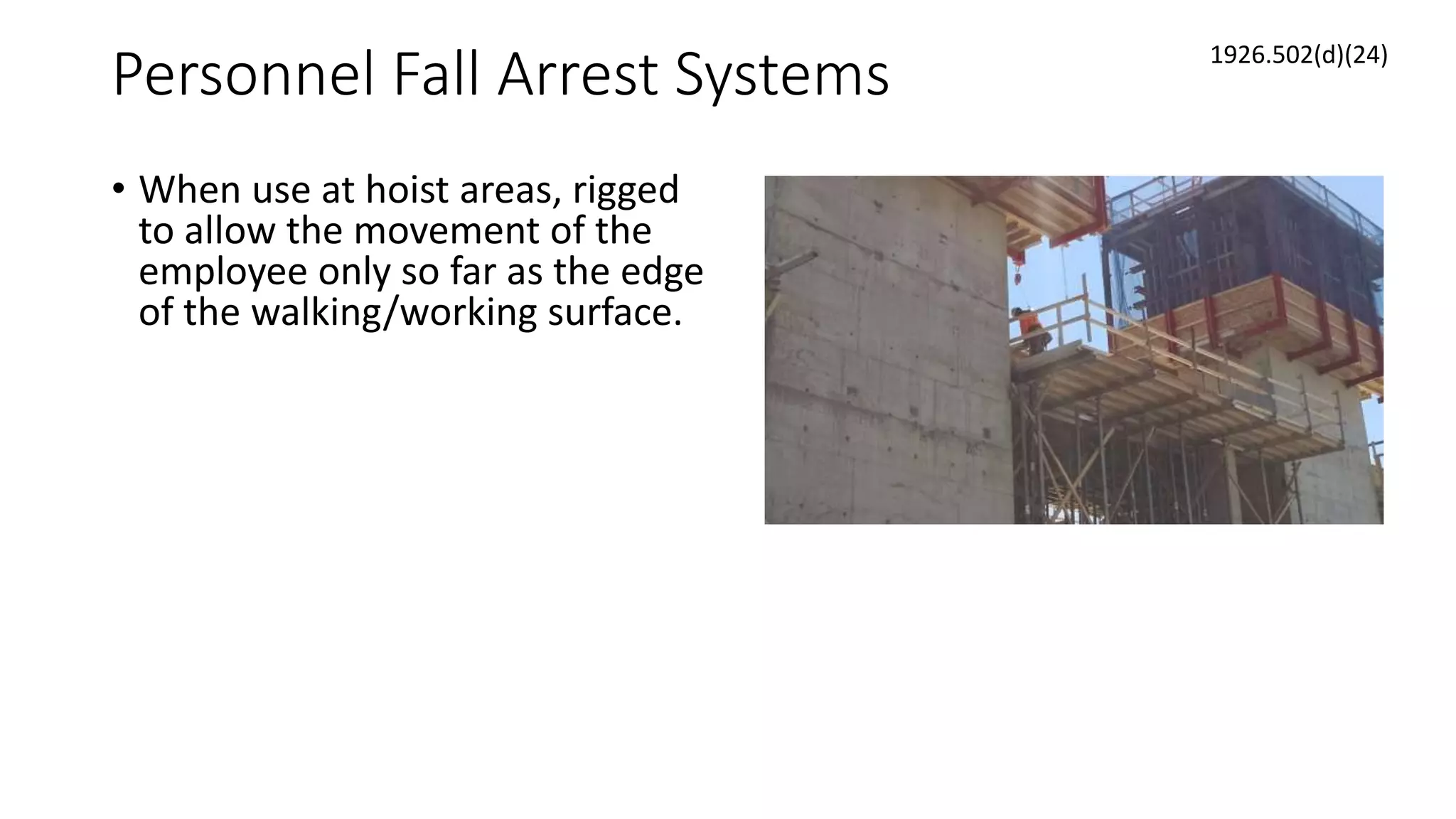
• When use at hoist areas, rigged
to allow the movement of the
employee only so far as the edge
of the walking/working surface.
1926.502(d)(24)
Work Positioning Systems
• Limit free fall to 2 feet
• Anchorage 3000 pounds
1926.502(e)(1)&(2)
Warning Line Systems
• Flags 6 feet away when mechanical
equipment not used
• Access path from ladder formed
from two warning lines
1926.502(f)(1)(i)&(iii)
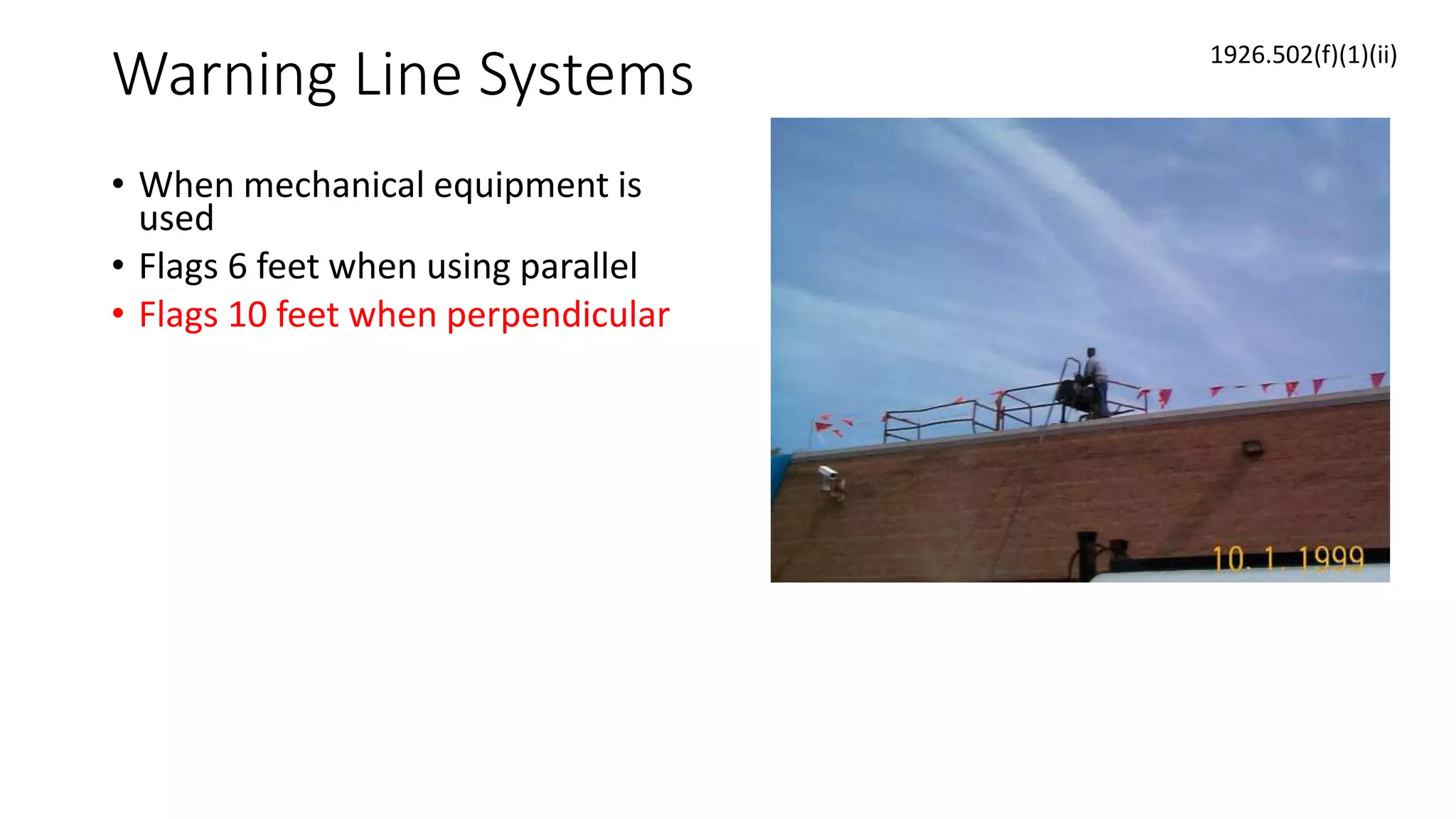
Warning Line Systems
• When mechanical equipment is
used
• Flags 6 feet when using parallel
• Flags 10 feet when perpendicular
1926.502(f)(1)(ii)
Controlled Access Zones
• Leading Edge
• Overhand Bricklaying
• Precast
1926.502(g)
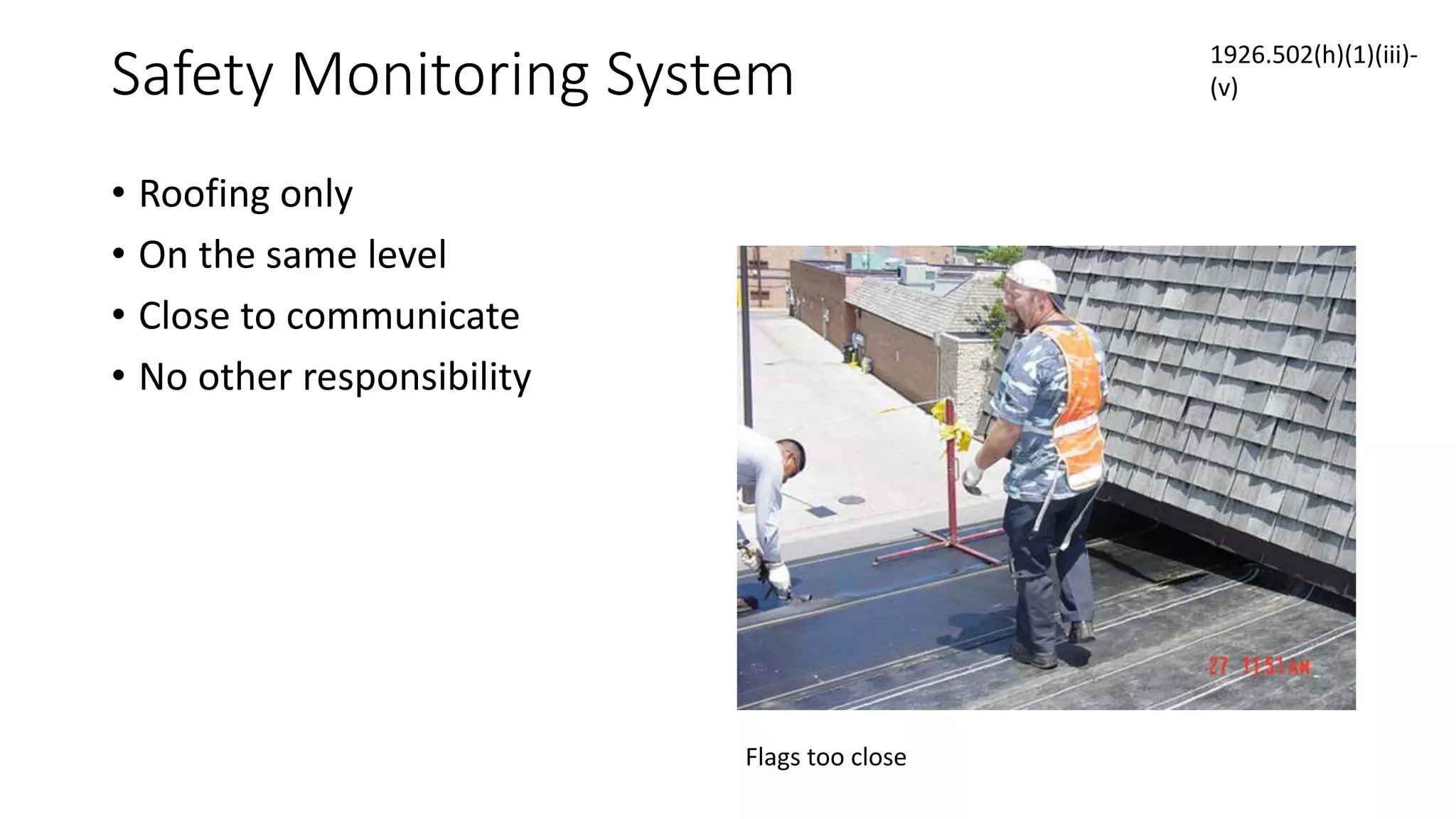
Safety Monitoring System
• Roofing only
• On the same level
• Close to communicate
• No other responsibility
1926.502(h)(1)(iii)-
(v)
Flags too close
Covers
• Support twice the weight
• Secured
• Colored coded, or use “Hole,
“Cover”
1926.502(i)(1)-(4)
Toeboards
• 50 pounds strength
• 3.5 inches high
1926.502(j)(2)-(3)
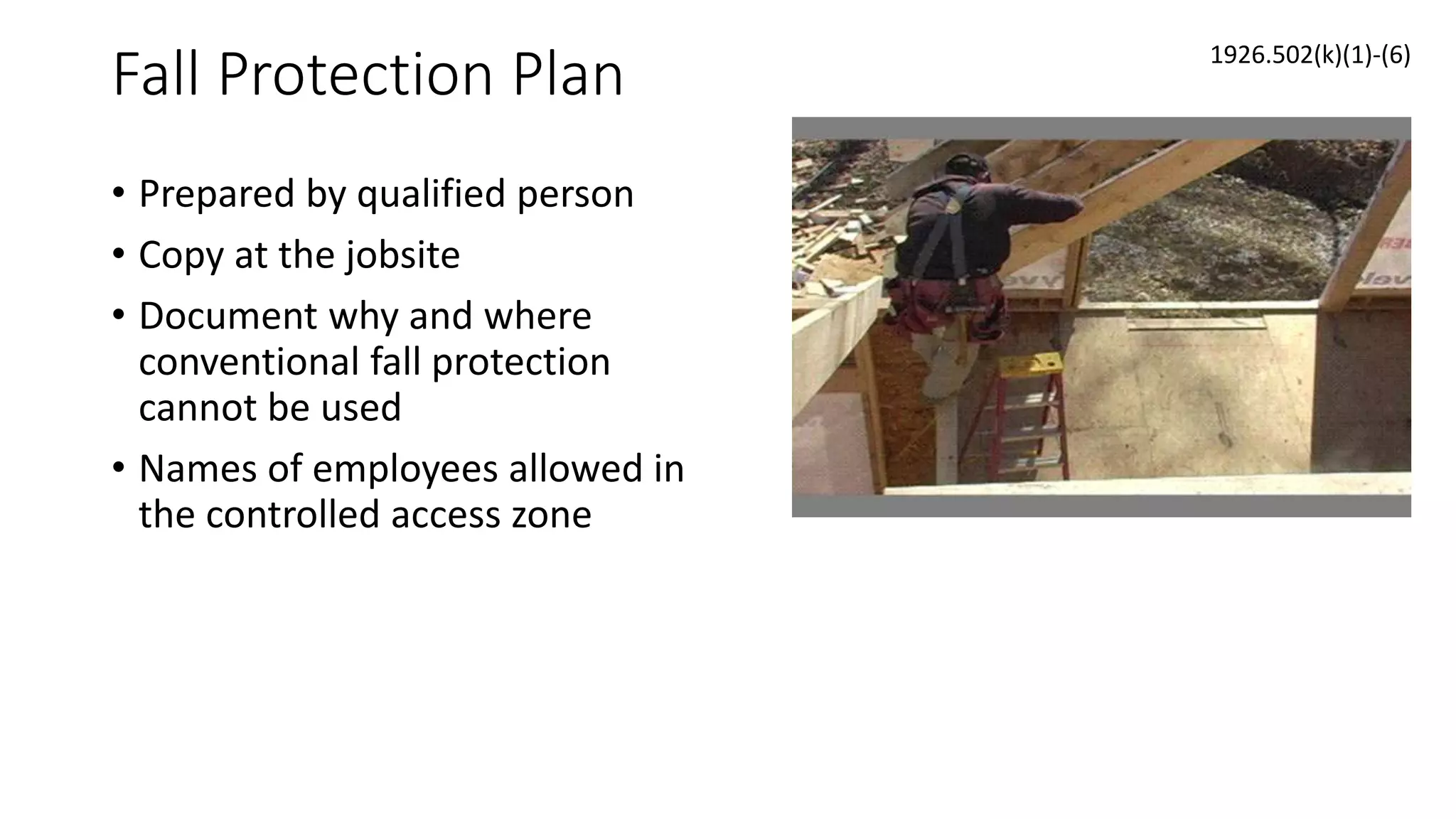
Fall Protection Plan
• Prepared by qualified person
• Copy at the jobsite
• Document why and where
conventional fall protection
cannot be used
• Names of employees allowed in
the controlled access zone
1926.502(k)(1)-(6)
Fall Protection Training
• Employer shall provide a training
program for each employee who
might be exposed to fall hazards.
• The program shall enable each
employee to recognize the
hazards of falling and shall train
each employee in the
procedures to be followed in
order to minimize these hazards.
1926.503(a)(1)
 fall protection 2015
 fall protection 2015

fall protection 2015

  • 1.
    Subpart M, FallProtection • 1926.500, Scope, application, and definitions applicable to this subpart • 1926.502, Fall protection systems criteria and practices • 1926.503, Training requirements • Appendix
  • 2.
    When Is FallProtection Required?  If workers are working over dangerous materials, they have to wear fall protection below 6 feet
  • 3.
    690 694 762 878 1145 1240 1351 1409 1585 4301 501(b)(10) 451(e)(1) 453(b)(2)(v) 451(g)(1) 100(a) 102(a)(1) 503(a)(1) 501(b)(1) 1053(b)(1) 501(b)(13) Most Frequently CitedSerious Violations in Construction 2014 3 1926OverallMFC FALL PROTECTION – RESIDENTIAL CONSTRUCTION PORTABLE LADDERS NOT EXTENDED 3 FEET ABOVE LANDING FALL PROTECTION – UNPROTECTED SIDES & EDGES FALL PROTECTION – TRAINING EYE AND FACE PROTECTION HEAD PROTECTION SCAFFOLDS – FALL PROTECTION AERIAL LIFTS – FALL PROTECTION SAFE ACCESS FALL PROTECTION – ROOFING WORK ON LOW-SLOPED ROOFS M X M M E E L L L M 29CFR1926SUBPARTS
  • 4.
    538 690 1351 1409 4301 501(b)(11) 501(b)(10) 503(a)(1) 501(b)(1) 501(b)(13) Fall Protection [1926.500– 503] 4 ROOFING WORK ON LOW-SLOPED ROOFS ROOFING WORK ON STEEP ROOFS RESIDENTIAL CONSTRUCTION UNPROTECTED SIDES & EDGES FALL HAZARD TRAINING SUBPARTM
  • 5.
    Scope and Application •Exception: inspection, investigation, or assessment of workplace conditions 1926.500(a)(1)
  • 6.
    Scope and Application •Does not apply to • scaffolds • working on cranes and derricks • steel erection work (except for towers and tanks) are provided in subpart R of this part. • certain types of equipment used in tunneling • erection of tanks and communication and broadcast • construction of electric transmission or distribution lines or equipment. • stairways and ladders 1926.500(a)(2)
  • 7.
    Definitions • Anchorage • securepoint of attachment for lifelines, lanyards or deceleration devices 1926.500(b)
  • 8.
    Definitions • Body Belt •strap with means both for securing it about the waist 1926.500(b)
  • 9.
    Definitions • Body Harness •straps which distribute the fall arrest forces 1926.500(b)
  • 10.
    Definitions • Connector • usedto connect parts of the personal fall arrest system and positioning device systems together 1926.500(b)
  • 11.
    Definitions • Controlled AccessZone • area in which certain work (e.g., overhand bricklaying) may take place 1926.500(b)
  • 12.
    Definitions • Dangerous Equipment •equipment hazardous to employees who fall onto or into such equipment. 1926.500(b)
  • 13.
    Definitions • Deceleration Device •equipment that dissipates a substantial amount of energy during a fall arrest 1926.500(b)
  • 14.
    Definitions • Deceleration Distance •distance between the location of an employee's body belt or body harness attachment point at the moment of activation and the location of that attachment point after the employee comes to a full stop. 1926.500(b)
  • 15.
    Definitions • Free Fall •act of falling before a personal fall arrest system begins to apply force to arrest the fall 1926.500(b)
  • 16.
    Definitions • Guardrail system •a barrier erected to prevent employees from falling to lower levels 1926.500(b)
  • 17.
    Definitions • Hole • agap or void 2 inches (5.1 cm) or more in its least dimension 1926.500(b)
  • 18.
    Definitions • Infeasible • impossibleto perform the construction work using a conventional fall protection system 1926.500(b)
  • 19.
    Definitions • Lanyard • flexibleline of rope, wire rope, or strap which generally has a connector at each end 1926.500(b)
  • 20.
    Definitions • Leading Edge •edge which changes location as additional sections are placed, formed, or constructed 1926.500(b)
  • 21.
    Definitions • Lifeline • componentconsisting of a flexible line for connection to an anchorage 1926.500(b)
  • 22.
    Definitions • Low SlopeRoof • roof having a slope less than or equal to 4 in 12 1926.500(b)
  • 23.
    Definitions • Mechanical equipment •motor or human propelled wheeled equipment used for roofing work, except wheelbarrows and mopcarts 1926.500(b)
  • 24.
    Definitions • Opening • gapor void 30 inches or more high and 18 inches or more wide, in a wall or partition, through which employees can fall to a lower level 1926.500(b)
  • 25.
    Definitions • Fall ArrestSystem • consists of an anchorage, connectors, a body belt or body harness 1926.500(b)
  • 26.
    Definitions • Positioning DeviceSystem • rigged to allow an employee to be supported on an elevated vertical surface and work with both hands free while leaning. 1926.500(b)
  • 27.
    Definitions • Rope Grab •deceleration device which travels on a lifeline and automatically, by friction, engages the lifeline and locks so as to arrest the fall of an employee. 1926.500(b)
  • 28.
    Definitions • Roofing work •hoisting, storage, application, and removal of roofing materials 1926.500(b)
  • 29.
    Definitions • Safety MonitoringSystem • safety system in which a competent person is responsible for recognizing and warning employees of fall hazards 1926.500(b)
  • 30.
    Definitions • Self-retracting lifeline/lanyard •deceleration device after onset of a fall, automatically locks the drum and arrests the fall 1926.500(b)
  • 31.
    Definitions • Snaphook • connectorcomprised of a hook- shaped member with a normally closed keeper • Takes two actions to open 1926.500(b)
  • 32.
    Definitions • Steep Roof •roof having a slope greater than 4 in 12 1926.500(b)
  • 33.
    Definitions • Toeboard • lowprotective barrier that will prevent the fall of materials and equipment to lower levels and provide protection from falls for personnel 1926.500(b)
  • 34.
    Definitions • Unprotected sideor edge • means any side where there is no wall or guardrail system at least 39 inches high. 1926.500(b)
  • 35.
    Definitions • Walking Workingsurface • surface, horizontal or vertical on which an employee walks or works • not include ladders, vehicles, or trailers 1926.500(b)
  • 36.
    Duty to HaveFall Protection • The employer shall determine if the walking/working surfaces on which its employees are to work have the strength and structural integrity to support employees safely. 1926.501(a)(2)
  • 37.
    Duty to HaveFall Protection • unprotected side or edge which is 6 feet or more above a lower level shall be protected from falling 1926.501(b)(1)
  • 38.
    Duty to HaveFall Protection • leading edge 6 feet or more above lower levels shall be protected 1926.501(b)(2)(i)
  • 39.
    Duty to HaveFall Protection • employee in a hoist area shall be protected from falling 6 feet or more to lower levels 1926.501(b)(3)
  • 40.
    Duty to HaveFall Protection • protected from falling through holes (including skylights) more than 6 feet above lower levels 1926.501(b)(4)(i)
  • 41.
    Duty to HaveFall Protection • protected from tripping in or stepping into or through holes (including skylights) by covers 1926.501(b)(4)(ii)
  • 42.
    Duty to HaveFall Protection • protected from objects falling through holes 1926.501(b)(4)(iii)
  • 43.
    Duty to HaveFall Protection • employee on the face of formwork or reinforcing steel shall be protected from falling 6 feet or more to lower levels 1926.501(b)(5)
  • 44.
    Duty to HaveFall Protection • employee on ramps, runways, and other walkways shall be protected from falling 6 feet or more to lower levels 1926.501(b)(6)
  • 45.
    Duty to HaveFall Protection • employee at the edge of an excavation 6 feet or more in depth shall be protected from falling when the excavations are not readily seen because of plant growth or other visual barrier 1926.501(b)(7)(i)
  • 46.
    Duty to HaveFall Protection • employee at the edge of a well, pit, shaft, and similar excavation 6 feet or more in depth shall be protected from falling 1926.501(b)(7)(ii)
  • 47.
    Duty to HaveFall Protection • employee less than 6 feet above dangerous equipment shall be protected from falling 1926.501(b)(8)(i)
  • 48.
    Duty to HaveFall Protection • employee performing overhand bricklaying and related work 6 feet or more above lower levels, shall be protected from falling’ • employee reaching more than 10 inches below the level of the walking/working surface on which they are working, shall be protected by conventional fall protection 1926.501(b)(9)(i)
  • 49.
    Duty to HaveFall Protection • employee engaged in roofing activities on low-slope roofs, with unprotected sides and edges 6 feet or more above lower levels shall be protected from falling • Warning line system allowed 1926.501(b)(10)
  • 50.
    Duty to HaveFall Protection • Each employee on a steep roof with unprotected sides and edges 6 feet or more above lower levels shall be protected from falling 1926.501(b)(11)
  • 51.
    Duty to HaveFall Protection • employee engaged in the erection of precast concrete members who is 6 feet or more above lower levels shall be protected from falling 1926.501(b)(12)
  • 52.
    Duty to HaveFall Protection • employee engaged in residential construction activities 6 feet or more above lower levels shall be protected 1926.501(b)(13)
  • 53.
    Duty to HaveFall Protection • employee working on, at, above, or near wall openings shall be protected from falling • Includes chutes 1926.501(b)(14)
  • 54.
    Duty to HaveFall Protection • Walking/working surfaces not otherwise addressed 1926.501(b)(15)
  • 55.
    Guardrail Systems • TopRail 42 inches +/- 3 inches 1926.502(b)(1)
  • 56.
    Guardrail Systems • Midrailsinstalled between top edge of guardrail and walking working surface 1926.502(b)(2)(i)
  • 57.
    Guardrail Systems • Intermediatemembers such as ballusters – 19 inches 1926.502(b)(2)(iii)
  • 58.
    Guardrail Systems • Guardrailsystems – 200 pounds outward and downward 1926.502(b)(3)
  • 59.
    Guardrail Systems • Midrails– 150 pounds outward and downward 1926.502(b)(5) Failure of a midrail
  • 60.
    Guardrail Systems • Sosurfaced to prevent injury to an employee from puncture or laceration 1926.502(b)(6)
  • 61.
    Guardrail Systems • Theends of top rails and midrails shall not over hang the terminus posts 1926.502(b)(7)
  • 62.
    Guardrail Systems • Ifwire rope is used for top rails, it shall be flagged at not than 6 foot intervals. 1926.502(b)(9)
  • 63.
    Guardrail Systems • Achain, gate, or removal guardrail section shall be places across the access openings at hoisting areas 1926.502(b)(10)
  • 64.
    Guardrail Systems • Ladderwaysor points of access shall be provided with a gate or offset 1926.502(b)(13) No gate or offset
  • 65.
    Safety Net Systems •See 1926.502(c) 1926.502(c)
  • 66.
    Personnel Fall ArrestSystems • Snaphooks not directly engaged to webbing, rope, wire rope • To each other • With another snaphook to the same d-ring • To a horizontal lifeline • Incompatible shaped 1926.502(d)(6)(i)- (vi)
  • 67.
    Personnel Fall ArrestSystems • Horizontal lifelines maintaining a safety factor of two 1926.502(d)(8)
  • 68.
    Personnel Fall ArrestSystems • Lanyards and lifelines shall have a minimum braking strength of 5,000 pounds 1926.502(d)(9)
  • 69.
    Personnel Fall ArrestSystems • Lifelines shall protected from being abraded 1926.502(d)(11)
  • 70.
    Personnel Fall ArrestSystems • Self-retracting lifelines and lanyards which limit free fall to 2 feet shall be capable of supporting 3,000 pounds 1926.502(d)(12)
  • 71.
    Personnel Fall ArrestSystems • Self-retracting lifelines and lanyards which do not limit free falls to 2 feet shall be capable of supporting 5,000 pounds 1926.502(d)(13)
  • 72.
    Personnel Fall ArrestSystems • Anchorages independent from equipment suspension anchorages 1926.502(d)(14)
  • 73.
    Personnel Fall ArrestSystems • Anchorages 5,000 pounds or maintain a safety factor of two 1926.502(d)(15)(i)
  • 74.
    Personnel Fall ArrestSystems • Limit fall arrest forces to 1800 pounds with a harness 1926.502(d)(16)(ii)
  • 75.
    Personnel Fall ArrestSystems • No free fall more than 6 feet nor contract and lower level 1926.502(d)(16)(iii)
  • 76.
    Personnel Fall ArrestSystems • Limit maximum deceleration distance to 3.5 feet 1926.502(d)(16)(iv)
  • 77.
    Personnel Fall ArrestSystems • Withstand twice the potential impact energy of an employee falling 6 feet or the free fall distance permitted by the system. 1926.502(d)(16)(v)
  • 78.
    Personnel Fall ArrestSystems • Remove when subjected to impact loading 1926.502(d)(19)
  • 79.
    Personnel Fall ArrestSystems • The employer shall provide for prompt rescue 1926.502(d)(20)
  • 80.
    Personnel Fall ArrestSystems • Inspected prior to each use 1926.502(d)(21)
  • 81.
    Personnel Fall ArrestSystems • Not attached to guardrails 1926.502(d)(23)
  • 82.
    Personnel Fall ArrestSystems • When use at hoist areas, rigged to allow the movement of the employee only so far as the edge of the walking/working surface. 1926.502(d)(24)
  • 83.
    Work Positioning Systems •Limit free fall to 2 feet • Anchorage 3000 pounds 1926.502(e)(1)&(2)
  • 84.
    Warning Line Systems •Flags 6 feet away when mechanical equipment not used • Access path from ladder formed from two warning lines 1926.502(f)(1)(i)&(iii)
  • 85.
    Warning Line Systems •When mechanical equipment is used • Flags 6 feet when using parallel • Flags 10 feet when perpendicular 1926.502(f)(1)(ii)
  • 86.
    Controlled Access Zones •Leading Edge • Overhand Bricklaying • Precast 1926.502(g)
  • 87.
    Safety Monitoring System •Roofing only • On the same level • Close to communicate • No other responsibility 1926.502(h)(1)(iii)- (v) Flags too close
  • 88.
    Covers • Support twicethe weight • Secured • Colored coded, or use “Hole, “Cover” 1926.502(i)(1)-(4)
  • 89.
    Toeboards • 50 poundsstrength • 3.5 inches high 1926.502(j)(2)-(3)
  • 90.
    Fall Protection Plan •Prepared by qualified person • Copy at the jobsite • Document why and where conventional fall protection cannot be used • Names of employees allowed in the controlled access zone 1926.502(k)(1)-(6)
  • 91.
    Fall Protection Training •Employer shall provide a training program for each employee who might be exposed to fall hazards. • The program shall enable each employee to recognize the hazards of falling and shall train each employee in the procedures to be followed in order to minimize these hazards. 1926.503(a)(1)