The  Living PrimatesCommon Primate TraitsClassification of PrimatesThe  Various PrimatesExplanations of Variable Primate AdaptationsDistinctive Human Traits
I. Common Primate TraitsAll  primates belong to class Mammalia and they share all the common features of mammals. Primates share a number of traits with other mammals:Fur (body hair)Give birth to live young- mammary glandWarm-blooded, the ability to maintain a constant body temperatureBehavior is learned rather than instinctive
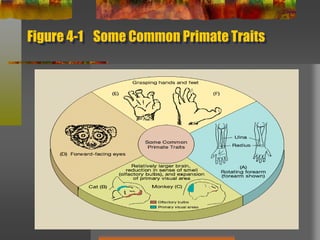
I. Common Primate TraitsPhysical Features        1. Skeletal features  of  primates reflect an arboreal (tree living existence) existence.         2. The forelimbs are specially flexible, built to withstand both pushing and pulling forces.         3. Clavicle or collarbone         4. Generally omnivorous, they eat all kinds of food, including insects and small animals, as well as fruits, seeds, leaves and roots.         5. Prehensile hands and opposable thumbs
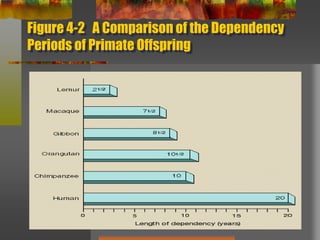
I. Common Primate Traits6. Vision is very important to primate life. Brain devoted to           vision rather than to smell.      7. Stereoscopic or depth vision- eyes are directed forward     8. Large brain relative to body size.D. Social Features- study of Harry Harlow     1. Social relationships begin with the mother and adult during the fairly long dependency period of primates.     2. Play is important for learning. It provides practice for the physical skills necessary or useful in adulthood.
Figure 4-1    Some Common Primate Traits
Figure 4-2   A Comparison of the Dependency Periods of Primate Offspring
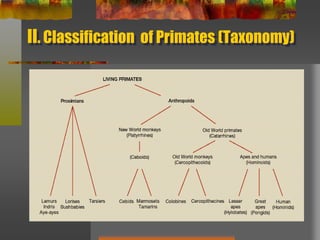
II. Classification  of Primates (Taxonomy)
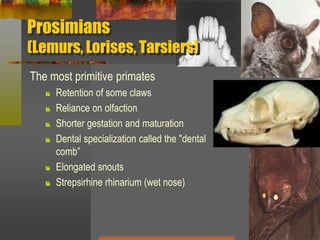
The most primitive primatesRetention of some clawsReliance on olfactionShorter gestation and maturationDental specialization called the "dental comb”Elongated snoutsStrepsirhine rhinarium (wet nose)Prosimians(Lemurs, Lorises, Tarsiers)
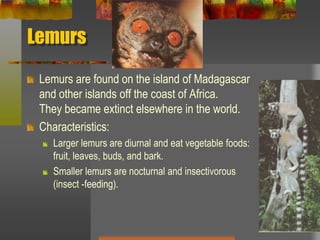
LemursLemurs are found on the island of Madagascar and other islands off the coast of Africa. They became extinct elsewhere in the world.Characteristics:Larger lemurs are diurnal and eat vegetable foods: fruit, leaves, buds, and bark.Smaller lemurs are nocturnal and insectivorous (insect -feeding).
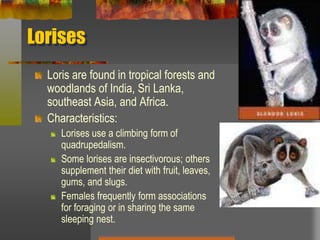
LorisesLoris are found in tropical forests and woodlands of India, Sri Lanka, southeast Asia, and Africa.Characteristics:Lorises use a climbing form of  quadrupedalism.Some lorises are insectivorous; others supplement their diet with fruit, leaves, gums, and slugs.Females frequently form associations for foraging or in sharing the same sleeping nest.
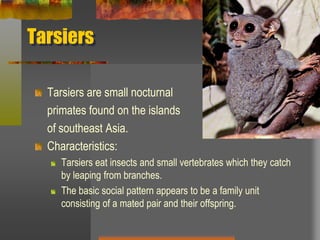
TarsiersTarsiers are small nocturnal 	primates found on the islands 	of southeast Asia.Characteristics:Tarsiers eat insects and small vertebrates which they catch by leaping from branches.The basic social pattern appears to be a family unit consisting of a mated pair and their offspring.
Anthropoids(Monkeys, Apes and Humans)Common traits:Larger brain and body sizeReduced reliance on the sense of smellGreater degree of color visionBony plate at the back of the eye socketLonger gestation and maturation periodOnly has nails
MonkeysMonkeys represent about 70% of all primatesMonkeys are divided into two large groups separated by geographic area as well as several million years of evolutionary history: New world monkeys (Platyrrhines) Old world monkeys (Catarrhines)
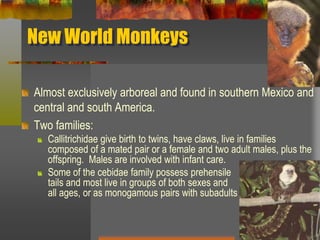
New World MonkeysAlmost exclusively arboreal and found in southern Mexico and central and south America.Two families:Callitrichidae give birth to twins, have claws, live in families composed of a mated pair or a female and two adult males, plus the offspring.  Males are involved with infant care.Some of the cebidae family possess prehensile                             tails and most live in groups of both sexes and                                 all ages, or as monogamous pairs with subadults
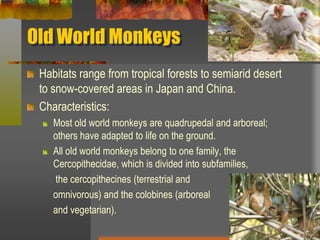
Old World MonkeysHabitats range from tropical forests to semiarid desert to snow-covered areas in Japan and China.Characteristics:Most old world monkeys are quadrupedal and arboreal; others have adapted to life on the ground.All old world monkeys belong to one family, the Cercopithecidae, which is divided into subfamilies,	 the cercopithecines (terrestrial and 	omnivorous) and the colobines (arboreal 	and vegetarian).
Hominoids (Apes and Humans)Characteristics that distinguish hominoids from monkeys:Larger body size Absence of a tailShortened trunkLong arms relative to legs (except humans)More complex behaviorMore complex brain and enhanced cognitive abilitiesIncreased period of infant development and dependency
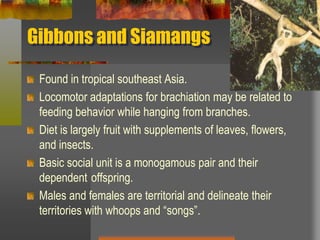
Gibbons and SiamangsFound in tropical southeast Asia.Locomotor adaptations for brachiation may be related to feeding behavior while hanging from branches.Diet is largely fruit with supplements of leaves, flowers, and insects.Basic social unit is a monogamous pair and their dependent	offspring. Males and females are territorial and delineate their territories with whoops and “songs”.
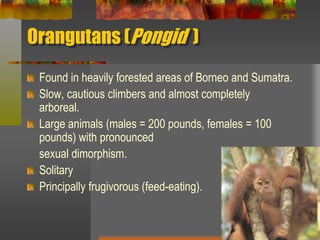
Orangutans (Pongid  )Found in heavily forested areas of Borneo and Sumatra.Slow, cautious climbers and almost completely arboreal.	Large animals (males = 200 pounds, females = 100 pounds) with pronounced 	sexual dimorphism. SolitaryPrincipally frugivorous (feed-eating).
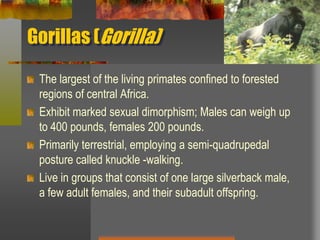
Gorillas (Gorilla)The largest of the living primates confined to forested regions of central Africa.Exhibit marked sexual dimorphism; Males can weigh up to 400 pounds, females 200 pounds.Primarily terrestrial, employing a semi-quadrupedal posture called knuckle -walking.Live in groups that consist of one large silverback male, a few adult females, and their subadult offspring.
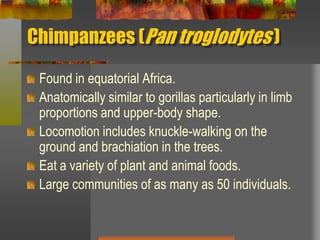
Chimpanzees (Pan troglodytes )Found in equatorial Africa.Anatomically similar to gorillas particularly in limb proportions and upper-body shape.Locomotion includes knuckle-walking on the ground and brachiation in the trees.Eat a variety of plant and animal foods. Large communities of as many as 50 individuals.
Bonobos (Pan paniscus) Only found in an area south of the Zaire river.Their population is believed to only number a few thousand individuals.Exploit many of the same foods as chimps, including occasional small mammals.Male-female bonds constitute the societal core.  Bonobo sexuality includes frequent copulations and occur throughout the female's estrous cycle.
Humans (Homo sapiens)The only living species in the family HominidsCharacteristics:Primate heritage is evident in anatomy, genetic makeup and aspects of behavior.Human teeth are typical primate teeth.Dependence on vision for orientation to the worldFlexible limbs and grasping handsOmnivorous dietCognitive abilities are the result of dramatic increases in brain size.Bipedal
III. The  Various PrimatesPrimates retain many primitive mammalian traits and cannot be defined by one or two traits alone.Primates are defined by evolutionary trends that characterize the entire order to one degree or another. Traits we will focus on:Limbs and LocomotionDiet and TeethSenses and the BrainMaturation and Learning Behaviors
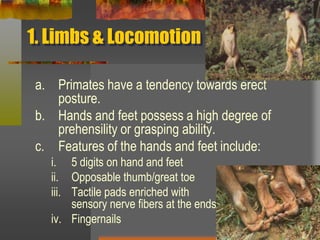
1. Limbs & LocomotionPrimates have a tendency towards erect posture.Hands and feet possess a high degree of prehensility or grasping ability.Features of the hands and feet include: 5 digits on hand and feetOpposable thumb/great toeTactile pads enriched with                                sensory nerve fibers at the endsFingernails
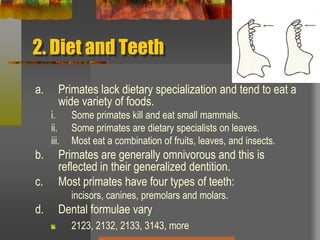
2. Diet and TeethPrimates lack dietary specialization and tend to eat a wide variety of foods. Some primates kill and eat small mammals.Some primates are dietary specialists on leaves.Most eat a combination of fruits, leaves, and insects.Primates are generally omnivorous and this is reflected in their generalized dentition.Most primates have four types of teeth:	incisors, canines, premolars and molars.Dental formulae vary2123, 2132, 2133, 3143, more
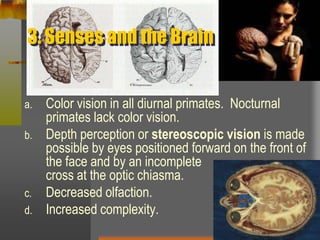
3. Senses and the BrainColor vision in all diurnal primates.  Nocturnal primates lack color vision.Depth perception or stereoscopic vision is made possible by eyes positioned forward on the front of the face and by an incomplete                          cross at the optic chiasma.Decreased olfaction.Increased complexity.
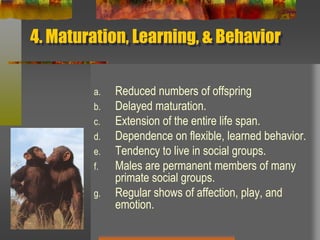
 4. Maturation, Learning, & BehaviorReduced numbers of offspring Delayed maturation.Extension of the entire life span.Dependence on flexible, learned behavior.Tendency to live in social groups.  Males are permanent members of many primate social groups.Regular shows of affection, play, and emotion.
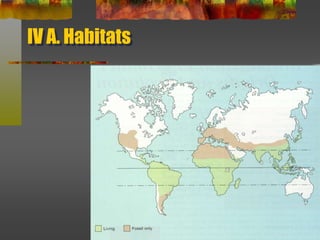
IV. Specific Primate TraitsHabitatsMost living nonhuman primates live in the tropical or semitropical areas of the new and old worlds.Most primates are arboreal, living in forest or woodland habitats.Some old world monkeys have adapted to life on the ground and gorillas and chimpanzees spend considerable time on the ground.No nonhuman primate is adapted to a fully terrestrial environment; all spend some time in the trees.
IV A. Habitats
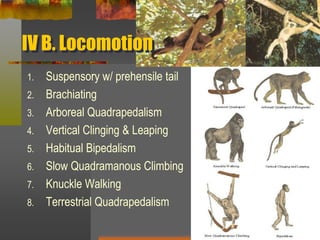
IV B. LocomotionSuspensory w/ prehensile tailBrachiatingArboreal QuadrapedalismVertical Clinging & LeapingHabitual BipedalismSlow Quadramanous ClimbingKnuckle WalkingTerrestrial Quadrapedalism
IV. Explanations of Variable  Primate AdaptationsBody SizeAll the nocturnal primates are small; and among the primates active during the day, the arboreal ones tend to be smaller than the terrestrial ones.2. Relative Brain SizeLarger primates usually have larger brains, but larger animals of all types generally have larger brains. (fruit-eating larger than leaf-eating)Group Size        Nocturnal activity is an important predictor not only of small body size but also of small group size.
V. Distinct Human Traits1. Physical  Traits    Only humans consistently walk erect on two feet.    Human brain is large and complex, particularly the cerebral cortex, the center of speech and other higher mental abilities.    Human sexuality2. Behavioral Abilities    Human behavior is learned and culturally patterned.
V. Distinct Human Traits3. Tool making     Humans are the only habitual tool making animal.4. Language     Only humans have spoken , symbolic language.5. Other Human Traits     Humans hunt very large animal     Completely terrestrial     Longest dependency period     Division of labor by gender

The living primates

  • 1.
    The LivingPrimatesCommon Primate TraitsClassification of PrimatesThe Various PrimatesExplanations of Variable Primate AdaptationsDistinctive Human Traits
  • 2.
    I. Common PrimateTraitsAll primates belong to class Mammalia and they share all the common features of mammals. Primates share a number of traits with other mammals:Fur (body hair)Give birth to live young- mammary glandWarm-blooded, the ability to maintain a constant body temperatureBehavior is learned rather than instinctive
  • 3.
    I. Common PrimateTraitsPhysical Features 1. Skeletal features of primates reflect an arboreal (tree living existence) existence. 2. The forelimbs are specially flexible, built to withstand both pushing and pulling forces. 3. Clavicle or collarbone 4. Generally omnivorous, they eat all kinds of food, including insects and small animals, as well as fruits, seeds, leaves and roots. 5. Prehensile hands and opposable thumbs
  • 4.
    I. Common PrimateTraits6. Vision is very important to primate life. Brain devoted to vision rather than to smell. 7. Stereoscopic or depth vision- eyes are directed forward 8. Large brain relative to body size.D. Social Features- study of Harry Harlow 1. Social relationships begin with the mother and adult during the fairly long dependency period of primates. 2. Play is important for learning. It provides practice for the physical skills necessary or useful in adulthood.
  • 5.
    Figure 4-1 Some Common Primate Traits
  • 6.
    Figure 4-2 A Comparison of the Dependency Periods of Primate Offspring
  • 7.
    II. Classification of Primates (Taxonomy)
  • 8.
    The most primitiveprimatesRetention of some clawsReliance on olfactionShorter gestation and maturationDental specialization called the "dental comb”Elongated snoutsStrepsirhine rhinarium (wet nose)Prosimians(Lemurs, Lorises, Tarsiers)
  • 9.
    LemursLemurs are foundon the island of Madagascar and other islands off the coast of Africa. They became extinct elsewhere in the world.Characteristics:Larger lemurs are diurnal and eat vegetable foods: fruit, leaves, buds, and bark.Smaller lemurs are nocturnal and insectivorous (insect -feeding).
  • 10.
    LorisesLoris are foundin tropical forests and woodlands of India, Sri Lanka, southeast Asia, and Africa.Characteristics:Lorises use a climbing form of quadrupedalism.Some lorises are insectivorous; others supplement their diet with fruit, leaves, gums, and slugs.Females frequently form associations for foraging or in sharing the same sleeping nest.
  • 11.
    TarsiersTarsiers are smallnocturnal primates found on the islands of southeast Asia.Characteristics:Tarsiers eat insects and small vertebrates which they catch by leaping from branches.The basic social pattern appears to be a family unit consisting of a mated pair and their offspring.
  • 12.
    Anthropoids(Monkeys, Apes andHumans)Common traits:Larger brain and body sizeReduced reliance on the sense of smellGreater degree of color visionBony plate at the back of the eye socketLonger gestation and maturation periodOnly has nails
  • 13.
    MonkeysMonkeys represent about70% of all primatesMonkeys are divided into two large groups separated by geographic area as well as several million years of evolutionary history: New world monkeys (Platyrrhines) Old world monkeys (Catarrhines)
  • 14.
    New World MonkeysAlmostexclusively arboreal and found in southern Mexico and central and south America.Two families:Callitrichidae give birth to twins, have claws, live in families composed of a mated pair or a female and two adult males, plus the offspring. Males are involved with infant care.Some of the cebidae family possess prehensile tails and most live in groups of both sexes and all ages, or as monogamous pairs with subadults
  • 15.
    Old World MonkeysHabitatsrange from tropical forests to semiarid desert to snow-covered areas in Japan and China.Characteristics:Most old world monkeys are quadrupedal and arboreal; others have adapted to life on the ground.All old world monkeys belong to one family, the Cercopithecidae, which is divided into subfamilies, the cercopithecines (terrestrial and omnivorous) and the colobines (arboreal and vegetarian).
  • 16.
    Hominoids (Apes andHumans)Characteristics that distinguish hominoids from monkeys:Larger body size Absence of a tailShortened trunkLong arms relative to legs (except humans)More complex behaviorMore complex brain and enhanced cognitive abilitiesIncreased period of infant development and dependency
  • 17.
    Gibbons and SiamangsFoundin tropical southeast Asia.Locomotor adaptations for brachiation may be related to feeding behavior while hanging from branches.Diet is largely fruit with supplements of leaves, flowers, and insects.Basic social unit is a monogamous pair and their dependent offspring. Males and females are territorial and delineate their territories with whoops and “songs”.
  • 18.
    Orangutans (Pongid )Found in heavily forested areas of Borneo and Sumatra.Slow, cautious climbers and almost completely arboreal. Large animals (males = 200 pounds, females = 100 pounds) with pronounced sexual dimorphism. SolitaryPrincipally frugivorous (feed-eating).
  • 19.
    Gorillas (Gorilla)The largestof the living primates confined to forested regions of central Africa.Exhibit marked sexual dimorphism; Males can weigh up to 400 pounds, females 200 pounds.Primarily terrestrial, employing a semi-quadrupedal posture called knuckle -walking.Live in groups that consist of one large silverback male, a few adult females, and their subadult offspring.
  • 20.
    Chimpanzees (Pan troglodytes)Found in equatorial Africa.Anatomically similar to gorillas particularly in limb proportions and upper-body shape.Locomotion includes knuckle-walking on the ground and brachiation in the trees.Eat a variety of plant and animal foods. Large communities of as many as 50 individuals.
  • 21.
    Bonobos (Pan paniscus)Only found in an area south of the Zaire river.Their population is believed to only number a few thousand individuals.Exploit many of the same foods as chimps, including occasional small mammals.Male-female bonds constitute the societal core. Bonobo sexuality includes frequent copulations and occur throughout the female's estrous cycle.
  • 22.
    Humans (Homo sapiens)Theonly living species in the family HominidsCharacteristics:Primate heritage is evident in anatomy, genetic makeup and aspects of behavior.Human teeth are typical primate teeth.Dependence on vision for orientation to the worldFlexible limbs and grasping handsOmnivorous dietCognitive abilities are the result of dramatic increases in brain size.Bipedal
  • 23.
    III. The Various PrimatesPrimates retain many primitive mammalian traits and cannot be defined by one or two traits alone.Primates are defined by evolutionary trends that characterize the entire order to one degree or another. Traits we will focus on:Limbs and LocomotionDiet and TeethSenses and the BrainMaturation and Learning Behaviors
  • 24.
    1. Limbs &LocomotionPrimates have a tendency towards erect posture.Hands and feet possess a high degree of prehensility or grasping ability.Features of the hands and feet include: 5 digits on hand and feetOpposable thumb/great toeTactile pads enriched with sensory nerve fibers at the endsFingernails
  • 25.
    2. Diet andTeethPrimates lack dietary specialization and tend to eat a wide variety of foods. Some primates kill and eat small mammals.Some primates are dietary specialists on leaves.Most eat a combination of fruits, leaves, and insects.Primates are generally omnivorous and this is reflected in their generalized dentition.Most primates have four types of teeth: incisors, canines, premolars and molars.Dental formulae vary2123, 2132, 2133, 3143, more
  • 26.
    3. Senses andthe BrainColor vision in all diurnal primates. Nocturnal primates lack color vision.Depth perception or stereoscopic vision is made possible by eyes positioned forward on the front of the face and by an incomplete cross at the optic chiasma.Decreased olfaction.Increased complexity.
  • 27.
    4. Maturation,Learning, & BehaviorReduced numbers of offspring Delayed maturation.Extension of the entire life span.Dependence on flexible, learned behavior.Tendency to live in social groups. Males are permanent members of many primate social groups.Regular shows of affection, play, and emotion.
  • 28.
    IV. Specific PrimateTraitsHabitatsMost living nonhuman primates live in the tropical or semitropical areas of the new and old worlds.Most primates are arboreal, living in forest or woodland habitats.Some old world monkeys have adapted to life on the ground and gorillas and chimpanzees spend considerable time on the ground.No nonhuman primate is adapted to a fully terrestrial environment; all spend some time in the trees.
  • 29.
  • 30.
    IV B. LocomotionSuspensoryw/ prehensile tailBrachiatingArboreal QuadrapedalismVertical Clinging & LeapingHabitual BipedalismSlow Quadramanous ClimbingKnuckle WalkingTerrestrial Quadrapedalism
  • 31.
    IV. Explanations ofVariable Primate AdaptationsBody SizeAll the nocturnal primates are small; and among the primates active during the day, the arboreal ones tend to be smaller than the terrestrial ones.2. Relative Brain SizeLarger primates usually have larger brains, but larger animals of all types generally have larger brains. (fruit-eating larger than leaf-eating)Group Size Nocturnal activity is an important predictor not only of small body size but also of small group size.
  • 32.
    V. Distinct HumanTraits1. Physical Traits Only humans consistently walk erect on two feet. Human brain is large and complex, particularly the cerebral cortex, the center of speech and other higher mental abilities. Human sexuality2. Behavioral Abilities Human behavior is learned and culturally patterned.
  • 33.
    V. Distinct HumanTraits3. Tool making Humans are the only habitual tool making animal.4. Language Only humans have spoken , symbolic language.5. Other Human Traits Humans hunt very large animal Completely terrestrial Longest dependency period Division of labor by gender