TWO TRUTHS
ONE LIE!
Direction: Read the following statements
about Intermolecular forces. Identify two true
statements and one incorrect statement.
a) The amount of energy required
to stretch the surface area of liquids is
called as surface tension
b) The weakest forces of attraction
are Hydrogen bonds
c) Water is often considered as a
universal solvent because of its ability to
dissolve almost numerous substances.
ANSWER:
b) The weakest forces of attraction
are Hydrogen bonds
2. a) London dispersion forces
predominate in methane, CH4.
b) The stronger the
intermolecular forces possessed by
molecules, the higher is the surface
tension of the substance.
c) Polar and Nonpolar substances
can combine to form a solution
ANSWER:
c) Polar and Nonpolar substances can
combine to form a solution
3. a) London dispersion forces
was suggested by German physicist
Fritz Wolfgang London.
b) Hydrogen bonding happens
when bonded to a highly
electronegative atom like bromine,
argon or calcium
c) Intermolecular forces are
collectively referred as “van der Waals
forces”,
ANSWER:
b) Hydrogen bonding happens when
bonded to a highly electronegative
atom like bromine, argon or calcium
4. a) Solubility is the ability of a
substance to dissolve in a given
substance.
b) Short-ranged forces that exist
between molecules are dipole - dipole
forces.
c) miscibility is when two liquids
combine or mix in all proportions,
creating a heterogenous mixture.
ANSWER:
c) miscibility is when two liquids
combine or mix in all proportions,
creating a heterogenous mixture.
5. a) The strength of IMFA
greatly affects the physical properties
of substances
b) capillary action is the ability of
liquid molecules to move against
gravity.
c) volatility is a measure of a
liquid’s resistance to flow.
ANSWER:
c) volatility is a measure of a liquid’s
resistance to flow.
Biological
Macromolecules
They’re
Organic!!!
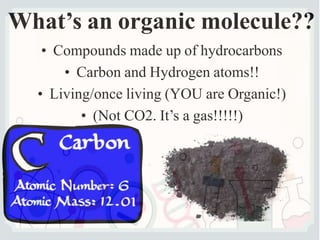
What’s an organic molecule??
• Compounds made up of hydrocarbons
• Carbon and Hydrogen atoms!!
• Living/once living (YOU are Organic!)
• (Not CO2. It’s a gas!!!!!)
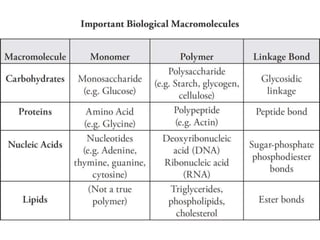
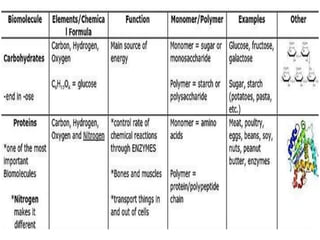
There are four classes of
biological macromolecules:
Proteins, lipids,
carbohydrates and nucleic
acids
Before you can understand the topics
in this unit there are some key
vocabulary terms you need to know.
Macromolecu
le Polymer
Monomer
What do these words mean?
Avery, very
large molecule!!
So What IsA
Macromolecule?
A very large molecule, such as a
polymer or protein, consisting of
many smaller structural units linked
together….by a process called
DEHYDRATION SYNTHESIS
Biological
Macromolecule
•All biological macro-molecule are
made up of a small number of
elements: Carbon, Hydrogen,
Oxygen, (Nitrogen, Phosphorus)
Macromolecules 
We’re looking at
“Mono” means one
SO… a polymer is
made up of many
monomers!!
Three out of the 4 types
of biochemical
macromolecules
can be found on food
nutrition labels…
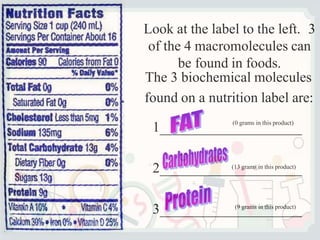
Look at the label to the left. 3
of the 4 macromolecules can
be found in foods.
The 3 biochemical molecules
found on a nutrition label are:
1
2
3
(0 grams in this product)
(13 grams in this product)
(9 grams in this product)
The 4th type of
biochemical
macromolecules are the
NUCLEIC ACIDS
The types of Nucleic
Acids
–DNA (DeoxyriboNucleic
Acid)
Almost all of the molecules
that make up your body are
polymers, chains of
subunits.
Each type of macromolecule
is a polymer composed of a
different type of subunit
called a monomer
The subunits of the
macromolecules are
covalently-bonded.
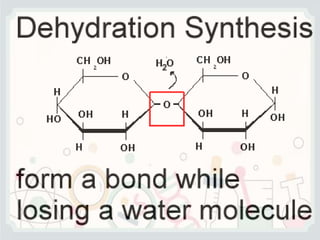
The covalent bonds between the
subunits are always formed by a
type of reaction called
Dehydration
Synthesis (making something
while losing water).
During dehydration
synthesis, a water
molecule is lost, electrons
are rearranged, and a new
bond is formed between
the subunits.
The structure of each
type of macromolecules
is what determines how
the molecules function
in our bodies
Organic Molecules
• Carbon atoms are present
• Carbon forms four covalent bonds
with other atoms
• This allows for a wide variety of
organic molecules.
• Organic molecules are found in
both living and non-living things.
Non-living Organic Molecules
• Hydrocarbons:
–The simplest organic compound
–Contain only carbon and hydrogen
–Carbon atoms bond easily to each
other forming numerous types of
hydrocarbons molecules
LET’S look a
CARBOHYDRA
TES
They are the main source for the body to gain energy.
They are our fuel!
They make up the cell wall in plants which allow them to
grow tall, without this carbohydrate, a plant would be a
mushy mess! This type of carbohydrate is called
Cellulose.
THINK: CARBS= ENERGY and CELL WALLS
CARBOHYDRATES
CARBOHYDRATES
THERE ARE 2 TYPES OF
CARBOHYDRATES
Simple Complex
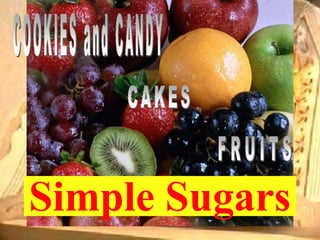
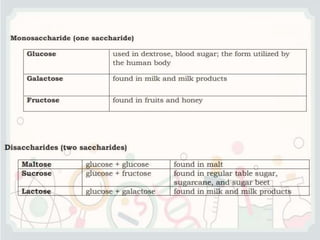
Simple Sugars are
carbohydrates made up of
1 or 2 monomers.
They also taste sweet.
Simple Sugars
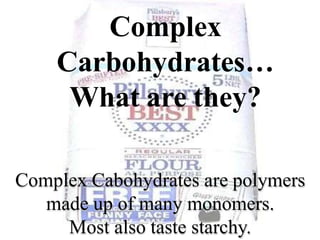
Complex
Carbohydrates…
What are they?
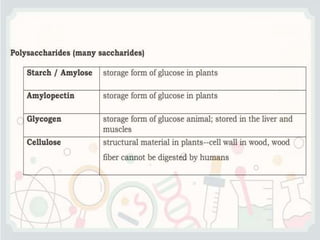
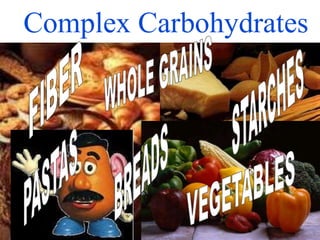
Complex Cabohydrates are polymers
made up of many monomers.
Most also taste starchy.
Complex Carbohydrates
CARBOHYDRATES
•Carbohydrates are chains (polymers)
made of monomers. The most
common monomer of carbohydrates
is…
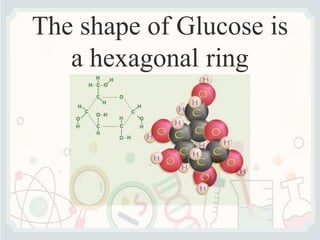
The shape of Glucose is
a hexagonal ring
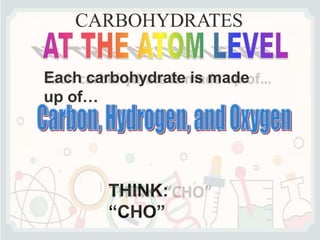
CARBOHYDRATES
Each carbohydrate is made
up of…
THINK:
“CHO”
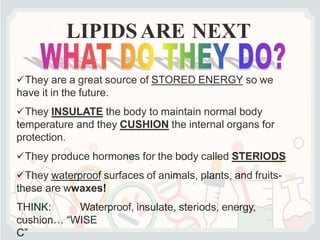
LIPIDSARE NEXT
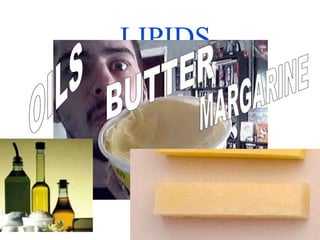
They are a great source of STORED ENERGY so we
have it in the future.
They INSULATE the body to maintain normal body
temperature and they CUSHION the internal organs for
protection.
They produce hormones for the body called STERIODS
They waterproof surfaces of animals, plants, and fruits-
these are wwaxes!
THINK: Waterproof, insulate, steriods, energy,
cushion… “WISE
C”
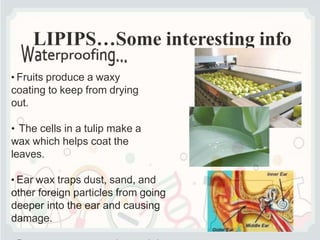
LIPIPS…Some interesting info
• Fruits produce a waxy
coating to keep from drying
out.
• The cells in a tulip make a
wax which helps coat the
leaves.
• Ear wax traps dust, sand, and
other foreign particles from going
deeper into the ear and causing
damage.
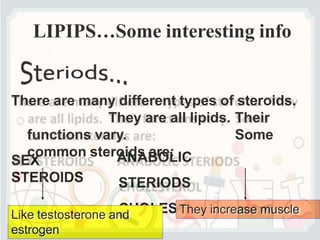
LIPIPS…Some interesting info
There are many different types of steroids.
They are all lipids. Their
functions vary. Some
common steroids are:
SEX
STEROIDS
ANABOLIC
STERIODS
CHOLESTEROL
Like testosterone and
estrogen
They increase muscle
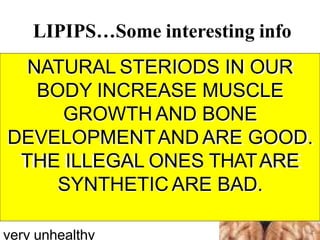
LIPIPS…Some interesting info
Some anabolic
steroids are illegal
And can be dangerous and
NATURAL STERIODS IN OUR
BODY INCREASE MUSCLE
GROWTH AND BONE
DEVELOPMENTAND ARE GOOD.
THE ILLEGAL ONES THATARE
SYNTHETIC ARE BAD.
very unhealthy
LIPIDS
• In plants
• --------------------------------------------------
-
• In animals- in adipose tissue,
connective tissue, in animals
---------------------------------------------------
• Lipids make up the cell membrane
LIPIDS
LIPIDS
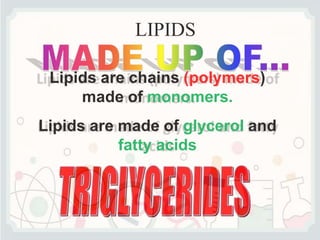
Lipids are chains (polymers)
made of monomers.
Lipids are made of glycerol and
fatty acids
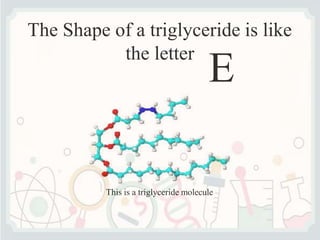
The Shape of a triglyceride is like
the letter
E
This is a triglyceride molecule
LIPIDS
Each carbohydrate is made
up of…
THINK:
“CHO”
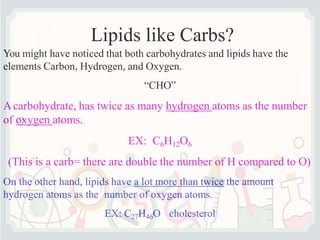
Lipids like Carbs?
You might have noticed that both carbohydrates and lipids have the
elements Carbon, Hydrogen, and Oxygen.
“CHO”
Acarbohydrate, has twice as many hydrogen atoms as the number
of oxygen atoms.
EX: C6H12O6
(This is a carb= there are double the number of H compared to O)
On the other hand, lipids have a lot more than twice the amount
hydrogen atoms as the number of oxygen atoms.
EX: C27H46O cholesterol
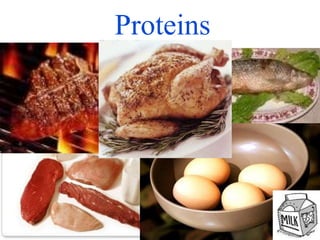
PROTEINS
They are the major structural molecules in living things for
growth and repair : muscles, ligaments, tendons, bones, hair,
skin, nails…IN FACT ALL CELL MEMBRANES have protein in
them
They make up antibodies in the immune system
They make up enzymes for helping chemical reactions
They makeup non-steriod hormones which
THINK: Proteins= membranes, enzymes, antibodies, non-
steriod
hormones, structural molecules, “MEANS”
Examples of proteins
1. Keratin
2. Fibroin / Silk protein
3. Collagen
4. Enzymes
5. Myoglobin
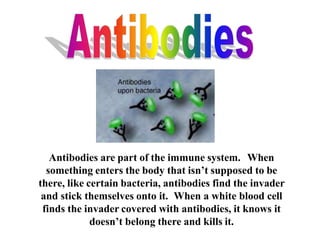
Antibodies are part of the immune system. When
something enters the body that isn’t supposed to be
there, like certain bacteria, antibodies find the invader
and stick themselves onto it. When a white blood cell
finds the invader covered with antibodies, it knows it
doesn’t belong there and kills it.
Enzymes are proteins that speed
up chemical reactions. If you
didn’t have enzymes in your
stomach to speed up digestion, the
food would rot in your stomach
because it would take so long!
Examples of enzymes
a. Lipase - help in digestion of fats
b. Pepsin - help in breaking down proteins
into peptides (smaller units)
c. Sucrase - also called invertase; help in the
digestion of sugars and starches
PROTEINS
• In plant foods- in the cell
membranes
• In animal products- in the cell
membranes- in the muscles or
living things- cows, chicken,
fish…
Proteins
Proteins
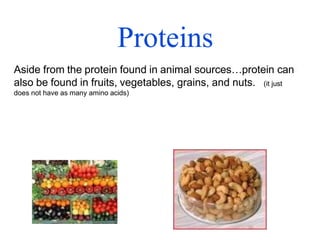
Aside from the protein found in animal sources…protein can
(it just
also be found in fruits, vegetables, grains, and nuts.
does not have as many amino acids)
PROTEINS
•Proteins are made of long chains (polymers) made of monomers. All
proteins are made of the monomer…
PROTEINS
Each protein is made up
of…
THINK:
“CHONS”
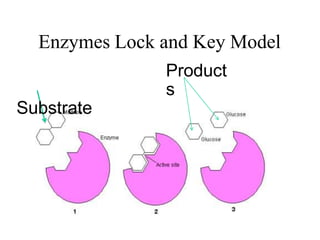
Enzymes Lock and Key Model
Product
s
Substrate
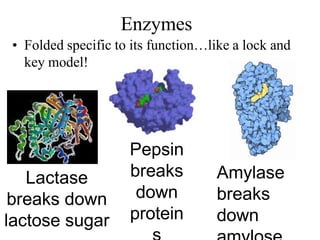
Enzymes
• Folded specific to its function…like a lock and
key model!
Lactase
breaks down
lactose sugar
Pepsin
breaks
down
protein
Amylase
breaks
down
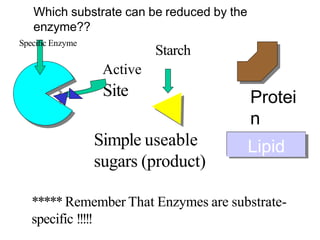
Site
Starch
Active
***** Remember That Enzymes are substrate-
specific !!!!!
Simple useable
sugars (product)
Protei
n
Lipid
Which substrate can be reduced by the
enzyme??
Specific Enzyme
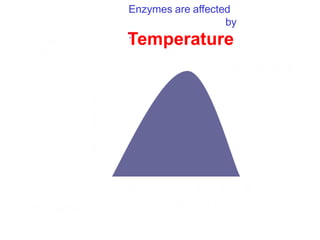
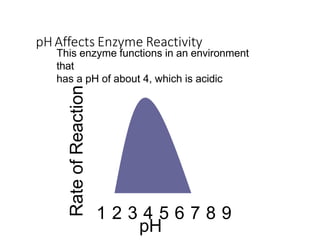
Enzymes are affected
by
:
Rate
of
Reaction
pHAffects Enzyme Reactivity
1 2 3 4 5 6 7 8 9
pH
This enzyme functions in an environment
that
has a pH of about 4, which is acidic
The 4th type is
NUCLEIC
ACIDS
The types of Nucleic
Acids
–DNA (DeoxyriboNucleic
Acid)
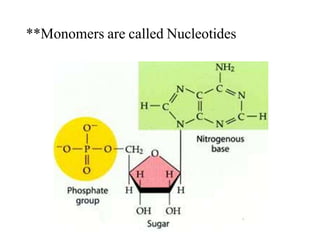
**Monomers are called Nucleotides
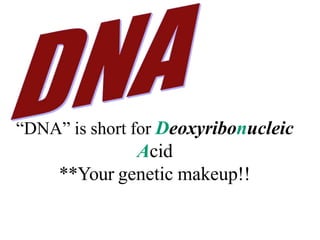
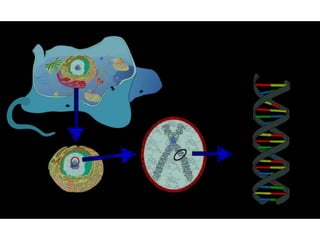
“DNA” is short for Deoxyribonucleic
Acid
**Your genetic makeup!!
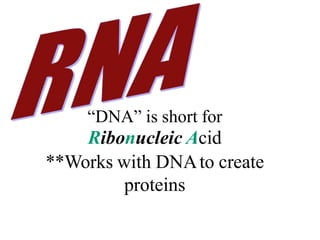
“DNA” is short for
Ribonucleic Acid
**Works with DNAto create
proteins
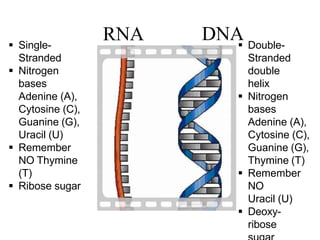
RNA DNA
 Single-
Stranded
 Nitrogen
bases
Adenine (A),
Cytosine (C),
Guanine (G),
Uracil (U)
 Remember
NO Thymine
(T)
 Ribose sugar
 Double-
Stranded
double
helix
 Nitrogen
bases
Adenine (A),
Cytosine (C),
Guanine (G),
Thymine (T)
 Remember
NO
Uracil (U)
 Deoxy-
ribose
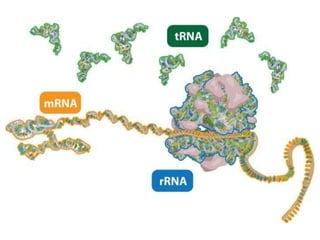
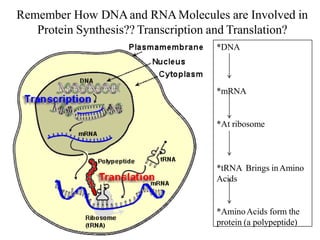
Remember How DNAand RNAMolecules are Involved in
Protein Synthesis?? Transcription and Translation?
*DNA
*mRNA
*At ribosome
*tRNA Brings inAmino
Acids
*AminoAcids form the
protein (a polypeptide)
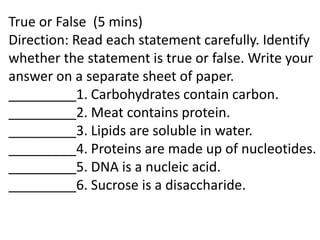
True or False (5 mins)
Direction: Read each statement carefully. Identify
whether the statement is true or false. Write your
answer on a separate sheet of paper.
_________1. Carbohydrates contain carbon.
_________2. Meat contains protein.
_________3. Lipids are soluble in water.
_________4. Proteins are made up of nucleotides.
_________5. DNA is a nucleic acid.
_________6. Sucrose is a disaccharide.
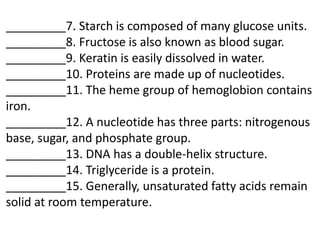
_________7. Starch is composed of many glucose units.
_________8. Fructose is also known as blood sugar.
_________9. Keratin is easily dissolved in water.
_________10. Proteins are made up of nucleotides.
_________11. The heme group of hemoglobion contains
iron.
_________12. A nucleotide has three parts: nitrogenous
base, sugar, and phosphate group.
_________13. DNA has a double-helix structure.
_________14. Triglyceride is a protein.
_________15. Generally, unsaturated fatty acids remain
solid at room temperature.
PHYSICAL SCIENCE BIOLOGICAL MACROMOLECULES.pptx

  • 1.
  • 2.
    Direction: Read thefollowing statements about Intermolecular forces. Identify two true statements and one incorrect statement.
  • 3.
    a) The amountof energy required to stretch the surface area of liquids is called as surface tension b) The weakest forces of attraction are Hydrogen bonds c) Water is often considered as a universal solvent because of its ability to dissolve almost numerous substances.
  • 4.
    ANSWER: b) The weakestforces of attraction are Hydrogen bonds
  • 5.
    2. a) Londondispersion forces predominate in methane, CH4. b) The stronger the intermolecular forces possessed by molecules, the higher is the surface tension of the substance. c) Polar and Nonpolar substances can combine to form a solution
  • 6.
    ANSWER: c) Polar andNonpolar substances can combine to form a solution
  • 7.
    3. a) Londondispersion forces was suggested by German physicist Fritz Wolfgang London. b) Hydrogen bonding happens when bonded to a highly electronegative atom like bromine, argon or calcium c) Intermolecular forces are collectively referred as “van der Waals forces”,
  • 8.
    ANSWER: b) Hydrogen bondinghappens when bonded to a highly electronegative atom like bromine, argon or calcium
  • 9.
    4. a) Solubilityis the ability of a substance to dissolve in a given substance. b) Short-ranged forces that exist between molecules are dipole - dipole forces. c) miscibility is when two liquids combine or mix in all proportions, creating a heterogenous mixture.
  • 10.
    ANSWER: c) miscibility iswhen two liquids combine or mix in all proportions, creating a heterogenous mixture.
  • 11.
    5. a) Thestrength of IMFA greatly affects the physical properties of substances b) capillary action is the ability of liquid molecules to move against gravity. c) volatility is a measure of a liquid’s resistance to flow.
  • 12.
    ANSWER: c) volatility isa measure of a liquid’s resistance to flow.
  • 13.
  • 14.
  • 15.
    What’s an organicmolecule?? • Compounds made up of hydrocarbons • Carbon and Hydrogen atoms!! • Living/once living (YOU are Organic!) • (Not CO2. It’s a gas!!!!!)
  • 16.
    There are fourclasses of biological macromolecules: Proteins, lipids, carbohydrates and nucleic acids
  • 17.
    Before you canunderstand the topics in this unit there are some key vocabulary terms you need to know. Macromolecu le Polymer Monomer
  • 18.
    What do thesewords mean?
  • 19.
  • 20.
    So What IsA Macromolecule? Avery large molecule, such as a polymer or protein, consisting of many smaller structural units linked together….by a process called DEHYDRATION SYNTHESIS
  • 21.
    Biological Macromolecule •All biological macro-moleculeare made up of a small number of elements: Carbon, Hydrogen, Oxygen, (Nitrogen, Phosphorus)
  • 22.
  • 25.
    “Mono” means one SO…a polymer is made up of many monomers!!
  • 26.
    Three out ofthe 4 types of biochemical macromolecules can be found on food nutrition labels…
  • 27.
    Look at thelabel to the left. 3 of the 4 macromolecules can be found in foods. The 3 biochemical molecules found on a nutrition label are: 1 2 3 (0 grams in this product) (13 grams in this product) (9 grams in this product)
  • 28.
    The 4th typeof biochemical macromolecules are the NUCLEIC ACIDS The types of Nucleic Acids –DNA (DeoxyriboNucleic Acid)
  • 29.
    Almost all ofthe molecules that make up your body are polymers, chains of subunits. Each type of macromolecule is a polymer composed of a different type of subunit called a monomer
  • 30.
    The subunits ofthe macromolecules are covalently-bonded. The covalent bonds between the subunits are always formed by a type of reaction called Dehydration Synthesis (making something while losing water).
  • 31.
    During dehydration synthesis, awater molecule is lost, electrons are rearranged, and a new bond is formed between the subunits.
  • 33.
    The structure ofeach type of macromolecules is what determines how the molecules function in our bodies
  • 34.
    Organic Molecules • Carbonatoms are present • Carbon forms four covalent bonds with other atoms • This allows for a wide variety of organic molecules. • Organic molecules are found in both living and non-living things.
  • 35.
    Non-living Organic Molecules •Hydrocarbons: –The simplest organic compound –Contain only carbon and hydrogen –Carbon atoms bond easily to each other forming numerous types of hydrocarbons molecules
  • 36.
    LET’S look a CARBOHYDRA TES Theyare the main source for the body to gain energy. They are our fuel! They make up the cell wall in plants which allow them to grow tall, without this carbohydrate, a plant would be a mushy mess! This type of carbohydrate is called Cellulose. THINK: CARBS= ENERGY and CELL WALLS
  • 37.
  • 38.
    CARBOHYDRATES THERE ARE 2TYPES OF CARBOHYDRATES Simple Complex
  • 39.
    Simple Sugars are carbohydratesmade up of 1 or 2 monomers. They also taste sweet.
  • 40.
  • 43.
    Complex Carbohydrates… What are they? ComplexCabohydrates are polymers made up of many monomers. Most also taste starchy.
  • 44.
  • 45.
    CARBOHYDRATES •Carbohydrates are chains(polymers) made of monomers. The most common monomer of carbohydrates is…
  • 46.
    The shape ofGlucose is a hexagonal ring
  • 47.
    CARBOHYDRATES Each carbohydrate ismade up of… THINK: “CHO”
  • 48.
    LIPIDSARE NEXT They area great source of STORED ENERGY so we have it in the future. They INSULATE the body to maintain normal body temperature and they CUSHION the internal organs for protection. They produce hormones for the body called STERIODS They waterproof surfaces of animals, plants, and fruits- these are wwaxes! THINK: Waterproof, insulate, steriods, energy, cushion… “WISE C”
  • 49.
    LIPIPS…Some interesting info •Fruits produce a waxy coating to keep from drying out. • The cells in a tulip make a wax which helps coat the leaves. • Ear wax traps dust, sand, and other foreign particles from going deeper into the ear and causing damage.
  • 50.
    LIPIPS…Some interesting info Thereare many different types of steroids. They are all lipids. Their functions vary. Some common steroids are: SEX STEROIDS ANABOLIC STERIODS CHOLESTEROL Like testosterone and estrogen They increase muscle
  • 51.
    LIPIPS…Some interesting info Someanabolic steroids are illegal And can be dangerous and NATURAL STERIODS IN OUR BODY INCREASE MUSCLE GROWTH AND BONE DEVELOPMENTAND ARE GOOD. THE ILLEGAL ONES THATARE SYNTHETIC ARE BAD. very unhealthy
  • 52.
    LIPIDS • In plants •-------------------------------------------------- - • In animals- in adipose tissue, connective tissue, in animals --------------------------------------------------- • Lipids make up the cell membrane
  • 53.
  • 54.
    LIPIDS Lipids are chains(polymers) made of monomers. Lipids are made of glycerol and fatty acids
  • 55.
    The Shape ofa triglyceride is like the letter E This is a triglyceride molecule
  • 56.
    LIPIDS Each carbohydrate ismade up of… THINK: “CHO”
  • 57.
    Lipids like Carbs? Youmight have noticed that both carbohydrates and lipids have the elements Carbon, Hydrogen, and Oxygen. “CHO” Acarbohydrate, has twice as many hydrogen atoms as the number of oxygen atoms. EX: C6H12O6 (This is a carb= there are double the number of H compared to O) On the other hand, lipids have a lot more than twice the amount hydrogen atoms as the number of oxygen atoms. EX: C27H46O cholesterol
  • 58.
    PROTEINS They are themajor structural molecules in living things for growth and repair : muscles, ligaments, tendons, bones, hair, skin, nails…IN FACT ALL CELL MEMBRANES have protein in them They make up antibodies in the immune system They make up enzymes for helping chemical reactions They makeup non-steriod hormones which THINK: Proteins= membranes, enzymes, antibodies, non- steriod hormones, structural molecules, “MEANS”
  • 59.
    Examples of proteins 1.Keratin 2. Fibroin / Silk protein 3. Collagen 4. Enzymes 5. Myoglobin
  • 60.
    Antibodies are partof the immune system. When something enters the body that isn’t supposed to be there, like certain bacteria, antibodies find the invader and stick themselves onto it. When a white blood cell finds the invader covered with antibodies, it knows it doesn’t belong there and kills it.
  • 61.
    Enzymes are proteinsthat speed up chemical reactions. If you didn’t have enzymes in your stomach to speed up digestion, the food would rot in your stomach because it would take so long!
  • 62.
    Examples of enzymes a.Lipase - help in digestion of fats b. Pepsin - help in breaking down proteins into peptides (smaller units) c. Sucrase - also called invertase; help in the digestion of sugars and starches
  • 63.
    PROTEINS • In plantfoods- in the cell membranes • In animal products- in the cell membranes- in the muscles or living things- cows, chicken, fish…
  • 64.
  • 65.
    Proteins Aside from theprotein found in animal sources…protein can (it just also be found in fruits, vegetables, grains, and nuts. does not have as many amino acids)
  • 66.
    PROTEINS •Proteins are madeof long chains (polymers) made of monomers. All proteins are made of the monomer…
  • 67.
    PROTEINS Each protein ismade up of… THINK: “CHONS”
  • 68.
    Enzymes Lock andKey Model Product s Substrate
  • 69.
    Enzymes • Folded specificto its function…like a lock and key model! Lactase breaks down lactose sugar Pepsin breaks down protein Amylase breaks down
  • 70.
    Site Starch Active ***** Remember ThatEnzymes are substrate- specific !!!!! Simple useable sugars (product) Protei n Lipid Which substrate can be reduced by the enzyme?? Specific Enzyme
  • 71.
  • 72.
    Rate of Reaction pHAffects Enzyme Reactivity 12 3 4 5 6 7 8 9 pH This enzyme functions in an environment that has a pH of about 4, which is acidic
  • 74.
    The 4th typeis NUCLEIC ACIDS The types of Nucleic Acids –DNA (DeoxyriboNucleic Acid)
  • 75.
  • 76.
    “DNA” is shortfor Deoxyribonucleic Acid **Your genetic makeup!!
  • 78.
    “DNA” is shortfor Ribonucleic Acid **Works with DNAto create proteins
  • 80.
    RNA DNA  Single- Stranded Nitrogen bases Adenine (A), Cytosine (C), Guanine (G), Uracil (U)  Remember NO Thymine (T)  Ribose sugar  Double- Stranded double helix  Nitrogen bases Adenine (A), Cytosine (C), Guanine (G), Thymine (T)  Remember NO Uracil (U)  Deoxy- ribose
  • 81.
    Remember How DNAandRNAMolecules are Involved in Protein Synthesis?? Transcription and Translation? *DNA *mRNA *At ribosome *tRNA Brings inAmino Acids *AminoAcids form the protein (a polypeptide)
  • 85.
    True or False(5 mins) Direction: Read each statement carefully. Identify whether the statement is true or false. Write your answer on a separate sheet of paper. _________1. Carbohydrates contain carbon. _________2. Meat contains protein. _________3. Lipids are soluble in water. _________4. Proteins are made up of nucleotides. _________5. DNA is a nucleic acid. _________6. Sucrose is a disaccharide.
  • 86.
    _________7. Starch iscomposed of many glucose units. _________8. Fructose is also known as blood sugar. _________9. Keratin is easily dissolved in water. _________10. Proteins are made up of nucleotides. _________11. The heme group of hemoglobion contains iron. _________12. A nucleotide has three parts: nitrogenous base, sugar, and phosphate group. _________13. DNA has a double-helix structure. _________14. Triglyceride is a protein. _________15. Generally, unsaturated fatty acids remain solid at room temperature.