Gene Therapy
Prepared by: 3rd year medicine students in
King AbdulAziz University.
Objectives
● 1-Definition of gene therapy.
● 2-Mechanism of gene therapy.
● 3-Types of gene therapy.
● 4-Types of somatic gene therapy.
● 5-Some case study of gene therapy.
● 6-Ethical issues surrounding gene therapy.
• Definition: an experimental technique for correcting
defective genes that are responsible for diseases
development.
What is gene therapy?
• Gene therapy is currently available in research
settings.
• The most common form of gene therapy involves inserting
a normal gene to replace an abnormal gene
• Other approaches used:
▪ Replacing a mutated gene that causes disease with a
healthy copy of the gene.
▪ Inactivating, or “knocking out,” a mutated gene that is
functioning improperly.
▪ Introducing a new gene into the body to help fight a
disease.
What is gene therapy?
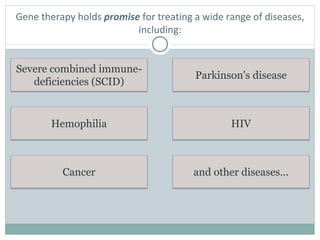
Severe combined immune-
deficiencies (SCID)
Hemophilia
Cancer
Parkinson's disease
HIV
and other diseases...
Gene therapy holds promise for treating a wide range of diseases,
including:
Objective 2
MECHANISM OF GENE
THERAPY
• A gene can't easily be inserted directly into the cells.
Rather, it usually has to be delivered using a carrier,
called a vector.
Mechanism of Gene Therapy
• The vector is genetically engineered to deliver the
gene into cells.
• Certain viruses are often used as vectors because
they can deliver the new gene by infecting the cell.
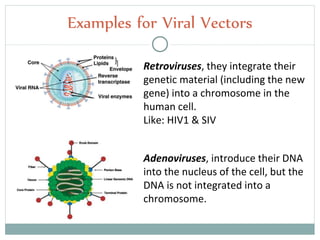
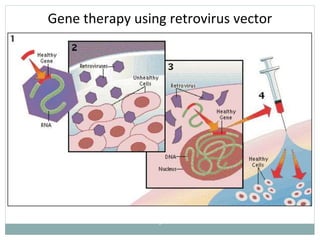
Retroviruses, they integrate their
genetic material (including the new
gene) into a chromosome in the
human cell.
Like: HIV1 & SIV
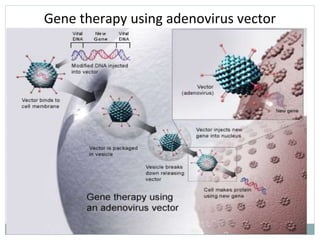
Adenoviruses, introduce their DNA
into the nucleus of the cell, but the
DNA is not integrated into a
chromosome.
Examples for Viral Vectors
9
Gene therapy using retrovirus vector
10
Gene therapy using adenovirus vector
TYPES OF GENE THERAPY
Objective 3
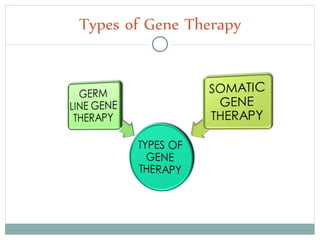
Types of Gene Therapy
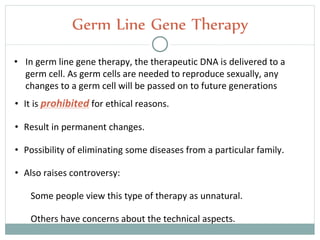
• It is prohibited for ethical reasons.
• Result in permanent changes.
• Possibility of eliminating some diseases from a particular family.
• Also raises controversy:
Some people view this type of therapy as unnatural.
Others have concerns about the technical aspects.
Germ Line Gene Therapy
• In germ line gene therapy, the therapeutic DNA is delivered to a
germ cell. As germ cells are needed to reproduce sexually, any
changes to a germ cell will be passed on to future generations
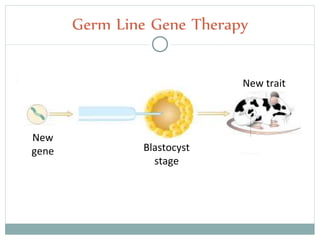
Germ Line Gene Therapy
Transgenic
cell
New
gene Blastocyst
stage
New trait
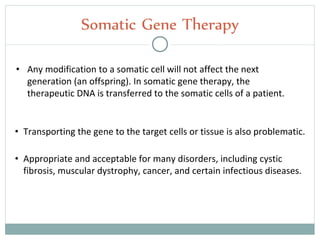
Somatic Gene Therapy
• Transporting the gene to the target cells or tissue is also problematic.
• Appropriate and acceptable for many disorders, including cystic
fibrosis, muscular dystrophy, cancer, and certain infectious diseases.
• Any modification to a somatic cell will not affect the next
generation (an offspring). In somatic gene therapy, the
therapeutic DNA is transferred to the somatic cells of a patient.
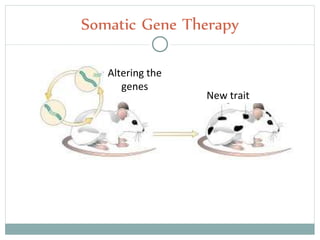
Somatic Gene Therapy
Altering the
genes
New trait
Objective 4
TYPES OF SOMATIC GENE
THERAPY
18
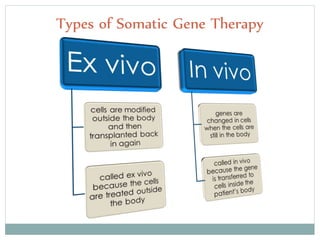
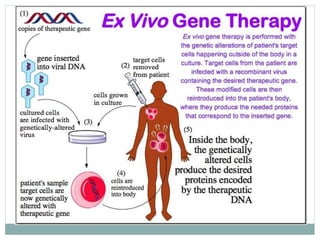
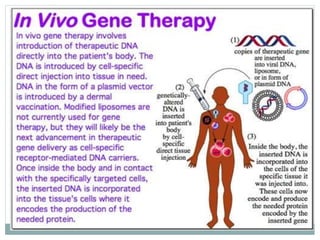
Types of Somatic Gene Therapy
Objective 5
SOME CASE STUDY OF
GENE THERAPY
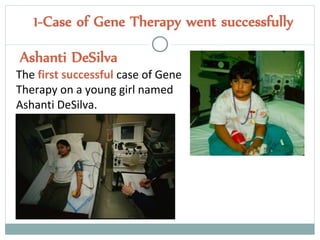
1-Case of Gene Therapy went successfully
Ashanti DeSilva
The first successful case of Gene
Therapy on a young girl named
Ashanti DeSilva.
What was the problem?
• Adenosine deaminase deficiency
• This disease is caused by a mutation in ADA gene.
• What is Adenosine deaminase deficiency?
• It’s an inherited disorder that damages the immune
system by not producing an important enzyme. This
made her immune system weak and vulnerable to
nearly every virus.
What the doctors did ?
1-They extracted some of the girl's white blood cells.
2-Then, they exposed them to a genetically engineered
virus carry normal versions of the gene that was not
3-The virus invaded the white blood cells, and
then these cells were transfused back into the girl.
functioning correctly in the girl.
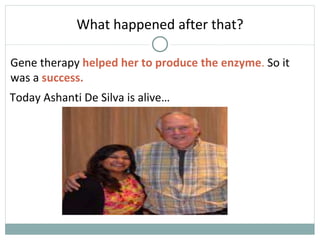
What happened after that?
Gene therapy helped her to produce the enzyme. So it
was a success.
Today Ashanti De Silva is alive…
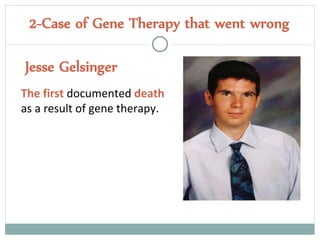
2-Case of Gene Therapy that went wrong
Jesse Gelsinger
The first documented death
as a result of gene therapy.
What was the problem?
• Gelsinger suffered from :
• a rare metabolic disorder called OTC (ornithine
transcarbamylase deficiency).
• What is OTC?
• is an inherited disorder that causes ammonia to
accumulate in the blood.
What the doctors did ?
• Replaced his defective genes with a healthy
one by a vector.
• He suffered symptoms that had never been seen in other
clinical tests that had been performed on (mice, and
another human).
• He had a:
What happened after that?
1. blood-clotting disorder.
2. function loss of: kidney, lungs, and brain.
As a result he died.
• Doctors are still not sure exactly what happened, but
they suspected that he went through reaction with the
vector.
Objective 6
ETHICAL ISSUES
SURROUNDING GENE
THERAPY.
• Because gene therapy involves making changes to
the body’s set of basic instructions, it raises many
unique ethical concerns. The ethical questions
surrounding gene therapy include
Ethical Issues Surrounding Gene Therapy
• How can “good” and “bad” uses of gene therapy be distinguished?
• Who decides which traits are normal and which constitute a disability
or disorder?
• Will the high costs of gene therapy make it available only to the
wealthy?
• Could the widespread use of gene therapy make society less
accepting of people who are different?
• Should people be allowed to use gene therapy to enhance basic
human traits such as height, intelligence, or athletic ability?
• The idea of germline gene therapy is controversial.
While it could spare future generations in a family
from having a particular genetic disorder, it might
affect the development of a fetus in unexpected
ways or have long-term side effects that are not yet
known. Because people who would be affected by
germline gene therapy are not yet born, they can’t
choose whether to have the treatment.
Ethical Issues Surrounding Gene Therapy
• Because of these ethical concerns, the U.S.
Government does not allow federal funds to
be used for research on germline gene
therapy in people.
Ethical Issues Surrounding Gene Therapy
• However, germ line therapy is
not permitted in any county, on
the basis that it is unethical.
1. Give a chance of a normal life to a human born with
a genetic disease.
2. Give hope of healthy life to cancer patient.
3. For certain disease that do not have any cure except
gene therapy, it could save many lives.
Advantages of Gene Therapy
1- The cost is very high.
2-Unwanted immune system reaction.
3-Targeting the wrong cells.
4-Multigene disorders.
5-Viral vectors problems.
Disadvantages and Risks of Gene Therapy
• http://www.mayoclinic.org/tests-procedures/gene-
therapy/basics/definition/prc-20014778
• http://ghr.nlm.nih.gov/handbook/therapy
• http://gene-therapy.yolasite.com/ethics.php
References
Thank you
PREPARED BY: 3RD YEAR
MEDICINE STUDENTS IN KING
ABDULAZIZ UNIVERSITY.

Gene therapy

  • 1.
    Gene Therapy Prepared by:3rd year medicine students in King AbdulAziz University.
  • 2.
    Objectives ● 1-Definition ofgene therapy. ● 2-Mechanism of gene therapy. ● 3-Types of gene therapy. ● 4-Types of somatic gene therapy. ● 5-Some case study of gene therapy. ● 6-Ethical issues surrounding gene therapy.
  • 3.
    • Definition: anexperimental technique for correcting defective genes that are responsible for diseases development. What is gene therapy? • Gene therapy is currently available in research settings.
  • 4.
    • The mostcommon form of gene therapy involves inserting a normal gene to replace an abnormal gene • Other approaches used: ▪ Replacing a mutated gene that causes disease with a healthy copy of the gene. ▪ Inactivating, or “knocking out,” a mutated gene that is functioning improperly. ▪ Introducing a new gene into the body to help fight a disease. What is gene therapy?
  • 5.
    Severe combined immune- deficiencies(SCID) Hemophilia Cancer Parkinson's disease HIV and other diseases... Gene therapy holds promise for treating a wide range of diseases, including:
  • 6.
  • 7.
    • A genecan't easily be inserted directly into the cells. Rather, it usually has to be delivered using a carrier, called a vector. Mechanism of Gene Therapy • The vector is genetically engineered to deliver the gene into cells. • Certain viruses are often used as vectors because they can deliver the new gene by infecting the cell.
  • 8.
    Retroviruses, they integratetheir genetic material (including the new gene) into a chromosome in the human cell. Like: HIV1 & SIV Adenoviruses, introduce their DNA into the nucleus of the cell, but the DNA is not integrated into a chromosome. Examples for Viral Vectors
  • 9.
    9 Gene therapy usingretrovirus vector
  • 10.
    10 Gene therapy usingadenovirus vector
  • 11.
    TYPES OF GENETHERAPY Objective 3
  • 12.
  • 13.
    • It isprohibited for ethical reasons. • Result in permanent changes. • Possibility of eliminating some diseases from a particular family. • Also raises controversy: Some people view this type of therapy as unnatural. Others have concerns about the technical aspects. Germ Line Gene Therapy • In germ line gene therapy, the therapeutic DNA is delivered to a germ cell. As germ cells are needed to reproduce sexually, any changes to a germ cell will be passed on to future generations
  • 14.
    Germ Line GeneTherapy Transgenic cell New gene Blastocyst stage New trait
  • 15.
    Somatic Gene Therapy •Transporting the gene to the target cells or tissue is also problematic. • Appropriate and acceptable for many disorders, including cystic fibrosis, muscular dystrophy, cancer, and certain infectious diseases. • Any modification to a somatic cell will not affect the next generation (an offspring). In somatic gene therapy, the therapeutic DNA is transferred to the somatic cells of a patient.
  • 16.
    Somatic Gene Therapy Alteringthe genes New trait
  • 17.
    Objective 4 TYPES OFSOMATIC GENE THERAPY
  • 18.
    18 Types of SomaticGene Therapy
  • 21.
    Objective 5 SOME CASESTUDY OF GENE THERAPY
  • 22.
    1-Case of GeneTherapy went successfully Ashanti DeSilva The first successful case of Gene Therapy on a young girl named Ashanti DeSilva.
  • 23.
    What was theproblem? • Adenosine deaminase deficiency • This disease is caused by a mutation in ADA gene. • What is Adenosine deaminase deficiency? • It’s an inherited disorder that damages the immune system by not producing an important enzyme. This made her immune system weak and vulnerable to nearly every virus.
  • 24.
    What the doctorsdid ? 1-They extracted some of the girl's white blood cells. 2-Then, they exposed them to a genetically engineered virus carry normal versions of the gene that was not 3-The virus invaded the white blood cells, and then these cells were transfused back into the girl. functioning correctly in the girl.
  • 25.
    What happened afterthat? Gene therapy helped her to produce the enzyme. So it was a success. Today Ashanti De Silva is alive…
  • 26.
    2-Case of GeneTherapy that went wrong Jesse Gelsinger The first documented death as a result of gene therapy.
  • 27.
    What was theproblem? • Gelsinger suffered from : • a rare metabolic disorder called OTC (ornithine transcarbamylase deficiency). • What is OTC? • is an inherited disorder that causes ammonia to accumulate in the blood.
  • 28.
    What the doctorsdid ? • Replaced his defective genes with a healthy one by a vector.
  • 29.
    • He sufferedsymptoms that had never been seen in other clinical tests that had been performed on (mice, and another human). • He had a: What happened after that? 1. blood-clotting disorder. 2. function loss of: kidney, lungs, and brain. As a result he died. • Doctors are still not sure exactly what happened, but they suspected that he went through reaction with the vector.
  • 30.
  • 31.
    • Because genetherapy involves making changes to the body’s set of basic instructions, it raises many unique ethical concerns. The ethical questions surrounding gene therapy include Ethical Issues Surrounding Gene Therapy
  • 32.
    Ethical Issues SurroundingGene Therapy • How can “good” and “bad” uses of gene therapy be distinguished? • Who decides which traits are normal and which constitute a disability or disorder? • Will the high costs of gene therapy make it available only to the wealthy? • Could the widespread use of gene therapy make society less accepting of people who are different? • Should people be allowed to use gene therapy to enhance basic human traits such as height, intelligence, or athletic ability?
  • 33.
    • The ideaof germline gene therapy is controversial. While it could spare future generations in a family from having a particular genetic disorder, it might affect the development of a fetus in unexpected ways or have long-term side effects that are not yet known. Because people who would be affected by germline gene therapy are not yet born, they can’t choose whether to have the treatment. Ethical Issues Surrounding Gene Therapy
  • 34.
    • Because ofthese ethical concerns, the U.S. Government does not allow federal funds to be used for research on germline gene therapy in people. Ethical Issues Surrounding Gene Therapy • However, germ line therapy is not permitted in any county, on the basis that it is unethical.
  • 35.
    1. Give achance of a normal life to a human born with a genetic disease. 2. Give hope of healthy life to cancer patient. 3. For certain disease that do not have any cure except gene therapy, it could save many lives. Advantages of Gene Therapy
  • 36.
    1- The costis very high. 2-Unwanted immune system reaction. 3-Targeting the wrong cells. 4-Multigene disorders. 5-Viral vectors problems. Disadvantages and Risks of Gene Therapy
  • 37.
  • 38.
    Thank you PREPARED BY:3RD YEAR MEDICINE STUDENTS IN KING ABDULAZIZ UNIVERSITY.