1
GENDER
SOCIALIZATION Presentedby
Mahalakshmi M
Central University of Tamilnadu
22
➢Gender is a social construct. An individual’s gender is
their social identity resulting from their culture’s
conceptions of masculinity and femininity.
➢Individual develop their own gender identity, influenced
in part by the process of gender socialization.
3
‘Gender Socialization is a process whereby humans in
the course of social interaction as well as
exposure and reactions to diverse information are
moulded and continuallyshaped to culturally
appropriate images of femaleness and maleness’.
4
The process of gender socialization begins early in life. Children develop an
understanding of gender categories at a young age. Studies have shown that
children can discern male voices from female voices at six months old, and
can differentiate between men and women in photographs at nine months
old. Between 11 and 14 months,children develop the ability to associate sight
and sound, matching male and female voices with photographs of men and
women. By age three, children have formed their own ender identity.They
have also begun to learn their culture’s gender norms, includingwhich toys,
activities,behaviors, and attitudes are associated with each gender.
Children were observes and imitate the behaviors of same gender model than
opposite gender model. So gender categorization is a significant part of a
child’s social development.
5
The process of gender socialization continues as adolescents enter
the workforce. Research has found that adolescents encounter
stereotypes of gendered performance in the workforce in their first
jobs. First jobs are significantly segregated by sex. Girls work fewer
hours and earn less per hour than boys. Hourly wages are higher in
job types dominated by boys while girls are more frequently assigned
housework and childcare duties. The impact of these first
experiences in the professional world will shape adolescents
perspectives on how men and women behave differently in the
workforce.
6
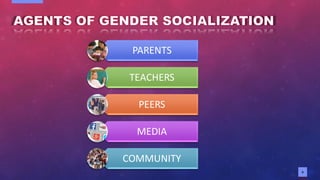
PARENTS
TEACHERS
PEERS
MEDIA
COMMUNITY
777
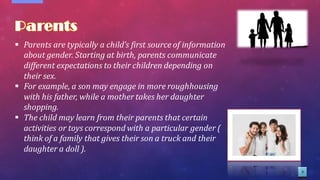
▪ Parents are typically a child’s first source of information
about gender. Starting at birth, parents communicate
different expectations to their children depending on
their sex.
▪ For example, a son may engage in more roughhousing
with his father, while a mother takes her daughter
shopping.
▪ The child may learn from their parents that certain
activities or toys correspond with a particular gender (
think of a family that gives their son a truck and their
daughter a doll ).
8
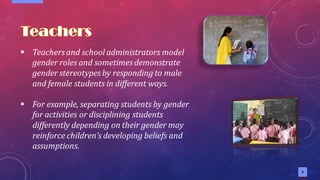
▪ Teachers and school administrators model
gender roles and sometimes demonstrate
gender stereotypes by responding to male
and female students in different ways.
▪ For example, separating students by gender
for activities or disciplining students
differently depending on their gender may
reinforce children’s developing beliefs and
assumptions.
9
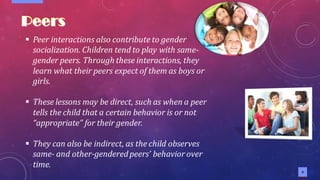
▪ Peer interactions also contribute to gender
socialization. Children tend to play with same-
gender peers. Through these interactions, they
learn what their peers expect of them as boys or
girls.
▪ These lessons may be direct, such as when a peer
tells the child that a certain behavior is or not
“appropriate” for their gender.
▪ They can also be indirect, as the child observes
same- and other-genderedpeers’ behavior over
time.
10
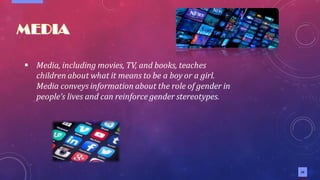
▪ Media, including movies, TV, and books, teaches
children about what it means to be a boy or a girl.
Media conveys information about the role of gender in
people’s lives and can reinforce gender stereotypes.
1111
▪ Mass media in gender socialization includes Linguistic sexism, The
print media, Television.
▪ Language is a medium of socialization. A child learns the language of
his or her culture and shapes his/her behavior in accordancewith that
culture.
▪ The research studies indicates that men and women speak different
gender lets.
▪ Women’s conversation have a cooperative character, where as men’s
conversation’s are move competitive, less social and more
individualistic.
12
12
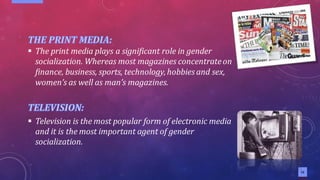
▪ The print media plays a significant role in gender
socialization. Whereas most magazines concentrateon
finance, business, sports, technology,hobbies and sex,
women’s as well as man’s magazines.
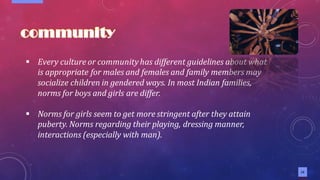
▪ Television is the most popular form of electronic media
and it is the most important agent of gender
socialization.
13
▪ Every culture or communityhas different guidelines about what
is appropriate for males and females and family members may
socialize children in gendered ways. In most Indian families,
norms for boys and girls are differ.
▪ Norms for girls seem to get more stringent after they attain
puberty. Norms regarding their playing, dressing manner,
interactions (especially with man).
14
14
▪ Certain Traditions Also May Contribute To
Gender Socialization.
For Example, AmongMembers Of Zemei Naga
Tribe Of North East India, Men Are Forbidden
To Touch The Meat Of An Animal Killed By An
Woman, As It Considered TouchingThe Meat
Would Be Below Their Dignity Because Bravery
Is A Quality Of Men And Docility Is Quality Of
Women.
151515
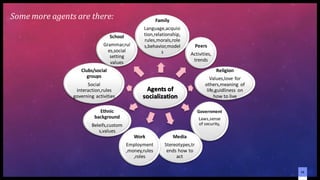
Some more agents are there:
Agents of
socialization
Family
Language,acquisi
tion,relationship,
rules,morals,role
s,behavior,model
s
Peers
Activities,
trends
Religion
Values,love for
others,meaning of
life,guidliness on
how to live
Government
Laws,sense
of security,
Media
Stereotypes,tr
ends how to
act
Work
Employment
,money,rules
,roles
Ethnic
background
Beleifs,custom
s,values
Clubs/social
groups
Social
interaction,rules
governing activities
School
Grammar,rul
es,social
setting
values
16
➢ Gender socialization is a lifelong process.The beliefs about gender that we
acquire in childhood can affect us throughout our lives. The impact of this
socialization can be big (shaping what we believe we are capable of
accomplishing and thus potentially determining our life's course), small
(influencing the color we choose for our bedroomwalls), or somewhere in
the middle.
➢ As adults, our beliefs about gender may grow more nuanced and flexible,
but gender socialization can still affect our behavior,whether in school, the
workplace,or our relationships.
17
➢www.thoughtco.com
➢courses.lumenlearning.com
➢www.researchgate.net
➢www.sciencedirect.com
18

GENDER SOCIALIZATION

  • 1.
  • 2.
    22 ➢Gender is asocial construct. An individual’s gender is their social identity resulting from their culture’s conceptions of masculinity and femininity. ➢Individual develop their own gender identity, influenced in part by the process of gender socialization.
  • 3.
    3 ‘Gender Socialization isa process whereby humans in the course of social interaction as well as exposure and reactions to diverse information are moulded and continuallyshaped to culturally appropriate images of femaleness and maleness’.
  • 4.
    4 The process ofgender socialization begins early in life. Children develop an understanding of gender categories at a young age. Studies have shown that children can discern male voices from female voices at six months old, and can differentiate between men and women in photographs at nine months old. Between 11 and 14 months,children develop the ability to associate sight and sound, matching male and female voices with photographs of men and women. By age three, children have formed their own ender identity.They have also begun to learn their culture’s gender norms, includingwhich toys, activities,behaviors, and attitudes are associated with each gender. Children were observes and imitate the behaviors of same gender model than opposite gender model. So gender categorization is a significant part of a child’s social development.
  • 5.
    5 The process ofgender socialization continues as adolescents enter the workforce. Research has found that adolescents encounter stereotypes of gendered performance in the workforce in their first jobs. First jobs are significantly segregated by sex. Girls work fewer hours and earn less per hour than boys. Hourly wages are higher in job types dominated by boys while girls are more frequently assigned housework and childcare duties. The impact of these first experiences in the professional world will shape adolescents perspectives on how men and women behave differently in the workforce.
  • 6.
  • 7.
    777 ▪ Parents aretypically a child’s first source of information about gender. Starting at birth, parents communicate different expectations to their children depending on their sex. ▪ For example, a son may engage in more roughhousing with his father, while a mother takes her daughter shopping. ▪ The child may learn from their parents that certain activities or toys correspond with a particular gender ( think of a family that gives their son a truck and their daughter a doll ).
  • 8.
    8 ▪ Teachers andschool administrators model gender roles and sometimes demonstrate gender stereotypes by responding to male and female students in different ways. ▪ For example, separating students by gender for activities or disciplining students differently depending on their gender may reinforce children’s developing beliefs and assumptions.
  • 9.
    9 ▪ Peer interactionsalso contribute to gender socialization. Children tend to play with same- gender peers. Through these interactions, they learn what their peers expect of them as boys or girls. ▪ These lessons may be direct, such as when a peer tells the child that a certain behavior is or not “appropriate” for their gender. ▪ They can also be indirect, as the child observes same- and other-genderedpeers’ behavior over time.
  • 10.
    10 ▪ Media, includingmovies, TV, and books, teaches children about what it means to be a boy or a girl. Media conveys information about the role of gender in people’s lives and can reinforce gender stereotypes.
  • 11.
    1111 ▪ Mass mediain gender socialization includes Linguistic sexism, The print media, Television. ▪ Language is a medium of socialization. A child learns the language of his or her culture and shapes his/her behavior in accordancewith that culture. ▪ The research studies indicates that men and women speak different gender lets. ▪ Women’s conversation have a cooperative character, where as men’s conversation’s are move competitive, less social and more individualistic.
  • 12.
    12 12 ▪ The printmedia plays a significant role in gender socialization. Whereas most magazines concentrateon finance, business, sports, technology,hobbies and sex, women’s as well as man’s magazines. ▪ Television is the most popular form of electronic media and it is the most important agent of gender socialization.
  • 13.
    13 ▪ Every cultureor communityhas different guidelines about what is appropriate for males and females and family members may socialize children in gendered ways. In most Indian families, norms for boys and girls are differ. ▪ Norms for girls seem to get more stringent after they attain puberty. Norms regarding their playing, dressing manner, interactions (especially with man).
  • 14.
    14 14 ▪ Certain TraditionsAlso May Contribute To Gender Socialization. For Example, AmongMembers Of Zemei Naga Tribe Of North East India, Men Are Forbidden To Touch The Meat Of An Animal Killed By An Woman, As It Considered TouchingThe Meat Would Be Below Their Dignity Because Bravery Is A Quality Of Men And Docility Is Quality Of Women.
  • 15.
    151515 Some more agentsare there: Agents of socialization Family Language,acquisi tion,relationship, rules,morals,role s,behavior,model s Peers Activities, trends Religion Values,love for others,meaning of life,guidliness on how to live Government Laws,sense of security, Media Stereotypes,tr ends how to act Work Employment ,money,rules ,roles Ethnic background Beleifs,custom s,values Clubs/social groups Social interaction,rules governing activities School Grammar,rul es,social setting values
  • 16.
    16 ➢ Gender socializationis a lifelong process.The beliefs about gender that we acquire in childhood can affect us throughout our lives. The impact of this socialization can be big (shaping what we believe we are capable of accomplishing and thus potentially determining our life's course), small (influencing the color we choose for our bedroomwalls), or somewhere in the middle. ➢ As adults, our beliefs about gender may grow more nuanced and flexible, but gender socialization can still affect our behavior,whether in school, the workplace,or our relationships.
  • 17.
  • 18.