Presentation of
Gender, School and
Society
Topic- Gender,
Socialization and
Features
Presented by- Ankit
What is Gender?
• Gender refers to the social and cultural
roles, behaviors, and attributes
considered by society which are
appropriate for men and women.
• It is distinct from biological sex, which
refers to physical and physiological
differences.
• Gender is dynamic, constructed,
learned, and performed rather than
fixed.
Gender v/s Sex
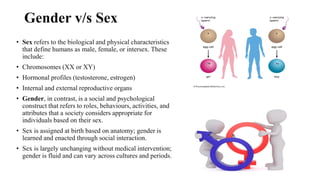
• Sex refers to the biological and physical characteristics
that define humans as male, female, or intersex. These
include:
• Chromosomes (XX or XY)
• Hormonal profiles (testosterone, estrogen)
• Internal and external reproductive organs
• Gender, in contrast, is a social and psychological
construct that refers to roles, behaviours, activities, and
attributes that a society considers appropriate for
individuals based on their sex.
• Sex is assigned at birth based on anatomy; gender is
learned and enacted through social interaction.
• Sex is largely unchanging without medical intervention;
gender is fluid and can vary across cultures and periods.
What is Socialization?
• Socialization is the lifelong process through which
individuals learn the values, norms, behaviors, and
cultural practices of their society.
• It helps people develop their identity, personality,
and social skills.
• It occurs through both formal (e.g., schools,
institutions) and informal (e.g., family, peers, media)
means.
• In the context of gender, socialization refers to how
individuals are taught to behave according to the
expectations associated with their assigned gender.
• From infancy, children are often treated differently
based on whether they are perceived as boys or
girls.
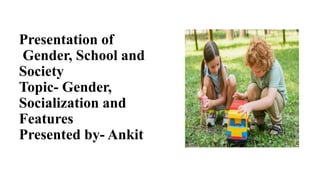
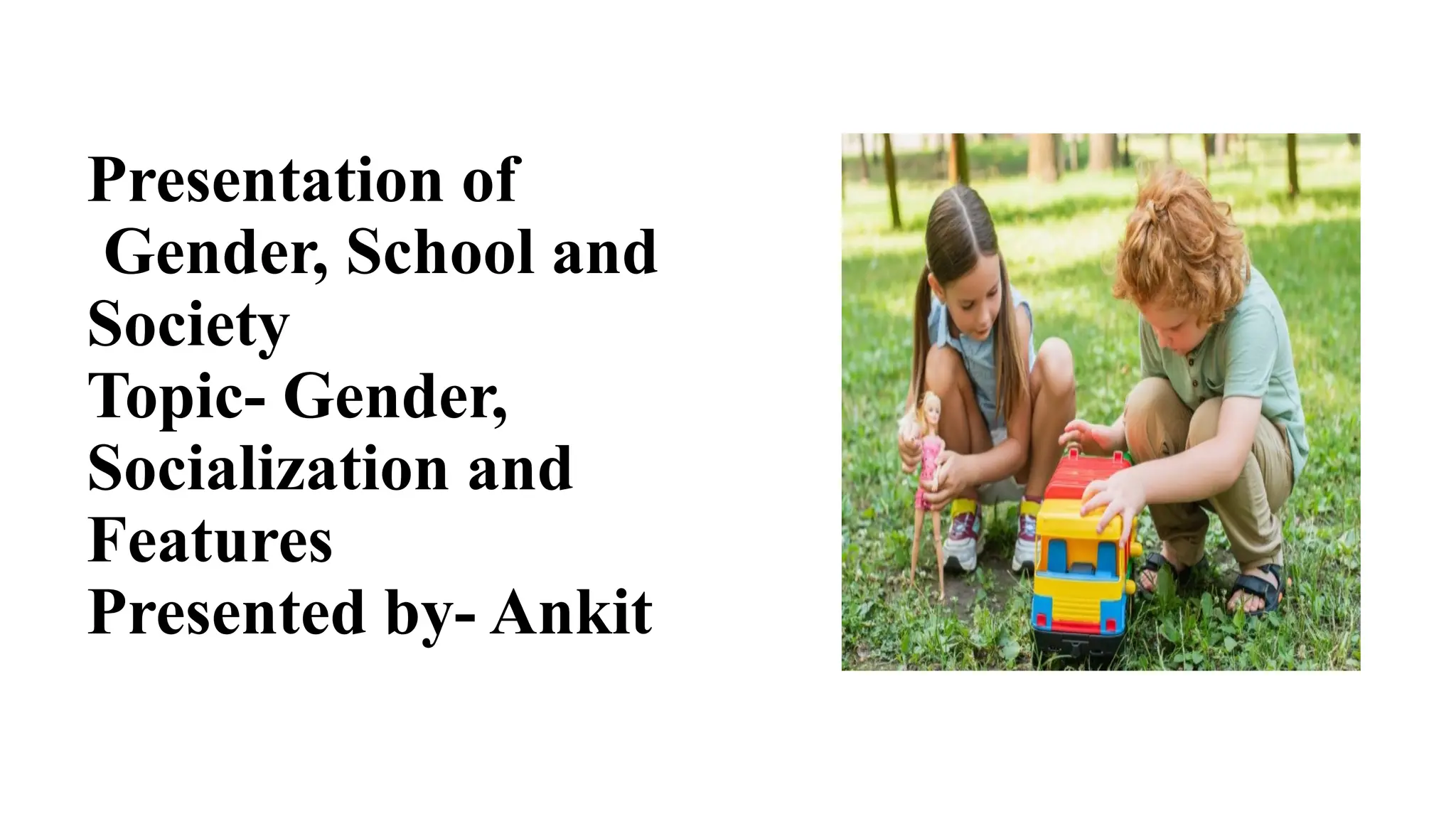
• This includes differences in toys, clothing, speech
patterns, discipline styles, and emotional expression.
Types of Socialization
• Primary Socialization (occurs in early childhood):
• Conducted mainly by the family.
• Teaches basic norms, language, and early gender roles.
• Children begin to internalize expectations of being “boy-
like” or “girl-like.”
• Secondary Socialization (occurs later through broader
society):
• Schools, peer groups, media, and religious institutions
reinforce gender norms.
• For example, boys may be encouraged to play sports
while girls may be steered toward domestic roles.
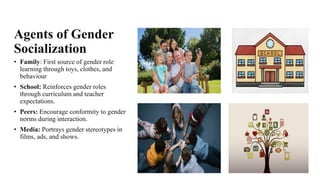
Agents of Gender
Socialization
• Family: First source of gender role
learning through toys, clothes, and
behaviour
• School: Reinforces gender roles
through curriculum and teacher
expectations.
• Peers: Encourage conformity to gender
norms during interaction.
• Media: Portrays gender stereotypes in
films, ads, and shows.
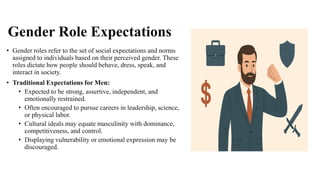
Gender Role Expectations
• Gender roles refer to the set of social expectations and norms
assigned to individuals based on their perceived gender. These
roles dictate how people should behave, dress, speak, and
interact in society.
• Traditional Expectations for Men:
• Expected to be strong, assertive, independent, and
emotionally restrained.
• Often encouraged to pursue careers in leadership, science,
or physical labor.
• Cultural ideals may equate masculinity with dominance,
competitiveness, and control.
• Displaying vulnerability or emotional expression may be
discouraged.
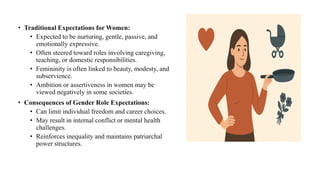
• Traditional Expectations for Women:
• Expected to be nurturing, gentle, passive, and
emotionally expressive.
• Often steered toward roles involving caregiving,
teaching, or domestic responsibilities.
• Femininity is often linked to beauty, modesty, and
subservience.
• Ambition or assertiveness in women may be
viewed negatively in some societies.
• Consequences of Gender Role Expectations:
• Can limit individual freedom and career choices.
• May result in internal conflict or mental health
challenges.
• Reinforces inequality and maintains patriarchal
power structures.
Features of Gender
Socialization
• Normative:
• Gender socialization establishes societal norms for
"acceptable" behaviour based on one’s gender.
• It teaches individuals to conform to traditional gender
roles—what is considered masculine or feminine.
• Differential Treatment:
• Boys and girls are often treated differently from birth.
• Examples include variations in toys, clothing, praise, and
expectations (e.g., boys praised for strength, girls for
appearance or obedience).
• Lifelong Process:
• Gender socialization does not stop after childhood.
• It continues through school, media, workplace,
relationships, and old age— often adapting to life stages
and societal changes.
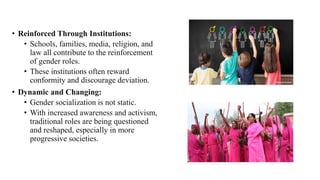
• Reinforced Through Institutions:
• Schools, families, media, religion, and
law all contribute to the reinforcement
of gender roles.
• These institutions often reward
conformity and discourage deviation.
• Dynamic and Changing:
• Gender socialization is not static.
• With increased awareness and activism,
traditional roles are being questioned
and reshaped, especially in more
progressive societies.
Impact of Gender
Socialization
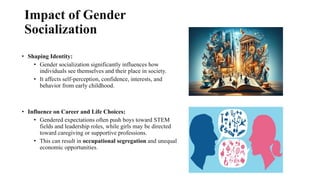
• Shaping Identity:
• Gender socialization significantly influences how
individuals see themselves and their place in society.
• It affects self-perception, confidence, interests, and
behavior from early childhood.
• Influence on Career and Life Choices:
• Gendered expectations often push boys toward STEM
fields and leadership roles, while girls may be directed
toward caregiving or supportive professions.
• This can result in occupational segregation and unequal
economic opportunities.
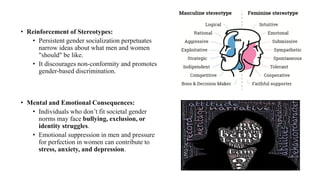
• Reinforcement of Stereotypes:
• Persistent gender socialization perpetuates
narrow ideas about what men and women
"should" be like.
• It discourages non-conformity and promotes
gender-based discrimination.
• Mental and Emotional Consequences:
• Individuals who don’t fit societal gender
norms may face bullying, exclusion, or
identity struggles.
• Emotional suppression in men and pressure
for perfection in women can contribute to
stress, anxiety, and depression.
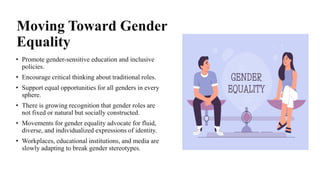
Moving Toward Gender
Equality
• Promote gender-sensitive education and inclusive
policies.
• Encourage critical thinking about traditional roles.
• Support equal opportunities for all genders in every
sphere.
• There is growing recognition that gender roles are
not fixed or natural but socially constructed.
• Movements for gender equality advocate for fluid,
diverse, and individualized expressions of identity.
• Workplaces, educational institutions, and media are
slowly adapting to break gender stereotypes.
Conclusion
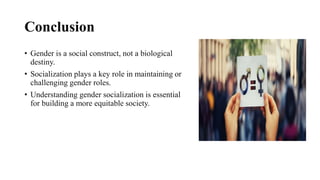
• Gender is a social construct, not a biological
destiny.
• Socialization plays a key role in maintaining or
challenging gender roles.
• Understanding gender socialization is essential
for building a more equitable society.

Gender Equality, socialization, Features and Gender Stereotypes

  • 1.
    Presentation of Gender, Schooland Society Topic- Gender, Socialization and Features Presented by- Ankit
  • 2.
    What is Gender? •Gender refers to the social and cultural roles, behaviors, and attributes considered by society which are appropriate for men and women. • It is distinct from biological sex, which refers to physical and physiological differences. • Gender is dynamic, constructed, learned, and performed rather than fixed.
  • 3.
    Gender v/s Sex •Sex refers to the biological and physical characteristics that define humans as male, female, or intersex. These include: • Chromosomes (XX or XY) • Hormonal profiles (testosterone, estrogen) • Internal and external reproductive organs • Gender, in contrast, is a social and psychological construct that refers to roles, behaviours, activities, and attributes that a society considers appropriate for individuals based on their sex. • Sex is assigned at birth based on anatomy; gender is learned and enacted through social interaction. • Sex is largely unchanging without medical intervention; gender is fluid and can vary across cultures and periods.
  • 4.
    What is Socialization? •Socialization is the lifelong process through which individuals learn the values, norms, behaviors, and cultural practices of their society. • It helps people develop their identity, personality, and social skills. • It occurs through both formal (e.g., schools, institutions) and informal (e.g., family, peers, media) means. • In the context of gender, socialization refers to how individuals are taught to behave according to the expectations associated with their assigned gender. • From infancy, children are often treated differently based on whether they are perceived as boys or girls. • This includes differences in toys, clothing, speech patterns, discipline styles, and emotional expression.
  • 5.
    Types of Socialization •Primary Socialization (occurs in early childhood): • Conducted mainly by the family. • Teaches basic norms, language, and early gender roles. • Children begin to internalize expectations of being “boy- like” or “girl-like.” • Secondary Socialization (occurs later through broader society): • Schools, peer groups, media, and religious institutions reinforce gender norms. • For example, boys may be encouraged to play sports while girls may be steered toward domestic roles.
  • 6.
    Agents of Gender Socialization •Family: First source of gender role learning through toys, clothes, and behaviour • School: Reinforces gender roles through curriculum and teacher expectations. • Peers: Encourage conformity to gender norms during interaction. • Media: Portrays gender stereotypes in films, ads, and shows.
  • 7.
    Gender Role Expectations •Gender roles refer to the set of social expectations and norms assigned to individuals based on their perceived gender. These roles dictate how people should behave, dress, speak, and interact in society. • Traditional Expectations for Men: • Expected to be strong, assertive, independent, and emotionally restrained. • Often encouraged to pursue careers in leadership, science, or physical labor. • Cultural ideals may equate masculinity with dominance, competitiveness, and control. • Displaying vulnerability or emotional expression may be discouraged.
  • 8.
    • Traditional Expectationsfor Women: • Expected to be nurturing, gentle, passive, and emotionally expressive. • Often steered toward roles involving caregiving, teaching, or domestic responsibilities. • Femininity is often linked to beauty, modesty, and subservience. • Ambition or assertiveness in women may be viewed negatively in some societies. • Consequences of Gender Role Expectations: • Can limit individual freedom and career choices. • May result in internal conflict or mental health challenges. • Reinforces inequality and maintains patriarchal power structures.
  • 9.
    Features of Gender Socialization •Normative: • Gender socialization establishes societal norms for "acceptable" behaviour based on one’s gender. • It teaches individuals to conform to traditional gender roles—what is considered masculine or feminine. • Differential Treatment: • Boys and girls are often treated differently from birth. • Examples include variations in toys, clothing, praise, and expectations (e.g., boys praised for strength, girls for appearance or obedience). • Lifelong Process: • Gender socialization does not stop after childhood. • It continues through school, media, workplace, relationships, and old age— often adapting to life stages and societal changes.
  • 10.
    • Reinforced ThroughInstitutions: • Schools, families, media, religion, and law all contribute to the reinforcement of gender roles. • These institutions often reward conformity and discourage deviation. • Dynamic and Changing: • Gender socialization is not static. • With increased awareness and activism, traditional roles are being questioned and reshaped, especially in more progressive societies.
  • 11.
    Impact of Gender Socialization •Shaping Identity: • Gender socialization significantly influences how individuals see themselves and their place in society. • It affects self-perception, confidence, interests, and behavior from early childhood. • Influence on Career and Life Choices: • Gendered expectations often push boys toward STEM fields and leadership roles, while girls may be directed toward caregiving or supportive professions. • This can result in occupational segregation and unequal economic opportunities.
  • 12.
    • Reinforcement ofStereotypes: • Persistent gender socialization perpetuates narrow ideas about what men and women "should" be like. • It discourages non-conformity and promotes gender-based discrimination. • Mental and Emotional Consequences: • Individuals who don’t fit societal gender norms may face bullying, exclusion, or identity struggles. • Emotional suppression in men and pressure for perfection in women can contribute to stress, anxiety, and depression.
  • 13.
    Moving Toward Gender Equality •Promote gender-sensitive education and inclusive policies. • Encourage critical thinking about traditional roles. • Support equal opportunities for all genders in every sphere. • There is growing recognition that gender roles are not fixed or natural but socially constructed. • Movements for gender equality advocate for fluid, diverse, and individualized expressions of identity. • Workplaces, educational institutions, and media are slowly adapting to break gender stereotypes.
  • 14.
    Conclusion • Gender isa social construct, not a biological destiny. • Socialization plays a key role in maintaining or challenging gender roles. • Understanding gender socialization is essential for building a more equitable society.