GENDER
and
DEVELOPMENT
(GAD)
By: Eloisa A. Rivera
OUTLINE
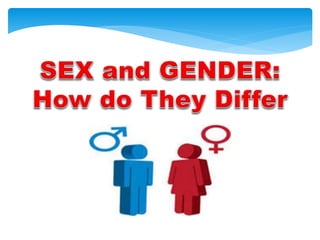
• SEX AND GENDER: HOW DO THEY DIFFER?
• WHAT IS GENDER SOCIALIZATION?
• THE SCHOOL AS A SOCIALIZATION AGENT
• GENDER SOCIALIZATION IN OTHER
LEARNING SETTING
• GENDER-FAIR EDUCATION
-- Dr. Kenneth Cushner, American Professor
Human Diversity in Education: An Intercultural Approach
“An extremely important
part of an individual’s
identity and one that begins
at least at birth, is gender.
It is more than just knowing that you
are male or female.
-Cushner, 2012
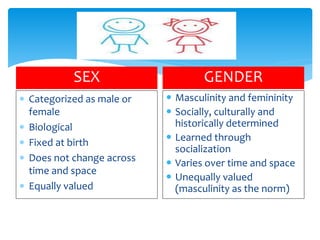
 Categorized as male or
female
 Biological
 Fixed at birth
 Does not change across
time and space
 Equally valued
 Masculinity and femininity
 Socially, culturally and
historically determined
 Learned through
socialization
 Varies over time and space
 Unequally valued
(masculinity as the norm)
SEX GENDER
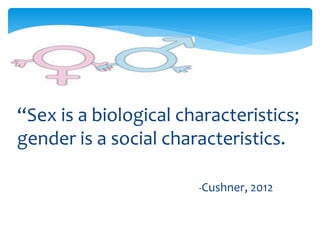
-Cushner, 2012
“Sex is a biological characteristics;
gender is a social characteristics.
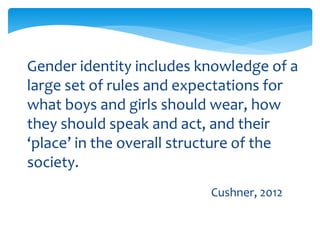
Gender identity includes knowledge of a
large set of rules and expectations for
what boys and girls should wear, how
they should speak and act, and their
‘place’ in the overall structure of the
society.
Cushner, 2012
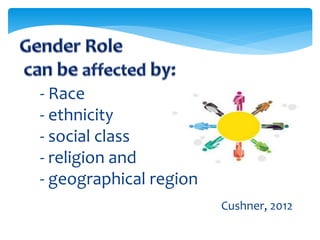
- Race
- ethnicity
- social class
- religion and
- geographical region
Cushner, 2012
If a father does the household work,
he is considered as “under the saya.”
Men are better leaders and
administrators than women.
It is the woman’s fault if she is being
harassed sexually when she is
wearing skimpy clothing.
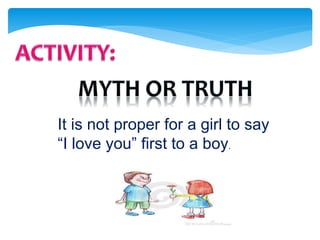
It is not proper for a girl to say
“I love you” first to a boy.
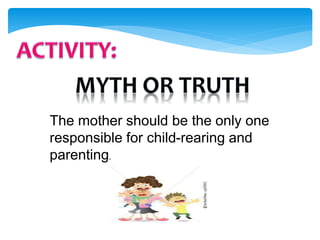
The mother should be the only one
responsible for child-rearing and
parenting.
Socialization – is the process by
which social norms, roles and
expectations are learned and
internalized.
Gender Socialization – is the
process by which norms and
expectations in relation to
gender are learned by women
and men.
Gender stereotype – a form of
prejudgment, bias or limitation
given to roles and expectations of
males and females.
GENDER INVOLVES THE
DIFFERENTIATIONS
attributed by a given culture to women
and men, in the following aspects:
1. social roles
2. capacities
3. traits and characteristics
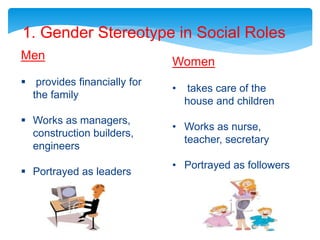
1. Gender Stereotype in Social Roles
Men
 provides financially for
the family
 Works as managers,
construction builders,
engineers
 Portrayed as leaders
Women
• takes care of the
house and children
• Works as nurse,
teacher, secretary
• Portrayed as followers
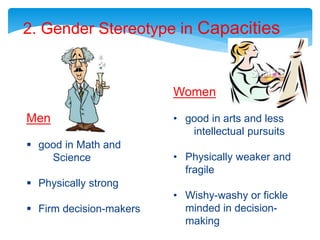
2. Gender Stereotype in Capacities
Men
 good in Math and
Science
 Physically strong
 Firm decision-makers
Women
• good in arts and less
intellectual pursuits
• Physically weaker and
fragile
• Wishy-washy or fickle
minded in decision-
making
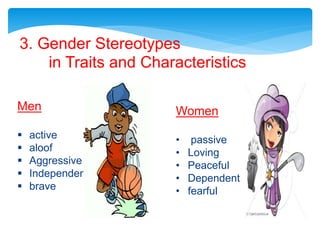
3. Gender Stereotypes
in Traits and Characteristics
Men
 active
 aloof
 Aggressive
 Independent
 brave
Women
• passive
• Loving
• Peaceful
• Dependent
• fearful
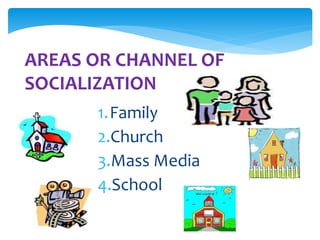
AREAS OR CHANNEL OF
SOCIALIZATION
1.Family
2.Church
3.Mass Media
4.School
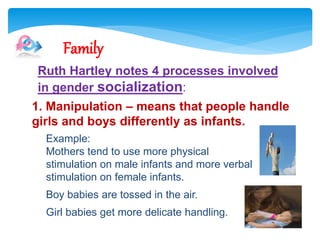
Example:
Mothers tend to use more physical
stimulation on male infants and more verbal
stimulation on female infants.
Boy babies are tossed in the air.
Girl babies get more delicate handling.
Family
Ruth Hartley notes 4 processes involved
in gender socialization:
1. Manipulation – means that people handle
girls and boys differently as infants.
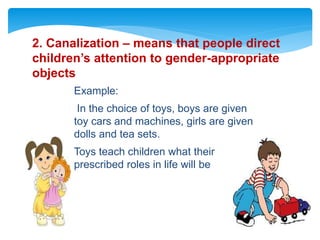
Example:
In the choice of toys, boys are given
toy cars and machines, girls are given
dolls and tea sets.
Toys teach children what their
prescribed roles in life will be
2. Canalization – means that people direct
children’s attention to gender-appropriate
objects
Example:
Brave boy, pretty girl
Boys don’t cry, girls don’t hit playmates
3. Verbal Appellation – telling children
what they are and what is expected of
them.
Example:
Girls help their mother with housework.
Boys are encouraged to play outside the
house
4. Activity exposure – familiarizing
children to their gender-appropriate tasks
church
Gender roles in Christianity vary
considerably today as they have during
the last two millennia. This is especially
true with regards to marriage and
ministry.
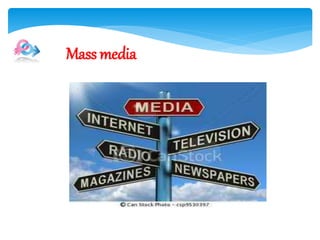
Mass media
Media`s sexualization of young female
celebrities
Music lyrics and music videos that promote
negative stereotypes and violence
Video games that promote violence and
negative stereotypes.
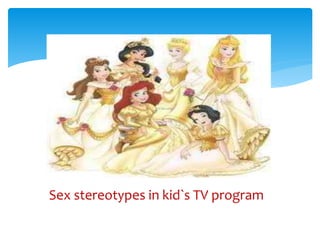
Sex stereotypes in kid`s TV program
school
A. Instructional Language
B. Classroom Management
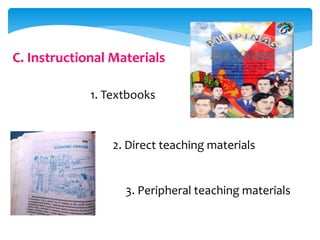
C. Instructional Materials
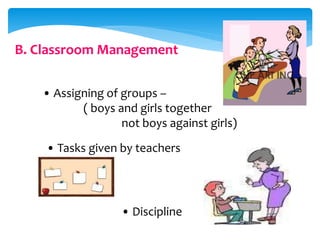
A. Instructional Language
• The use of generic words to refer to
both girls and boys
Example: he, his, man
• The use of stereotyped language
Example:
freshman… first year student
mankind…. humanity
fisherman …fisher folk
chairman ….chairperson
B. Classroom Management
• Assigning of groups –
( boys and girls together
not boys against girls)
• Tasks given by teachers
• Discipline
3. Peripheral teaching materials
C. Instructional Materials
1. Textbooks
2. Direct teaching materials
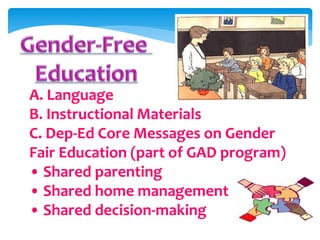
A. Language
B. Instructional Materials
C. Dep-Ed Core Messages on Gender
Fair Education (part of GAD program)
• Shared parenting
• Shared home management
• Shared decision-making
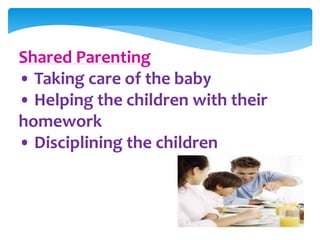
Shared Parenting
• Taking care of the baby
• Helping the children with their
homework
• Disciplining the children
Shared Home Management
• Fixing the house, cleaning the
house
• Doing laundry
• Going to market
• Cooking, preparing the table,
washing the dishes
Share Decision Making
• Family council
• Giving permission to children
• Deciding for the affairs of the
children
THE BIASED TEACHER
Blurred consciousness
Indirectly builds consciousness
Alarmingly unconscious
Supportive of a false consciousness
Enacts a different consciousness
Delays ‘real’ learning
THE GENDER-SENSITIVE TEACHER
Cares to give fair recognition of both genders
Opposes language use that restricts genders
Makes proper addresses a must
Brings forth messages with sensitivity
Avoids exclusionary expressions; and
Treats all individuals with tact
and sense
As teachers, we play a major
role in creating school
environments that are free of
gender bias and in
encouraging both male and
female to reach their highest
potentials in work and
abilities.
GENDER AND DEVELOPMENT

GENDER AND DEVELOPMENT

  • 1.
  • 6.
    OUTLINE • SEX ANDGENDER: HOW DO THEY DIFFER? • WHAT IS GENDER SOCIALIZATION? • THE SCHOOL AS A SOCIALIZATION AGENT • GENDER SOCIALIZATION IN OTHER LEARNING SETTING • GENDER-FAIR EDUCATION
  • 7.
    -- Dr. KennethCushner, American Professor Human Diversity in Education: An Intercultural Approach “An extremely important part of an individual’s identity and one that begins at least at birth, is gender.
  • 8.
    It is morethan just knowing that you are male or female. -Cushner, 2012
  • 10.
     Categorized asmale or female  Biological  Fixed at birth  Does not change across time and space  Equally valued  Masculinity and femininity  Socially, culturally and historically determined  Learned through socialization  Varies over time and space  Unequally valued (masculinity as the norm) SEX GENDER
  • 11.
    -Cushner, 2012 “Sex isa biological characteristics; gender is a social characteristics.
  • 12.
    Gender identity includesknowledge of a large set of rules and expectations for what boys and girls should wear, how they should speak and act, and their ‘place’ in the overall structure of the society. Cushner, 2012
  • 13.
    - Race - ethnicity -social class - religion and - geographical region Cushner, 2012
  • 15.
    If a fatherdoes the household work, he is considered as “under the saya.”
  • 16.
    Men are betterleaders and administrators than women.
  • 17.
    It is thewoman’s fault if she is being harassed sexually when she is wearing skimpy clothing.
  • 18.
    It is notproper for a girl to say “I love you” first to a boy.
  • 19.
    The mother shouldbe the only one responsible for child-rearing and parenting.
  • 20.
    Socialization – isthe process by which social norms, roles and expectations are learned and internalized. Gender Socialization – is the process by which norms and expectations in relation to gender are learned by women and men.
  • 21.
    Gender stereotype –a form of prejudgment, bias or limitation given to roles and expectations of males and females.
  • 22.
    GENDER INVOLVES THE DIFFERENTIATIONS attributedby a given culture to women and men, in the following aspects: 1. social roles 2. capacities 3. traits and characteristics
  • 23.
    1. Gender Stereotypein Social Roles Men  provides financially for the family  Works as managers, construction builders, engineers  Portrayed as leaders Women • takes care of the house and children • Works as nurse, teacher, secretary • Portrayed as followers
  • 24.
    2. Gender Stereotypein Capacities Men  good in Math and Science  Physically strong  Firm decision-makers Women • good in arts and less intellectual pursuits • Physically weaker and fragile • Wishy-washy or fickle minded in decision- making
  • 25.
    3. Gender Stereotypes inTraits and Characteristics Men  active  aloof  Aggressive  Independent  brave Women • passive • Loving • Peaceful • Dependent • fearful
  • 27.
    AREAS OR CHANNELOF SOCIALIZATION 1.Family 2.Church 3.Mass Media 4.School
  • 28.
    Example: Mothers tend touse more physical stimulation on male infants and more verbal stimulation on female infants. Boy babies are tossed in the air. Girl babies get more delicate handling. Family Ruth Hartley notes 4 processes involved in gender socialization: 1. Manipulation – means that people handle girls and boys differently as infants.
  • 29.
    Example: In the choiceof toys, boys are given toy cars and machines, girls are given dolls and tea sets. Toys teach children what their prescribed roles in life will be 2. Canalization – means that people direct children’s attention to gender-appropriate objects
  • 30.
    Example: Brave boy, prettygirl Boys don’t cry, girls don’t hit playmates 3. Verbal Appellation – telling children what they are and what is expected of them.
  • 31.
    Example: Girls help theirmother with housework. Boys are encouraged to play outside the house 4. Activity exposure – familiarizing children to their gender-appropriate tasks
  • 32.
    church Gender roles inChristianity vary considerably today as they have during the last two millennia. This is especially true with regards to marriage and ministry.
  • 33.
  • 34.
    Media`s sexualization ofyoung female celebrities
  • 35.
    Music lyrics andmusic videos that promote negative stereotypes and violence Video games that promote violence and negative stereotypes.
  • 36.
    Sex stereotypes inkid`s TV program
  • 37.
    school A. Instructional Language B.Classroom Management C. Instructional Materials
  • 38.
    A. Instructional Language •The use of generic words to refer to both girls and boys Example: he, his, man • The use of stereotyped language Example: freshman… first year student mankind…. humanity fisherman …fisher folk chairman ….chairperson
  • 39.
    B. Classroom Management •Assigning of groups – ( boys and girls together not boys against girls) • Tasks given by teachers • Discipline
  • 40.
    3. Peripheral teachingmaterials C. Instructional Materials 1. Textbooks 2. Direct teaching materials
  • 44.
    A. Language B. InstructionalMaterials C. Dep-Ed Core Messages on Gender Fair Education (part of GAD program) • Shared parenting • Shared home management • Shared decision-making
  • 45.
    Shared Parenting • Takingcare of the baby • Helping the children with their homework • Disciplining the children
  • 46.
    Shared Home Management •Fixing the house, cleaning the house • Doing laundry • Going to market • Cooking, preparing the table, washing the dishes
  • 47.
    Share Decision Making •Family council • Giving permission to children • Deciding for the affairs of the children
  • 48.
    THE BIASED TEACHER Blurredconsciousness Indirectly builds consciousness Alarmingly unconscious Supportive of a false consciousness Enacts a different consciousness Delays ‘real’ learning
  • 49.
    THE GENDER-SENSITIVE TEACHER Caresto give fair recognition of both genders Opposes language use that restricts genders Makes proper addresses a must Brings forth messages with sensitivity Avoids exclusionary expressions; and Treats all individuals with tact and sense
  • 50.
    As teachers, weplay a major role in creating school environments that are free of gender bias and in encouraging both male and female to reach their highest potentials in work and abilities.