CHEMISTRY FORM 4
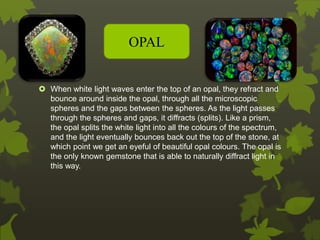
 When white light waves enter the top of an opal, they refract and
bounce around inside the opal, through all the microscopic
spheres and the gaps between the spheres. As the light passes
through the spheres and gaps, it diffracts (splits). Like a prism,
the opal splits the white light into all the colours of the spectrum,
and the light eventually bounces back out the top of the stone, at
which point we get an eyeful of beautiful opal colours. The opal is
the only known gemstone that is able to naturally diffract light in
this way.
OPAL
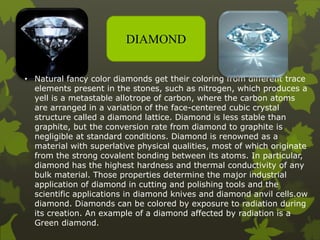
DIAMOND
• Natural fancy color diamonds get their coloring from different trace
elements present in the stones, such as nitrogen, which produces a
yell is a metastable allotrope of carbon, where the carbon atoms
are arranged in a variation of the face-centered cubic crystal
structure called a diamond lattice. Diamond is less stable than
graphite, but the conversion rate from diamond to graphite is
negligible at standard conditions. Diamond is renowned as a
material with superlative physical qualities, most of which originate
from the strong covalent bonding between its atoms. In particular,
diamond has the highest hardness and thermal conductivity of any
bulk material. Those properties determine the major industrial
application of diamond in cutting and polishing tools and the
scientific applications in diamond knives and diamond anvil cells.ow
diamond. Diamonds can be colored by exposure to radiation during
its creation. An example of a diamond affected by radiation is a
Green diamond.
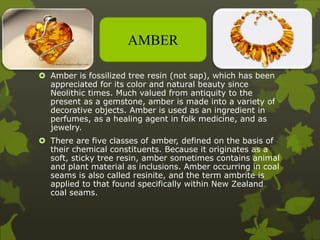
 Amber is fossilized tree resin (not sap), which has been
appreciated for its color and natural beauty since
Neolithic times. Much valued from antiquity to the
present as a gemstone, amber is made into a variety of
decorative objects. Amber is used as an ingredient in
perfumes, as a healing agent in folk medicine, and as
jewelry.
 There are five classes of amber, defined on the basis of
their chemical constituents. Because it originates as a
soft, sticky tree resin, amber sometimes contains animal
and plant material as inclusions. Amber occurring in coal
seams is also called resinite, and the term ambrite is
applied to that found specifically within New Zealand
coal seams.
AMBER
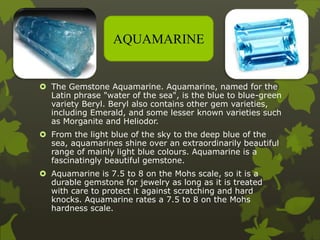
 The Gemstone Aquamarine. Aquamarine, named for the
Latin phrase "water of the sea", is the blue to blue-green
variety Beryl. Beryl also contains other gem varieties,
including Emerald, and some lesser known varieties such
as Morganite and Heliodor.
 From the light blue of the sky to the deep blue of the
sea, aquamarines shine over an extraordinarily beautiful
range of mainly light blue colours. Aquamarine is a
fascinatingly beautiful gemstone.
 Aquamarine is 7.5 to 8 on the Mohs scale, so it is a
durable gemstone for jewelry as long as it is treated
with care to protect it against scratching and hard
knocks. Aquamarine rates a 7.5 to 8 on the Mohs
hardness scale.
AQUAMARINE
 is a typically blue gemstone variety of the mineral corundum, an
aluminium oxide (α-Al2O3). Trace amounts of elements such as
iron, titanium, chromium, copper, or magnesium can give
corundum respectively blue, yellow, purple, orange, or green color.
Chromium impurities in corundum yield pink or red tint, the latter
being called ruby.
 Commonly, sapphires are worn in jewelry. Sapphires may be found
naturally, by searching through certain sediments (due to their
resistance to being eroded compared to softer stones) or rock
formations. They also may be manufactured for industrial or
decorative purposes in large crystal boules. Because of the
remarkable hardness of sapphires – 9 on the Mohs scale (the third
hardest mineral, after diamond at 10 and moissanite at 9.5) – and
of aluminium oxide in general, sapphires are used in some non-
ornamental applications, including infrared optical components,
such as in scientific instruments; high-durability windows;
wristwatch crystals and movement bearings; and very thin
electronic wafers, which are used as the insulating substrates of
very special-purpose solid-state electronics (especially integrated
circuits and GaN-based LEDs).
SAPPHIRE

Chemistry form 4 gemstone

  • 1.
  • 2.
     When whitelight waves enter the top of an opal, they refract and bounce around inside the opal, through all the microscopic spheres and the gaps between the spheres. As the light passes through the spheres and gaps, it diffracts (splits). Like a prism, the opal splits the white light into all the colours of the spectrum, and the light eventually bounces back out the top of the stone, at which point we get an eyeful of beautiful opal colours. The opal is the only known gemstone that is able to naturally diffract light in this way. OPAL
  • 3.
    DIAMOND • Natural fancycolor diamonds get their coloring from different trace elements present in the stones, such as nitrogen, which produces a yell is a metastable allotrope of carbon, where the carbon atoms are arranged in a variation of the face-centered cubic crystal structure called a diamond lattice. Diamond is less stable than graphite, but the conversion rate from diamond to graphite is negligible at standard conditions. Diamond is renowned as a material with superlative physical qualities, most of which originate from the strong covalent bonding between its atoms. In particular, diamond has the highest hardness and thermal conductivity of any bulk material. Those properties determine the major industrial application of diamond in cutting and polishing tools and the scientific applications in diamond knives and diamond anvil cells.ow diamond. Diamonds can be colored by exposure to radiation during its creation. An example of a diamond affected by radiation is a Green diamond.
  • 4.
     Amber isfossilized tree resin (not sap), which has been appreciated for its color and natural beauty since Neolithic times. Much valued from antiquity to the present as a gemstone, amber is made into a variety of decorative objects. Amber is used as an ingredient in perfumes, as a healing agent in folk medicine, and as jewelry.  There are five classes of amber, defined on the basis of their chemical constituents. Because it originates as a soft, sticky tree resin, amber sometimes contains animal and plant material as inclusions. Amber occurring in coal seams is also called resinite, and the term ambrite is applied to that found specifically within New Zealand coal seams. AMBER
  • 5.
     The GemstoneAquamarine. Aquamarine, named for the Latin phrase "water of the sea", is the blue to blue-green variety Beryl. Beryl also contains other gem varieties, including Emerald, and some lesser known varieties such as Morganite and Heliodor.  From the light blue of the sky to the deep blue of the sea, aquamarines shine over an extraordinarily beautiful range of mainly light blue colours. Aquamarine is a fascinatingly beautiful gemstone.  Aquamarine is 7.5 to 8 on the Mohs scale, so it is a durable gemstone for jewelry as long as it is treated with care to protect it against scratching and hard knocks. Aquamarine rates a 7.5 to 8 on the Mohs hardness scale. AQUAMARINE
  • 6.
     is atypically blue gemstone variety of the mineral corundum, an aluminium oxide (α-Al2O3). Trace amounts of elements such as iron, titanium, chromium, copper, or magnesium can give corundum respectively blue, yellow, purple, orange, or green color. Chromium impurities in corundum yield pink or red tint, the latter being called ruby.  Commonly, sapphires are worn in jewelry. Sapphires may be found naturally, by searching through certain sediments (due to their resistance to being eroded compared to softer stones) or rock formations. They also may be manufactured for industrial or decorative purposes in large crystal boules. Because of the remarkable hardness of sapphires – 9 on the Mohs scale (the third hardest mineral, after diamond at 10 and moissanite at 9.5) – and of aluminium oxide in general, sapphires are used in some non- ornamental applications, including infrared optical components, such as in scientific instruments; high-durability windows; wristwatch crystals and movement bearings; and very thin electronic wafers, which are used as the insulating substrates of very special-purpose solid-state electronics (especially integrated circuits and GaN-based LEDs). SAPPHIRE