Shaumik Daityari
   GLT, 2nd year
Gemstone

A gemstone or gem (also called a precious or semi-
precious stone, a fine gem, or jewel) is a piece of
mineral, which, in cut and polished form, is used to
make jewellery or other adornments.

Certain other materials (like amber) which are not
minerals, used to make jewellery, are also called
gemstones.
Classification
Traditional classification in the West: Precious
(diamond, ruby, sapphire and emerald) and Semi-
precious
Chemical Composition: Carbon (Diamond),
Aluminium Oxide (Ruby)
Crystal System: Cubic (Diamond), Hexagonal
(Tourmaline)
Groups and Varieties
Refractive index, dispersion, specific gravity,
hardness, cleavage, fracture, luster, pleochlroism,
birefringence, inclusions
In terms of their “water”: first second and third water
Cutting and Polishing


A citrine preform and the finished faceted stone.


                                                    Raw
                                                    Gemstones
Cutting and Polishing
The process of cutting and polishing gems is
called gemcutting or lapidary.
Gemstone material that has not been extensively
cut and polished is referred to generally as
rough. Rough material that has been lightly
hammered to knock off brittle, fractured material
is said to have been cobbed.
All gems are cut and polished by progressive
abrasion using finer and finer grits of harder
substances.
Diamond and Silicon Carbide used as abrasives.
Treatment
Gemstones are often treated to
enhance the colour or clarity of the
stone. Depending on the type and
extent of treatment, they can affect
the value of the stone. Some
treatments are used widely
because the resulting gem is
stable, while others are not
accepted most commonly because
the gem colour is unstable and
may revert to the original tone.
Diamond
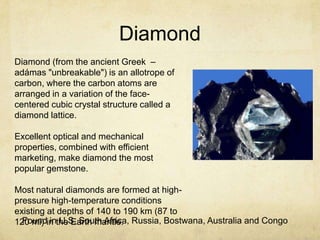
Diamond (from the ancient Greek –
adámas "unbreakable") is an allotrope of
carbon, where the carbon atoms are
arranged in a variation of the face-
centered cubic crystal structure called a
diamond lattice.

Excellent optical and mechanical
properties, combined with efficient
marketing, make diamond the most
popular gemstone.

Most natural diamonds are formed at high-
pressure high-temperature conditions
existing at depths of 140 to 190 km (87 to
120 mi) in the Earth mantle. Russia, Bostwana, Australia and Congo
  Found in U.S, South Africa,
Diamond
Color: Typically yellow, brown or gray to colorless.
Crystal habit: Octahedral Crystal system: Cubic

Cleavage: 111 (perfect in four directions) Fracture:
Conchoidal

Hardness: 10        Luster: AdamantineStreak:
Colorless

Diaphaneity: Transparent Specific gravity: 3.52

Optical properties: Isotropic      Refractive index:
2.418
Diamond Thin Section (PP)


   Colour: Colourless
   Cleavage: Perfectly
   Octahedral
   Relief: Extremely High
Diamonds can be
identified by their high
thermal conductivity.
Their high refractive
index is also indicative.
Also have fairly high
dispersion.

Diamonds can scratch
other diamonds, but         Most gemologists still rely upon
this can result in          skilled use of a loupe
damage to one or both       (magnifying glass) to identify
stones. So hardness         diamonds 'by eye'.
tests rarely used.
Corundum
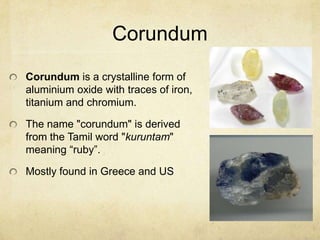
Corundum is a crystalline form of
aluminium oxide with traces of iron,
titanium and chromium.

The name "corundum" is derived
from the Tamil word "kuruntam"
meaning “ruby”.

Mostly found in Greece and US
Corundum
Color: Colorless, gray, brown; pink to pigeon-blood
red

Crystal habit: Rhombohedral crystals, massive or
granular

Crystal system: Trigonal (Hexagonal
Scalenohedral)

Cleavage: None, Rectangular Parting     Hardness:
9

Luster: AdamantineTransparency: Translucent

Specific Gravity: 3.9 - 4.1 Streak: White
Corundum: Optical
            Properties
Colour: Colourless, pale pink, green, blue or yellow
Relief: Very High
Pleochlroism: Yes
Uniaxial (negative)
Extinction: Parallel
Weakly Birefringent
Twinning: Yes
Corundum in PP Light
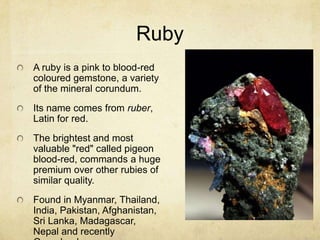
Ruby
A ruby is a pink to blood-red
coloured gemstone, a variety
of the mineral corundum.
Its name comes from ruber,
Latin for red.
The brightest and most
valuable "red" called pigeon
blood-red, commands a huge
premium over other rubies of
similar quality.
Found in Myanmar, Thailand,
India, Pakistan, Afghanistan,
Sri Lanka, Madagascar,
Nepal and recently
Sapphire
Sapphire is a gemstone variety of the
mineral corundum, an aluminium
oxide, when it is a colour other than
red or dark pink.
Trace amounts of other elements such
as iron, titanium, or chromium can give
corundum blue, yellow, pink, purple,
orange, or greenish color.
Name derived from Greek sappheiros,
meaning "blue stone“.
Found in Australia, Thailand, Sri
Lanka, Madagascar and US.
Pink, Padmaraga and Star Sapphires
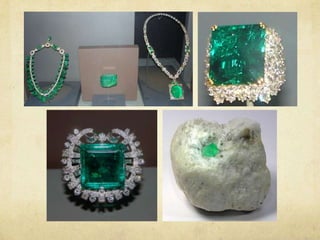
Emerald
Emerald is a variety of the mineral
beryl coloured green by trace
amounts of chromium and
sometimes vanadium.
The word "Emerald" is derived from
either the Hebrew word izmargad
meaning "green“.
Found in Afghanistan, Australia,
Austria, Brazil, Bulgaria, Cambodia,
Canada, China, Egypt, Ethiopia,
France, Germany, India, Italy,
Kazakhstan, Madagascar,
Mozambique, Namibia, Nigeria,
Norway, Pakistan, Russia, Somalia,
South Africa, Spain, Switzerland,
Tanzania, United States, Zambia
and Zimbabwe.
Emerald (Beryl)
Colour: Blue-green

Streak: White        Hardness: 7.5 – 8

Cleavage: Very Poor        Fracture: Even Luster:
Vitreous

Specific Gravity: 2.7 - 2.9 Transparency:
Translucent

Crystal System: Hexagonal

Crystal Habit: Hexagonal Prisms
Emerald: Optical
            Properties
Colour: Colourless

Relief: Low to Moderate

Pleochlroism: Yes

Uniaxial (negative)

Birefringence: Low, first order grays

Cleavage: At right angles
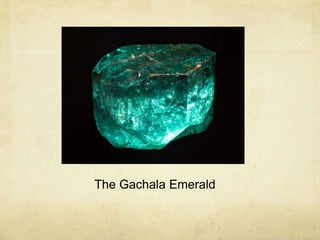
The Gachala Emerald
Tourmaline
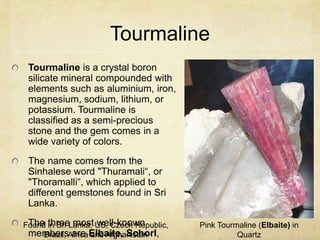
 Tourmaline is a crystal boron
 silicate mineral compounded with
 elements such as aluminium, iron,
 magnesium, sodium, lithium, or
 potassium. Tourmaline is
 classified as a semi-precious
 stone and the gem comes in a
 wide variety of colors.
 The name comes from the
 Sinhalese word "Thuramali“, or
 "Thoramalli“, which applied to
 different gemstones found in Sri
 Lanka.

Found three most US, Czech Republic,
 The in Sri Lanka, well-known          Pink Tourmaline (Elbaite) in
 membersAfrica Elbaite, Schorl,
     Brazil, are and Afghanistan                 Quartz
Tourmaline
Color: Black, brown, green, red, pink, blue, and
gray.
Streak: White
Luster: Resinous
Transparency: Transparent to Opaque; usually
Translucent
Hardness: 7 - 7.5
Crystal System: Hexagonal
Habit: Deformed Triangular Prisms
Cleavage/Fracture: Poor/Conchoidal to Uneven
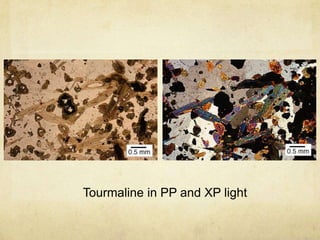
Tourmaline: Optical
            Properties
Colour: Colourless
Pleochlorism: Yes
Relief: High
Uniaxial (Negative)
Cleavage: None but prominent cracks visible
Parallel extinction
Lower 2nd order to lower 3rd order interference
colours.
Tourmaline in PP and XP light
Thermochromism: The
colour of some Tourmaline
can be enhanced through
heat treatment. Some
greenish stones can be
made deep green, some
brownish-red stones can be
made red, and some light
pink stones can be made
colourless through heating.

Tourmaline can form in
extremely aesthetic slender
crystals that are highly
valued by collectors.
Chatoyant variety used as
cat’s eye.
Quartz
Quartz is the second-most-
abundant mineral in the Earth's
continental crust, after feldspar.
There are many different
varieties of quartz, several of
which are semi-precious
gemstones. Especially in
Europe and the Middle East,
varieties of quartz have been
since antiquity the most
commonly used minerals in the
making of jewellery and
hardstone carvings.
Gemstone variety mostly found
in US and Brazil.
Quartz
Colour: Colourless, Milky, Purple, Pink, Yellow,
Brown

Streak: White Specific Gravity: 2.65 Hardness: 7

Cleavage/Fracture: None/Conchoidal or Brittle

Luster: Vitreous Transparency: Transparent to
Opaque

Crystal Shape: Hexagonal

Crystal Habit: Prismatic/Massive
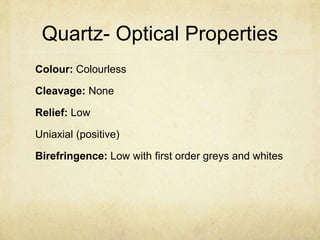
Quartz- Optical Properties
Colour: Colourless

Cleavage: None

Relief: Low

Uniaxial (positive)

Birefringence: Low with first order greys and whites
Quartz in PP and XP Light
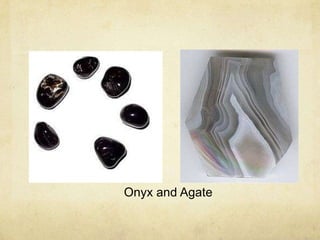
Onyx and Agate
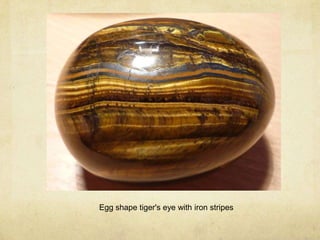
Tiger’s Eye

Tiger's eye is a chatoyant
gemstone that is usually
a metamorphic rock that
is a golden to red-brown
colour, with a silky luster.
Egg shape tiger's eye with iron stripes
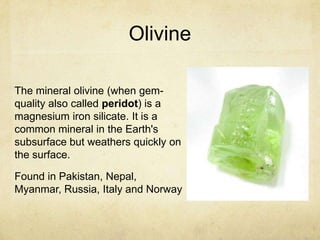
Olivine

The mineral olivine (when gem-
quality also called peridot) is a
magnesium iron silicate. It is a
common mineral in the Earth's
subsurface but weathers quickly on
the surface.

Found in Pakistan, Nepal,
Myanmar, Russia, Italy and Norway
Olivine
Colour: Colourless, Olive Green, Greenish Yellow,
Grey

Streak: White Specific Gravity: 3.1 -3.4 Hardness:
5.5 - 6.5

Cleavage/Fracture: Poor/Conchoidal

Luster: Vitreous Transparency: Translucent

Crystal Shape: Orthorhombic

Crystal Habit: Prisms and Dipyramids
Olivine - Optical Properties
Colour: Colourless to faint green

Cleavage: None

Relief: High

Biaxial

Birefringence: High with mostly third order colours
Olivine in PP and
     XP light
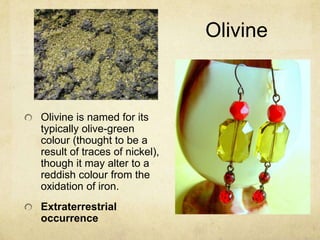
Olivine


Olivine is named for its
typically olive-green
colour (thought to be a
result of traces of nickel),
though it may alter to a
reddish colour from the
oxidation of iron.
Extraterrestrial
occurrence
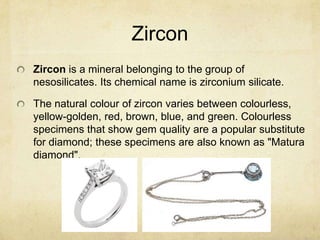
Zircon
Zircon is a mineral belonging to the group of
nesosilicates. Its chemical name is zirconium silicate.

The natural colour of zircon varies between colourless,
yellow-golden, red, brown, blue, and green. Colourless
specimens that show gem quality are a popular substitute
for diamond; these specimens are also known as "Matura
diamond".
Zircon
Colour: Colourless, Brown, Green, Grey, Red

Streak: Colourless - White Specific Gravity: 4.68

Hardness: 7.5 Cleavage/Fracture:
Poor/Conchoidal

Luster: Adamantine

Transparency: Transparent- Translucent

Crystal Shape: Tetragonal

Crystal Habit: Square Prisms, Pyramids or a
combination of the two
Zircon - Optical Properties
Colour: Colourless to faint green

Cleavage: Imperfect

Relief: Very High

Birefringence: High with mostly third to fouth order
colours in Prismatic Sections

Uniaxial (Positive)

Basal Sections are isotropic
Zircon in PP and XP
        Light
Imitations and Artificial
            Gemstones
Some gemstones are manufactured to imitate other gemstones.
They are called imitations.
The imitations copy the look and colour of the real stone but
possess neither their chemical nor physical characteristics.
Lab created gemstones are not imitations. Synthetic (lab
created) corundums, including ruby and sapphire, are very
common and they cost only a fraction of the natural stones.
Whether a gemstone is a natural stone or a lab-created
(synthetic) stone, the characteristics of each are the same.
Lab-created stones tend to have a more vivid colour to them, as
impurities are not present in a lab and do not modify the clarity
or colour of the stone.
Thank you!

Gemstones

  • 1.
    Shaumik Daityari GLT, 2nd year
  • 2.
    Gemstone A gemstone orgem (also called a precious or semi- precious stone, a fine gem, or jewel) is a piece of mineral, which, in cut and polished form, is used to make jewellery or other adornments. Certain other materials (like amber) which are not minerals, used to make jewellery, are also called gemstones.
  • 3.
    Classification Traditional classification inthe West: Precious (diamond, ruby, sapphire and emerald) and Semi- precious Chemical Composition: Carbon (Diamond), Aluminium Oxide (Ruby) Crystal System: Cubic (Diamond), Hexagonal (Tourmaline) Groups and Varieties Refractive index, dispersion, specific gravity, hardness, cleavage, fracture, luster, pleochlroism, birefringence, inclusions In terms of their “water”: first second and third water
  • 4.
    Cutting and Polishing Acitrine preform and the finished faceted stone. Raw Gemstones
  • 5.
    Cutting and Polishing Theprocess of cutting and polishing gems is called gemcutting or lapidary. Gemstone material that has not been extensively cut and polished is referred to generally as rough. Rough material that has been lightly hammered to knock off brittle, fractured material is said to have been cobbed. All gems are cut and polished by progressive abrasion using finer and finer grits of harder substances. Diamond and Silicon Carbide used as abrasives.
  • 6.
    Treatment Gemstones are oftentreated to enhance the colour or clarity of the stone. Depending on the type and extent of treatment, they can affect the value of the stone. Some treatments are used widely because the resulting gem is stable, while others are not accepted most commonly because the gem colour is unstable and may revert to the original tone.
  • 7.
    Diamond Diamond (from theancient Greek – adámas "unbreakable") is an allotrope of carbon, where the carbon atoms are arranged in a variation of the face- centered cubic crystal structure called a diamond lattice. Excellent optical and mechanical properties, combined with efficient marketing, make diamond the most popular gemstone. Most natural diamonds are formed at high- pressure high-temperature conditions existing at depths of 140 to 190 km (87 to 120 mi) in the Earth mantle. Russia, Bostwana, Australia and Congo Found in U.S, South Africa,
  • 8.
    Diamond Color: Typically yellow,brown or gray to colorless. Crystal habit: Octahedral Crystal system: Cubic Cleavage: 111 (perfect in four directions) Fracture: Conchoidal Hardness: 10 Luster: AdamantineStreak: Colorless Diaphaneity: Transparent Specific gravity: 3.52 Optical properties: Isotropic Refractive index: 2.418
  • 9.
    Diamond Thin Section(PP) Colour: Colourless Cleavage: Perfectly Octahedral Relief: Extremely High
  • 10.
    Diamonds can be identifiedby their high thermal conductivity. Their high refractive index is also indicative. Also have fairly high dispersion. Diamonds can scratch other diamonds, but Most gemologists still rely upon this can result in skilled use of a loupe damage to one or both (magnifying glass) to identify stones. So hardness diamonds 'by eye'. tests rarely used.
  • 11.
    Corundum Corundum is acrystalline form of aluminium oxide with traces of iron, titanium and chromium. The name "corundum" is derived from the Tamil word "kuruntam" meaning “ruby”. Mostly found in Greece and US
  • 12.
    Corundum Color: Colorless, gray,brown; pink to pigeon-blood red Crystal habit: Rhombohedral crystals, massive or granular Crystal system: Trigonal (Hexagonal Scalenohedral) Cleavage: None, Rectangular Parting Hardness: 9 Luster: AdamantineTransparency: Translucent Specific Gravity: 3.9 - 4.1 Streak: White
  • 13.
    Corundum: Optical Properties Colour: Colourless, pale pink, green, blue or yellow Relief: Very High Pleochlroism: Yes Uniaxial (negative) Extinction: Parallel Weakly Birefringent Twinning: Yes
  • 14.
  • 15.
    Ruby A ruby isa pink to blood-red coloured gemstone, a variety of the mineral corundum. Its name comes from ruber, Latin for red. The brightest and most valuable "red" called pigeon blood-red, commands a huge premium over other rubies of similar quality. Found in Myanmar, Thailand, India, Pakistan, Afghanistan, Sri Lanka, Madagascar, Nepal and recently
  • 16.
    Sapphire Sapphire is agemstone variety of the mineral corundum, an aluminium oxide, when it is a colour other than red or dark pink. Trace amounts of other elements such as iron, titanium, or chromium can give corundum blue, yellow, pink, purple, orange, or greenish color. Name derived from Greek sappheiros, meaning "blue stone“. Found in Australia, Thailand, Sri Lanka, Madagascar and US.
  • 17.
    Pink, Padmaraga andStar Sapphires
  • 18.
    Emerald Emerald is avariety of the mineral beryl coloured green by trace amounts of chromium and sometimes vanadium. The word "Emerald" is derived from either the Hebrew word izmargad meaning "green“. Found in Afghanistan, Australia, Austria, Brazil, Bulgaria, Cambodia, Canada, China, Egypt, Ethiopia, France, Germany, India, Italy, Kazakhstan, Madagascar, Mozambique, Namibia, Nigeria, Norway, Pakistan, Russia, Somalia, South Africa, Spain, Switzerland, Tanzania, United States, Zambia and Zimbabwe.
  • 19.
    Emerald (Beryl) Colour: Blue-green Streak:White Hardness: 7.5 – 8 Cleavage: Very Poor Fracture: Even Luster: Vitreous Specific Gravity: 2.7 - 2.9 Transparency: Translucent Crystal System: Hexagonal Crystal Habit: Hexagonal Prisms
  • 20.
    Emerald: Optical Properties Colour: Colourless Relief: Low to Moderate Pleochlroism: Yes Uniaxial (negative) Birefringence: Low, first order grays Cleavage: At right angles
  • 21.
  • 23.
    Tourmaline Tourmaline isa crystal boron silicate mineral compounded with elements such as aluminium, iron, magnesium, sodium, lithium, or potassium. Tourmaline is classified as a semi-precious stone and the gem comes in a wide variety of colors. The name comes from the Sinhalese word "Thuramali“, or "Thoramalli“, which applied to different gemstones found in Sri Lanka. Found three most US, Czech Republic, The in Sri Lanka, well-known Pink Tourmaline (Elbaite) in membersAfrica Elbaite, Schorl, Brazil, are and Afghanistan Quartz
  • 24.
    Tourmaline Color: Black, brown,green, red, pink, blue, and gray. Streak: White Luster: Resinous Transparency: Transparent to Opaque; usually Translucent Hardness: 7 - 7.5 Crystal System: Hexagonal Habit: Deformed Triangular Prisms Cleavage/Fracture: Poor/Conchoidal to Uneven
  • 25.
    Tourmaline: Optical Properties Colour: Colourless Pleochlorism: Yes Relief: High Uniaxial (Negative) Cleavage: None but prominent cracks visible Parallel extinction Lower 2nd order to lower 3rd order interference colours.
  • 26.
    Tourmaline in PPand XP light
  • 27.
    Thermochromism: The colour ofsome Tourmaline can be enhanced through heat treatment. Some greenish stones can be made deep green, some brownish-red stones can be made red, and some light pink stones can be made colourless through heating. Tourmaline can form in extremely aesthetic slender crystals that are highly valued by collectors. Chatoyant variety used as cat’s eye.
  • 28.
    Quartz Quartz is thesecond-most- abundant mineral in the Earth's continental crust, after feldspar. There are many different varieties of quartz, several of which are semi-precious gemstones. Especially in Europe and the Middle East, varieties of quartz have been since antiquity the most commonly used minerals in the making of jewellery and hardstone carvings. Gemstone variety mostly found in US and Brazil.
  • 29.
    Quartz Colour: Colourless, Milky,Purple, Pink, Yellow, Brown Streak: White Specific Gravity: 2.65 Hardness: 7 Cleavage/Fracture: None/Conchoidal or Brittle Luster: Vitreous Transparency: Transparent to Opaque Crystal Shape: Hexagonal Crystal Habit: Prismatic/Massive
  • 30.
    Quartz- Optical Properties Colour:Colourless Cleavage: None Relief: Low Uniaxial (positive) Birefringence: Low with first order greys and whites
  • 31.
    Quartz in PPand XP Light
  • 32.
  • 33.
    Tiger’s Eye Tiger's eyeis a chatoyant gemstone that is usually a metamorphic rock that is a golden to red-brown colour, with a silky luster.
  • 34.
    Egg shape tiger'seye with iron stripes
  • 35.
    Olivine The mineral olivine(when gem- quality also called peridot) is a magnesium iron silicate. It is a common mineral in the Earth's subsurface but weathers quickly on the surface. Found in Pakistan, Nepal, Myanmar, Russia, Italy and Norway
  • 36.
    Olivine Colour: Colourless, OliveGreen, Greenish Yellow, Grey Streak: White Specific Gravity: 3.1 -3.4 Hardness: 5.5 - 6.5 Cleavage/Fracture: Poor/Conchoidal Luster: Vitreous Transparency: Translucent Crystal Shape: Orthorhombic Crystal Habit: Prisms and Dipyramids
  • 37.
    Olivine - OpticalProperties Colour: Colourless to faint green Cleavage: None Relief: High Biaxial Birefringence: High with mostly third order colours
  • 38.
    Olivine in PPand XP light
  • 39.
    Olivine Olivine is namedfor its typically olive-green colour (thought to be a result of traces of nickel), though it may alter to a reddish colour from the oxidation of iron. Extraterrestrial occurrence
  • 40.
    Zircon Zircon is amineral belonging to the group of nesosilicates. Its chemical name is zirconium silicate. The natural colour of zircon varies between colourless, yellow-golden, red, brown, blue, and green. Colourless specimens that show gem quality are a popular substitute for diamond; these specimens are also known as "Matura diamond".
  • 41.
    Zircon Colour: Colourless, Brown,Green, Grey, Red Streak: Colourless - White Specific Gravity: 4.68 Hardness: 7.5 Cleavage/Fracture: Poor/Conchoidal Luster: Adamantine Transparency: Transparent- Translucent Crystal Shape: Tetragonal Crystal Habit: Square Prisms, Pyramids or a combination of the two
  • 42.
    Zircon - OpticalProperties Colour: Colourless to faint green Cleavage: Imperfect Relief: Very High Birefringence: High with mostly third to fouth order colours in Prismatic Sections Uniaxial (Positive) Basal Sections are isotropic
  • 43.
    Zircon in PPand XP Light
  • 44.
    Imitations and Artificial Gemstones Some gemstones are manufactured to imitate other gemstones. They are called imitations. The imitations copy the look and colour of the real stone but possess neither their chemical nor physical characteristics. Lab created gemstones are not imitations. Synthetic (lab created) corundums, including ruby and sapphire, are very common and they cost only a fraction of the natural stones. Whether a gemstone is a natural stone or a lab-created (synthetic) stone, the characteristics of each are the same. Lab-created stones tend to have a more vivid colour to them, as impurities are not present in a lab and do not modify the clarity or colour of the stone.
  • 45.