Topical medications 
Creams, Ointments, Pastes And Gels 
Presented by: 
Faryal Alam
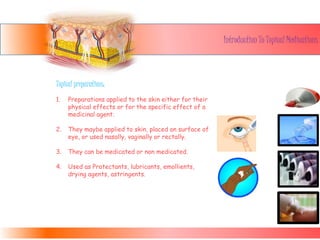
Introduction To Topical Medications 
Topical preparations: 
1. Preparations applied to the skin either for their 
physical effects or for the specific effect of a 
medicinal agent. 
2. They maybe applied to skin, placed on surface of 
eye, or used nasally, vaginally or rectally. 
3. They can be medicated or non medicated. 
4. Used as Protectants, lubricants, emollients, 
drying agents, astringents.
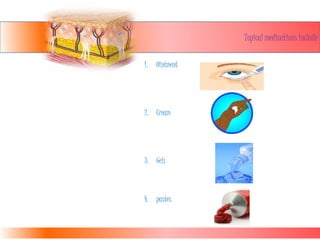
Topical medications include 
1. Ointment 
2. Cream 
3. Gels 
4. pastes
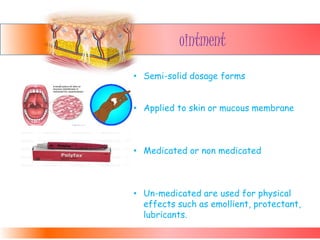
ointment 
• Semi-solid dosage forms 
• Applied to skin or mucous membrane 
• Medicated or non medicated 
• Un-medicated are used for physical 
effects such as emollient, protectant, 
lubricants.
Ointment bases 
• Oleaginous Bases 
• Absorption Bases 
• Water-Removable Bases 
• Water-Soluble Bases
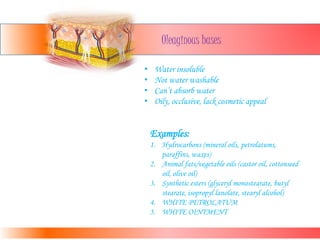
Oleaginous bases 
• Water insoluble 
• Not water washable 
• Can’t absorb water 
• Oily, occlusive, lack cosmetic appeal 
Examples: 
1. Hydrocarbons (mineral oils, petrolatums, 
paraffins, waxes) 
2. Animal fats/vegetable oils (castor oil, cottonseed 
oil, olive oil) 
3. Synthetic esters (glyceryl monostearate, butyl 
stearate, isopropyl lanolate, stearyl alcohol) 
4. WHITE PETROLATUM 
5. WHITE OINTMENT
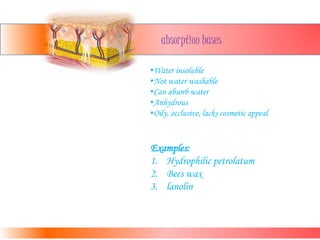
absorption bases 
•Water insoluble 
•Not water washable 
•Can absorb water 
•Anhydrous 
•Oily, occlusive, lacks cosmetic appeal 
Examples: 
1. Hydrophilic petrolatum 
2. Bees wax 
3. lanolin
water-removable bases 
• Water Washable 
• Can Absorb Water 
• External Phase Contains Water 
Examples: 
•Hydrophilic Ointment
water-soluble bases 
• Water soluble 
• Water washable 
• Can absorb water 
• Anhydrous or hydrous 
• All water soluble, no oil phase 
Example: 
•Polyethylene Glycol Ointment 
•Biozyme Ointment, Desenex Ointment
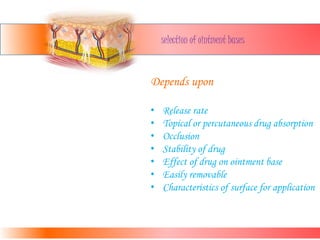
selection of ointment bases 
Depends upon 
• Release rate 
• Topical or percutaneous drug absorption 
• Occlusion 
• Stability of drug 
• Effect of drug on ointment base 
• Easily removable 
• Characteristics of surface for application
preparation of ointment 
•Ointment Slab/Pill Tile 
•Mortar/Pestle 
•Ointment Mill 
•Fusion 
 Heat highest melting point material first 
 Water phase a few degrees higher 
 W/O: add water slowly 
 O/W: add oil slowly 
• Incorporation 
 Mortar and pestle or spatula is used 
 Materials are rubbed on a slab 
 Material of spatula is stainless steel or rubber 
 Ointment is prepared by thoroughly rubbing solid 
material in base
packaging 
• Jars: Glass, Plastic 
 Do not pour in while hot! 
• Disp. Jars: Plastic 
• Tubes: Plastic, tin, aluminum 
• Syringes: Individually dosed, good 
protection of the product
creams
creams 
•Opaque, soft solids, or thick liquids intended for 
external application 
•Can be of two types 
o/w 
w/o
manufacturing area 
1. Wax melting device 
2. Water heating device 
3. Manufacturing vessel 
4. Storage vessels 
5. Automated panel
manufacturing of creams 
Wax 
melting 
vessel 
Water heating 
vessel 
Mfg 
vessel 
Silverson mixer 
Water and steam jacketed Paddle mixer 
Wax, water, antioxidants, 
emulsifying agents, 
preservatives 
60-80 ͦC 
SS316 
Muslin cloth 
SS3 
16 
Temp gauge
gels
gels 
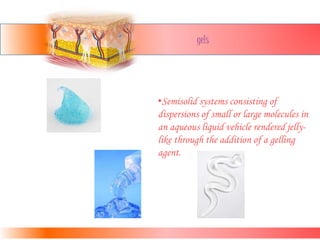
•Semisolid systems consisting of 
dispersions of small or large molecules in 
an aqueous liquid vehicle rendered jelly-like 
through the addition of a gelling 
agent.
Types of gels 
•Single Phase 
• Gels in which the macromolecules are 
uniformly distributed throughout a 
liquid with no apparent boundaries 
between the dispersed macromolecules 
and the liquid 
• Usually involve organics 
•Two Phase 
• When the gel mass consists of floccules 
of small distinct particles 
• Usually involve inorganics
gels 
Composition of gels 
• Gelling agent 
• Water 
• Cosolvents 
• Preservatives 
• Stabilizers 
Kinds of Gels 
1. Hydrogels 
• Silica, bentonite, pectin, sodium alginate, 
methylcellulose, alumina 
2. Organic Gels 
• Contain an organic liquid (e.g., Plastibase) 
3. Carbomer Gels 
• Aqueous dispersion neutralized with sodium hydroxide 
or triethanolamine 
4. Methylcellulose Gels 
5. Starch Glycerite 
6. Aluminum Hydroxide Gel
Phenomena Associated with Gels 
•Syneresis 
phenomenon associated with gels 
- When the interaction between particles of the dispersed phase becomes so great that on 
standing, the dispersing medium is squeezed out in droplets and the gel shrinks 
•Swelling 
-The taking up of liquid by a gel with an increase in volume 
•Imbibition 
- The taking up of a certain amount of liquid without a measurable increase in volume 
•Thixotropy 
-A reversible gel-sol formation with no change in volume or temperature 
•Jelene/Plastibase 
- A combination of mineral oils and heavy hydrocarbon waxes with a MW of about 1300 
•Carbomer 934 
- A polymer of acrylic acid cross-linked with a polyfunctional agent; recognized as an 
official emulsifying and suspending agent
applications and gelling agents 
Applications of gels 
•Oral 
•Topical 
•Intranasal 
•Vaginal 
•Rectal 
Gelling agents 
1. Carbomer 
2. Cmc 
3. Tragacanth 
4. Gelatin 
5. Aerosil
gelling agents 
Carbomers: 
1. Acrylic based 
2. Sustain release in stomach 
3. Thickening agent 
4. Used in conc of 0.5-1% 
Carboxy methyl cellulose: 
1. Used in conc of 4-6% 
2. Viscosity enhancer 
3. Insoluble in water but salts are 
soluble in water such as sodium CMC 
Tragacanth 
• Soaked overnight 
• Used with glycerine and propylene 
glycol as wetting agent 
Gelatin 
• Obtained from bone collagen 
• Bio-compatible 
• cosmotological 
• Contains human serum albumin 
Ehtyl cellulose 
• 5% conc 
Aerosil 
• Inorganic 
• No microbial growth
Stability 
•Physical Stability 
- Shrinkage 
- Separation of liquid from the gel 
- Discoloration 
•Microbial Stability 
•BUD: Unless otherwise documented, 14 days 
when stored in a refrigerator (USP) 
Packaging/Storage/Labeling 
•Tight containers 
•Room or refrigerated temperatures, as 
appropriate 
•Prior to use, store in tight containers.
pastes 
• Thick, stiff ointments that do not ordinarily flow 
at body temperature. 
• Serve as protective coatings over the areas to 
which they are applied. 
• Usually >20% solids 
• Medicated (zinc oxide) 
• Un-medicated (toothpaste) 
• Bulking agent  calcium carbonate, starch.
Topical medications

Topical medications

  • 1.
    Topical medications Creams,Ointments, Pastes And Gels Presented by: Faryal Alam
  • 2.
    Introduction To TopicalMedications Topical preparations: 1. Preparations applied to the skin either for their physical effects or for the specific effect of a medicinal agent. 2. They maybe applied to skin, placed on surface of eye, or used nasally, vaginally or rectally. 3. They can be medicated or non medicated. 4. Used as Protectants, lubricants, emollients, drying agents, astringents.
  • 3.
    Topical medications include 1. Ointment 2. Cream 3. Gels 4. pastes
  • 4.
    ointment • Semi-soliddosage forms • Applied to skin or mucous membrane • Medicated or non medicated • Un-medicated are used for physical effects such as emollient, protectant, lubricants.
  • 5.
    Ointment bases •Oleaginous Bases • Absorption Bases • Water-Removable Bases • Water-Soluble Bases
  • 6.
    Oleaginous bases •Water insoluble • Not water washable • Can’t absorb water • Oily, occlusive, lack cosmetic appeal Examples: 1. Hydrocarbons (mineral oils, petrolatums, paraffins, waxes) 2. Animal fats/vegetable oils (castor oil, cottonseed oil, olive oil) 3. Synthetic esters (glyceryl monostearate, butyl stearate, isopropyl lanolate, stearyl alcohol) 4. WHITE PETROLATUM 5. WHITE OINTMENT
  • 7.
    absorption bases •Waterinsoluble •Not water washable •Can absorb water •Anhydrous •Oily, occlusive, lacks cosmetic appeal Examples: 1. Hydrophilic petrolatum 2. Bees wax 3. lanolin
  • 8.
    water-removable bases •Water Washable • Can Absorb Water • External Phase Contains Water Examples: •Hydrophilic Ointment
  • 9.
    water-soluble bases •Water soluble • Water washable • Can absorb water • Anhydrous or hydrous • All water soluble, no oil phase Example: •Polyethylene Glycol Ointment •Biozyme Ointment, Desenex Ointment
  • 10.
    selection of ointmentbases Depends upon • Release rate • Topical or percutaneous drug absorption • Occlusion • Stability of drug • Effect of drug on ointment base • Easily removable • Characteristics of surface for application
  • 11.
    preparation of ointment •Ointment Slab/Pill Tile •Mortar/Pestle •Ointment Mill •Fusion  Heat highest melting point material first  Water phase a few degrees higher  W/O: add water slowly  O/W: add oil slowly • Incorporation  Mortar and pestle or spatula is used  Materials are rubbed on a slab  Material of spatula is stainless steel or rubber  Ointment is prepared by thoroughly rubbing solid material in base
  • 12.
    packaging • Jars:Glass, Plastic  Do not pour in while hot! • Disp. Jars: Plastic • Tubes: Plastic, tin, aluminum • Syringes: Individually dosed, good protection of the product
  • 13.
  • 14.
    creams •Opaque, softsolids, or thick liquids intended for external application •Can be of two types o/w w/o
  • 15.
    manufacturing area 1.Wax melting device 2. Water heating device 3. Manufacturing vessel 4. Storage vessels 5. Automated panel
  • 16.
    manufacturing of creams Wax melting vessel Water heating vessel Mfg vessel Silverson mixer Water and steam jacketed Paddle mixer Wax, water, antioxidants, emulsifying agents, preservatives 60-80 ͦC SS316 Muslin cloth SS3 16 Temp gauge
  • 17.
  • 18.
    gels •Semisolid systemsconsisting of dispersions of small or large molecules in an aqueous liquid vehicle rendered jelly-like through the addition of a gelling agent.
  • 19.
    Types of gels •Single Phase • Gels in which the macromolecules are uniformly distributed throughout a liquid with no apparent boundaries between the dispersed macromolecules and the liquid • Usually involve organics •Two Phase • When the gel mass consists of floccules of small distinct particles • Usually involve inorganics
  • 20.
    gels Composition ofgels • Gelling agent • Water • Cosolvents • Preservatives • Stabilizers Kinds of Gels 1. Hydrogels • Silica, bentonite, pectin, sodium alginate, methylcellulose, alumina 2. Organic Gels • Contain an organic liquid (e.g., Plastibase) 3. Carbomer Gels • Aqueous dispersion neutralized with sodium hydroxide or triethanolamine 4. Methylcellulose Gels 5. Starch Glycerite 6. Aluminum Hydroxide Gel
  • 21.
    Phenomena Associated withGels •Syneresis phenomenon associated with gels - When the interaction between particles of the dispersed phase becomes so great that on standing, the dispersing medium is squeezed out in droplets and the gel shrinks •Swelling -The taking up of liquid by a gel with an increase in volume •Imbibition - The taking up of a certain amount of liquid without a measurable increase in volume •Thixotropy -A reversible gel-sol formation with no change in volume or temperature •Jelene/Plastibase - A combination of mineral oils and heavy hydrocarbon waxes with a MW of about 1300 •Carbomer 934 - A polymer of acrylic acid cross-linked with a polyfunctional agent; recognized as an official emulsifying and suspending agent
  • 22.
    applications and gellingagents Applications of gels •Oral •Topical •Intranasal •Vaginal •Rectal Gelling agents 1. Carbomer 2. Cmc 3. Tragacanth 4. Gelatin 5. Aerosil
  • 23.
    gelling agents Carbomers: 1. Acrylic based 2. Sustain release in stomach 3. Thickening agent 4. Used in conc of 0.5-1% Carboxy methyl cellulose: 1. Used in conc of 4-6% 2. Viscosity enhancer 3. Insoluble in water but salts are soluble in water such as sodium CMC Tragacanth • Soaked overnight • Used with glycerine and propylene glycol as wetting agent Gelatin • Obtained from bone collagen • Bio-compatible • cosmotological • Contains human serum albumin Ehtyl cellulose • 5% conc Aerosil • Inorganic • No microbial growth
  • 24.
    Stability •Physical Stability - Shrinkage - Separation of liquid from the gel - Discoloration •Microbial Stability •BUD: Unless otherwise documented, 14 days when stored in a refrigerator (USP) Packaging/Storage/Labeling •Tight containers •Room or refrigerated temperatures, as appropriate •Prior to use, store in tight containers.
  • 25.
    pastes • Thick,stiff ointments that do not ordinarily flow at body temperature. • Serve as protective coatings over the areas to which they are applied. • Usually >20% solids • Medicated (zinc oxide) • Un-medicated (toothpaste) • Bulking agent  calcium carbonate, starch.