

in
EDUCATION
Radhika Palany
Europe Education Lead,
Samsung Enterprise Business
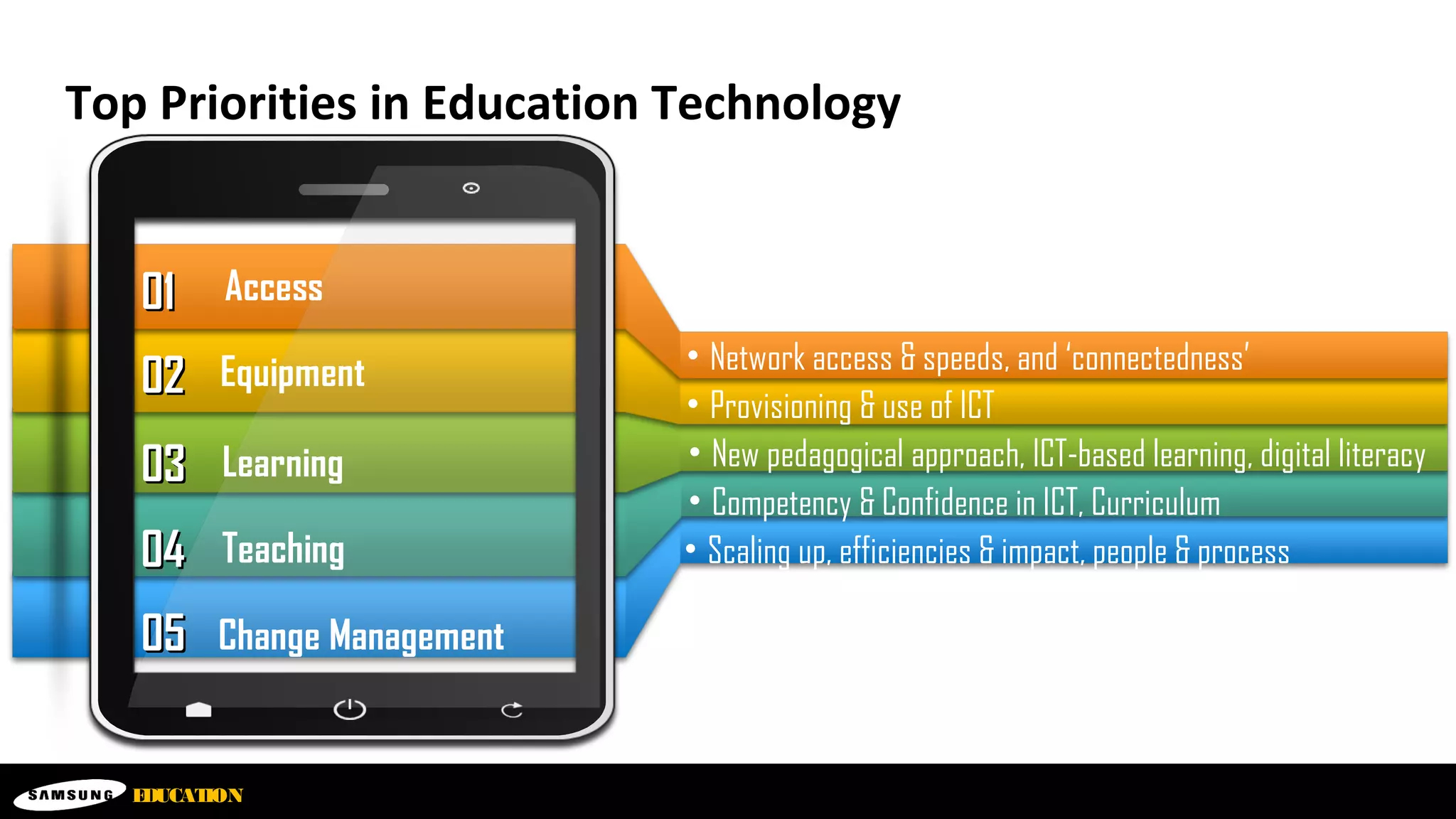
Top Priorities in Education TechnologyTop Priorities in Education Technology
- A European Perspective- A European Perspective
2
EDUCATION
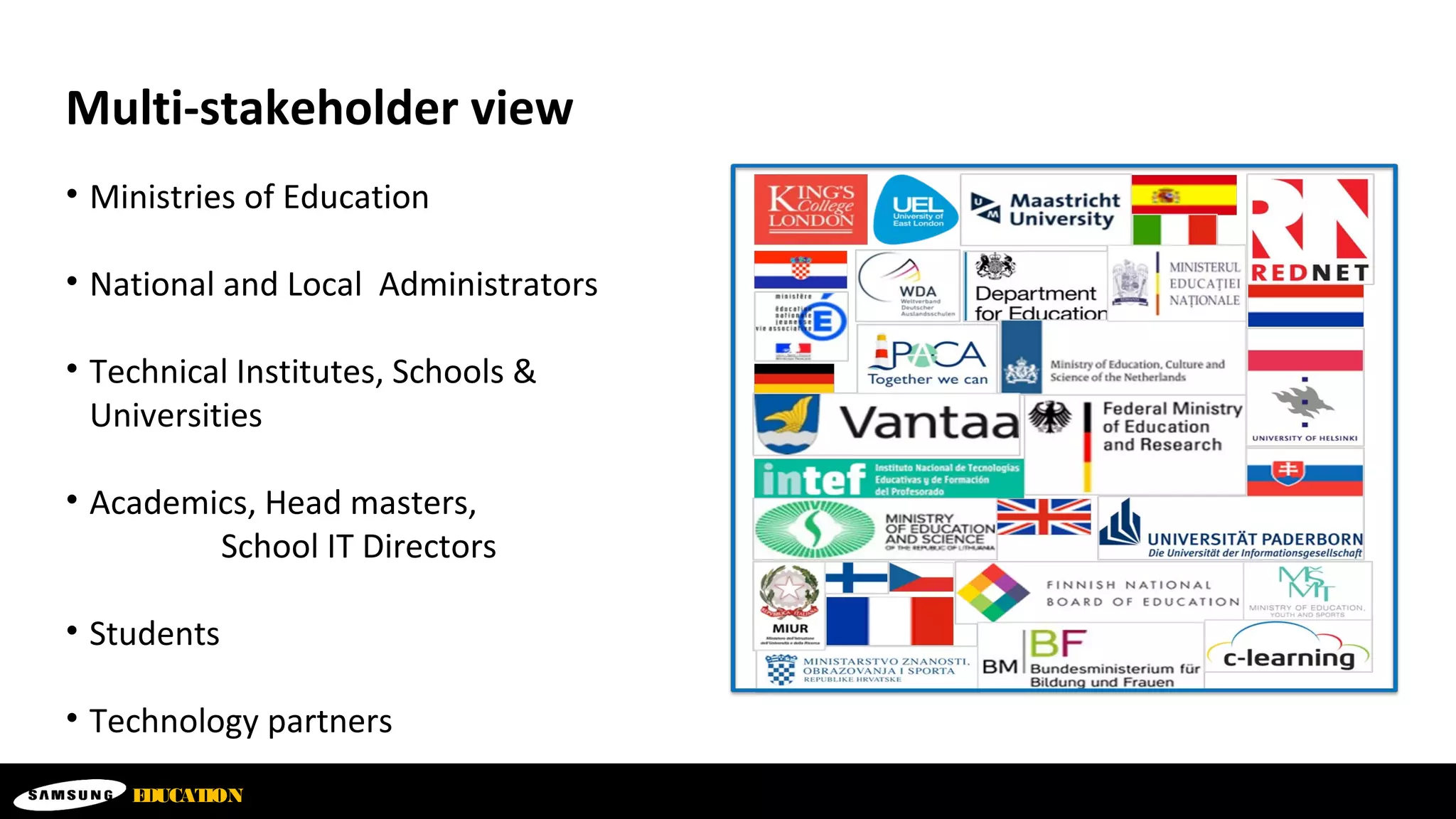
Multi-stakeholder view
• Ministries of Education
• National and Local Administrators
• Technical Institutes, Schools &
Universities
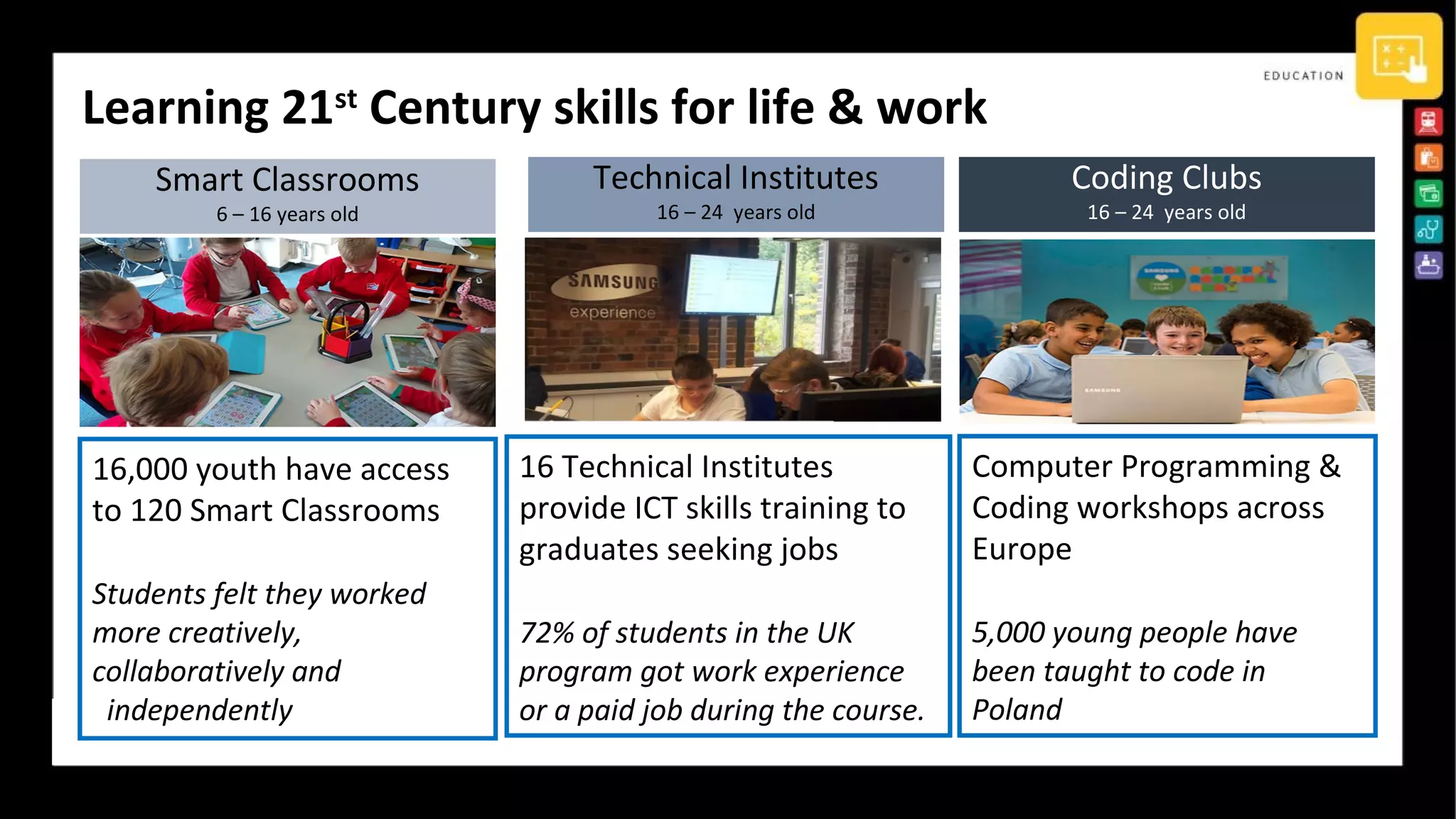
• Academics, Head masters,
School IT Directors
• Students
• Technology partners
EDUCATION
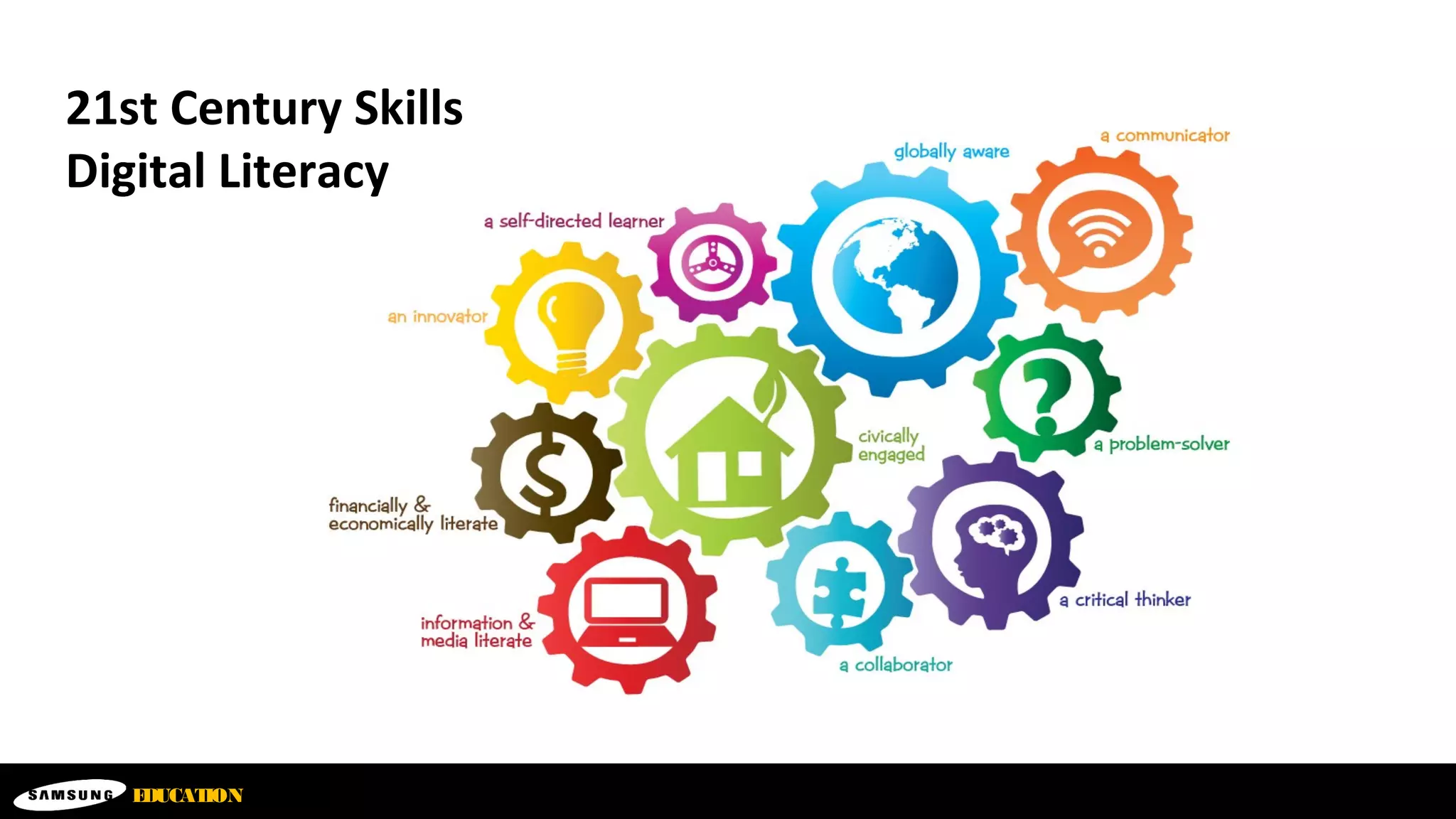
21st Century Skills
Digital Literacy
EDUCATION
Technology … Tools for 21st
Century Learning
EDUCATION
CREATECREATE
COLLABORATECOLLABORATE
COMMUNICATECOMMUNICATE
CRITICAL
THINKING
CRITICAL
THINKING
Your logo
Top Priorities in Education Technology
• Bring your presentation to life. Download this awesome diagram.
0202 Equipment
0101 Access
Learning
Teaching
Change Management
0303
0404
0505
• Scaling up, efficiencies & impact, people & process
EDUCATION
• Competency & Confidence in ICT, Curriculum
• New pedagogical approach, ICT-based learning, digital literacy
• Provisioning & use of ICT
• Network access & speeds, and ‘connectedness’
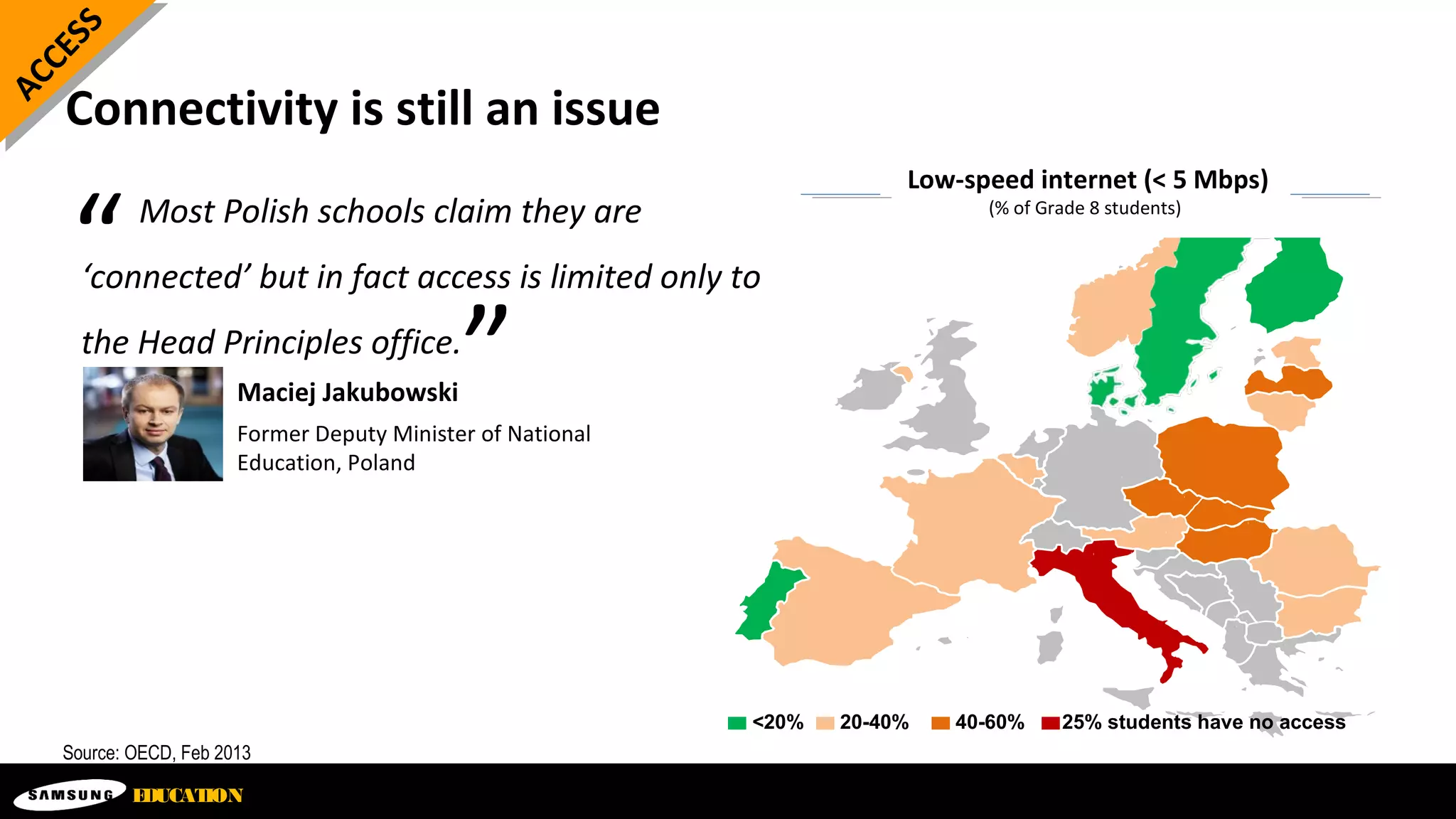
Connectivity is still an issue
Source: OECD, Feb 2013
<20% 20-40% 40-60% 25% students have no access
ACCESS
Your logoEDUCATION
“
”
Most Polish schools claim they are
‘connected’ but in fact access is limited only to
the Head Principles office.
Maciej Jakubowski
Former Deputy Minister of National
Education, Poland
Low-speed internet (< 5 Mbps)
(% of Grade 8 students)
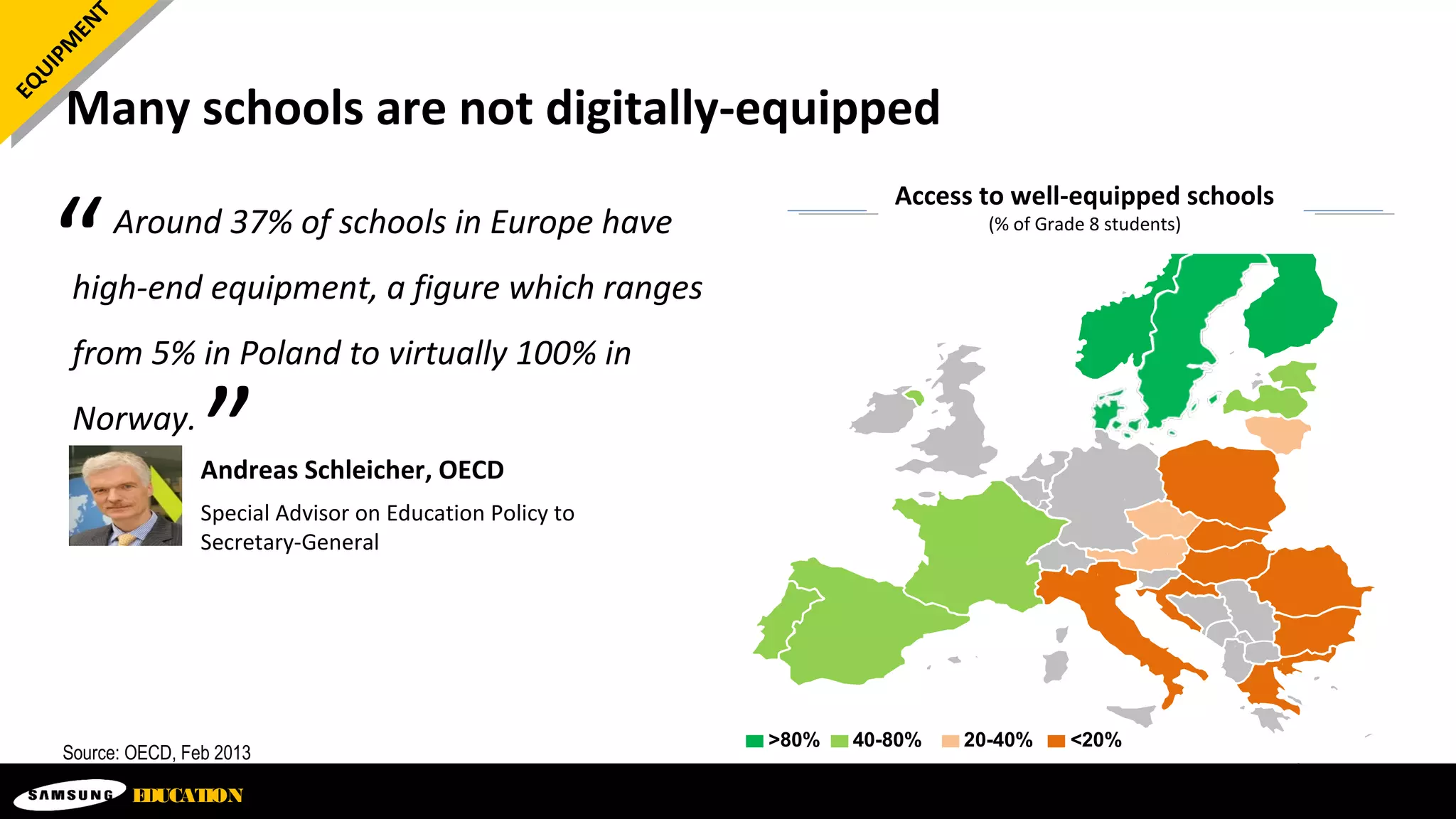
Many schools are not digitally-equipped
EQUIPM
ENT
Source: OECD, Feb 2013
Andreas Schleicher, OECD
Special Advisor on Education Policy to
Secretary-General
>80% 40-80% 20-40% <20%
Your logo
EDUCATION
“
”
Around 37% of schools in Europe have
high-end equipment, a figure which ranges
from 5% in Poland to virtually 100% in
Norway.
Access to well-equipped schools
(% of Grade 8 students)
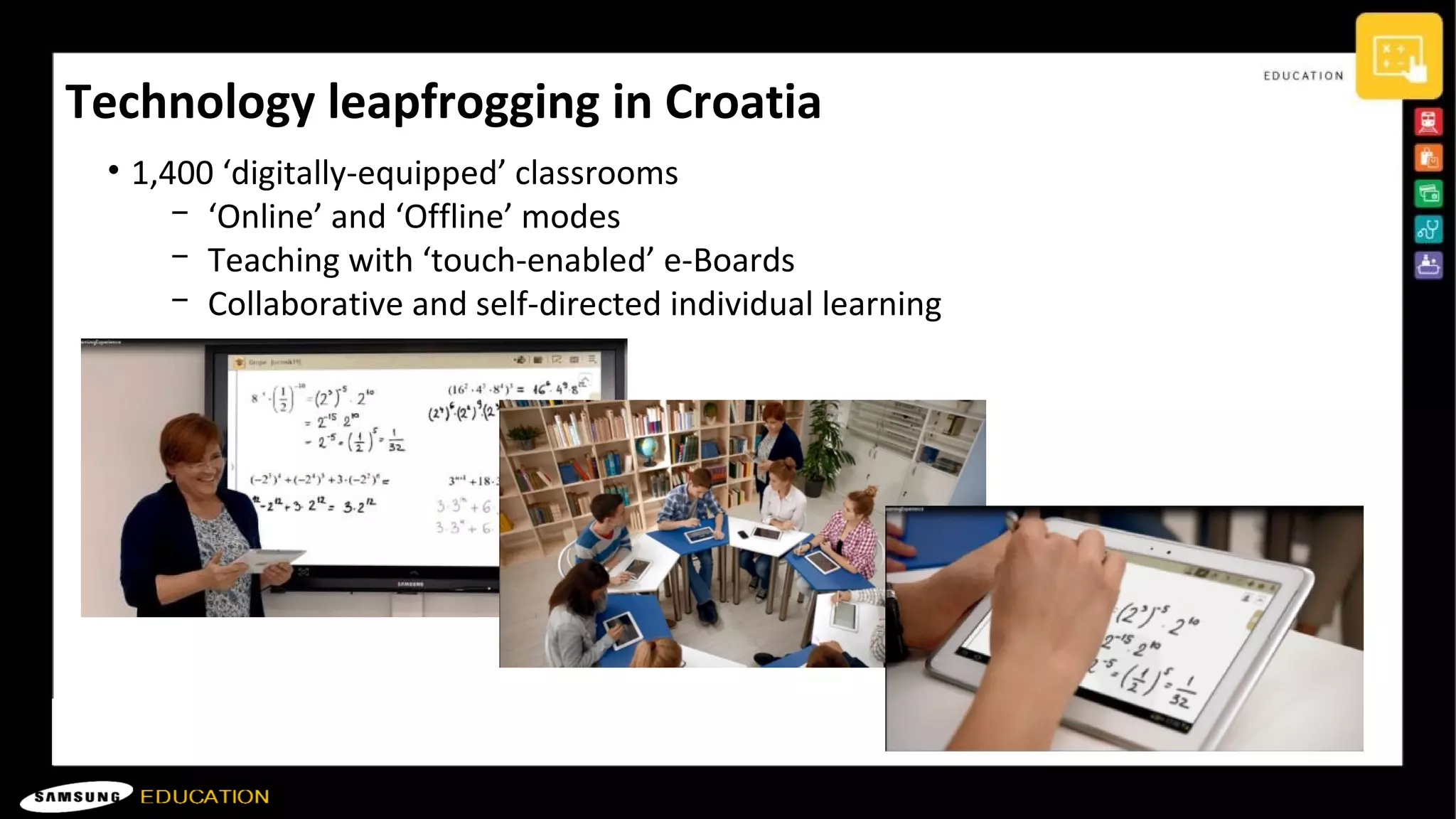
Technology leapfrogging in Croatia
• 1,400 ‘digitally-equipped’ classrooms
­ ‘Online’ and ‘Offline’ modes
­ Teaching with ‘touch-enabled’ e-Boards
­ Collaborative and self-directed individual learning
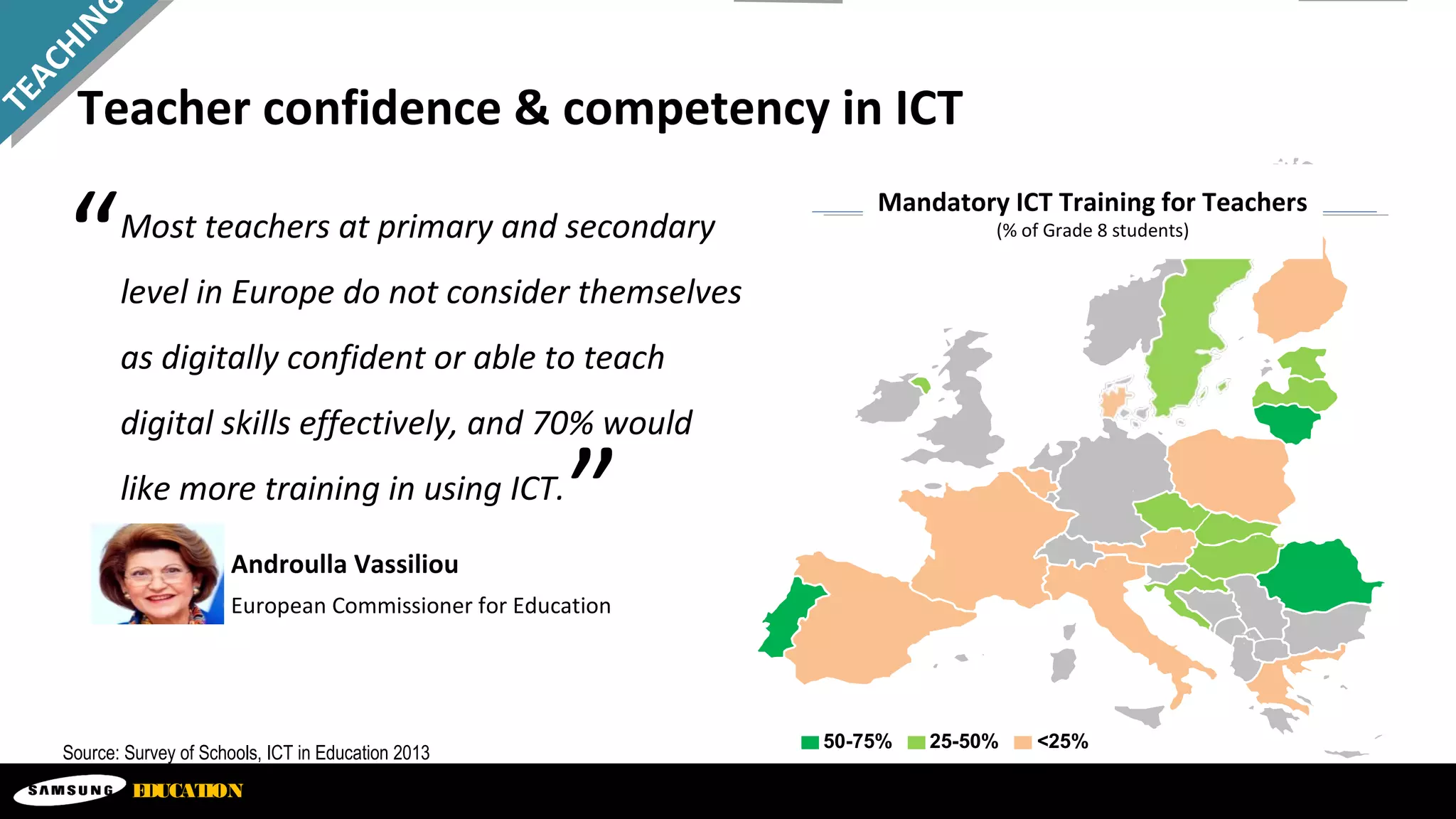
Teacher confidence & competency in ICT
EDUCATION
Source: Survey of Schools, ICT in Education 2013
TEACHING
Androulla Vassiliou
European Commissioner for Education
Most teachers at primary and secondary
level in Europe do not consider themselves
as digitally confident or able to teach
digital skills effectively, and 70% would
like more training in using ICT.
“
”
50-75% 25-50% <25%
Mandatory ICT Training for Teachers
(% of Grade 8 students)
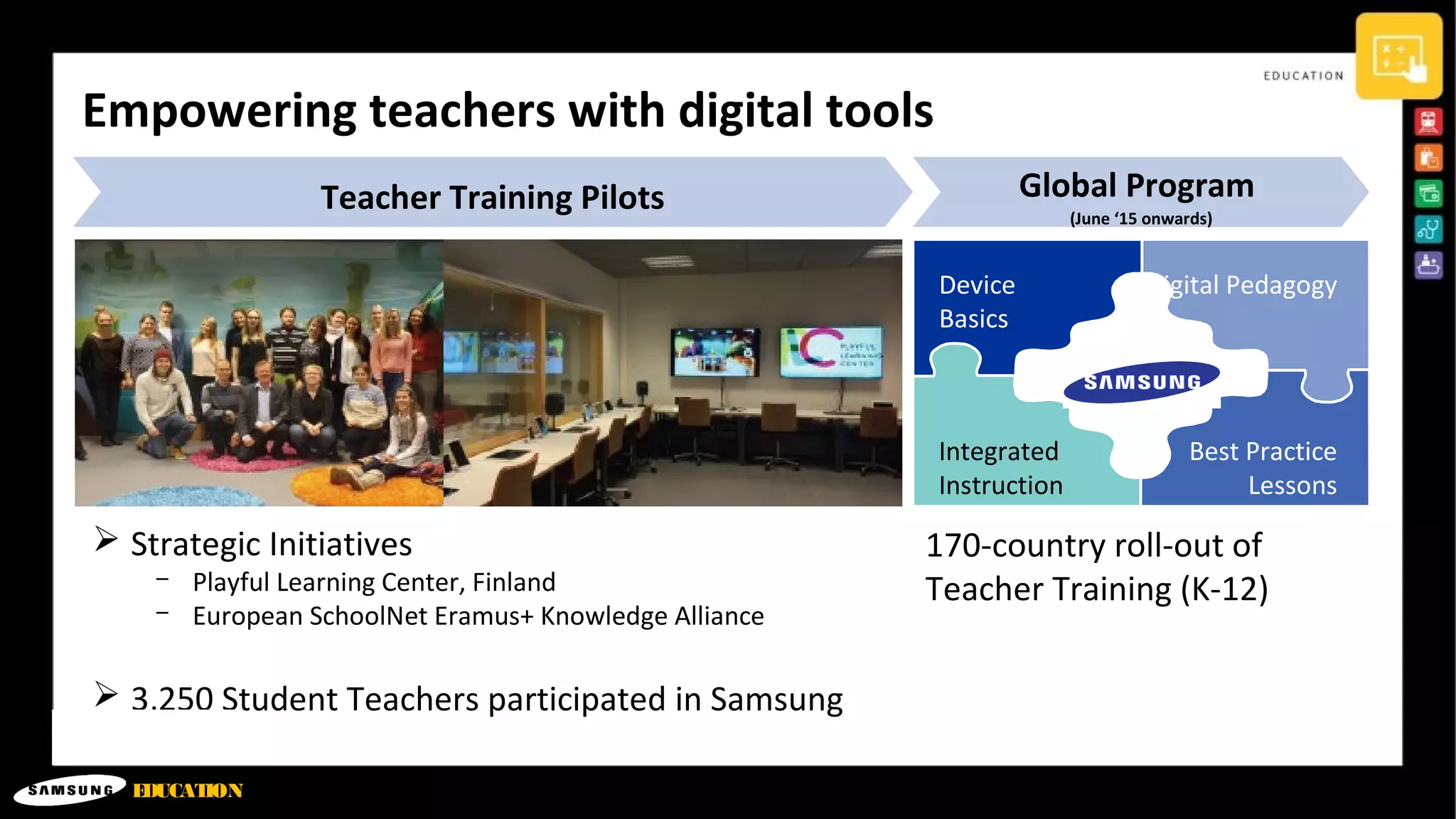
Empowering teachers with digital tools
170-country roll-out of
Teacher Training (K-12)
 Strategic Initiatives
­ Playful Learning Center, Finland
­ European SchoolNet Eramus+ Knowledge Alliance
 3,250 Student Teachers participated in Samsung
Labs
Teacher Training Pilots Global Program
(June ‘15 onwards)
Device
Basics
Digital Pedagogy
Integrated
Instruction
Best Practice
Lessons
EDUCATION
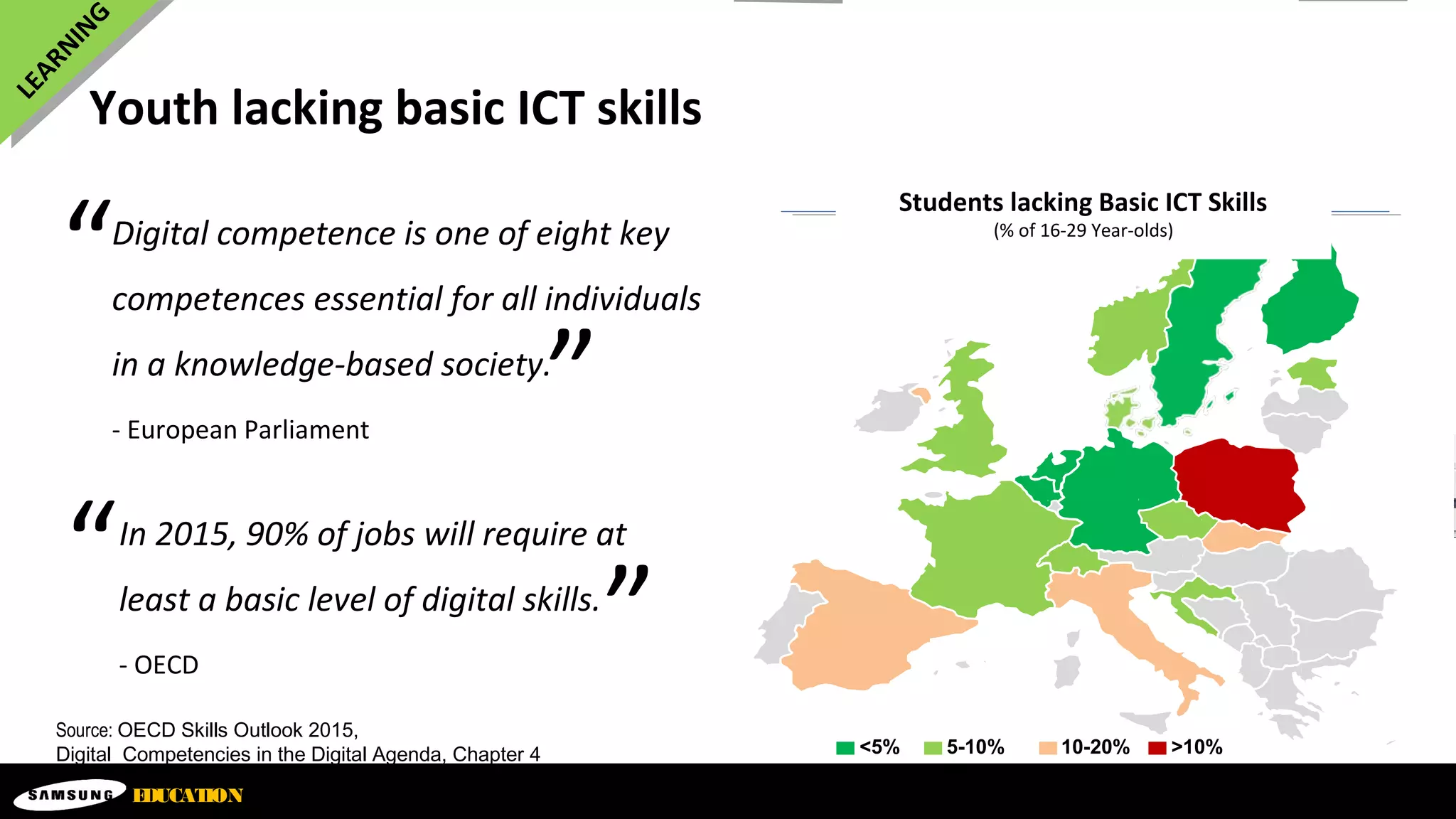
Youth lacking basic ICT skills
Source: OECD Skills Outlook 2015,
Digital Competencies in the Digital Agenda, Chapter 4
Digital competence is one of eight key
competences essential for all individuals
in a knowledge-based society.
- European Parliament
LEARNING
“
”
“In 2015, 90% of jobs will require at
least a basic level of digital skills.
- OECD
”
<5% 5-10% 10-20% >10%
Your logo
EDUCATION
Students lacking Basic ICT Skills
(% of 16-29 Year-olds)
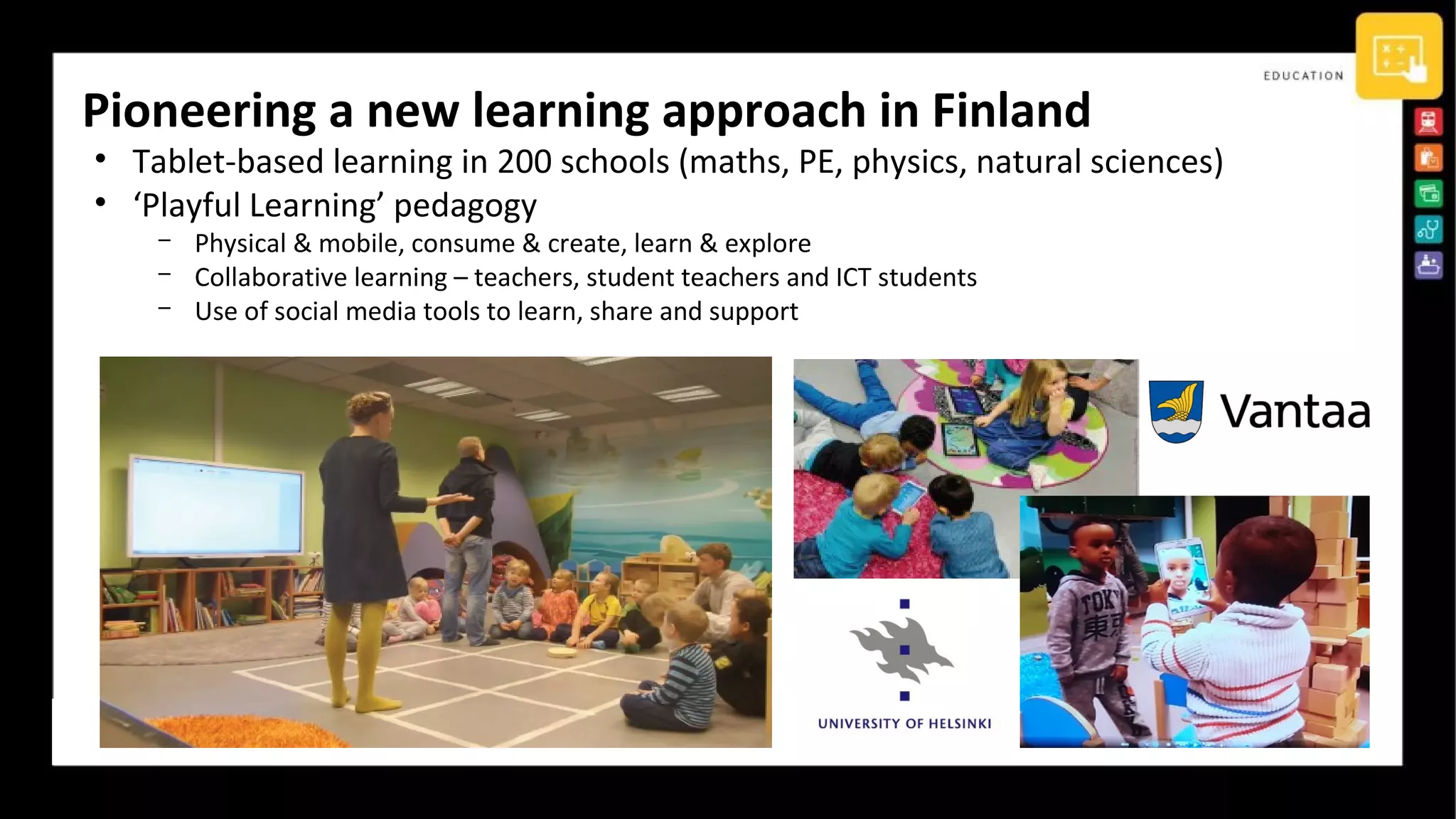
Pioneering a new learning approach in Finland
• Tablet-based learning in 200 schools (maths, PE, physics, natural sciences)
• ‘Playful Learning’ pedagogy
­ Physical & mobile, consume & create, learn & explore
­ Collaborative learning – teachers, student teachers and ICT students
­ Use of social media tools to learn, share and support
Learning 21st
Century skills for life & work
Smart Classrooms
6 – 16 years old
16,000 youth have access
to 120 Smart Classrooms
Students felt they worked
more creatively,
collaboratively and
independently
Technical Institutes
16 – 24 years old
Coding Clubs
16 – 24 years old
16 Technical Institutes
provide ICT skills training to
graduates seeking jobs
72% of students in the UK
program got work experience
or a paid job during the course.
Computer Programming &
Coding workshops across
Europe
5,000 young people have
been taught to code in
Poland
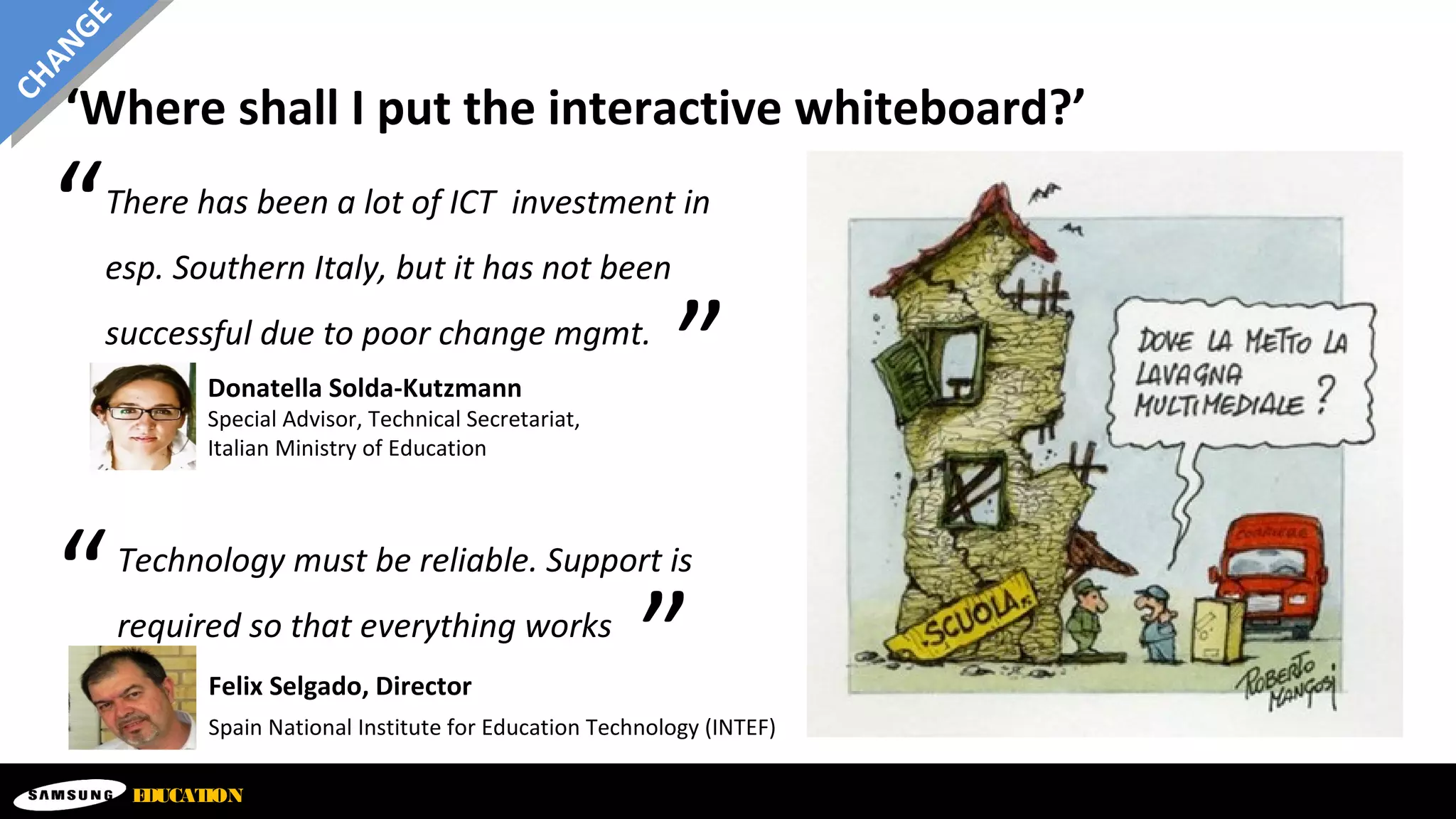
‘Where shall I put the interactive whiteboard?’
EDUCATION
CHANGE
Donatella Solda-Kutzmann
Special Advisor, Technical Secretariat,
Italian Ministry of Education
There has been a lot of ICT investment in
esp. Southern Italy, but it has not been
successful due to poor change mgmt.
“
”
Felix Selgado, Director
Spain National Institute for Education Technology (INTEF)
Technology must be reliable. Support is
required so that everything works
“
”
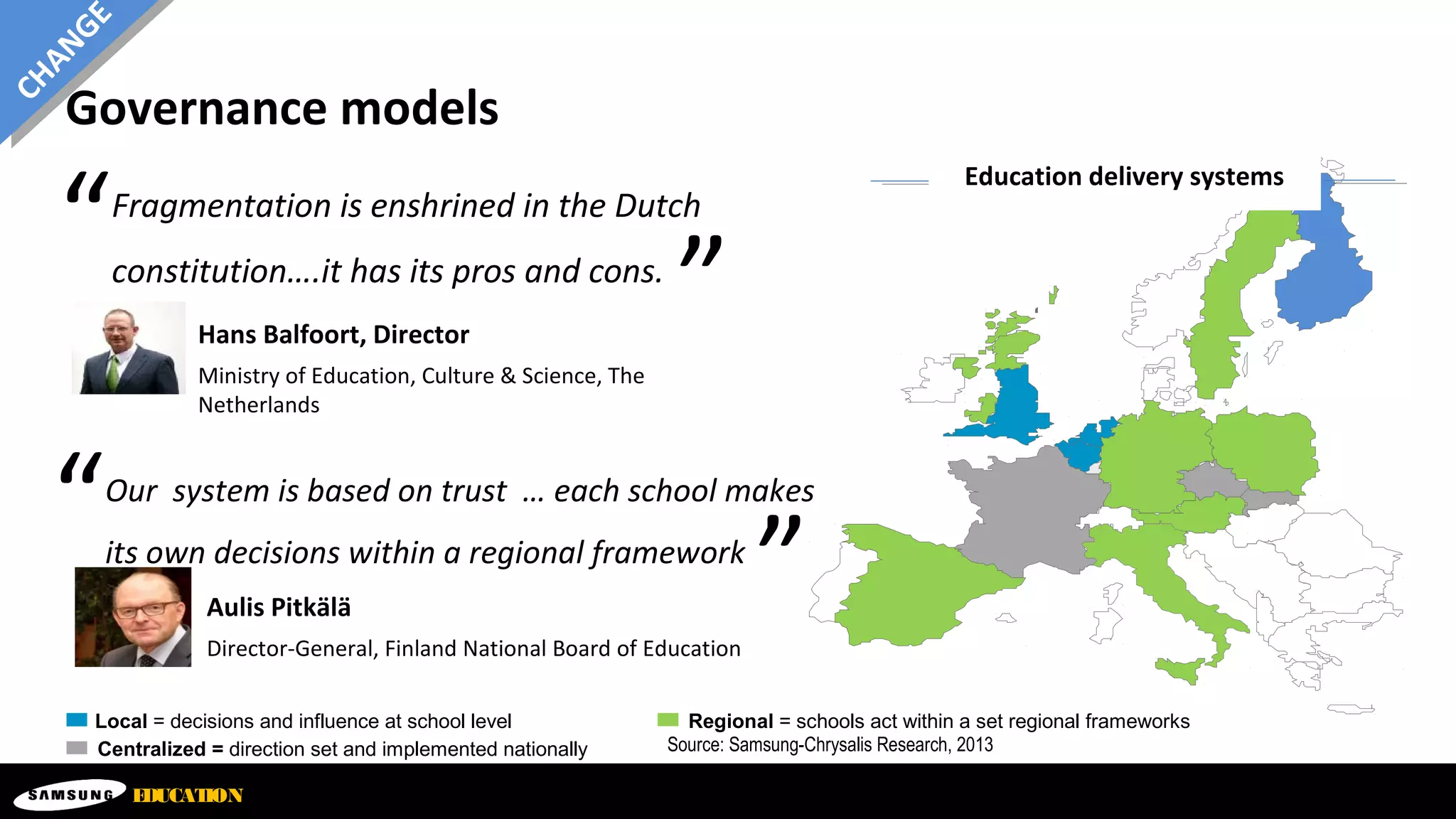
Governance models
Local = decisions and influence at school level Regional = schools act within a set regional frameworks
Centralized = direction set and implemented nationally Source: Samsung-Chrysalis Research, 2013
Hans Balfoort, Director
Ministry of Education, Culture & Science, The
Netherlands
Fragmentation is enshrined in the Dutch
constitution….it has its pros and cons.
“
”
Aulis Pitkälä
Director-General, Finland National Board of Education
Our system is based on trust … each school makes
its own decisions within a regional framework
“
”
EDUCATION
CHANGE
Education delivery systems
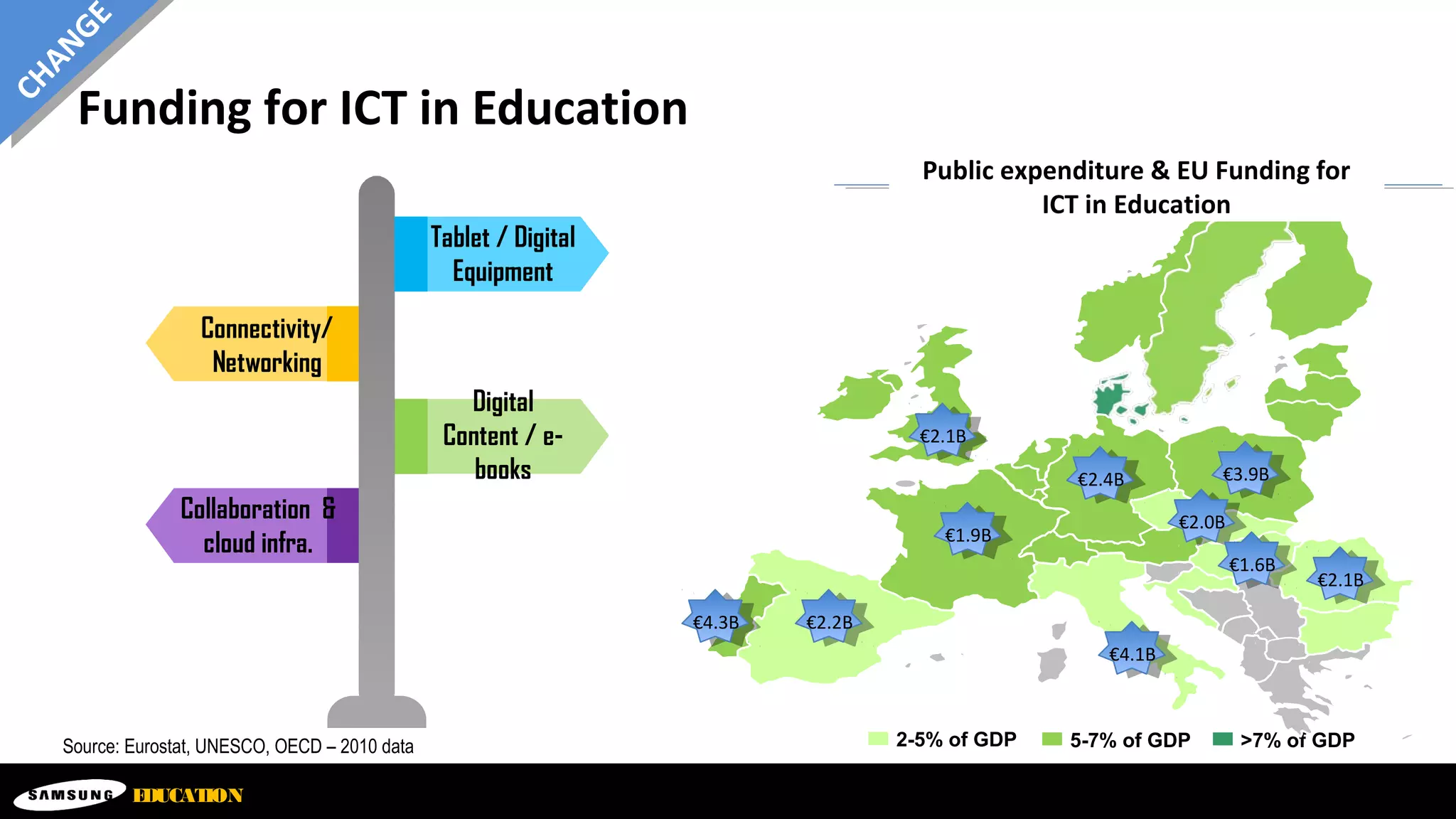
Funding for ICT in Education
Source: Eurostat, UNESCO, OECD – 2010 data 2-5% of GDP 5-7% of GDP >7% of GDP
€4.3B
€4.1B
€3.9B€2.4B
€2.2B
€2.1B
€2.1B
€2.0B
€1.9B
€1.6B
EDUCATION
CHANGE
Public expenditure & EU Funding for
ICT in Education
Tablet / Digital
Equipment
Connectivity/
Networking
Digital
Content / e-
books
Collaboration &
cloud infra.
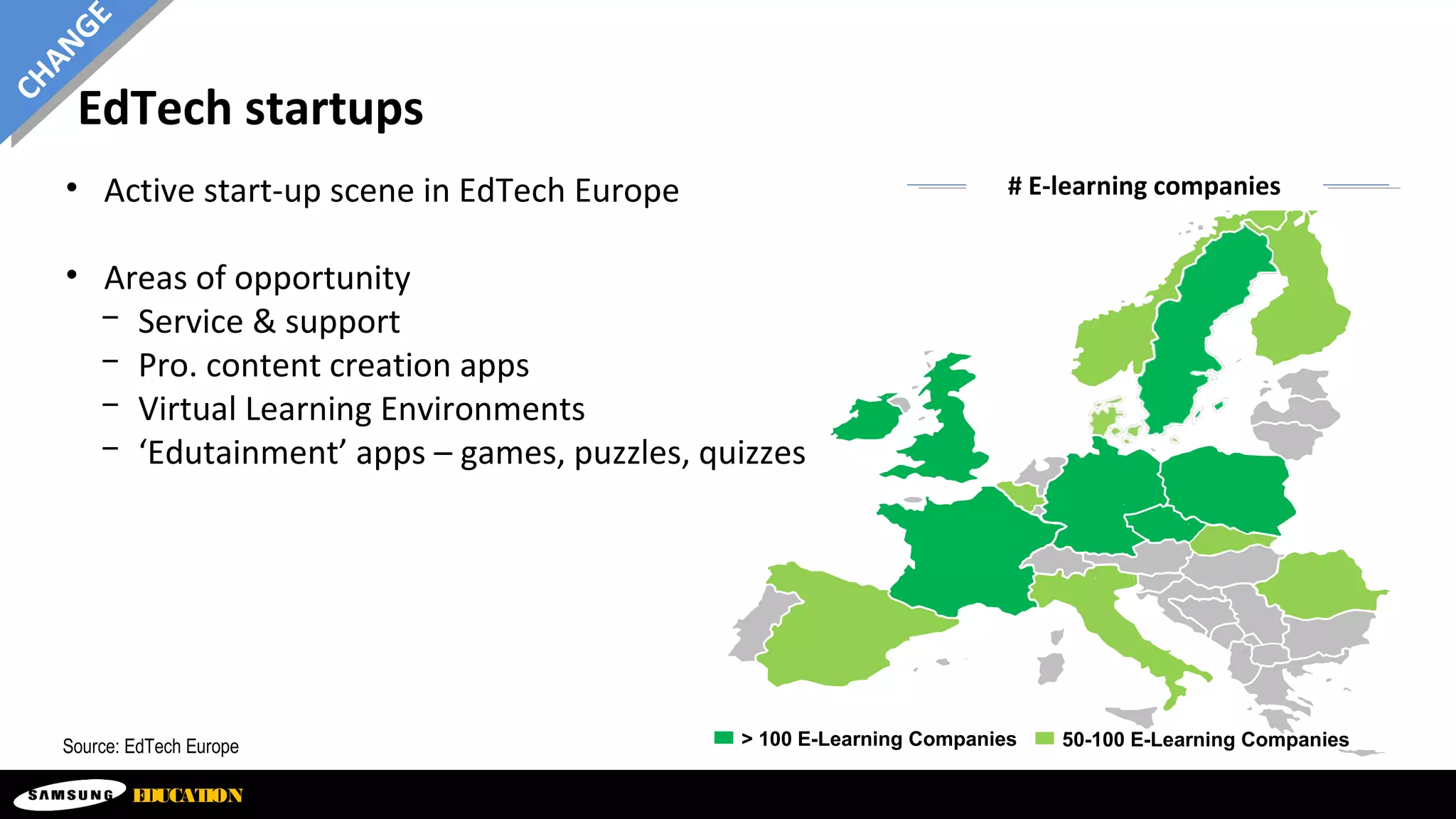
EdTech startups
EDUCATION
• Active start-up scene in EdTech Europe
• Areas of opportunity
­ Service & support
­ Pro. content creation apps
­ Virtual Learning Environments
­ ‘Edutainment’ apps – games, puzzles, quizzes
Source: EdTech Europe > 100 E-Learning Companies 50-100 E-Learning Companies
# E-learning companies
CHANGE
EDUCATION
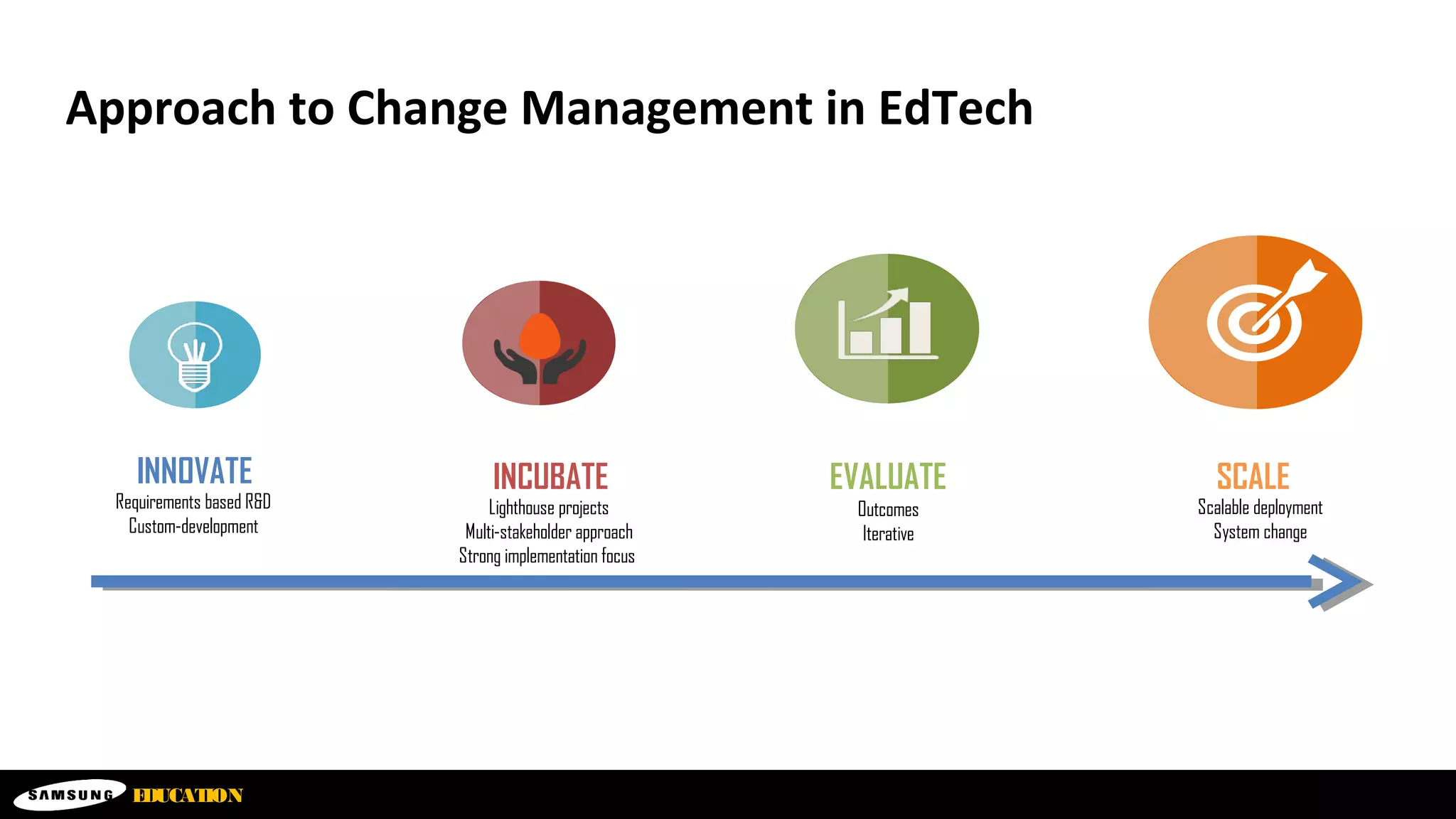
Approach to Change Management in EdTech
Scalable deployment
System change
SCALE
Requirements based R&D
Custom-development
INNOVATE EVALUATE
Outcomes
Iterative
Lighthouse projects
Multi-stakeholder approach
Strong implementation focus
INCUBATE
EDUCATION
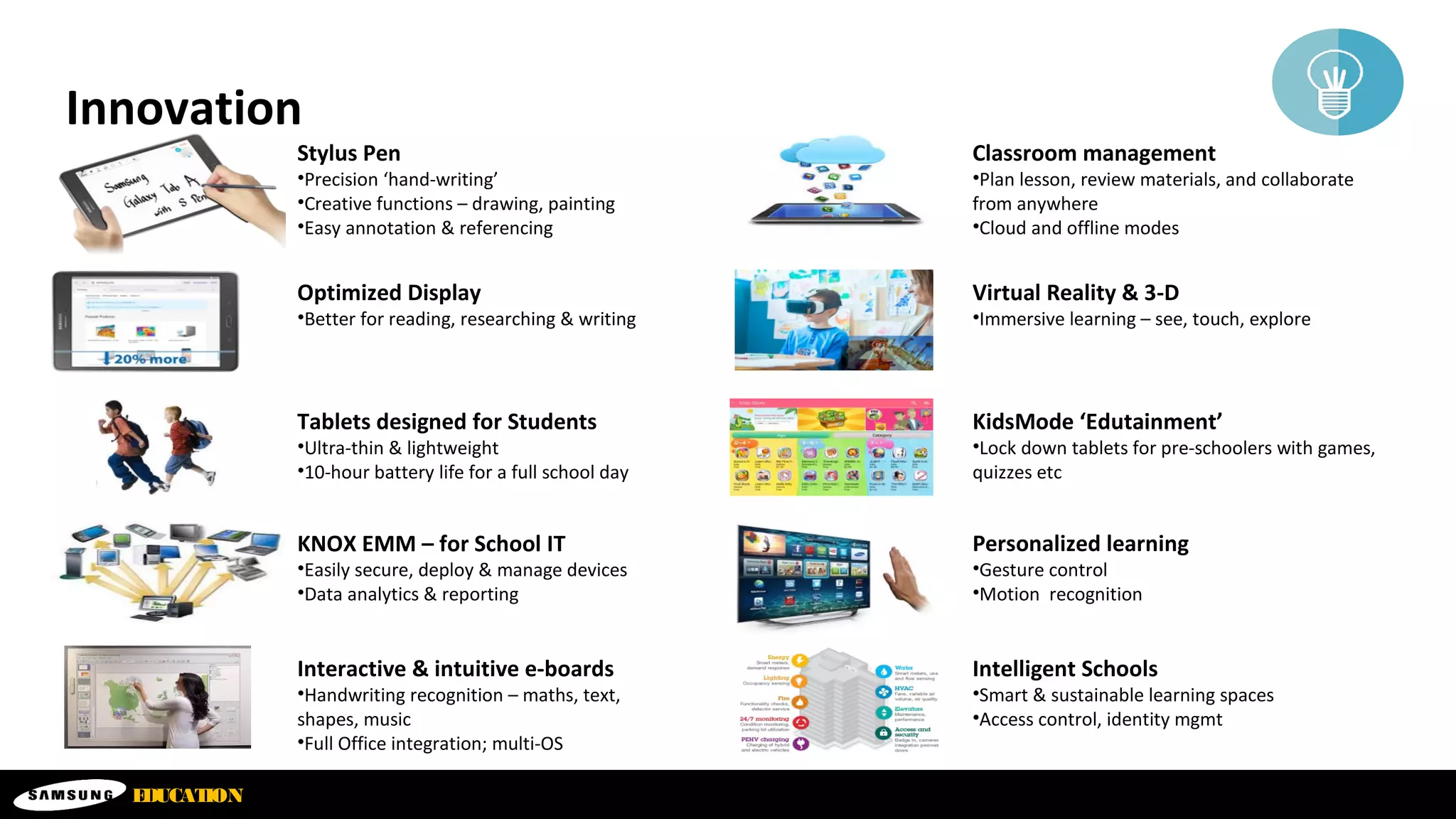
Innovation
Stylus Pen
•Precision ‘hand-writing’
•Creative functions – drawing, painting
•Easy annotation & referencing
Optimized Display
•Better for reading, researching & writing
Tablets designed for Students
•Ultra-thin & lightweight
•10-hour battery life for a full school day
KNOX EMM – for School IT
•Easily secure, deploy & manage devices
•Data analytics & reporting
Interactive & intuitive e-boards
•Handwriting recognition – maths, text,
shapes, music
•Full Office integration; multi-OS
Classroom management
•Plan lesson, review materials, and collaborate
from anywhere
•Cloud and offline modes
Virtual Reality & 3-D
•Immersive learning – see, touch, explore
KidsMode ‘Edutainment’
•Lock down tablets for pre-schoolers with games,
quizzes etc
Personalized learning
•Gesture control
•Motion recognition
Intelligent Schools
•Smart & sustainable learning spaces
•Access control, identity mgmt
EDUCATION
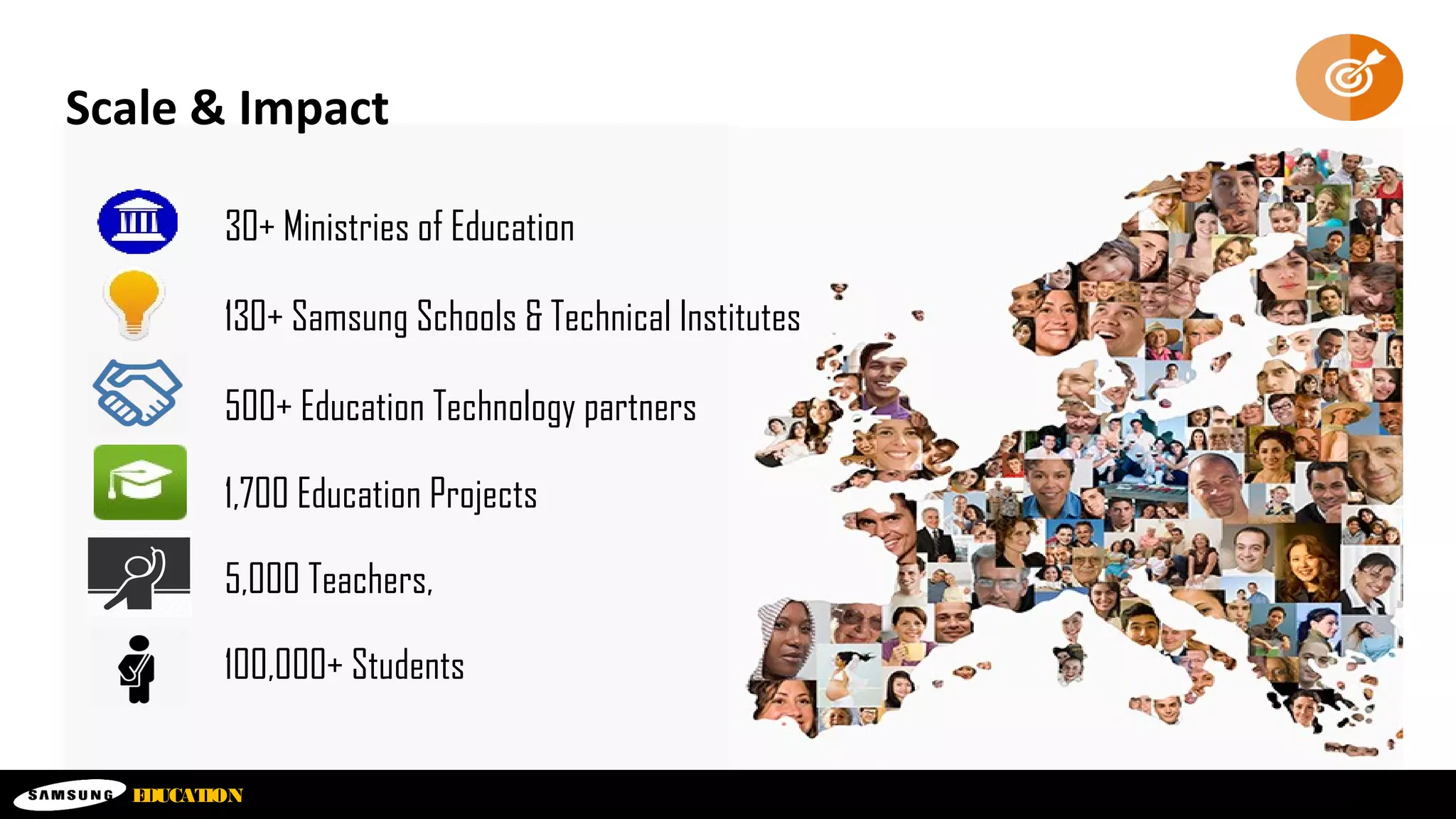
Scale & Impact
1,700 Education Projects
30+ Ministries of Education
130+ Samsung Schools & Technical Institutes
500+ Education Technology partners
5,000 Teachers,
100,000+ Students
in
EDUCATION

EdTech Europe 2015 [Track 1]: [Samsung], ([Radhika Palany], [Education Lead])

  • 1.
    in EDUCATION Radhika Palany Europe EducationLead, Samsung Enterprise Business
  • 2.
    Top Priorities inEducation TechnologyTop Priorities in Education Technology - A European Perspective- A European Perspective 2 EDUCATION
  • 3.
    Multi-stakeholder view • Ministriesof Education • National and Local Administrators • Technical Institutes, Schools & Universities • Academics, Head masters, School IT Directors • Students • Technology partners EDUCATION
  • 4.
    21st Century Skills DigitalLiteracy EDUCATION
  • 5.
    Technology … Toolsfor 21st Century Learning EDUCATION CREATECREATE COLLABORATECOLLABORATE COMMUNICATECOMMUNICATE CRITICAL THINKING CRITICAL THINKING
  • 6.
    Your logo Top Prioritiesin Education Technology • Bring your presentation to life. Download this awesome diagram. 0202 Equipment 0101 Access Learning Teaching Change Management 0303 0404 0505 • Scaling up, efficiencies & impact, people & process EDUCATION • Competency & Confidence in ICT, Curriculum • New pedagogical approach, ICT-based learning, digital literacy • Provisioning & use of ICT • Network access & speeds, and ‘connectedness’
  • 7.
    Connectivity is stillan issue Source: OECD, Feb 2013 <20% 20-40% 40-60% 25% students have no access ACCESS Your logoEDUCATION “ ” Most Polish schools claim they are ‘connected’ but in fact access is limited only to the Head Principles office. Maciej Jakubowski Former Deputy Minister of National Education, Poland Low-speed internet (< 5 Mbps) (% of Grade 8 students)
  • 8.
    Many schools arenot digitally-equipped EQUIPM ENT Source: OECD, Feb 2013 Andreas Schleicher, OECD Special Advisor on Education Policy to Secretary-General >80% 40-80% 20-40% <20% Your logo EDUCATION “ ” Around 37% of schools in Europe have high-end equipment, a figure which ranges from 5% in Poland to virtually 100% in Norway. Access to well-equipped schools (% of Grade 8 students)
  • 9.
    Technology leapfrogging inCroatia • 1,400 ‘digitally-equipped’ classrooms ­ ‘Online’ and ‘Offline’ modes ­ Teaching with ‘touch-enabled’ e-Boards ­ Collaborative and self-directed individual learning
  • 10.
    Teacher confidence &competency in ICT EDUCATION Source: Survey of Schools, ICT in Education 2013 TEACHING Androulla Vassiliou European Commissioner for Education Most teachers at primary and secondary level in Europe do not consider themselves as digitally confident or able to teach digital skills effectively, and 70% would like more training in using ICT. “ ” 50-75% 25-50% <25% Mandatory ICT Training for Teachers (% of Grade 8 students)
  • 11.
    Empowering teachers withdigital tools 170-country roll-out of Teacher Training (K-12)  Strategic Initiatives ­ Playful Learning Center, Finland ­ European SchoolNet Eramus+ Knowledge Alliance  3,250 Student Teachers participated in Samsung Labs Teacher Training Pilots Global Program (June ‘15 onwards) Device Basics Digital Pedagogy Integrated Instruction Best Practice Lessons EDUCATION
  • 12.
    Youth lacking basicICT skills Source: OECD Skills Outlook 2015, Digital Competencies in the Digital Agenda, Chapter 4 Digital competence is one of eight key competences essential for all individuals in a knowledge-based society. - European Parliament LEARNING “ ” “In 2015, 90% of jobs will require at least a basic level of digital skills. - OECD ” <5% 5-10% 10-20% >10% Your logo EDUCATION Students lacking Basic ICT Skills (% of 16-29 Year-olds)
  • 13.
    Pioneering a newlearning approach in Finland • Tablet-based learning in 200 schools (maths, PE, physics, natural sciences) • ‘Playful Learning’ pedagogy ­ Physical & mobile, consume & create, learn & explore ­ Collaborative learning – teachers, student teachers and ICT students ­ Use of social media tools to learn, share and support
  • 14.
    Learning 21st Century skillsfor life & work Smart Classrooms 6 – 16 years old 16,000 youth have access to 120 Smart Classrooms Students felt they worked more creatively, collaboratively and independently Technical Institutes 16 – 24 years old Coding Clubs 16 – 24 years old 16 Technical Institutes provide ICT skills training to graduates seeking jobs 72% of students in the UK program got work experience or a paid job during the course. Computer Programming & Coding workshops across Europe 5,000 young people have been taught to code in Poland
  • 15.
    ‘Where shall Iput the interactive whiteboard?’ EDUCATION CHANGE Donatella Solda-Kutzmann Special Advisor, Technical Secretariat, Italian Ministry of Education There has been a lot of ICT investment in esp. Southern Italy, but it has not been successful due to poor change mgmt. “ ” Felix Selgado, Director Spain National Institute for Education Technology (INTEF) Technology must be reliable. Support is required so that everything works “ ”
  • 16.
    Governance models Local =decisions and influence at school level Regional = schools act within a set regional frameworks Centralized = direction set and implemented nationally Source: Samsung-Chrysalis Research, 2013 Hans Balfoort, Director Ministry of Education, Culture & Science, The Netherlands Fragmentation is enshrined in the Dutch constitution….it has its pros and cons. “ ” Aulis Pitkälä Director-General, Finland National Board of Education Our system is based on trust … each school makes its own decisions within a regional framework “ ” EDUCATION CHANGE Education delivery systems
  • 17.
    Funding for ICTin Education Source: Eurostat, UNESCO, OECD – 2010 data 2-5% of GDP 5-7% of GDP >7% of GDP €4.3B €4.1B €3.9B€2.4B €2.2B €2.1B €2.1B €2.0B €1.9B €1.6B EDUCATION CHANGE Public expenditure & EU Funding for ICT in Education Tablet / Digital Equipment Connectivity/ Networking Digital Content / e- books Collaboration & cloud infra.
  • 18.
    EdTech startups EDUCATION • Activestart-up scene in EdTech Europe • Areas of opportunity ­ Service & support ­ Pro. content creation apps ­ Virtual Learning Environments ­ ‘Edutainment’ apps – games, puzzles, quizzes Source: EdTech Europe > 100 E-Learning Companies 50-100 E-Learning Companies # E-learning companies CHANGE
  • 19.
    EDUCATION Approach to ChangeManagement in EdTech Scalable deployment System change SCALE Requirements based R&D Custom-development INNOVATE EVALUATE Outcomes Iterative Lighthouse projects Multi-stakeholder approach Strong implementation focus INCUBATE
  • 20.
    EDUCATION Innovation Stylus Pen •Precision ‘hand-writing’ •Creativefunctions – drawing, painting •Easy annotation & referencing Optimized Display •Better for reading, researching & writing Tablets designed for Students •Ultra-thin & lightweight •10-hour battery life for a full school day KNOX EMM – for School IT •Easily secure, deploy & manage devices •Data analytics & reporting Interactive & intuitive e-boards •Handwriting recognition – maths, text, shapes, music •Full Office integration; multi-OS Classroom management •Plan lesson, review materials, and collaborate from anywhere •Cloud and offline modes Virtual Reality & 3-D •Immersive learning – see, touch, explore KidsMode ‘Edutainment’ •Lock down tablets for pre-schoolers with games, quizzes etc Personalized learning •Gesture control •Motion recognition Intelligent Schools •Smart & sustainable learning spaces •Access control, identity mgmt
  • 21.
    EDUCATION Scale & Impact 1,700Education Projects 30+ Ministries of Education 130+ Samsung Schools & Technical Institutes 500+ Education Technology partners 5,000 Teachers, 100,000+ Students
  • 22.

Editor's Notes

  • #2 Good morning Introduction … Been in tech for 15 years 4 years ago I joined Samsung, and was part of the management team that founded the Enterprise Business in Europe Launching Samsung’s market entry into industry sectors including Education, but also Hospitality, Healthcare, Finance etc Scaled the Enterprise Business from 0 to 5 Bn in 3 years Last year Samsung tasked me to take on Education I have responsibility for Europe which covers all markets from UK &amp; Ireland till Romania My role has involved setting up and managing our sales teams, developing GTM and leading engagements with Govt, partners and education institutions
  • #3 My presentation will focus on ‘Top Issues in Education Tech’
  • #4 Based on my discussions so far with various stakeholders that I work with Its an exciting and challenging time to be EdTech. I think the sector is at an early stage, and everyone has great ideas Policy makers across Europe are struggling with issues such as youth unemployment, drop-out rates, low STEM scores, and the overall competitiveness of the Education system compared to US and Asia Schools &amp; Uni are under pressure to improve the quality of education service delivery. Esp. head masters talk about the ‘pressure’ they feel from parents to provide a better experience and better learning outcomes Teachers are under pressure …
  • #5 Fundamental question everyone is asking is … Are schools &amp; Uni. providing students with the digital skills needed to be successful in the 21st Century society and job market So what are these 21st Century Skills? It’s the ability to communicate, to collaborate, to solve problems, to be self-directed, to innovate, and to be ICT literate
  • #6 This brings us to the role of technology in Education Tech. can enable students to collaborate, communicate, problem-solve and explore in a that traditional learning simply cannot Tech. can be the catalyst that will transform education system Providing teachers and students with New Tools For the 21st Century
  • #7 These are the Top-5 priorities in EdTech, and probably where the bulk of Govt. and school funding will go in the next 2-years In my conversations with policy makers, teachers and headmasters, I was a bit surprised that fundamental things such as Access and Equipment are still an issue, even in W.Europe. And in these areas I find the education sector lagging and reacting to better standard of access and equipment that students are used to in their daily lives, and at home On the other than more, there is a real sense of innovation and thought-leadership esp in the Learning area Teaching and change management, are ‘opportunity areas’ for tech. suppliers in the sense that they are the biggest barriers to mainstream adoption of EdTech and so schools and Govt are putting a lot of money to teach ICT to teachers and ensure that tech. implementation is managed and supported adequately.
  • #8 Lets talk about the #1 issue - Access On avg. 35% of Europe students have less than 5mbps access at school That’s not enough to XXX The worst case is Italy where 25% students have no Internet access As the Former Polish Education Minister pointed out …. There will be a lot of funding to connect schools esp. in Southern &amp; Eastern Europe eg. Spanish Govt has allocated EUR300 Mn to provide 100 Mbps speeds to schools
  • #9 Priority #2 – equipment Turns out only 37% European students have access to well-equipped facilities Digitally-equipped classrooms are defined as classrooms that have sufficient provisioning of Equipment such as desktop and laptop computers, tablets, interactive whiteboards, digital cameras and data projectors; And also ‘connectivity’ such as a website, email servers, a local area network, a virtual learning environment How operational the technology is is also considered so maintenance and support is included For example in the typical 8th Grade class, 14 students share an internet-enabled laptop (this can be as high as 63 students even in countries like France and Belgium). Addtionally most laptops are provided in central facilities like a Comp Lab for example and usage is often limited to CS classes. (On avg. only about 15% students have access to a laptop in the classroom)
  • #10 So what are we doing about it? There is a lot of work going on across Europe in this space One example, Working with the Croatian Govt. to connect 1400 classrooms The solution is very innovation – classroom management solution that can work in offline and online modes – so that classrooms can be connected even when there is no internet access Classroom are also equipped with IWB and tablets all back up to the cloud, with training and support provided to the teachers and students on digital T&amp;L.
  • #11 Not only do we have access and equipment issues, But also the majority of teachers in Europe lack the confidence and competency to teach ICT to students. 70% self-report that they would like more ICT training. The avg. age of teachers in Europe is 55 years, and Most teachers do not consider themselves digitally confident. Teachers that don’t understand your product or solution will not use it in the classroom. I believe this is the biggest barrier of tech. adoption in the classroom. Across Europe, Teacher ICT training is a major policy and investment priority for Govt. For example, the Italian Ministry’s new ‘National Plan for Digital Education’ which becomes Law in July, there will be a section dedicated to Teacher PD called Buona Scola. This will include ICT Training for Italy’s 1M teacher workforce, and an innovative program where teachers will be provided EUR500 prepaid cards to use towards their ICT training
  • #12 Samsung is trying to support teacher training in 2 ways Strategic collaborations to incorporate ICT more fundamentally in how teachers are trained in Europe Also rolling out a large global teacher training program this summer across 170 countries which will focus on empowering teachers with new tools &amp; ICT skills
  • #13 Issue #4 - Learning And the key question as we said really is ‘are students learning 21st century skills’ in the classroom today? Unfortunately the answer is no for many students. In Poland for example a whopping 20% graduates lack Basic ICT skills When 90% of job today require atleast some basic digital skills, Its no surprise youth unemployment rates are so high Part of the problem is as we spoke access, equipment, teacher training issues. But the other part is that there isnt any R&amp;D work done on tablet or laptop-based pedagogical approaches to learning. Sure most children know how to surf the internet and play video-games on the tablet, but not many know how to code, or design a webpage, or create a blog.
  • #14 I think this space has a lot of potential and it is early days. I will share with you just a few examples of the pioneering work Samsung is doing to develop new tech-based learning approaches Collaboration with Helsinki Uni. to develop a new pedagogical approach ‘playful learning’ We piloted tablet-based learning in 200 schools in the city of Vantaa The pilot resulted in the development of a new learning approach ‘Playful learning’ Using tablet, children were assigned tasks that required them to be physically active and mobile. The tablet also encouraged children to collaborate in taking photographs, posting them to a blog, exploring the internet in a self-directed way to gather more information about the lesson topics etc. In short to actively do practice 21st Century skills Engineers worked together with student teachers, teachers and students to apply tech. in a creative and playful way and develop from scratch new lesson plans and teaching methodologies
  • #15 Samsung has also invested in Smart Classrooms, Tech. Institutes and Coding Clubs across Europe where students of all ages and esp. from disadvantaged backgrounds can learn digital skills Even through there isn&amp;apos;t a lot of research in this space, the programs positive learning outcomes and success rates in the job market
  • #16 5th and last issue is change management This picture really sums it up for me, where a e-board gets delivered to a dilapidated school which clearly has bigger issues that connectivity to worry about When I spoke to Donatella who is the special advisor on EdTech to the Italian Ministry, she said … Change management in EdTech requires a truly multi-stakeholder approach Public funding, policy priorities, private sector initiatives and school operations need to be aligned to deliver measurable and scalable impact
  • #17 There is a lot of variation across Europe in terms of how education technology is delivered and this affects the speed and scale of change and impact In countries such as Netherlands and UK, where school’s have complete autonomy in terms of technology decisions and spending, there is a lot of innovation and experimentation, perhaps at the cost of systematic and scalable change In more centralised systems such as Czech republic where the Center has a lot more control on tech. policy and funding, I have seen a consistent National EdTech Vision developed and rolled-out in a fast and scalable way
  • #18 On top of each country’s public expenditure for Education European Union has allocated ~EUR 31.7Bn ‘Cohesion Funding’ to expedite EdTech deployment in Europe i.e the blue stars in the chart indicate each country’s allocation Each country has autonomy in utilization of the funds … Trends in tablet provisioning, network equipment, digital contents A lot of the EU Funds will be allocated on a project-basis and for innovative solutions so this is really good news