H2020 Innovation and
Research opportunities for
ICT in Education
Zoran Stančič - Deputy Director General,
DG CONNECT, European Commission
Ljubljana 23rd
April 2014
• Context / Policy and R&I background
• Challenges & Scope
• Research and Innovation WP 2014-15
• Conclusions
Outline of the presentation
Digital Agenda for Europe
"Member States to mainstream eLearning
in national policies for the modernisation
of education and training, including in
curricula, assessment of learning
outcomes and the professional
development of teachers and trainers."
• Promote excellence in education and skills
through pervasive access to digital learning
and 21st century competencies
• Ensure adequacy between skills and
employment market
• Support to a triple play: innovation, inclusion
(digital literacy) and economic impact (growth
and jobs), and development of learning
technology industry in Europe.
Challenges
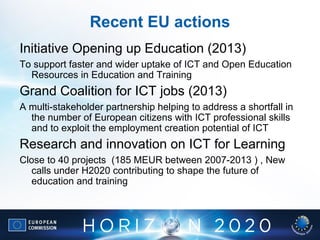
Recent EU actions
Initiative Opening up Education (2013)
To support faster and wider uptake of ICT and Open Education
Resources in Education and Training
Grand Coalition for ICT jobs (2013)
A multi-stakeholder partnership helping to address a shortfall in
the number of European citizens with ICT professional skills
and to exploit the employment creation potential of ICT
Research and innovation on ICT for Learning
Close to 40 projects (185 MEUR between 2007-2013 ) , New
calls under H2020 contributing to shape the future of
education and training
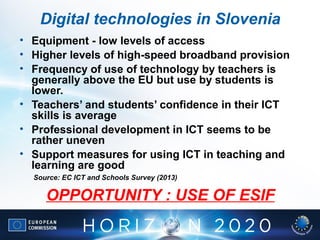
• Equipment - low levels of access
• Higher levels of high-speed broadband provision
• Frequency of use of technology by teachers is
generally above the EU but use by students is
lower.
• Teachers’ and students’ confidence in their ICT
skills is average
• Professional development in ICT seems to be
rather uneven
• Support measures for using ICT in teaching and
learning are good
Source: EC ICT and Schools Survey (2013)
OPPORTUNITY : USE OF ESIF
Digital technologies in Slovenia
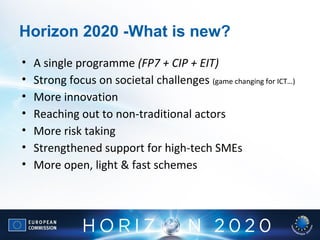
• A single programme (FP7 + CIP + EIT)
• Strong focus on societal challenges (game changing for ICT…)
• More innovation
• Reaching out to non-traditional actors
• More risk taking
• Strengthened support for high-tech SMEs
• More open, light & fast schemes
Horizon 2020 -What is new?
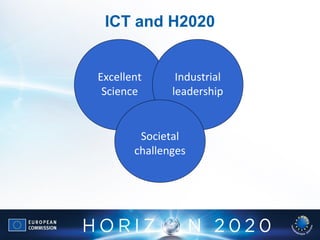
ICT and H2020
Excellent
Science
Industrial
leadership
Societal
challenges
Excellent Science - ICT
• Future and Emerging Technologies (FET)
• FET Open: fostering novel ideas
• FET Proactive: nurturing emerging themes and communities
• FET Flagships: pursuing grand interdisciplinary science and
technology challenges
• Research infrastructures
• Developing the European research infrastructure for 2020 and beyond
• Development, deployment and operation of ICT-based e-
infrastructures
Key principles for ICT R&I
in the Societal Challenges
• Interoperability
• Re-use and economies of scale
• Breakthroughs leveraging the
transformative power of ICT
• Preparation for market deployment
+
• Information for future digital policy
Industrial Leadership - ICT
• A new generation of components and systems:
• engineering of advanced embedded and resource efficient components and
systems
• Next generation computing:
• advanced and secure computing systems and technologies, including cloud
computing
• Future Internet:
• software, hardware, infrastructures, technologies and services
• Content technologies and information management:
• ICT for digital content, cultural and creative industries
• Advanced interfaces and robots:
• robotics and smart spaces
• Micro- and nanoelectronics and photonics:
• key enabling technologies
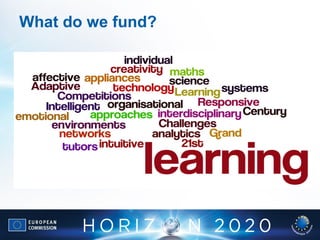
What do we fund?
Technologies for better human
learning and teaching in WP 2014-15
• Multidisciplinary research
experimentations on smart learning
environments
• Technology platform for digital learning
• Large scale pilots in real settings
• Procuring innovative solutions for
digital learning and teaching
I - Research experimentations on
smart learning environments
• Multidisciplinary research (neuroscience, pedagogical
and learning theories, educational psychology as well as
artificial intelligence)
• Focusing on adaptive and personalised learning and
assessment
• Through multi-modal/multi-sensory interaction
technologies and advanced interfaces
• Application scenarios include formal and informal
education, including workplace learning.
Budget 9 MEUR
II - Technology Platform Digital Learning
• A framework and roadmap for stakeholders to
- develop innovative technologies for learning
adaptive solutions; learning analytics, augmented reality; mobile
learning, etc.
- address standards for interactive content
composition, re-use and distribution
- adaptation into learning scenarios
Led by industry in collaboration with academia
Budget 5 MEUR
III - Large scale pilots in real settings
• Innovative digital educational tools, solutions and
services for learning and teaching practices
Engagement of teachers, learners and parents
Reducing time and physical space restrictions
Greater connection formal, non-formal and informal learning
• Pilots to link all relevant stakeholders
• As part of piloting scenarios, include also target group
children and adults with mental or physical disabilities who
undergo general education, lifelong learning or vocational
training.
Budget 28 MEUR
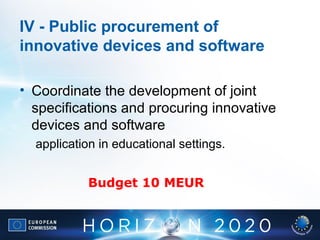
IV - Public procurement of
innovative devices and software
• Coordinate the development of joint
specifications and procuring innovative
devices and software
application in educational settings.
Budget 10 MEUR
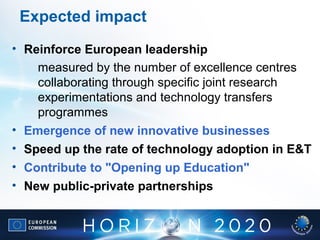
Expected impact
• Reinforce European leadership
measured by the number of excellence centres
collaborating through specific joint research
experimentations and technology transfers
programmes
• Emergence of new innovative businesses
• Speed up the rate of technology adoption in E&T
• Contribute to "Opening up Education"
• New public-private partnerships
THANK YOU FOR YOUR
ATTENTION!

H2020 Innovation and Research opportunities for ICT in Education

  • 1.
    H2020 Innovation and Researchopportunities for ICT in Education Zoran Stančič - Deputy Director General, DG CONNECT, European Commission Ljubljana 23rd April 2014
  • 2.
    • Context /Policy and R&I background • Challenges & Scope • Research and Innovation WP 2014-15 • Conclusions Outline of the presentation
  • 3.
    Digital Agenda forEurope "Member States to mainstream eLearning in national policies for the modernisation of education and training, including in curricula, assessment of learning outcomes and the professional development of teachers and trainers."
  • 4.
    • Promote excellencein education and skills through pervasive access to digital learning and 21st century competencies • Ensure adequacy between skills and employment market • Support to a triple play: innovation, inclusion (digital literacy) and economic impact (growth and jobs), and development of learning technology industry in Europe. Challenges
  • 5.
    Recent EU actions InitiativeOpening up Education (2013) To support faster and wider uptake of ICT and Open Education Resources in Education and Training Grand Coalition for ICT jobs (2013) A multi-stakeholder partnership helping to address a shortfall in the number of European citizens with ICT professional skills and to exploit the employment creation potential of ICT Research and innovation on ICT for Learning Close to 40 projects (185 MEUR between 2007-2013 ) , New calls under H2020 contributing to shape the future of education and training
  • 6.
    • Equipment -low levels of access • Higher levels of high-speed broadband provision • Frequency of use of technology by teachers is generally above the EU but use by students is lower. • Teachers’ and students’ confidence in their ICT skills is average • Professional development in ICT seems to be rather uneven • Support measures for using ICT in teaching and learning are good Source: EC ICT and Schools Survey (2013) OPPORTUNITY : USE OF ESIF Digital technologies in Slovenia
  • 7.
    • A singleprogramme (FP7 + CIP + EIT) • Strong focus on societal challenges (game changing for ICT…) • More innovation • Reaching out to non-traditional actors • More risk taking • Strengthened support for high-tech SMEs • More open, light & fast schemes Horizon 2020 -What is new?
  • 8.
  • 9.
    Excellent Science -ICT • Future and Emerging Technologies (FET) • FET Open: fostering novel ideas • FET Proactive: nurturing emerging themes and communities • FET Flagships: pursuing grand interdisciplinary science and technology challenges • Research infrastructures • Developing the European research infrastructure for 2020 and beyond • Development, deployment and operation of ICT-based e- infrastructures
  • 10.
    Key principles forICT R&I in the Societal Challenges • Interoperability • Re-use and economies of scale • Breakthroughs leveraging the transformative power of ICT • Preparation for market deployment + • Information for future digital policy
  • 11.
    Industrial Leadership -ICT • A new generation of components and systems: • engineering of advanced embedded and resource efficient components and systems • Next generation computing: • advanced and secure computing systems and technologies, including cloud computing • Future Internet: • software, hardware, infrastructures, technologies and services • Content technologies and information management: • ICT for digital content, cultural and creative industries • Advanced interfaces and robots: • robotics and smart spaces • Micro- and nanoelectronics and photonics: • key enabling technologies
  • 12.
  • 13.
    Technologies for betterhuman learning and teaching in WP 2014-15 • Multidisciplinary research experimentations on smart learning environments • Technology platform for digital learning • Large scale pilots in real settings • Procuring innovative solutions for digital learning and teaching
  • 14.
    I - Researchexperimentations on smart learning environments • Multidisciplinary research (neuroscience, pedagogical and learning theories, educational psychology as well as artificial intelligence) • Focusing on adaptive and personalised learning and assessment • Through multi-modal/multi-sensory interaction technologies and advanced interfaces • Application scenarios include formal and informal education, including workplace learning. Budget 9 MEUR
  • 15.
    II - TechnologyPlatform Digital Learning • A framework and roadmap for stakeholders to - develop innovative technologies for learning adaptive solutions; learning analytics, augmented reality; mobile learning, etc. - address standards for interactive content composition, re-use and distribution - adaptation into learning scenarios Led by industry in collaboration with academia Budget 5 MEUR
  • 16.
    III - Largescale pilots in real settings • Innovative digital educational tools, solutions and services for learning and teaching practices Engagement of teachers, learners and parents Reducing time and physical space restrictions Greater connection formal, non-formal and informal learning • Pilots to link all relevant stakeholders • As part of piloting scenarios, include also target group children and adults with mental or physical disabilities who undergo general education, lifelong learning or vocational training. Budget 28 MEUR
  • 17.
    IV - Publicprocurement of innovative devices and software • Coordinate the development of joint specifications and procuring innovative devices and software application in educational settings. Budget 10 MEUR
  • 18.
    Expected impact • ReinforceEuropean leadership measured by the number of excellence centres collaborating through specific joint research experimentations and technology transfers programmes • Emergence of new innovative businesses • Speed up the rate of technology adoption in E&T • Contribute to "Opening up Education" • New public-private partnerships
  • 19.
    THANK YOU FORYOUR ATTENTION!

Editor's Notes

  • #5 We will develop an ambitious strategy to , with effective support for learners, students, teachers and parents.
  • #8 Horizon 2020 represents a break from the past, in order to meet the new challenges and opportunities. It brings together all EU level research and innovation funding into a single programme, covering the current 7th research Framework Programme, the innovation activities from the Competitiveness and Innovation Framework Programme, as well as EU funding to the European Institute of Innovation and Technology. These currently separate activities have been integrated to allow seamless funding of research and innovation, allowing innovative projects to be supported from the laboratory to commercial exploitation. Previously separate activities have been brought together to focus on the societal challenges such as health, clean energy and transport. All forms of innovation will be included, including innovation in services and social innovation. Support will also be given to develop the market and legal frameworks for innovations to be deployed, such as on public procurement, standard setting and regulations. Horizon 2020 will also provide a major simplification, with a single set of rules, less paperwork, and faster funding. The aim is to attract the best researchers and innovators regardless of where they are located.
  • #13 Understanding of how ICT can improve learning processes and digital teaching practices - effectiveness and efficiency central role of ICT in personalisation – working to the individual's needs models of the future classroom – merging technology and teaching practices – improving the understanding of both innovative tools – serious games, emotive computing, collaborative learning tools cluster on technologies for teaching science and maths learning analytics Large-scale pilots for the design of the classroom of the 21st century Embedding learning experiences in organisational processes and practices Combining creative, cognitive and computational processes for workplace learning Adaptive and intuitive systems - affective and emotional approaches Tutors for STEM Learning appliances and cognitive tutors Digital games for learning Learning analytics Pre-Commercial procurements Roadmapping, evaluation, showcases …..