Content
Gear Trains:
•
•
Simple gear trains
Compound gear trains.
Gear Trains
When two or more gears are made to mesh with each other to transmit power from
one shaft to another, such a combination
wheels.
is called gear train or train of toothed
The nature of the train, depends upon
 The velocity ratio required
 The relative position of the axes of shafts.
A gear train may consist of spur and bevel gears.
Types of Gear Trains
Depending upon the arrangement of wheels / gears:
1.
2.
Simple gear train
Compound gear train
Simple Gear Train
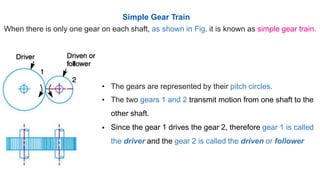
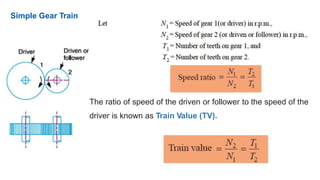
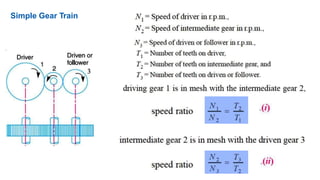
When there is only one gear on each shaft, as shown in Fig. it is known as simple gear train.
•
•
The gears are represented by their pitch circles.
The two gears 1 and 2 transmit motion from one shaft to the
other shaft.
Since the gear 1 drives the gear 2, therefore gear 1 is called
the driver and the gear 2 is called the driven or follower
•
Simple Gear Train
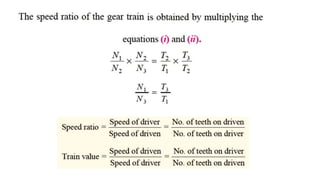
The ratio of speed of the driven or follower to the speed of the
driver is known as Train Value (TV).
Simple Gear Train
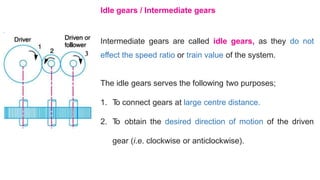
Idle gears / Intermediate gears
Intermediate gears are called idle gears, as they
effect the speed ratio or train value of the system.
do not
The idle gears serves the following two purposes;
1. T
o connect gears at large centre distance.
2. T
o obtain the desired direction of motion of the driven
gear (i.e. clockwise or anticlockwise).
Compound Gear Train
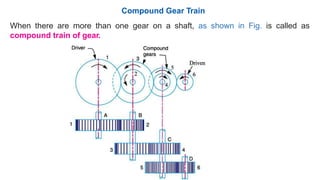
When there are more than one gear on a shaft, as shown in Fig. is called as
compound train of gear.
Compound Gear Train
•
•
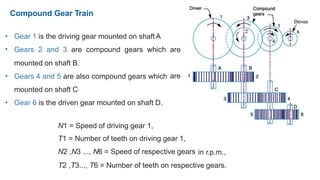
Gear 1 is the driving gear mounted on shaft A
Gears 2 and 3 are compound gears which are
mounted on shaft B.
Gears 4 and 5 are also compound gears which
mounted on shaft C
• are
• Gear 6 is the driven gear mounted on shaft D.
N1 = Speed of driving gear 1,
T1 = Number of teeth on driving gear 1,
N2 ,N3 ..., N6 = Speed of respective gears in r.p.m.,
T2 ,T3..., T6 = Number of teeth on respective gears.
Compound Gear Train
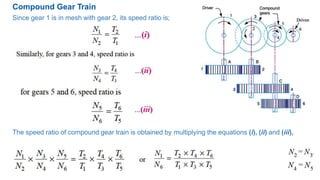
Since gear 1 is in mesh with gear 2, its speed ratio is;
The speed ratio of compound gear train is obtained by multiplying the equations (i), (ii) and (iii),
Compound Gear Train
Numerical
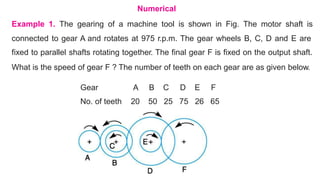
Example 1. The gearing of a machine tool is shown in Fig. The motor shaft is
connected to gear A and rotates at 975 r.p.m. The gear wheels B, C, D and E are
fixed to parallel shafts rotating together. The final gear F is fixed on the output shaft.
What is the speed of gear F ? The number of teeth on each gear are as given below.
Gear
No. of teeth
A
20
B
50
C
25
D
75
E
26
F
65
Numerical
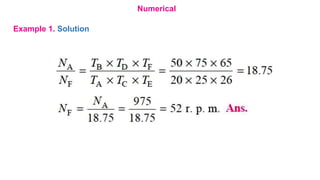
Example 1. Solution

Gear trains 1.pptx

  • 1.
    Content Gear Trains: • • Simple geartrains Compound gear trains.
  • 2.
    Gear Trains When twoor more gears are made to mesh with each other to transmit power from one shaft to another, such a combination wheels. is called gear train or train of toothed The nature of the train, depends upon  The velocity ratio required  The relative position of the axes of shafts. A gear train may consist of spur and bevel gears.
  • 3.
    Types of GearTrains Depending upon the arrangement of wheels / gears: 1. 2. Simple gear train Compound gear train
  • 4.
    Simple Gear Train Whenthere is only one gear on each shaft, as shown in Fig. it is known as simple gear train. • • The gears are represented by their pitch circles. The two gears 1 and 2 transmit motion from one shaft to the other shaft. Since the gear 1 drives the gear 2, therefore gear 1 is called the driver and the gear 2 is called the driven or follower •
  • 5.
    Simple Gear Train Theratio of speed of the driven or follower to the speed of the driver is known as Train Value (TV).
  • 6.
  • 8.
    Idle gears /Intermediate gears Intermediate gears are called idle gears, as they effect the speed ratio or train value of the system. do not The idle gears serves the following two purposes; 1. T o connect gears at large centre distance. 2. T o obtain the desired direction of motion of the driven gear (i.e. clockwise or anticlockwise).
  • 9.
    Compound Gear Train Whenthere are more than one gear on a shaft, as shown in Fig. is called as compound train of gear.
  • 10.
    Compound Gear Train • • Gear1 is the driving gear mounted on shaft A Gears 2 and 3 are compound gears which are mounted on shaft B. Gears 4 and 5 are also compound gears which mounted on shaft C • are • Gear 6 is the driven gear mounted on shaft D. N1 = Speed of driving gear 1, T1 = Number of teeth on driving gear 1, N2 ,N3 ..., N6 = Speed of respective gears in r.p.m., T2 ,T3..., T6 = Number of teeth on respective gears.
  • 11.
    Compound Gear Train Sincegear 1 is in mesh with gear 2, its speed ratio is; The speed ratio of compound gear train is obtained by multiplying the equations (i), (ii) and (iii),
  • 12.
  • 13.
    Numerical Example 1. Thegearing of a machine tool is shown in Fig. The motor shaft is connected to gear A and rotates at 975 r.p.m. The gear wheels B, C, D and E are fixed to parallel shafts rotating together. The final gear F is fixed on the output shaft. What is the speed of gear F ? The number of teeth on each gear are as given below. Gear No. of teeth A 20 B 50 C 25 D 75 E 26 F 65
  • 14.