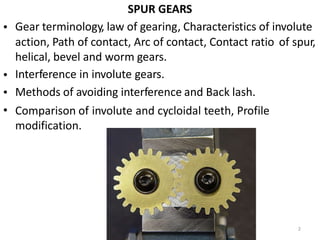
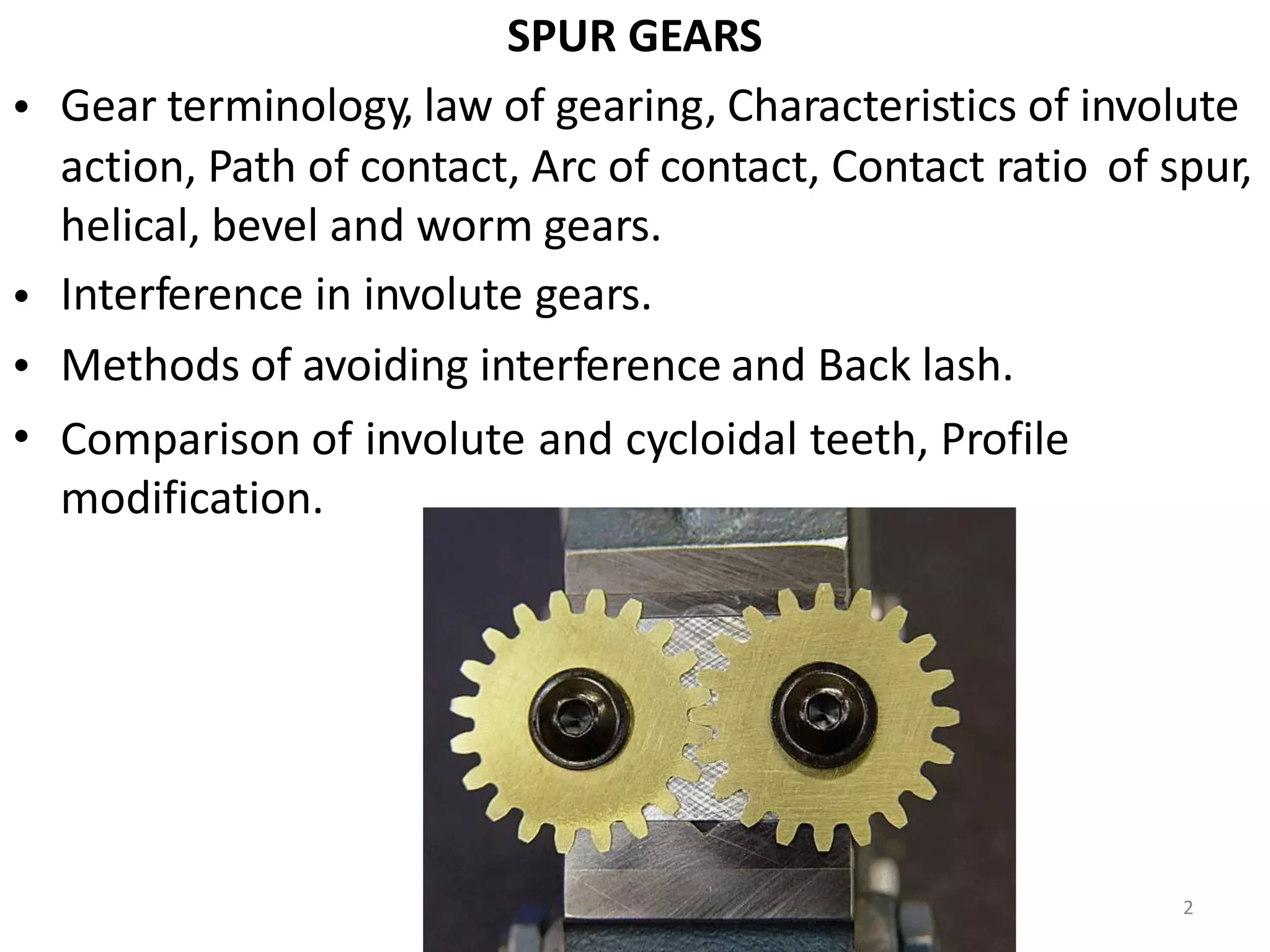
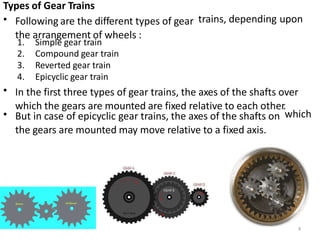
This document discusses different types of gear trains used to transmit power between rotating shafts, including:
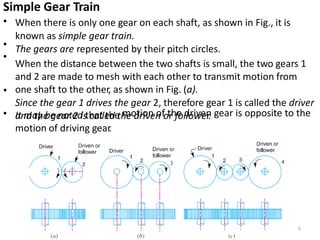
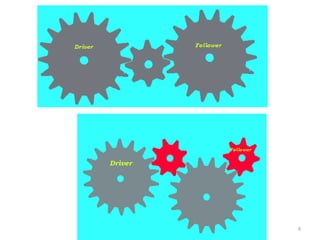
1. Simple gear trains with one gear on each shaft to transmit power between parallel shafts.
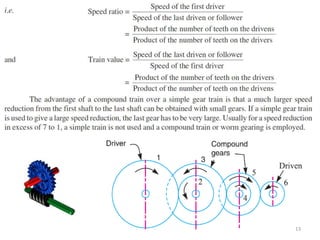
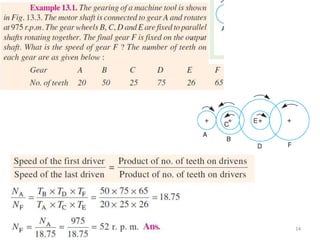
2. Compound gear trains with more than one gear on a shaft used to bridge space between driver and driven gears. Speed ratios are calculated by multiplying the tooth ratios of each gear set.
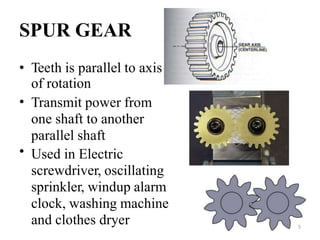
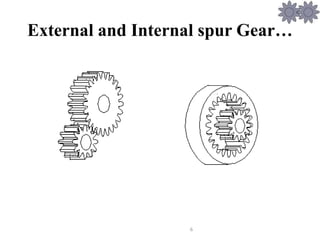
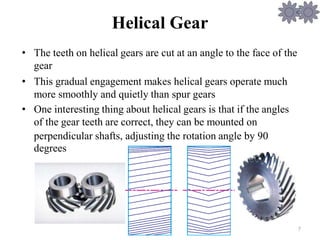
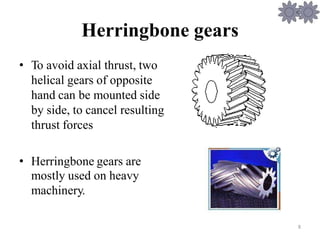
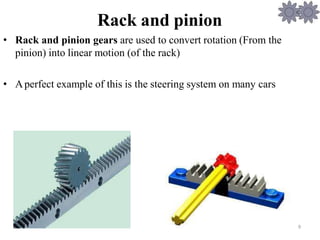
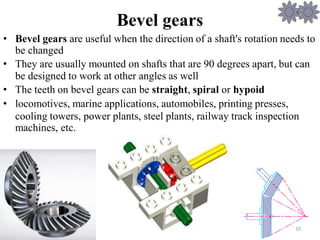
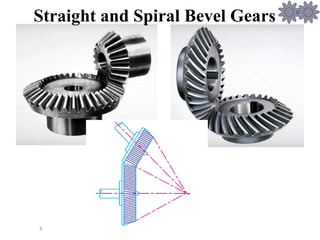
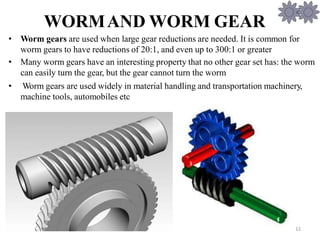
3. Gears can be spur, helical, bevel, worm or rack and pinion, with different arrangements depending on the relative positions and angles of the shafts. Compound and epicyclic gear trains allow for greater speed reductions than simple trains.
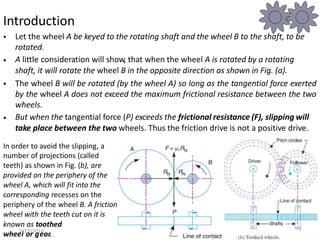
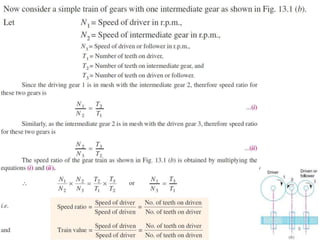
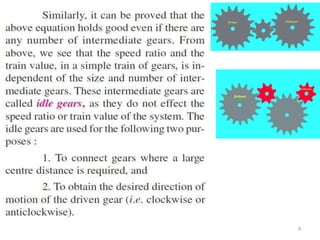
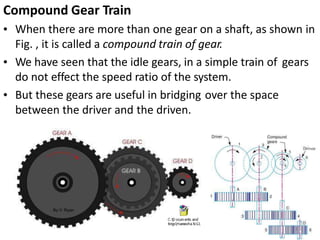
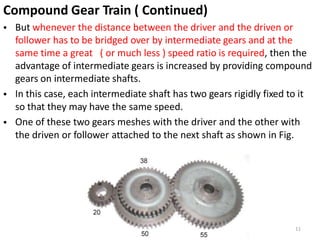
![In a compound train of gears, as shown in Fig. 13.2, the gear 1 is the driving gear mounted on
gears 2 and 3 are compound gears which are mounted on shaft B. The gears 4 and 5 are also
shaftA
compound gears which
Let
are mounted on shaft C and the gear 6 is the driven gear mounted
N 1= Speed of driving gear 1
T, = Number of teeth on driving gear 1
N 2 N3 ..., N6 = Speed of respective gears in r.p.m., and
on shaft D.
T2 ,T3"" T6 = Number of teeth on respective
gears.
Since gear 1 is in mesh with gear 2, therefore its speed ratio is
T2
I
i
N]
N2
...(i)
Driver Compound
for gears 3 and 4 speed ratio
Similarly is
N3
N4
for gears 5 and 6 speed ratio is
N5
N6
The speed ratio of compound gear
T4
1
3
...(ii)
and
T6
T5
train is
...(iii)
obtained by multiplying
.'.
the equations and (iii),
(i), (ii)
_ T2 x T4
X
T1xT3xT5
"N,
N6
T6
or
Since gear 2 and 3 are mounted
1
h/a
2f7t/2C
01
,4
therefore N4 = N5'
on one shaft B, therefore N2 = N3"
Similarly
gears 4 and 5 are mounted on
12](https://image.slidesharecdn.com/geardrives-230109060005-8bbd3f54/85/Gear-Drives-pptx-22-320.jpg)