FABRICATION OF GEARLESS DRIVE 
Submitted in the partial fulfillment of the requirement for the award of 
“DIPLOMA IN MECHANICAL ENGINEERING ” 
SUBMITTED BY: 
1. G.K. MANIGANDAN 4. J. DHANAJEYAN 
2. B. KARTHIKEYAN 5. D. DURAIVEL 
3. P. BALASUBRAMANI 6. L. PRABHU 
Under guidance of 
Mr. V.K. RAJENDRAN,M.E. 
MARCH 2013. 
DEPARTMENT OF MECHANICAL ENGINEERING 
A M K TECHNOLOGICAL POLYTECHNIC COLLEGE 
CHEM BARAMBAKKAM, CHENNAI – 602 103 
1
A M K TECHNOLOGICAL POLYTECHNIC COLLEGE 
CHEM BARAMBAKKAM, CHENNAI – 602 103 
BONAFIDE CERTIFICATE 
This is to certify that this Project work on 
“ FABRICATION OF GEARLESS DRIVE” 
submitted by …………………… ……………. Reg. No. …………… 
in partial fulfillment for the award of 
DIPLOMA IN MECHANICAL ENGINEERING 
This is the bonafide record of work carried out by him under our supervision 
during the year 2013 
Submitted for the Viva-voce exam held on …………….. 
HEAD OF THE DEPARTMENT PROJECT GUIDE 
INTERNAL EXAMINER EXTERNAL EXAMINER 
2
ACKNOWLEDGEMENT 
3
ACKNOWLEDGEMENT 
At the outset, we would like to emphasize our sincere thanks to the 
Principal Mr. R. J. KUMAR, B.E., M.E., MISTE., Ph.D., encouragement and 
valuable advice. 
we thank our Esquired Head of Department Mr R. RAJKUMAR, A.M.I.E, 
M.E., for presenting his felicitations on us. 
We are grateful on our Entourages Mr. V.K.RAJENDRAN, M.E., for 
guiding in various aspects of the project making it a grand success. 
We also owe our sincere thanks to all staff members of the Mechanical 
Engineering (MTMR) Department. 
Ultimately, we extend our thanks to all who had rendered their co-operation 
for the success of the project. 
4
CONTENTS 
5
CONTENTS 
Sl.No NAME OF THE CONTENT PAGE NO. 
1 SYNOPSIS 4 
2 INTRODUCTION 6 
3 PROJECT PLANNING 11 
4 FABRICATION DETAILS 19 
5 MECHANISM FOR GEARLESS DRIVE 22 
6 LIST OF MATERIAL 24 
7 COST ESTIMATION 26 
8 PLUMMER BLOCK 28 
9 DRAWING 41 
10 CONCLUSION 43 
11 BIBILIOGRAPHY 46 
12 PARTS OF DIAGRAM 48 
13 ASSEMBLY OF DIAGRAM 50 
6
SYNOPSIS 
7
SYNOPSIS 
Mechanical power may be transmitted directly using a solid structure such as a 
driveshaft; transmission gears can adjust the amount of torque or force vs. speed in 
much the same way an electrical transformer adjusts voltage vs current. 
Hydraulic systems use liquid under pressure to transmit power; canals and 
hydroelectric power generation facilities harness natural water power to lift ships 
or generate electricity. Pneumatic systems use gasses under pressure to transmit 
power; compressed air is commonly used to operate pneumatic tools in factories 
and repair garages. A pneumatic wrench (for instance) is used to remove and 
install automotive tires far more quickly than could be done with standard manual 
hand tools. 
In this project , the rotary power is transmitted at perpendicular direction through 
four rods without using gear drive transmission. 
It is made up of mild steel material. The whole construction of machine is 
placed on the base plate. The grinding tool is screwed to the main spindle which is 
driven through the gearless drive transmission from the motor. This motor with 
the gearless drive mechanism are mounted in base plate.The stone is fixed in the 
spindle and rotated by motor. 
8
INTRODUCTION 
9
INTRODUCTION 
This is a self – assessment test on the part of the students to assess his 
competency in creativity. 
During the course of study, the student is put on a sound theoretical 
foundation of various mechanical engineering subjects and of course, to a 
satisfactory extent. Opportunities are made available to him to work on different 
kinds of machines, so that he is exposed to various kinds of manufacturing 
process. 
As a students learn more and more his hold on production technology 
becomes stronger. He attains a stage of perfection, when he himself is able to 
design and fabricate a device. 
This is the project work. That is the testimony for the strenuous training, 
which the student had in the institute. This assures that he is no more a student, 
he is an engineer. 
This report discuses the necessity of the project and various aspects of 
planning , design, selection of materials, fabrication, erection, estimation and 
testing. 
10
11
PRECAUTION BEFORE SELECTION OF 
THE PROJECT 
12
PRECAUTION BEFORE SELECTION OF THE PROJECT 
Before rushing out of buy the material for the component first determine 
the Size of material required for gearless drive in order to transmit the load. 
Obviously the first thing to look at is Whether the drive having an easier 
provisions to attach the with the input and output devices or what extent we 
modify this. If the drive having easier provision fit the devices to transmit the 
load or and them try. 
13
PROJECT PLANNING 
14
PROJECT PLANNING 
CONCEPT OF THE PROJECT 
Before starting every project its planning is to be done. In planning 
functions are life the functions of never in our body. planning a project is a very 
important task and should be taken up with great care as the efficiency of the 
whole project largely defends upon its planning, while planning a project each 
and every details should be worked our in anticipation should be carefully 
considered with all the relative provisions aspects. 
PROJECT CAPACITY 
The capacity of the project must be decided considering theamount of 
money which can be invested. The availability of materialand machines and 
usefulness of the project. 
DESIGN AND DRAWING 
Having decided about the project to be manufactured at must be designed. 
Design work should be done very considering all the relevant factors. 
After design the project detailed drawing are prepared. DetailedSpecification for 
raw material and finished products should be decided Carefully along with the 
specification of the machine required for the manufacture. 
15
MATERIAL REQUIREMENTS 
The list of material required for manufacture is prepared from the drawing. 
The list is known as “Bill of materials”. Availability of these materials is surveyed 
and purchased from the market. 
OPERATION PLANNING 
Next work of planning is to “select the best method” manufacture the product, 
so that the wastage of materials, labour, machines and time can be eliminated by 
considering various methods. The best method is to be selected for fabrication 
and other works. 
The proper method and proper person and the purposes of operation, necessity 
operation, proper machine planning. The best method is the developed and is 
applied to fabricate the project. 
MACHINE LOADING 
While planning proper care should be taken to find the machining time for the 
operation as correct as possible. So that arrangement of full use of machines can 
be made and the machine loading program can be decided. 
16
PURCHASE CONSIDERATION 
It is difficult to manufacture all the components needed for the project 
in the machine shop. In each case, we should decide whether tomake or buy 
about a particular item. It is decided during the planning after making a complete 
study of relative merits and demerits. 
EQUIPMENT PROCEDURE 
Results obtained from “operation planning” and machine loading help in 
calculating the equipment require Specification of the equipment should be laid 
down by considering then drawings. Drawings will also help in deciding the 
necessary requirement of tools and accessories. 
17
FABRICATION DETAILS 
18
FABRICATION OF PARTS DETAILS 
1. BED 
It is made up of mild steel L andle channel material. The motor is 
engaged with base plate. All the parts for drive this mechanism are mounted 
on base plate or bed. 
2. GRINDING STONE 
The stone is fixed in the spindle and rotated by motor. 
3. FOUR “ L “ RODS DRIVE TRANSMISSION 
The power is transmitted from the motor , V belt drive to the grinding wheel 
through the these four L shaped rods having 8mm diameter. These rods are 
transmit the power in perpendicular directions and sliding in two cylinders. 
4. V BELT DRIVE TRANSMISSION; 
A belt is a loop of flexible material used to link two or more rotating shafts 
mechanically. Belts may be used as a source of motion, to transmit power 
efficiently, or to track relative movement. Belts are looped over pulleys. In a two 
pulley system, the belt can either drive the pulleys in the same direction, or the belt 
may be crossed, so that the direction of the shafts is opposite. As a source of 
motion, a conveyor belt is one application where the belt is adapted to 
continuously carry a load between two points. The power is transmitted from the 
19
motor to the grinding wheel through four L shaped rods and V belt drive.The 
belt is a V belt of B 45.The driving pulley is made in cast iron material of 25 mm 
diameter and the driven is made in cast iron material having 100 mm diameter. The 
purpose of this V belt drive is to reduce the speed from the motor. 
Vee belts 
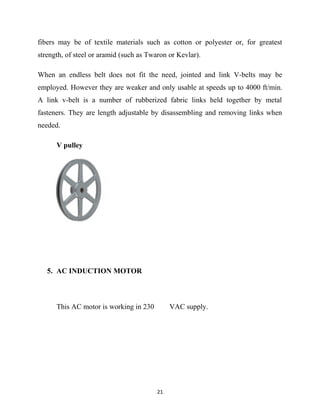
Vee belts (also known as V-belt or wedge rope) solved the slippage and alignment 
problem. It is now the basic belt for power transmission. They provide the best 
combination of traction, speed of movement, load of the bearings, and long service 
life. They are generally endless, and their general cross-section shape is trapezoidal 
(hence the name "V"). The "V" shape of the belt tracks in a mating groove in the 
pulley (or sheave), with the result that the belt cannot slip off. The belt also tends 
to wedge into the groove as the load increases—the greater the load, the greater the 
wedging action—improving torque transmission and making the V-belt an 
effective solution, needing less width and tension than flat belts. V-belts trump flat 
belts with their small center distances and high reduction ratios. The preferred 
center distance is larger than the largest pulley diameter, but less than three times 
the sum of both pulleys. Optimal speed range is 1000–7000 ft/min. V-belts need 
larger pulleys for their larger thickness than flat belts. 
For high-power requirements, two or more vee belts can be joined side-by-side in 
an arrangement called a multi-V, running on matching multi-groove sheaves. This 
is known as a multiple-V-belt drive (or sometimes a "classical V-belt drive"). 
V-belts may be homogeneously rubber or polymer throughout, or there may be 
fibers embedded in the rubber or polymer for strength and reinforcement. The 
20
fibers may be of textile materials such as cotton or polyester or, for greatest 
strength, of steel or aramid (such as Twaron or Kevlar). 
When an endless belt does not fit the need, jointed and link V-belts may be 
employed. However they are weaker and only usable at speeds up to 4000 ft/min. 
A link v-belt is a number of rubberized fabric links held together by metal 
fasteners. They are length adjustable by disassembling and removing links when 
needed. 
V pulley 
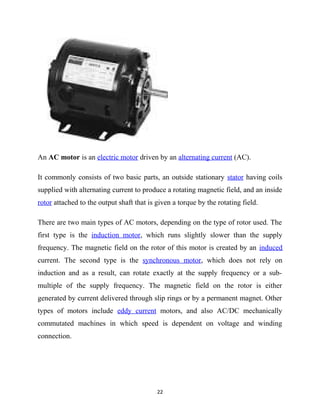
5. AC INDUCTION MOTOR 
This AC motor is working in 230 VAC supply. 
21
An AC motor is an electric motor driven by an alternating current (AC). 
It commonly consists of two basic parts, an outside stationary stator having coils 
supplied with alternating current to produce a rotating magnetic field, and an inside 
rotor attached to the output shaft that is given a torque by the rotating field. 
There are two main types of AC motors, depending on the type of rotor used. The 
first type is the induction motor, which runs slightly slower than the supply 
frequency. The magnetic field on the rotor of this motor is created by an induced 
current. The second type is the synchronous motor, which does not rely on 
induction and as a result, can rotate exactly at the supply frequency or a sub-multiple 
of the supply frequency. The magnetic field on the rotor is either 
generated by current delivered through slip rings or by a permanent magnet. Other 
types of motors include eddy current motors, and also AC/DC mechanically 
commutated machines in which speed is dependent on voltage and winding 
connection. 
22
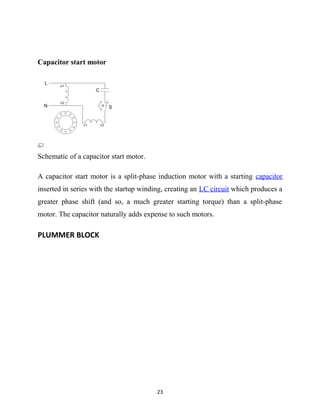
Capacitor start motor 
Schematic of a capacitor start motor. 
A capacitor start motor is a split-phase induction motor with a starting capacitor 
inserted in series with the startup winding, creating an LC circuit which produces a 
greater phase shift (and so, a much greater starting torque) than a split-phase 
motor. The capacitor naturally adds expense to such motors. 
PLUMMER BLOCK 
23
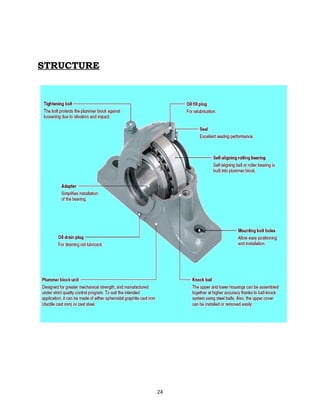
STRUCTURE 
24
HANDLING THE PLUMMER BLOCK AND BEARING 
Rolling bearings are precision components. To maintain 
accuracies, they must be handled very carefully. In particular, they 
must be kept clean, not be subjected to long impact, and be 
protected against possible rusting. Plummer blocks also need 
similar handling practices. 
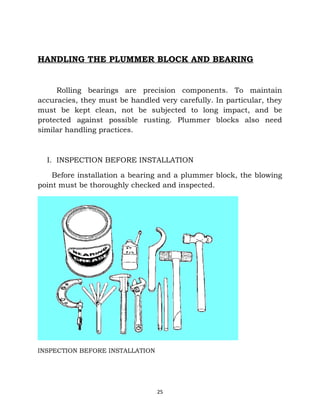
I. INSPECTION BEFORE INSTALLATION 
Before installation a bearing and a plummer block, the blowing 
point must be thoroughly checked and inspected. 
INSPECTION BEFORE INSTALLATION 
25
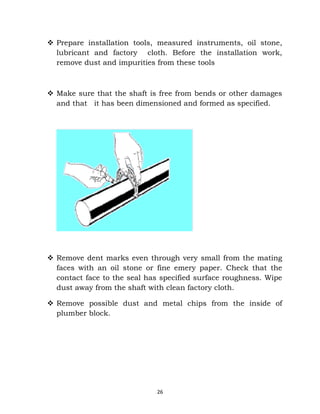
 Prepare installation tools, measured instruments, oil stone, 
lubricant and factory cloth. Before the installation work, 
remove dust and impurities from these tools 
 Make sure that the shaft is free from bends or other damages 
and that it has been dimensioned and formed as specified. 
 Remove dent marks even through very small from the mating 
faces with an oil stone or fine emery paper. Check that the 
contact face to the seal has specified surface roughness. Wipe 
dust away from the shaft with clean factory cloth. 
 Remove possible dust and metal chips from the inside of 
plumber block. 
26
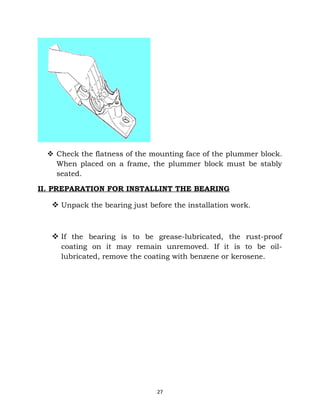
 Check the flatness of the mounting face of the plummer block. 
When placed on a frame, the plummer block must be stably 
seated. 
II. PREPARATION FOR INSTALLINT THE BEARING 
 Unpack the bearing just before the installation work. 
 If the bearing is to be grease-lubricated, the rust-proof 
coating on it may remain unremoved. If it is to be oil-lubricated, 
remove the coating with benzene or kerosene. 
27
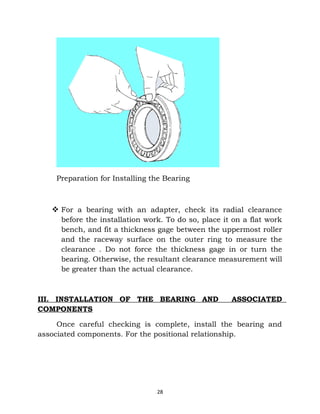
Preparation for Installing the Bearing 
 For a bearing with an adapter, check its radial clearance 
before the installation work. To do so, place it on a flat work 
bench, and fit a thickness gage between the uppermost roller 
and the raceway surface on the outer ring to measure the 
clearance . Do not force the thickness gage in or turn the 
bearing. Otherwise, the resultant clearance measurement will 
be greater than the actual clearance. 
III. INSTALLATION OF THE BEARING AND ASSOCIATED 
COMPONENTS 
Once careful checking is complete, install the bearing and 
associated components. For the positional relationship. 
28
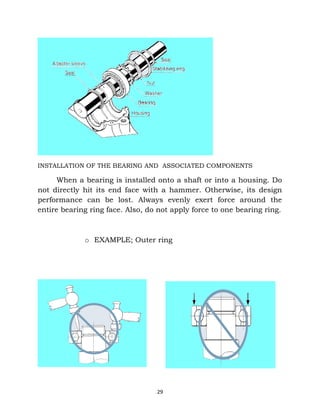
INSTALLATION OF THE BEARING AND ASSOCIATED COMPONENTS 
When a bearing is installed onto a shaft or into a housing. Do 
not directly hit its end face with a hammer. Otherwise, its design 
performance can be lost. Always evenly exert force around the 
entire bearing ring face. Also, do not apply force to one bearing ring. 
o EXAMPLE; Outer ring 
29
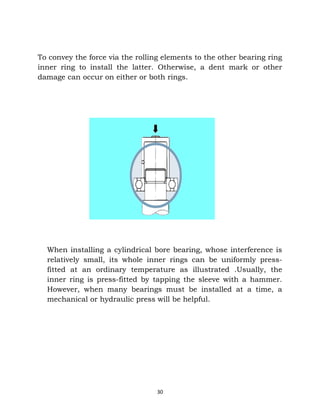
To convey the force via the rolling elements to the other bearing ring 
inner ring to install the latter. Otherwise, a dent mark or other 
damage can occur on either or both rings. 
When installing a cylindrical bore bearing, whose interference is 
relatively small, its whole inner rings can be uniformly press-fitted 
at an ordinary temperature as illustrated .Usually, the 
inner ring is press-fitted by tapping the sleeve with a hammer. 
However, when many bearings must be installed at a time, a 
mechanical or hydraulic press will be helpful. 
30
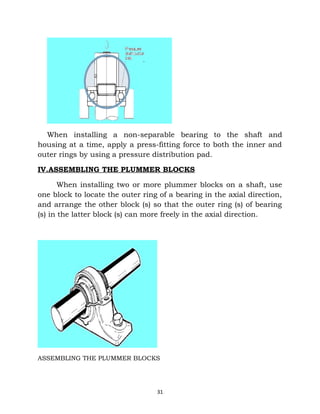
When installing a non-separable bearing to the shaft and 
housing at a time, apply a press-fitting force to both the inner and 
outer rings by using a pressure distribution pad. 
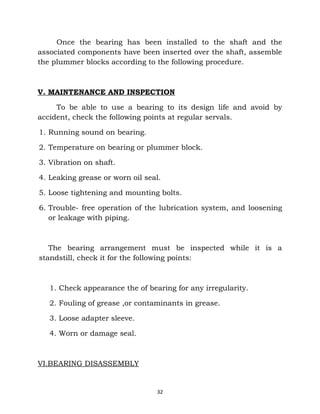
IV.ASSEMBLING THE PLUMMER BLOCKS 
When installing two or more plummer blocks on a shaft, use 
one block to locate the outer ring of a bearing in the axial direction, 
and arrange the other block (s) so that the outer ring (s) of bearing 
(s) in the latter block (s) can more freely in the axial direction. 
ASSEMBLING THE PLUMMER BLOCKS 
31
Once the bearing has been installed to the shaft and the 
associated components have been inserted over the shaft, assemble 
the plummer blocks according to the following procedure. 
V. MAINTENANCE AND INSPECTION 
To be able to use a bearing to its design life and avoid by 
accident, check the following points at regular servals. 
1. Running sound on bearing. 
2. Temperature on bearing or plummer block. 
3. Vibration on shaft. 
4. Leaking grease or worn oil seal. 
5. Loose tightening and mounting bolts. 
6. Trouble- free operation of the lubrication system, and loosening 
or leakage with piping. 
The bearing arrangement must be inspected while it is a 
standstill, check it for the following points: 
1. Check appearance the of bearing for any irregularity. 
2. Fouling of grease ,or contaminants in grease. 
3. Loose adapter sleeve. 
4. Worn or damage seal. 
VI.BEARING DISASSEMBLY 
32
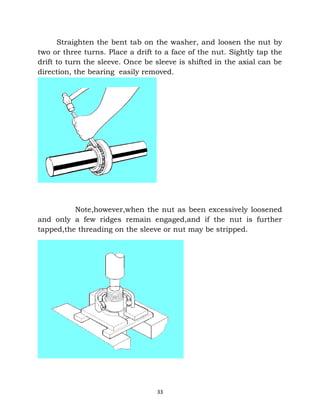
Straighten the bent tab on the washer, and loosen the nut by 
two or three turns. Place a drift to a face of the nut. Sightly tap the 
drift to turn the sleeve. Once be sleeve is shifted in the axial can be 
direction, the bearing easily removed. 
Note,however,when the nut as been excessively loosened 
and only a few ridges remain engaged,and if the nut is further 
tapped,the threading on the sleeve or nut may be stripped. 
33
VII.CYLINDRICAL BORE BEARING 
Usually, a cylindrical bore bearing is interference-fitted. 
Thus, the bearing is simply drawn out by placing a jig to yhr face of 
the inner ring and exerting a forces illustied with a hand press. 
However,be careful not to apply a force to the outer ring. When 
using this tool, make sure that the jig is fully engaged with the face 
of the inner ring. 
VIII.CLEANING THE BEARING 
Clean the removed bearing with diesel oil or kerosene. 
USE TWO VESSELS. 
One for rough cleaning and the other for finish cleaning. 
Prepare a cleaning station that has a metal screen as illustrated. So 
that the bearing does not directly contact the fouling on the bottom 
of vessel. In rough cleaning, virtually all oil and foreign matters 
should be removed from the bearing which should be immediately 
transferred to the finish vessel. The finish vessel must be provide 
with a filter unit to maintain the cleaning agent clean. 
Once cleaned, the bearing must be immediately rust-proofed. 
The bearings (which have been carefully removed) must be 
checked whether they can be reused. The judging criterion for reuse 
should be determined considering the following criteria through a 
trial-and-error basis. 
1. Scheduled operating duration to next regular inspection. 
2. Importance of the machine that uses the bearing in question 
34
3. Operating conditions such as loading and bearing speed. 
4. Severity of damage on the rolling contact surface. 
5. Tendency of increasing bearing clearance and wear on the 
cage. 
6. Loss in accuracy, etc., 
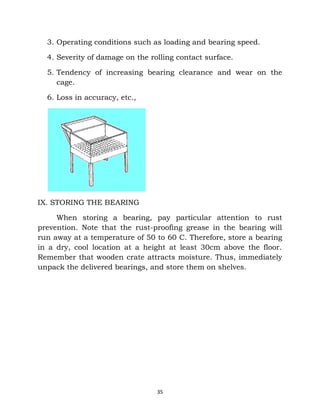
IX. STORING THE BEARING 
When storing a bearing, pay particular attention to rust 
prevention. Note that the rust-proofing grease in the bearing will 
run away at a temperature of 50 to 60 C. Therefore, store a bearing 
in a dry, cool location at a height at least 30cm above the floor. 
Remember that wooden crate attracts moisture. Thus, immediately 
unpack the delivered bearings, and store them on shelves. 
35
Introduction to Grinding wheel 
Grinding wheels 
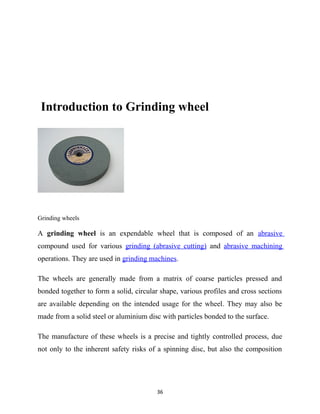
A grinding wheel is an expendable wheel that is composed of an abrasive 
compound used for various grinding (abrasive cutting) and abrasive machining 
operations. They are used in grinding machines. 
The wheels are generally made from a matrix of coarse particles pressed and 
bonded together to form a solid, circular shape, various profiles and cross sections 
are available depending on the intended usage for the wheel. They may also be 
made from a solid steel or aluminium disc with particles bonded to the surface. 
The manufacture of these wheels is a precise and tightly controlled process, due 
not only to the inherent safety risks of a spinning disc, but also the composition 
36
and uniformity required to prevent that disc from exploding due to the high stresses 
produced on rotation. 
Characteristics 
There are five characteristics of a cutting wheel: material, grain size, wheel grade, 
grain spacing, and bond type. They will be indicated by codes on the wheel's label. 
Material, the actual abrasive, is selected according to the hardness of the material 
being cut. 
· Aluminium Oxide (A) 
· Silicon Carbide (S) 
· Ceramic (C) 
· Diamond (D, MD, SD) 
· Cubic Boron Nitride (B) 
Grain size, from 8 (coarsest) 1200 (finest), determines the physical size of the 
abrasive grains in the wheel. A larger grain will cut freely, allowing fast cutting but 
poor surface finish. Ultra-fine grain sizes are for precision finish work. 
Wheel grade, from A (soft) to Z (hard), determines how tightly the bond holds the 
abrasive. Grade affects almost all considerations of grinding, such as wheel speed, 
coolant flow, maximum and minimum feed rates, and grinding depth. 
Grain spacing, or structure, from 1 (densest) to 16 (least dense). Density is the 
ratio of bond and abrasive to air space. A less-dense wheel will cut freely, and has 
37
a large effect on surface finish. It is also able to take a deeper or wider cut with less 
coolant, as the chip clearance on the wheel is greater. 
Wheel bond, how the wheel holds the abrasives, affects finish, coolant, and 
minimum/maximum wheel speed. 
· Vitrified (V) 
· Resinoid (B) 
· Silicate (S) 
· Shellac (E) 
· Rubber (R) 
· Metal (M) 
· Oxychloride (O) 
Types 
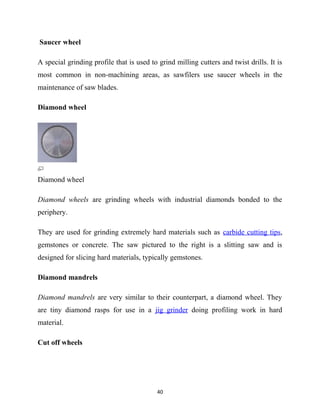
Straight wheel 
Straight wheel 
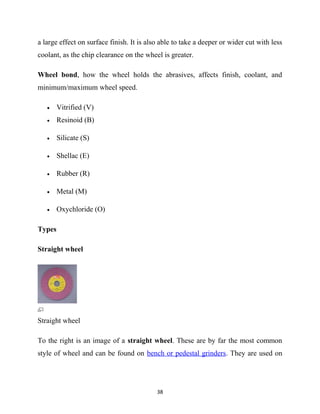
To the right is an image of a straight wheel. These are by far the most common 
style of wheel and can be found on bench or pedestal grinders. They are used on 
38
the periphery only and therefore produce a slightly concave surface (hollow 
ground) on the part. This can be used to advantage on many tools such as chisels. 
Straight Wheels are generally used for cylindrical, centreless, and surface grinding 
operations. Wheels of this form vary greatly in size, the diameter and width of face 
naturally depending upon the class of work for which is used and the size and 
power of the grinding machine. 
Cylinder or wheel ring 
Cylinder wheels provide a long, wide surface with no center mounting support 
(hollow). They can be very large, up to 12" in width. They are used only in vertical 
or horizontal spindle grinders. Cylinder or wheel ring is used for producing flat 
surfaces, the grinding being done with the end face of the wheel. 
Tapered wheel 
A straight wheel that tapers outward towards the center of the wheel. This 
arrangement is stronger than straight wheels and can accept higher lateral loads. 
Tapered face straight wheel is primarily used for grinding thread, gear teeth etc. 
Straight cup 
Straight cup wheels are an alternative to cup wheels in tool and cutter grinders, 
where having an additional radial grinding surface is beneficial. 
Dish cup 
A very shallow cup-style grinding wheel. The thinness allows grinding in slots and 
crevices. It is used primarily in cutter grinding and jig grinding. 
39
Saucer wheel 
A special grinding profile that is used to grind milling cutters and twist drills. It is 
most common in non-machining areas, as sawfilers use saucer wheels in the 
maintenance of saw blades. 
Diamond wheel 
Diamond wheel 
Diamond wheels are grinding wheels with industrial diamonds bonded to the 
periphery. 
They are used for grinding extremely hard materials such as carbide cutting tips, 
gemstones or concrete. The saw pictured to the right is a slitting saw and is 
designed for slicing hard materials, typically gemstones. 
Diamond mandrels 
Diamond mandrels are very similar to their counterpart, a diamond wheel. They 
are tiny diamond rasps for use in a jig grinder doing profiling work in hard 
material. 
Cut off wheels 
40
Cut off wheels, also known as parting wheels, are self-sharpening wheels that are 
thin in width and often have radial fibres reinforcing them. They are often used in 
the construction industry for cutting reinforcement bars (rebar), protruding bolts or 
anything that needs quick removal or trimming. Most handymen would recognise 
an angle grinder and the discs they use. 
Use 
To use the grinding wheel it must first be clamped to the grinding machine. The 
wheel type (e.g. cup or plain wheel below) fit freely on their supporting arbors, the 
necessary clamping force to transfer the rotary motion being applied to the wheels 
side by identically sized flanges (metal discs). The paper blotter shown in the 
images is intended to distribute this clamping force evenly across the wheels 
surface. 
Dressing 
Grinding wheels are self sharpening to a small degree; for optimal use they may be 
dressed and trued by the use of wheel or grinding dressers. Dressing the wheel 
refers to removing the current layer of abrasive, so that a fresh and sharp surface is 
exposed to the work surface. Trueing the wheel makes the grinding surface parallel 
to the grinding table or other reference plane, so that the entire grinding wheel is 
even and produces an accurate surface. 
41
WORKING PRINCIPLE 
42
WORKING PRINCIPLE 
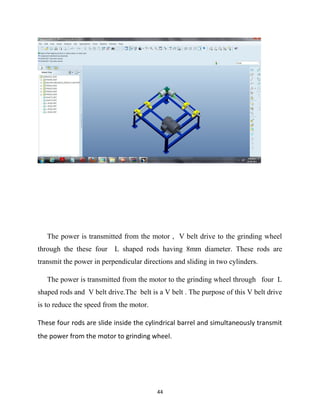
This drive consists of 
1. Ac capacitor start type induction motor 
2. V belt drive transmission 
3. Four L shaped rods drive transmission 
4. Plummer block support bearings with shaft drive for grinding wheel. 
This drive mechanism is shown below 
43
The power is transmitted from the motor , V belt drive to the grinding wheel 
through the these four L shaped rods having 8mm diameter. These rods are 
transmit the power in perpendicular directions and sliding in two cylinders. 
The power is transmitted from the motor to the grinding wheel through four L 
shaped rods and V belt drive.The belt is a V belt . The purpose of this V belt drive 
is to reduce the speed from the motor. 
These four rods are slide inside the cylindrical barrel and simultaneously transmit 
the power from the motor to grinding wheel. 
44
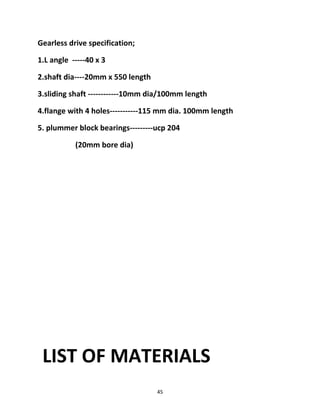
Gearless drive specification; 
1.L angle -----40 x 3 
2.shaft dia----20mm x 550 length 
3.sliding shaft ------------10mm dia/100mm length 
4.flange with 4 holes-----------115 mm dia. 100mm length 
5. plummer block bearings---------ucp 204 
(20mm bore dia) 
LIST OF MATERIALS 
45
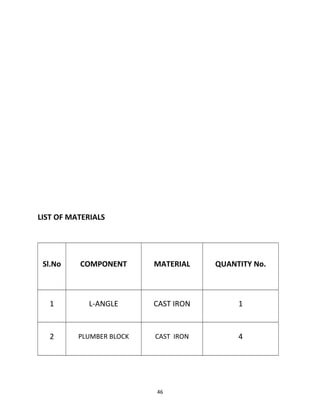
LIST OF MATERIALS 
Sl.No COMPONENT MATERIAL QUANTITY No. 
1 L-ANGLE CAST IRON 1 
2 PLUMBER BLOCK CAST IRON 4 
46
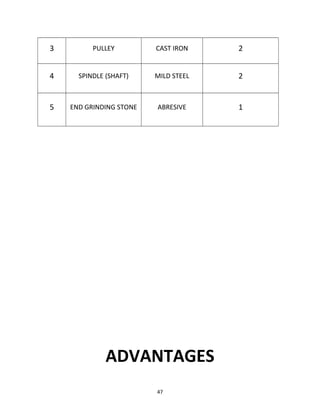
3 PULLEY CAST IRON 2 
4 SPINDLE (SHAFT) MILD STEEL 2 
5 END GRINDING STONE ABRESIVE 1 
ADVANTAGES 
47
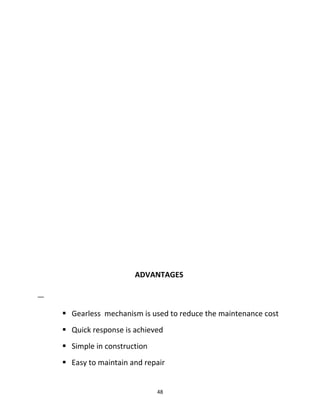
ADVANTAGES 
 Gearless mechanism is used to reduce the maintenance cost 
 Quick response is achieved 
 Simple in construction 
 Easy to maintain and repair 
48
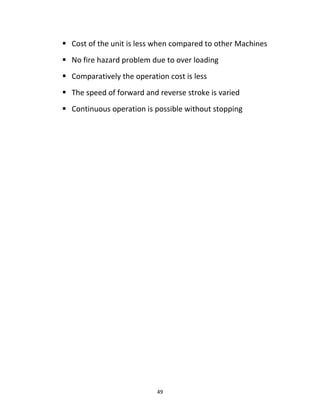
 Cost of the unit is less when compared to other Machines 
 No fire hazard problem due to over loading 
 Comparatively the operation cost is less 
 The speed of forward and reverse stroke is varied 
 Continuous operation is possible without stopping 
49
APPLICATIONS 
APPLICATIONS 
· Small and Medium load transmission 
· It is very useful in machine shop 
50
· Industrial Application 
51
LIMITATIONS 
LIMITATIONS 
52
 High torque cannot be obtained 
 Load carrying capacity of this unit is not very low 
53
FINISHING AND 
PAINTING 
FINISHING AND PAINTING 
JOB PREPARATION; 
54
Before welding, remove any bend in the L angle with the sludge hammer on 
the anvil block. Then it is cut to the required length with the hacksaw blade and 
fabricated to required dimensional shape with arc welding. 
FINISHING OPERATION BEFORE PAINTING; 
After welding, any slag on the welded area is removed with the chipping 
hammer and cleaned with the metal wire brush. Then all the surfaces are rubbed 
with the emery sheet. 
Metal primer is applied on the surfaces with the brush .After drying the metal 
primer, the second coating is applied with the paint. 
55
COST ESTIMATION 
COST ESTIMATION 
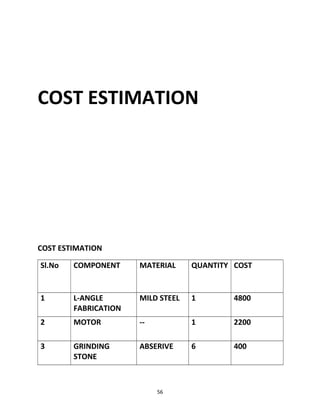
Sl.No COMPONENT MATERIAL QUANTITY COST 
1 L-ANGLE 
FABRICATION 
MILD STEEL 1 4800 
2 MOTOR -- 1 2200 
3 GRINDING 
STONE 
ABSERIVE 6 400 
56
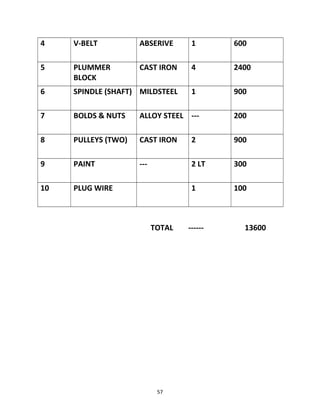
4 V-BELT ABSERIVE 1 600 
5 PLUMMER 
BLOCK 
CAST IRON 4 2400 
6 SPINDLE (SHAFT) MILDSTEEL 1 900 
7 BOLDS & NUTS ALLOY STEEL --- 200 
8 PULLEYS (TWO) CAST IRON 2 900 
9 PAINT --- 2 LT 300 
10 PLUG WIRE 1 100 
TOTAL ------ 13600 
57
DRAWINGS 
58
59
CONCLUSION 
CONCLUSION 
60
We are assembling the gearless drive to enable the machine to perform one 
additional operation. At present this attachment is purely operated and 
controller by means of mechanical. 
The present made can eliminate the rescue work of the geared drive and at 
the same time reduce the maintenance cost of the same machine. 
We present out idea for mechanism in manual assisted or operated type 
attachment. We have decided an equipment namely “Gearless Attachment” 
has been completed successfully to our entire satisfaction While processing 
his project, we happen to visit number of libraries and industries to collect 
information. We got an opportunity to meet a few experienced person in this 
field. This experience have also enriched our knowledge both theoretically 
and practically creating confidence. Which would be useful in my future span 
of life. 
61
BIBLOGRAPHY 
BIBLOGRAPHY 
62
WORKSHOP : W.J. CHAPMAN 
PRODUCTION TECHNOLOGY : R.K. JAIN 
PRODUCTION TECHNOLOGY : R.K. JAIN & S.C. QUPTA 
METAL FORMING PROCESS : R.S. KURMI 
MANUFACTURING PROCESS : K. RAMACHANDRAN 
MACHINE SHOP TECHNOLOGY : S.S. MANIAN & 
RAJAGOPAL & 
G. BALAJI SINGH 
DESIGN OF MACHINE ELEMENTS : R.S. KURMI & 
P.N. VENKATESAN 
DESIGN OF MACHINE ELEMENTS : RAMACHANDRAN 
DESIGN DATA BOOK : P.S.G. COLLEGE OF 
TECHNOLOGY 
63
PHOTO VIEW 
PHOTO VIEW 
64
65

Gearless drive report 2014 lst

  • 1.
    FABRICATION OF GEARLESSDRIVE Submitted in the partial fulfillment of the requirement for the award of “DIPLOMA IN MECHANICAL ENGINEERING ” SUBMITTED BY: 1. G.K. MANIGANDAN 4. J. DHANAJEYAN 2. B. KARTHIKEYAN 5. D. DURAIVEL 3. P. BALASUBRAMANI 6. L. PRABHU Under guidance of Mr. V.K. RAJENDRAN,M.E. MARCH 2013. DEPARTMENT OF MECHANICAL ENGINEERING A M K TECHNOLOGICAL POLYTECHNIC COLLEGE CHEM BARAMBAKKAM, CHENNAI – 602 103 1
  • 2.
    A M KTECHNOLOGICAL POLYTECHNIC COLLEGE CHEM BARAMBAKKAM, CHENNAI – 602 103 BONAFIDE CERTIFICATE This is to certify that this Project work on “ FABRICATION OF GEARLESS DRIVE” submitted by …………………… ……………. Reg. No. …………… in partial fulfillment for the award of DIPLOMA IN MECHANICAL ENGINEERING This is the bonafide record of work carried out by him under our supervision during the year 2013 Submitted for the Viva-voce exam held on …………….. HEAD OF THE DEPARTMENT PROJECT GUIDE INTERNAL EXAMINER EXTERNAL EXAMINER 2
  • 3.
  • 4.
    ACKNOWLEDGEMENT At theoutset, we would like to emphasize our sincere thanks to the Principal Mr. R. J. KUMAR, B.E., M.E., MISTE., Ph.D., encouragement and valuable advice. we thank our Esquired Head of Department Mr R. RAJKUMAR, A.M.I.E, M.E., for presenting his felicitations on us. We are grateful on our Entourages Mr. V.K.RAJENDRAN, M.E., for guiding in various aspects of the project making it a grand success. We also owe our sincere thanks to all staff members of the Mechanical Engineering (MTMR) Department. Ultimately, we extend our thanks to all who had rendered their co-operation for the success of the project. 4
  • 5.
  • 6.
    CONTENTS Sl.No NAMEOF THE CONTENT PAGE NO. 1 SYNOPSIS 4 2 INTRODUCTION 6 3 PROJECT PLANNING 11 4 FABRICATION DETAILS 19 5 MECHANISM FOR GEARLESS DRIVE 22 6 LIST OF MATERIAL 24 7 COST ESTIMATION 26 8 PLUMMER BLOCK 28 9 DRAWING 41 10 CONCLUSION 43 11 BIBILIOGRAPHY 46 12 PARTS OF DIAGRAM 48 13 ASSEMBLY OF DIAGRAM 50 6
  • 7.
  • 8.
    SYNOPSIS Mechanical powermay be transmitted directly using a solid structure such as a driveshaft; transmission gears can adjust the amount of torque or force vs. speed in much the same way an electrical transformer adjusts voltage vs current. Hydraulic systems use liquid under pressure to transmit power; canals and hydroelectric power generation facilities harness natural water power to lift ships or generate electricity. Pneumatic systems use gasses under pressure to transmit power; compressed air is commonly used to operate pneumatic tools in factories and repair garages. A pneumatic wrench (for instance) is used to remove and install automotive tires far more quickly than could be done with standard manual hand tools. In this project , the rotary power is transmitted at perpendicular direction through four rods without using gear drive transmission. It is made up of mild steel material. The whole construction of machine is placed on the base plate. The grinding tool is screwed to the main spindle which is driven through the gearless drive transmission from the motor. This motor with the gearless drive mechanism are mounted in base plate.The stone is fixed in the spindle and rotated by motor. 8
  • 9.
  • 10.
    INTRODUCTION This isa self – assessment test on the part of the students to assess his competency in creativity. During the course of study, the student is put on a sound theoretical foundation of various mechanical engineering subjects and of course, to a satisfactory extent. Opportunities are made available to him to work on different kinds of machines, so that he is exposed to various kinds of manufacturing process. As a students learn more and more his hold on production technology becomes stronger. He attains a stage of perfection, when he himself is able to design and fabricate a device. This is the project work. That is the testimony for the strenuous training, which the student had in the institute. This assures that he is no more a student, he is an engineer. This report discuses the necessity of the project and various aspects of planning , design, selection of materials, fabrication, erection, estimation and testing. 10
  • 11.
  • 12.
    PRECAUTION BEFORE SELECTIONOF THE PROJECT 12
  • 13.
    PRECAUTION BEFORE SELECTIONOF THE PROJECT Before rushing out of buy the material for the component first determine the Size of material required for gearless drive in order to transmit the load. Obviously the first thing to look at is Whether the drive having an easier provisions to attach the with the input and output devices or what extent we modify this. If the drive having easier provision fit the devices to transmit the load or and them try. 13
  • 14.
  • 15.
    PROJECT PLANNING CONCEPTOF THE PROJECT Before starting every project its planning is to be done. In planning functions are life the functions of never in our body. planning a project is a very important task and should be taken up with great care as the efficiency of the whole project largely defends upon its planning, while planning a project each and every details should be worked our in anticipation should be carefully considered with all the relative provisions aspects. PROJECT CAPACITY The capacity of the project must be decided considering theamount of money which can be invested. The availability of materialand machines and usefulness of the project. DESIGN AND DRAWING Having decided about the project to be manufactured at must be designed. Design work should be done very considering all the relevant factors. After design the project detailed drawing are prepared. DetailedSpecification for raw material and finished products should be decided Carefully along with the specification of the machine required for the manufacture. 15
  • 16.
    MATERIAL REQUIREMENTS Thelist of material required for manufacture is prepared from the drawing. The list is known as “Bill of materials”. Availability of these materials is surveyed and purchased from the market. OPERATION PLANNING Next work of planning is to “select the best method” manufacture the product, so that the wastage of materials, labour, machines and time can be eliminated by considering various methods. The best method is to be selected for fabrication and other works. The proper method and proper person and the purposes of operation, necessity operation, proper machine planning. The best method is the developed and is applied to fabricate the project. MACHINE LOADING While planning proper care should be taken to find the machining time for the operation as correct as possible. So that arrangement of full use of machines can be made and the machine loading program can be decided. 16
  • 17.
    PURCHASE CONSIDERATION Itis difficult to manufacture all the components needed for the project in the machine shop. In each case, we should decide whether tomake or buy about a particular item. It is decided during the planning after making a complete study of relative merits and demerits. EQUIPMENT PROCEDURE Results obtained from “operation planning” and machine loading help in calculating the equipment require Specification of the equipment should be laid down by considering then drawings. Drawings will also help in deciding the necessary requirement of tools and accessories. 17
  • 18.
  • 19.
    FABRICATION OF PARTSDETAILS 1. BED It is made up of mild steel L andle channel material. The motor is engaged with base plate. All the parts for drive this mechanism are mounted on base plate or bed. 2. GRINDING STONE The stone is fixed in the spindle and rotated by motor. 3. FOUR “ L “ RODS DRIVE TRANSMISSION The power is transmitted from the motor , V belt drive to the grinding wheel through the these four L shaped rods having 8mm diameter. These rods are transmit the power in perpendicular directions and sliding in two cylinders. 4. V BELT DRIVE TRANSMISSION; A belt is a loop of flexible material used to link two or more rotating shafts mechanically. Belts may be used as a source of motion, to transmit power efficiently, or to track relative movement. Belts are looped over pulleys. In a two pulley system, the belt can either drive the pulleys in the same direction, or the belt may be crossed, so that the direction of the shafts is opposite. As a source of motion, a conveyor belt is one application where the belt is adapted to continuously carry a load between two points. The power is transmitted from the 19
  • 20.
    motor to thegrinding wheel through four L shaped rods and V belt drive.The belt is a V belt of B 45.The driving pulley is made in cast iron material of 25 mm diameter and the driven is made in cast iron material having 100 mm diameter. The purpose of this V belt drive is to reduce the speed from the motor. Vee belts Vee belts (also known as V-belt or wedge rope) solved the slippage and alignment problem. It is now the basic belt for power transmission. They provide the best combination of traction, speed of movement, load of the bearings, and long service life. They are generally endless, and their general cross-section shape is trapezoidal (hence the name "V"). The "V" shape of the belt tracks in a mating groove in the pulley (or sheave), with the result that the belt cannot slip off. The belt also tends to wedge into the groove as the load increases—the greater the load, the greater the wedging action—improving torque transmission and making the V-belt an effective solution, needing less width and tension than flat belts. V-belts trump flat belts with their small center distances and high reduction ratios. The preferred center distance is larger than the largest pulley diameter, but less than three times the sum of both pulleys. Optimal speed range is 1000–7000 ft/min. V-belts need larger pulleys for their larger thickness than flat belts. For high-power requirements, two or more vee belts can be joined side-by-side in an arrangement called a multi-V, running on matching multi-groove sheaves. This is known as a multiple-V-belt drive (or sometimes a "classical V-belt drive"). V-belts may be homogeneously rubber or polymer throughout, or there may be fibers embedded in the rubber or polymer for strength and reinforcement. The 20
  • 21.
    fibers may beof textile materials such as cotton or polyester or, for greatest strength, of steel or aramid (such as Twaron or Kevlar). When an endless belt does not fit the need, jointed and link V-belts may be employed. However they are weaker and only usable at speeds up to 4000 ft/min. A link v-belt is a number of rubberized fabric links held together by metal fasteners. They are length adjustable by disassembling and removing links when needed. V pulley 5. AC INDUCTION MOTOR This AC motor is working in 230 VAC supply. 21
  • 22.
    An AC motoris an electric motor driven by an alternating current (AC). It commonly consists of two basic parts, an outside stationary stator having coils supplied with alternating current to produce a rotating magnetic field, and an inside rotor attached to the output shaft that is given a torque by the rotating field. There are two main types of AC motors, depending on the type of rotor used. The first type is the induction motor, which runs slightly slower than the supply frequency. The magnetic field on the rotor of this motor is created by an induced current. The second type is the synchronous motor, which does not rely on induction and as a result, can rotate exactly at the supply frequency or a sub-multiple of the supply frequency. The magnetic field on the rotor is either generated by current delivered through slip rings or by a permanent magnet. Other types of motors include eddy current motors, and also AC/DC mechanically commutated machines in which speed is dependent on voltage and winding connection. 22
  • 23.
    Capacitor start motor Schematic of a capacitor start motor. A capacitor start motor is a split-phase induction motor with a starting capacitor inserted in series with the startup winding, creating an LC circuit which produces a greater phase shift (and so, a much greater starting torque) than a split-phase motor. The capacitor naturally adds expense to such motors. PLUMMER BLOCK 23
  • 24.
  • 25.
    HANDLING THE PLUMMERBLOCK AND BEARING Rolling bearings are precision components. To maintain accuracies, they must be handled very carefully. In particular, they must be kept clean, not be subjected to long impact, and be protected against possible rusting. Plummer blocks also need similar handling practices. I. INSPECTION BEFORE INSTALLATION Before installation a bearing and a plummer block, the blowing point must be thoroughly checked and inspected. INSPECTION BEFORE INSTALLATION 25
  • 26.
     Prepare installationtools, measured instruments, oil stone, lubricant and factory cloth. Before the installation work, remove dust and impurities from these tools  Make sure that the shaft is free from bends or other damages and that it has been dimensioned and formed as specified.  Remove dent marks even through very small from the mating faces with an oil stone or fine emery paper. Check that the contact face to the seal has specified surface roughness. Wipe dust away from the shaft with clean factory cloth.  Remove possible dust and metal chips from the inside of plumber block. 26
  • 27.
     Check theflatness of the mounting face of the plummer block. When placed on a frame, the plummer block must be stably seated. II. PREPARATION FOR INSTALLINT THE BEARING  Unpack the bearing just before the installation work.  If the bearing is to be grease-lubricated, the rust-proof coating on it may remain unremoved. If it is to be oil-lubricated, remove the coating with benzene or kerosene. 27
  • 28.
    Preparation for Installingthe Bearing  For a bearing with an adapter, check its radial clearance before the installation work. To do so, place it on a flat work bench, and fit a thickness gage between the uppermost roller and the raceway surface on the outer ring to measure the clearance . Do not force the thickness gage in or turn the bearing. Otherwise, the resultant clearance measurement will be greater than the actual clearance. III. INSTALLATION OF THE BEARING AND ASSOCIATED COMPONENTS Once careful checking is complete, install the bearing and associated components. For the positional relationship. 28
  • 29.
    INSTALLATION OF THEBEARING AND ASSOCIATED COMPONENTS When a bearing is installed onto a shaft or into a housing. Do not directly hit its end face with a hammer. Otherwise, its design performance can be lost. Always evenly exert force around the entire bearing ring face. Also, do not apply force to one bearing ring. o EXAMPLE; Outer ring 29
  • 30.
    To convey theforce via the rolling elements to the other bearing ring inner ring to install the latter. Otherwise, a dent mark or other damage can occur on either or both rings. When installing a cylindrical bore bearing, whose interference is relatively small, its whole inner rings can be uniformly press-fitted at an ordinary temperature as illustrated .Usually, the inner ring is press-fitted by tapping the sleeve with a hammer. However, when many bearings must be installed at a time, a mechanical or hydraulic press will be helpful. 30
  • 31.
    When installing anon-separable bearing to the shaft and housing at a time, apply a press-fitting force to both the inner and outer rings by using a pressure distribution pad. IV.ASSEMBLING THE PLUMMER BLOCKS When installing two or more plummer blocks on a shaft, use one block to locate the outer ring of a bearing in the axial direction, and arrange the other block (s) so that the outer ring (s) of bearing (s) in the latter block (s) can more freely in the axial direction. ASSEMBLING THE PLUMMER BLOCKS 31
  • 32.
    Once the bearinghas been installed to the shaft and the associated components have been inserted over the shaft, assemble the plummer blocks according to the following procedure. V. MAINTENANCE AND INSPECTION To be able to use a bearing to its design life and avoid by accident, check the following points at regular servals. 1. Running sound on bearing. 2. Temperature on bearing or plummer block. 3. Vibration on shaft. 4. Leaking grease or worn oil seal. 5. Loose tightening and mounting bolts. 6. Trouble- free operation of the lubrication system, and loosening or leakage with piping. The bearing arrangement must be inspected while it is a standstill, check it for the following points: 1. Check appearance the of bearing for any irregularity. 2. Fouling of grease ,or contaminants in grease. 3. Loose adapter sleeve. 4. Worn or damage seal. VI.BEARING DISASSEMBLY 32
  • 33.
    Straighten the benttab on the washer, and loosen the nut by two or three turns. Place a drift to a face of the nut. Sightly tap the drift to turn the sleeve. Once be sleeve is shifted in the axial can be direction, the bearing easily removed. Note,however,when the nut as been excessively loosened and only a few ridges remain engaged,and if the nut is further tapped,the threading on the sleeve or nut may be stripped. 33
  • 34.
    VII.CYLINDRICAL BORE BEARING Usually, a cylindrical bore bearing is interference-fitted. Thus, the bearing is simply drawn out by placing a jig to yhr face of the inner ring and exerting a forces illustied with a hand press. However,be careful not to apply a force to the outer ring. When using this tool, make sure that the jig is fully engaged with the face of the inner ring. VIII.CLEANING THE BEARING Clean the removed bearing with diesel oil or kerosene. USE TWO VESSELS. One for rough cleaning and the other for finish cleaning. Prepare a cleaning station that has a metal screen as illustrated. So that the bearing does not directly contact the fouling on the bottom of vessel. In rough cleaning, virtually all oil and foreign matters should be removed from the bearing which should be immediately transferred to the finish vessel. The finish vessel must be provide with a filter unit to maintain the cleaning agent clean. Once cleaned, the bearing must be immediately rust-proofed. The bearings (which have been carefully removed) must be checked whether they can be reused. The judging criterion for reuse should be determined considering the following criteria through a trial-and-error basis. 1. Scheduled operating duration to next regular inspection. 2. Importance of the machine that uses the bearing in question 34
  • 35.
    3. Operating conditionssuch as loading and bearing speed. 4. Severity of damage on the rolling contact surface. 5. Tendency of increasing bearing clearance and wear on the cage. 6. Loss in accuracy, etc., IX. STORING THE BEARING When storing a bearing, pay particular attention to rust prevention. Note that the rust-proofing grease in the bearing will run away at a temperature of 50 to 60 C. Therefore, store a bearing in a dry, cool location at a height at least 30cm above the floor. Remember that wooden crate attracts moisture. Thus, immediately unpack the delivered bearings, and store them on shelves. 35
  • 36.
    Introduction to Grindingwheel Grinding wheels A grinding wheel is an expendable wheel that is composed of an abrasive compound used for various grinding (abrasive cutting) and abrasive machining operations. They are used in grinding machines. The wheels are generally made from a matrix of coarse particles pressed and bonded together to form a solid, circular shape, various profiles and cross sections are available depending on the intended usage for the wheel. They may also be made from a solid steel or aluminium disc with particles bonded to the surface. The manufacture of these wheels is a precise and tightly controlled process, due not only to the inherent safety risks of a spinning disc, but also the composition 36
  • 37.
    and uniformity requiredto prevent that disc from exploding due to the high stresses produced on rotation. Characteristics There are five characteristics of a cutting wheel: material, grain size, wheel grade, grain spacing, and bond type. They will be indicated by codes on the wheel's label. Material, the actual abrasive, is selected according to the hardness of the material being cut. · Aluminium Oxide (A) · Silicon Carbide (S) · Ceramic (C) · Diamond (D, MD, SD) · Cubic Boron Nitride (B) Grain size, from 8 (coarsest) 1200 (finest), determines the physical size of the abrasive grains in the wheel. A larger grain will cut freely, allowing fast cutting but poor surface finish. Ultra-fine grain sizes are for precision finish work. Wheel grade, from A (soft) to Z (hard), determines how tightly the bond holds the abrasive. Grade affects almost all considerations of grinding, such as wheel speed, coolant flow, maximum and minimum feed rates, and grinding depth. Grain spacing, or structure, from 1 (densest) to 16 (least dense). Density is the ratio of bond and abrasive to air space. A less-dense wheel will cut freely, and has 37
  • 38.
    a large effecton surface finish. It is also able to take a deeper or wider cut with less coolant, as the chip clearance on the wheel is greater. Wheel bond, how the wheel holds the abrasives, affects finish, coolant, and minimum/maximum wheel speed. · Vitrified (V) · Resinoid (B) · Silicate (S) · Shellac (E) · Rubber (R) · Metal (M) · Oxychloride (O) Types Straight wheel Straight wheel To the right is an image of a straight wheel. These are by far the most common style of wheel and can be found on bench or pedestal grinders. They are used on 38
  • 39.
    the periphery onlyand therefore produce a slightly concave surface (hollow ground) on the part. This can be used to advantage on many tools such as chisels. Straight Wheels are generally used for cylindrical, centreless, and surface grinding operations. Wheels of this form vary greatly in size, the diameter and width of face naturally depending upon the class of work for which is used and the size and power of the grinding machine. Cylinder or wheel ring Cylinder wheels provide a long, wide surface with no center mounting support (hollow). They can be very large, up to 12" in width. They are used only in vertical or horizontal spindle grinders. Cylinder or wheel ring is used for producing flat surfaces, the grinding being done with the end face of the wheel. Tapered wheel A straight wheel that tapers outward towards the center of the wheel. This arrangement is stronger than straight wheels and can accept higher lateral loads. Tapered face straight wheel is primarily used for grinding thread, gear teeth etc. Straight cup Straight cup wheels are an alternative to cup wheels in tool and cutter grinders, where having an additional radial grinding surface is beneficial. Dish cup A very shallow cup-style grinding wheel. The thinness allows grinding in slots and crevices. It is used primarily in cutter grinding and jig grinding. 39
  • 40.
    Saucer wheel Aspecial grinding profile that is used to grind milling cutters and twist drills. It is most common in non-machining areas, as sawfilers use saucer wheels in the maintenance of saw blades. Diamond wheel Diamond wheel Diamond wheels are grinding wheels with industrial diamonds bonded to the periphery. They are used for grinding extremely hard materials such as carbide cutting tips, gemstones or concrete. The saw pictured to the right is a slitting saw and is designed for slicing hard materials, typically gemstones. Diamond mandrels Diamond mandrels are very similar to their counterpart, a diamond wheel. They are tiny diamond rasps for use in a jig grinder doing profiling work in hard material. Cut off wheels 40
  • 41.
    Cut off wheels,also known as parting wheels, are self-sharpening wheels that are thin in width and often have radial fibres reinforcing them. They are often used in the construction industry for cutting reinforcement bars (rebar), protruding bolts or anything that needs quick removal or trimming. Most handymen would recognise an angle grinder and the discs they use. Use To use the grinding wheel it must first be clamped to the grinding machine. The wheel type (e.g. cup or plain wheel below) fit freely on their supporting arbors, the necessary clamping force to transfer the rotary motion being applied to the wheels side by identically sized flanges (metal discs). The paper blotter shown in the images is intended to distribute this clamping force evenly across the wheels surface. Dressing Grinding wheels are self sharpening to a small degree; for optimal use they may be dressed and trued by the use of wheel or grinding dressers. Dressing the wheel refers to removing the current layer of abrasive, so that a fresh and sharp surface is exposed to the work surface. Trueing the wheel makes the grinding surface parallel to the grinding table or other reference plane, so that the entire grinding wheel is even and produces an accurate surface. 41
  • 42.
  • 43.
    WORKING PRINCIPLE Thisdrive consists of 1. Ac capacitor start type induction motor 2. V belt drive transmission 3. Four L shaped rods drive transmission 4. Plummer block support bearings with shaft drive for grinding wheel. This drive mechanism is shown below 43
  • 44.
    The power istransmitted from the motor , V belt drive to the grinding wheel through the these four L shaped rods having 8mm diameter. These rods are transmit the power in perpendicular directions and sliding in two cylinders. The power is transmitted from the motor to the grinding wheel through four L shaped rods and V belt drive.The belt is a V belt . The purpose of this V belt drive is to reduce the speed from the motor. These four rods are slide inside the cylindrical barrel and simultaneously transmit the power from the motor to grinding wheel. 44
  • 45.
    Gearless drive specification; 1.L angle -----40 x 3 2.shaft dia----20mm x 550 length 3.sliding shaft ------------10mm dia/100mm length 4.flange with 4 holes-----------115 mm dia. 100mm length 5. plummer block bearings---------ucp 204 (20mm bore dia) LIST OF MATERIALS 45
  • 46.
    LIST OF MATERIALS Sl.No COMPONENT MATERIAL QUANTITY No. 1 L-ANGLE CAST IRON 1 2 PLUMBER BLOCK CAST IRON 4 46
  • 47.
    3 PULLEY CASTIRON 2 4 SPINDLE (SHAFT) MILD STEEL 2 5 END GRINDING STONE ABRESIVE 1 ADVANTAGES 47
  • 48.
    ADVANTAGES  Gearlessmechanism is used to reduce the maintenance cost  Quick response is achieved  Simple in construction  Easy to maintain and repair 48
  • 49.
     Cost ofthe unit is less when compared to other Machines  No fire hazard problem due to over loading  Comparatively the operation cost is less  The speed of forward and reverse stroke is varied  Continuous operation is possible without stopping 49
  • 50.
    APPLICATIONS APPLICATIONS ·Small and Medium load transmission · It is very useful in machine shop 50
  • 51.
  • 52.
  • 53.
     High torquecannot be obtained  Load carrying capacity of this unit is not very low 53
  • 54.
    FINISHING AND PAINTING FINISHING AND PAINTING JOB PREPARATION; 54
  • 55.
    Before welding, removeany bend in the L angle with the sludge hammer on the anvil block. Then it is cut to the required length with the hacksaw blade and fabricated to required dimensional shape with arc welding. FINISHING OPERATION BEFORE PAINTING; After welding, any slag on the welded area is removed with the chipping hammer and cleaned with the metal wire brush. Then all the surfaces are rubbed with the emery sheet. Metal primer is applied on the surfaces with the brush .After drying the metal primer, the second coating is applied with the paint. 55
  • 56.
    COST ESTIMATION COSTESTIMATION Sl.No COMPONENT MATERIAL QUANTITY COST 1 L-ANGLE FABRICATION MILD STEEL 1 4800 2 MOTOR -- 1 2200 3 GRINDING STONE ABSERIVE 6 400 56
  • 57.
    4 V-BELT ABSERIVE1 600 5 PLUMMER BLOCK CAST IRON 4 2400 6 SPINDLE (SHAFT) MILDSTEEL 1 900 7 BOLDS & NUTS ALLOY STEEL --- 200 8 PULLEYS (TWO) CAST IRON 2 900 9 PAINT --- 2 LT 300 10 PLUG WIRE 1 100 TOTAL ------ 13600 57
  • 58.
  • 59.
  • 60.
  • 61.
    We are assemblingthe gearless drive to enable the machine to perform one additional operation. At present this attachment is purely operated and controller by means of mechanical. The present made can eliminate the rescue work of the geared drive and at the same time reduce the maintenance cost of the same machine. We present out idea for mechanism in manual assisted or operated type attachment. We have decided an equipment namely “Gearless Attachment” has been completed successfully to our entire satisfaction While processing his project, we happen to visit number of libraries and industries to collect information. We got an opportunity to meet a few experienced person in this field. This experience have also enriched our knowledge both theoretically and practically creating confidence. Which would be useful in my future span of life. 61
  • 62.
  • 63.
    WORKSHOP : W.J.CHAPMAN PRODUCTION TECHNOLOGY : R.K. JAIN PRODUCTION TECHNOLOGY : R.K. JAIN & S.C. QUPTA METAL FORMING PROCESS : R.S. KURMI MANUFACTURING PROCESS : K. RAMACHANDRAN MACHINE SHOP TECHNOLOGY : S.S. MANIAN & RAJAGOPAL & G. BALAJI SINGH DESIGN OF MACHINE ELEMENTS : R.S. KURMI & P.N. VENKATESAN DESIGN OF MACHINE ELEMENTS : RAMACHANDRAN DESIGN DATA BOOK : P.S.G. COLLEGE OF TECHNOLOGY 63
  • 64.
  • 65.