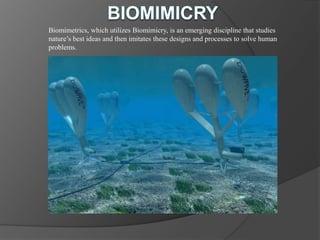
Biomimetrics, which utilizes Biomimicry, is an emerging discipline that studies
nature’s best ideas and then imitates these designs and processes to solve human
problems.
Introduction


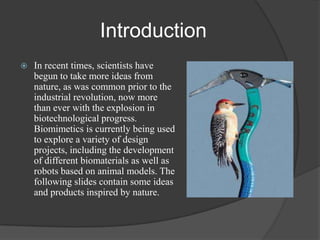
In recent times, scientists have
begun to take more ideas from
nature, as was common prior to the
industrial revolution, now more
than ever with the explosion in
biotechnological progress.
Biomimetics is currently being used
to explore a variety of design
projects, including the development
of different biomaterials as well as
robots based on animal models. The
following slides contain some ideas
and products inspired by nature.
Slippery When Wet
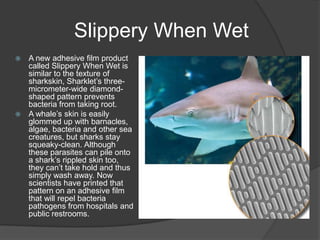
A new adhesive film product
called Slippery When Wet is
similar to the texture of
sharkskin, Sharklet’s threemicrometer-wide diamondshaped pattern prevents
bacteria from taking root.
 A whale’s skin is easily
glommed up with barnacles,
algae, bacteria and other sea
creatures, but sharks stay
squeaky-clean. Although
these parasites can pile onto
a shark’s rippled skin too,
they can’t take hold and thus
simply wash away. Now
scientists have printed that
pattern on an adhesive film
that will repel bacteria
pathogens from hospitals and
public restrooms.

Secrets of the sandcastle worm





There is also a new adhesive material utilizing
Biomimicry that can by used in the medical field.
The sandcastle worm makes a protective
home out of beads of zirconium oxide in
a lab. At the University of Utah, scientists
have created a synthetic version of this
glue for possible use in repairing
fractured bones. They have achieved this by using
bioactive molecules in an adhesive that could allow
it to fix bone fragments and deliver medicines to the
fracture site, such as antibiotics, pain relievers or
compounds that might accelerate healing.
The traditional method of repairing shattered bones
is to use mechanical connectors like nails, pins and
metal screws for support until they can bear weight.
But achieving and maintaining alignment of small
bone fragments using screws and wires is
challenging, Stewart said. For precise
reconstruction of small bones, health officials have
acknowledged that a biocompatible, biodegradable
adhesive could be valuable because it would
reduce metal hardware in the body while
maintaining proper alignment of fractures.

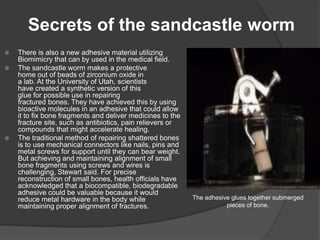
The adhesive glues together submerged
pieces of bone.
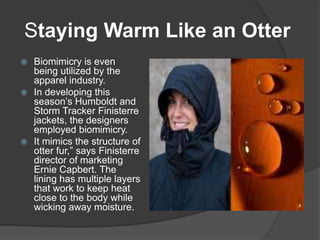
Staying Warm Like an Otter
Biomimicry is even
being utilized by the
apparel industry.
 In developing this
season’s Humboldt and
Storm Tracker Finisterre
jackets, the designers
employed biomimicry.
 It mimics the structure of
otter fur,” says Finisterre
director of marketing
Ernie Capbert. The
lining has multiple layers
that work to keep heat
close to the body while
wicking away moisture.

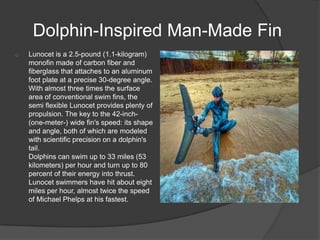
Dolphin-Inspired Man-Made Fin
o

Lunocet is a 2.5-pound (1.1-kilogram)
monofin made of carbon fiber and
fiberglass that attaches to an aluminum
foot plate at a precise 30-degree angle.
With almost three times the surface
area of conventional swim fins, the
semi flexible Lunocet provides plenty of
propulsion. The key to the 42-inch(one-meter-) wide fin's speed: its shape
and angle, both of which are modeled
with scientific precision on a dolphin's
tail.
Dolphins can swim up to 33 miles (53
kilometers) per hour and turn up to 80
percent of their energy into thrust.
Lunocet swimmers have hit about eight
miles per hour, almost twice the speed
of Michael Phelps at his fastest.
Robotic Biomimicry


Another application of Biomimetrics is the field
of robotics. Animal models are being used as
the inspiration for many different types of
robots. Researchers closely study the mechanics
of various animals, and then apply these
observations to robot design. The goal is to
develop a new class of biologically-inspired
robots with greater performance in unstructured
environments, able to respond to changing
environmental factors such as irregular terrain.
Robotic Cockroach
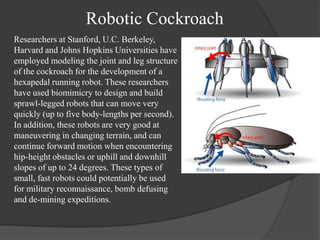
Researchers at Stanford, U.C. Berkeley,
Harvard and Johns Hopkins Universities have
employed modeling the joint and leg structure
of the cockroach for the development of a
hexapedal running robot. These researchers
have used biomimicry to design and build
sprawl-legged robots that can move very
quickly (up to five body-lengths per second).
In addition, these robots are very good at
maneuvering in changing terrain, and can
continue forward motion when encountering
hip-height obstacles or uphill and downhill
slopes of up to 24 degrees. These types of
small, fast robots could potentially be used
for military reconnaissance, bomb defusing
and de-mining expeditions.
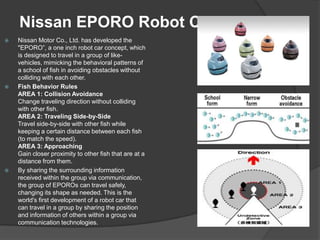
Nissan EPORO Robot Car






Nissan Motor Co., Ltd. has developed the
"EPORO”, a one inch robot car concept, which
is designed to travel in a group of likevehicles, mimicking the behavioral patterns of
a school of fish in avoiding obstacles without
colliding with each other.
Fish Behavior Rules
AREA 1: Collision Avoidance
Change traveling direction without colliding
with other fish.
AREA 2: Traveling Side-by-Side
Travel side-by-side with other fish while
keeping a certain distance between each fish
(to match the speed).
AREA 3: Approaching
Gain closer proximity to other fish that are at a
distance from them.
By sharing the surrounding information
received within the group via communication,
the group of EPOROs can travel safely,
changing its shape as needed. This is the
world's first development of a robot car that
can travel in a group by sharing the position
and information of others within a group via
communication technologies.
Conclusion:
The Future of Biomimicry




In the coming decades, you will see more and more production utilizing biomimicry. The
main obstacle historically has been that nature builds things radically differently than
humans do--building from DNA upwards, gathering a few molecules at a time to selfassemble into larger structures; much of biology's best engineering happens at the
nanoscale, with extraordinarily sophisticated organic chemistry. Traditional industry, by
contrast, has made things using "heat, beat, and treat" methods, where a large block of
raw material is cut away, bent, melted, cast, and otherwise manipulated until it achieves
the desired form; industrial chemistry often happens at high temperatures and
pressures which require huge energy inputs. Building in this way is inherently wasteful
and resource-intensive, but so far it has been the only way we know to get things done,
because it is simpler than biological building.
Now, however, chemists are improving their grasp on the complex organic realm,
where material can be built up a few molecules at a time in specific places, effectively
growing material rather than having to cut it away. For instance, MIT researchers are
attempting to grow batteries like how abalone shells grow, and are using virus microbes
to do it with. Carbon nanotubes have been used to create self-assembling electronics.
Other researchers are learning how to get from nanoscale materials to macro-scale
products, like the nanotube ribbon which can be produced at seven meters per minute.
As our nanotech and biotech capabilities improve, it will become easier and easier to
grow things rather than build them. Pollution regulations and growing awareness of
resource scarcity are also starting to motivate industry to find non-toxic chemistry,
which will drive people towards chemistry as nature does it--in water, at ambient
temperature and pressure.
References











“Biomimicry in the News”. The Biomimicry Institute: October 2009. Web. Dec. 10, 2009.
http://www.biomimicryinstitute.org
Faludi, Jeremy. “Biomimicry 101”. Worldchanging : October 2005. Web. Dec. 10, 2009.
http:www.worldchanging.com/archives/003625.html
Kennedy, Sean . “ BIOMIMICRY/BIMIMETICS: GENERAL PRINCIPLES AND
PRACTICAL EXAMPLES". Urban Ecology Australia: June 2006. Web. Dec. 10, 2009.
http://www.urbanecology.org.au/topics/biomimicry.html

Biomimicry

  • 1.
    Biomimetrics, which utilizesBiomimicry, is an emerging discipline that studies nature’s best ideas and then imitates these designs and processes to solve human problems.
  • 2.
    Introduction  In recent times,scientists have begun to take more ideas from nature, as was common prior to the industrial revolution, now more than ever with the explosion in biotechnological progress. Biomimetics is currently being used to explore a variety of design projects, including the development of different biomaterials as well as robots based on animal models. The following slides contain some ideas and products inspired by nature.
  • 3.
    Slippery When Wet Anew adhesive film product called Slippery When Wet is similar to the texture of sharkskin, Sharklet’s threemicrometer-wide diamondshaped pattern prevents bacteria from taking root.  A whale’s skin is easily glommed up with barnacles, algae, bacteria and other sea creatures, but sharks stay squeaky-clean. Although these parasites can pile onto a shark’s rippled skin too, they can’t take hold and thus simply wash away. Now scientists have printed that pattern on an adhesive film that will repel bacteria pathogens from hospitals and public restrooms. 
  • 4.
    Secrets of thesandcastle worm    There is also a new adhesive material utilizing Biomimicry that can by used in the medical field. The sandcastle worm makes a protective home out of beads of zirconium oxide in a lab. At the University of Utah, scientists have created a synthetic version of this glue for possible use in repairing fractured bones. They have achieved this by using bioactive molecules in an adhesive that could allow it to fix bone fragments and deliver medicines to the fracture site, such as antibiotics, pain relievers or compounds that might accelerate healing. The traditional method of repairing shattered bones is to use mechanical connectors like nails, pins and metal screws for support until they can bear weight. But achieving and maintaining alignment of small bone fragments using screws and wires is challenging, Stewart said. For precise reconstruction of small bones, health officials have acknowledged that a biocompatible, biodegradable adhesive could be valuable because it would reduce metal hardware in the body while maintaining proper alignment of fractures. The adhesive glues together submerged pieces of bone.
  • 5.
    Staying Warm Likean Otter Biomimicry is even being utilized by the apparel industry.  In developing this season’s Humboldt and Storm Tracker Finisterre jackets, the designers employed biomimicry.  It mimics the structure of otter fur,” says Finisterre director of marketing Ernie Capbert. The lining has multiple layers that work to keep heat close to the body while wicking away moisture. 
  • 6.
    Dolphin-Inspired Man-Made Fin o Lunocetis a 2.5-pound (1.1-kilogram) monofin made of carbon fiber and fiberglass that attaches to an aluminum foot plate at a precise 30-degree angle. With almost three times the surface area of conventional swim fins, the semi flexible Lunocet provides plenty of propulsion. The key to the 42-inch(one-meter-) wide fin's speed: its shape and angle, both of which are modeled with scientific precision on a dolphin's tail. Dolphins can swim up to 33 miles (53 kilometers) per hour and turn up to 80 percent of their energy into thrust. Lunocet swimmers have hit about eight miles per hour, almost twice the speed of Michael Phelps at his fastest.
  • 7.
    Robotic Biomimicry  Another applicationof Biomimetrics is the field of robotics. Animal models are being used as the inspiration for many different types of robots. Researchers closely study the mechanics of various animals, and then apply these observations to robot design. The goal is to develop a new class of biologically-inspired robots with greater performance in unstructured environments, able to respond to changing environmental factors such as irregular terrain.
  • 8.
    Robotic Cockroach Researchers atStanford, U.C. Berkeley, Harvard and Johns Hopkins Universities have employed modeling the joint and leg structure of the cockroach for the development of a hexapedal running robot. These researchers have used biomimicry to design and build sprawl-legged robots that can move very quickly (up to five body-lengths per second). In addition, these robots are very good at maneuvering in changing terrain, and can continue forward motion when encountering hip-height obstacles or uphill and downhill slopes of up to 24 degrees. These types of small, fast robots could potentially be used for military reconnaissance, bomb defusing and de-mining expeditions.
  • 9.
    Nissan EPORO RobotCar    Nissan Motor Co., Ltd. has developed the "EPORO”, a one inch robot car concept, which is designed to travel in a group of likevehicles, mimicking the behavioral patterns of a school of fish in avoiding obstacles without colliding with each other. Fish Behavior Rules AREA 1: Collision Avoidance Change traveling direction without colliding with other fish. AREA 2: Traveling Side-by-Side Travel side-by-side with other fish while keeping a certain distance between each fish (to match the speed). AREA 3: Approaching Gain closer proximity to other fish that are at a distance from them. By sharing the surrounding information received within the group via communication, the group of EPOROs can travel safely, changing its shape as needed. This is the world's first development of a robot car that can travel in a group by sharing the position and information of others within a group via communication technologies.
  • 10.
    Conclusion: The Future ofBiomimicry   In the coming decades, you will see more and more production utilizing biomimicry. The main obstacle historically has been that nature builds things radically differently than humans do--building from DNA upwards, gathering a few molecules at a time to selfassemble into larger structures; much of biology's best engineering happens at the nanoscale, with extraordinarily sophisticated organic chemistry. Traditional industry, by contrast, has made things using "heat, beat, and treat" methods, where a large block of raw material is cut away, bent, melted, cast, and otherwise manipulated until it achieves the desired form; industrial chemistry often happens at high temperatures and pressures which require huge energy inputs. Building in this way is inherently wasteful and resource-intensive, but so far it has been the only way we know to get things done, because it is simpler than biological building. Now, however, chemists are improving their grasp on the complex organic realm, where material can be built up a few molecules at a time in specific places, effectively growing material rather than having to cut it away. For instance, MIT researchers are attempting to grow batteries like how abalone shells grow, and are using virus microbes to do it with. Carbon nanotubes have been used to create self-assembling electronics. Other researchers are learning how to get from nanoscale materials to macro-scale products, like the nanotube ribbon which can be produced at seven meters per minute. As our nanotech and biotech capabilities improve, it will become easier and easier to grow things rather than build them. Pollution regulations and growing awareness of resource scarcity are also starting to motivate industry to find non-toxic chemistry, which will drive people towards chemistry as nature does it--in water, at ambient temperature and pressure.
  • 11.
    References        “Biomimicry in theNews”. The Biomimicry Institute: October 2009. Web. Dec. 10, 2009. http://www.biomimicryinstitute.org Faludi, Jeremy. “Biomimicry 101”. Worldchanging : October 2005. Web. Dec. 10, 2009. http:www.worldchanging.com/archives/003625.html Kennedy, Sean . “ BIOMIMICRY/BIMIMETICS: GENERAL PRINCIPLES AND PRACTICAL EXAMPLES". Urban Ecology Australia: June 2006. Web. Dec. 10, 2009. http://www.urbanecology.org.au/topics/biomimicry.html