COLLEGE PROJECTS
SYB.arch – B
SEM-III
Topic – BIO MIMICRY
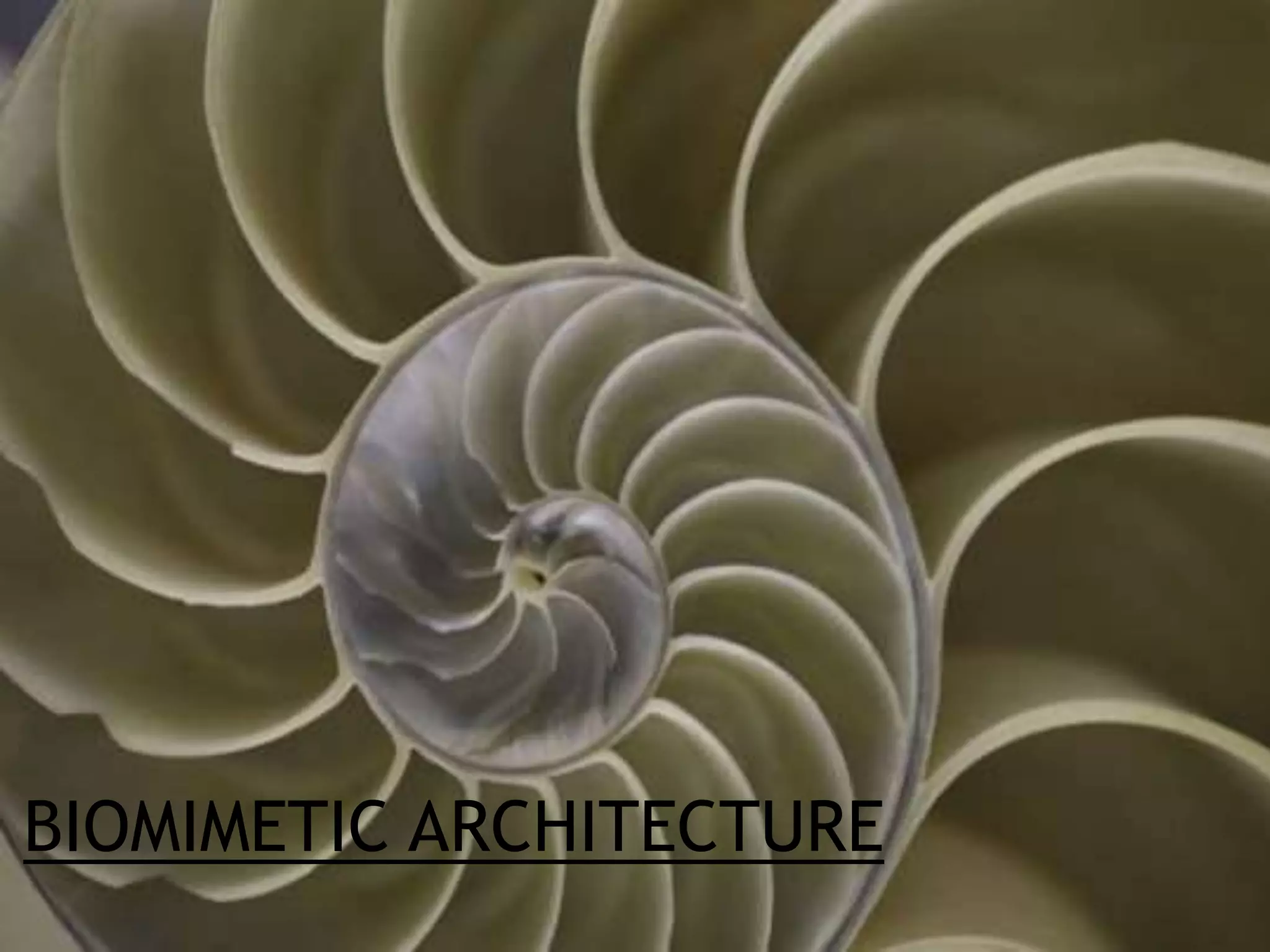
BIOMIMETIC ARCHITECTURE
 Derived from ;– bio - life
memises - immitate
 It is an alternate solution in search of sustainable
buiding design and technology….
 The inspiration from nature is driving force in
architecture, resulting in majestic works of
architecture.
 Bio mimicry is about solution refined and are
developed by nature…
 Bio mimicry design
is not only adapting
the design from the
nature but also
considering how to
use nature’s
effective functions
such as heating and
cooling system,
protecting natural
light and
ventilation.
 One of the earliest examples of Bio mimicry
was the study of birds which enabled humans
to gain the technology of flight.
 Though, it could be argued that our
ancestors mimicked the techniques of the
animals around them to become more
successful hunters or gatherers, or to create
better shelter.
 Nature has been offering immense ideas and
inspirations to designers for creating
architecture
 Bio mimicry is a new science that studies
nature’s models and then emulates these
forms, process, systems, and strategies to
solve human problems – sustainably.
 Bio mimicry uses an ecological standard to
judge the sustainability of our innovations.
 After many years of evolution, nature has
learned what works and what lasts.
 Bio mimicry is a new way of viewing and
valuing nature. It introduces an era based
not on what we can extract from the natural
world, but what we can learn from it.
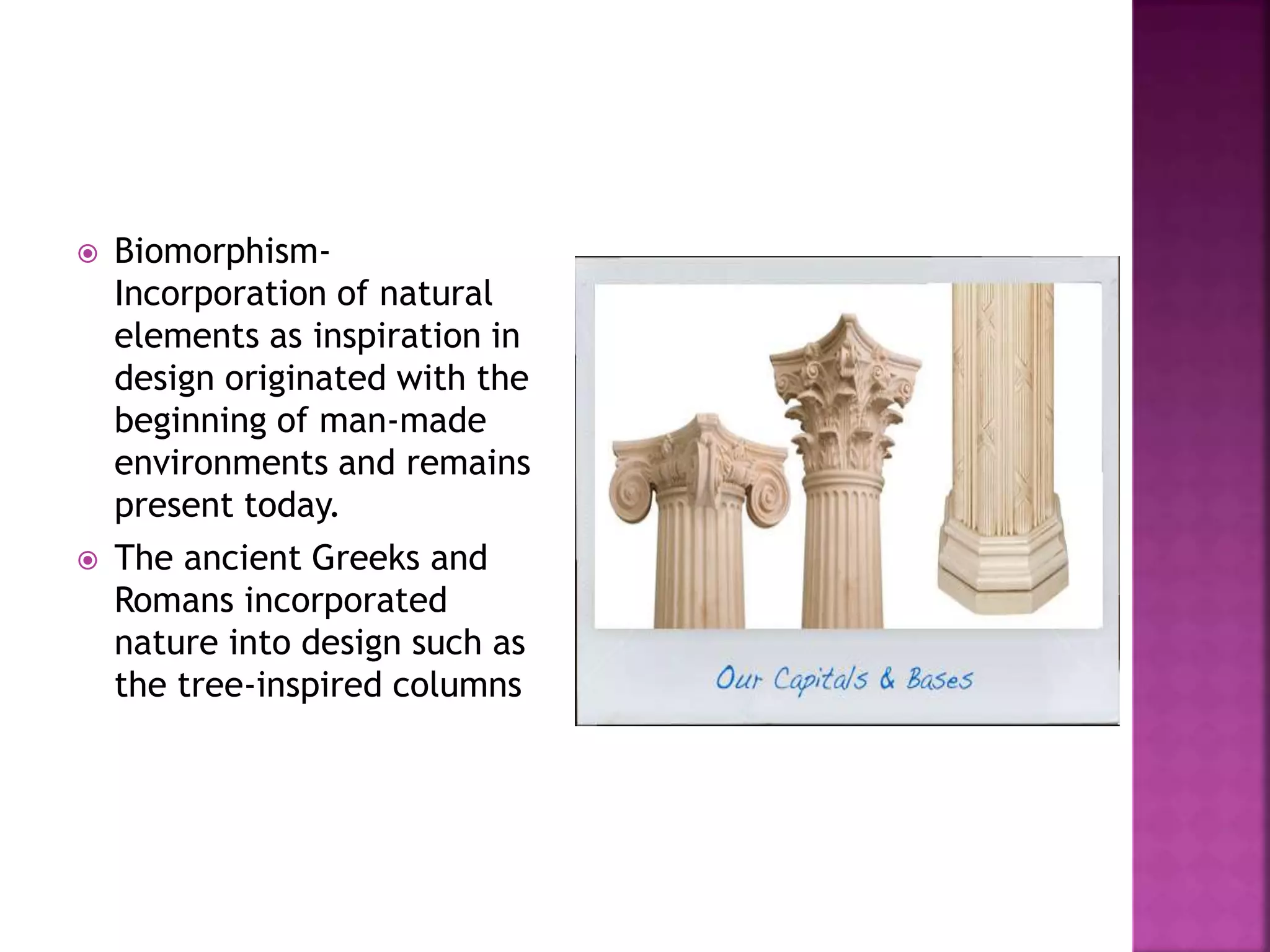
 Biomorphism-
Incorporation of natural
elements as inspiration in
design originated with the
beginning of man-made
environments and remains
present today.
 The ancient Greeks and
Romans incorporated
nature into design such as
the tree-inspired columns
 Bio mimicry can work on three
levels:the organism, its behaviors, and
the ecosystem.
 Buildings on the organism level mimic a specific
organism. Working on this level without
mimicking how the organism participates in a
larger context may not be sufficient to produce
a building that integrates well with its
environment
 On a behavior level, buildings mimic how an
organism behaves or relates to its larger
context.
 On the level of the ecosystem, a building mimics
the natural process and cycle of the greater
environment.
Popularly known as the Lotus
Temple and located in New
Delhi, India, the temple is a
place of worship for followers
of the Baha’i faith.
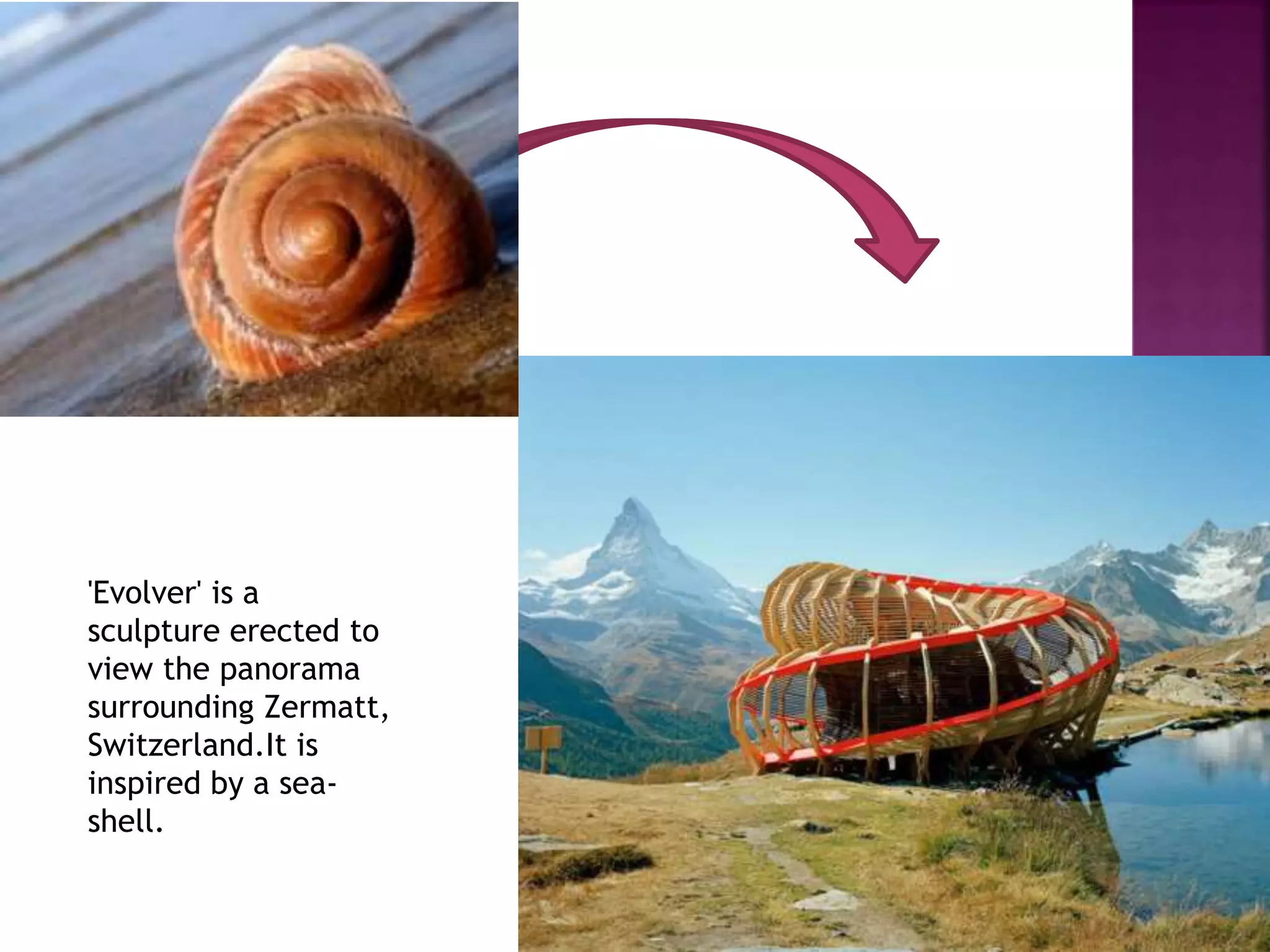
'Evolver' is a
sculpture erected to
view the panorama
surrounding Zermatt,
Switzerland.It is
inspired by a sea-
shell.
Formerly known as Taipei World
Financial Center, the Taipei 101
in Taipei, Taiwan is the second
tallest skyscraper in the world2.
Drawing inspiration from the
bamboo tree
Beijing National
Stadium in
Beijing,China is
inspired by a
Bird’s nest.
The Palm Jumeirah
islands are artificial
islands built on the
coast of Dubai.Inspired
by palm trees, the
islands are in the shape
of a palm tree.
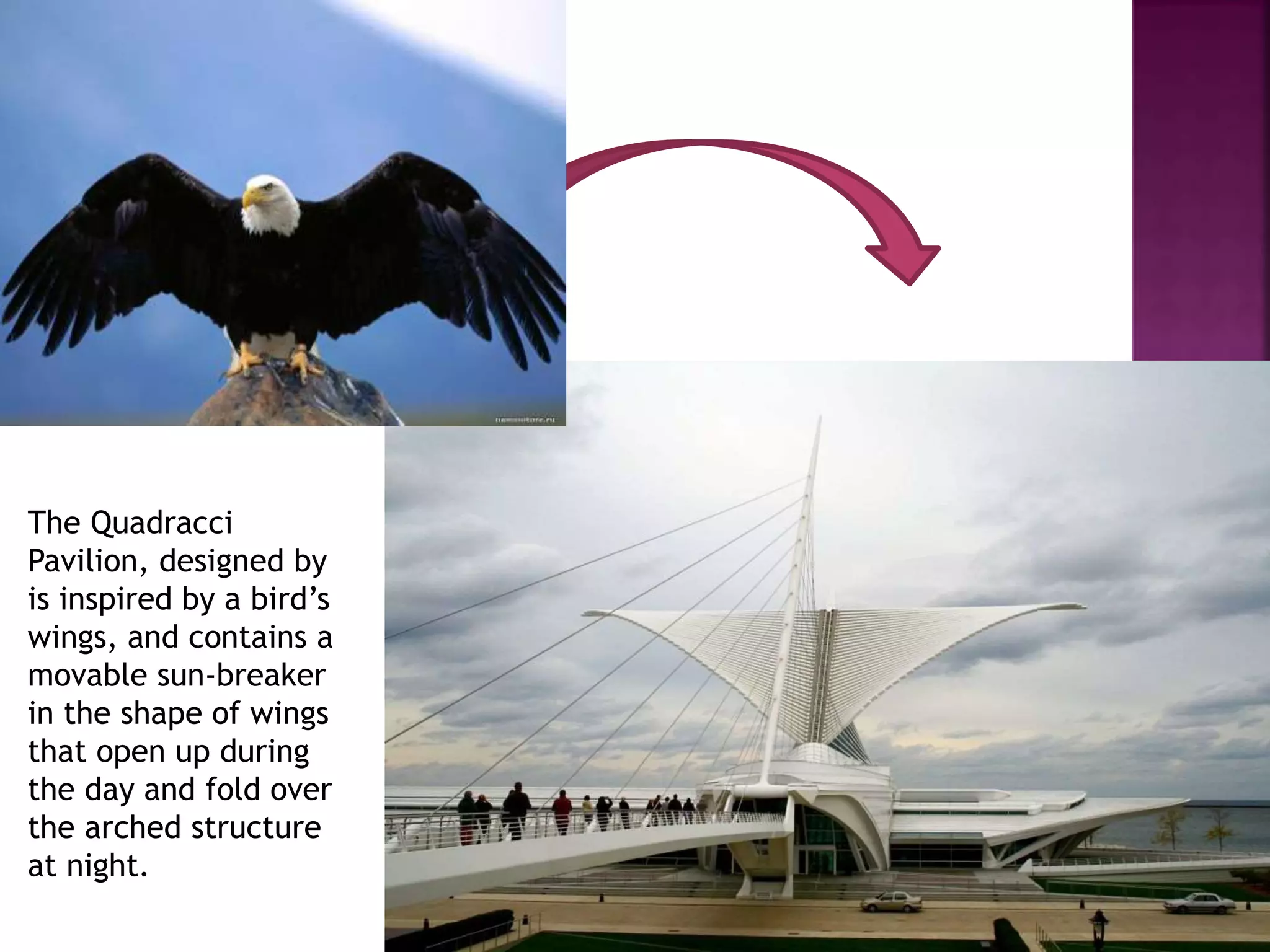
The Quadracci
Pavilion, designed by
is inspired by a bird’s
wings, and contains a
movable sun-breaker
in the shape of wings
that open up during
the day and fold over
the arched structure
at night.
This is the Nautilis
kindergarten in
Germany. The structure,
inspired by the nautilus,
is made from untreated
wood with an infill of
clay, old bricks, natural
stones, sand and lime
Inspired by water
bubbles, the Beijing
National Aquatics
Centre in Beijing,
China, also known
as Water Cube was
built for the 2008
Summer Olympics
As testimony to the
flexibility and strength
of bamboo, these sea
urchin shaped pods are
the library and
reception at Bambu
Indah, John Hardy's
hotel resort in Bali,
Indonesia.
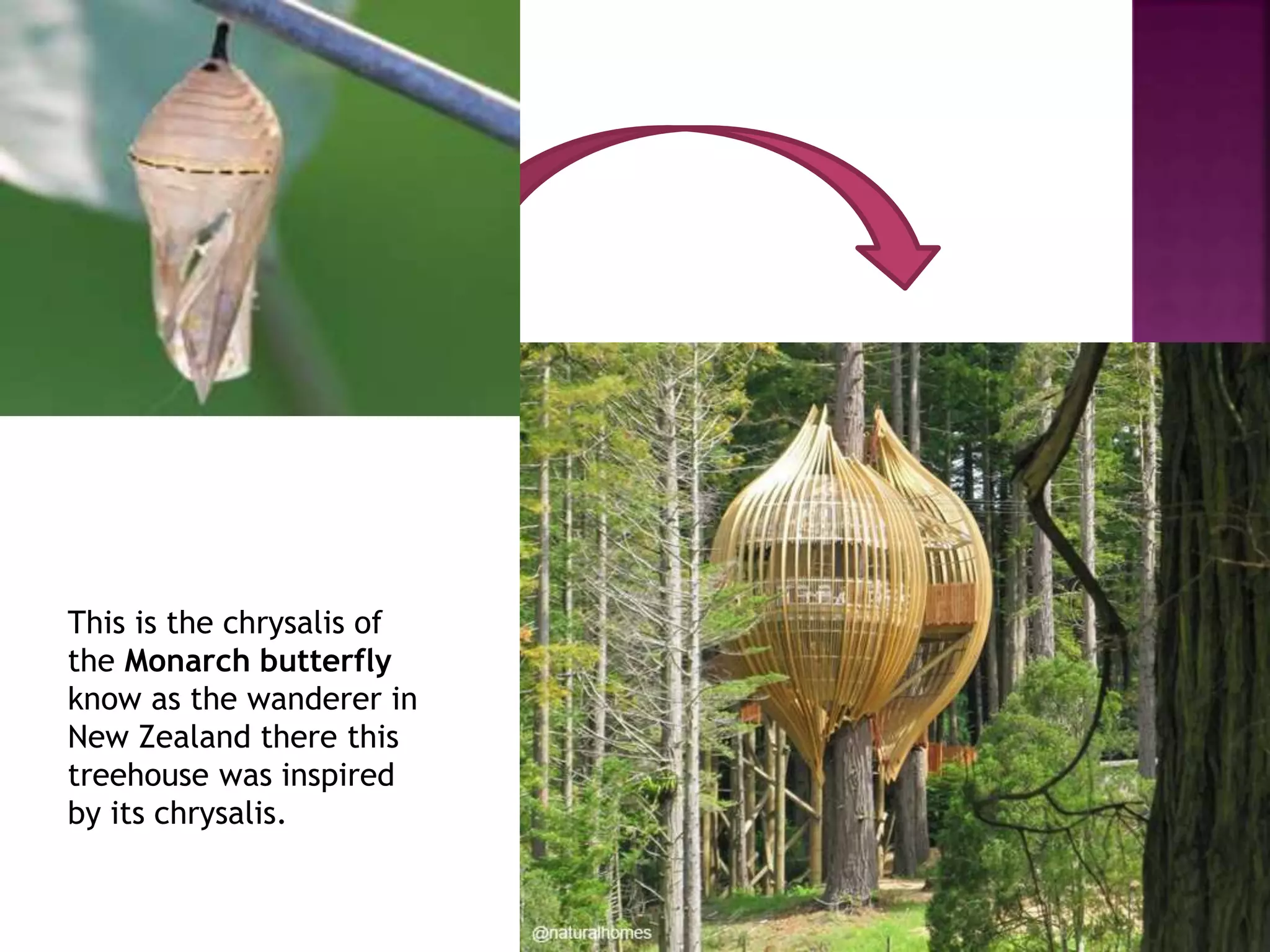
This is the chrysalis of
the Monarch butterfly
know as the wanderer in
New Zealand there this
treehouse was inspired
by its chrysalis.
 In fact, under this new order of
sustainability, buildings, outdoor art and
other manmade structures would function
like trees, meadows, flora and fauna,
capturing, cleaning and storing rainwater;
converting sunlight to energy and carbon
dioxide to oxygen;and eliminating waste.
 There is need for future young Architects
and designers to Create bio-inspired design
adaptations that emulate nature’s best ideas,
so that all futuristic buildings will be
sustainable.

Biomimicry

  • 1.
    COLLEGE PROJECTS SYB.arch –B SEM-III Topic – BIO MIMICRY
  • 2.
  • 3.
     Derived from;– bio - life memises - immitate  It is an alternate solution in search of sustainable buiding design and technology….  The inspiration from nature is driving force in architecture, resulting in majestic works of architecture.  Bio mimicry is about solution refined and are developed by nature…
  • 4.
     Bio mimicrydesign is not only adapting the design from the nature but also considering how to use nature’s effective functions such as heating and cooling system, protecting natural light and ventilation.
  • 5.
     One ofthe earliest examples of Bio mimicry was the study of birds which enabled humans to gain the technology of flight.  Though, it could be argued that our ancestors mimicked the techniques of the animals around them to become more successful hunters or gatherers, or to create better shelter.  Nature has been offering immense ideas and inspirations to designers for creating architecture
  • 7.
     Bio mimicryis a new science that studies nature’s models and then emulates these forms, process, systems, and strategies to solve human problems – sustainably.  Bio mimicry uses an ecological standard to judge the sustainability of our innovations.  After many years of evolution, nature has learned what works and what lasts.  Bio mimicry is a new way of viewing and valuing nature. It introduces an era based not on what we can extract from the natural world, but what we can learn from it.
  • 8.
     Biomorphism- Incorporation ofnatural elements as inspiration in design originated with the beginning of man-made environments and remains present today.  The ancient Greeks and Romans incorporated nature into design such as the tree-inspired columns
  • 9.
     Bio mimicrycan work on three levels:the organism, its behaviors, and the ecosystem.  Buildings on the organism level mimic a specific organism. Working on this level without mimicking how the organism participates in a larger context may not be sufficient to produce a building that integrates well with its environment  On a behavior level, buildings mimic how an organism behaves or relates to its larger context.  On the level of the ecosystem, a building mimics the natural process and cycle of the greater environment.
  • 10.
    Popularly known asthe Lotus Temple and located in New Delhi, India, the temple is a place of worship for followers of the Baha’i faith.
  • 11.
    'Evolver' is a sculptureerected to view the panorama surrounding Zermatt, Switzerland.It is inspired by a sea- shell.
  • 12.
    Formerly known asTaipei World Financial Center, the Taipei 101 in Taipei, Taiwan is the second tallest skyscraper in the world2. Drawing inspiration from the bamboo tree
  • 13.
    Beijing National Stadium in Beijing,Chinais inspired by a Bird’s nest.
  • 14.
    The Palm Jumeirah islandsare artificial islands built on the coast of Dubai.Inspired by palm trees, the islands are in the shape of a palm tree.
  • 15.
    The Quadracci Pavilion, designedby is inspired by a bird’s wings, and contains a movable sun-breaker in the shape of wings that open up during the day and fold over the arched structure at night.
  • 16.
    This is theNautilis kindergarten in Germany. The structure, inspired by the nautilus, is made from untreated wood with an infill of clay, old bricks, natural stones, sand and lime
  • 17.
    Inspired by water bubbles,the Beijing National Aquatics Centre in Beijing, China, also known as Water Cube was built for the 2008 Summer Olympics
  • 18.
    As testimony tothe flexibility and strength of bamboo, these sea urchin shaped pods are the library and reception at Bambu Indah, John Hardy's hotel resort in Bali, Indonesia.
  • 19.
    This is thechrysalis of the Monarch butterfly know as the wanderer in New Zealand there this treehouse was inspired by its chrysalis.
  • 20.
     In fact,under this new order of sustainability, buildings, outdoor art and other manmade structures would function like trees, meadows, flora and fauna, capturing, cleaning and storing rainwater; converting sunlight to energy and carbon dioxide to oxygen;and eliminating waste.  There is need for future young Architects and designers to Create bio-inspired design adaptations that emulate nature’s best ideas, so that all futuristic buildings will be sustainable.