BIOMIMETIC
ARCHITECTURE
ROLL NO: CE16AR29
CE16AR49
CE16-14AR26
CONTENTS:
1. WHAT IS BIOMIMETIC ?
2. HISTORY OF BIOMIMETIC
3. BIOMIMETIC ARCHITECTURE
4. CLASSIFICATION OF BIOMIMETIC ARCHITECTURE
5. SOME MAJOR EXAMPLES OF BIOMIMETIC ARCHITECTURE
6. WHY WE NEED BIOMIMETIC ?
2
WHAT IS BIOMIMETIC?
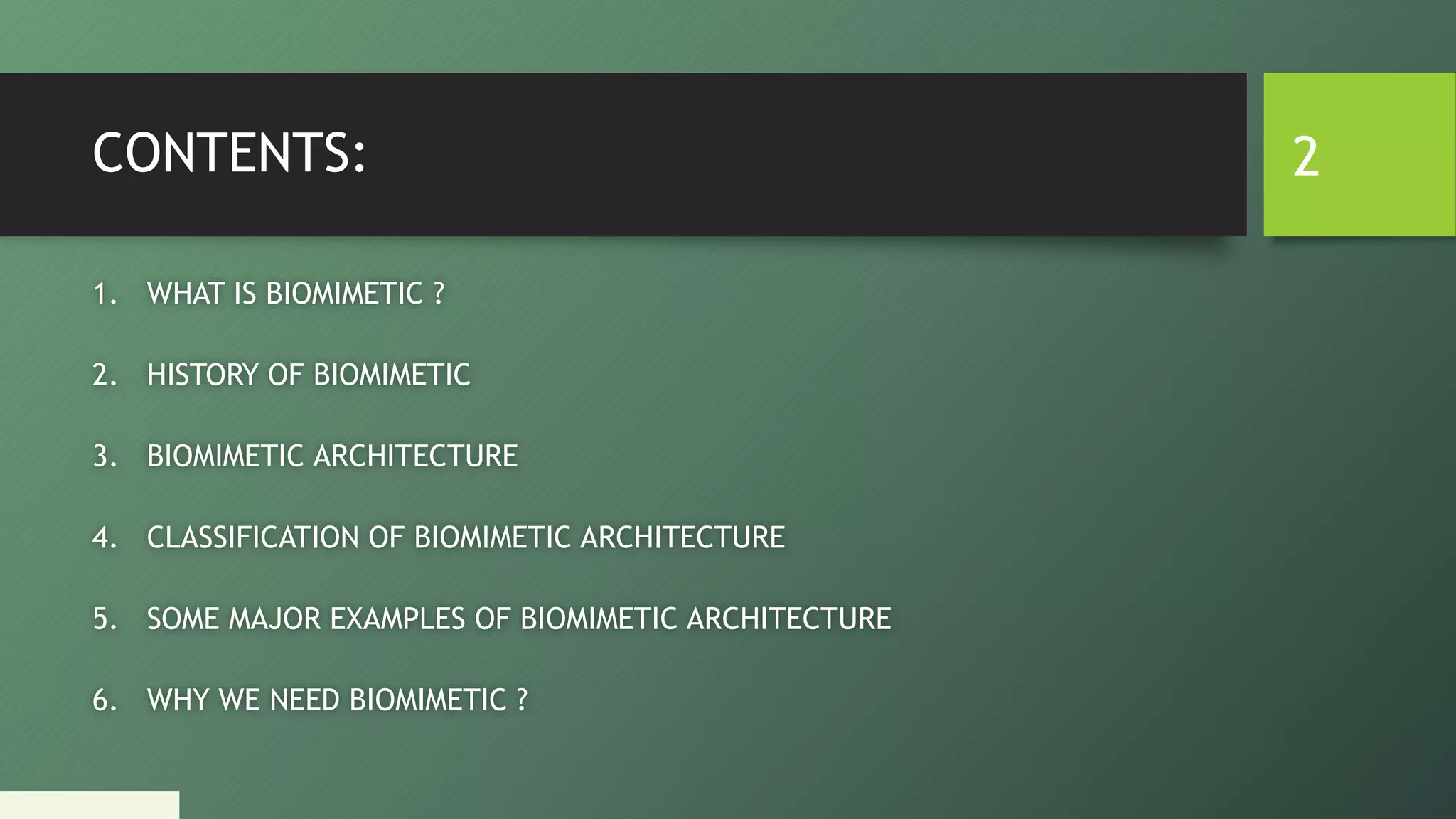
• DERIVED FROM: BIO – LIFE
MEMISES – IMMITATE
• Biomimicry is the practice of applying lessons from nature to the
invention of healthier, more sustainable technologies for people.
• A new science that studies nature’s models and ten uses these
designs and processes to solve human problems.
• Humans evolved by learning from nature and getting inspired by
the natural phenomenon.
• Biomimicry is used in every field ranging from architecture to
computer science.
3
HISTORY OF BIOMIMETIC
• PRE INDUSTRIAL REVOLUTION:
• 1.Rock-Cut Architecture: 6000 BCE
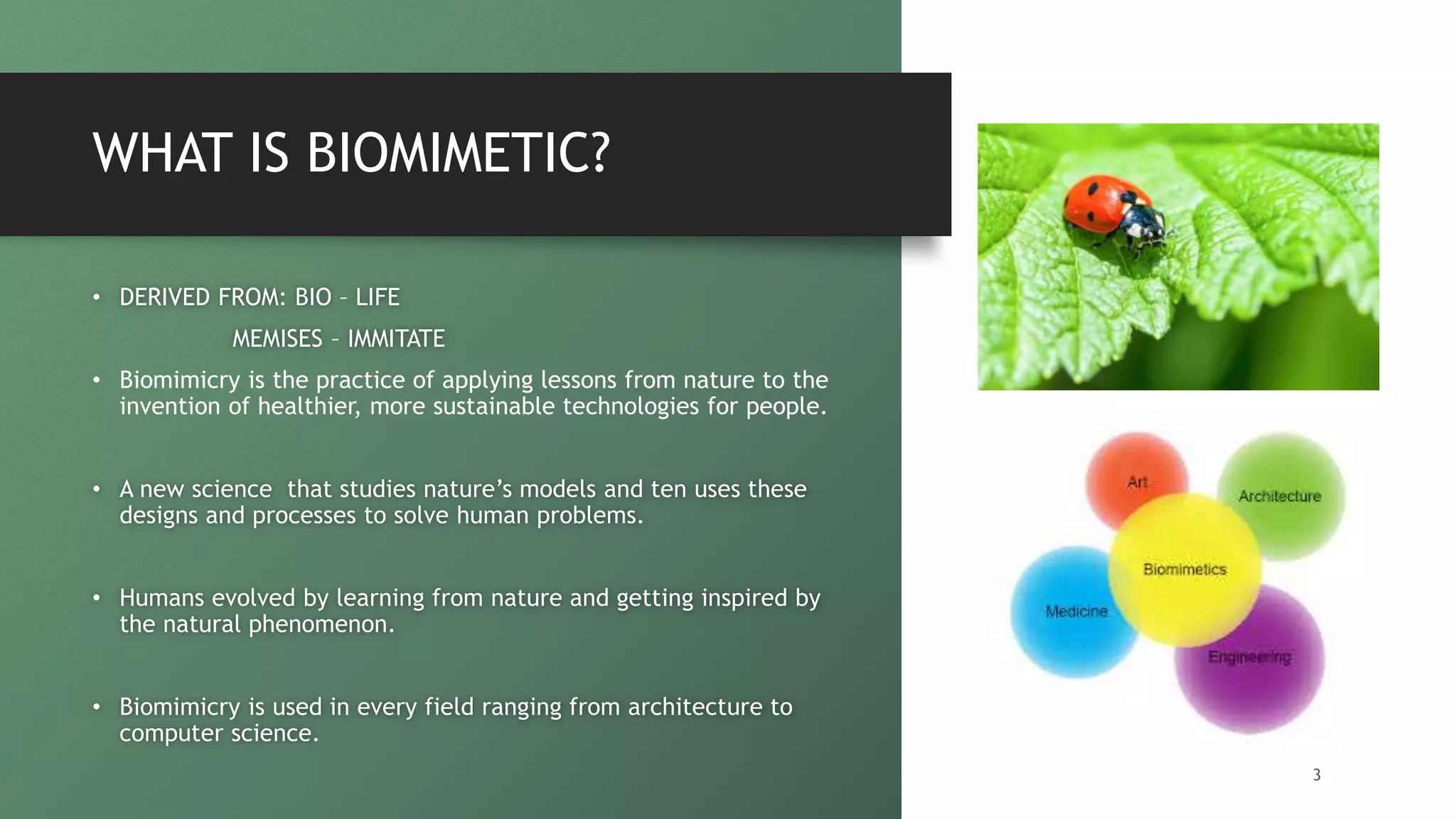
• Caves have been used as shelter since the monolithic era 6000
BCE, so it makes perfect sense that in India Buddhist temples and
shrines were actually carved into caves and mountain sides. These
temples eventually doubled as trade posts on the Silk Road.
• 2.Umbrellas: 3 CE
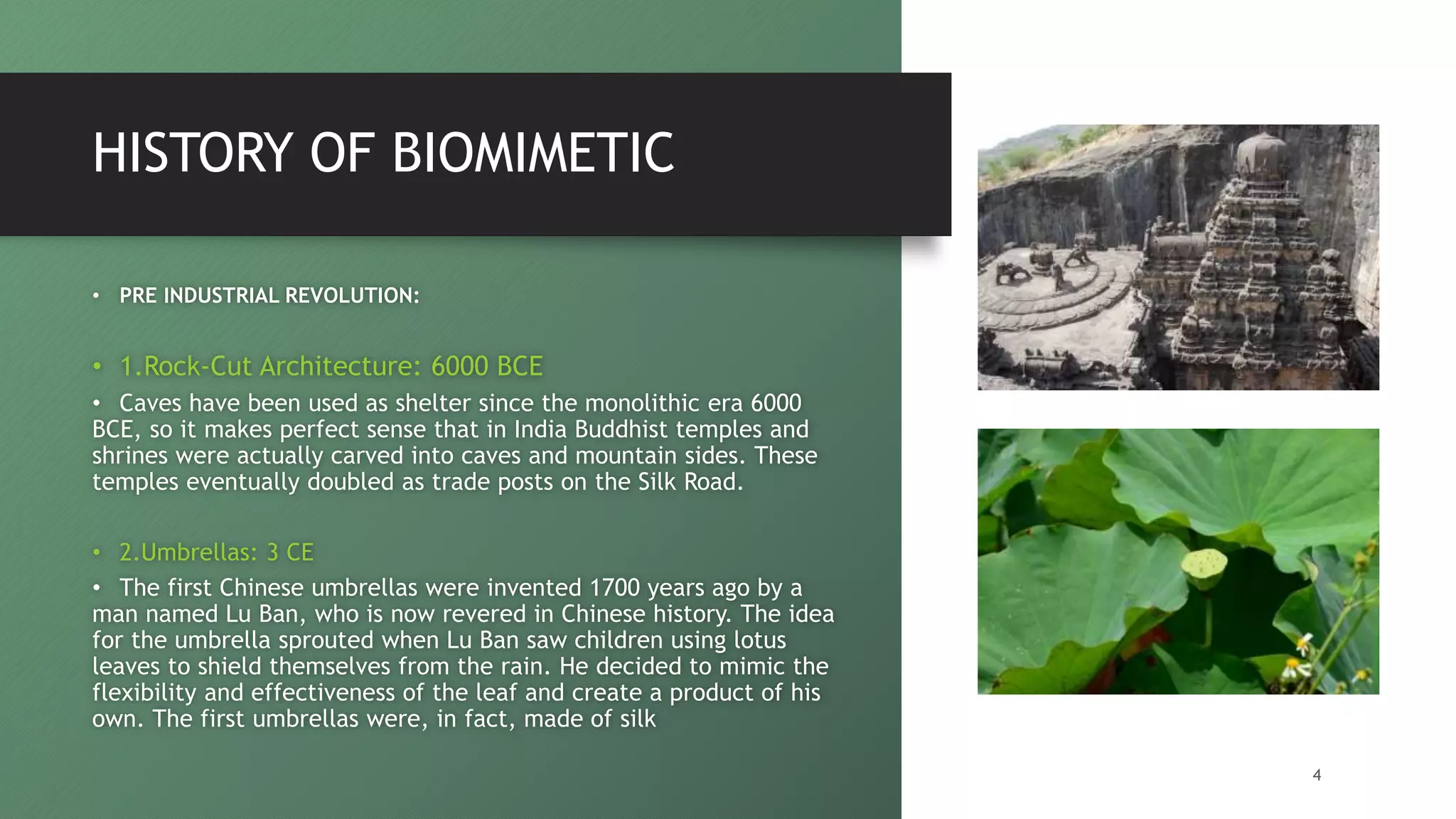
• The first Chinese umbrellas were invented 1700 years ago by a
man named Lu Ban, who is now revered in Chinese history. The idea
for the umbrella sprouted when Lu Ban saw children using lotus
leaves to shield themselves from the rain. He decided to mimic the
flexibility and effectiveness of the leaf and create a product of his
own. The first umbrellas were, in fact, made of silk
4
5
POST INDUSTRIAL REVOLUTION
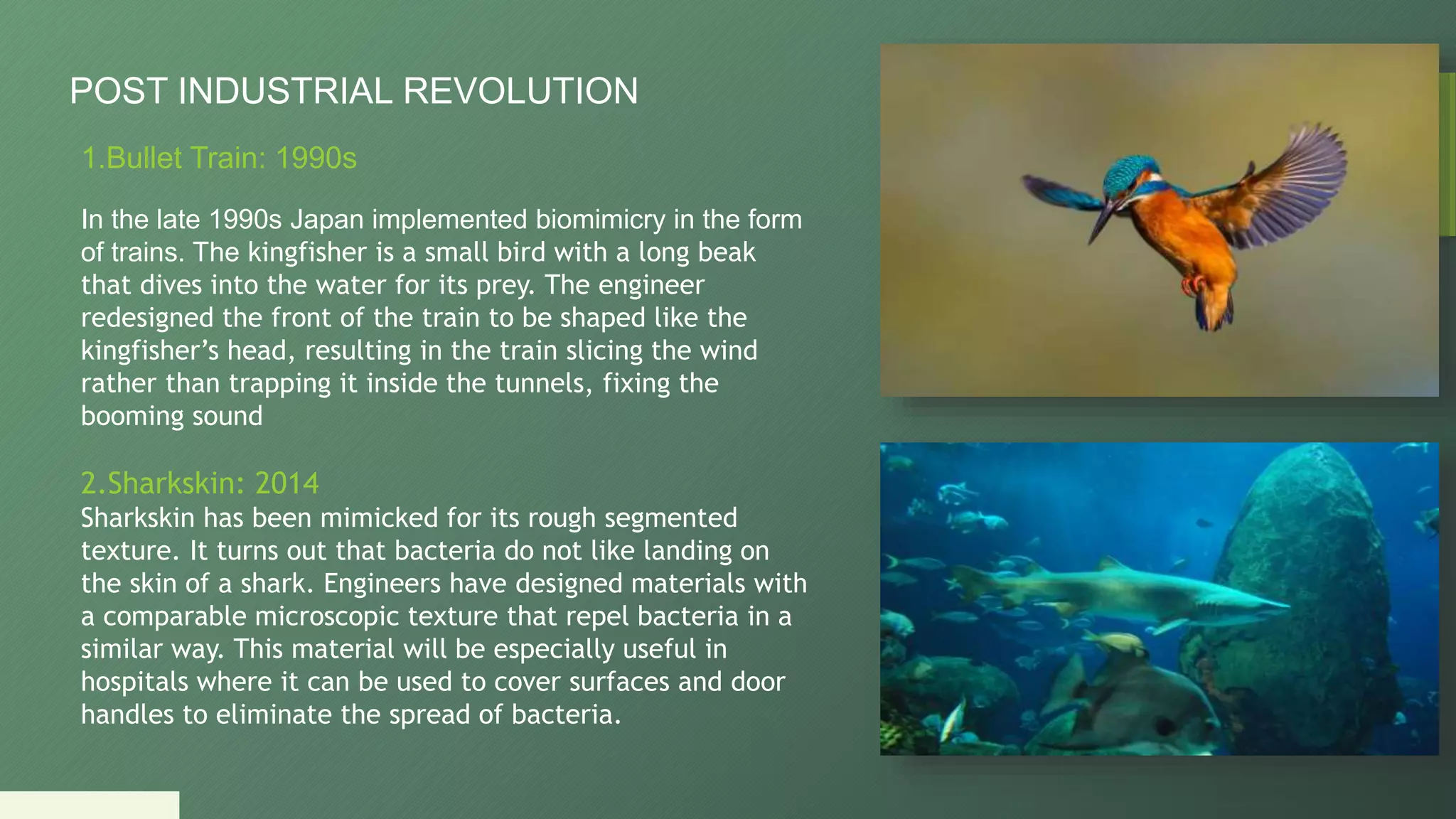
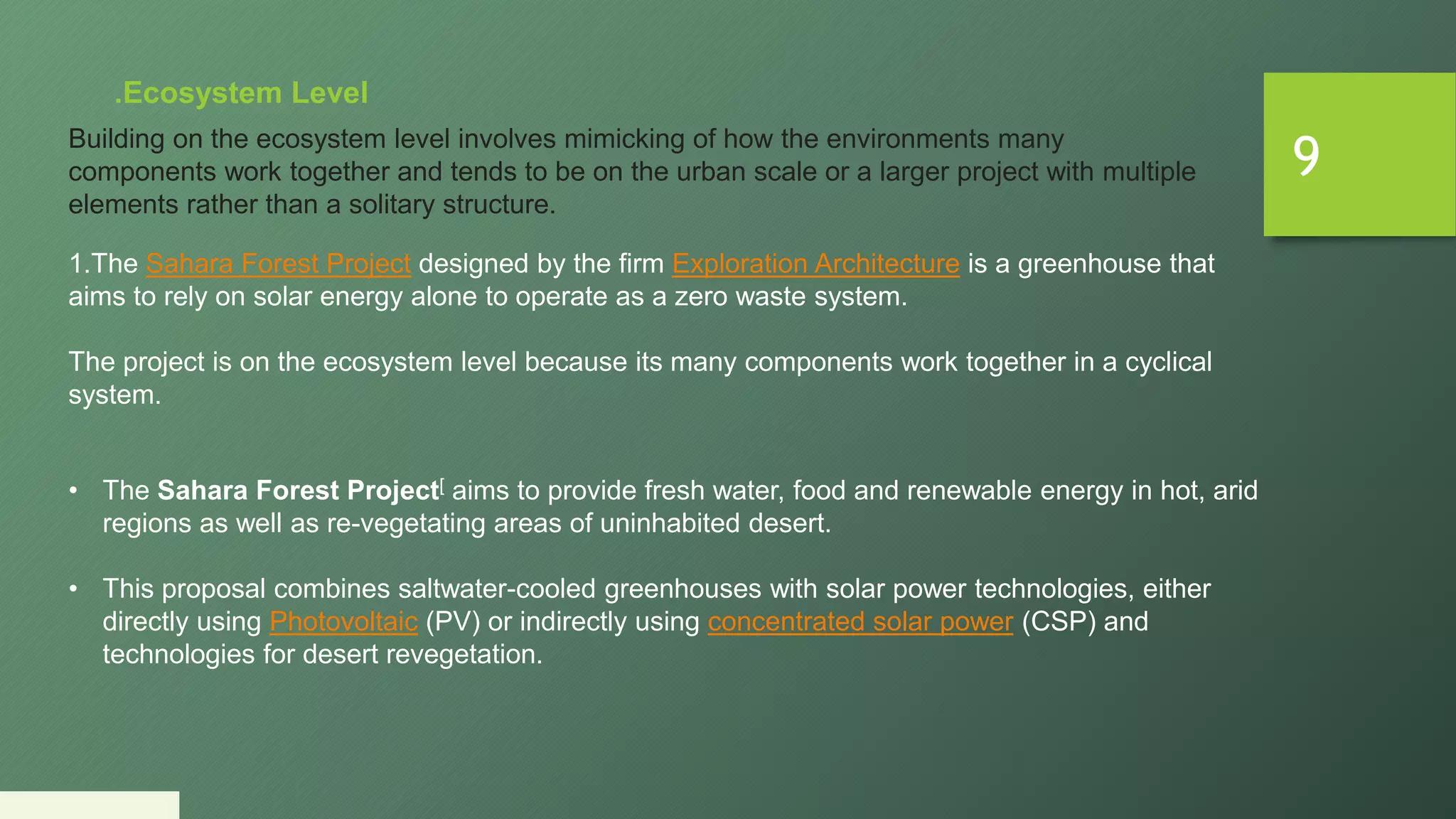
1.Bullet Train: 1990s
In the late 1990s Japan implemented biomimicry in the form
of trains. The kingfisher is a small bird with a long beak
that dives into the water for its prey. The engineer
redesigned the front of the train to be shaped like the
kingfisher’s head, resulting in the train slicing the wind
rather than trapping it inside the tunnels, fixing the
booming sound
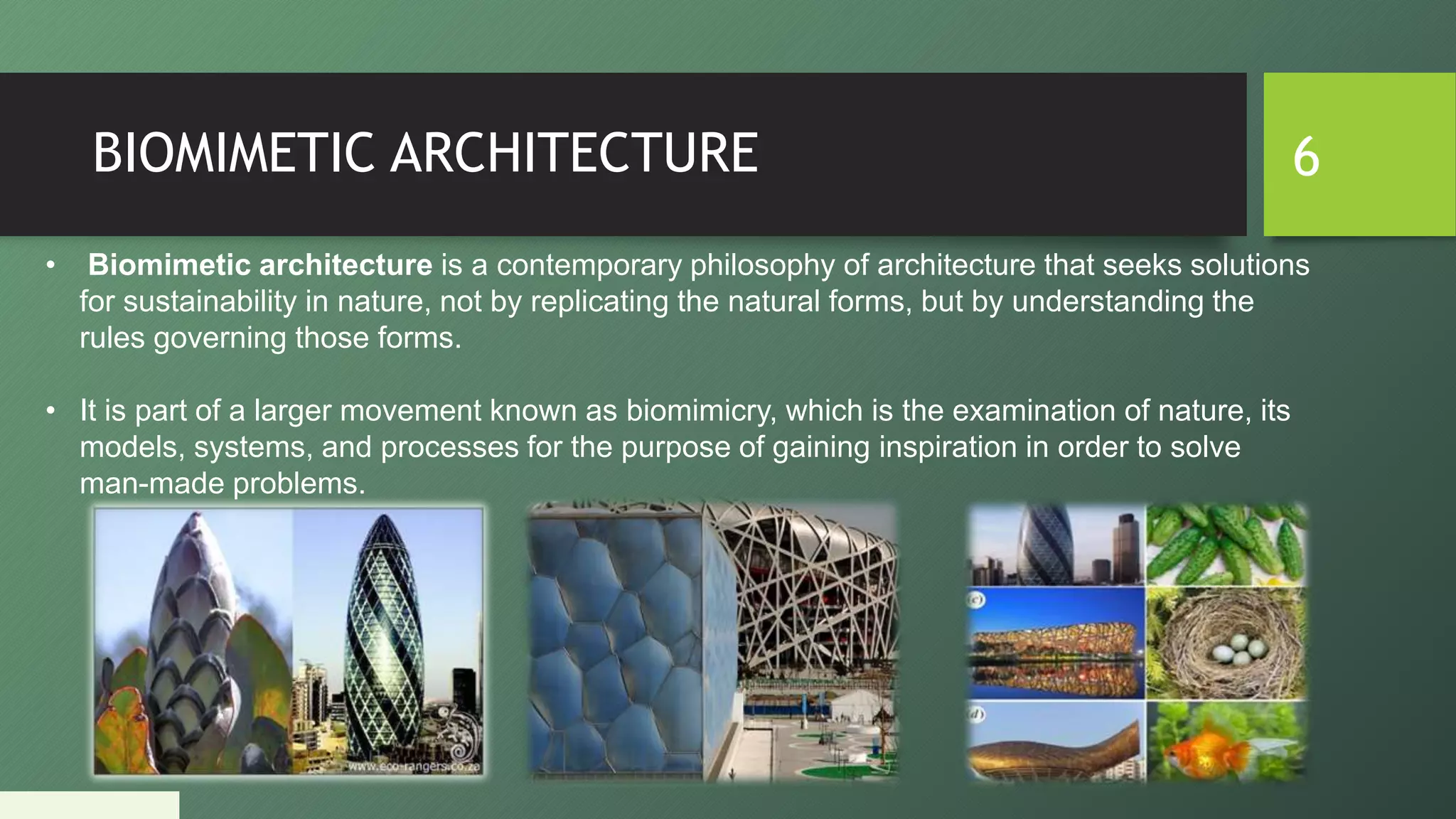
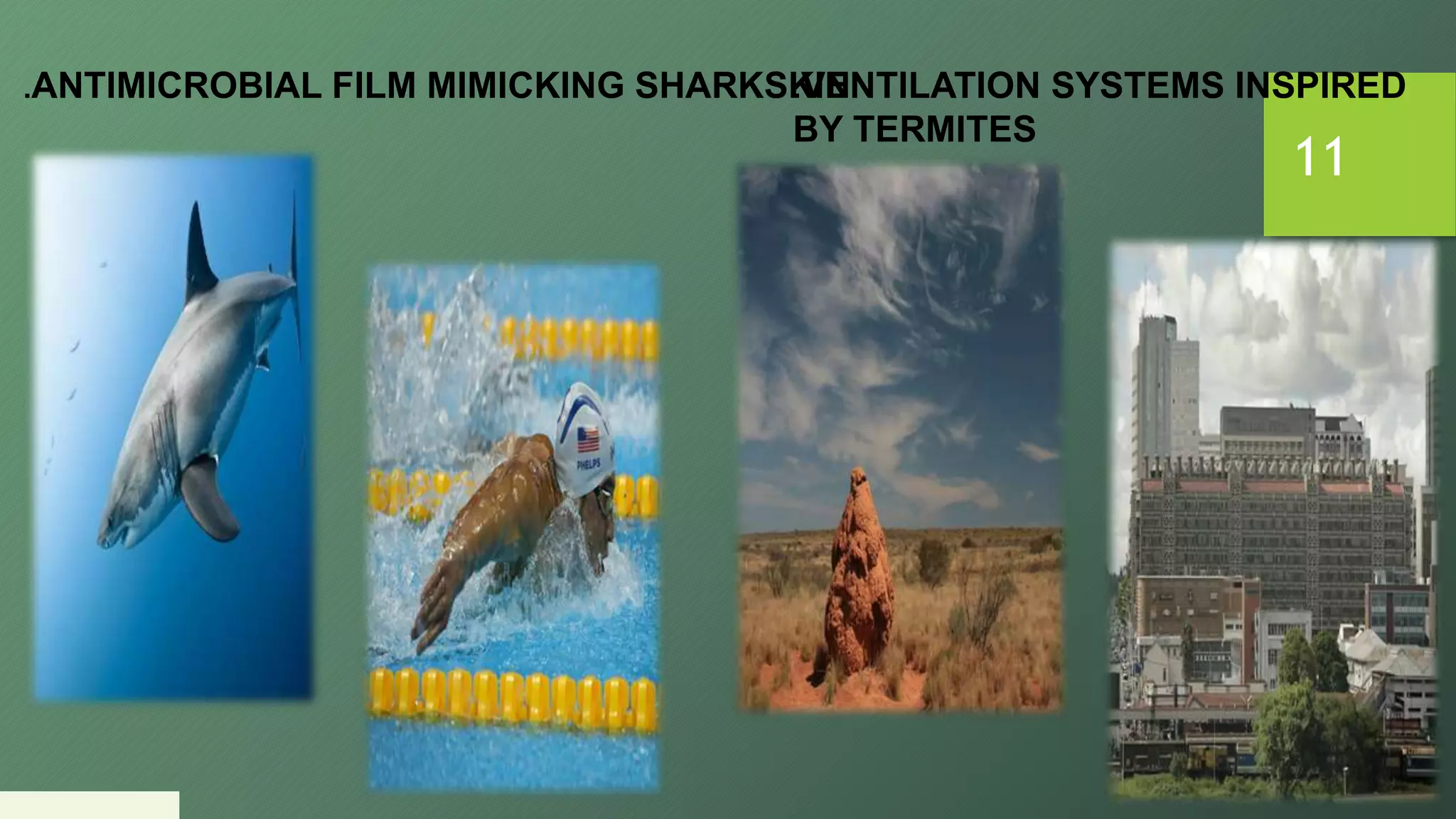
2.Sharkskin: 2014
Sharkskin has been mimicked for its rough segmented
texture. It turns out that bacteria do not like landing on
the skin of a shark. Engineers have designed materials with
a comparable microscopic texture that repel bacteria in a
similar way. This material will be especially useful in
hospitals where it can be used to cover surfaces and door
handles to eliminate the spread of bacteria.
BIOMIMETIC ARCHITECTURE 6
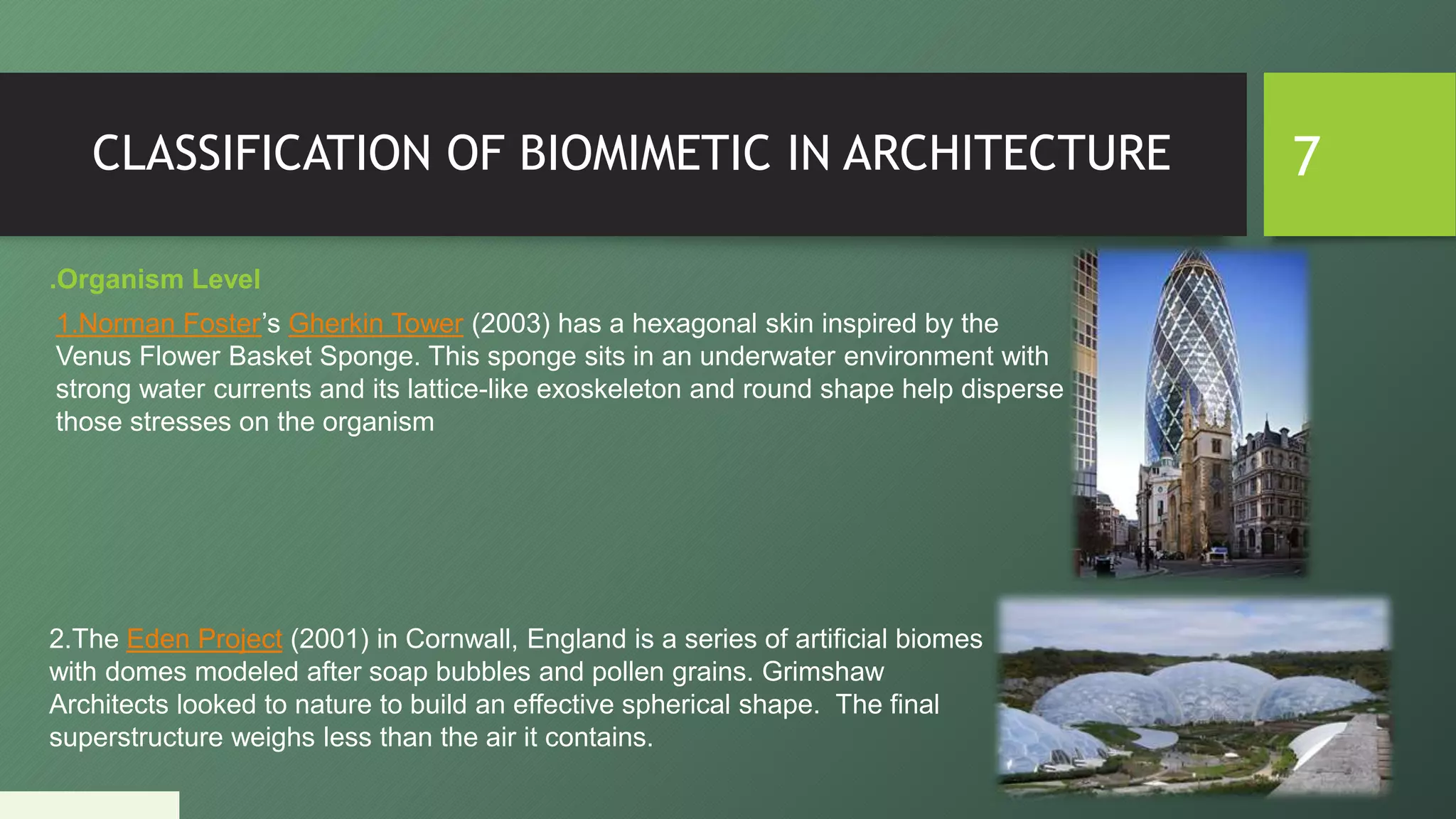
• Biomimetic architecture is a contemporary philosophy of architecture that seeks solutions
for sustainability in nature, not by replicating the natural forms, but by understanding the
rules governing those forms.
• It is part of a larger movement known as biomimicry, which is the examination of nature, its
models, systems, and processes for the purpose of gaining inspiration in order to solve
man-made problems.
CLASSIFICATION OF BIOMIMETIC IN ARCHITECTURE 7
.Organism Level
1.Norman Foster’s Gherkin Tower (2003) has a hexagonal skin inspired by the
Venus Flower Basket Sponge. This sponge sits in an underwater environment with
strong water currents and its lattice-like exoskeleton and round shape help disperse
those stresses on the organism
2.The Eden Project (2001) in Cornwall, England is a series of artificial biomes
with domes modeled after soap bubbles and pollen grains. Grimshaw
Architects looked to nature to build an effective spherical shape. The final
superstructure weighs less than the air it contains.
8
.Behavior Level
On the behavior level, the building mimics how the organism interacts with its environment to
build a structure that can also fit in without resistance in its surrounding environment.
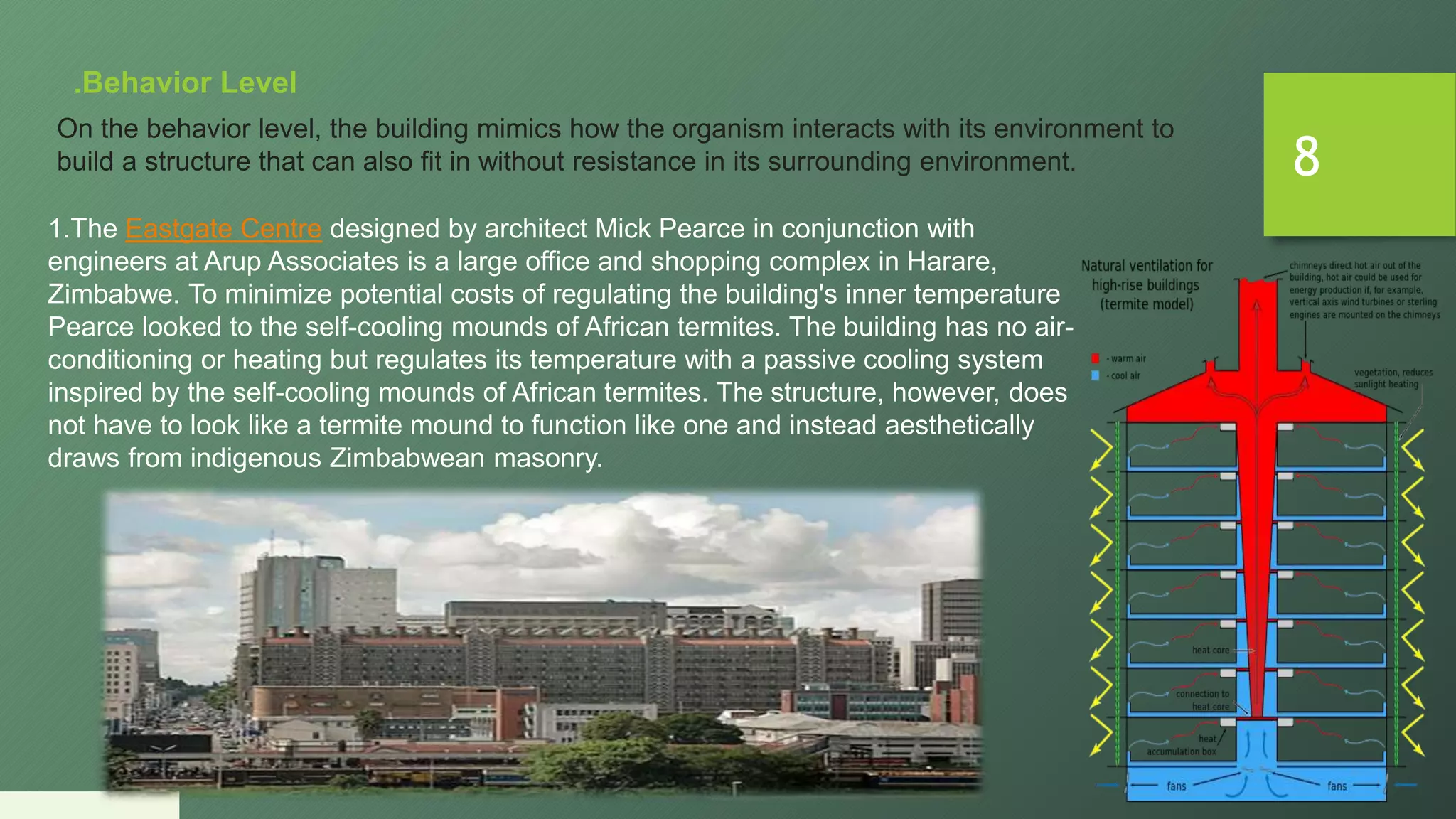
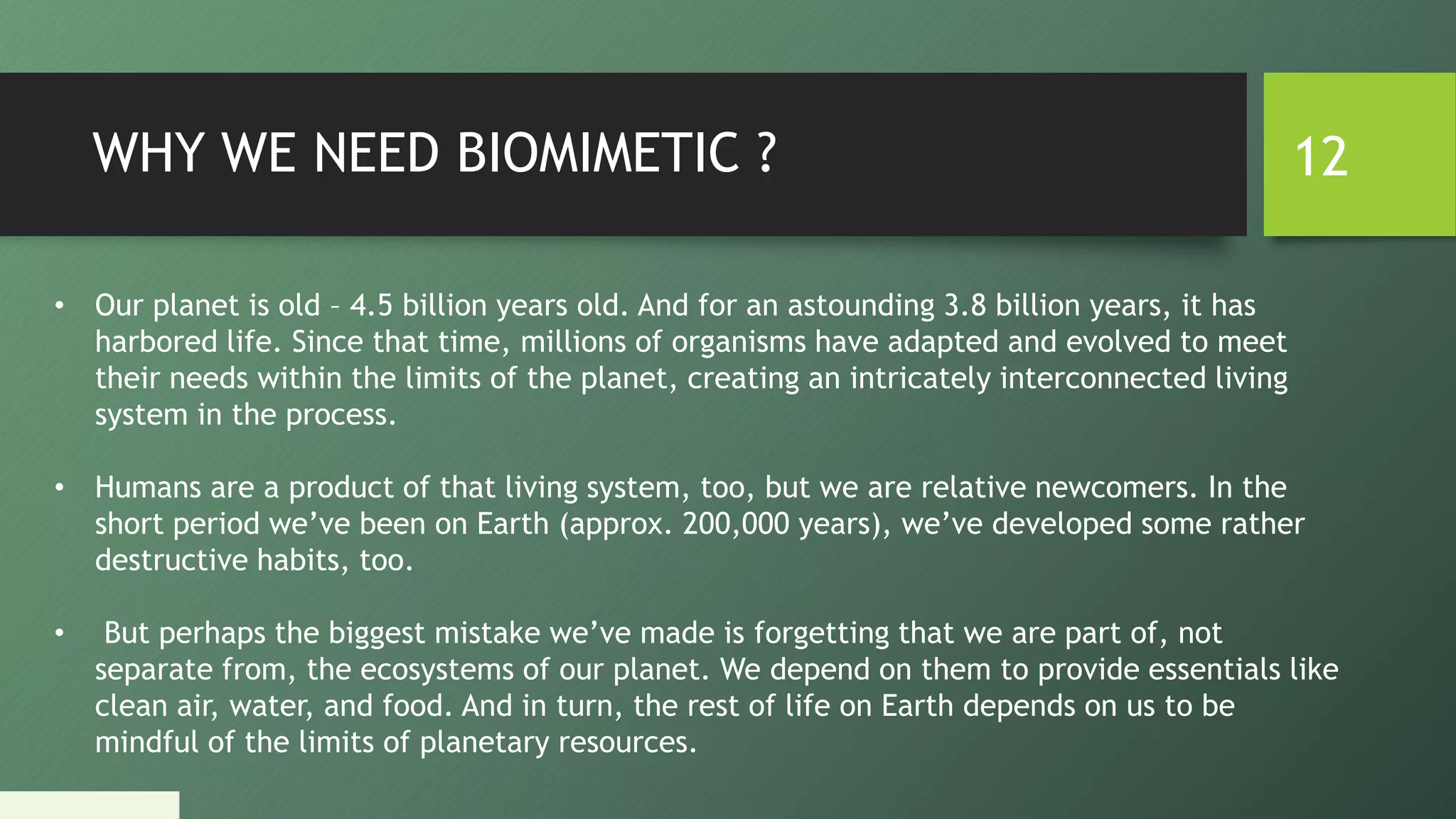
1.The Eastgate Centre designed by architect Mick Pearce in conjunction with
engineers at Arup Associates is a large office and shopping complex in Harare,
Zimbabwe. To minimize potential costs of regulating the building's inner temperature
Pearce looked to the self-cooling mounds of African termites. The building has no air-
conditioning or heating but regulates its temperature with a passive cooling system
inspired by the self-cooling mounds of African termites. The structure, however, does
not have to look like a termite mound to function like one and instead aesthetically
draws from indigenous Zimbabwean masonry.
9
.Ecosystem Level
Building on the ecosystem level involves mimicking of how the environments many
components work together and tends to be on the urban scale or a larger project with multiple
elements rather than a solitary structure.
1.The Sahara Forest Project designed by the firm Exploration Architecture is a greenhouse that
aims to rely on solar energy alone to operate as a zero waste system.
The project is on the ecosystem level because its many components work together in a cyclical
system.
• The Sahara Forest Project[ aims to provide fresh water, food and renewable energy in hot, arid
regions as well as re-vegetating areas of uninhabited desert.
• This proposal combines saltwater-cooled greenhouses with solar power technologies, either
directly using Photovoltaic (PV) or indirectly using concentrated solar power (CSP) and
technologies for desert revegetation.
SOME MAJOR EXAMPLES
• BULLET TRAINS INSPIRED BY
KINGFISHER BIRDS
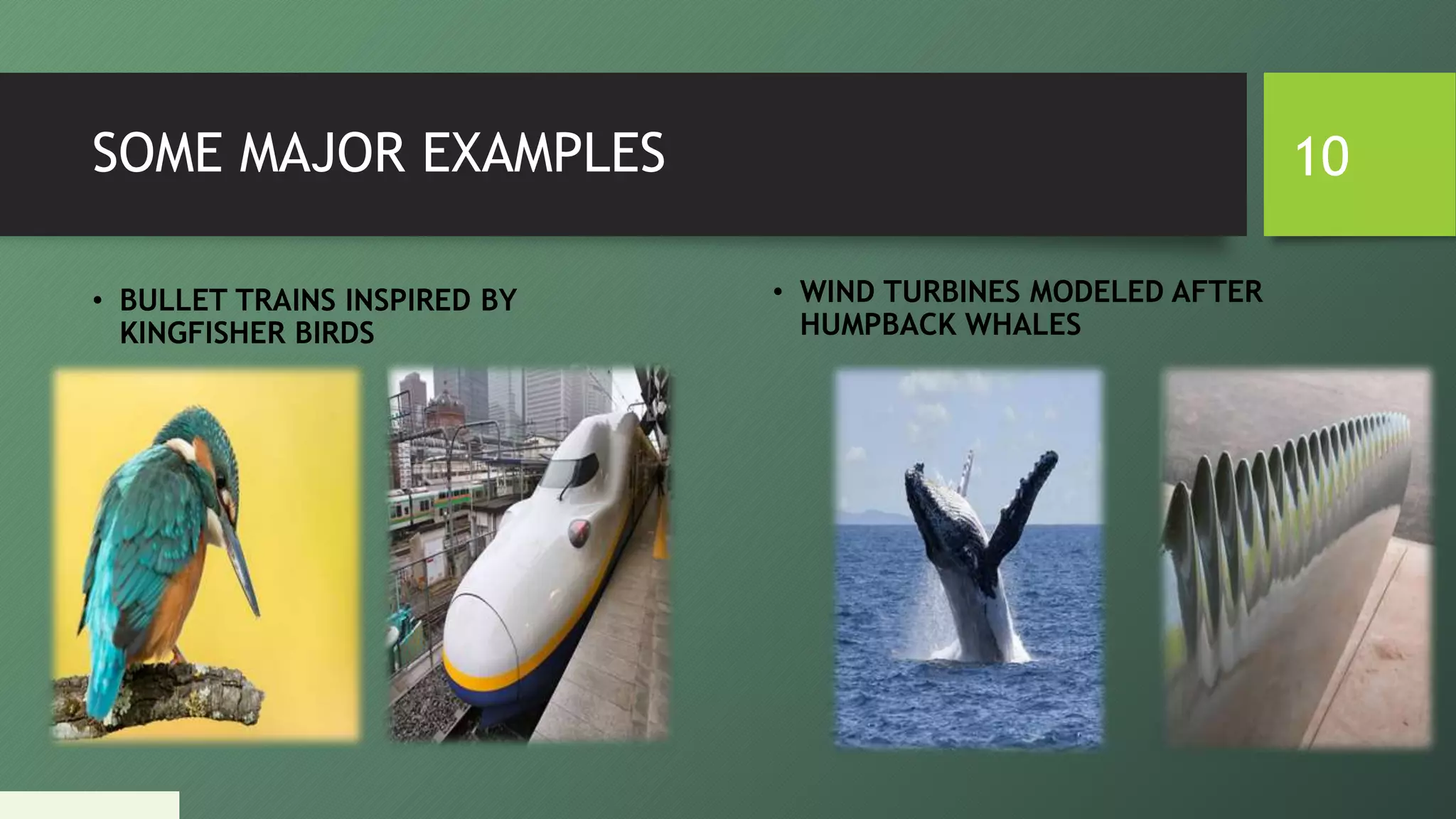
• WIND TURBINES MODELED AFTER
HUMPBACK WHALES
10
11
.ANTIMICROBIAL FILM MIMICKING SHARKSKIN.VENTILATION SYSTEMS INSPIRED
BY TERMITES
WHY WE NEED BIOMIMETIC ? 12
• Our planet is old – 4.5 billion years old. And for an astounding 3.8 billion years, it has
harbored life. Since that time, millions of organisms have adapted and evolved to meet
their needs within the limits of the planet, creating an intricately interconnected living
system in the process.
• Humans are a product of that living system, too, but we are relative newcomers. In the
short period we’ve been on Earth (approx. 200,000 years), we’ve developed some rather
destructive habits, too.
• But perhaps the biggest mistake we’ve made is forgetting that we are part of, not
separate from, the ecosystems of our planet. We depend on them to provide essentials like
clean air, water, and food. And in turn, the rest of life on Earth depends on us to be
mindful of the limits of planetary resources.
THANKYOU

Biomimetic architecture

  • 1.
  • 2.
    CONTENTS: 1. WHAT ISBIOMIMETIC ? 2. HISTORY OF BIOMIMETIC 3. BIOMIMETIC ARCHITECTURE 4. CLASSIFICATION OF BIOMIMETIC ARCHITECTURE 5. SOME MAJOR EXAMPLES OF BIOMIMETIC ARCHITECTURE 6. WHY WE NEED BIOMIMETIC ? 2
  • 3.
    WHAT IS BIOMIMETIC? •DERIVED FROM: BIO – LIFE MEMISES – IMMITATE • Biomimicry is the practice of applying lessons from nature to the invention of healthier, more sustainable technologies for people. • A new science that studies nature’s models and ten uses these designs and processes to solve human problems. • Humans evolved by learning from nature and getting inspired by the natural phenomenon. • Biomimicry is used in every field ranging from architecture to computer science. 3
  • 4.
    HISTORY OF BIOMIMETIC •PRE INDUSTRIAL REVOLUTION: • 1.Rock-Cut Architecture: 6000 BCE • Caves have been used as shelter since the monolithic era 6000 BCE, so it makes perfect sense that in India Buddhist temples and shrines were actually carved into caves and mountain sides. These temples eventually doubled as trade posts on the Silk Road. • 2.Umbrellas: 3 CE • The first Chinese umbrellas were invented 1700 years ago by a man named Lu Ban, who is now revered in Chinese history. The idea for the umbrella sprouted when Lu Ban saw children using lotus leaves to shield themselves from the rain. He decided to mimic the flexibility and effectiveness of the leaf and create a product of his own. The first umbrellas were, in fact, made of silk 4
  • 5.
    5 POST INDUSTRIAL REVOLUTION 1.BulletTrain: 1990s In the late 1990s Japan implemented biomimicry in the form of trains. The kingfisher is a small bird with a long beak that dives into the water for its prey. The engineer redesigned the front of the train to be shaped like the kingfisher’s head, resulting in the train slicing the wind rather than trapping it inside the tunnels, fixing the booming sound 2.Sharkskin: 2014 Sharkskin has been mimicked for its rough segmented texture. It turns out that bacteria do not like landing on the skin of a shark. Engineers have designed materials with a comparable microscopic texture that repel bacteria in a similar way. This material will be especially useful in hospitals where it can be used to cover surfaces and door handles to eliminate the spread of bacteria.
  • 6.
    BIOMIMETIC ARCHITECTURE 6 •Biomimetic architecture is a contemporary philosophy of architecture that seeks solutions for sustainability in nature, not by replicating the natural forms, but by understanding the rules governing those forms. • It is part of a larger movement known as biomimicry, which is the examination of nature, its models, systems, and processes for the purpose of gaining inspiration in order to solve man-made problems.
  • 7.
    CLASSIFICATION OF BIOMIMETICIN ARCHITECTURE 7 .Organism Level 1.Norman Foster’s Gherkin Tower (2003) has a hexagonal skin inspired by the Venus Flower Basket Sponge. This sponge sits in an underwater environment with strong water currents and its lattice-like exoskeleton and round shape help disperse those stresses on the organism 2.The Eden Project (2001) in Cornwall, England is a series of artificial biomes with domes modeled after soap bubbles and pollen grains. Grimshaw Architects looked to nature to build an effective spherical shape. The final superstructure weighs less than the air it contains.
  • 8.
    8 .Behavior Level On thebehavior level, the building mimics how the organism interacts with its environment to build a structure that can also fit in without resistance in its surrounding environment. 1.The Eastgate Centre designed by architect Mick Pearce in conjunction with engineers at Arup Associates is a large office and shopping complex in Harare, Zimbabwe. To minimize potential costs of regulating the building's inner temperature Pearce looked to the self-cooling mounds of African termites. The building has no air- conditioning or heating but regulates its temperature with a passive cooling system inspired by the self-cooling mounds of African termites. The structure, however, does not have to look like a termite mound to function like one and instead aesthetically draws from indigenous Zimbabwean masonry.
  • 9.
    9 .Ecosystem Level Building onthe ecosystem level involves mimicking of how the environments many components work together and tends to be on the urban scale or a larger project with multiple elements rather than a solitary structure. 1.The Sahara Forest Project designed by the firm Exploration Architecture is a greenhouse that aims to rely on solar energy alone to operate as a zero waste system. The project is on the ecosystem level because its many components work together in a cyclical system. • The Sahara Forest Project[ aims to provide fresh water, food and renewable energy in hot, arid regions as well as re-vegetating areas of uninhabited desert. • This proposal combines saltwater-cooled greenhouses with solar power technologies, either directly using Photovoltaic (PV) or indirectly using concentrated solar power (CSP) and technologies for desert revegetation.
  • 10.
    SOME MAJOR EXAMPLES •BULLET TRAINS INSPIRED BY KINGFISHER BIRDS • WIND TURBINES MODELED AFTER HUMPBACK WHALES 10
  • 11.
    11 .ANTIMICROBIAL FILM MIMICKINGSHARKSKIN.VENTILATION SYSTEMS INSPIRED BY TERMITES
  • 12.
    WHY WE NEEDBIOMIMETIC ? 12 • Our planet is old – 4.5 billion years old. And for an astounding 3.8 billion years, it has harbored life. Since that time, millions of organisms have adapted and evolved to meet their needs within the limits of the planet, creating an intricately interconnected living system in the process. • Humans are a product of that living system, too, but we are relative newcomers. In the short period we’ve been on Earth (approx. 200,000 years), we’ve developed some rather destructive habits, too. • But perhaps the biggest mistake we’ve made is forgetting that we are part of, not separate from, the ecosystems of our planet. We depend on them to provide essentials like clean air, water, and food. And in turn, the rest of life on Earth depends on us to be mindful of the limits of planetary resources.
  • 13.