Ground-Based Augmentation
System (GBAS)
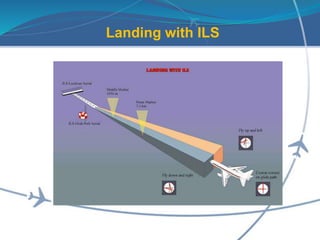
Landing with ILS
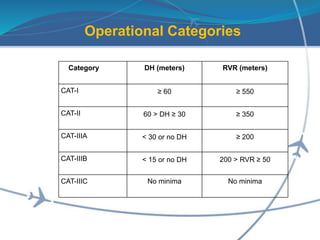
Operational Categories
Category DH (meters) RVR (meters)
CAT-I ≥ 60 ≥ 550
CAT-II 60 > DH ≥ 30 ≥ 350
CAT-IIIA < 30 or no DH ≥ 200
CAT-IIIB < 15 or no DH 200 > RVR ≥ 50
CAT-IIIC No minima No minima
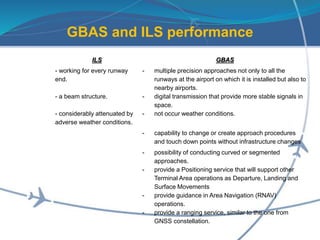
ILS GBAS
- working for every runway
end.
- multiple precision approaches not only to all the
runways at the airport on which it is installed but also to
nearby airports.
- a beam structure. - digital transmission that provide more stable signals in
space.
- considerably attenuated by
adverse weather conditions.
- not occur weather conditions.
- capability to change or create approach procedures
and touch down points without infrastructure changes
- possibility of conducting curved or segmented
approaches.
- provide a Positioning service that will support other
Terminal Area operations as Departure, Landing and
Surface Movements
- provide guidance in Area Navigation (RNAV)
operations.
- provide a ranging service, similar to the one from
GNSS constellation.
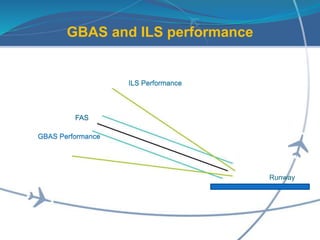
GBAS and ILS performance
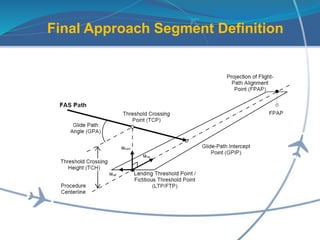
Final Approach Segment Definition
Runway
ILS Performance
GBAS Performance
FAS
GBAS and ILS performance
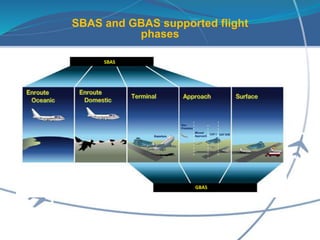
SBAS
GBAS
SBAS and GBAS supported flight
phases
GBAS Mission
 Ground-Based Augmentation Systems are mainly intended
to support Precision Approach (PA) operations, from CAT-I
to CAT-III PAs. The PA service will act by first establishing a
Final Approach Segment (FAS), which is the Instrument
Approach phase.
GBAS Mission
 ICAO GNSS SARPs provide guidelines and requirements
for GBAS operations to support CAT-I PAs and for the
GBAS Positioning service.
 As referred in the European Civil Aviation Conference
(ECAC) Navigation Strategy, it is expected that by 2015
GBAS facilities have already widespread replacing ILS as
the main provider of CAT-I capability at airports.
Conformance:
 ICAO and EUROCAE international standards (ICAO SARPs on GBAS
Annex 10, Volume I with amendments 76, 77, 79; ED-114);
 ICAO Doc “Guide for ground based augmentation system implementation”
May, 2013.
 ICAO Annex 14 to the Convention on International Civil Aviation;
 ICAO Doc 9849 – GNSS Manual;
 ICAO NSP Manual on Ionospheric Effects on GNSS Aviation Operations –
December/2006
 TSO C162 - Ground Based Augmentation System Very High
Frequency Data Broadcast Equipment.
 TSO C161 - Ground Based Augmentation System Positioning and
Navigation Equipment.
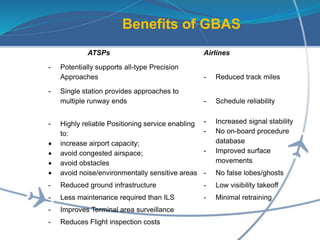
Benefits of GBAS
ATSPs Airlines
- Potentially supports all-type Precision
Approaches - Reduced track miles
- Single station provides approaches to
multiple runway ends - Schedule reliability
- Highly reliable Positioning service enabling
to:
 increase airport capacity;
 avoid congested airspace;
 avoid obstacles
 avoid noise/environmentally sensitive areas
- Increased signal stability
- No on-board procedure
database
- Improved surface
movements
- No false lobes/ghosts
- Reduced ground infrastructure - Low visibility takeoff
- Less maintenance required than ILS - Minimal retraining
- Improves Terminal area surveillance
- Reduces Flight inspection costs
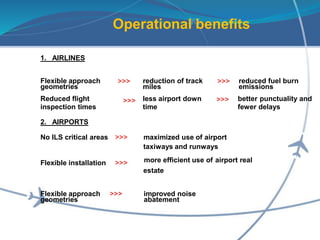
1. AIRLINES
Flexible approach
geometries
Reduced flight
inspection times
>>> reduction of track
miles
less airport down
time
>>>
>>>
reduced fuel burn
emissions
better punctuality and
fewer delays
>>>
2. AIRPORTS
No ILS critical areas >>> maximized use of airport
taxiways and runways
more efficient use of airport real
estate
Flexible installation >>>
Flexible approach
geometries
>>> improved noise
abatement
Operational benefits
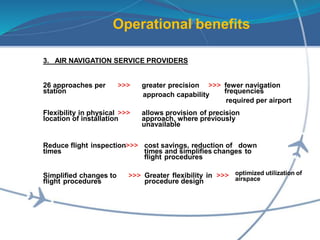
3. AIR NAVIGATION SERVICE PROVIDERS
26 approaches per
station
>>> greater precision
approach capability
>>> fewer navigation
frequencies
required per airport
Flexibility in physical
location of installation
>>> allows provision of precision
approach, where previously
unavailable
Reduce flight inspection
times
>>> cost savings, reduction of down
times and simplifies changes to
flight procedures
Simplified changes to
flight procedures
>>> Greater flexibility in
procedure design
>>> optimized utilization of
airspace
Operational benefits
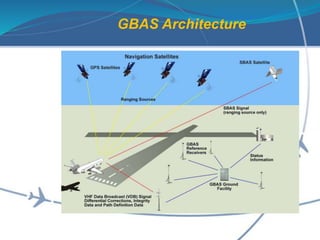
GBAS Architecture
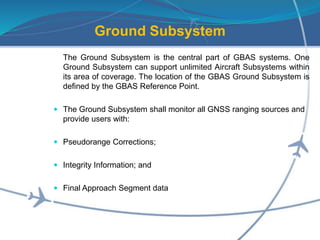
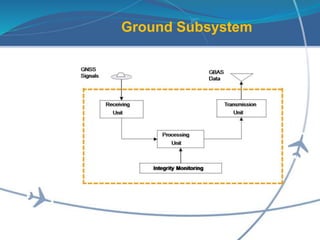
Ground Subsystem
The Ground Subsystem is the central part of GBAS systems. One
Ground Subsystem can support unlimited Aircraft Subsystems within
its area of coverage. The location of the GBAS Ground Subsystem is
defined by the GBAS Reference Point.
 The Ground Subsystem shall monitor all GNSS ranging sources and
provide users with:
 Pseudorange Corrections;
 Integrity Information; and
 Final Approach Segment data
Ground Subsystem
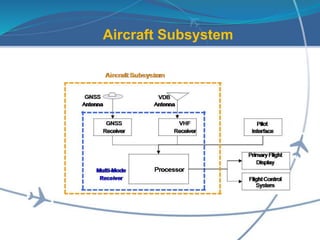
Aircraft Subsystem
The primary functions of the Aircraft Subsystem are to:
 Receive and decode the GNSS satellite and GBAS signals;
 Assess the system Availability to support the flight operation in
progress;
 Determine the aircraft position and its Integrity; and
 Provide guidance signals and Integrity information.
Aircraft Subsystem
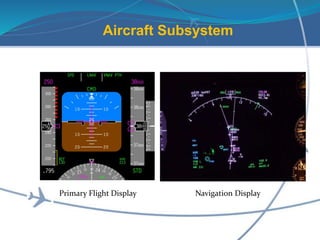
Primary Flight Display Navigation Display
Aircraft Subsystem
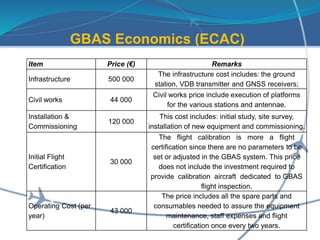
GBAS Economics (ECAC)
Item Price (€) Remarks
Infrastructure 500 000
The infrastructure cost includes: the ground
station, VDB transmitter and GNSS receivers;
Civil works 44 000
Civil works price include execution of platforms
for the various stations and antennae.
Installation &
Commissioning
120 000
This cost includes: initial study, site survey,
installation of new equipment and commissioning.
Initial Flight
Certification
30 000
The flight calibration is more a flight
certification since there are no parameters to be
set or adjusted in the GBAS system. This price
does not include the investment required to
provide calibration aircraft dedicated to GBAS
flight inspection.
Operating Cost (per
year)
43 000
The price includes all the spare parts and
consumables needed to assure the equipment
maintenance, staff expenses and flight
certification once every two years.
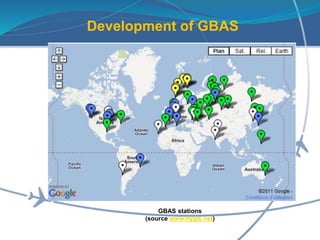
Development of GBAS
GBAS stations
(source www.flygls.net)
GBAS station manufacturers
 Several companies are working on GBAS ground
stations: Honeywell, IACIT, SELEX, NPPF Spectr,
Indra, Thales, NEC, Park Air, GM Merck and others.
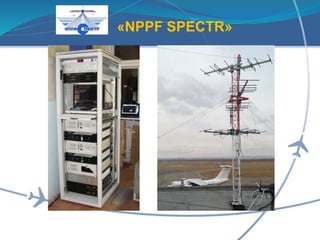
«NPPF SPECTR»
GBAS in aircraft manufacturers
 The big aircraft manufacturers (Boeing and Airbus) have
already implemented GBAS landing capability in several of
their aircrafts.
 Airbus offers GBAS CAT I as an optional item for customers
in A380, A350 and A320. For A330 and A340, they are still
working on approval for operation.
 Boeing offers GBAS CAT I as an optional item in B737-NG
and as a regular item in B747-8 and B787.
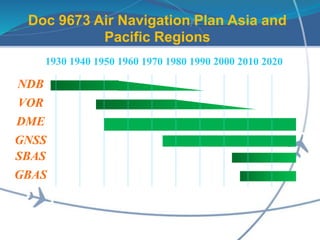
NDB
VOR
DME
GNSS
SBAS
GBAS
1930 1940 1950 1960 1970 1980 1990 2000 2010 2020
Doc 9673 Air Navigation Plan Asia and
Pacific Regions
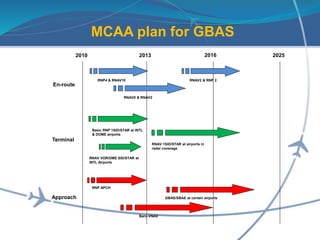
MCAA plan for GBAS
En-route
2010 2013 2016 2025
Terminal
Approach
RNP4 & RNAV10 RNAV2 & RNP 2
RNAV5 & RNAV2
Basic RNP 1SID/STAR at INTL
& DOME airports
RNAV VOR/DME SID/STAR at
INTL Airports
RNAV 1SID/STAR at airports in
radar coverage
RNP APCH
Baro-VNAV
GBAS/SBAS at certain airports

Gbas

  • 1.
  • 2.
  • 3.
    Operational Categories Category DH(meters) RVR (meters) CAT-I ≥ 60 ≥ 550 CAT-II 60 > DH ≥ 30 ≥ 350 CAT-IIIA < 30 or no DH ≥ 200 CAT-IIIB < 15 or no DH 200 > RVR ≥ 50 CAT-IIIC No minima No minima
  • 4.
    ILS GBAS - workingfor every runway end. - multiple precision approaches not only to all the runways at the airport on which it is installed but also to nearby airports. - a beam structure. - digital transmission that provide more stable signals in space. - considerably attenuated by adverse weather conditions. - not occur weather conditions. - capability to change or create approach procedures and touch down points without infrastructure changes - possibility of conducting curved or segmented approaches. - provide a Positioning service that will support other Terminal Area operations as Departure, Landing and Surface Movements - provide guidance in Area Navigation (RNAV) operations. - provide a ranging service, similar to the one from GNSS constellation. GBAS and ILS performance
  • 5.
  • 6.
  • 7.
    SBAS GBAS SBAS and GBASsupported flight phases
  • 8.
    GBAS Mission  Ground-BasedAugmentation Systems are mainly intended to support Precision Approach (PA) operations, from CAT-I to CAT-III PAs. The PA service will act by first establishing a Final Approach Segment (FAS), which is the Instrument Approach phase.
  • 9.
    GBAS Mission  ICAOGNSS SARPs provide guidelines and requirements for GBAS operations to support CAT-I PAs and for the GBAS Positioning service.  As referred in the European Civil Aviation Conference (ECAC) Navigation Strategy, it is expected that by 2015 GBAS facilities have already widespread replacing ILS as the main provider of CAT-I capability at airports.
  • 10.
    Conformance:  ICAO andEUROCAE international standards (ICAO SARPs on GBAS Annex 10, Volume I with amendments 76, 77, 79; ED-114);  ICAO Doc “Guide for ground based augmentation system implementation” May, 2013.  ICAO Annex 14 to the Convention on International Civil Aviation;  ICAO Doc 9849 – GNSS Manual;  ICAO NSP Manual on Ionospheric Effects on GNSS Aviation Operations – December/2006  TSO C162 - Ground Based Augmentation System Very High Frequency Data Broadcast Equipment.  TSO C161 - Ground Based Augmentation System Positioning and Navigation Equipment.
  • 11.
    Benefits of GBAS ATSPsAirlines - Potentially supports all-type Precision Approaches - Reduced track miles - Single station provides approaches to multiple runway ends - Schedule reliability - Highly reliable Positioning service enabling to:  increase airport capacity;  avoid congested airspace;  avoid obstacles  avoid noise/environmentally sensitive areas - Increased signal stability - No on-board procedure database - Improved surface movements - No false lobes/ghosts - Reduced ground infrastructure - Low visibility takeoff - Less maintenance required than ILS - Minimal retraining - Improves Terminal area surveillance - Reduces Flight inspection costs
  • 12.
    1. AIRLINES Flexible approach geometries Reducedflight inspection times >>> reduction of track miles less airport down time >>> >>> reduced fuel burn emissions better punctuality and fewer delays >>> 2. AIRPORTS No ILS critical areas >>> maximized use of airport taxiways and runways more efficient use of airport real estate Flexible installation >>> Flexible approach geometries >>> improved noise abatement Operational benefits
  • 13.
    3. AIR NAVIGATIONSERVICE PROVIDERS 26 approaches per station >>> greater precision approach capability >>> fewer navigation frequencies required per airport Flexibility in physical location of installation >>> allows provision of precision approach, where previously unavailable Reduce flight inspection times >>> cost savings, reduction of down times and simplifies changes to flight procedures Simplified changes to flight procedures >>> Greater flexibility in procedure design >>> optimized utilization of airspace Operational benefits
  • 14.
  • 15.
    Ground Subsystem The GroundSubsystem is the central part of GBAS systems. One Ground Subsystem can support unlimited Aircraft Subsystems within its area of coverage. The location of the GBAS Ground Subsystem is defined by the GBAS Reference Point.  The Ground Subsystem shall monitor all GNSS ranging sources and provide users with:  Pseudorange Corrections;  Integrity Information; and  Final Approach Segment data
  • 16.
  • 17.
    Aircraft Subsystem The primaryfunctions of the Aircraft Subsystem are to:  Receive and decode the GNSS satellite and GBAS signals;  Assess the system Availability to support the flight operation in progress;  Determine the aircraft position and its Integrity; and  Provide guidance signals and Integrity information.
  • 18.
  • 19.
    Primary Flight DisplayNavigation Display Aircraft Subsystem
  • 20.
    GBAS Economics (ECAC) ItemPrice (€) Remarks Infrastructure 500 000 The infrastructure cost includes: the ground station, VDB transmitter and GNSS receivers; Civil works 44 000 Civil works price include execution of platforms for the various stations and antennae. Installation & Commissioning 120 000 This cost includes: initial study, site survey, installation of new equipment and commissioning. Initial Flight Certification 30 000 The flight calibration is more a flight certification since there are no parameters to be set or adjusted in the GBAS system. This price does not include the investment required to provide calibration aircraft dedicated to GBAS flight inspection. Operating Cost (per year) 43 000 The price includes all the spare parts and consumables needed to assure the equipment maintenance, staff expenses and flight certification once every two years.
  • 21.
    Development of GBAS GBASstations (source www.flygls.net)
  • 22.
    GBAS station manufacturers Several companies are working on GBAS ground stations: Honeywell, IACIT, SELEX, NPPF Spectr, Indra, Thales, NEC, Park Air, GM Merck and others.
  • 24.
  • 25.
    GBAS in aircraftmanufacturers  The big aircraft manufacturers (Boeing and Airbus) have already implemented GBAS landing capability in several of their aircrafts.  Airbus offers GBAS CAT I as an optional item for customers in A380, A350 and A320. For A330 and A340, they are still working on approval for operation.  Boeing offers GBAS CAT I as an optional item in B737-NG and as a regular item in B747-8 and B787.
  • 26.
    NDB VOR DME GNSS SBAS GBAS 1930 1940 19501960 1970 1980 1990 2000 2010 2020 Doc 9673 Air Navigation Plan Asia and Pacific Regions
  • 27.
    MCAA plan forGBAS En-route 2010 2013 2016 2025 Terminal Approach RNP4 & RNAV10 RNAV2 & RNP 2 RNAV5 & RNAV2 Basic RNP 1SID/STAR at INTL & DOME airports RNAV VOR/DME SID/STAR at INTL Airports RNAV 1SID/STAR at airports in radar coverage RNP APCH Baro-VNAV GBAS/SBAS at certain airports