The Gaussian Surface and
Gauss’s Law
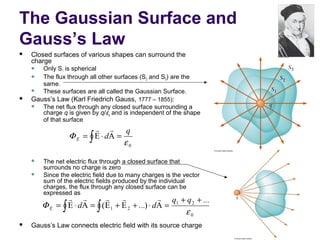
 Closed surfaces of various shapes can surround the
charge
 Only S1 is spherical
 The flux through all other surfaces (S2 and S3) are the
same.
 These surfaces are all called the Gaussian Surface.
 Gauss’s Law (Karl Friedrich Gauss, 1777 – 1855):
 The net flux through any closed surface surrounding a
charge q is given by q/εo and is independent of the shape
of that surface
 The net electric flux through a closed surface that
surrounds no charge is zero
 Since the electric field due to many charges is the vector
sum of the electric fields produced by the individual
charges, the flux through any closed surface can be
expressed as
 Gauss’s Law connects electric field with its source charge
0
AE
ε
Φ
q
dE =⋅= ∫

0
21
21 A)EE(AE
ε
Φ
...qq
d...dE
++
=⋅++=⋅= ∫∫

Gauss’s Law – Summary
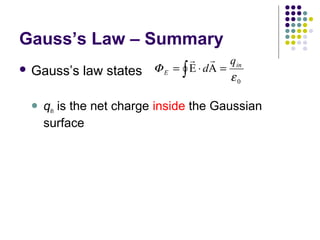
 Gauss’s law states
 qin is the net charge inside the Gaussian
surface
0
AE
ε
Φ in
E
q
d =⋅= ∫


Gauss's law

  • 1.
    The Gaussian Surfaceand Gauss’s Law  Closed surfaces of various shapes can surround the charge  Only S1 is spherical  The flux through all other surfaces (S2 and S3) are the same.  These surfaces are all called the Gaussian Surface.  Gauss’s Law (Karl Friedrich Gauss, 1777 – 1855):  The net flux through any closed surface surrounding a charge q is given by q/εo and is independent of the shape of that surface  The net electric flux through a closed surface that surrounds no charge is zero  Since the electric field due to many charges is the vector sum of the electric fields produced by the individual charges, the flux through any closed surface can be expressed as  Gauss’s Law connects electric field with its source charge 0 AE ε Φ q dE =⋅= ∫  0 21 21 A)EE(AE ε Φ ...qq d...dE ++ =⋅++=⋅= ∫∫ 
  • 2.
    Gauss’s Law –Summary  Gauss’s law states  qin is the net charge inside the Gaussian surface 0 AE ε Φ in E q d =⋅= ∫ 