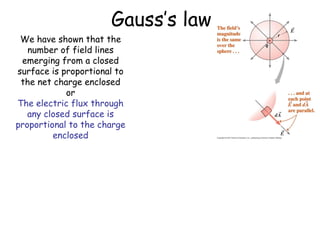
We have shown that the
number of field lines
emerging from a closed
surface is proportional to
the net charge enclosed
or
The electric flux through
any closed surface is
proportional to the charge
enclosed
Gauss’s law
Gauss’s law
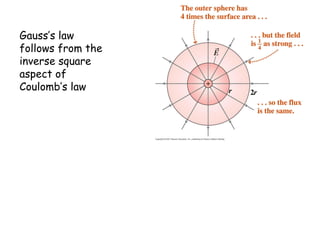
follows from the
inverse square
aspect of
Coulomb’s law
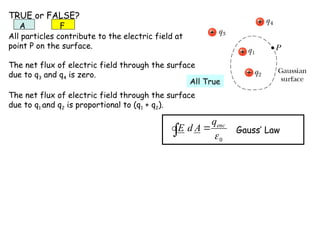
TRUE or FALSE?
All particles contribute to the electric field at
point P on the surface.
The net flux of electric field through the surface
due to q3 and q4 is zero.
The net flux of electric field through the surface
due to q1 and q2 is proportional to (q1 + q2).
All True
A F
0

enc
q
A
d
E 

 Gauss’ Law
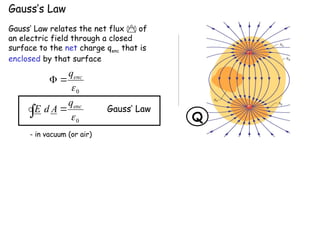
Gauss’s Law
Gauss’ Law relates the net flux  of
an electric field through a closed
surface to the net charge qenc that is
enclosed by that surface
0

enc
q


0

enc
q
A
d
E 

 Gauss’ Law
- in vacuum (or air)
• Charge outside not included
• Exact location of charges inside
doesn’t matter, only magnitude and
sign
• But, E is the resultant of all
charges, both inside and outside
Q
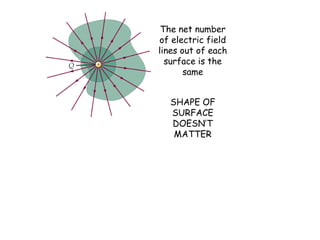
The net number
of electric field
lines out of each
surface is the
same
SHAPE OF
SURFACE
DOESN’T
MATTER
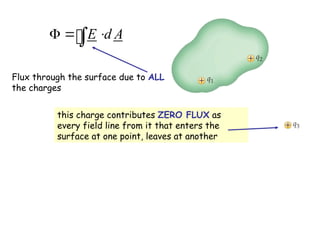
E d A
  


Flux through the surface due to ALL
the charges
this charge contributes ZERO FLUX as
every field line from it that enters the
surface at one point, leaves at another
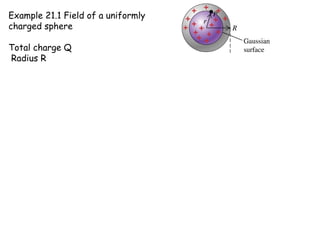
Example 21.1 Field of a uniformly
charged sphere
Total charge Q
Radius R
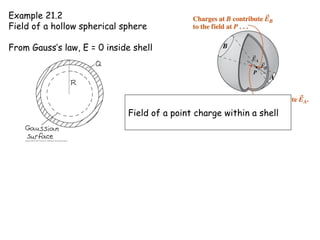
Example 21.2
Field of a hollow spherical sphere
From Gauss’s law, E = 0 inside shell
Field of a point charge within a shell
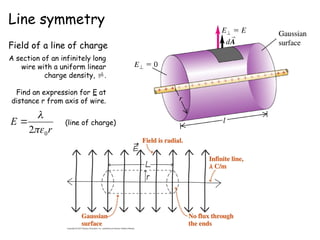
Line symmetry
Field of a line of charge
r
E
0
2

 (line of charge)
A section of an infinitely long
wire with a uniform linear
charge density, .
Find an expression for E at
distance r from axis of wire.
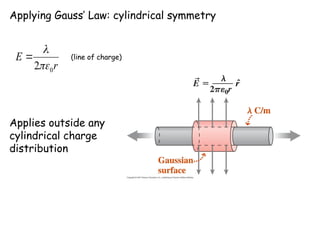
Applying Gauss’ Law: cylindrical symmetry
r
E
0
2

 (line of charge)
Applies outside any
cylindrical charge
distribution
Lecture- lecture lecture lecture lecture 3.pptx

  • 1.
    We have shownthat the number of field lines emerging from a closed surface is proportional to the net charge enclosed or The electric flux through any closed surface is proportional to the charge enclosed Gauss’s law
  • 2.
    Gauss’s law follows fromthe inverse square aspect of Coulomb’s law
  • 3.
    TRUE or FALSE? Allparticles contribute to the electric field at point P on the surface. The net flux of electric field through the surface due to q3 and q4 is zero. The net flux of electric field through the surface due to q1 and q2 is proportional to (q1 + q2). All True A F 0  enc q A d E    Gauss’ Law
  • 4.
    Gauss’s Law Gauss’ Lawrelates the net flux  of an electric field through a closed surface to the net charge qenc that is enclosed by that surface 0  enc q   0  enc q A d E    Gauss’ Law - in vacuum (or air) • Charge outside not included • Exact location of charges inside doesn’t matter, only magnitude and sign • But, E is the resultant of all charges, both inside and outside Q
  • 5.
    The net number ofelectric field lines out of each surface is the same SHAPE OF SURFACE DOESN’T MATTER
  • 6.
    E d A     Flux through the surface due to ALL the charges this charge contributes ZERO FLUX as every field line from it that enters the surface at one point, leaves at another
  • 7.
    Example 21.1 Fieldof a uniformly charged sphere Total charge Q Radius R
  • 8.
    Example 21.2 Field ofa hollow spherical sphere From Gauss’s law, E = 0 inside shell Field of a point charge within a shell
  • 9.
    Line symmetry Field ofa line of charge r E 0 2   (line of charge) A section of an infinitely long wire with a uniform linear charge density, . Find an expression for E at distance r from axis of wire.
  • 10.
    Applying Gauss’ Law:cylindrical symmetry r E 0 2   (line of charge) Applies outside any cylindrical charge distribution