GBH Enterprises, Ltd.

Process Engineering Guide:
GBHE-PEG-MIX-702

Gas Mixing
Information contained in this publication or as otherwise supplied to Users is
believed to be accurate and correct at time of going to press, and is given in
good faith, but it is for the User to satisfy itself of the suitability of the information
for its own particular purpose. GBHE gives no warranty as to the fitness of this
information for any particular purpose and any implied warranty or condition
(statutory or otherwise) is excluded except to the extent that exclusion is
prevented by law. GBHE accepts no liability resulting from reliance on this
information. Freedom under Patent, Copyright and Designs cannot be assumed.

Refinery Process Stream Purification Refinery Process Catalysts Troubleshooting Refinery Process Catalyst Start-Up / Shutdown
Activation Reduction In-situ Ex-situ Sulfiding Specializing in Refinery Process Catalyst Performance Evaluation Heat & Mass
Balance Analysis Catalyst Remaining Life Determination Catalyst Deactivation Assessment Catalyst Performance
Characterization Refining & Gas Processing & Petrochemical Industries Catalysts / Process Technology - Hydrogen Catalysts /
Process Technology – Ammonia Catalyst Process Technology - Methanol Catalysts / process Technology – Petrochemicals
Specializing in the Development & Commercialization of New Technology in the Refining & Petrochemical Industries
Web Site: www.GBHEnterprises.com
Process Engineering Guide:

Gas Mixing

CONTENTS

SECTION

0

INTRODUCTION/PURPOSE

2

1

SCOPE

2

2

FIELD OF APPLICATION

2

3

DEFINITIONS

2

4

RECOMMENDATIONS FOR GAS MIXING:
PLUG FLOW

2

RECOMMENDATIONS FOR GAS MIXING:
BACKMIXED INITIAL ZONE

4

BIBLIOGRAPHY

6

5

6

Refinery Process Stream Purification Refinery Process Catalysts Troubleshooting Refinery Process Catalyst Start-Up / Shutdown
Activation Reduction In-situ Ex-situ Sulfiding Specializing in Refinery Process Catalyst Performance Evaluation Heat & Mass
Balance Analysis Catalyst Remaining Life Determination Catalyst Deactivation Assessment Catalyst Performance
Characterization Refining & Gas Processing & Petrochemical Industries Catalysts / Process Technology - Hydrogen Catalysts /
Process Technology – Ammonia Catalyst Process Technology - Methanol Catalysts / process Technology – Petrochemicals
Specializing in the Development & Commercialization of New Technology in the Refining & Petrochemical Industries
Web Site: www.GBHEnterprises.com
FIGURES

1

RESULTS OBTAINED USING A SULZER SMV MIXER

3

2

RECIRCULATION ZONE : CONFINED JET

4

3

RECIRCULATION ZONE : BLUFF BODY

5

4

STREAMLINES OF RECIRCULATION EDDY IN SWIRLING
JET, S = 1.57

5

SCHEME OF SWIRL BURNER WITH AXIAL AND
TANGENTIAL AIR ENTRIES

6

5

6

COMPARISON OF THE RADIAL DISTRIBUTIONS OF VELOCITY
IN THE VORTEX REGION FOR JETS WITH AND WITHOUT
DIVERGENT EXTENSIONS
7

7

BACKMIXED 'PRE-REACTION' ZONE

7

DOCUMENTS REFERRED TO IN THIS PROCESS
ENGINEERING GUIDE

8

Refinery Process Stream Purification Refinery Process Catalysts Troubleshooting Refinery Process Catalyst Start-Up / Shutdown
Activation Reduction In-situ Ex-situ Sulfiding Specializing in Refinery Process Catalyst Performance Evaluation Heat & Mass
Balance Analysis Catalyst Remaining Life Determination Catalyst Deactivation Assessment Catalyst Performance
Characterization Refining & Gas Processing & Petrochemical Industries Catalysts / Process Technology - Hydrogen Catalysts /
Process Technology – Ammonia Catalyst Process Technology - Methanol Catalysts / process Technology – Petrochemicals
Specializing in the Development & Commercialization of New Technology in the Refining & Petrochemical Industries
Web Site: www.GBHEnterprises.com
0

INTRODUCTION/PURPOSE

This Guide is one in a series of Mixing Guides and has been produced for GBH
Enterprises.

1

SCOPE

This guide covers the mixing of gases.
If a backmixed 'pre-reaction' zone is not required, refer to Clause 4. Where a
backmixed 'pre-reaction' zone is required, refer to Clause 5.

2

FIELD OF APPLICATION

This Guide applies to Process Engineers in GBH Enterprises worldwide.

3

DEFINITIONS

No specific definitions apply to this Guide.
With the exception of terms used as proper nouns or titles, those terms with initial
capital letters which appear in this document and are not defined above are
defined in the Glossary of Engineering Terms.

4

RECOMMENDATIONS FOR GAS MIXING: PLUG FLOW

Jet flow mixers and static mixers are recommended for gas mixing. The design
procedures presented for miscible liquids in GBHE-PEG-MIX-701, should be
followed using the appropriate gas physical properties.
Empty pipes may be used in the turbulent region: for gases of the same density,
a length of about 100 pipe diameters is required for good mixing. For gases with
a density ratio > 2, up to 1000 pipe diameters may be required because of the
formation of stable layers.

Refinery Process Stream Purification Refinery Process Catalysts Troubleshooting Refinery Process Catalyst Start-Up / Shutdown
Activation Reduction In-situ Ex-situ Sulfiding Specializing in Refinery Process Catalyst Performance Evaluation Heat & Mass
Balance Analysis Catalyst Remaining Life Determination Catalyst Deactivation Assessment Catalyst Performance
Characterization Refining & Gas Processing & Petrochemical Industries Catalysts / Process Technology - Hydrogen Catalysts /
Process Technology – Ammonia Catalyst Process Technology - Methanol Catalysts / process Technology – Petrochemicals
Specializing in the Development & Commercialization of New Technology in the Refining & Petrochemical Industries
Web Site: www.GBHEnterprises.com
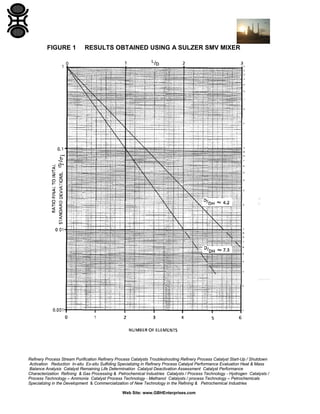
Static mixers can achieve good mixing in less than five pipe diameters regardless
of the density difference. Figure 1 shows the results obtained using a Sulzer
SMV mixer. Unless the densities are similar and the flow rates constant, a
minimum operating velocity, UG, is recommended. For the Sulzer SMV mixer,
this is obtained if the modified Froude number exceeds 20 [Ref 1 : Germain et
al., 1982]:

. The values of f and DH are obtained from the manufacturers' data;

Refinery Process Stream Purification Refinery Process Catalysts Troubleshooting Refinery Process Catalyst Start-Up / Shutdown
Activation Reduction In-situ Ex-situ Sulfiding Specializing in Refinery Process Catalyst Performance Evaluation Heat & Mass
Balance Analysis Catalyst Remaining Life Determination Catalyst Deactivation Assessment Catalyst Performance
Characterization Refining & Gas Processing & Petrochemical Industries Catalysts / Process Technology - Hydrogen Catalysts /
Process Technology – Ammonia Catalyst Process Technology - Methanol Catalysts / process Technology – Petrochemicals
Specializing in the Development & Commercialization of New Technology in the Refining & Petrochemical Industries
Web Site: www.GBHEnterprises.com
FIGURE 1

RESULTS OBTAINED USING A SULZER SMV MIXER

Refinery Process Stream Purification Refinery Process Catalysts Troubleshooting Refinery Process Catalyst Start-Up / Shutdown
Activation Reduction In-situ Ex-situ Sulfiding Specializing in Refinery Process Catalyst Performance Evaluation Heat & Mass
Balance Analysis Catalyst Remaining Life Determination Catalyst Deactivation Assessment Catalyst Performance
Characterization Refining & Gas Processing & Petrochemical Industries Catalysts / Process Technology - Hydrogen Catalysts /
Process Technology – Ammonia Catalyst Process Technology - Methanol Catalysts / process Technology – Petrochemicals
Specializing in the Development & Commercialization of New Technology in the Refining & Petrochemical Industries
Web Site: www.GBHEnterprises.com
5

RECOMMENDATIONS FOR GAS MIXING: BACKMIXED INITIAL ZONE

Such cases are covered in the combustion literature, e.g. in Beer, J M and
Chigier, N A, ”Combustion Aerodynamics”, Krieger, 1983 (reprint of 1972
edition).
In this reference design of jet mixers for the particular requirements of
combustion, namely rapid mixing and stable flame, are discussed, and
information provided for entrainment rate into the jet, flow patterns, recirculation
vortex position, effects of jet swirl, etc.
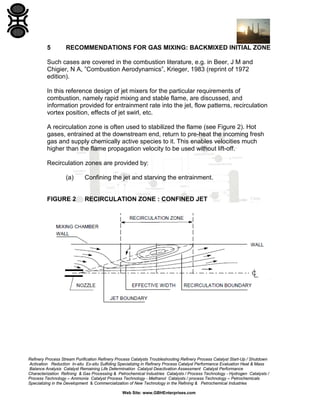
A recirculation zone is often used to stabilized the flame (see Figure 2). Hot
gases, entrained at the downstream end, return to pre-heat the incoming fresh
gas and supply chemically active species to it. This enables velocities much
higher than the flame propagation velocity to be used without lift-off.
Recirculation zones are provided by:
(a)

FIGURE 2

Confining the jet and starving the entrainment.

RECIRCULATION ZONE : CONFINED JET

Refinery Process Stream Purification Refinery Process Catalysts Troubleshooting Refinery Process Catalyst Start-Up / Shutdown
Activation Reduction In-situ Ex-situ Sulfiding Specializing in Refinery Process Catalyst Performance Evaluation Heat & Mass
Balance Analysis Catalyst Remaining Life Determination Catalyst Deactivation Assessment Catalyst Performance
Characterization Refining & Gas Processing & Petrochemical Industries Catalysts / Process Technology - Hydrogen Catalysts /
Process Technology – Ammonia Catalyst Process Technology - Methanol Catalysts / process Technology – Petrochemicals
Specializing in the Development & Commercialization of New Technology in the Refining & Petrochemical Industries
Web Site: www.GBHEnterprises.com
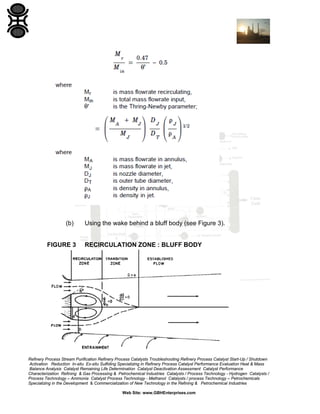
(b)

FIGURE 3

Using the wake behind a bluff body (see Figure 3).

RECIRCULATION ZONE : BLUFF BODY

Refinery Process Stream Purification Refinery Process Catalysts Troubleshooting Refinery Process Catalyst Start-Up / Shutdown
Activation Reduction In-situ Ex-situ Sulfiding Specializing in Refinery Process Catalyst Performance Evaluation Heat & Mass
Balance Analysis Catalyst Remaining Life Determination Catalyst Deactivation Assessment Catalyst Performance
Characterization Refining & Gas Processing & Petrochemical Industries Catalysts / Process Technology - Hydrogen Catalysts /
Process Technology – Ammonia Catalyst Process Technology - Methanol Catalysts / process Technology – Petrochemicals
Specializing in the Development & Commercialization of New Technology in the Refining & Petrochemical Industries
Web Site: www.GBHEnterprises.com
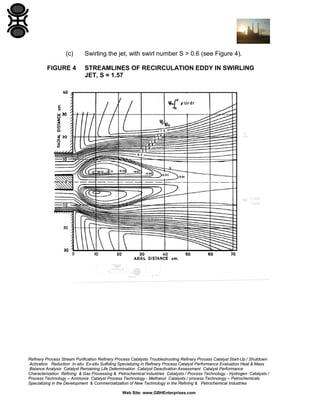
(c)
FIGURE 4

Swirling the jet, with swirl number S > 0.6 (see Figure 4).
STREAMLINES OF RECIRCULATION EDDY IN SWIRLING
JET, S = 1.57

Refinery Process Stream Purification Refinery Process Catalysts Troubleshooting Refinery Process Catalyst Start-Up / Shutdown
Activation Reduction In-situ Ex-situ Sulfiding Specializing in Refinery Process Catalyst Performance Evaluation Heat & Mass
Balance Analysis Catalyst Remaining Life Determination Catalyst Deactivation Assessment Catalyst Performance
Characterization Refining & Gas Processing & Petrochemical Industries Catalysts / Process Technology - Hydrogen Catalysts /
Process Technology – Ammonia Catalyst Process Technology - Methanol Catalysts / process Technology – Petrochemicals
Specializing in the Development & Commercialization of New Technology in the Refining & Petrochemical Industries
Web Site: www.GBHEnterprises.com
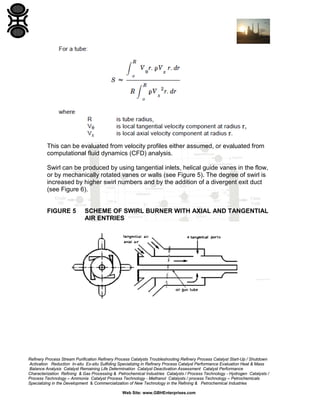
This can be evaluated from velocity profiles either assumed, or evaluated from
computational fluid dynamics (CFD) analysis.
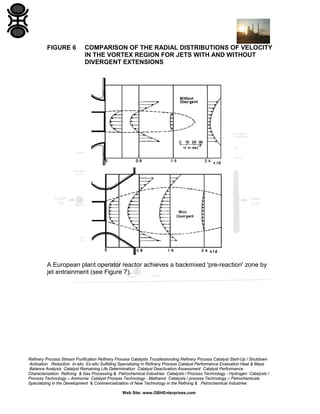
Swirl can be produced by using tangential inlets, helical guide vanes in the flow,
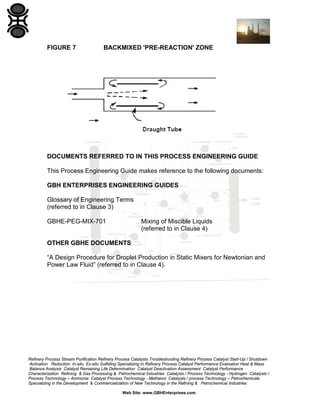
or by mechanically rotated vanes or walls (see Figure 5). The degree of swirl is
increased by higher swirl numbers and by the addition of a divergent exit duct
(see Figure 6).

FIGURE 5

SCHEME OF SWIRL BURNER WITH AXIAL AND TANGENTIAL
AIR ENTRIES

Refinery Process Stream Purification Refinery Process Catalysts Troubleshooting Refinery Process Catalyst Start-Up / Shutdown
Activation Reduction In-situ Ex-situ Sulfiding Specializing in Refinery Process Catalyst Performance Evaluation Heat & Mass
Balance Analysis Catalyst Remaining Life Determination Catalyst Deactivation Assessment Catalyst Performance
Characterization Refining & Gas Processing & Petrochemical Industries Catalysts / Process Technology - Hydrogen Catalysts /
Process Technology – Ammonia Catalyst Process Technology - Methanol Catalysts / process Technology – Petrochemicals
Specializing in the Development & Commercialization of New Technology in the Refining & Petrochemical Industries
Web Site: www.GBHEnterprises.com
6

BIBLIOGRAPHY

Reference

Authors, Title and Source

[1]

Germain, E & Wetter, R. Mélange Statique de gaz, Informations
Chimie No. 232. Dec 1982, p 135 (referred to in Clause 4).

Refinery Process Stream Purification Refinery Process Catalysts Troubleshooting Refinery Process Catalyst Start-Up / Shutdown
Activation Reduction In-situ Ex-situ Sulfiding Specializing in Refinery Process Catalyst Performance Evaluation Heat & Mass
Balance Analysis Catalyst Remaining Life Determination Catalyst Deactivation Assessment Catalyst Performance
Characterization Refining & Gas Processing & Petrochemical Industries Catalysts / Process Technology - Hydrogen Catalysts /
Process Technology – Ammonia Catalyst Process Technology - Methanol Catalysts / process Technology – Petrochemicals
Specializing in the Development & Commercialization of New Technology in the Refining & Petrochemical Industries
Web Site: www.GBHEnterprises.com
FIGURE 6

COMPARISON OF THE RADIAL DISTRIBUTIONS OF VELOCITY
IN THE VORTEX REGION FOR JETS WITH AND WITHOUT
DIVERGENT EXTENSIONS

A European plant operator reactor achieves a backmixed 'pre-reaction' zone by
jet entrainment (see Figure 7).

Refinery Process Stream Purification Refinery Process Catalysts Troubleshooting Refinery Process Catalyst Start-Up / Shutdown
Activation Reduction In-situ Ex-situ Sulfiding Specializing in Refinery Process Catalyst Performance Evaluation Heat & Mass
Balance Analysis Catalyst Remaining Life Determination Catalyst Deactivation Assessment Catalyst Performance
Characterization Refining & Gas Processing & Petrochemical Industries Catalysts / Process Technology - Hydrogen Catalysts /
Process Technology – Ammonia Catalyst Process Technology - Methanol Catalysts / process Technology – Petrochemicals
Specializing in the Development & Commercialization of New Technology in the Refining & Petrochemical Industries
Web Site: www.GBHEnterprises.com
FIGURE 7

BACKMIXED 'PRE-REACTION' ZONE

DOCUMENTS REFERRED TO IN THIS PROCESS ENGINEERING GUIDE
This Process Engineering Guide makes reference to the following documents:
GBH ENTERPRISES ENGINEERING GUIDES
Glossary of Engineering Terms
(referred to in Clause 3)
GBHE-PEG-MIX-701

Mixing of Miscible Liquids
(referred to in Clause 4)

OTHER GBHE DOCUMENTS
“A Design Procedure for Droplet Production in Static Mixers for Newtonian and
Power Law Fluid” (referred to in Clause 4).

Refinery Process Stream Purification Refinery Process Catalysts Troubleshooting Refinery Process Catalyst Start-Up / Shutdown
Activation Reduction In-situ Ex-situ Sulfiding Specializing in Refinery Process Catalyst Performance Evaluation Heat & Mass
Balance Analysis Catalyst Remaining Life Determination Catalyst Deactivation Assessment Catalyst Performance
Characterization Refining & Gas Processing & Petrochemical Industries Catalysts / Process Technology - Hydrogen Catalysts /
Process Technology – Ammonia Catalyst Process Technology - Methanol Catalysts / process Technology – Petrochemicals
Specializing in the Development & Commercialization of New Technology in the Refining & Petrochemical Industries
Web Site: www.GBHEnterprises.com
Refinery Process Stream Purification Refinery Process Catalysts Troubleshooting Refinery Process Catalyst Start-Up / Shutdown
Activation Reduction In-situ Ex-situ Sulfiding Specializing in Refinery Process Catalyst Performance Evaluation Heat & Mass
Balance Analysis Catalyst Remaining Life Determination Catalyst Deactivation Assessment Catalyst Performance
Characterization Refining & Gas Processing & Petrochemical Industries Catalysts / Process Technology - Hydrogen Catalysts /
Process Technology – Ammonia Catalyst Process Technology - Methanol Catalysts / process Technology – Petrochemicals
Specializing in the Development & Commercialization of New Technology in the Refining & Petrochemical Industries
Web Site: www.GBHEnterprises.com

Gas Mixing

  • 1.
    GBH Enterprises, Ltd. ProcessEngineering Guide: GBHE-PEG-MIX-702 Gas Mixing Information contained in this publication or as otherwise supplied to Users is believed to be accurate and correct at time of going to press, and is given in good faith, but it is for the User to satisfy itself of the suitability of the information for its own particular purpose. GBHE gives no warranty as to the fitness of this information for any particular purpose and any implied warranty or condition (statutory or otherwise) is excluded except to the extent that exclusion is prevented by law. GBHE accepts no liability resulting from reliance on this information. Freedom under Patent, Copyright and Designs cannot be assumed. Refinery Process Stream Purification Refinery Process Catalysts Troubleshooting Refinery Process Catalyst Start-Up / Shutdown Activation Reduction In-situ Ex-situ Sulfiding Specializing in Refinery Process Catalyst Performance Evaluation Heat & Mass Balance Analysis Catalyst Remaining Life Determination Catalyst Deactivation Assessment Catalyst Performance Characterization Refining & Gas Processing & Petrochemical Industries Catalysts / Process Technology - Hydrogen Catalysts / Process Technology – Ammonia Catalyst Process Technology - Methanol Catalysts / process Technology – Petrochemicals Specializing in the Development & Commercialization of New Technology in the Refining & Petrochemical Industries Web Site: www.GBHEnterprises.com
  • 2.
    Process Engineering Guide: GasMixing CONTENTS SECTION 0 INTRODUCTION/PURPOSE 2 1 SCOPE 2 2 FIELD OF APPLICATION 2 3 DEFINITIONS 2 4 RECOMMENDATIONS FOR GAS MIXING: PLUG FLOW 2 RECOMMENDATIONS FOR GAS MIXING: BACKMIXED INITIAL ZONE 4 BIBLIOGRAPHY 6 5 6 Refinery Process Stream Purification Refinery Process Catalysts Troubleshooting Refinery Process Catalyst Start-Up / Shutdown Activation Reduction In-situ Ex-situ Sulfiding Specializing in Refinery Process Catalyst Performance Evaluation Heat & Mass Balance Analysis Catalyst Remaining Life Determination Catalyst Deactivation Assessment Catalyst Performance Characterization Refining & Gas Processing & Petrochemical Industries Catalysts / Process Technology - Hydrogen Catalysts / Process Technology – Ammonia Catalyst Process Technology - Methanol Catalysts / process Technology – Petrochemicals Specializing in the Development & Commercialization of New Technology in the Refining & Petrochemical Industries Web Site: www.GBHEnterprises.com
  • 3.
    FIGURES 1 RESULTS OBTAINED USINGA SULZER SMV MIXER 3 2 RECIRCULATION ZONE : CONFINED JET 4 3 RECIRCULATION ZONE : BLUFF BODY 5 4 STREAMLINES OF RECIRCULATION EDDY IN SWIRLING JET, S = 1.57 5 SCHEME OF SWIRL BURNER WITH AXIAL AND TANGENTIAL AIR ENTRIES 6 5 6 COMPARISON OF THE RADIAL DISTRIBUTIONS OF VELOCITY IN THE VORTEX REGION FOR JETS WITH AND WITHOUT DIVERGENT EXTENSIONS 7 7 BACKMIXED 'PRE-REACTION' ZONE 7 DOCUMENTS REFERRED TO IN THIS PROCESS ENGINEERING GUIDE 8 Refinery Process Stream Purification Refinery Process Catalysts Troubleshooting Refinery Process Catalyst Start-Up / Shutdown Activation Reduction In-situ Ex-situ Sulfiding Specializing in Refinery Process Catalyst Performance Evaluation Heat & Mass Balance Analysis Catalyst Remaining Life Determination Catalyst Deactivation Assessment Catalyst Performance Characterization Refining & Gas Processing & Petrochemical Industries Catalysts / Process Technology - Hydrogen Catalysts / Process Technology – Ammonia Catalyst Process Technology - Methanol Catalysts / process Technology – Petrochemicals Specializing in the Development & Commercialization of New Technology in the Refining & Petrochemical Industries Web Site: www.GBHEnterprises.com
  • 4.
    0 INTRODUCTION/PURPOSE This Guide isone in a series of Mixing Guides and has been produced for GBH Enterprises. 1 SCOPE This guide covers the mixing of gases. If a backmixed 'pre-reaction' zone is not required, refer to Clause 4. Where a backmixed 'pre-reaction' zone is required, refer to Clause 5. 2 FIELD OF APPLICATION This Guide applies to Process Engineers in GBH Enterprises worldwide. 3 DEFINITIONS No specific definitions apply to this Guide. With the exception of terms used as proper nouns or titles, those terms with initial capital letters which appear in this document and are not defined above are defined in the Glossary of Engineering Terms. 4 RECOMMENDATIONS FOR GAS MIXING: PLUG FLOW Jet flow mixers and static mixers are recommended for gas mixing. The design procedures presented for miscible liquids in GBHE-PEG-MIX-701, should be followed using the appropriate gas physical properties. Empty pipes may be used in the turbulent region: for gases of the same density, a length of about 100 pipe diameters is required for good mixing. For gases with a density ratio > 2, up to 1000 pipe diameters may be required because of the formation of stable layers. Refinery Process Stream Purification Refinery Process Catalysts Troubleshooting Refinery Process Catalyst Start-Up / Shutdown Activation Reduction In-situ Ex-situ Sulfiding Specializing in Refinery Process Catalyst Performance Evaluation Heat & Mass Balance Analysis Catalyst Remaining Life Determination Catalyst Deactivation Assessment Catalyst Performance Characterization Refining & Gas Processing & Petrochemical Industries Catalysts / Process Technology - Hydrogen Catalysts / Process Technology – Ammonia Catalyst Process Technology - Methanol Catalysts / process Technology – Petrochemicals Specializing in the Development & Commercialization of New Technology in the Refining & Petrochemical Industries Web Site: www.GBHEnterprises.com
  • 5.
    Static mixers canachieve good mixing in less than five pipe diameters regardless of the density difference. Figure 1 shows the results obtained using a Sulzer SMV mixer. Unless the densities are similar and the flow rates constant, a minimum operating velocity, UG, is recommended. For the Sulzer SMV mixer, this is obtained if the modified Froude number exceeds 20 [Ref 1 : Germain et al., 1982]: . The values of f and DH are obtained from the manufacturers' data; Refinery Process Stream Purification Refinery Process Catalysts Troubleshooting Refinery Process Catalyst Start-Up / Shutdown Activation Reduction In-situ Ex-situ Sulfiding Specializing in Refinery Process Catalyst Performance Evaluation Heat & Mass Balance Analysis Catalyst Remaining Life Determination Catalyst Deactivation Assessment Catalyst Performance Characterization Refining & Gas Processing & Petrochemical Industries Catalysts / Process Technology - Hydrogen Catalysts / Process Technology – Ammonia Catalyst Process Technology - Methanol Catalysts / process Technology – Petrochemicals Specializing in the Development & Commercialization of New Technology in the Refining & Petrochemical Industries Web Site: www.GBHEnterprises.com
  • 6.
    FIGURE 1 RESULTS OBTAINEDUSING A SULZER SMV MIXER Refinery Process Stream Purification Refinery Process Catalysts Troubleshooting Refinery Process Catalyst Start-Up / Shutdown Activation Reduction In-situ Ex-situ Sulfiding Specializing in Refinery Process Catalyst Performance Evaluation Heat & Mass Balance Analysis Catalyst Remaining Life Determination Catalyst Deactivation Assessment Catalyst Performance Characterization Refining & Gas Processing & Petrochemical Industries Catalysts / Process Technology - Hydrogen Catalysts / Process Technology – Ammonia Catalyst Process Technology - Methanol Catalysts / process Technology – Petrochemicals Specializing in the Development & Commercialization of New Technology in the Refining & Petrochemical Industries Web Site: www.GBHEnterprises.com
  • 7.
    5 RECOMMENDATIONS FOR GASMIXING: BACKMIXED INITIAL ZONE Such cases are covered in the combustion literature, e.g. in Beer, J M and Chigier, N A, ”Combustion Aerodynamics”, Krieger, 1983 (reprint of 1972 edition). In this reference design of jet mixers for the particular requirements of combustion, namely rapid mixing and stable flame, are discussed, and information provided for entrainment rate into the jet, flow patterns, recirculation vortex position, effects of jet swirl, etc. A recirculation zone is often used to stabilized the flame (see Figure 2). Hot gases, entrained at the downstream end, return to pre-heat the incoming fresh gas and supply chemically active species to it. This enables velocities much higher than the flame propagation velocity to be used without lift-off. Recirculation zones are provided by: (a) FIGURE 2 Confining the jet and starving the entrainment. RECIRCULATION ZONE : CONFINED JET Refinery Process Stream Purification Refinery Process Catalysts Troubleshooting Refinery Process Catalyst Start-Up / Shutdown Activation Reduction In-situ Ex-situ Sulfiding Specializing in Refinery Process Catalyst Performance Evaluation Heat & Mass Balance Analysis Catalyst Remaining Life Determination Catalyst Deactivation Assessment Catalyst Performance Characterization Refining & Gas Processing & Petrochemical Industries Catalysts / Process Technology - Hydrogen Catalysts / Process Technology – Ammonia Catalyst Process Technology - Methanol Catalysts / process Technology – Petrochemicals Specializing in the Development & Commercialization of New Technology in the Refining & Petrochemical Industries Web Site: www.GBHEnterprises.com
  • 8.
    (b) FIGURE 3 Using thewake behind a bluff body (see Figure 3). RECIRCULATION ZONE : BLUFF BODY Refinery Process Stream Purification Refinery Process Catalysts Troubleshooting Refinery Process Catalyst Start-Up / Shutdown Activation Reduction In-situ Ex-situ Sulfiding Specializing in Refinery Process Catalyst Performance Evaluation Heat & Mass Balance Analysis Catalyst Remaining Life Determination Catalyst Deactivation Assessment Catalyst Performance Characterization Refining & Gas Processing & Petrochemical Industries Catalysts / Process Technology - Hydrogen Catalysts / Process Technology – Ammonia Catalyst Process Technology - Methanol Catalysts / process Technology – Petrochemicals Specializing in the Development & Commercialization of New Technology in the Refining & Petrochemical Industries Web Site: www.GBHEnterprises.com
  • 9.
    (c) FIGURE 4 Swirling thejet, with swirl number S > 0.6 (see Figure 4). STREAMLINES OF RECIRCULATION EDDY IN SWIRLING JET, S = 1.57 Refinery Process Stream Purification Refinery Process Catalysts Troubleshooting Refinery Process Catalyst Start-Up / Shutdown Activation Reduction In-situ Ex-situ Sulfiding Specializing in Refinery Process Catalyst Performance Evaluation Heat & Mass Balance Analysis Catalyst Remaining Life Determination Catalyst Deactivation Assessment Catalyst Performance Characterization Refining & Gas Processing & Petrochemical Industries Catalysts / Process Technology - Hydrogen Catalysts / Process Technology – Ammonia Catalyst Process Technology - Methanol Catalysts / process Technology – Petrochemicals Specializing in the Development & Commercialization of New Technology in the Refining & Petrochemical Industries Web Site: www.GBHEnterprises.com
  • 10.
    This can beevaluated from velocity profiles either assumed, or evaluated from computational fluid dynamics (CFD) analysis. Swirl can be produced by using tangential inlets, helical guide vanes in the flow, or by mechanically rotated vanes or walls (see Figure 5). The degree of swirl is increased by higher swirl numbers and by the addition of a divergent exit duct (see Figure 6). FIGURE 5 SCHEME OF SWIRL BURNER WITH AXIAL AND TANGENTIAL AIR ENTRIES Refinery Process Stream Purification Refinery Process Catalysts Troubleshooting Refinery Process Catalyst Start-Up / Shutdown Activation Reduction In-situ Ex-situ Sulfiding Specializing in Refinery Process Catalyst Performance Evaluation Heat & Mass Balance Analysis Catalyst Remaining Life Determination Catalyst Deactivation Assessment Catalyst Performance Characterization Refining & Gas Processing & Petrochemical Industries Catalysts / Process Technology - Hydrogen Catalysts / Process Technology – Ammonia Catalyst Process Technology - Methanol Catalysts / process Technology – Petrochemicals Specializing in the Development & Commercialization of New Technology in the Refining & Petrochemical Industries Web Site: www.GBHEnterprises.com
  • 11.
    6 BIBLIOGRAPHY Reference Authors, Title andSource [1] Germain, E & Wetter, R. Mélange Statique de gaz, Informations Chimie No. 232. Dec 1982, p 135 (referred to in Clause 4). Refinery Process Stream Purification Refinery Process Catalysts Troubleshooting Refinery Process Catalyst Start-Up / Shutdown Activation Reduction In-situ Ex-situ Sulfiding Specializing in Refinery Process Catalyst Performance Evaluation Heat & Mass Balance Analysis Catalyst Remaining Life Determination Catalyst Deactivation Assessment Catalyst Performance Characterization Refining & Gas Processing & Petrochemical Industries Catalysts / Process Technology - Hydrogen Catalysts / Process Technology – Ammonia Catalyst Process Technology - Methanol Catalysts / process Technology – Petrochemicals Specializing in the Development & Commercialization of New Technology in the Refining & Petrochemical Industries Web Site: www.GBHEnterprises.com
  • 12.
    FIGURE 6 COMPARISON OFTHE RADIAL DISTRIBUTIONS OF VELOCITY IN THE VORTEX REGION FOR JETS WITH AND WITHOUT DIVERGENT EXTENSIONS A European plant operator reactor achieves a backmixed 'pre-reaction' zone by jet entrainment (see Figure 7). Refinery Process Stream Purification Refinery Process Catalysts Troubleshooting Refinery Process Catalyst Start-Up / Shutdown Activation Reduction In-situ Ex-situ Sulfiding Specializing in Refinery Process Catalyst Performance Evaluation Heat & Mass Balance Analysis Catalyst Remaining Life Determination Catalyst Deactivation Assessment Catalyst Performance Characterization Refining & Gas Processing & Petrochemical Industries Catalysts / Process Technology - Hydrogen Catalysts / Process Technology – Ammonia Catalyst Process Technology - Methanol Catalysts / process Technology – Petrochemicals Specializing in the Development & Commercialization of New Technology in the Refining & Petrochemical Industries Web Site: www.GBHEnterprises.com
  • 13.
    FIGURE 7 BACKMIXED 'PRE-REACTION'ZONE DOCUMENTS REFERRED TO IN THIS PROCESS ENGINEERING GUIDE This Process Engineering Guide makes reference to the following documents: GBH ENTERPRISES ENGINEERING GUIDES Glossary of Engineering Terms (referred to in Clause 3) GBHE-PEG-MIX-701 Mixing of Miscible Liquids (referred to in Clause 4) OTHER GBHE DOCUMENTS “A Design Procedure for Droplet Production in Static Mixers for Newtonian and Power Law Fluid” (referred to in Clause 4). Refinery Process Stream Purification Refinery Process Catalysts Troubleshooting Refinery Process Catalyst Start-Up / Shutdown Activation Reduction In-situ Ex-situ Sulfiding Specializing in Refinery Process Catalyst Performance Evaluation Heat & Mass Balance Analysis Catalyst Remaining Life Determination Catalyst Deactivation Assessment Catalyst Performance Characterization Refining & Gas Processing & Petrochemical Industries Catalysts / Process Technology - Hydrogen Catalysts / Process Technology – Ammonia Catalyst Process Technology - Methanol Catalysts / process Technology – Petrochemicals Specializing in the Development & Commercialization of New Technology in the Refining & Petrochemical Industries Web Site: www.GBHEnterprises.com
  • 14.
    Refinery Process StreamPurification Refinery Process Catalysts Troubleshooting Refinery Process Catalyst Start-Up / Shutdown Activation Reduction In-situ Ex-situ Sulfiding Specializing in Refinery Process Catalyst Performance Evaluation Heat & Mass Balance Analysis Catalyst Remaining Life Determination Catalyst Deactivation Assessment Catalyst Performance Characterization Refining & Gas Processing & Petrochemical Industries Catalysts / Process Technology - Hydrogen Catalysts / Process Technology – Ammonia Catalyst Process Technology - Methanol Catalysts / process Technology – Petrochemicals Specializing in the Development & Commercialization of New Technology in the Refining & Petrochemical Industries Web Site: www.GBHEnterprises.com