Clostridium perfringens Clostridium botulinum Dr Kamran Afzal Classified Microbiologist
Clinically important Gram positive bacilli Spore forming 1. Bacillus 2. Clostridium Non spore forming 1. Corynebacterium 2. Listeria Bacilli w/ branching filaments 1. Actinomyces 2. Nocardia
Spores
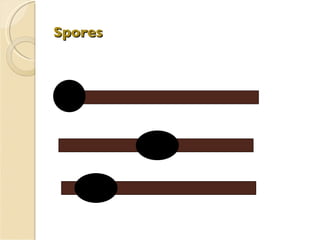
Spores Clostridia form endospores under adverse environmental conditions Spores are a survival mechanism Spores are characterized on the basis of position, size and shape Most Clostridium spp., including  Cl. perfringens  and  Cl. botulinum , have ovoid subterminal (OST) spores Cl. tetani  have round terminal (RT) spores
Classification Based On The Type Of Disease Produced A .  Tetanus   Cl. tetani  -  Present in  soil B.  Gas gangrene Established  Cl. perfringens   ‘gut’ organism Cl. septicum Cl. novyi - Less pathogenic  Cl. histolyticum Cl. fallax - Doubtful   Cl. bifermentans Cl. sporogenes
C. Food poisoning   1. Gastroenteritis   Cl perfringens  Type A 2. Botulism  Cl botulinum   Soil 3. Pig-bel Cl perfringens  Type C D. Acute colitis   -  Cl difficile  Gut (pseudomembranous colitis) Commonest cause of ‘nosocomial’ diarrhoea
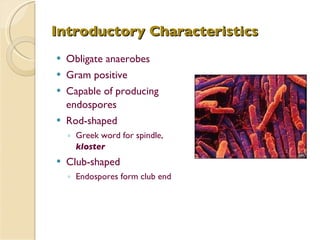
Introductory Characteristics Obligate anaerobes  Gram positive Capable of producing endospores Rod-shaped Greek word for spindle,  kloster Club-shaped Endospores form club end
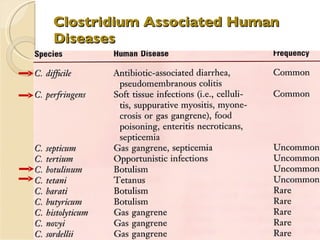
Clostridium Associated Human Diseases
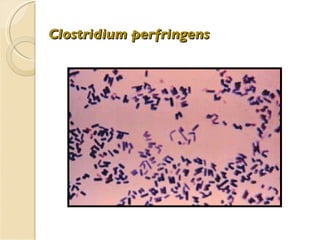
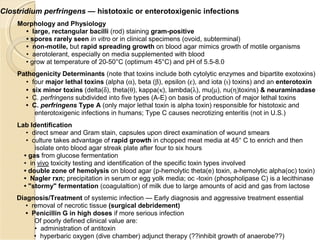
Clostridium perfringens
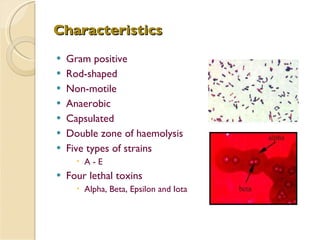
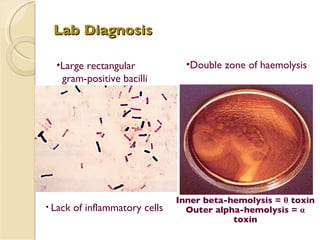
Characteristics Gram positive Rod-shaped Non-motile Anaerobic Capsulated Double zone of haemolysis Five types of strains A - E Four lethal toxins Alpha, Beta, Epsilon and Iota
Epidemiology Lives in soils esp manured and cultivated lands Persists in human and animal intestinal tracts and faecal matter  Can survive higher temp (45 0 C) Doubling time can be as short as 8 minutes Food poisoning strains produce spores that can resist boiling for several hours Gas gangrene strains produce spores that are inactivated by boiling for few minutes
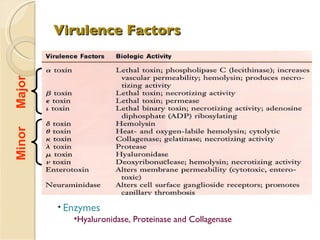
Virulence Factors Major Minor Enzymes Hyaluronidase, Proteinase and Collagenase
Lab Diagnosis Large rectangular  gram-positive bacilli Inner beta-hemolysis =  θ  toxin Outer alpha-hemolysis =  α  toxin Double zone of haemolysis Lack of inflammatory cells
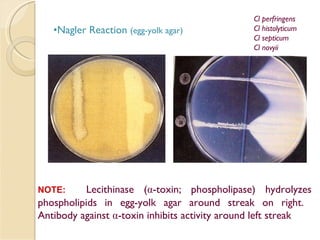
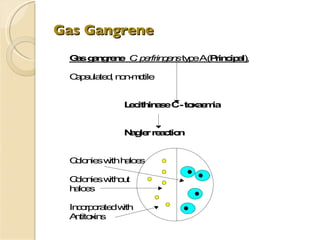
Nagler Reaction  (egg-yolk agar) NOTE:   Lecithinase ( α -toxin; phospholipase) hydrolyzes phospholipids in egg-yolk agar around streak on right.  Antibody against  α -toxin inhibits activity around left streak Cl perfringens Cl histolyticum Cl septicum Cl novyii
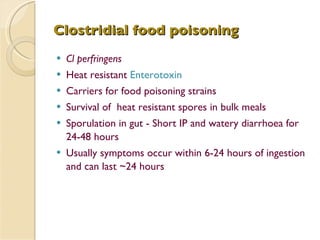
Clostridial food poisoning Cl perfringens Heat resistant  Enterotoxin   Carriers for food poisoning strains Survival of  heat resistant spores in bulk meals Sporulation in gut - Short IP and watery diarrhoea for 24-48 hours Usually symptoms occur within 6-24 hours of ingestion and can last ~24 hours
Salmonella spp Staphylococcus aureus Campylobacter spp Clostridium perfringens
Necrotizing enteritis (Pig-bel) New Guinea natives have pork feasts Clostridia survive in under-cooked meat Production of  Beta toxin  by  Cl perfringens  Type C   Beta toxin acts on small intestine
Gas Gangrene
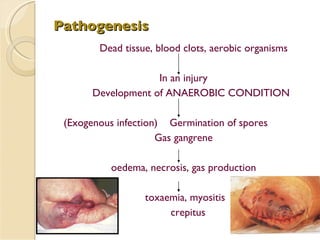
Pathogenesis Dead tissue, blood clots, aerobic organisms In an injury Development of ANAEROBIC CONDITION (Exogenous infection)  Germination of spores Gas gangrene oedema, necrosis, gas production toxaemia, myositis crepitus
Management   Prompt surgical intervention Sutures are removed, fascial compartments are incised to release tension, necrotic tissue is debrided Hyperbaric oxygen Special pressurized chamber Antitoxin antiserum A polyvalent antitoxin antiserum containing  Cl perfringens ,  Cl novyii  and  Cl septicum  antitoxin Now replaced with intensive antimicrobial therapy
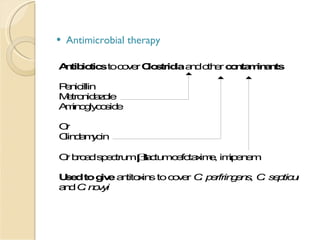
Antimicrobial therapy
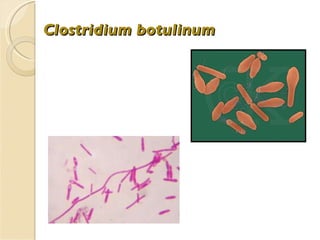
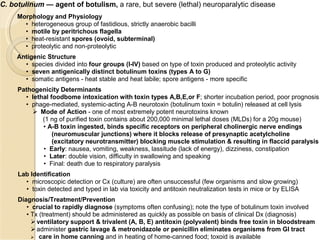
Clostridium botulinum
Epidemiology Found  in soil, sediments of lakes, ponds, coastal waters, decaying vegetation  Intestinal tracts of birds, mammals and fish Usually seen in canned foods Hams, sausages, fish, liver paste, honey and home preserved meat products and vegetables
Characteristics Anaerobic Gram-positive bacillus that forms oval sub-terminal spores Botulinum Toxin - One of the most poisonous natural substances known Seven toxigenic subtypes of the organism A, B, C, D, E, F and G The principle cause of human disease A,B and E
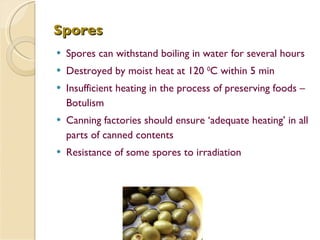
Spores Spores can withstand boiling in water for several hours Destroyed by moist heat at 120  0 C within 5 min Insufficient heating in the process of preserving foods – Botulism Canning factories should ensure ‘adequate heating’ in all parts of canned contents Resistance of some spores to irradiation
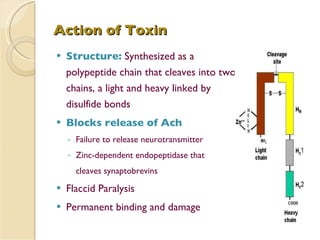
Action of Toxin Structure:  Synthesized as a polypeptide chain that cleaves into two chains, a light and heavy linked by disulfide bonds Blocks release of Ach   Failure to release neurotransmitter Zinc-dependent endopeptidase that  cleaves synaptobrevins Flaccid Paralysis Permanent binding and damage
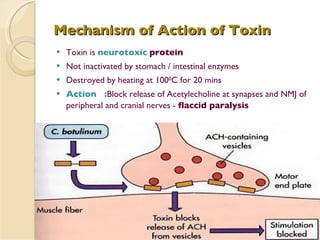
Mechanism of Action of Toxin Toxin is  neurotoxic   protein Not inactivated by stomach / intestinal enzymes Destroyed by heating at 100 0 C for 20 mins Action   : Block release of Acetylecholine at synapses and NMJ of peripheral and cranial nerves -  flaccid paralysis
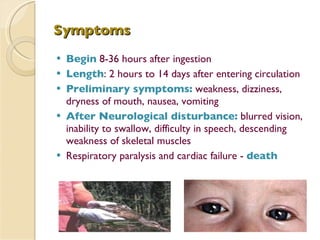
Symptoms Begin  8-36 hours after ingestion Length : 2 hours to 14 days after entering circulation Preliminary symptoms:  weakness, dizziness, dryness of mouth, nausea, vomiting After Neurological disturbance:  blurred vision, inability to swallow, difficulty in speech, descending weakness of skeletal muscles Respiratory paralysis and cardiac failure -  death
Clinical Syndromes Flaccid paralysis Food-borne:  ingestion of foods in which spores have germinated and grown in, considered an  intoxication  –  most common form Wound:  infects a wound and then produces toxins that spread through the bloodstream – very rare Infant:  infection establishes itself in the bowels of infants, colonizes and produces the toxin – common source is honey Unidentified:  source is unknown, usually from intestinal colonization with  in vivo  production of toxin – usually from surgeries
Lab diagnosis Clinical samples Suspected food, faeces or vomitus  Cl botulinum  cultured anaerobically Toxin detection Toxin-Anti toxin neutralization by inoculation in mice
Treatment   Priorities To remove unabsorbed toxin from stomach and small intestine To neutralize unfixed toxin by giving polyvalent antitoxin  (A,B and E) To give relevant intensive care and support Penicillin  or other beta-lactam antibiotics? A prophylactic dose of polyvalent  antitoxin  should be given to all the persons who have eaten ‘suspicious food’ containing botulism toxin
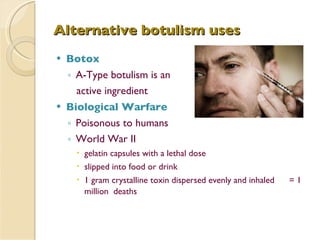
Alternative botulism uses Botox A-Type botulism is an  active ingredient Biological Warfare Poisonous to humans World War II  gelatin capsules with a lethal dose slipped into food or drink 1 gram crystalline toxin dispersed evenly and inhaled  = 1 million  deaths
What are the causative agent(s) of gas gangrene? Cl. perfringens Cl. novyii Cl. difficile Cl. septicum Cl. botulinum
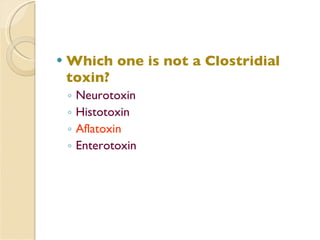
Which one is not a Clostridial toxin? Neurotoxin Histotoxin Aflatoxin Enterotoxin


Cl Perf+ Cl Botu

  • 1.
    Clostridium perfringens Clostridiumbotulinum Dr Kamran Afzal Classified Microbiologist
  • 2.
    Clinically important Grampositive bacilli Spore forming 1. Bacillus 2. Clostridium Non spore forming 1. Corynebacterium 2. Listeria Bacilli w/ branching filaments 1. Actinomyces 2. Nocardia
  • 3.
  • 4.
    Spores Clostridia formendospores under adverse environmental conditions Spores are a survival mechanism Spores are characterized on the basis of position, size and shape Most Clostridium spp., including Cl. perfringens and Cl. botulinum , have ovoid subterminal (OST) spores Cl. tetani have round terminal (RT) spores
  • 5.
    Classification Based OnThe Type Of Disease Produced A . Tetanus Cl. tetani - Present in soil B. Gas gangrene Established Cl. perfringens ‘gut’ organism Cl. septicum Cl. novyi - Less pathogenic Cl. histolyticum Cl. fallax - Doubtful Cl. bifermentans Cl. sporogenes
  • 6.
    C. Food poisoning 1. Gastroenteritis Cl perfringens Type A 2. Botulism Cl botulinum Soil 3. Pig-bel Cl perfringens Type C D. Acute colitis - Cl difficile Gut (pseudomembranous colitis) Commonest cause of ‘nosocomial’ diarrhoea
  • 7.
    Introductory Characteristics Obligateanaerobes Gram positive Capable of producing endospores Rod-shaped Greek word for spindle, kloster Club-shaped Endospores form club end
  • 8.
  • 9.
  • 10.
    Characteristics Gram positiveRod-shaped Non-motile Anaerobic Capsulated Double zone of haemolysis Five types of strains A - E Four lethal toxins Alpha, Beta, Epsilon and Iota
  • 11.
    Epidemiology Lives insoils esp manured and cultivated lands Persists in human and animal intestinal tracts and faecal matter Can survive higher temp (45 0 C) Doubling time can be as short as 8 minutes Food poisoning strains produce spores that can resist boiling for several hours Gas gangrene strains produce spores that are inactivated by boiling for few minutes
  • 12.
    Virulence Factors MajorMinor Enzymes Hyaluronidase, Proteinase and Collagenase
  • 13.
    Lab Diagnosis Largerectangular gram-positive bacilli Inner beta-hemolysis = θ toxin Outer alpha-hemolysis = α toxin Double zone of haemolysis Lack of inflammatory cells
  • 14.
    Nagler Reaction (egg-yolk agar) NOTE: Lecithinase ( α -toxin; phospholipase) hydrolyzes phospholipids in egg-yolk agar around streak on right. Antibody against α -toxin inhibits activity around left streak Cl perfringens Cl histolyticum Cl septicum Cl novyii
  • 15.
    Clostridial food poisoningCl perfringens Heat resistant Enterotoxin Carriers for food poisoning strains Survival of heat resistant spores in bulk meals Sporulation in gut - Short IP and watery diarrhoea for 24-48 hours Usually symptoms occur within 6-24 hours of ingestion and can last ~24 hours
  • 16.
    Salmonella spp Staphylococcusaureus Campylobacter spp Clostridium perfringens
  • 17.
    Necrotizing enteritis (Pig-bel)New Guinea natives have pork feasts Clostridia survive in under-cooked meat Production of Beta toxin by Cl perfringens Type C Beta toxin acts on small intestine
  • 18.
  • 19.
    Pathogenesis Dead tissue,blood clots, aerobic organisms In an injury Development of ANAEROBIC CONDITION (Exogenous infection) Germination of spores Gas gangrene oedema, necrosis, gas production toxaemia, myositis crepitus
  • 20.
    Management Prompt surgical intervention Sutures are removed, fascial compartments are incised to release tension, necrotic tissue is debrided Hyperbaric oxygen Special pressurized chamber Antitoxin antiserum A polyvalent antitoxin antiserum containing Cl perfringens , Cl novyii and Cl septicum antitoxin Now replaced with intensive antimicrobial therapy
  • 21.
  • 22.
  • 23.
    Epidemiology Found in soil, sediments of lakes, ponds, coastal waters, decaying vegetation Intestinal tracts of birds, mammals and fish Usually seen in canned foods Hams, sausages, fish, liver paste, honey and home preserved meat products and vegetables
  • 24.
    Characteristics Anaerobic Gram-positivebacillus that forms oval sub-terminal spores Botulinum Toxin - One of the most poisonous natural substances known Seven toxigenic subtypes of the organism A, B, C, D, E, F and G The principle cause of human disease A,B and E
  • 25.
    Spores Spores canwithstand boiling in water for several hours Destroyed by moist heat at 120 0 C within 5 min Insufficient heating in the process of preserving foods – Botulism Canning factories should ensure ‘adequate heating’ in all parts of canned contents Resistance of some spores to irradiation
  • 26.
    Action of ToxinStructure: Synthesized as a polypeptide chain that cleaves into two chains, a light and heavy linked by disulfide bonds Blocks release of Ach Failure to release neurotransmitter Zinc-dependent endopeptidase that cleaves synaptobrevins Flaccid Paralysis Permanent binding and damage
  • 27.
    Mechanism of Actionof Toxin Toxin is neurotoxic protein Not inactivated by stomach / intestinal enzymes Destroyed by heating at 100 0 C for 20 mins Action : Block release of Acetylecholine at synapses and NMJ of peripheral and cranial nerves - flaccid paralysis
  • 28.
    Symptoms Begin 8-36 hours after ingestion Length : 2 hours to 14 days after entering circulation Preliminary symptoms: weakness, dizziness, dryness of mouth, nausea, vomiting After Neurological disturbance: blurred vision, inability to swallow, difficulty in speech, descending weakness of skeletal muscles Respiratory paralysis and cardiac failure - death
  • 29.
    Clinical Syndromes Flaccidparalysis Food-borne: ingestion of foods in which spores have germinated and grown in, considered an intoxication – most common form Wound: infects a wound and then produces toxins that spread through the bloodstream – very rare Infant: infection establishes itself in the bowels of infants, colonizes and produces the toxin – common source is honey Unidentified: source is unknown, usually from intestinal colonization with in vivo production of toxin – usually from surgeries
  • 30.
    Lab diagnosis Clinicalsamples Suspected food, faeces or vomitus Cl botulinum cultured anaerobically Toxin detection Toxin-Anti toxin neutralization by inoculation in mice
  • 31.
    Treatment Priorities To remove unabsorbed toxin from stomach and small intestine To neutralize unfixed toxin by giving polyvalent antitoxin (A,B and E) To give relevant intensive care and support Penicillin or other beta-lactam antibiotics? A prophylactic dose of polyvalent antitoxin should be given to all the persons who have eaten ‘suspicious food’ containing botulism toxin
  • 32.
    Alternative botulism usesBotox A-Type botulism is an active ingredient Biological Warfare Poisonous to humans World War II gelatin capsules with a lethal dose slipped into food or drink 1 gram crystalline toxin dispersed evenly and inhaled = 1 million deaths
  • 33.
    What are thecausative agent(s) of gas gangrene? Cl. perfringens Cl. novyii Cl. difficile Cl. septicum Cl. botulinum
  • 34.
    What are thecausative agent(s) of gas gangrene? Cl. perfringens Cl. novyii Cl. difficile Cl. septicum Cl. botulinum
  • 35.
    Which one isnot a Clostridial toxin? Neurotoxin Histotoxin Aflatoxin Enterotoxin
  • 36.
    Which one isnot a Clostridial toxin? Neurotoxin Histotoxin Aflatoxin Enterotoxin
  • 37.
  • 38.