“GARMENT
PRODUCTION
SYSTEM”


        BY:
         Aymi RajpuT
Garment Production System

 In simple a ‘garment production system’ is a way how
  fabric is being converted into garment in a
  manufacturing system.
 The choice of best apparel production system depend on
  the Product, The Policies of the Company and the
  capacities of manpower.
 There are basically three Production systems:
I. Progressive Bundle System
II. Unit Production System
III. Modular Production System
1. Progressive Bundle System
(PBS)

 Also Called Material Handling System.
 As name implies the bundle of garment parts move from
  operation to operation.
 Traditional Production system.
 Widely used by apparel manufacturers for several
  decades and still today.
 80% apparel manufacturers use the Bundle system
  (PBS).
PBS Workflow

 Bundles consist of garment parts needed to complete a
  specific operation (e.g an operation bundle for pocket
  setting might include shirt fronts and pockets to b stitched
  together.
 Some firms operate with a standard bundle size, while other
  vary bundle sizes acc. to size of pieces in bundle and
  operation to b completed.
 Bundles are assembled in the cutting room, where cut parts
  are matched up with corresponding parts and bundle
  tickets.
 Workers (labour) transport and move Bundles of cut parts
  to sewing room via trollies.
 Operator scheduled to complete the operation and perform
  same operation on all pieces in the bundle, retie the bundle,
  remove Bundle ticket and move bundle for next operation.
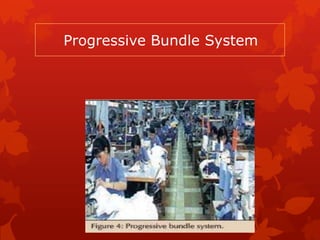
Progressive Bundle System
Advantages of PBS

 Labor of all levels ie unskilled, skilled, semi skilled labors
  are involved. Small simple operations.
 Quantity of each operation is checked during every
  single operation thus quality is good.
 Due to bundle system, less chance of mixing up of
  parts…thus less confusion.
 Bundle tracking is possible, so identifying and solving
  problems become easy.
 Effective production control system and Quality control
  system.
Dis-advantages of PBS

 Time Consuming due to assembling, moving and un-
  tieing of bundles.
 More labor…More labor cost.
 Needs efficient supervisor.
 Labor absentiees can effect production due to
  incompletion of contracts.
 Variety of styles and less quantity is not effective in this
  system.
 Proper planning is required for each style, each batch.
 Improper planning causes labour turnover, poor quality,
  less production, etc.
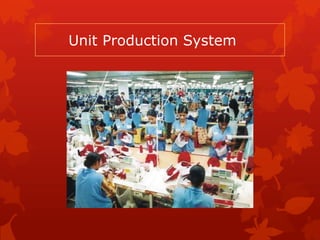
2. Unit Production System (UPS)
 A Unit Production System is a type of layout that uses an
  overhead transporter system to move garment
  components from work station to work station for
  assembly.
 In UPS, there are hangers. One hanger have multiple
  clips containing all parts of the single garment.
 All parts for the single garment are advanced through
  stitching line together by means of hanging carrier that
  moves along an overhead conveyor.
 Hanging carrier can be moved manually by the operator
  using button after completion of single operation or By
  computerized system that move the conveyor after a
  specific fed throughput time.
UPS Workflow

 Load all the pieces of single garment in a product
  carrier.
 The product carrier with the pieces will be routed
  through the different operation steps.
 At every machine/operation the patented chain will
  position the product ideally.
 Completed the product arrives to an unloading
  station. The empty product carrier returns to the
  loading station.
Unit Production System
Advantages of UPS

 Bundle Handling completely eliminated.
 The time involved in the pick-up and disposal is
  reduced to minimum.
 Output is automatically recorded, eliminates the
  operator to register the work.
 The computerized system automatically balance
  the work between stations.
 Improved lead times-less work in process.
 Improved space utilization (more machines can be
  adjusted)
Advantages of UPS (Cont.)

 Increased Productivity.
 Throughput time can be drastically
  reduced.
 Indirect labor costs are reduced (by
  elimination of bundle handling and
  requiring fewer supervisors)
 Improved production and quality.
Dis-advantages of UPS


 Unit Production system requires high
  investment.
 Proper planning is required to be effective.
 Highly expensive-buying equipment and
  cost of installing.
 Specialized training for the system.
3. Modular Production System

 A Modular Production System is a contained,
  manageable work unit that includes an empowered work
  team, equipment and work to be executed.
 The number of teams in a plant varies with the size and
  needs of the firm and product line.
 Usually there are 4-15 labors in one team depending
  upon the type of garment to be stitched and skills of
  labor.
 Teams may be used to perform all the operations (whole
  garment production) or certain portion of assembly
  operations.
 Team is responsible fro maintaining a smooth work flow,
  meeting production goals, quality level.
Modular Production System


 Team members develop an interdependency to
  improve the process and accomplish their goals.
 A worker in a team can perform Multiple functions
  depending upon his skills (Multi-skills).
Modular Production System
Advantages of MPS


1) High Flexibility.
2) Fast throughput times.
3) Low wastages.
4) Reduced absenteeism.
5) Empowered employees.
6) Improved Quality.
Dis-advantages of MPS


 A high capital investment in equipment.
 High investment in initial training.
 No compatibility between team members can
  cause problems thus loss in production…
 Dependency on the Team for whole Production.
Thanks
For
Bearing…

Garments production system

  • 1.
  • 2.
    Garment Production System In simple a ‘garment production system’ is a way how fabric is being converted into garment in a manufacturing system.  The choice of best apparel production system depend on the Product, The Policies of the Company and the capacities of manpower.  There are basically three Production systems: I. Progressive Bundle System II. Unit Production System III. Modular Production System
  • 3.
    1. Progressive BundleSystem (PBS)  Also Called Material Handling System.  As name implies the bundle of garment parts move from operation to operation.  Traditional Production system.  Widely used by apparel manufacturers for several decades and still today.  80% apparel manufacturers use the Bundle system (PBS).
  • 4.
    PBS Workflow  Bundlesconsist of garment parts needed to complete a specific operation (e.g an operation bundle for pocket setting might include shirt fronts and pockets to b stitched together.  Some firms operate with a standard bundle size, while other vary bundle sizes acc. to size of pieces in bundle and operation to b completed.  Bundles are assembled in the cutting room, where cut parts are matched up with corresponding parts and bundle tickets.  Workers (labour) transport and move Bundles of cut parts to sewing room via trollies.  Operator scheduled to complete the operation and perform same operation on all pieces in the bundle, retie the bundle, remove Bundle ticket and move bundle for next operation.
  • 5.
  • 6.
    Advantages of PBS Labor of all levels ie unskilled, skilled, semi skilled labors are involved. Small simple operations.  Quantity of each operation is checked during every single operation thus quality is good.  Due to bundle system, less chance of mixing up of parts…thus less confusion.  Bundle tracking is possible, so identifying and solving problems become easy.  Effective production control system and Quality control system.
  • 7.
    Dis-advantages of PBS Time Consuming due to assembling, moving and un- tieing of bundles.  More labor…More labor cost.  Needs efficient supervisor.  Labor absentiees can effect production due to incompletion of contracts.  Variety of styles and less quantity is not effective in this system.  Proper planning is required for each style, each batch.  Improper planning causes labour turnover, poor quality, less production, etc.
  • 8.
    2. Unit ProductionSystem (UPS)  A Unit Production System is a type of layout that uses an overhead transporter system to move garment components from work station to work station for assembly.  In UPS, there are hangers. One hanger have multiple clips containing all parts of the single garment.  All parts for the single garment are advanced through stitching line together by means of hanging carrier that moves along an overhead conveyor.  Hanging carrier can be moved manually by the operator using button after completion of single operation or By computerized system that move the conveyor after a specific fed throughput time.
  • 9.
    UPS Workflow  Loadall the pieces of single garment in a product carrier.  The product carrier with the pieces will be routed through the different operation steps.  At every machine/operation the patented chain will position the product ideally.  Completed the product arrives to an unloading station. The empty product carrier returns to the loading station.
  • 10.
  • 11.
    Advantages of UPS Bundle Handling completely eliminated.  The time involved in the pick-up and disposal is reduced to minimum.  Output is automatically recorded, eliminates the operator to register the work.  The computerized system automatically balance the work between stations.  Improved lead times-less work in process.  Improved space utilization (more machines can be adjusted)
  • 12.
    Advantages of UPS(Cont.)  Increased Productivity.  Throughput time can be drastically reduced.  Indirect labor costs are reduced (by elimination of bundle handling and requiring fewer supervisors)  Improved production and quality.
  • 13.
    Dis-advantages of UPS Unit Production system requires high investment.  Proper planning is required to be effective.  Highly expensive-buying equipment and cost of installing.  Specialized training for the system.
  • 14.
    3. Modular ProductionSystem  A Modular Production System is a contained, manageable work unit that includes an empowered work team, equipment and work to be executed.  The number of teams in a plant varies with the size and needs of the firm and product line.  Usually there are 4-15 labors in one team depending upon the type of garment to be stitched and skills of labor.  Teams may be used to perform all the operations (whole garment production) or certain portion of assembly operations.  Team is responsible fro maintaining a smooth work flow, meeting production goals, quality level.
  • 15.
    Modular Production System Team members develop an interdependency to improve the process and accomplish their goals.  A worker in a team can perform Multiple functions depending upon his skills (Multi-skills).
  • 16.
  • 17.
    Advantages of MPS 1)High Flexibility. 2) Fast throughput times. 3) Low wastages. 4) Reduced absenteeism. 5) Empowered employees. 6) Improved Quality.
  • 18.
    Dis-advantages of MPS A high capital investment in equipment.  High investment in initial training.  No compatibility between team members can cause problems thus loss in production…  Dependency on the Team for whole Production.
  • 19.