“GARMENT PRODUCTION
SYSTEM”
Production system terminologies
Work flow
Movement of material through conversion process
Dictated by: slow operator, machine fault, fabric problem, quality issue
Balancing
Process of planning smooth workflow for steady supply of work
Buffer
Planned backup of work at each operation
Through put
Volume of work that can be completed in a given time
Bottle neck
Dictator of through put succeeding operation when work is not completed
at expected rate, other operation delay, thus operation dictates workflow
WIP(work in progress
Number of garments under production at a given tme
Production Systems Used in
Apparel Industry
Garment Production System:
Production system is the framework within which the
production activities take place.A production system
comprises attributes with the function to transform inputs
into desired and predicted outputs.The attributes can be
human labor, machines, or tools. For the apparel industry,
the production system is defined as “an integration of
material handling, production processes, personnel and
equipment”.
Garment production system is a combination of production
processes, materials handling, personnel and equipment that
direct workflow and produce finished garments.
 It is a system that depicts how the two-
dimensional fabric is transformed into a three-
dimensional garment in a manufacturing system.
 The names of the production systems are based
on the various factors like utilization of a
number of machines to assemble a garment,
layout of machines, total number of operators
involved to produce a garment and number of
pieces moving in a production line during the
production of a garment.
 Each garment production system needs a suitable
management philosophy, materials handling procedures,
plant layout for garments spreading and worker training.
 The garment industry could combine various production
systems to achieve their specific garments’ production
needs like utilizing only one production system or a
combination of different systems for one product style.
 Designing production system ensures the coordination of
various production activities.There is no particular
production system that is universally accepted, yet there are
different types of production systems followed by different
organizations as discussed in the following section.
Types of Garment Production System:
The different types of garment production systems are
distinct and require different conditions for working.
However, they should meet the two basic objectives, that
is, to meet the specification of the final product and to be
cost-effective in nature.
The main aim of any production system is to achieve a
minimum possible total production time.This
automatically reduces in-process inventory and its cost.
The sub-assembly system reduces temporary storage time
to zero by combining temporary storage time with
transportation time.
 Any production system has four primary factors that make up the
system.
 Processing time +Transportation time +Temporary
storage time + Inspection time =Total ProductionTime.
 Processing time: is the sum total of working time of all
operations involved in manufacturing a garment.
 Transportation time: it involves the time taken to
transport semi finished or finished garments from one
department to another or from one operation/machine
to another.
 Temporary storage time: is the time during which the
garment/bundle is idle as it waits for the next operation
or for completion of certain parts.
 Inspection time: is time taken for inspecting semi
finished garments for any defects during manufacturing
or inspecting fully finished garments before packing.
four types of production systems
 In the apparel industry, four types of production systems are
commonly used: make-through, progressive bundle system (PBS), unit
production system (UPS), and modular system.The volume of
clothes that can be produced is different.The factory can use
a combination of these systems to produce garments.
 The bundle system and PBS are categorized into mass production and
UPS and modular systems are categorized into flexible specialization.
 There are five attributes that used to classify the production systems :
workflow, method of retrieval between workstations,
work in progress (WIP) inventory, number of tasks per operator,
and interaction between workers.The study found that one
production system could be distinguished from another according to
these attributes.
 The choice of best apparel production system depend on the Product,
the Policies of the Company and the capacities of manpower.
1. Individual system/Make through
This is the traditional and oldest method of production
whereby one operator assembles the entire garment.
It uses a single tailor for all aspects of garment production.
The tailor is responsible for making the pattern, cutting the
cloth, stitching, and finishing it.
This manufacturing system is mostly used in small-scale
businesses where production quantities are low.
In this production system the operator would be given a
bundle of cut work and would proceed to sew it according to
his or her own method of work.
. This type of system is efficient when a huge category of
garment styles has to be produced in very few quantities.
The benefits of implementing the make
through system are:
•Quick throughput time
•Easy to supervise
The shortcomings of the make through system
are:
• Low productivity
•High labor cost
•high production costs
•The process isn’t streamlined and could hamper
productivity. That is one of the major shortcoming
of this system
•The system requires highly skilled and versatile
operator, which makes this system expensive
•This system is limited to couture and sample
making
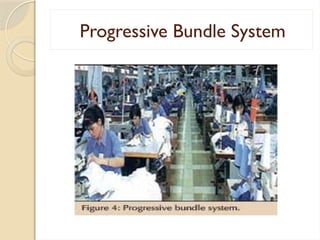
2. Progressive Bundle System (PBS)
 This is another traditional production system that is more
streamlined than the make-through system. The PBS also
relies heavily on manpower to propel the operations.
 Tailors are lined up and each given a single task. Each tailor is
given a bundle of clothes to complete their operation on.
Then, the bundle is tied up and passed to the next operator.
 Implies the bundle of garment parts move from operation to
operation.
 Traditionally Also Called Material Handling System.
 Bundle move operation to operation
 Most popular production system
 About 80% organizations are run on this system
PBS Workflow
 Bundles consist of garment parts needed to complete a
specific operation (e.g an operation bundle for pocket setting
might include shirt fronts and pockets to be stitched
together.
 Some firms operate with a standard bundle size, while other
vary bundle sizes according to size of pieces in bundle and
operation to b completed.
 Bundles are assembled in the cutting room, where cut parts
are matched up with corresponding parts and bundle tickets.
 Workers (labour) transport and move Bundles of cut parts to
sewing room via trollies.
 Operator scheduled to complete the operation and perform
same operation on all pieces in the bundle, retie the bundle,
remove Bundle ticket and move bundle for next operation.
continued
 PBS requires high WIP because of large number
of units in bundle + large buffer of back up
needed for smooth workflow
 PBS is driven by cost efficiency for individual
operations operator performs the same
operation on a continuing basis
 Slow processing ,absenteeism, equipment failure
may also cause bottleneck and large WIP. This
cause longer throughput time, large inventory,
extra handling +difficulty in controlling inventory
+poor quality
Progressive Bundle System
Advantages of PBS
 Labor of all levels i.e unskilled, skilled, semi skilled labors
are involved. Small simple operations.
 Quantity of each operation is checked during every
single operation thus quality is good.
 Due to bundle system, less chance of mixing up of
parts…thus less confusion.
 Bundle tracking is possible, so identifying and solving
problems become easy.
 Effective production control system and Quality control
system.
Dis-advantages of PBS
 Time Consuming due to assembling, moving and un-tieing
of bundles.
 More labor…More labor cost.
 Needs efficient supervisor.
 Labor absentiees can effect production due to
incompletion of contracts.
 Variety of styles and less quantity is not effective in this
system.
 Proper planning is required for each style, each batch.
 Improper planning causes labour turnover, poor quality,
less production, etc.
The section production system is a variation of the
progressive bundle system. Here, the tailors are
divided into sections instead of in a line. This is a way
to solve the line-balancing issue that could happen in a
progressive bundle system.
Machines of similar operations are clubbed together
instead of spreading over in all lines.
It is also a development of the individual system, with
the difference that the operators specialize in one
major component and sew it from beginning to end.
For example, an operator specializing in backs would
assemble the back and yoke, label attaching, etc., and
performs all the operations required to finish that
particular component.
Group System/ Section or Process
System:
Ex. Formal mens shirt is being made in section lay out;
collar, cuffs, and sleeve are in the preparatory section and
then send to assembly section.
The sewing room would have a number of sections, each
containing multi-talented operators capable of performing
all the operations required for a specific component.
• Collar preparation
• Sleeve preparation
• Front preparation
• Back preparation
• Assembling operations (closing, setting collars and
sleeves, etc.)
Finishing operations (buttonholes, blind-stitching, etc.)
This system is popular to improve line balancing and
utilization human resources
One-Piece Flow System
This is another variation of the progressive bundle
system.
Instead of making a bundle multiple pieces, bundle is
made with all components of a single piece.The
operator receive one piece from back and move one
piece to his next operator.
All other aspects remain the same.A worker is
responsible only for one duty. So the tailors don’t have
to be skilled workers.
Benefits of one piece:
• Less through put time
• Less WIP
Whole Garment Production System
There are two types ofWhole Garment
Production Systems:
1. Complete whole garment .
2. Departmental whole garment.
Whole garment production system
One individual makes the entire garment from cutting the
cloth to sewing and pressing the garment. The garment is
ready for dispatch once the operator completes the final
operation.
 This type of system is used in a few places, which are
engaged in custom-wholesale.They are normally high priced
and exclusively made for a particular customer. They are
limited in number and distribution; normally about 10-20
garment are made.…………………………………………...
2. Departmental whole garment system
One individual does all the work with the equipment
allocated to a department.
 For example, one person does all the cutting work in
cutting department, second person does all the sewing
work in sewing department, and the third person does the
pressing and packing work.
The workers in this system may use more than one
equipment to complete their respective job.
Advantages
More effective when a very large variety of garments in
extremely small quantities.
In piece rate system the operators will do with full
involvement:To finish more pieces, to earn more money.
Operator will be specialized in his own working area.
The Work in Progress (WIP) is reduced, at a time one cut
garment to one operator and so the amount as inventory is
reduced.
Disadvantages
Highly skilled laborers are used, so the cost of labor is high.
The operator is more concerned on the number of pieces
finished rather than the quality of work.
Productivity is less due to lack of specialization.
For long run/bulk quantity of same style is not effective in
this system.
3. Unit Production System (UPS)
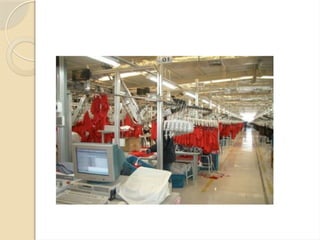
 A Unit Production System is a type of layout that uses an
overhead transporter system to move garment
components from work station to work station for
assembly.
 In UPS, there are hangers. One hanger have multiple clips
containing all parts of the single garment.
 All parts for the single garment are advanced through
stitching line together by means of hanging carrier that
moves along an overhead conveyor.
 Hanging carrier can be moved manually by the operator
using button after completion of single operation or By
computerized system that move the conveyor after a
specific fed throughput time.
UPS Workflow
 Load all the pieces of single garment in a product
carrier.
 The product carrier with the pieces will be routed
through the different operation steps.
 At every machine/operation the patented chain will
position the product ideally.
 Completed the product arrives to an unloading station.
The empty product carrier returns to the loading
station.
Unit Production System
• Less throughput time
• Direct labor cost are reduced due to
pre-position parts in carrier
• Require fewer supervisors ,good
accountability
• Immediate visibility of problems
• Cost ,training ,down time
Advantages of UPS
 Bundle Handling completely eliminated.
 The time involved in the pick-up and disposal is reduced
to minimum.
 Output is automatically recorded, eliminates the
operator to register the work.
 The computerized system automatically balance the
work between stations.
 Improved lead times-less work in process.
 Improved space utilization (more machines can be
adjusted)
Advantages of UPS (Cont.)
 Increased Productivity.
 Throughput time can be drastically reduced.
 Indirect labor costs are reduced (by elimination of
bundle handling and requiring fewer supervisors)
 Improved production and quality.
Dis-advantages of UPS
 Unit Production system requires high investment.
 Proper planning is required to be effective.
 Highly expensive-buying equipment and cost of
installing.
 Specialized training for the system.
Factors for Differentiation
between PBS & UPS
 Real Time Information
 Management Planning & Control
 Load on Cutting Department
 Through PutTime
 Sewing Time Material Handling
 Disposing of Garment
Thank you

apparel industries Production system.pptx

  • 1.
  • 2.
    Production system terminologies Workflow Movement of material through conversion process Dictated by: slow operator, machine fault, fabric problem, quality issue Balancing Process of planning smooth workflow for steady supply of work Buffer Planned backup of work at each operation Through put Volume of work that can be completed in a given time Bottle neck Dictator of through put succeeding operation when work is not completed at expected rate, other operation delay, thus operation dictates workflow WIP(work in progress Number of garments under production at a given tme
  • 3.
    Production Systems Usedin Apparel Industry Garment Production System: Production system is the framework within which the production activities take place.A production system comprises attributes with the function to transform inputs into desired and predicted outputs.The attributes can be human labor, machines, or tools. For the apparel industry, the production system is defined as “an integration of material handling, production processes, personnel and equipment”. Garment production system is a combination of production processes, materials handling, personnel and equipment that direct workflow and produce finished garments.
  • 4.
     It isa system that depicts how the two- dimensional fabric is transformed into a three- dimensional garment in a manufacturing system.  The names of the production systems are based on the various factors like utilization of a number of machines to assemble a garment, layout of machines, total number of operators involved to produce a garment and number of pieces moving in a production line during the production of a garment.
  • 5.
     Each garmentproduction system needs a suitable management philosophy, materials handling procedures, plant layout for garments spreading and worker training.  The garment industry could combine various production systems to achieve their specific garments’ production needs like utilizing only one production system or a combination of different systems for one product style.  Designing production system ensures the coordination of various production activities.There is no particular production system that is universally accepted, yet there are different types of production systems followed by different organizations as discussed in the following section.
  • 6.
    Types of GarmentProduction System: The different types of garment production systems are distinct and require different conditions for working. However, they should meet the two basic objectives, that is, to meet the specification of the final product and to be cost-effective in nature. The main aim of any production system is to achieve a minimum possible total production time.This automatically reduces in-process inventory and its cost. The sub-assembly system reduces temporary storage time to zero by combining temporary storage time with transportation time.  Any production system has four primary factors that make up the system.  Processing time +Transportation time +Temporary storage time + Inspection time =Total ProductionTime.
  • 7.
     Processing time:is the sum total of working time of all operations involved in manufacturing a garment.  Transportation time: it involves the time taken to transport semi finished or finished garments from one department to another or from one operation/machine to another.  Temporary storage time: is the time during which the garment/bundle is idle as it waits for the next operation or for completion of certain parts.  Inspection time: is time taken for inspecting semi finished garments for any defects during manufacturing or inspecting fully finished garments before packing.
  • 8.
    four types ofproduction systems  In the apparel industry, four types of production systems are commonly used: make-through, progressive bundle system (PBS), unit production system (UPS), and modular system.The volume of clothes that can be produced is different.The factory can use a combination of these systems to produce garments.  The bundle system and PBS are categorized into mass production and UPS and modular systems are categorized into flexible specialization.  There are five attributes that used to classify the production systems : workflow, method of retrieval between workstations, work in progress (WIP) inventory, number of tasks per operator, and interaction between workers.The study found that one production system could be distinguished from another according to these attributes.  The choice of best apparel production system depend on the Product, the Policies of the Company and the capacities of manpower.
  • 9.
    1. Individual system/Makethrough This is the traditional and oldest method of production whereby one operator assembles the entire garment. It uses a single tailor for all aspects of garment production. The tailor is responsible for making the pattern, cutting the cloth, stitching, and finishing it. This manufacturing system is mostly used in small-scale businesses where production quantities are low. In this production system the operator would be given a bundle of cut work and would proceed to sew it according to his or her own method of work. . This type of system is efficient when a huge category of garment styles has to be produced in very few quantities.
  • 10.
    The benefits ofimplementing the make through system are: •Quick throughput time •Easy to supervise The shortcomings of the make through system are: • Low productivity •High labor cost •high production costs •The process isn’t streamlined and could hamper productivity. That is one of the major shortcoming of this system •The system requires highly skilled and versatile operator, which makes this system expensive •This system is limited to couture and sample making
  • 11.
    2. Progressive BundleSystem (PBS)  This is another traditional production system that is more streamlined than the make-through system. The PBS also relies heavily on manpower to propel the operations.  Tailors are lined up and each given a single task. Each tailor is given a bundle of clothes to complete their operation on. Then, the bundle is tied up and passed to the next operator.  Implies the bundle of garment parts move from operation to operation.  Traditionally Also Called Material Handling System.  Bundle move operation to operation  Most popular production system  About 80% organizations are run on this system
  • 12.
    PBS Workflow  Bundlesconsist of garment parts needed to complete a specific operation (e.g an operation bundle for pocket setting might include shirt fronts and pockets to be stitched together.  Some firms operate with a standard bundle size, while other vary bundle sizes according to size of pieces in bundle and operation to b completed.  Bundles are assembled in the cutting room, where cut parts are matched up with corresponding parts and bundle tickets.  Workers (labour) transport and move Bundles of cut parts to sewing room via trollies.  Operator scheduled to complete the operation and perform same operation on all pieces in the bundle, retie the bundle, remove Bundle ticket and move bundle for next operation.
  • 13.
    continued  PBS requireshigh WIP because of large number of units in bundle + large buffer of back up needed for smooth workflow  PBS is driven by cost efficiency for individual operations operator performs the same operation on a continuing basis  Slow processing ,absenteeism, equipment failure may also cause bottleneck and large WIP. This cause longer throughput time, large inventory, extra handling +difficulty in controlling inventory +poor quality
  • 14.
  • 15.
    Advantages of PBS Labor of all levels i.e unskilled, skilled, semi skilled labors are involved. Small simple operations.  Quantity of each operation is checked during every single operation thus quality is good.  Due to bundle system, less chance of mixing up of parts…thus less confusion.  Bundle tracking is possible, so identifying and solving problems become easy.  Effective production control system and Quality control system.
  • 16.
    Dis-advantages of PBS Time Consuming due to assembling, moving and un-tieing of bundles.  More labor…More labor cost.  Needs efficient supervisor.  Labor absentiees can effect production due to incompletion of contracts.  Variety of styles and less quantity is not effective in this system.  Proper planning is required for each style, each batch.  Improper planning causes labour turnover, poor quality, less production, etc.
  • 17.
    The section productionsystem is a variation of the progressive bundle system. Here, the tailors are divided into sections instead of in a line. This is a way to solve the line-balancing issue that could happen in a progressive bundle system. Machines of similar operations are clubbed together instead of spreading over in all lines. It is also a development of the individual system, with the difference that the operators specialize in one major component and sew it from beginning to end. For example, an operator specializing in backs would assemble the back and yoke, label attaching, etc., and performs all the operations required to finish that particular component. Group System/ Section or Process System:
  • 18.
    Ex. Formal mensshirt is being made in section lay out; collar, cuffs, and sleeve are in the preparatory section and then send to assembly section. The sewing room would have a number of sections, each containing multi-talented operators capable of performing all the operations required for a specific component. • Collar preparation • Sleeve preparation • Front preparation • Back preparation • Assembling operations (closing, setting collars and sleeves, etc.) Finishing operations (buttonholes, blind-stitching, etc.) This system is popular to improve line balancing and utilization human resources
  • 19.
    One-Piece Flow System Thisis another variation of the progressive bundle system. Instead of making a bundle multiple pieces, bundle is made with all components of a single piece.The operator receive one piece from back and move one piece to his next operator. All other aspects remain the same.A worker is responsible only for one duty. So the tailors don’t have to be skilled workers. Benefits of one piece: • Less through put time • Less WIP
  • 20.
    Whole Garment ProductionSystem There are two types ofWhole Garment Production Systems: 1. Complete whole garment . 2. Departmental whole garment.
  • 21.
    Whole garment productionsystem One individual makes the entire garment from cutting the cloth to sewing and pressing the garment. The garment is ready for dispatch once the operator completes the final operation.  This type of system is used in a few places, which are engaged in custom-wholesale.They are normally high priced and exclusively made for a particular customer. They are limited in number and distribution; normally about 10-20 garment are made.…………………………………………...
  • 22.
    2. Departmental wholegarment system One individual does all the work with the equipment allocated to a department.  For example, one person does all the cutting work in cutting department, second person does all the sewing work in sewing department, and the third person does the pressing and packing work. The workers in this system may use more than one equipment to complete their respective job.
  • 23.
    Advantages More effective whena very large variety of garments in extremely small quantities. In piece rate system the operators will do with full involvement:To finish more pieces, to earn more money. Operator will be specialized in his own working area. The Work in Progress (WIP) is reduced, at a time one cut garment to one operator and so the amount as inventory is reduced. Disadvantages Highly skilled laborers are used, so the cost of labor is high. The operator is more concerned on the number of pieces finished rather than the quality of work. Productivity is less due to lack of specialization. For long run/bulk quantity of same style is not effective in this system.
  • 24.
    3. Unit ProductionSystem (UPS)  A Unit Production System is a type of layout that uses an overhead transporter system to move garment components from work station to work station for assembly.  In UPS, there are hangers. One hanger have multiple clips containing all parts of the single garment.  All parts for the single garment are advanced through stitching line together by means of hanging carrier that moves along an overhead conveyor.  Hanging carrier can be moved manually by the operator using button after completion of single operation or By computerized system that move the conveyor after a specific fed throughput time.
  • 25.
    UPS Workflow  Loadall the pieces of single garment in a product carrier.  The product carrier with the pieces will be routed through the different operation steps.  At every machine/operation the patented chain will position the product ideally.  Completed the product arrives to an unloading station. The empty product carrier returns to the loading station.
  • 27.
    Unit Production System •Less throughput time • Direct labor cost are reduced due to pre-position parts in carrier • Require fewer supervisors ,good accountability • Immediate visibility of problems • Cost ,training ,down time
  • 28.
    Advantages of UPS Bundle Handling completely eliminated.  The time involved in the pick-up and disposal is reduced to minimum.  Output is automatically recorded, eliminates the operator to register the work.  The computerized system automatically balance the work between stations.  Improved lead times-less work in process.  Improved space utilization (more machines can be adjusted)
  • 29.
    Advantages of UPS(Cont.)  Increased Productivity.  Throughput time can be drastically reduced.  Indirect labor costs are reduced (by elimination of bundle handling and requiring fewer supervisors)  Improved production and quality.
  • 30.
    Dis-advantages of UPS Unit Production system requires high investment.  Proper planning is required to be effective.  Highly expensive-buying equipment and cost of installing.  Specialized training for the system.
  • 31.
    Factors for Differentiation betweenPBS & UPS  Real Time Information  Management Planning & Control  Load on Cutting Department  Through PutTime  Sewing Time Material Handling  Disposing of Garment
  • 32.