


ADVANCEAPPARELMANUFACTURINGTECHNOLOGY
AME-557
PRESENTATIONON-
AdvanceManufacturingSysteminSewingRoom
SUBMITTED TO
PROF.DR.MD.MASHIURRAHMANKHAN
DEAN,FACULTYOFFASHIONDESIGNANDAPPARELENGINEERING
BANGLADESHUNIVERSITYOFTEXTILE(BUTEX)
SUBMITTED BY
JAHIRULALAMCHOWDHURY
ID:2017-2-4-10
DEPARTMENT:APPARELENGINEERING
M.ScINTEXTILEENGINEERING
BANGLADESHUNIVERSITYOFTEXTILE(BUTEX)
INTRODUCTION
 The garment industry is undergoing enormous change which
ends up in increased pressures on retailers and apparel
manufacturers.
Both retailers and manufacturers are challenged to compete, not
just in terms of price, but also in delivery times and services offered
 The demands of today's market require the flexibility and fast
throughput implied to quick response (QR) strategies.
 To meet market demands and generate profit, firms must fully
utilize their resources and successfully expand their productivity.
 Consumers' demand for timely fashion, quality and value has made the
manufacturers think of their production strategies.
 In this modern industry manufacturing attributes for focused business are:
 Quality,
 Speed,
 Dependability
 Flexibility and
Cost
 The type apparel of production system is determined by the quantity of
production and the required rate of delivery.
 the following factors have significant role in apparel production and plays
key role in sewing floor :
Numberofmachineareusedtomakeagarment
Machineslayout
Totalnumberofoperatorsortailorsinvolvedtosewacompletegarment
Numberofpiecesmovinginalineduringmakingagarment.
OBJECTIVES
 To know about how to achieve higher production and quality.
 To know how to ensure uninterrupted production in sewing floor.
 To learn about continuous flow of material handling.
 To learn about how can we reduce cost of the product.
 To know how to reduce excess machinery and man.
 To study how to achieve continuous flow of apparel production.
 To study different production system in sewing floor.
Some conventional system in the sewing floor
 Make Through System
When a tailor alone makes a complete garment, then it is called as make
though system. In this system tailors are not depended to others.
For example, tailors in the tailor shops do all jobs from cut to pack.
 Progressive Bundle System
In Progressive bundle system, each operator does different operations of a
garment. All sewing machines needed to make the garment are laid in a
line. Cut parts are fed in a bundle form.
For example, Most of the export oriented garment manufacturers adopted
progressive bundle system as a main production system.
 Section Production System
This system is similar to the progressive bundle system. But the difference is
that, instead of one line, work is divided into sections. Machines of similar
operations are clubbed together instead of spreading over in all lines.
For example, when a man’s formal shirt is being made in a section layout –
collars, cuffs and sleeves are in the preparatory sections and then send to the
assembly section.
 One Piece Flow System
Instead of making a bundle of multiple pieces, bundle is made with all
components of a single piece. Sewing machines in One-piece-flow system can be
laid in a straight line or modular line. Main difference is that, operator will
receive one piece from back and move one piece to his next operator after
completing his work.
Garments manufacturer are always trying their best for increasing quality and
production and therefore trying different production system.
There are three modern system are now used mostly in advance apparel
manufacturing system in the sewing floor. They are:
Swift track system
U-shape production line
Traffic light system
MODERN MANUFACTURING SYSTEM IN SEWING FLOOR
SWIFT TRACK SYSTEM
 A unit production system (UPS) is a type of line layout that uses an
overhead transporter system to move garment components from work station
to work station for assembly.
 All the parts for a single garment are advanced through the production line
together by means of a hanging carrier that travels along an overhead
conveyor.
 The overhead rail system consists of the main conveyor and accumulating
rails for each work station. Carriers are moved along the main conveyor and
switched to an accumulating rail at the work station where an operation is to
be performed.
At the completion of an operation the operator presses a button, and the
carrier moves on to the next operation. Most unit production systems are linked
to a computer control center that routes and tracks production and provides up-
to-the-minute data for management decisions.
 The unit production system transports all the pieces of one complete product
through the manufacturing process. An addressable product carrier takes all the
pieces of one entire unit (ie, for trousers - backs, fronts, pockets, etc) through the
different steps of production. Operations are performed at individual
workstations. The end result is a cost-efficient product, processed from pieces to
completion.
SWIFT TRACK PRODUCTION SYSTEM
Workflow in Unit Production System
Load all the pieces in a product carrier
The product carrier with the pieces will be routed through the different operation
steps
At every machine/operation the patented chain will position the product ideally
Completed the product arrives to an unloading station. The empty product carrier
returns to the loading station.
DIFFERENT HANGER SYSTEM
Electric transportation systems
Manual hanging system
6R Arm type intelligent hanging system
7R Arm type intelligent hanging system
8R Arm type intelligent hanging system
ADVANTAGES
 No need to change machine lay out for different style product.
 Direct labor costs are reduced
 Bottle neck problem can easily identified.
 Better material handling.
 Improved lead times - less Work In Process.
 Improved space utilization,
 Increased productivity
 Improved production and quality monitoring.
 Improved ergonomics.
DISADVANTAGES
 Unit production system requires high investments.
 The payback period of the investment takes long time.
 Proper planning is required to be effective.
 High cost of maintenance.
 It requires proper training of the worker.
Modular manufacturing system
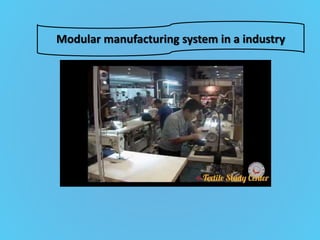
 This system aims for just in time production. In ‘Modular production system’
sewing operators work as a team. Neither they sew complete garment nor do they
sew only single operation.
 Multi skilled operators form a group and each of the team members do multiple
operations.
 To increase the operator working efficiency, the number of sewing machine
should be two to three times that of the operators.
 As one of has to be in charge or two or three operation, each time with a piece
of fabric according to the pitch time of each operation, he should be skilled in
multiple operations and capable of handeling various sewing machine.
In addition she/ he should do the operation in standing position as to move
easily.
 The U- Shaped line is employed according to the order of the operations so that
the operation can easily move on. Sewing machine and equipment are arranged in
a order to work in standing position.
 In modular, always team performance is measured instead of individual operator
performance
 This system is very successful where quick response is needed.
Modular manufacturing system in a industry
ADVANTAGES
 Improved Quality
 Reduced absenteeism
 High flexibility
 Fast throughput times
 Low wastages
 Reduced Repetitive Motion Ailments
 Increased employee ownership of the production process
 Empowered employees
DISADVANTGES
 A high capital investment in equipment.
 High investment in initial training.
 High cost incurred in continued training.
 Not suitable for large production.
 No compatibility between team members can cause problems thus loss in
production.
 High dependency on the worker for whole production.
TRAFFIC LIGHT SYSTEM
 Traffic light system is the most effective inspection tool to reduce
defect generation at source.
 At the same time it measure operator’s performance level in quality.
 No operators like to be presented themselves as lower quality
makers. They concentrate on quality aspect during stitching garments.
 Traffic light quality system works in a similar fashion the
transportation traffic light system work. Three different colour cards are
placed in each operators place.
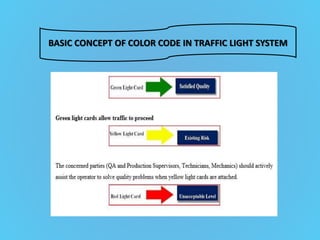
GreenindicatesthatQualitymeetsthecustomersStandard.
Yellowindicatesthataminorfaulthasbeenfoundandcautionisrequired.
RedindicatesthattheQualityStandarddoesnotmeetthecustomer’sstandard
BASIC CONCEPT OF COLOR CODE IN TRAFFIC LIGHT SYSTEM
HOW TRAFFIC LIGHT SYSTEM WORKS
 One Inline Quality Checker is to be allocated for every line of particular
style or cover 15 or 20 Workstations.
 She/he has to check the semi finished garment pieces from current
bundle once in an hour or two.
Pieces will be taken randomly and check all the quality parameters
required for that operation.
 While inspecting, depending upon the quality level, coloUr cards are
placed on their machine.
MARKING SYSTEM IN TRAFFIC LIGHT SYSTEM
ADVANTAGES
Increase operator motivation
Increase productivity
Improved production and quality monitoring.
Improved Quality
DISADVANTAGES
Chance of creating operator arrogance.
Extra cost
Need to train operator
CONCLUSION
 The main aim of any production system is to make the total production
time as small as possible.
 The choice of the production system highly depends on the volume of
production and the strategy of production.
 For basic goods, a traditional production system such as progressive
bundle system are still in use largely.
 The modular system or some type of flexible manufacturing can be
adopted for the production of fashion goods.
 As the fashion market is in diversion and product price is reducing the
only way to sustain in this market is increasing production cost.
REFFERANCE
 http://www.fibre2fashion.com/industry-article/6990/traffic-light-
system-a-visual-quality-control-tool
 http://www.eajournals.org/wp-content/uploads/Implementation-of-
Modern-Garment-Planning-Tools-Techniques-in-Garment-Industry-of-
Bangladesh.pdf
 http://www.onlineclothingstudy.com/2015/05/different-types-of-
sewing-line-layout.html
 http://www.ina-ina.com/en/product.asp.
 https://www.youtube.com/watch?v=OxdKET_94RU
 https://www.youtube.com/watch?v=0vGPIoQuQtU
Advance manufacturing system in sewing floor

Advance manufacturing system in sewing floor

  • 1.
  • 2.
    INTRODUCTION  The garmentindustry is undergoing enormous change which ends up in increased pressures on retailers and apparel manufacturers. Both retailers and manufacturers are challenged to compete, not just in terms of price, but also in delivery times and services offered  The demands of today's market require the flexibility and fast throughput implied to quick response (QR) strategies.  To meet market demands and generate profit, firms must fully utilize their resources and successfully expand their productivity.
  • 3.
     Consumers' demandfor timely fashion, quality and value has made the manufacturers think of their production strategies.  In this modern industry manufacturing attributes for focused business are:  Quality,  Speed,  Dependability  Flexibility and Cost  The type apparel of production system is determined by the quantity of production and the required rate of delivery.  the following factors have significant role in apparel production and plays key role in sewing floor : Numberofmachineareusedtomakeagarment Machineslayout Totalnumberofoperatorsortailorsinvolvedtosewacompletegarment Numberofpiecesmovinginalineduringmakingagarment.
  • 4.
    OBJECTIVES  To knowabout how to achieve higher production and quality.  To know how to ensure uninterrupted production in sewing floor.  To learn about continuous flow of material handling.  To learn about how can we reduce cost of the product.  To know how to reduce excess machinery and man.  To study how to achieve continuous flow of apparel production.  To study different production system in sewing floor.
  • 5.
    Some conventional systemin the sewing floor  Make Through System When a tailor alone makes a complete garment, then it is called as make though system. In this system tailors are not depended to others. For example, tailors in the tailor shops do all jobs from cut to pack.  Progressive Bundle System In Progressive bundle system, each operator does different operations of a garment. All sewing machines needed to make the garment are laid in a line. Cut parts are fed in a bundle form. For example, Most of the export oriented garment manufacturers adopted progressive bundle system as a main production system.
  • 6.
     Section ProductionSystem This system is similar to the progressive bundle system. But the difference is that, instead of one line, work is divided into sections. Machines of similar operations are clubbed together instead of spreading over in all lines. For example, when a man’s formal shirt is being made in a section layout – collars, cuffs and sleeves are in the preparatory sections and then send to the assembly section.  One Piece Flow System Instead of making a bundle of multiple pieces, bundle is made with all components of a single piece. Sewing machines in One-piece-flow system can be laid in a straight line or modular line. Main difference is that, operator will receive one piece from back and move one piece to his next operator after completing his work.
  • 7.
    Garments manufacturer arealways trying their best for increasing quality and production and therefore trying different production system. There are three modern system are now used mostly in advance apparel manufacturing system in the sewing floor. They are: Swift track system U-shape production line Traffic light system MODERN MANUFACTURING SYSTEM IN SEWING FLOOR
  • 8.
    SWIFT TRACK SYSTEM A unit production system (UPS) is a type of line layout that uses an overhead transporter system to move garment components from work station to work station for assembly.  All the parts for a single garment are advanced through the production line together by means of a hanging carrier that travels along an overhead conveyor.  The overhead rail system consists of the main conveyor and accumulating rails for each work station. Carriers are moved along the main conveyor and switched to an accumulating rail at the work station where an operation is to be performed.
  • 9.
    At the completionof an operation the operator presses a button, and the carrier moves on to the next operation. Most unit production systems are linked to a computer control center that routes and tracks production and provides up- to-the-minute data for management decisions.  The unit production system transports all the pieces of one complete product through the manufacturing process. An addressable product carrier takes all the pieces of one entire unit (ie, for trousers - backs, fronts, pockets, etc) through the different steps of production. Operations are performed at individual workstations. The end result is a cost-efficient product, processed from pieces to completion.
  • 10.
  • 11.
    Workflow in UnitProduction System Load all the pieces in a product carrier The product carrier with the pieces will be routed through the different operation steps At every machine/operation the patented chain will position the product ideally Completed the product arrives to an unloading station. The empty product carrier returns to the loading station.
  • 12.
    DIFFERENT HANGER SYSTEM Electrictransportation systems Manual hanging system 6R Arm type intelligent hanging system 7R Arm type intelligent hanging system 8R Arm type intelligent hanging system
  • 13.
    ADVANTAGES  No needto change machine lay out for different style product.  Direct labor costs are reduced  Bottle neck problem can easily identified.  Better material handling.  Improved lead times - less Work In Process.  Improved space utilization,  Increased productivity  Improved production and quality monitoring.  Improved ergonomics.
  • 14.
    DISADVANTAGES  Unit productionsystem requires high investments.  The payback period of the investment takes long time.  Proper planning is required to be effective.  High cost of maintenance.  It requires proper training of the worker.
  • 15.
    Modular manufacturing system This system aims for just in time production. In ‘Modular production system’ sewing operators work as a team. Neither they sew complete garment nor do they sew only single operation.  Multi skilled operators form a group and each of the team members do multiple operations.  To increase the operator working efficiency, the number of sewing machine should be two to three times that of the operators.  As one of has to be in charge or two or three operation, each time with a piece of fabric according to the pitch time of each operation, he should be skilled in multiple operations and capable of handeling various sewing machine.
  • 16.
    In addition she/he should do the operation in standing position as to move easily.  The U- Shaped line is employed according to the order of the operations so that the operation can easily move on. Sewing machine and equipment are arranged in a order to work in standing position.  In modular, always team performance is measured instead of individual operator performance  This system is very successful where quick response is needed.
  • 17.
  • 18.
    ADVANTAGES  Improved Quality Reduced absenteeism  High flexibility  Fast throughput times  Low wastages  Reduced Repetitive Motion Ailments  Increased employee ownership of the production process  Empowered employees
  • 19.
    DISADVANTGES  A highcapital investment in equipment.  High investment in initial training.  High cost incurred in continued training.  Not suitable for large production.  No compatibility between team members can cause problems thus loss in production.  High dependency on the worker for whole production.
  • 20.
    TRAFFIC LIGHT SYSTEM Traffic light system is the most effective inspection tool to reduce defect generation at source.  At the same time it measure operator’s performance level in quality.  No operators like to be presented themselves as lower quality makers. They concentrate on quality aspect during stitching garments.  Traffic light quality system works in a similar fashion the transportation traffic light system work. Three different colour cards are placed in each operators place. GreenindicatesthatQualitymeetsthecustomersStandard. Yellowindicatesthataminorfaulthasbeenfoundandcautionisrequired. RedindicatesthattheQualityStandarddoesnotmeetthecustomer’sstandard
  • 21.
    BASIC CONCEPT OFCOLOR CODE IN TRAFFIC LIGHT SYSTEM
  • 22.
    HOW TRAFFIC LIGHTSYSTEM WORKS  One Inline Quality Checker is to be allocated for every line of particular style or cover 15 or 20 Workstations.  She/he has to check the semi finished garment pieces from current bundle once in an hour or two. Pieces will be taken randomly and check all the quality parameters required for that operation.  While inspecting, depending upon the quality level, coloUr cards are placed on their machine.
  • 23.
    MARKING SYSTEM INTRAFFIC LIGHT SYSTEM
  • 24.
    ADVANTAGES Increase operator motivation Increaseproductivity Improved production and quality monitoring. Improved Quality
  • 25.
    DISADVANTAGES Chance of creatingoperator arrogance. Extra cost Need to train operator
  • 26.
    CONCLUSION  The mainaim of any production system is to make the total production time as small as possible.  The choice of the production system highly depends on the volume of production and the strategy of production.  For basic goods, a traditional production system such as progressive bundle system are still in use largely.  The modular system or some type of flexible manufacturing can be adopted for the production of fashion goods.  As the fashion market is in diversion and product price is reducing the only way to sustain in this market is increasing production cost.
  • 27.
    REFFERANCE  http://www.fibre2fashion.com/industry-article/6990/traffic-light- system-a-visual-quality-control-tool  http://www.eajournals.org/wp-content/uploads/Implementation-of- Modern-Garment-Planning-Tools-Techniques-in-Garment-Industry-of- Bangladesh.pdf http://www.onlineclothingstudy.com/2015/05/different-types-of- sewing-line-layout.html  http://www.ina-ina.com/en/product.asp.  https://www.youtube.com/watch?v=OxdKET_94RU  https://www.youtube.com/watch?v=0vGPIoQuQtU