Gamification
Designing for Engagement

Shantanu Singh
11th Sept 2013
What is Gamification?
Gamification is applying the mechanics of gaming to nongame activities to change people’s
behavior — is an important and powerful new strategy for influencing and motivating groups of
people

Goal & Scope
Goal & Scope
Goal & Scope
Goal of Gamification is to engage with consumers and get them to participate, share and interact
in some activity or community. Game Activity creates a compelling, engaging user experience.
The compelling, motivational nature of this experience is, in turn, increases revenue due to
enhanced engagement & loyalty.
And the concept has the potential to solve a variety of problems outside the business world
as well, in areas such as:
•

Health & Wellness

•

Education & Training

•

Public Policy & Government

•

E-Commerce

•

Travel Industry & Social Platforms
How To Gamify?
How to Gamify?
How to Gamify?
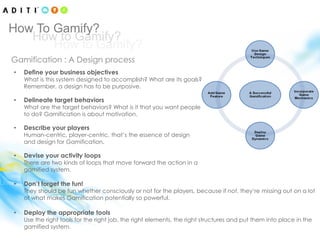
Gamification : A Design process
•

Define your business objectives

•

Delineate target behaviors

•

Describe your players

•

Devise your activity loops

•

Don’t forget the fun!

•

Deploy the appropriate tools

What is this system designed to accomplish? What are its goals?
Remember, a design has to be purposive.
What are the target behaviors? What is it that you want people
to do? Gamification is about motivation.
Human-centric, player-centric, that’s the essence of design
and design for Gamification.
There are two kinds of loops that move forward the action in a
gamified system.
They should be fun whether consciously or not for the players, because if not, they’re missing out on a lot
of what makes Gamification potentially so powerful.

Use the right tools for the right job, the right elements, the right structures and put them into place in the
gamified system.
Tools Used (so far)
Tools Used (so far)
Tools Used (so far)
Badges
Goals, Rewards, Status

Leaderboards
Comparison , Competition

Points
Tracking & Feedback

Incentives
Rewards
Design: Framework
Design: Framework
Design: Framework
One of the most frequently leveraged framework for Game design is referred to as MDA – Which
stands for :
• Mechanics
• Dynamics
• Aesthetics
Game mechanics include:
•
•
•
•

Points - Levels Challenges
Virtual goods and spaces
Leaderboards and Badges
Mission, Gifts and charity

Game dynamics include:
•
•
•
•

Pacing
Progressive Unlocks
Reward Schedules
Dynamic System

Finally, the aesthetics of the system are or how the game makes the player feel during interaction.
Game aesthetics can be viewed as the composite outcome of the mechanics.

•
•
•
•
•
•

Curiosity
Satisfaction
Surprise
Pride & Envy
Fun
Connection
Know your Player
Know your Player
Know your Player
Define Player

Motivation: Why People Play
A good working theory for why people are motivated to play games maintains that there are four
underlying reasons, which can be viewed together or separately as individual motivators:

•
•
•
•

For mastery
To distress
To have fun
To socialize
Player’s Motivation
Player’s Motivation
Player’s Motivation
An aspect to understanding player motivations is by questioning where motivations come from.
Broadly speaking, psychology has divided our motivations into two groups: intrinsic and extrinsic.

Winning

Autonomy
Mastery
Order

Our
Basic
Desires

Tranquility
Meaning
Sensuality
Physical
Activity

Acceptance
Collecting
Family

What
We
“Really”
Want

Romance
Who am I? The 16 Basic Desires that Motivate Our Actions and Define Our Personalities
~Stephen Reiss

Power
Status

Social Contact
Honor
Case Study: Get Glue
“The easiest way to find your next favorite thing”
Case Study: Get Glue
Onboarding: “Rate Content to build taste Profile ”

“Explore content & other people”
Case Study: Get Glue
“Discover neighbor who share your taste”

“Become a Guru by interacting
with content”
Case Study: Get Glue
Light weight Quests: “Suggests what to do next ”

Earn stickers for exploring
rating & socializing
Case Study: Get Glue
Like/Comment/Review content to earn points

Leadership board: Showcase
active & engaged users
Other deployments (NIKE)
Nike Plus: Making fitness fun
Where Is It Going?
Where Is It Going?
Where Is It Going?
•

Gartner Says By 2015, More Than 50 Percent of Organizations That Manage Innovation Processes
Will Gamify Those Processes http://www.gartner.com/it/page.jsp?id=1629214s

•

Research Kart says Gamification industry to grow to a 3.6 billion dollar market between 2012-2017
http://researchkart.wordpress.com

Warning! Hype Cycle Ahead
Benefits
Benefits
Benefits

What
Can
I
Achieve
What
Can
I
Achieve
Thank You !
Thank You !
Thank You !

Gamification

  • 1.
  • 2.
    What is Gamification? Whatis Gamification? What is Gamification? Gamification is applying the mechanics of gaming to nongame activities to change people’s behavior — is an important and powerful new strategy for influencing and motivating groups of people Goal & Scope Goal & Scope Goal & Scope Goal of Gamification is to engage with consumers and get them to participate, share and interact in some activity or community. Game Activity creates a compelling, engaging user experience. The compelling, motivational nature of this experience is, in turn, increases revenue due to enhanced engagement & loyalty. And the concept has the potential to solve a variety of problems outside the business world as well, in areas such as: • Health & Wellness • Education & Training • Public Policy & Government • E-Commerce • Travel Industry & Social Platforms
  • 3.
    How To Gamify? Howto Gamify? How to Gamify? Gamification : A Design process • Define your business objectives • Delineate target behaviors • Describe your players • Devise your activity loops • Don’t forget the fun! • Deploy the appropriate tools What is this system designed to accomplish? What are its goals? Remember, a design has to be purposive. What are the target behaviors? What is it that you want people to do? Gamification is about motivation. Human-centric, player-centric, that’s the essence of design and design for Gamification. There are two kinds of loops that move forward the action in a gamified system. They should be fun whether consciously or not for the players, because if not, they’re missing out on a lot of what makes Gamification potentially so powerful. Use the right tools for the right job, the right elements, the right structures and put them into place in the gamified system.
  • 4.
    Tools Used (sofar) Tools Used (so far) Tools Used (so far) Badges Goals, Rewards, Status Leaderboards Comparison , Competition Points Tracking & Feedback Incentives Rewards
  • 5.
    Design: Framework Design: Framework Design:Framework One of the most frequently leveraged framework for Game design is referred to as MDA – Which stands for : • Mechanics • Dynamics • Aesthetics Game mechanics include: • • • • Points - Levels Challenges Virtual goods and spaces Leaderboards and Badges Mission, Gifts and charity Game dynamics include: • • • • Pacing Progressive Unlocks Reward Schedules Dynamic System Finally, the aesthetics of the system are or how the game makes the player feel during interaction. Game aesthetics can be viewed as the composite outcome of the mechanics. • • • • • • Curiosity Satisfaction Surprise Pride & Envy Fun Connection
  • 6.
    Know your Player Knowyour Player Know your Player Define Player Motivation: Why People Play A good working theory for why people are motivated to play games maintains that there are four underlying reasons, which can be viewed together or separately as individual motivators: • • • • For mastery To distress To have fun To socialize
  • 7.
    Player’s Motivation Player’s Motivation Player’sMotivation An aspect to understanding player motivations is by questioning where motivations come from. Broadly speaking, psychology has divided our motivations into two groups: intrinsic and extrinsic. Winning Autonomy Mastery Order Our Basic Desires Tranquility Meaning Sensuality Physical Activity Acceptance Collecting Family What We “Really” Want Romance Who am I? The 16 Basic Desires that Motivate Our Actions and Define Our Personalities ~Stephen Reiss Power Status Social Contact Honor
  • 8.
    Case Study: GetGlue “The easiest way to find your next favorite thing”
  • 9.
    Case Study: GetGlue Onboarding: “Rate Content to build taste Profile ” “Explore content & other people”
  • 10.
    Case Study: GetGlue “Discover neighbor who share your taste” “Become a Guru by interacting with content”
  • 11.
    Case Study: GetGlue Light weight Quests: “Suggests what to do next ” Earn stickers for exploring rating & socializing
  • 12.
    Case Study: GetGlue Like/Comment/Review content to earn points Leadership board: Showcase active & engaged users
  • 13.
    Other deployments (NIKE) NikePlus: Making fitness fun
  • 14.
    Where Is ItGoing? Where Is It Going? Where Is It Going? • Gartner Says By 2015, More Than 50 Percent of Organizations That Manage Innovation Processes Will Gamify Those Processes http://www.gartner.com/it/page.jsp?id=1629214s • Research Kart says Gamification industry to grow to a 3.6 billion dollar market between 2012-2017 http://researchkart.wordpress.com Warning! Hype Cycle Ahead Warning! Hype Cycle Ahead Warning! Hype Cycle Ahead
  • 15.
  • 16.
    Thank You ! ThankYou ! Thank You !