Gametization 101: Before we begin
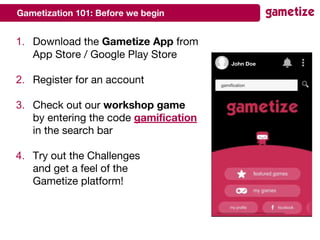
1. Download the Gametize App from
App Store / Google Play Store
2. Register for an account
3. Check out our workshop game
by entering the code gamification
in the search bar
4. Try out the Challenges
and get a feel of the
Gametize platform!
John Doe
gamification
About us
Al-Fairuz
● Studied Big Data & Analytics
● Used to be a Trainer/Planner in
BMTC (Basic Military Training
Centre)
● Loves working with Python.
● Wants to be a Python
Programmer one day
fairuz@gametize.com
Prapim
● Trained as a graphic designer
● Stumbled into instructional
design
● Used to teach art to children (and
adults)
● Loves Photoshop, Illustrator and
cats.
prapim@gametize.com
The Game Plan for today
● Getting to know you
(and you, us)
● Learn what gamification is
● Motivation Frameworks
● 5D Gamification Framework
● Case Studies of Gamification
Implementations
● Learn how to use Gametize’s
platform with platform training
● Practice creating your own Game
● Debrief and Q&A
● Feedback and survey
How to maximize this session
● Feel free to ask questions at the end of each section
● Let us know at any time if you’re lost and need us to slow
down
● This will NOT be a fun session, but keep an open and creative
mind, relax, and we will our best to make
it enjoyable :)
● Don’t be afraid to get hands-on and try out the Gametize
platform, both as a creator and a player
● We’ll be taking a look at the final product you create during
the workshop, so keep your own use case in mind during the
session
Nobody likes Working
Learning is Boring
But everyone loves
Playing
Gamification – The Basics
What is gamification?
gamification =
??????????????????????????????
??????????????????????????????
??????????????????????????????
??????????????????????????????
??????????????????????????????
??????????????????????????????
??????????????????????????????
What is gamification?
gamification =
Use of game design and game
psychology in non-game settings to
engage and motivate target audience
for target behaviors.
It is a process, and not an end point.
Gamification in Consumer Engagement
gamification =
A design-thinking focused process to engage
and motivate your consumers into behaviors
that directly or indirectly increase sales.
It DOES NOT need to be transactional.
Gamification in Learning & Employee Engagement
gamification =
A design-thinking focused process to engage
and motivate your audience into desired
behaviors, with a balance of intrinsic and
extrinsic rewards, to make learning more
enjoyable.
It MUST NOT be transactional.
Is this
Gamification?
Is this gamification or not?
Source: National Steps Challenge, Health Hub,
Ministry of Health Singapore
Is this gamification or not?
Source: National Steps Challenge, Health Hub,
Ministry of Health Singapore
Is this gamification?
Source: Fitbit
Is this gamification?
Source: Fitbit
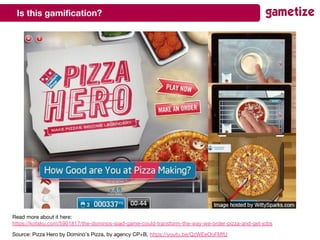
Is this gamification?
Source: Pizza Hero by Domino’s Pizza, by agency CP+B, https://youtu.be/QzWEeOoFMfU
Read more about it here:
https://kotaku.com/5901817/the-dominos-ipad-game-could-transform-the-way-we-order-pizza-and-get-jobs
Is this gamification?
Source: NTUC
Fairprice, Singapore
Is this gamification?
Source: IndusGeeks, http://www.indusgeeks.com/serious-games.php
Is this gamification or not?
gamification =
Points and badges
Advertgaming
Social gaming
Farmville
Candy Crush
Pokemon Go
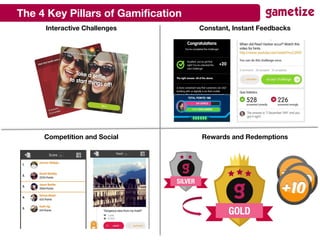
The 4 Key Pillars of Gamification
Interactive Challenges
Competition and Social
Constant, Instant Feedbacks
Rewards and Redemptions
Motivation Frameworks
Why do people like to play games?
DOPAMINE. OH YEAH!
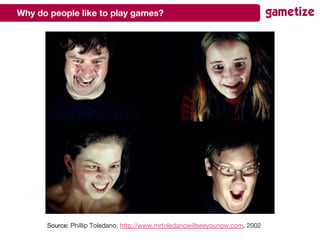
Why do people like to play games?
Source: Phillip Toledano, http://www.mrtoledanowillseeyounow.com, 2002
“SORRY, I CAN’T GO
TO WORK TODAY.
I FRACTURED MY
MOTIVATION”
What motivates us?
Extrinsic Motivation
Behavior that is driven
by external rewards.
...such as money,
grades, and praise, or
negative reinforcement
such as fear of
punishment or failure.
money
grades
praise
deadlines
Intrinsic Motivation
Behavior that is driven
by internal (self-driven)
rewards.
...such as striving
towards a goal for
personal satisfaction
or accomplishment.
pride
interest
curiosity
achievement
Maslow’s Hierarchy of Needs
Herzberg’s Two-Factor Theory
Dissatisfaction
and
demotivation
Not dissatisfied
but
not motivated
Positive
satisfaction
and
motivation
Hygiene Factors
● Company policies
● Quality of supervision
● Relation with others
● Personal life
● Rate of pay
● Job security
● Working conditions
Motivational Factors
● Achievement
● Career advancement
● Personal growth
● Job interest
● Recognition
● Responsibility
Hygiene
Factors
Motivational
Factors
Mihaly’s Flow Theory
Mihaly Csikszentmihályi
and his fellow researchers
began researching flow after
Csikszentmihályi became
fascinated by artists who
would essentially get lost in
their work.
Artists, especially painters,
got so immersed in their
work that they would
disregard their need for
food, water and even sleep.
What makes
these people so
motivated?
Image source: https://www.ted.com/talks/mihaly_csikszentmihalyi_on_flow
Mihaly’s Flow Theory
What motivates us?
Mihaly’s Flow Theory
• One must be involved in an activity
with a clear set of goals and
progress.
This adds direction and structure
to the task.
• The task at hand must have clear
and immediate feedback.
This helps the person negotiate any
changing demands and allows
them to adjust their performance to
maintain the flow state.
What is the average age of a video
gamer in US, in 2017?
*According to Entertainment Software Association
Here’s a question for you...
Source: Entertainment Software Association 2017, http://www.theesa.com/about-esa/essential-facts-computer-video-game-industry/
More Gamer stats for thought...
Gametize’s 5D Framework
The 5Ds of Gamification
5D Framework
Learning & Development
● Sales Training
● Leadership Training
Use Cases we’ve applied the 5D Framework to
Employee Engagement
● Onboarding
● Wellness
● Team-Building,
Community-Building
Talent Acquisition
● Recruitment
● Employer Branding
Consumer Engagement
● Content Marketing
● Consumer Loyalty
The 5Ds of Gamification
5D Framework
1. Define your problem Identify a problem
you want to solve.
“Our new hires find our orientation
programme cumbersome and don’t
remember what they’re taught during the
onboarding”
“We want to bring engagement of our
team-building and training modules to outside
of just the classroom”
“Our recruitment process is difficult to
manage with our small team”
The 5Ds of Gamification
5D Framework
2. Determine your goals What is the outcome
you want to achieve
out of gamification?
“We want to enrich the onboarding
experience by making our programme more
experiential and interactive”
“We want our students to practice their
team-building skills outside of the classroom,
including more interactions & networking”
“We want to automate and standardize the
recruitment process to decrease the time it
takes to screen potential candidates”
The 5Ds of Gamification
5D Framework
3. Decide your target
behaviors
What are your target
behaviours and
emotions?
“Your organization’s orientation
programme is fun!”
“I understand how to put what I’ve
learned during this module to use now!”
“This organization’s recruitment process
is innovative; I want to join!”
The 5Ds of Gamification
5D Framework
4. Describe and Profile
your Players
Make a list of
characteristics of
your target group.
Clue: Create a persona and
tell us a story.
“Kylie is 20 and is in the Business
Development Course. She’s very active on
social media, especially Instagram – she’s
used to sharing stories with her friends and
followers, and likes to try new things.”
Bartle’s 4 Player Types
Killer
Defined by:
A focus on winning, rank,
and direct peer-to-peer
competition.
Engaged by:
Leaderboards, Ranks
Achievers
Defined by:
A focus on attaining status
and achieving present
goals quickly and/or
completely.
Engaged by:
Achievements
Socialites
Defined by:
A focus on socializing and
a drive to develop a
network of friends and
contacts.
Engaged by:
Community, Interaction
Explorers
Defined by:
A focus on exploring and a
drive to discover the
unknown.
Engaged by:
Obscure Achievements
Which Player Type are you?
Find out which Player Type you are by
trying out our Personality quiz at
myplayertype.com
The 5Ds of Gamification
5D Framework
5. Design your
Gamification Strategy
Decide on:
● Visual style
● Game storyline
● Tone of voice
● Interactions to use
The 5Ds of Gamification: Gametize’s Design Strategy
G
A
M
E
T
I
S
E
Generous, Extrinsic Rewards (With clear paths)
Appealing, Fresh Content (create stickiness)
Maintain it (easy dashboard to manage for iterations)
Easy and Emotional, relevant to audience profiles
Tribalism (create tribes and communities)
Intrinsic motivations (moving from extrinsic rewards)
Social behaviors (create conversations, sharing)
KEY
ELEMENTS
KEY GOALS
Anti-Gaming Mechanics
Iterative Testing
and Changes
DESIGN CONSTANTS
D Data for analysis (create valuable intelligence)
Engaged target behaviors relevant to target goals
5D Framework Demo
We’ve developed a demo card game to help you
understand the 5D Framework better!
Activity:
Create your own
5D Framework
(Don’t worry if you get stuck – we’ll have
plenty of case studies for you to get inspired
by in a bit!)
Gametize Platform Training
is a rewards and motivation platform to engage your
consumers/employees with gamification concepts.
To use Gametize, you just have to start a Project,
create a Topic, and start adding in the Content
(Challenges & Flashcards)
PROJECT
Topic 1 Topic 2 Topic 3
Content: Challenge
Content: Flashcard
Content: Challenge
Content: Challenge
Content: Flashcard
Content: Flashcard
Content: Challenge
Content: Challenge
Content: Flashcard
Content: Flashcard
Content: Flashcard
Content: Flashcard
Challenges
are content with an action
required.
Flashcards are
static content where no
action is required.
Topics are groups of
Challenges that are
themed, such as a
grammar Topic with
different grammar Quiz
Challenges.
Projects are groups
of Topics.
What are Challenges, Flashcard, Topics, and Projects?
Photos
● Gametize Image
Library
● Pixabay
● Unsplash
● Pexels
Illustrations
● Flaticon
Be aware of attribution rights!
Image Resources
Rewards
● Redeem Rewards by
spending points
accumulated throughout
the whole Project
● Utilizes the Rewards
Store
Rewards vs. Achievements
Achievements
● Are like badges
● Earn by special actions
per Topic
● Actions can include:
○ Completing x number of Challenges
○ Completing Challenge A x number of
times
○ Earning x number of points
SAPs
Status
Access
Power
Rewards
Rewards: A Masterclass on its own
Have a mix of Reward types
so you can motivate for
different purposes
But is SAP always enough?
What else can you do as an Admin?
As an Admin, even after
your game has launched,
you can still edit,
moderate, and analyze
your game’s content and
performance.
Analytics
Once your game has gathered enough data, you can review your game’s
performance using Analytics
Let’s wrap up the
Theory Stuff now...
Finishing line: Avoiding Pitfalls
gamification =
IS NOT MAGIC.
It is a process, which like many others, must be
well-designed and planned.
There are no rules to fun.
1. create emotions
even better, stories
2.don’t try too hard,
they’ll know
3. bring in heroes
if possible
4. regular fresh
content, please
5. do 1 - 4 again
Gamification Toolkit
● Pixabay for royalty-free images
● Google Slides for collaborative content creation
● GoAnimate for videos animation creations
● Canva, Piktochart, Stencil for graphical work
● Gametize for gamification platform
● MyPlayerType.com for basic player type profiling
● Look at some of the best examples out there –
influitive.com’s resource section
● Someone who can do it full-time and do lots of testing
● What is Gamification, Really?
By Michael Wu
http://lithosphere.lithium.com/t5/Building-Community-the-Platform/What-is-Gamification-Really/ba-p/30447
● Why We Play Games: Four Keys to More Emotion
Without Story
By Nicole Lazzaro
http://xeodesign.com/xeodesign_whyweplaygames.pdf
● Smart Gamification: Social Game Design for a
Connected World
By Amy Jokim
http://www.slideshare.net/amyjokim/smart-gamification-social-game-design-for-a-connected-world
● Meaningful Play: Getting Gamification Right
By Sebastian Deterding
http://www.slideshare.net/dings/meaningful-play-getting-gamification-right
References
“The opposite of
play is not work. It
is depression.”
– Dr. Stuart Brown
accept challenge
gametize.comenquiry@gametize.com

Gametization 101 (14 Dec 2018)

  • 1.
    Gametization 101: Beforewe begin 1. Download the Gametize App from App Store / Google Play Store 2. Register for an account 3. Check out our workshop game by entering the code gamification in the search bar 4. Try out the Challenges and get a feel of the Gametize platform! John Doe gamification
  • 2.
    About us Al-Fairuz ● StudiedBig Data & Analytics ● Used to be a Trainer/Planner in BMTC (Basic Military Training Centre) ● Loves working with Python. ● Wants to be a Python Programmer one day fairuz@gametize.com Prapim ● Trained as a graphic designer ● Stumbled into instructional design ● Used to teach art to children (and adults) ● Loves Photoshop, Illustrator and cats. prapim@gametize.com
  • 3.
    The Game Planfor today ● Getting to know you (and you, us) ● Learn what gamification is ● Motivation Frameworks ● 5D Gamification Framework ● Case Studies of Gamification Implementations ● Learn how to use Gametize’s platform with platform training ● Practice creating your own Game ● Debrief and Q&A ● Feedback and survey
  • 4.
    How to maximizethis session ● Feel free to ask questions at the end of each section ● Let us know at any time if you’re lost and need us to slow down ● This will NOT be a fun session, but keep an open and creative mind, relax, and we will our best to make it enjoyable :) ● Don’t be afraid to get hands-on and try out the Gametize platform, both as a creator and a player ● We’ll be taking a look at the final product you create during the workshop, so keep your own use case in mind during the session
  • 5.
    Nobody likes Working Learningis Boring But everyone loves Playing
  • 6.
  • 7.
    What is gamification? gamification= ?????????????????????????????? ?????????????????????????????? ?????????????????????????????? ?????????????????????????????? ?????????????????????????????? ?????????????????????????????? ??????????????????????????????
  • 8.
    What is gamification? gamification= Use of game design and game psychology in non-game settings to engage and motivate target audience for target behaviors. It is a process, and not an end point.
  • 9.
    Gamification in ConsumerEngagement gamification = A design-thinking focused process to engage and motivate your consumers into behaviors that directly or indirectly increase sales. It DOES NOT need to be transactional.
  • 10.
    Gamification in Learning& Employee Engagement gamification = A design-thinking focused process to engage and motivate your audience into desired behaviors, with a balance of intrinsic and extrinsic rewards, to make learning more enjoyable. It MUST NOT be transactional.
  • 11.
  • 12.
    Is this gamificationor not? Source: National Steps Challenge, Health Hub, Ministry of Health Singapore
  • 13.
    Is this gamificationor not? Source: National Steps Challenge, Health Hub, Ministry of Health Singapore
  • 14.
  • 15.
  • 16.
    Is this gamification? Source:Pizza Hero by Domino’s Pizza, by agency CP+B, https://youtu.be/QzWEeOoFMfU Read more about it here: https://kotaku.com/5901817/the-dominos-ipad-game-could-transform-the-way-we-order-pizza-and-get-jobs
  • 17.
    Is this gamification? Source:NTUC Fairprice, Singapore
  • 18.
    Is this gamification? Source:IndusGeeks, http://www.indusgeeks.com/serious-games.php
  • 19.
    Is this gamificationor not? gamification = Points and badges Advertgaming Social gaming Farmville Candy Crush Pokemon Go
  • 20.
    The 4 KeyPillars of Gamification Interactive Challenges Competition and Social Constant, Instant Feedbacks Rewards and Redemptions
  • 21.
  • 22.
    Why do peoplelike to play games?
  • 23.
    Why do peoplelike to play games? DOPAMINE. OH YEAH!
  • 24.
    Why do peoplelike to play games? Source: Phillip Toledano, http://www.mrtoledanowillseeyounow.com, 2002
  • 25.
    “SORRY, I CAN’TGO TO WORK TODAY. I FRACTURED MY MOTIVATION” What motivates us?
  • 26.
    Extrinsic Motivation Behavior thatis driven by external rewards. ...such as money, grades, and praise, or negative reinforcement such as fear of punishment or failure. money grades praise deadlines
  • 27.
    Intrinsic Motivation Behavior thatis driven by internal (self-driven) rewards. ...such as striving towards a goal for personal satisfaction or accomplishment. pride interest curiosity achievement
  • 28.
  • 29.
    Herzberg’s Two-Factor Theory Dissatisfaction and demotivation Notdissatisfied but not motivated Positive satisfaction and motivation Hygiene Factors ● Company policies ● Quality of supervision ● Relation with others ● Personal life ● Rate of pay ● Job security ● Working conditions Motivational Factors ● Achievement ● Career advancement ● Personal growth ● Job interest ● Recognition ● Responsibility Hygiene Factors Motivational Factors
  • 30.
    Mihaly’s Flow Theory MihalyCsikszentmihályi and his fellow researchers began researching flow after Csikszentmihályi became fascinated by artists who would essentially get lost in their work. Artists, especially painters, got so immersed in their work that they would disregard their need for food, water and even sleep. What makes these people so motivated? Image source: https://www.ted.com/talks/mihaly_csikszentmihalyi_on_flow
  • 31.
  • 32.
    Mihaly’s Flow Theory Whatmotivates us? Mihaly’s Flow Theory • One must be involved in an activity with a clear set of goals and progress. This adds direction and structure to the task. • The task at hand must have clear and immediate feedback. This helps the person negotiate any changing demands and allows them to adjust their performance to maintain the flow state.
  • 33.
    What is theaverage age of a video gamer in US, in 2017? *According to Entertainment Software Association Here’s a question for you...
  • 34.
    Source: Entertainment SoftwareAssociation 2017, http://www.theesa.com/about-esa/essential-facts-computer-video-game-industry/ More Gamer stats for thought...
  • 35.
  • 36.
    The 5Ds ofGamification 5D Framework
  • 37.
    Learning & Development ●Sales Training ● Leadership Training Use Cases we’ve applied the 5D Framework to Employee Engagement ● Onboarding ● Wellness ● Team-Building, Community-Building Talent Acquisition ● Recruitment ● Employer Branding Consumer Engagement ● Content Marketing ● Consumer Loyalty
  • 38.
    The 5Ds ofGamification 5D Framework 1. Define your problem Identify a problem you want to solve. “Our new hires find our orientation programme cumbersome and don’t remember what they’re taught during the onboarding” “We want to bring engagement of our team-building and training modules to outside of just the classroom” “Our recruitment process is difficult to manage with our small team”
  • 39.
    The 5Ds ofGamification 5D Framework 2. Determine your goals What is the outcome you want to achieve out of gamification? “We want to enrich the onboarding experience by making our programme more experiential and interactive” “We want our students to practice their team-building skills outside of the classroom, including more interactions & networking” “We want to automate and standardize the recruitment process to decrease the time it takes to screen potential candidates”
  • 40.
    The 5Ds ofGamification 5D Framework 3. Decide your target behaviors What are your target behaviours and emotions? “Your organization’s orientation programme is fun!” “I understand how to put what I’ve learned during this module to use now!” “This organization’s recruitment process is innovative; I want to join!”
  • 41.
    The 5Ds ofGamification 5D Framework 4. Describe and Profile your Players Make a list of characteristics of your target group. Clue: Create a persona and tell us a story. “Kylie is 20 and is in the Business Development Course. She’s very active on social media, especially Instagram – she’s used to sharing stories with her friends and followers, and likes to try new things.”
  • 42.
    Bartle’s 4 PlayerTypes Killer Defined by: A focus on winning, rank, and direct peer-to-peer competition. Engaged by: Leaderboards, Ranks Achievers Defined by: A focus on attaining status and achieving present goals quickly and/or completely. Engaged by: Achievements Socialites Defined by: A focus on socializing and a drive to develop a network of friends and contacts. Engaged by: Community, Interaction Explorers Defined by: A focus on exploring and a drive to discover the unknown. Engaged by: Obscure Achievements
  • 43.
    Which Player Typeare you? Find out which Player Type you are by trying out our Personality quiz at myplayertype.com
  • 44.
    The 5Ds ofGamification 5D Framework 5. Design your Gamification Strategy Decide on: ● Visual style ● Game storyline ● Tone of voice ● Interactions to use
  • 45.
    The 5Ds ofGamification: Gametize’s Design Strategy G A M E T I S E Generous, Extrinsic Rewards (With clear paths) Appealing, Fresh Content (create stickiness) Maintain it (easy dashboard to manage for iterations) Easy and Emotional, relevant to audience profiles Tribalism (create tribes and communities) Intrinsic motivations (moving from extrinsic rewards) Social behaviors (create conversations, sharing) KEY ELEMENTS KEY GOALS Anti-Gaming Mechanics Iterative Testing and Changes DESIGN CONSTANTS D Data for analysis (create valuable intelligence) Engaged target behaviors relevant to target goals
  • 46.
    5D Framework Demo We’vedeveloped a demo card game to help you understand the 5D Framework better!
  • 47.
    Activity: Create your own 5DFramework (Don’t worry if you get stuck – we’ll have plenty of case studies for you to get inspired by in a bit!)
  • 48.
  • 49.
    is a rewardsand motivation platform to engage your consumers/employees with gamification concepts.
  • 50.
    To use Gametize,you just have to start a Project, create a Topic, and start adding in the Content (Challenges & Flashcards) PROJECT Topic 1 Topic 2 Topic 3 Content: Challenge Content: Flashcard Content: Challenge Content: Challenge Content: Flashcard Content: Flashcard Content: Challenge Content: Challenge Content: Flashcard Content: Flashcard Content: Flashcard Content: Flashcard
  • 51.
    Challenges are content withan action required. Flashcards are static content where no action is required. Topics are groups of Challenges that are themed, such as a grammar Topic with different grammar Quiz Challenges. Projects are groups of Topics. What are Challenges, Flashcard, Topics, and Projects?
  • 52.
    Photos ● Gametize Image Library ●Pixabay ● Unsplash ● Pexels Illustrations ● Flaticon Be aware of attribution rights! Image Resources
  • 53.
    Rewards ● Redeem Rewardsby spending points accumulated throughout the whole Project ● Utilizes the Rewards Store Rewards vs. Achievements Achievements ● Are like badges ● Earn by special actions per Topic ● Actions can include: ○ Completing x number of Challenges ○ Completing Challenge A x number of times ○ Earning x number of points
  • 54.
  • 55.
    Have a mixof Reward types so you can motivate for different purposes But is SAP always enough?
  • 56.
    What else canyou do as an Admin? As an Admin, even after your game has launched, you can still edit, moderate, and analyze your game’s content and performance.
  • 57.
    Analytics Once your gamehas gathered enough data, you can review your game’s performance using Analytics
  • 58.
    Let’s wrap upthe Theory Stuff now...
  • 59.
    Finishing line: AvoidingPitfalls gamification = IS NOT MAGIC. It is a process, which like many others, must be well-designed and planned. There are no rules to fun.
  • 60.
    1. create emotions evenbetter, stories 2.don’t try too hard, they’ll know 3. bring in heroes if possible 4. regular fresh content, please 5. do 1 - 4 again
  • 61.
    Gamification Toolkit ● Pixabayfor royalty-free images ● Google Slides for collaborative content creation ● GoAnimate for videos animation creations ● Canva, Piktochart, Stencil for graphical work ● Gametize for gamification platform ● MyPlayerType.com for basic player type profiling ● Look at some of the best examples out there – influitive.com’s resource section ● Someone who can do it full-time and do lots of testing
  • 62.
    ● What isGamification, Really? By Michael Wu http://lithosphere.lithium.com/t5/Building-Community-the-Platform/What-is-Gamification-Really/ba-p/30447 ● Why We Play Games: Four Keys to More Emotion Without Story By Nicole Lazzaro http://xeodesign.com/xeodesign_whyweplaygames.pdf ● Smart Gamification: Social Game Design for a Connected World By Amy Jokim http://www.slideshare.net/amyjokim/smart-gamification-social-game-design-for-a-connected-world ● Meaningful Play: Getting Gamification Right By Sebastian Deterding http://www.slideshare.net/dings/meaningful-play-getting-gamification-right References
  • 63.
    “The opposite of playis not work. It is depression.” – Dr. Stuart Brown
  • 64.