





“SERIOUS SPORTS – GBL
FRAMEWORK FOR
SPORTS AND COACHING”
Presented by: Maja Pivec, FH JOANNEUM, AT
Slides by: Darragh Coakley & Roisin Garvey,
CIT, Cork, IE
Ljubljana 24/4/2014
TITLE
GROWTH OF
DIGITAL GAMES
DIGITAL GAMES AND GAMERS
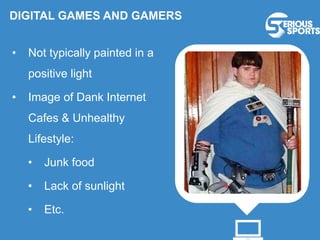
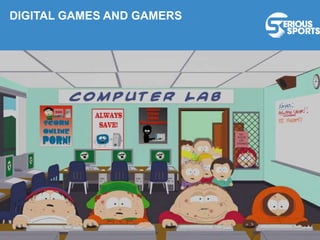
• Not typically painted in a
positive light
• Image of Dank Internet
Cafes & Unhealthy
Lifestyle:
• Junk food
• Lack of sunlight
• Etc.
DIGITAL GAMES AND GAMERS
TITLE
Games Nowadays used for a myriad of purposes
SPARX
• www.sparx.org.nz
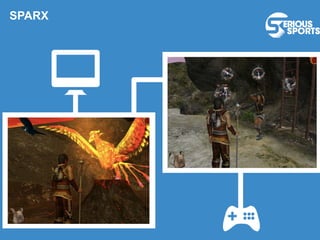
• Fantasy Game
• Player must talk to
characters, solve problems
• Designed to treat mild -
moderate depression
SPARX
SPARX
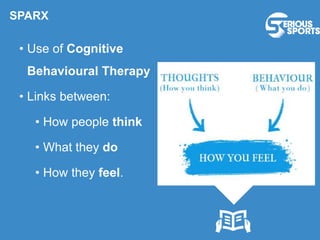
• Use of Cognitive
Behavioural Therapy
• Links between:
• How people think
• What they do
• How they feel.
SPARX
“It turns out according to a clinical trial published in
the British Medical Journal Sparx is at least as
effective as “traditional” therapies in treating
depression. Again this is for mild to moderate
cases of depression not severe cases"
“The effectiveness of SPARX, a
computerised self help intervention for
adolescents seeking help for depression:
randomised controlled non-inferiority trial”
TITLE
BUILDING COGNITIVE ABILITIES
NEURORACER
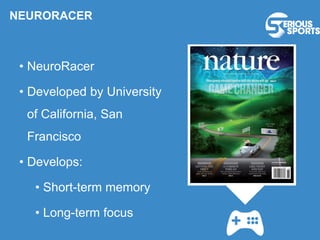
• NeuroRacer
• Developed by University
of California, San
Francisco
• Develops:
• Short-term memory
• Long-term focus
NEURORACER
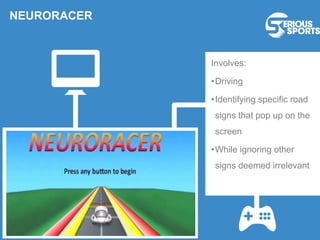
Involves:
•Driving
•Identifying specific road
signs that pop up on the
screen
•While ignoring other
signs deemed irrelevant
TITLE
BUILDING PHYSICAL ABILITIES
EXERGAMES
"Exergame play increases caloric expenditure, heart
rate, and coordination. Psychosocial and
cognitive impacts of exergame play may include
increased self-esteem, social interaction,
motivation, attention, and visual–spatial skill"
“Exergames for Physical Education Courses:
Physical, Social, and Cognitive Benefits -
(Staiano &Calvert, 2011)”
EXERGAMES
• www.weecanfightobesity.org
• Alabama State Department of
Education
• “To empower students and
educators …through the use of
technology based interactive
game activities”
EXERGAMES
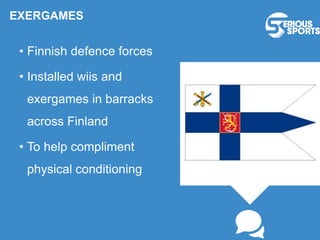
• Finnish defence forces
• Installed wiis and
exergames in barracks
across Finland
• To help compliment
physical conditioning
EXERGAMES
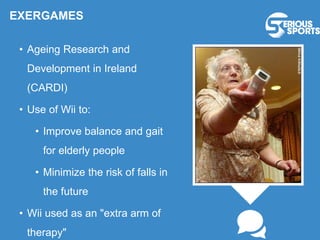
• Ageing Research and
Development in Ireland
(CARDI)
• Use of Wii to:
• Improve balance and gait
for elderly people
• Minimize the risk of falls in
the future
• Wii used as an "extra arm of
therapy"
TITLE
LEARNING
THROUGH GAMES
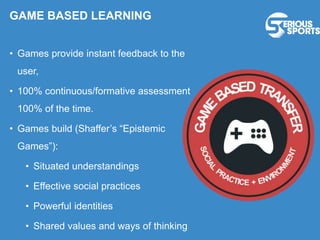
GAME BASED LEARNING
• Games provide instant feedback to the
user,
• 100% continuous/formative assessment
100% of the time.
• Games build (Shaffer’s “Epistemic
Games”):
• Situated understandings
• Effective social practices
• Powerful identities
• Shared values and ways of thinking
GAME BASED LEARNING
• Gee suggests games may have as many as 36 learning
principles build into them, e.g.
• Achievement Principle: there are intrinsic rewards from the
beginning, customised to each learner's level, effort, and growing
mastery
• Practice Principle: Learners get lots and lots of practice in a
context where the practice is not boring
• "Psychosocial Moratorium" Principle: learners can take risks in a
space where real-world consequences are lowered
• Multimodal Principle: Meaning and knowledge are built up through
various modalities (images, texts, symbols, interactions, abstract
design, sound, etc.), not just words
TITLE
SPORTS GAMES
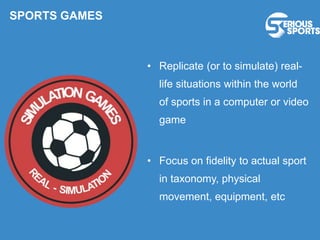
• Replicate (or to simulate) real-
life situations within the world
of sports in a computer or video
game
• Focus on fidelity to actual sport
in taxonomy, physical
movement, equipment, etc
SPORTS GAMES
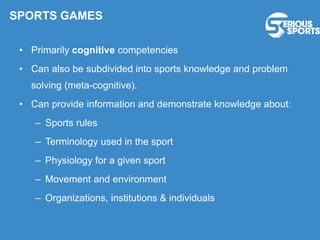
• Primarily cognitive competencies
• Can also be subdivided into sports knowledge and problem
solving (meta-cognitive).
• Can provide information and demonstrate knowledge about:
– Sports rules
– Terminology used in the sport
– Physiology for a given sport
– Movement and environment
– Organizations, institutions & individuals
SPORTS GAMES
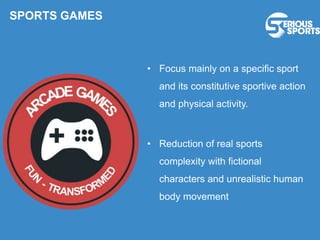
• Focus mainly on a specific sport
and its constitutive sportive action
and physical activity.
• Reduction of real sports
complexity with fictional
characters and unrealistic human
body movement
SPORTS GAMES
• Primarily cognitive & social competencies
• Less fidelity to real-life, more emphasis on “action gaming”
• Can provide information on:
– Sports techniques
– Terminology used in the sport
• Can engage the user in
– Wider communication
– Co-operation/ teamwork
SPORTS GAMES
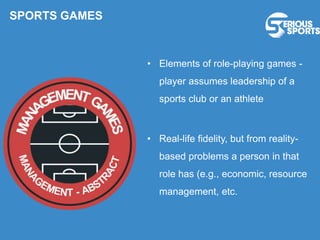
• Elements of role-playing games -
player assumes leadership of a
sports club or an athlete
• Real-life fidelity, but from reality-
based problems a person in that
role has (e.g., economic, resource
management, etc.
SPORTS GAMES
• Primarily meta-cognitive
• Analysis of individual game-play, facilitating thinking and
problem-solving and decision making
• Can allow the user to:
– Engage in problem-solving and decision making in the
sport
– Build hypotheses for the relevant sport
– Facilitate information-gathering and re-use of information
– Engage in creativity in their approach to the game
SPORTS GAMES
• Exercise or motion-orientated games
with focus on gross motor skills.
• Rarely claim real-life fidelity in terms
of sports movement, but can
legitimately claim provision of
aerobic/ anaerobic activity
SPORTS GAMES
• Primarily motor skill competencies
• Focus on player’s real-life movement - “action gaming”
• Generally, fidelity to real sport irrelevant
• Can involve player in:
– Gross motor skills
– Eye-hand/ eye-foot- /eye-leg- coordination
– Sense of embodied cognition
– Sense of agency
SPORTS GAMES
TITLE
SERIOUS SPORTS
PROJECT
TITLE
TITLE
GAME DEVELOPMENT FRAMEWORK
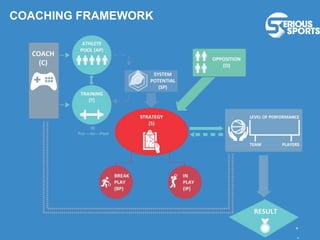
COACHING FRAMEWORK
TITLE
ONLINE DIGITAL GAME
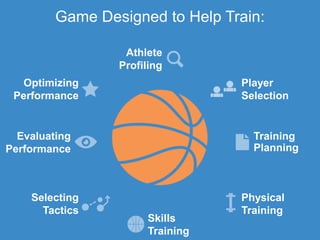
Player
Selection
Training
Planning
Physical
Training
Skills
Training
Athlete
Profiling
Optimizing
Performance
Selecting
Tactics
Evaluating
Performance
Game Designed to Help Train:
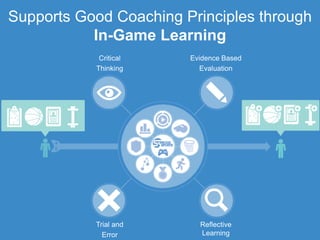
Supports Good Coaching Principles through
In-Game Learning
Reflective
Learning
Trial and
Error
Evidence Based
Evaluation
Critical
Thinking
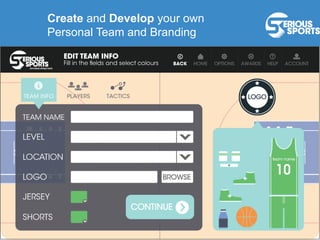
Create and Develop your own
Personal Team and Branding
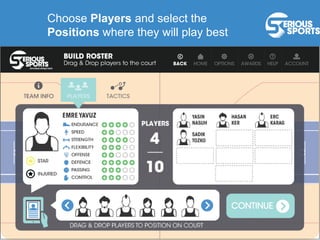
Choose Players and select the
Positions where they will play best
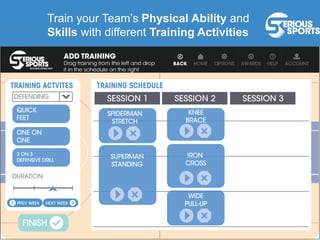
Train your Team’s Physical Ability and
Skills with different Training Activities
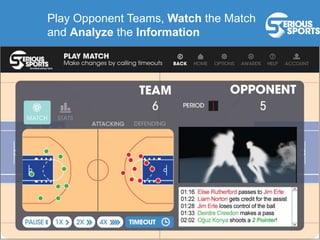
Play Opponent Teams, Watch the Match
and Analyze the Information
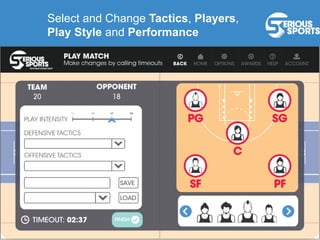
Select and Change Tactics, Players,
Play Style and Performance
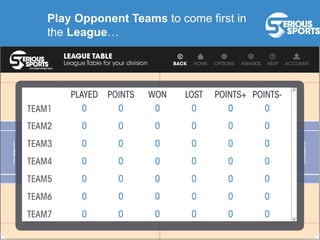
Play Opponent Teams to come first in
the League…
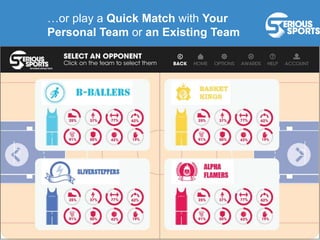
…or play a Quick Match with Your
Personal Team or an Existing Team
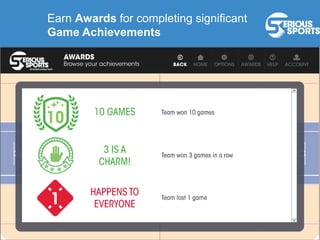
Earn Awards for completing significant
Game Achievements
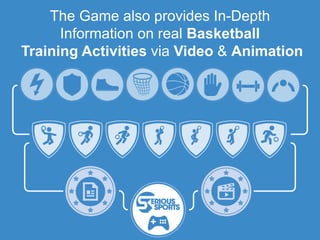
The Game also provides In-Depth
Information on real Basketball
Training Activities via Video & Animation
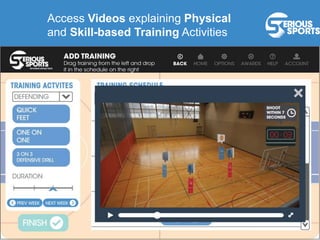
Access Videos explaining Physical
and Skill-based Training Activities
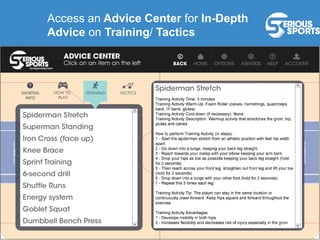
Access an Advice Center for In-Depth
Advice on Training/ Tactics
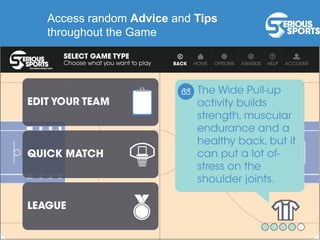
Access random Advice and Tips
throughout the Game
TITLE
ISSUES AND
RESISTANCES
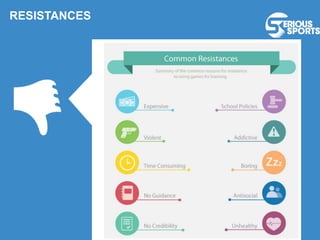
RESISTANCES
ISSUES
• Obviously Games are not sufficient in
themselves, or certainly should not be taken as
a replacement to traditional means.
• You can't replace what athletes do in a game
with what they do on a video game
• But technology is ever-improving and the line
between real and realistic is growing
increasingly blurry.
TITLE
http://serious-sports.org/

Serious Sports

  • 1.
    “SERIOUS SPORTS –GBL FRAMEWORK FOR SPORTS AND COACHING” Presented by: Maja Pivec, FH JOANNEUM, AT Slides by: Darragh Coakley & Roisin Garvey, CIT, Cork, IE Ljubljana 24/4/2014
  • 2.
  • 3.
    DIGITAL GAMES ANDGAMERS • Not typically painted in a positive light • Image of Dank Internet Cafes & Unhealthy Lifestyle: • Junk food • Lack of sunlight • Etc.
  • 4.
  • 5.
    TITLE Games Nowadays usedfor a myriad of purposes
  • 6.
    SPARX • www.sparx.org.nz • FantasyGame • Player must talk to characters, solve problems • Designed to treat mild - moderate depression
  • 7.
  • 8.
    SPARX • Use ofCognitive Behavioural Therapy • Links between: • How people think • What they do • How they feel.
  • 9.
    SPARX “It turns outaccording to a clinical trial published in the British Medical Journal Sparx is at least as effective as “traditional” therapies in treating depression. Again this is for mild to moderate cases of depression not severe cases" “The effectiveness of SPARX, a computerised self help intervention for adolescents seeking help for depression: randomised controlled non-inferiority trial”
  • 10.
  • 11.
    NEURORACER • NeuroRacer • Developedby University of California, San Francisco • Develops: • Short-term memory • Long-term focus
  • 12.
    NEURORACER Involves: •Driving •Identifying specific road signsthat pop up on the screen •While ignoring other signs deemed irrelevant
  • 13.
  • 14.
    EXERGAMES "Exergame play increasescaloric expenditure, heart rate, and coordination. Psychosocial and cognitive impacts of exergame play may include increased self-esteem, social interaction, motivation, attention, and visual–spatial skill" “Exergames for Physical Education Courses: Physical, Social, and Cognitive Benefits - (Staiano &Calvert, 2011)”
  • 15.
    EXERGAMES • www.weecanfightobesity.org • AlabamaState Department of Education • “To empower students and educators …through the use of technology based interactive game activities”
  • 16.
    EXERGAMES • Finnish defenceforces • Installed wiis and exergames in barracks across Finland • To help compliment physical conditioning
  • 17.
    EXERGAMES • Ageing Researchand Development in Ireland (CARDI) • Use of Wii to: • Improve balance and gait for elderly people • Minimize the risk of falls in the future • Wii used as an "extra arm of therapy"
  • 18.
  • 19.
    GAME BASED LEARNING •Games provide instant feedback to the user, • 100% continuous/formative assessment 100% of the time. • Games build (Shaffer’s “Epistemic Games”): • Situated understandings • Effective social practices • Powerful identities • Shared values and ways of thinking
  • 20.
    GAME BASED LEARNING •Gee suggests games may have as many as 36 learning principles build into them, e.g. • Achievement Principle: there are intrinsic rewards from the beginning, customised to each learner's level, effort, and growing mastery • Practice Principle: Learners get lots and lots of practice in a context where the practice is not boring • "Psychosocial Moratorium" Principle: learners can take risks in a space where real-world consequences are lowered • Multimodal Principle: Meaning and knowledge are built up through various modalities (images, texts, symbols, interactions, abstract design, sound, etc.), not just words
  • 21.
  • 22.
    • Replicate (orto simulate) real- life situations within the world of sports in a computer or video game • Focus on fidelity to actual sport in taxonomy, physical movement, equipment, etc SPORTS GAMES
  • 23.
    • Primarily cognitivecompetencies • Can also be subdivided into sports knowledge and problem solving (meta-cognitive). • Can provide information and demonstrate knowledge about: – Sports rules – Terminology used in the sport – Physiology for a given sport – Movement and environment – Organizations, institutions & individuals SPORTS GAMES
  • 24.
    • Focus mainlyon a specific sport and its constitutive sportive action and physical activity. • Reduction of real sports complexity with fictional characters and unrealistic human body movement SPORTS GAMES
  • 25.
    • Primarily cognitive& social competencies • Less fidelity to real-life, more emphasis on “action gaming” • Can provide information on: – Sports techniques – Terminology used in the sport • Can engage the user in – Wider communication – Co-operation/ teamwork SPORTS GAMES
  • 26.
    • Elements ofrole-playing games - player assumes leadership of a sports club or an athlete • Real-life fidelity, but from reality- based problems a person in that role has (e.g., economic, resource management, etc. SPORTS GAMES
  • 27.
    • Primarily meta-cognitive •Analysis of individual game-play, facilitating thinking and problem-solving and decision making • Can allow the user to: – Engage in problem-solving and decision making in the sport – Build hypotheses for the relevant sport – Facilitate information-gathering and re-use of information – Engage in creativity in their approach to the game SPORTS GAMES
  • 28.
    • Exercise ormotion-orientated games with focus on gross motor skills. • Rarely claim real-life fidelity in terms of sports movement, but can legitimately claim provision of aerobic/ anaerobic activity SPORTS GAMES
  • 29.
    • Primarily motorskill competencies • Focus on player’s real-life movement - “action gaming” • Generally, fidelity to real sport irrelevant • Can involve player in: – Gross motor skills – Eye-hand/ eye-foot- /eye-leg- coordination – Sense of embodied cognition – Sense of agency SPORTS GAMES
  • 30.
  • 31.
  • 32.
  • 33.
  • 34.
  • 35.
  • 36.
    Supports Good CoachingPrinciples through In-Game Learning Reflective Learning Trial and Error Evidence Based Evaluation Critical Thinking
  • 37.
    Create and Developyour own Personal Team and Branding
  • 38.
    Choose Players andselect the Positions where they will play best
  • 39.
    Train your Team’sPhysical Ability and Skills with different Training Activities
  • 40.
    Play Opponent Teams,Watch the Match and Analyze the Information
  • 41.
    Select and ChangeTactics, Players, Play Style and Performance
  • 42.
    Play Opponent Teamsto come first in the League…
  • 43.
    …or play aQuick Match with Your Personal Team or an Existing Team
  • 44.
    Earn Awards forcompleting significant Game Achievements
  • 45.
    The Game alsoprovides In-Depth Information on real Basketball Training Activities via Video & Animation
  • 46.
    Access Videos explainingPhysical and Skill-based Training Activities
  • 47.
    Access an AdviceCenter for In-Depth Advice on Training/ Tactics
  • 48.
    Access random Adviceand Tips throughout the Game
  • 49.
  • 50.
  • 51.
    ISSUES • Obviously Gamesare not sufficient in themselves, or certainly should not be taken as a replacement to traditional means. • You can't replace what athletes do in a game with what they do on a video game • But technology is ever-improving and the line between real and realistic is growing increasingly blurry.
  • 52.