GAMIFICATION.
IT’S WHAT WE DO.
KASEY MCCURDY // @PYROBLUE
DIRECTOR OF ENGINEERING, FRONT-END
ME IN A NUTSHELL
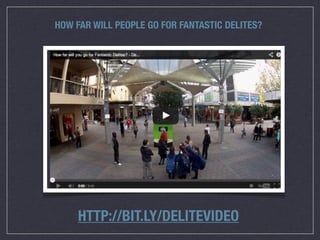
HTTP://BIT.LY/DELITEVIDEO
HOW FAR WILL PEOPLE GO FOR FANTASTIC DELITES?
WHAT IS GAMIFICATION?
NO, WE DON’T MAKE VIDEO GAMES.
PART 1 OF 7
Gamification Is...
The motivational techniques that game designers
have used for years to motivate players, used in a
non-game context.
A HISTORY LESSON.
YOU’RE GONNA TELL YOUR KIDS ABOUT THIS.
PART 2 OF 7
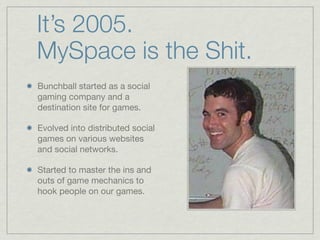
It’s 2005.
MySpace is the Shit.
Bunchball started as a social
gaming company and a
destination site for games.
Evolved into distributed social
games on various websites
and social networks.
Started to master the ins and
outs of game mechanics to
hook people on our games.
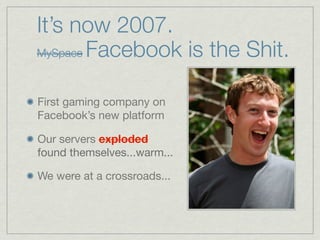
It’s now 2007.
MySpace Facebook is the Shit.
First gaming company on
Facebook’s new platform
Our servers exploded
found themselves...warm...
We were at a crossroads...
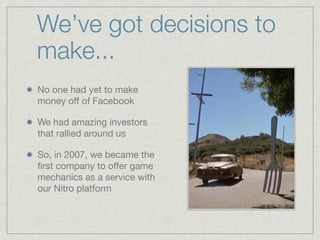
We’ve got decisions to
make...
No one had yet to make
money off of Facebook
We had amazing investors
that rallied around us
So, in 2007, we became the
first company to offer game
mechanics as a service with
our Nitro platform
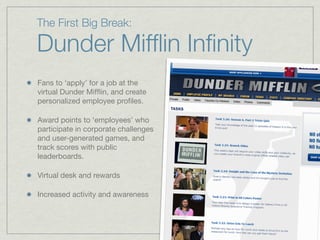
The First Big Break:
Dunder Mifflin Infinity
Fans to ‘apply’ for a job at the
virtual Dunder Mifflin, and create
personalized employee profiles.
Award points to ‘employees’ who
participate in corporate challenges
and user-generated games, and
track scores with public
leaderboards.
Virtual desk and rewards
Increased activity and awareness
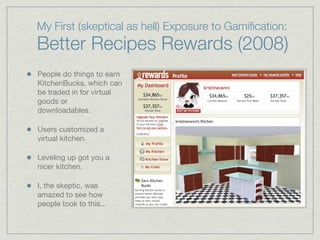
My First (skeptical as hell) Exposure to Gamification:
Better Recipes Rewards (2008)
People do things to earn
KitchenBucks, which can
be traded in for virtual
goods or
downloadables.
Users customized a
virtual kitchen.
Leveling up got you a
nicer kitchen.
I, the skeptic, was
amazed to see how
people took to this...
A GAMIFICATION
DEEP-DIVE.
IT’S ABOUT TO GET HEAVY.
PART 3 OF 7
Seriously, I’ve had people think I
code for the latest Call of Duty.
Gamification is the motivational techniques that
game designers have used for years to motivate
players, used in a non-game context.
A game’s storyline, strategy and challenge are the
center and focus of the overall experience.
With gamification, your core application / website
is the centerpiece. The game mechanics merely
enhance it.
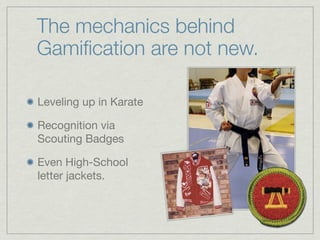
The mechanics behind
Gamification are not new.
Leveling up in Karate
Recognition via
Scouting Badges
Even High-School
letter jackets.
The Core Gamification Mechanics:
1. Fast Feedback
2. Transparency
3. Goals
4. Badges
5. Leveling Up
6. Onboarding
7. Competition
8. Collaboration
9. Community
10. Points
Core Gamification Mechanics:
1//FAST FEEDBACK
Reinforcement via positive /
negative feedback
Slow feedback loops create a
disconnect
Notifications can be used to offer
instant feedback and a path to the
“next thing”
Core Gamification Mechanics:
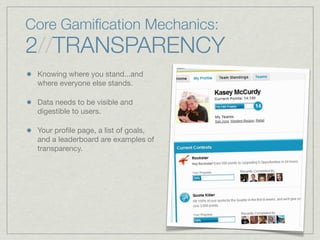
2//TRANSPARENCY
Knowing where you stand...and
where everyone else stands.
Data needs to be visible and
digestible to users.
Your profile page, a list of goals,
and a leaderboard are examples of
transparency.
Core Gamification Mechanics:
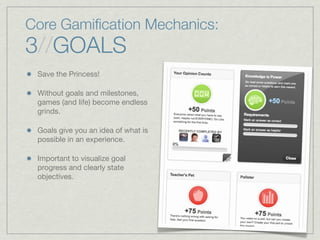
3//GOALS
Save the Princess!
Without goals and milestones,
games (and life) become endless
grinds.
Goals give you an idea of what is
possible in an experience.
Important to visualize goal
progress and clearly state
objectives.
Core Gamification Mechanics:
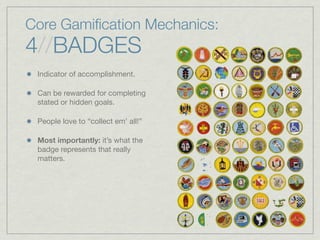
4//BADGES
Indicator of accomplishment.
Can be rewarded for completing
stated or hidden goals.
People love to “collect em’ all!”
Most importantly: it’s what the
badge represents that really
matters.
Core Gamification Mechanics:
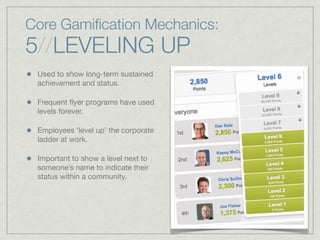
5//LEVELING UP
Used to show long-term sustained
achievement and status.
Frequent flyer programs have used
levels forever.
Employees ‘level up’ the corporate
ladder at work.
Important to show a level next to
someone’s name to indicate their
status within a community.
Core Gamification Mechanics:
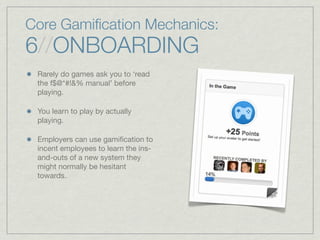
6//ONBOARDING
Rarely do games ask you to ‘read
the f$@*#!&% manual’ before
playing.
You learn to play by actually
playing.
Employers can use gamification to
incent employees to learn the ins-
and-outs of a new system they
might normally be hesitant
towards.
Core Gamification Mechanics:
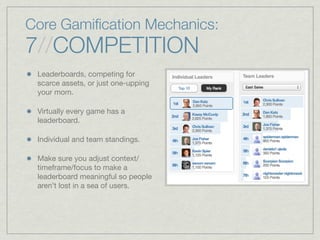
7//COMPETITION
Leaderboards, competing for
scarce assets, or just one-upping
your mom.
Virtually every game has a
leaderboard.
Individual and team standings.
Make sure you adjust context/
timeframe/focus to make a
leaderboard meaningful so people
aren’t lost in a sea of users.
Core Gamification Mechanics:
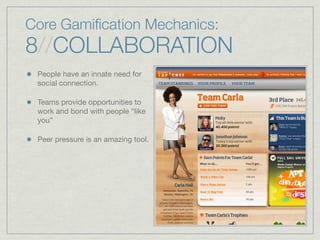
8//COLLABORATION
People have an innate need for
social connection.
Teams provide opportunities to
work and bond with people “like
you”
Peer pressure is an amazing tool.
Core Gamification Mechanics:
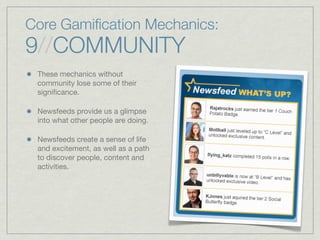
9//COMMUNITY
These mechanics without
community lose some of their
significance.
Newsfeeds provide us a glimpse
into what other people are doing.
Newsfeeds create a sense of life
and excitement, as well as a path
to discover people, content and
activities.
Core Gamification Mechanics:
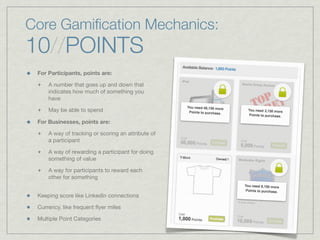
10//POINTS
For Participants, points are:
A number that goes up and down that
indicates how much of something you
have
May be able to spend
For Businesses, points are:
A way of tracking or scoring an attribute of
a participant
A way of rewarding a participant for doing
something of value
A way for participants to reward each
other for something
Keeping score like LinkedIn connections
Currency, like frequent flyer miles
Multiple Point Categories
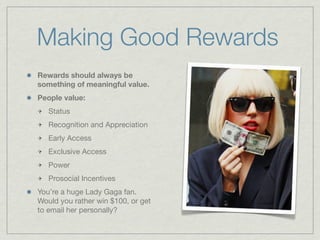
Making Good Rewards
Rewards should always be
something of meaningful value.
People value:
Status
Recognition and Appreciation
Early Access
Exclusive Access
Power
Prosocial Incentives
You’re a huge Lady Gaga fan.
Would you rather win $100, or get
to email her personally?
The Core Gamification Mechanics:
1. Fast Feedback
2. Transparency
3. Goals
4. Badges
5. Leveling Up
6. Onboarding
7. Competition
8. Collaboration
9. Community
10. Points
LOYALTY.
THE REASON I PAY TOO DAMNED MUCH FOR
MY DELTA™ AIRLINE TICKETS EVERY TIME.
PART 4 OF 7
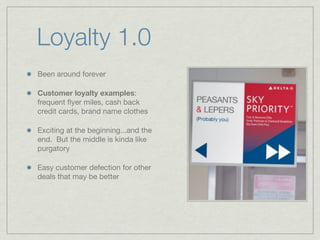
Loyalty 1.0
Been around forever
Customer loyalty examples:
frequent flyer miles, cash back
credit cards, brand name clothes
Exciting at the beginning...and the
end. But the middle is kinda like
purgatory
Easy customer defection for other
deals that may be better
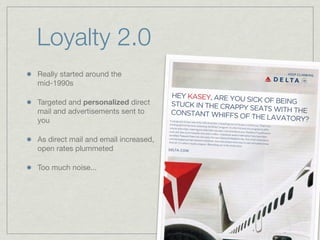
Loyalty 2.0
Really started around the
mid-1990s
Targeted and personalized direct
mail and advertisements sent to
you
As direct mail and email increased,
open rates plummeted
Too much noise...
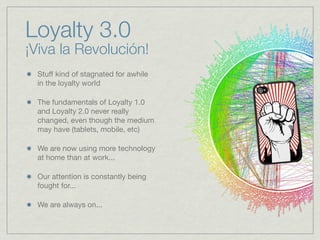
Stuff kind of stagnated for awhile
in the loyalty world
The fundamentals of Loyalty 1.0
and Loyalty 2.0 never really
changed, even though the medium
may have (tablets, mobile, etc)
We are now using more technology
at home than at work...
Our attention is constantly being
fought for...
We are always on...
Loyalty 3.0
¡Viva la Revolución!
Loyalty 3.0 is...
Motivation + Big Data + Gamification
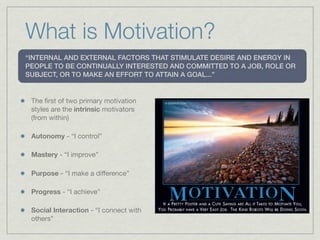
The first of two primary motivation
styles are the intrinsic motivators
(from within)
Autonomy - “I control”
Mastery - “I improve”
Purpose - “I make a difference”
Progress - “I achieve”
Social Interaction - “I connect with
others”
What is Motivation?
“INTERNAL AND EXTERNAL FACTORS THAT STIMULATE DESIRE AND ENERGY IN
PEOPLE TO BE CONTINUALLY INTERESTED AND COMMITTED TO A JOB, ROLE OR
SUBJECT, OR TO MAKE AN EFFORT TO ATTAIN A GOAL...”
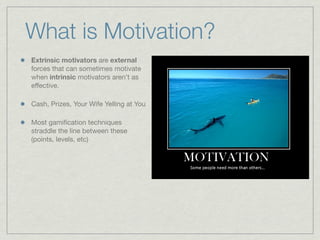
Extrinsic motivators are external
forces that can sometimes motivate
when intrinsic motivators aren’t as
effective.
Cash, Prizes, Your Wife Yelling at You
Most gamification techniques
straddle the line between these
(points, levels, etc)
What is Motivation?
M.I.T Quote:
“Each of us is a walking data
generator...”
GPS location, shopping habits, social
networks, blog posts, etc...
Having large amounts of data is like
having each of your customers and
constituents raise their hand and tell
you exactly what they think about
you, and how you can motivate them
Big data gives you the ability to react
and adapt quickly
A/B Testing
Cluster Analysis - “my users love
Chocolate AND Star Wars...”
Big Data
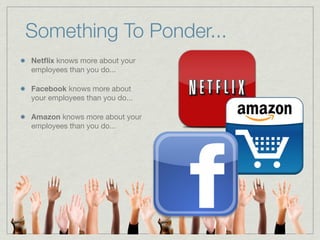
Netflix knows more about your
employees than you do...
Facebook knows more about
your employees than you do...
Amazon knows more about your
employees than you do...
Something To Ponder...
MOTIVATING THE
UNMOTIVATED.
(f$*@ it...no one’s reading this line, anyway)
PART 5 OF 7
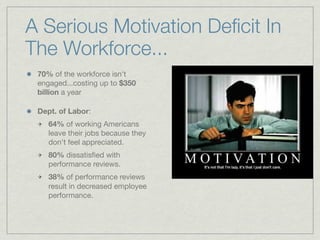
70% of the workforce isn't
engaged...costing up to $350
billion a year
Dept. of Labor:
64% of working Americans
leave their jobs because they
don't feel appreciated.
80% dissatisfied with
performance reviews.
38% of performance reviews
result in decreased employee
performance.
A Serious Motivation Deficit In
The Workforce...
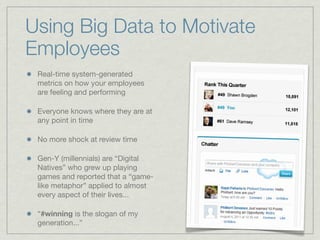
Real-time system-generated
metrics on how your employees
are feeling and performing
Everyone knows where they are at
any point in time
No more shock at review time
Gen-Y (millennials) are “Digital
Natives” who grew up playing
games and reported that a “game-
like metaphor” applied to almost
every aspect of their lives...
“#winning is the slogan of my
generation...”
Using Big Data to Motivate
Employees
People will spend 4 hours playing
Angry Birds, but won’t spend 5
minutes to learn a new system
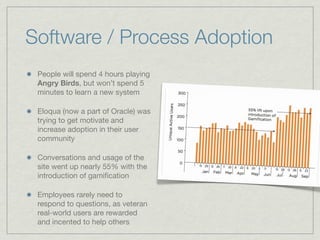
Eloqua (now a part of Oracle) was
trying to get motivate and
increase adoption in their user
community
Conversations and usage of the
site went up nearly 55% with the
introduction of gamification
Employees rarely need to
respond to questions, as veteran
real-world users are rewarded
and incented to help others
Software / Process Adoption
A FEW CASE STUDIES IN
USER ENGAGEMENT.
BOOM.
PART 6 OF 7
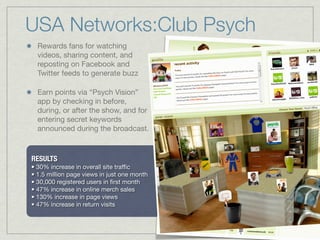
Rewards fans for watching
videos, sharing content, and
reposting on Facebook and
Twitter feeds to generate buzz
Earn points via “Psych Vision”
app by checking in before,
during, or after the show, and for
entering secret keywords
announced during the broadcast.
USA Networks:Club Psych
RESULTS
• 30% increase in overall site traffic
• 1.5 million page views in just one month
• 30,000 registered users in first month
• 47% increase in online merch sales
• 130% increase in page views
• 47% increase in return visits
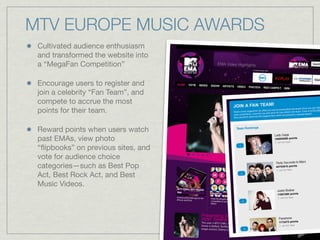
Cultivated audience enthusiasm
and transformed the website into
a “MegaFan Competition”
Encourage users to register and
join a celebrity “Fan Team”, and
compete to accrue the most
points for their team.
Reward points when users watch
past EMAs, view photo
“flipbooks” on previous sites, and
vote for audience choice
categories—such as Best Pop
Act, Best Rock Act, and Best
Music Videos.
MTV EUROPE MUSIC AWARDS
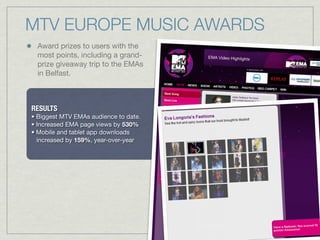
Award prizes to users with the
most points, including a grand-
prize giveaway trip to the EMAs
in Belfast.
MTV EUROPE MUSIC AWARDS
RESULTS
• Biggest MTV EMAs audience to date.
• Increased EMA page views by 530%
• Mobile and tablet app downloads
increased by 159%, year-over-year
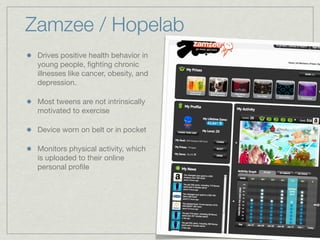
Drives positive health behavior in
young people, fighting chronic
illnesses like cancer, obesity, and
depression.
Most tweens are not intrinsically
motivated to exercise
Device worn on belt or in pocket
Monitors physical activity, which
is uploaded to their online
personal profile
Zamzee / Hopelab
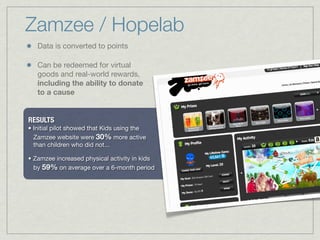
RESULTS
• Initial pilot showed that Kids using the
Zamzee website were 30% more active
than children who did not...
• Zamzee increased physical activity in kids
by 59% on average over a 6-month period
Data is converted to points
Can be redeemed for virtual
goods and real-world rewards,
including the ability to donate
to a cause
Zamzee / Hopelab
TODAY AND THE FUTURE.
I CAN’T WAIT FOR MY HOVERBOARD.
PART 7 OF 7
Where We Are...
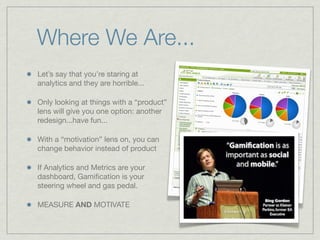
Let’s say that you’re staring at
analytics and they are horrible...
Only looking at things with a “product”
lens will give you one option: another
redesign...have fun...
With a “motivation” lens on, you can
change behavior instead of product
If Analytics and Metrics are your
dashboard, Gamification is your
steering wheel and gas pedal.
MEASURE AND MOTIVATE
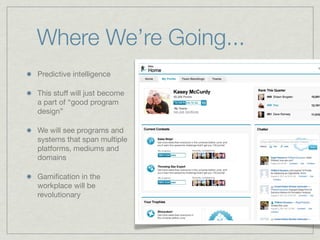
Where We’re Going...
Predictive intelligence
This stuff will just become
a part of “good program
design”
We will see programs and
systems that span multiple
platforms, mediums and
domains
Gamification in the
workplace will be
revolutionary
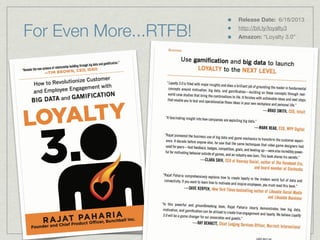
For Even More...RTFB!
Release Date: 6/18/2013
http://bit.ly/loyalty3
Amazon: “Loyalty 3.0”
THANKS! THE END.
QUESTIONS?

Design+Tech: Gamification

  • 1.
    GAMIFICATION. IT’S WHAT WEDO. KASEY MCCURDY // @PYROBLUE DIRECTOR OF ENGINEERING, FRONT-END
  • 2.
    ME IN ANUTSHELL
  • 3.
    HTTP://BIT.LY/DELITEVIDEO HOW FAR WILLPEOPLE GO FOR FANTASTIC DELITES?
  • 4.
    WHAT IS GAMIFICATION? NO,WE DON’T MAKE VIDEO GAMES. PART 1 OF 7
  • 5.
    Gamification Is... The motivationaltechniques that game designers have used for years to motivate players, used in a non-game context.
  • 6.
    A HISTORY LESSON. YOU’REGONNA TELL YOUR KIDS ABOUT THIS. PART 2 OF 7
  • 7.
    It’s 2005. MySpace isthe Shit. Bunchball started as a social gaming company and a destination site for games. Evolved into distributed social games on various websites and social networks. Started to master the ins and outs of game mechanics to hook people on our games.
  • 8.
    It’s now 2007. MySpaceFacebook is the Shit. First gaming company on Facebook’s new platform Our servers exploded found themselves...warm... We were at a crossroads...
  • 9.
    We’ve got decisionsto make... No one had yet to make money off of Facebook We had amazing investors that rallied around us So, in 2007, we became the first company to offer game mechanics as a service with our Nitro platform
  • 10.
    The First BigBreak: Dunder Mifflin Infinity Fans to ‘apply’ for a job at the virtual Dunder Mifflin, and create personalized employee profiles. Award points to ‘employees’ who participate in corporate challenges and user-generated games, and track scores with public leaderboards. Virtual desk and rewards Increased activity and awareness
  • 11.
    My First (skepticalas hell) Exposure to Gamification: Better Recipes Rewards (2008) People do things to earn KitchenBucks, which can be traded in for virtual goods or downloadables. Users customized a virtual kitchen. Leveling up got you a nicer kitchen. I, the skeptic, was amazed to see how people took to this...
  • 12.
    A GAMIFICATION DEEP-DIVE. IT’S ABOUTTO GET HEAVY. PART 3 OF 7
  • 13.
    Seriously, I’ve hadpeople think I code for the latest Call of Duty. Gamification is the motivational techniques that game designers have used for years to motivate players, used in a non-game context. A game’s storyline, strategy and challenge are the center and focus of the overall experience. With gamification, your core application / website is the centerpiece. The game mechanics merely enhance it.
  • 14.
    The mechanics behind Gamificationare not new. Leveling up in Karate Recognition via Scouting Badges Even High-School letter jackets.
  • 15.
    The Core GamificationMechanics: 1. Fast Feedback 2. Transparency 3. Goals 4. Badges 5. Leveling Up 6. Onboarding 7. Competition 8. Collaboration 9. Community 10. Points
  • 16.
    Core Gamification Mechanics: 1//FASTFEEDBACK Reinforcement via positive / negative feedback Slow feedback loops create a disconnect Notifications can be used to offer instant feedback and a path to the “next thing”
  • 17.
    Core Gamification Mechanics: 2//TRANSPARENCY Knowingwhere you stand...and where everyone else stands. Data needs to be visible and digestible to users. Your profile page, a list of goals, and a leaderboard are examples of transparency.
  • 18.
    Core Gamification Mechanics: 3//GOALS Savethe Princess! Without goals and milestones, games (and life) become endless grinds. Goals give you an idea of what is possible in an experience. Important to visualize goal progress and clearly state objectives.
  • 19.
    Core Gamification Mechanics: 4//BADGES Indicatorof accomplishment. Can be rewarded for completing stated or hidden goals. People love to “collect em’ all!” Most importantly: it’s what the badge represents that really matters.
  • 20.
    Core Gamification Mechanics: 5//LEVELINGUP Used to show long-term sustained achievement and status. Frequent flyer programs have used levels forever. Employees ‘level up’ the corporate ladder at work. Important to show a level next to someone’s name to indicate their status within a community.
  • 21.
    Core Gamification Mechanics: 6//ONBOARDING Rarelydo games ask you to ‘read the f$@*#!&% manual’ before playing. You learn to play by actually playing. Employers can use gamification to incent employees to learn the ins- and-outs of a new system they might normally be hesitant towards.
  • 22.
    Core Gamification Mechanics: 7//COMPETITION Leaderboards,competing for scarce assets, or just one-upping your mom. Virtually every game has a leaderboard. Individual and team standings. Make sure you adjust context/ timeframe/focus to make a leaderboard meaningful so people aren’t lost in a sea of users.
  • 23.
    Core Gamification Mechanics: 8//COLLABORATION Peoplehave an innate need for social connection. Teams provide opportunities to work and bond with people “like you” Peer pressure is an amazing tool.
  • 24.
    Core Gamification Mechanics: 9//COMMUNITY Thesemechanics without community lose some of their significance. Newsfeeds provide us a glimpse into what other people are doing. Newsfeeds create a sense of life and excitement, as well as a path to discover people, content and activities.
  • 25.
    Core Gamification Mechanics: 10//POINTS ForParticipants, points are: A number that goes up and down that indicates how much of something you have May be able to spend For Businesses, points are: A way of tracking or scoring an attribute of a participant A way of rewarding a participant for doing something of value A way for participants to reward each other for something Keeping score like LinkedIn connections Currency, like frequent flyer miles Multiple Point Categories
  • 26.
    Making Good Rewards Rewardsshould always be something of meaningful value. People value: Status Recognition and Appreciation Early Access Exclusive Access Power Prosocial Incentives You’re a huge Lady Gaga fan. Would you rather win $100, or get to email her personally?
  • 27.
    The Core GamificationMechanics: 1. Fast Feedback 2. Transparency 3. Goals 4. Badges 5. Leveling Up 6. Onboarding 7. Competition 8. Collaboration 9. Community 10. Points
  • 28.
    LOYALTY. THE REASON IPAY TOO DAMNED MUCH FOR MY DELTA™ AIRLINE TICKETS EVERY TIME. PART 4 OF 7
  • 29.
    Loyalty 1.0 Been aroundforever Customer loyalty examples: frequent flyer miles, cash back credit cards, brand name clothes Exciting at the beginning...and the end. But the middle is kinda like purgatory Easy customer defection for other deals that may be better
  • 30.
    Loyalty 2.0 Really startedaround the mid-1990s Targeted and personalized direct mail and advertisements sent to you As direct mail and email increased, open rates plummeted Too much noise...
  • 31.
    Stuff kind ofstagnated for awhile in the loyalty world The fundamentals of Loyalty 1.0 and Loyalty 2.0 never really changed, even though the medium may have (tablets, mobile, etc) We are now using more technology at home than at work... Our attention is constantly being fought for... We are always on... Loyalty 3.0 ¡Viva la Revolución!
  • 32.
    Loyalty 3.0 is... Motivation+ Big Data + Gamification
  • 33.
    The first oftwo primary motivation styles are the intrinsic motivators (from within) Autonomy - “I control” Mastery - “I improve” Purpose - “I make a difference” Progress - “I achieve” Social Interaction - “I connect with others” What is Motivation? “INTERNAL AND EXTERNAL FACTORS THAT STIMULATE DESIRE AND ENERGY IN PEOPLE TO BE CONTINUALLY INTERESTED AND COMMITTED TO A JOB, ROLE OR SUBJECT, OR TO MAKE AN EFFORT TO ATTAIN A GOAL...”
  • 34.
    Extrinsic motivators areexternal forces that can sometimes motivate when intrinsic motivators aren’t as effective. Cash, Prizes, Your Wife Yelling at You Most gamification techniques straddle the line between these (points, levels, etc) What is Motivation?
  • 35.
    M.I.T Quote: “Each ofus is a walking data generator...” GPS location, shopping habits, social networks, blog posts, etc... Having large amounts of data is like having each of your customers and constituents raise their hand and tell you exactly what they think about you, and how you can motivate them Big data gives you the ability to react and adapt quickly A/B Testing Cluster Analysis - “my users love Chocolate AND Star Wars...” Big Data
  • 36.
    Netflix knows moreabout your employees than you do... Facebook knows more about your employees than you do... Amazon knows more about your employees than you do... Something To Ponder...
  • 37.
    MOTIVATING THE UNMOTIVATED. (f$*@ it...noone’s reading this line, anyway) PART 5 OF 7
  • 38.
    70% of theworkforce isn't engaged...costing up to $350 billion a year Dept. of Labor: 64% of working Americans leave their jobs because they don't feel appreciated. 80% dissatisfied with performance reviews. 38% of performance reviews result in decreased employee performance. A Serious Motivation Deficit In The Workforce...
  • 39.
    Real-time system-generated metrics onhow your employees are feeling and performing Everyone knows where they are at any point in time No more shock at review time Gen-Y (millennials) are “Digital Natives” who grew up playing games and reported that a “game- like metaphor” applied to almost every aspect of their lives... “#winning is the slogan of my generation...” Using Big Data to Motivate Employees
  • 40.
    People will spend4 hours playing Angry Birds, but won’t spend 5 minutes to learn a new system Eloqua (now a part of Oracle) was trying to get motivate and increase adoption in their user community Conversations and usage of the site went up nearly 55% with the introduction of gamification Employees rarely need to respond to questions, as veteran real-world users are rewarded and incented to help others Software / Process Adoption
  • 41.
    A FEW CASESTUDIES IN USER ENGAGEMENT. BOOM. PART 6 OF 7
  • 42.
    Rewards fans forwatching videos, sharing content, and reposting on Facebook and Twitter feeds to generate buzz Earn points via “Psych Vision” app by checking in before, during, or after the show, and for entering secret keywords announced during the broadcast. USA Networks:Club Psych RESULTS • 30% increase in overall site traffic • 1.5 million page views in just one month • 30,000 registered users in first month • 47% increase in online merch sales • 130% increase in page views • 47% increase in return visits
  • 43.
    Cultivated audience enthusiasm andtransformed the website into a “MegaFan Competition” Encourage users to register and join a celebrity “Fan Team”, and compete to accrue the most points for their team. Reward points when users watch past EMAs, view photo “flipbooks” on previous sites, and vote for audience choice categories—such as Best Pop Act, Best Rock Act, and Best Music Videos. MTV EUROPE MUSIC AWARDS
  • 44.
    Award prizes tousers with the most points, including a grand- prize giveaway trip to the EMAs in Belfast. MTV EUROPE MUSIC AWARDS RESULTS • Biggest MTV EMAs audience to date. • Increased EMA page views by 530% • Mobile and tablet app downloads increased by 159%, year-over-year
  • 45.
    Drives positive healthbehavior in young people, fighting chronic illnesses like cancer, obesity, and depression. Most tweens are not intrinsically motivated to exercise Device worn on belt or in pocket Monitors physical activity, which is uploaded to their online personal profile Zamzee / Hopelab
  • 46.
    RESULTS • Initial pilotshowed that Kids using the Zamzee website were 30% more active than children who did not... • Zamzee increased physical activity in kids by 59% on average over a 6-month period Data is converted to points Can be redeemed for virtual goods and real-world rewards, including the ability to donate to a cause Zamzee / Hopelab
  • 47.
    TODAY AND THEFUTURE. I CAN’T WAIT FOR MY HOVERBOARD. PART 7 OF 7
  • 48.
    Where We Are... Let’ssay that you’re staring at analytics and they are horrible... Only looking at things with a “product” lens will give you one option: another redesign...have fun... With a “motivation” lens on, you can change behavior instead of product If Analytics and Metrics are your dashboard, Gamification is your steering wheel and gas pedal. MEASURE AND MOTIVATE
  • 49.
    Where We’re Going... Predictiveintelligence This stuff will just become a part of “good program design” We will see programs and systems that span multiple platforms, mediums and domains Gamification in the workplace will be revolutionary
  • 50.
    For Even More...RTFB! ReleaseDate: 6/18/2013 http://bit.ly/loyalty3 Amazon: “Loyalty 3.0”
  • 51.