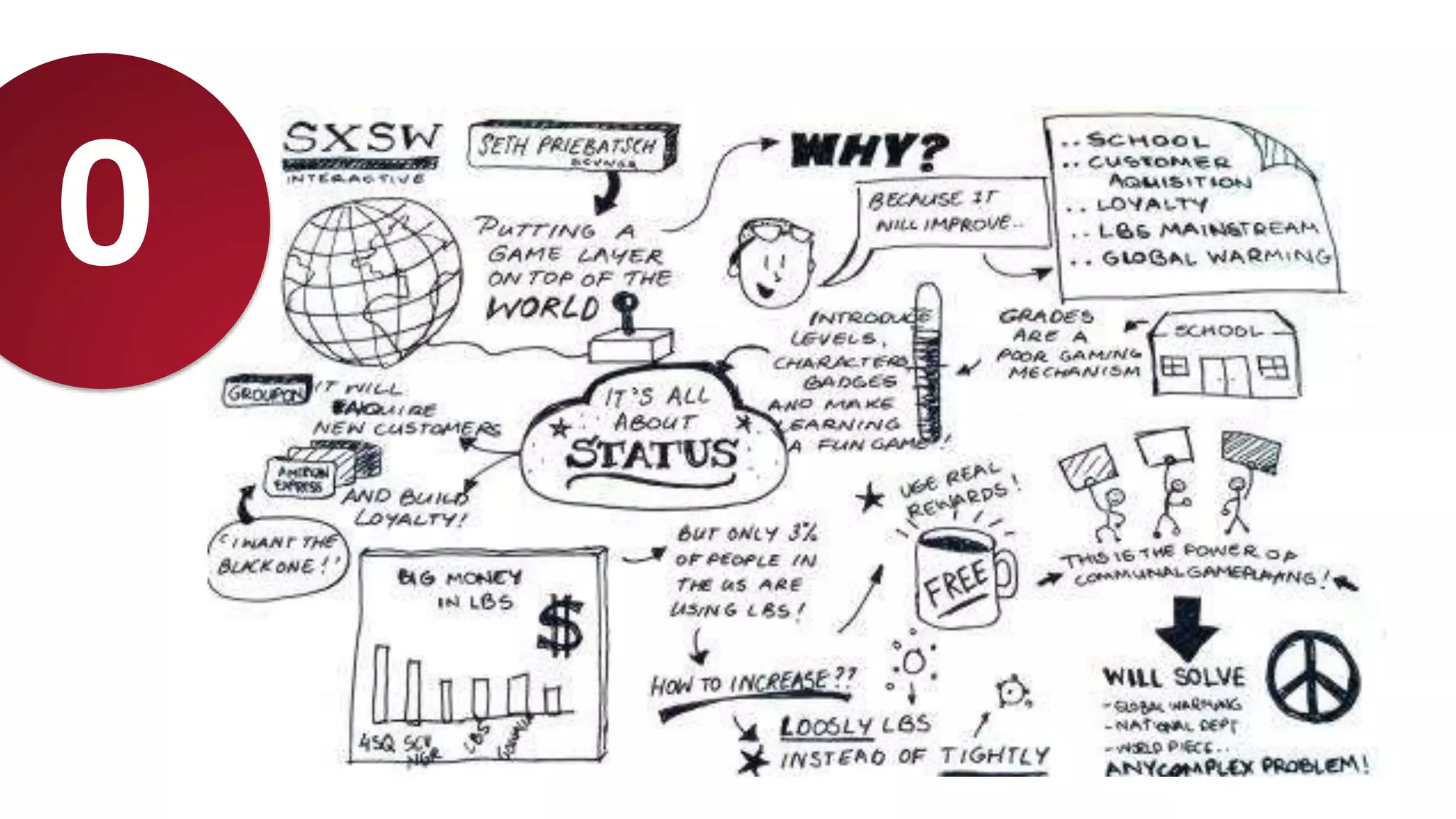
INTRODUCTIONGamification
Group-11
Narasimhan
Sai Akhil
Vishnu
Vijayalakshmi
Yogeshwaran
Kaarthika
1. What is gamification?
2. Why are games valuable in serious business contexts?
3. How can game concepts be employed in your business?
4. When is gamification most effective?
Overview
What is Gamification?
Google:
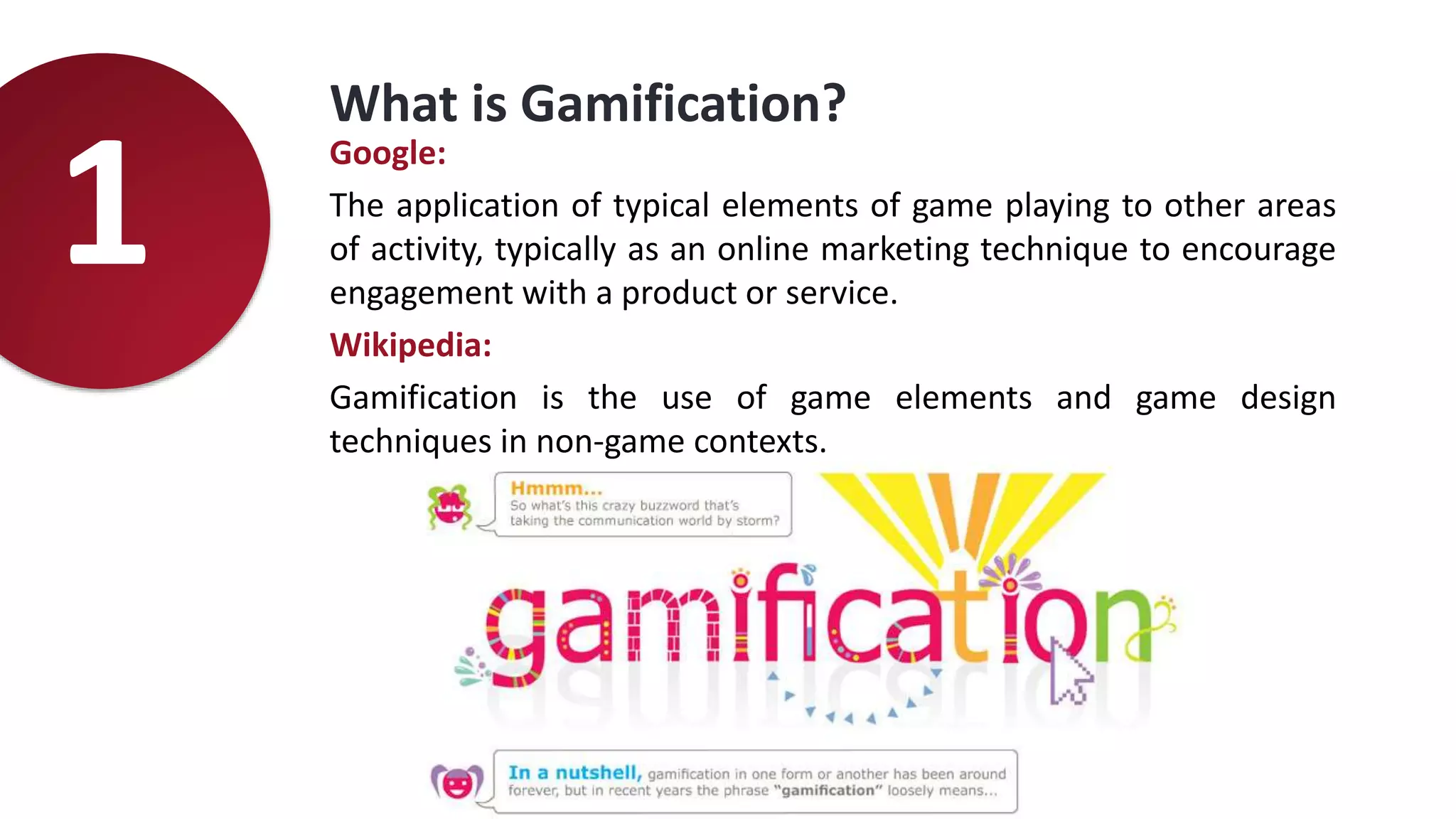
The application of typical elements of game playing to other areas
of activity, typically as an online marketing technique to encourage
engagement with a product or service.
Wikipedia:
Gamification is the use of game elements and game design
techniques in non-game contexts.
1
Importance
There are any number of settings in which this approach can
work, but at this early stage three non-game contexts are
particularly prominent:
 Internal- To improve productivity within the organization in order
to foster innovation, enhance camaraderie, or otherwise derive
positive business results through their own employees.
 External-Improve the relationships between businesses and
customers, producing increased engagement, identification with
the product, stronger loyalty, and ultimately higher revenues.
 Behavior change- To form beneficial new habits among a
population.
2
Game Concepts
 Gamification isn’t about building a full-fledged game. It’s just
about using some elements of games, and because it operates at
the level of elements, using gamification offers more flexibility
than using a game.
 Challenge of gamification therefore, is to take the elements that
normally operate within the game universe and apply them
effectively in the real world.
3
How it is Effective ?
4 There are two compelling reasons why every business should at
least consider gamification:
 Engagement- Making your customers and employees to
strengthen their relationship with your company, or to buy
your product, or to engage with the goals of the company.
 Experimentation- A second powerful aspect of game-based
motivation is to open up the space of possibility. Mastering a
game is all about experimentation.
Game thinking: Learn to think like game
designers
Gamification
1. What is a game?
2. How do I think like a game designer?
3. Will gamification solve my business problem?
4. How do I start?
Overview
Google:
An activity that one engages in for amusement.
Wikipedia:
A game is structured playing, usually undertaken
for enjoyment and sometimes used as an
educational tool.
Merriam-Webster:
A physical or mental activity or contest that has
rules and that people do for pleasure.
 It’s almost impossible to define any essential
attribute of games.
What is A game?
1
Game Thinking
 Game thinking means using all the resources you can muster to
create an engaging experience that motivates desired behaviours.
[Ad1, Ad2]
 Gamers try to win; game designers try to make gamers play.
 Games are a process, not an outcome.
 In a game, the sense of autonomy is always somewhat illusory. That’s
true in business as well.
2
Is Gamification right for my business challenge?
• Motivation: Where would you derive value from encouraging
behaviour?
• Meaningful Choices: Are your target activities sufficiently interesting?
• Structure: Can the desired behaviours be modelled through a set of
algorithms?
• Potential Conflicts: Can the game avoid conflicts with existing
motivational structures?
3
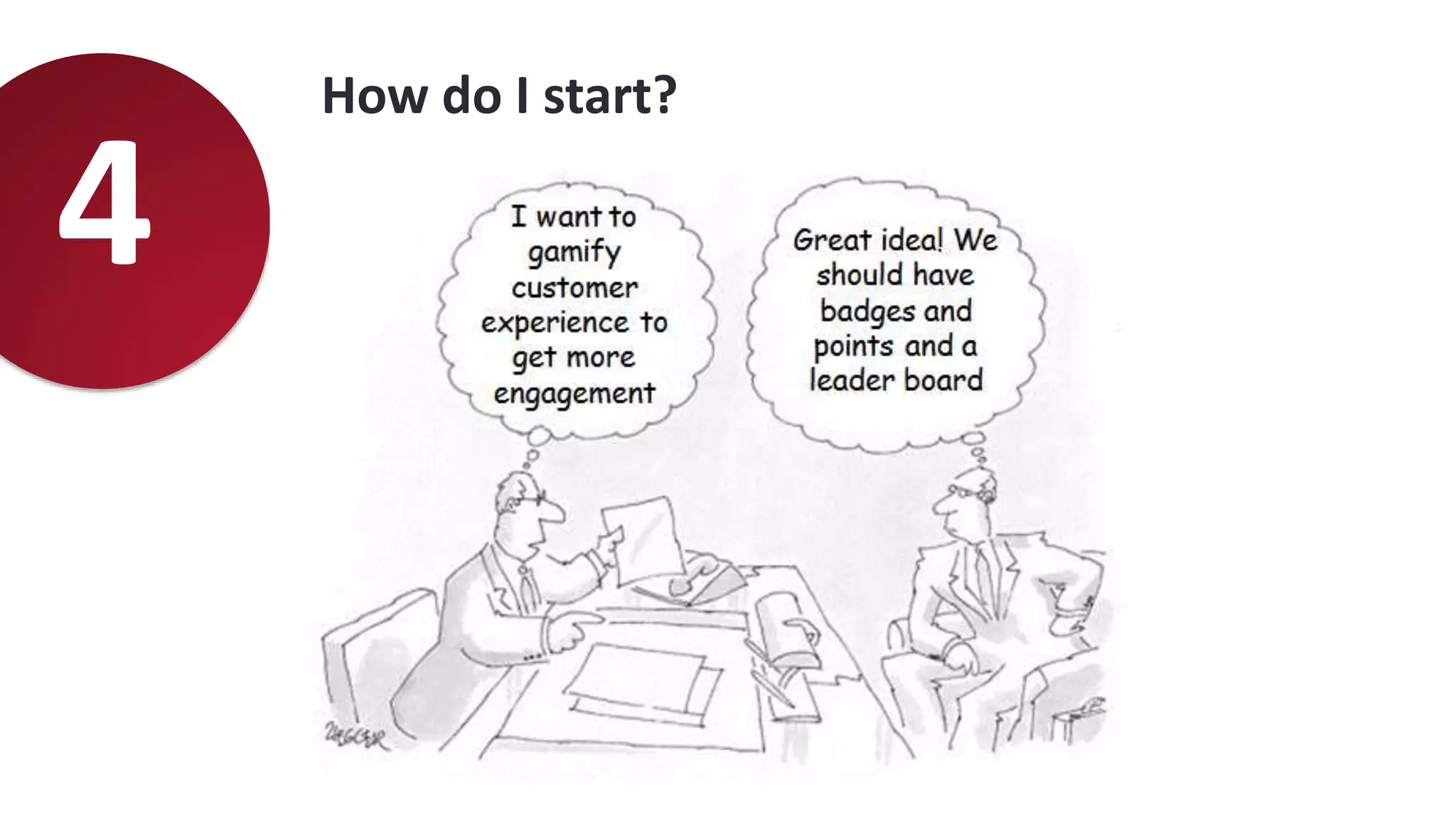
How do I start?
4
Why Games WorkGamification
1. What does research tell us about psychology and motivation?
2. How can I make use of extrinsic and intrinsic motivators?
3. How do I motivate behavior through gamification?
Overview
0
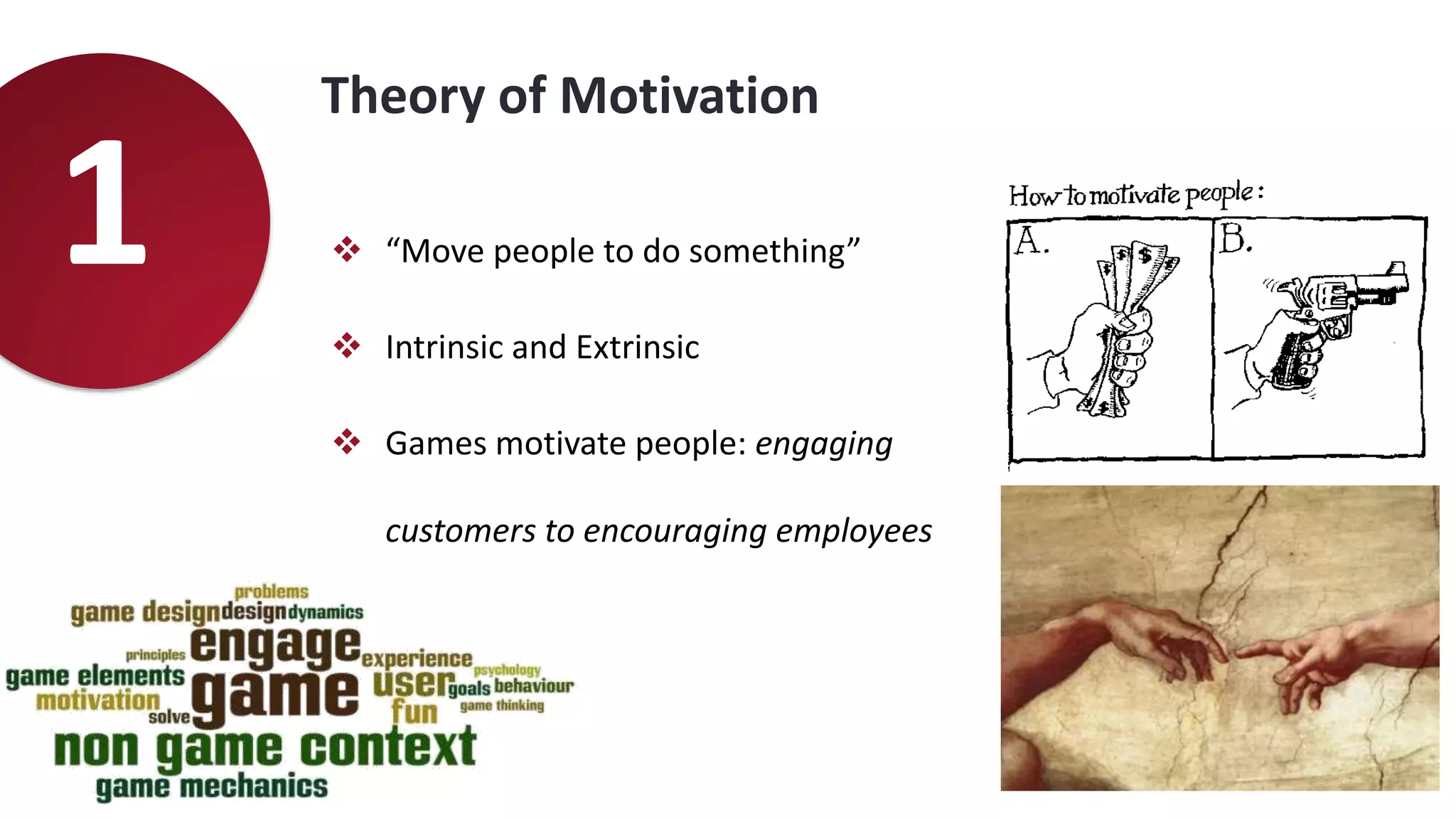
Theory of Motivation
1  “Move people to do something”
 Intrinsic and Extrinsic
 Games motivate people: engaging
customers to encouraging employees
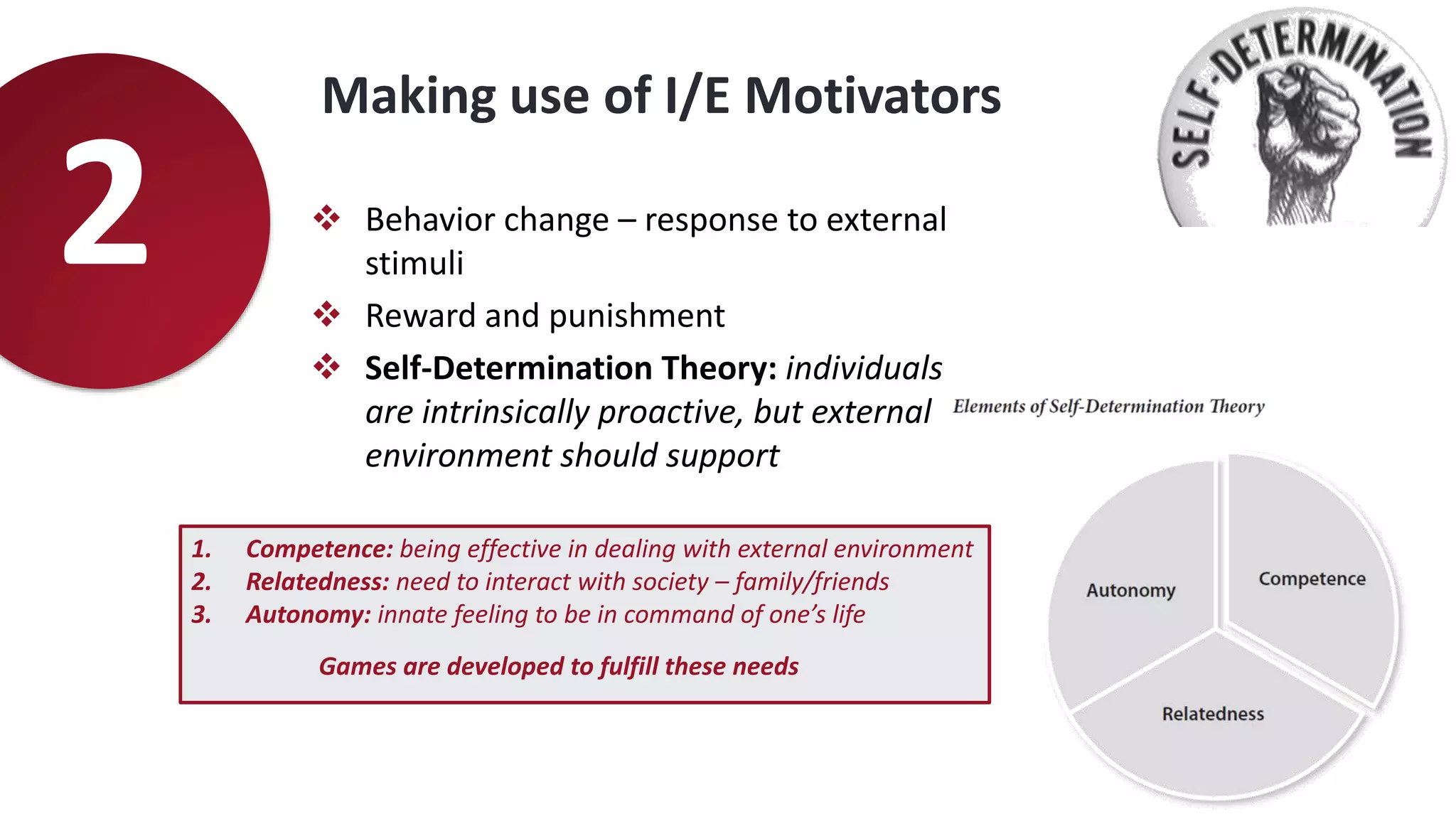
Making use of I/E Motivators
2  Behavior change – response to external
stimuli
 Reward and punishment
 Self-Determination Theory: individuals
are intrinsically proactive, but external
environment should support
1. Competence: being effective in dealing with external environment
2. Relatedness: need to interact with society – family/friends
3. Autonomy: innate feeling to be in command of one’s life
Games are developed to fulfill these needs
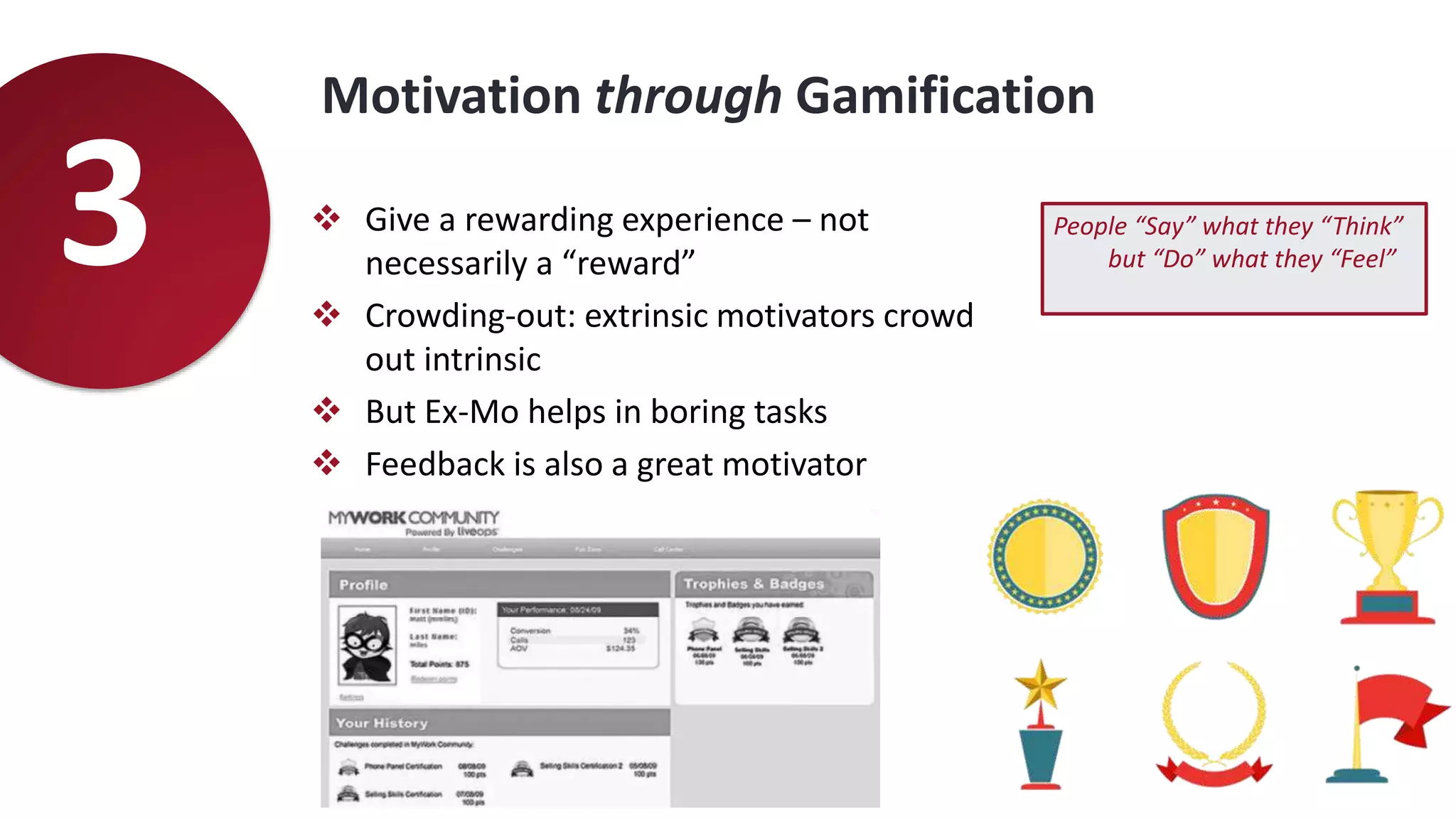
Motivation through Gamification
3  Give a rewarding experience – not
necessarily a “reward”
 Crowding-out: extrinsic motivators crowd
out intrinsic
 But Ex-Mo helps in boring tasks
 Feedback is also a great motivator
People “Say” what they “Think”
but “Do” what they “Feel”
TOOLKIT AND GAME ELEMENTSGamification
INTRODUCTION
• Club Pysch launched in 2010 built around USA
network’s successful TV program Psych.
• Mystery game Hash tag Killer – allows players to
stimulate interactions with the shows characters over
twitter and facebook.
• Mobile App – Pysch vision. Allows fans to unlock
prizes and chat with each other while redeeming
points for virtual goods or physical merchandise.
1
Points
• Encourage people to do things by collecting points.
• Points effectively keep score
• Points may determine the win state of a gamified
process.
• Points provide feedback quickly and easily.
• Points can be an external display of progress.
• Points provide data for the game designer.
2
Badges
• Representation of some achievement.
• Provides a goal to strive forward.
• Provide guidance.
• Symbol of what user cares about and has performed.
• Operate as virtual status symbols and affirmations.
• Function as tribal markers.
3
Leader boards
• The most troublesome part of the triad.
• Usually reduces performance rather than enhance it.
• A leader board can track one or multiple attributes
but one or many the designer to emphasize.
• They can also be tied to social networks to provide
more contextual information.
4
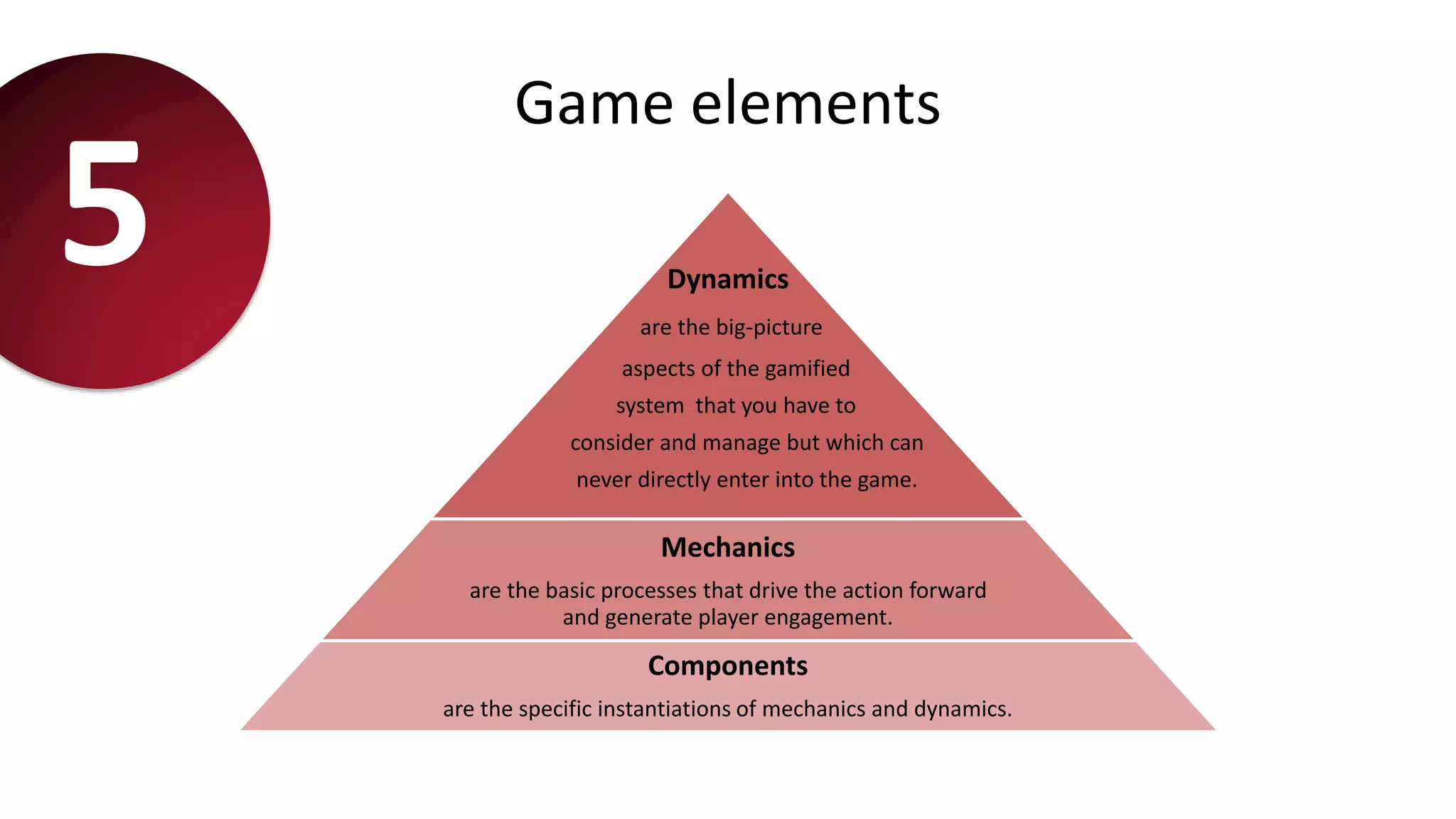
Game elements
Dynamics
are the big-picture
aspects of the gamified
system that you have to
consider and manage but which can
never directly enter into the game.
Mechanics
are the basic processes that drive the action forward
and generate player engagement.
Components
are the specific instantiations of mechanics and dynamics.
5
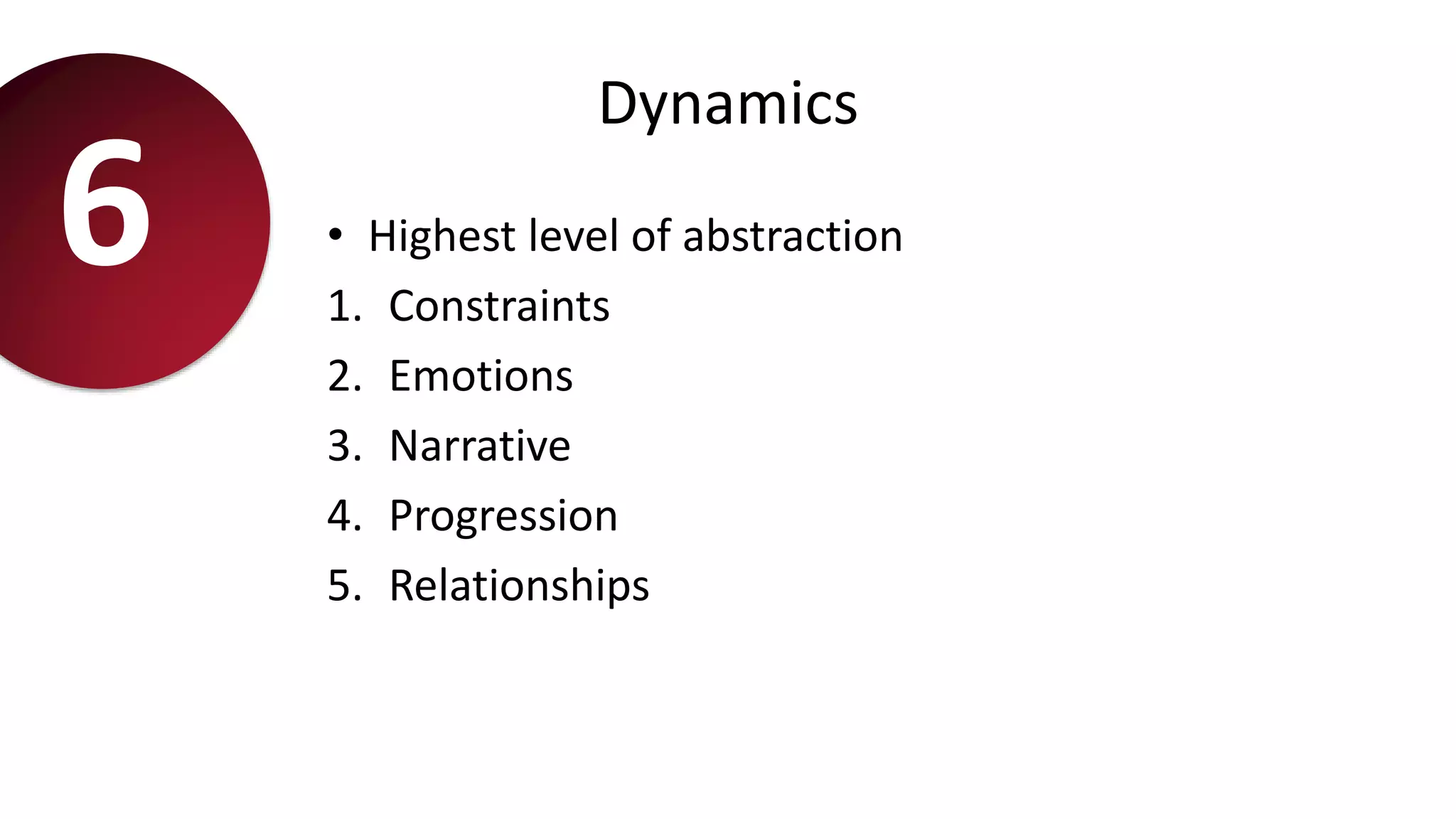
Dynamics
• Highest level of abstraction
1. Constraints
2. Emotions
3. Narrative
4. Progression
5. Relationships
6
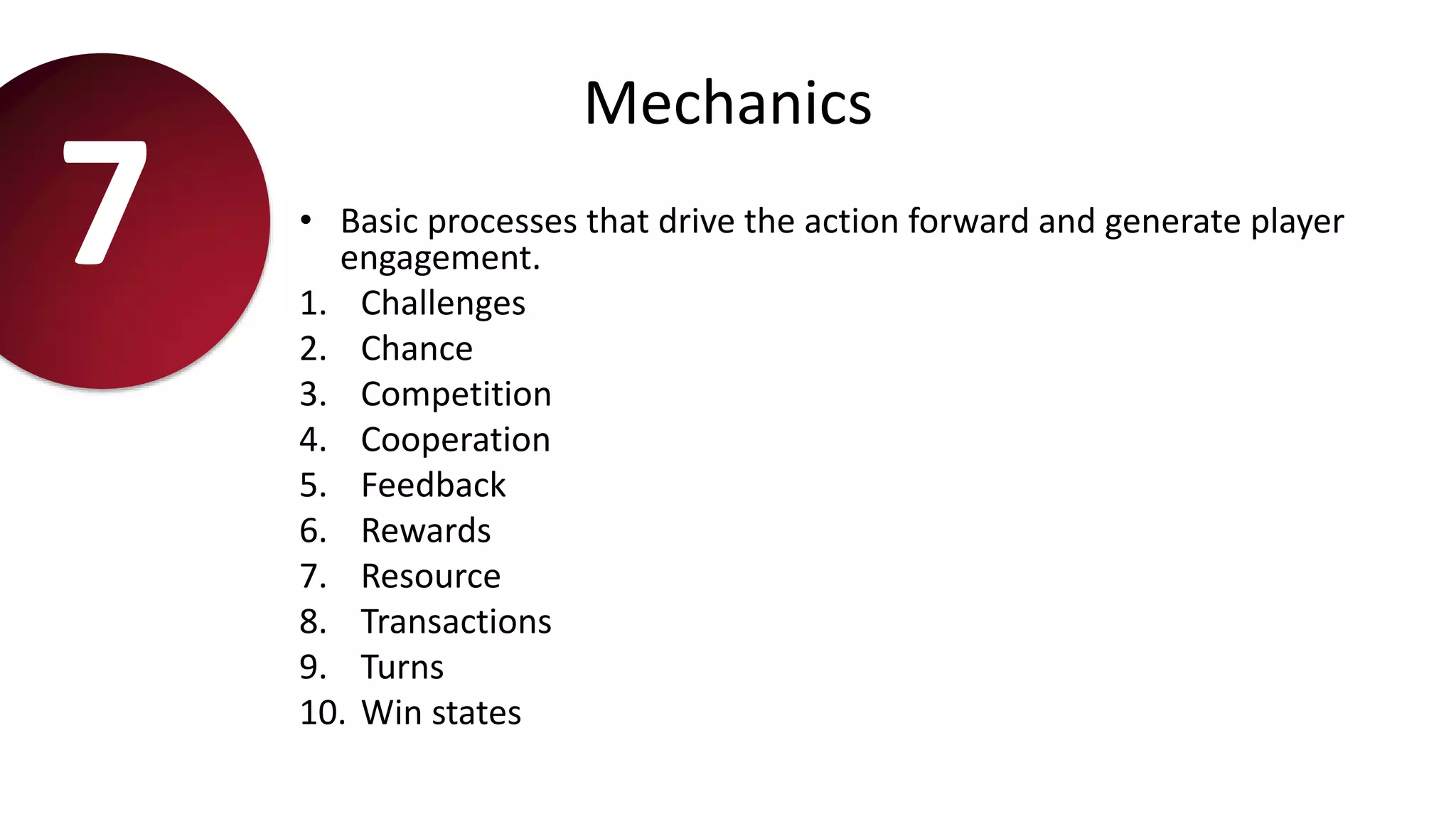
Mechanics
• Basic processes that drive the action forward and generate player
engagement.
1. Challenges
2. Chance
3. Competition
4. Cooperation
5. Feedback
6. Rewards
7. Resource
8. Transactions
9. Turns
10. Win states
7
Components
• Most specific form that mechanics or dynamics can take.
1. Achievements
2. Avatars
3. Badges
4. Points
5. Comfort
6. Levels
7. Quests
8. Virtual goods
8
Game Changer: Six Steps to
Gamification
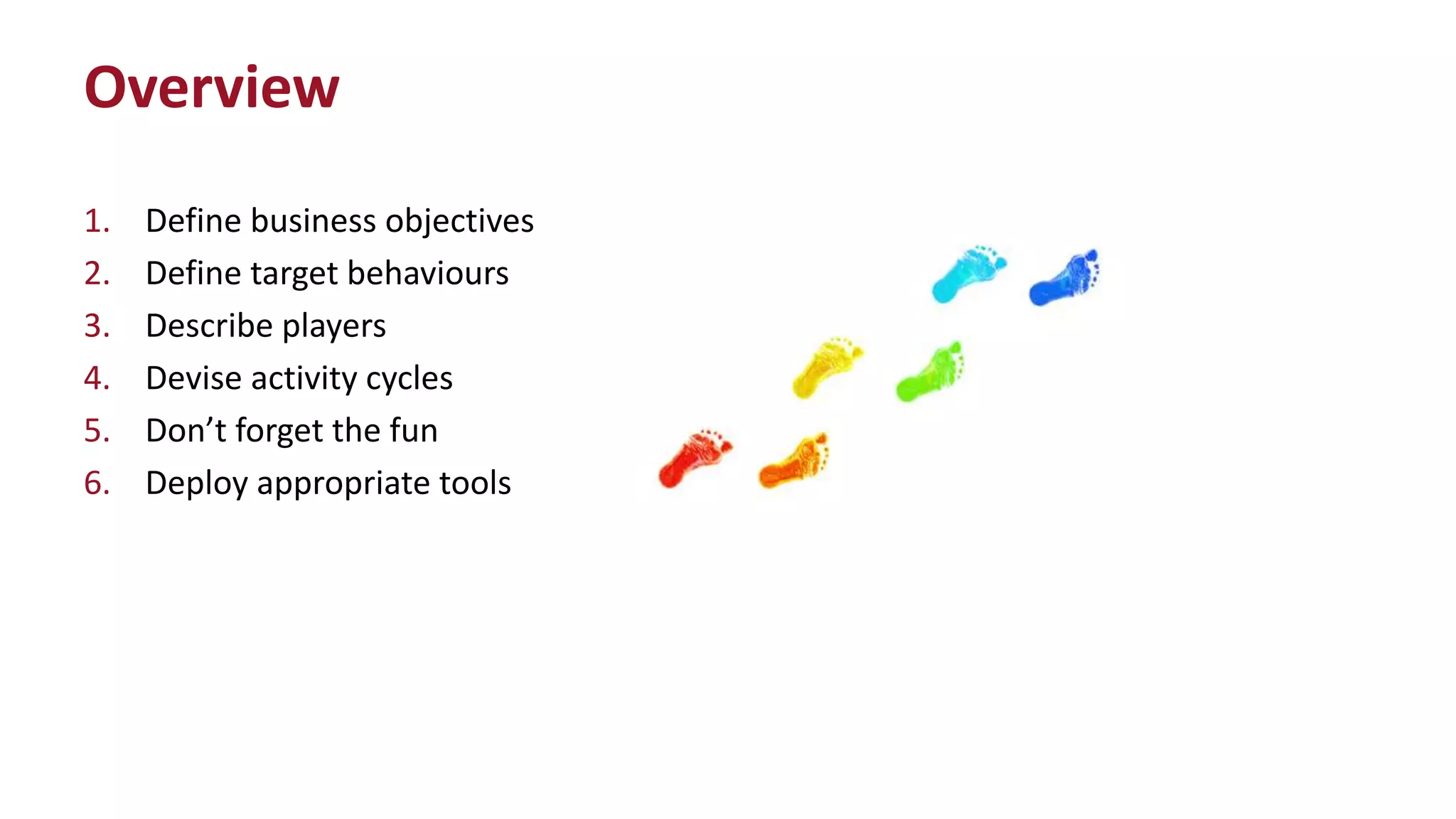
Gamification
1. Define business objectives
2. Define target behaviours
3. Describe players
4. Devise activity cycles
5. Don’t forget the fun
6. Deploy appropriate tools
Overview
Define business objectives
Specific performance goals for gamified systems
Increasing customer retention, brand loyalty, employee
productivity
Eg: Devhub(Website building tool)
Website building=Empire building game
Eight fold increase in users completing
Failed to attract users
Lesson-Being effective need not produce results
Stepping stone to a more important goal
1
Delineate target behaviours
Specific things you want Customers, Staff, etc.
Success Metrics (“win states”)
Analytics-Algorithm and data to measure key performance
indicators
Daily / Monthly average users
Virality – friend referrals – Pinterest, Zynga, etc.
Volume of Activity – how much activity, points, badges, etc.
Total goods purchased
2
Describe your players
• People playing your game?
• Demographics
• Psychographics – things they like to do, buy, etc.
help you “segment” – offer choices
• What motivates your players?
• Richard Bartle Player Type Model
• Achievers, Explorers, Socializers, Killers
• Avatars and player life cycles
3
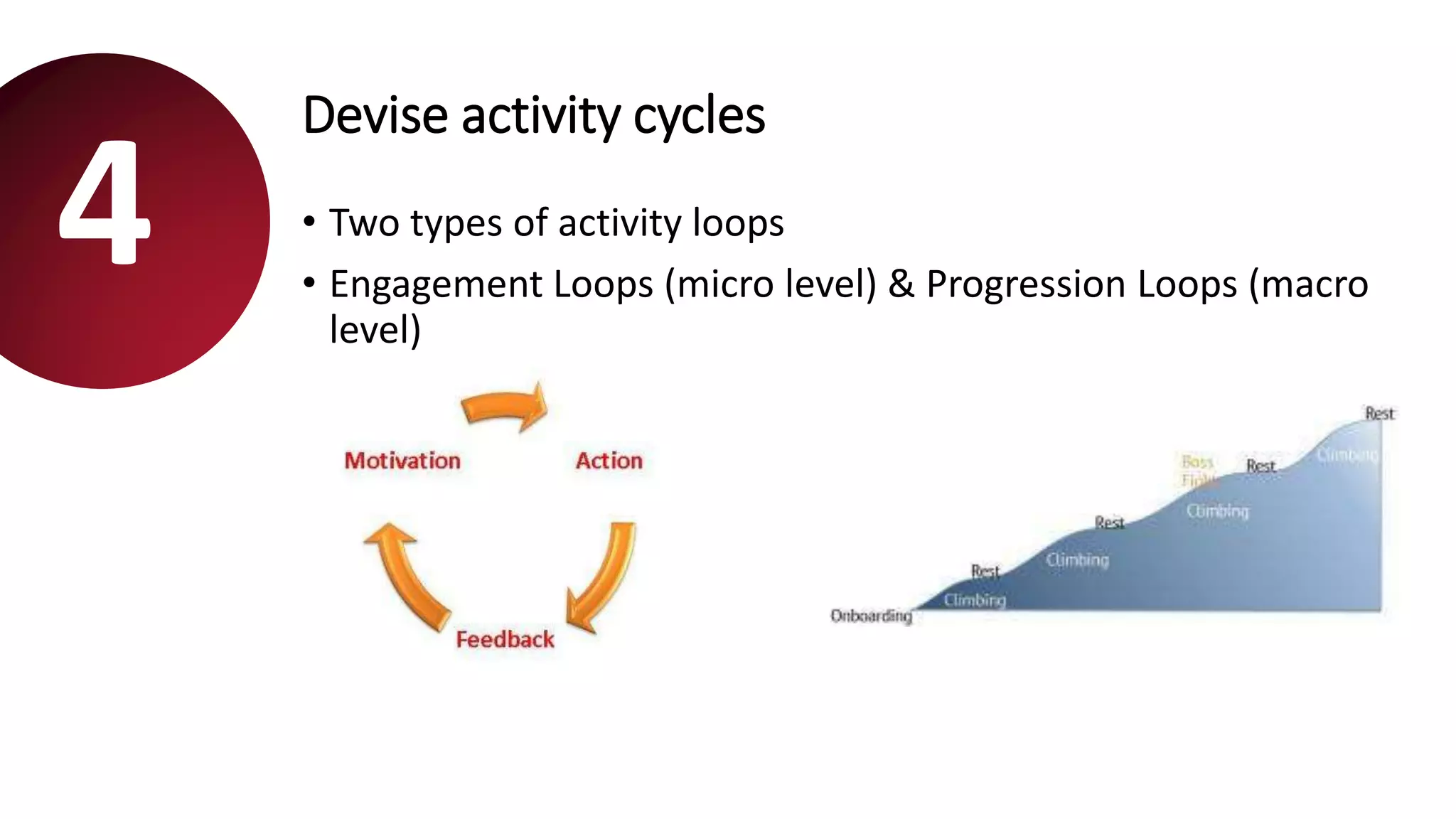
Devise activity cycles
• Two types of activity loops
• Engagement Loops (micro level) & Progression Loops (macro
level)
4
Don’t Forget the Fun!
• Getting wrapped up in the details
• Would players participate in your system voluntarily?
• Four distinct kinds of fun
• Hard fun, easy fun, altered states, the people factor
• Best games offer a broad spectrum of fun
5
Deploy the Appropriate Tools for the Job
• Picking the appropriate mechanics and components and coding
them into your systems
• Outside consulting firm
• Track interactions with game elements and integrate those
results with your existing business systems.
• Two basic options
• Building custom implementations yourself or use one of the
software-as-a-service offerings.
• Eg: Keas, Objective Logistics, Salesforce Rypple etc:
6
Epic Fails
And How to Avoid Them
Gamification
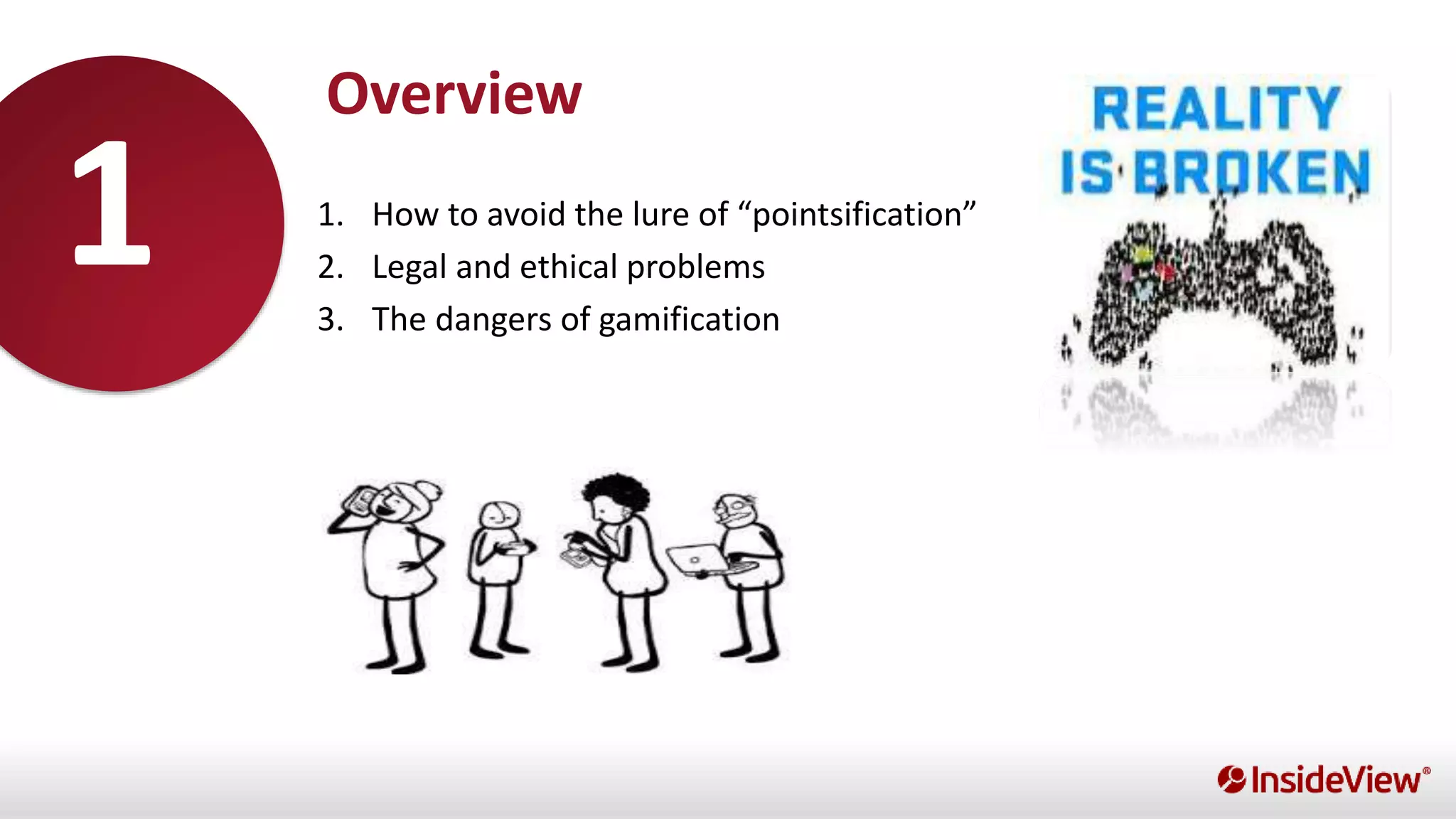
1. How to avoid the lure of “pointsification”
2. Legal and ethical problems
3. The dangers of gamification
Overview
1
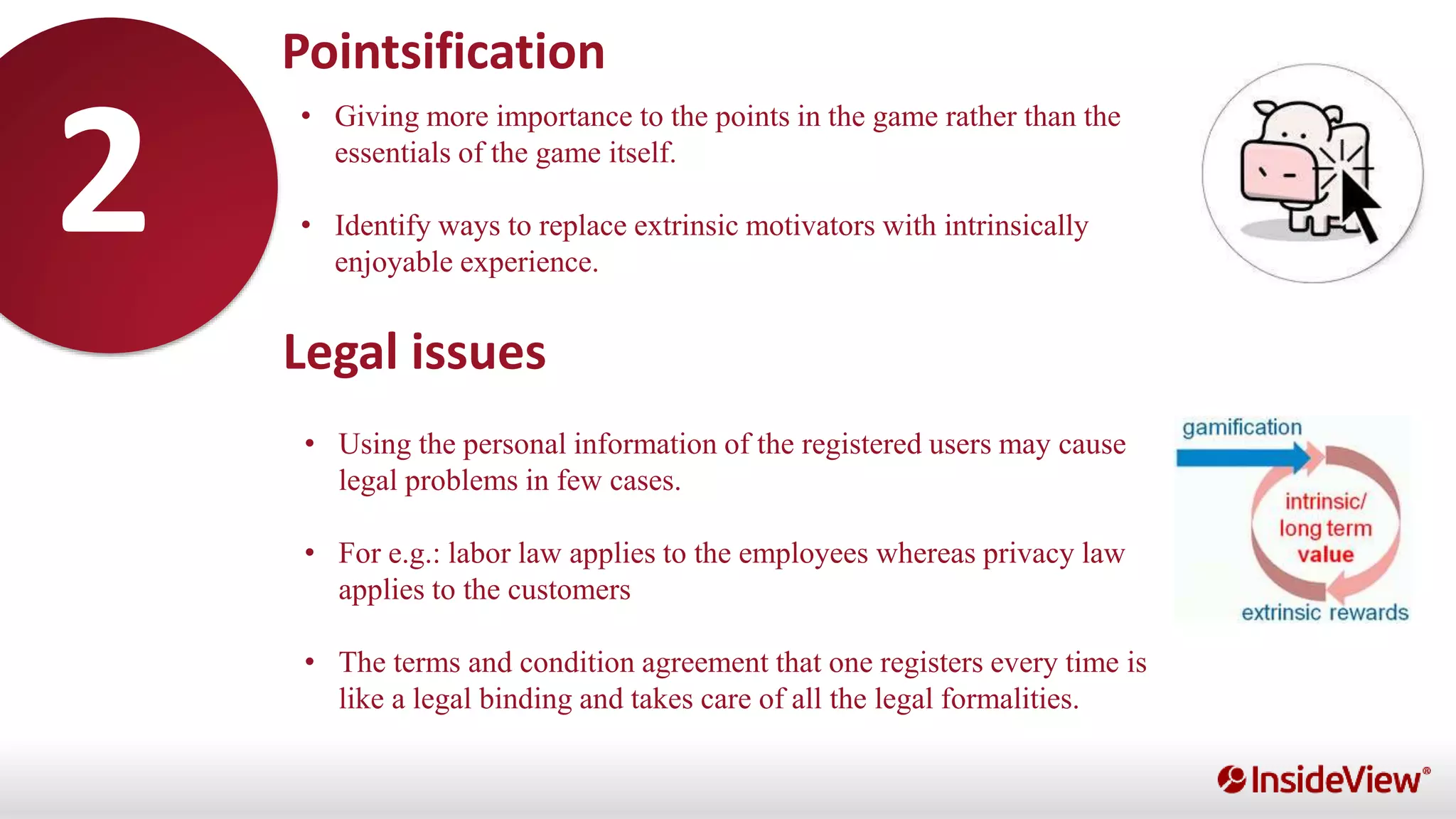
• Giving more importance to the points in the game rather than the
essentials of the game itself.
• Identify ways to replace extrinsic motivators with intrinsically
enjoyable experience.
Pointsification
Legal issues
• Using the personal information of the registered users may cause
legal problems in few cases.
• For e.g.: labor law applies to the employees whereas privacy law
applies to the customers
• The terms and condition agreement that one registers every time is
like a legal binding and takes care of all the legal formalities.
2
•
• The personal data of the user can be cross referenced and their prior
transaction history, age, and address can be easily amassed.
• Introducing a privacy policy by the designer helps the user to know for
what all purposes the personal data collected is used for and related
purposes.
• Having data security helps the personal data of the users from being
stolen or leaked.
Privacy
Intellectual Property
• Intellectual property: copyright, trademarks, patents, and trade
secrets.
• Registering the patent helps it from being copied by others and stops
lots of legal problems.
3
Property Rights in Virtual Assets
Deceptive Practices
Sweepstakes and Gambling
Advertising
• The assets that are owned by
the designer and the assets
owned by the user.
• The virtual assets can be owned
by the user which are
contractual licenses from the
game developers.
• Laws regulating sweepstakes,
gambling, and related activities.
• Depending on the circumstances,
gamified service might be
considered a sweepstakes, a
lottery, gambling, or a contest.
• Deceptive practices are where the
company frauds the users.
• The users do not have any
awareness if the company is
financially benefiting at their
expanse.
• Similar to deceptive practices
,the users must be made aware
if the game is for
advertisement purposes since
it benefits the developer.
34
Labor
Virtual Currency Regulation
Paid Endorsements
Future Legal Issues
• The employee cannot be made to
act against their own interest.
• The employer can generally use
performance in a game-like
system as a criterion for
promotion or firing .
• The products sponsored by the
creator for endorsement in social
media is known as paid
endorsement.
• Legal laws has adopted guidelines
requiring disclosure of paid
endorsements .
• Virtual currency are also under lots
of regulations and restrictions since
they are connected to real money.
• It is also accountable to
Accounting and taxation
• The legal rules should be
considered as the base for
gamification.
• Regulators and legislators be
more involved when gamification
becomes more
common.
5
Exploitation ware
• Gamification is a form of motivational techniques that operate through
fear rather than fun for the employees.
• Such a move forgoes all the benefits of intrinsic motivation. Gamification
done well creates powerful motivational impulses.
• Gamification should instead be called exploitationware since it exploits
people to do things against their interests or beliefs. Gamification will
come to be seen as one of many methods of regulating people’s behavior.
• The sense of autonomy that users experienced when finding unplanned
ways to exploit a gamified system also reinforced their intrinsic
engagement.
• The most successful practitioner recognize that the people at the other
end are people like them and to always expect the
unexpected.
Gaming the Game
6
Gamification in Digital Marketing

Gamification in Digital Marketing

  • 1.
  • 2.
    1. What isgamification? 2. Why are games valuable in serious business contexts? 3. How can game concepts be employed in your business? 4. When is gamification most effective? Overview
  • 3.
    What is Gamification? Google: Theapplication of typical elements of game playing to other areas of activity, typically as an online marketing technique to encourage engagement with a product or service. Wikipedia: Gamification is the use of game elements and game design techniques in non-game contexts. 1
  • 4.
    Importance There are anynumber of settings in which this approach can work, but at this early stage three non-game contexts are particularly prominent:  Internal- To improve productivity within the organization in order to foster innovation, enhance camaraderie, or otherwise derive positive business results through their own employees.  External-Improve the relationships between businesses and customers, producing increased engagement, identification with the product, stronger loyalty, and ultimately higher revenues.  Behavior change- To form beneficial new habits among a population. 2
  • 5.
    Game Concepts  Gamificationisn’t about building a full-fledged game. It’s just about using some elements of games, and because it operates at the level of elements, using gamification offers more flexibility than using a game.  Challenge of gamification therefore, is to take the elements that normally operate within the game universe and apply them effectively in the real world. 3
  • 6.
    How it isEffective ? 4 There are two compelling reasons why every business should at least consider gamification:  Engagement- Making your customers and employees to strengthen their relationship with your company, or to buy your product, or to engage with the goals of the company.  Experimentation- A second powerful aspect of game-based motivation is to open up the space of possibility. Mastering a game is all about experimentation.
  • 7.
    Game thinking: Learnto think like game designers Gamification
  • 8.
    1. What isa game? 2. How do I think like a game designer? 3. Will gamification solve my business problem? 4. How do I start? Overview
  • 9.
    Google: An activity thatone engages in for amusement. Wikipedia: A game is structured playing, usually undertaken for enjoyment and sometimes used as an educational tool. Merriam-Webster: A physical or mental activity or contest that has rules and that people do for pleasure.  It’s almost impossible to define any essential attribute of games. What is A game? 1
  • 10.
    Game Thinking  Gamethinking means using all the resources you can muster to create an engaging experience that motivates desired behaviours. [Ad1, Ad2]  Gamers try to win; game designers try to make gamers play.  Games are a process, not an outcome.  In a game, the sense of autonomy is always somewhat illusory. That’s true in business as well. 2
  • 11.
    Is Gamification rightfor my business challenge? • Motivation: Where would you derive value from encouraging behaviour? • Meaningful Choices: Are your target activities sufficiently interesting? • Structure: Can the desired behaviours be modelled through a set of algorithms? • Potential Conflicts: Can the game avoid conflicts with existing motivational structures? 3
  • 12.
    How do Istart? 4
  • 13.
  • 14.
    1. What doesresearch tell us about psychology and motivation? 2. How can I make use of extrinsic and intrinsic motivators? 3. How do I motivate behavior through gamification? Overview
  • 15.
  • 16.
    Theory of Motivation 1 “Move people to do something”  Intrinsic and Extrinsic  Games motivate people: engaging customers to encouraging employees
  • 17.
    Making use ofI/E Motivators 2  Behavior change – response to external stimuli  Reward and punishment  Self-Determination Theory: individuals are intrinsically proactive, but external environment should support 1. Competence: being effective in dealing with external environment 2. Relatedness: need to interact with society – family/friends 3. Autonomy: innate feeling to be in command of one’s life Games are developed to fulfill these needs
  • 18.
    Motivation through Gamification 3 Give a rewarding experience – not necessarily a “reward”  Crowding-out: extrinsic motivators crowd out intrinsic  But Ex-Mo helps in boring tasks  Feedback is also a great motivator People “Say” what they “Think” but “Do” what they “Feel”
  • 19.
    TOOLKIT AND GAMEELEMENTSGamification
  • 20.
    INTRODUCTION • Club Pyschlaunched in 2010 built around USA network’s successful TV program Psych. • Mystery game Hash tag Killer – allows players to stimulate interactions with the shows characters over twitter and facebook. • Mobile App – Pysch vision. Allows fans to unlock prizes and chat with each other while redeeming points for virtual goods or physical merchandise. 1
  • 21.
    Points • Encourage peopleto do things by collecting points. • Points effectively keep score • Points may determine the win state of a gamified process. • Points provide feedback quickly and easily. • Points can be an external display of progress. • Points provide data for the game designer. 2
  • 22.
    Badges • Representation ofsome achievement. • Provides a goal to strive forward. • Provide guidance. • Symbol of what user cares about and has performed. • Operate as virtual status symbols and affirmations. • Function as tribal markers. 3
  • 23.
    Leader boards • Themost troublesome part of the triad. • Usually reduces performance rather than enhance it. • A leader board can track one or multiple attributes but one or many the designer to emphasize. • They can also be tied to social networks to provide more contextual information. 4
  • 24.
    Game elements Dynamics are thebig-picture aspects of the gamified system that you have to consider and manage but which can never directly enter into the game. Mechanics are the basic processes that drive the action forward and generate player engagement. Components are the specific instantiations of mechanics and dynamics. 5
  • 25.
    Dynamics • Highest levelof abstraction 1. Constraints 2. Emotions 3. Narrative 4. Progression 5. Relationships 6
  • 26.
    Mechanics • Basic processesthat drive the action forward and generate player engagement. 1. Challenges 2. Chance 3. Competition 4. Cooperation 5. Feedback 6. Rewards 7. Resource 8. Transactions 9. Turns 10. Win states 7
  • 27.
    Components • Most specificform that mechanics or dynamics can take. 1. Achievements 2. Avatars 3. Badges 4. Points 5. Comfort 6. Levels 7. Quests 8. Virtual goods 8
  • 28.
    Game Changer: SixSteps to Gamification Gamification
  • 29.
    1. Define businessobjectives 2. Define target behaviours 3. Describe players 4. Devise activity cycles 5. Don’t forget the fun 6. Deploy appropriate tools Overview
  • 30.
    Define business objectives Specificperformance goals for gamified systems Increasing customer retention, brand loyalty, employee productivity Eg: Devhub(Website building tool) Website building=Empire building game Eight fold increase in users completing Failed to attract users Lesson-Being effective need not produce results Stepping stone to a more important goal 1
  • 31.
    Delineate target behaviours Specificthings you want Customers, Staff, etc. Success Metrics (“win states”) Analytics-Algorithm and data to measure key performance indicators Daily / Monthly average users Virality – friend referrals – Pinterest, Zynga, etc. Volume of Activity – how much activity, points, badges, etc. Total goods purchased 2
  • 32.
    Describe your players •People playing your game? • Demographics • Psychographics – things they like to do, buy, etc. help you “segment” – offer choices • What motivates your players? • Richard Bartle Player Type Model • Achievers, Explorers, Socializers, Killers • Avatars and player life cycles 3
  • 33.
    Devise activity cycles •Two types of activity loops • Engagement Loops (micro level) & Progression Loops (macro level) 4
  • 34.
    Don’t Forget theFun! • Getting wrapped up in the details • Would players participate in your system voluntarily? • Four distinct kinds of fun • Hard fun, easy fun, altered states, the people factor • Best games offer a broad spectrum of fun 5
  • 35.
    Deploy the AppropriateTools for the Job • Picking the appropriate mechanics and components and coding them into your systems • Outside consulting firm • Track interactions with game elements and integrate those results with your existing business systems. • Two basic options • Building custom implementations yourself or use one of the software-as-a-service offerings. • Eg: Keas, Objective Logistics, Salesforce Rypple etc: 6
  • 36.
    Epic Fails And Howto Avoid Them Gamification
  • 37.
    1. How toavoid the lure of “pointsification” 2. Legal and ethical problems 3. The dangers of gamification Overview 1
  • 38.
    • Giving moreimportance to the points in the game rather than the essentials of the game itself. • Identify ways to replace extrinsic motivators with intrinsically enjoyable experience. Pointsification Legal issues • Using the personal information of the registered users may cause legal problems in few cases. • For e.g.: labor law applies to the employees whereas privacy law applies to the customers • The terms and condition agreement that one registers every time is like a legal binding and takes care of all the legal formalities. 2
  • 39.
    • • The personaldata of the user can be cross referenced and their prior transaction history, age, and address can be easily amassed. • Introducing a privacy policy by the designer helps the user to know for what all purposes the personal data collected is used for and related purposes. • Having data security helps the personal data of the users from being stolen or leaked. Privacy Intellectual Property • Intellectual property: copyright, trademarks, patents, and trade secrets. • Registering the patent helps it from being copied by others and stops lots of legal problems. 3
  • 40.
    Property Rights inVirtual Assets Deceptive Practices Sweepstakes and Gambling Advertising • The assets that are owned by the designer and the assets owned by the user. • The virtual assets can be owned by the user which are contractual licenses from the game developers. • Laws regulating sweepstakes, gambling, and related activities. • Depending on the circumstances, gamified service might be considered a sweepstakes, a lottery, gambling, or a contest. • Deceptive practices are where the company frauds the users. • The users do not have any awareness if the company is financially benefiting at their expanse. • Similar to deceptive practices ,the users must be made aware if the game is for advertisement purposes since it benefits the developer. 34
  • 41.
    Labor Virtual Currency Regulation PaidEndorsements Future Legal Issues • The employee cannot be made to act against their own interest. • The employer can generally use performance in a game-like system as a criterion for promotion or firing . • The products sponsored by the creator for endorsement in social media is known as paid endorsement. • Legal laws has adopted guidelines requiring disclosure of paid endorsements . • Virtual currency are also under lots of regulations and restrictions since they are connected to real money. • It is also accountable to Accounting and taxation • The legal rules should be considered as the base for gamification. • Regulators and legislators be more involved when gamification becomes more common. 5
  • 42.
    Exploitation ware • Gamificationis a form of motivational techniques that operate through fear rather than fun for the employees. • Such a move forgoes all the benefits of intrinsic motivation. Gamification done well creates powerful motivational impulses. • Gamification should instead be called exploitationware since it exploits people to do things against their interests or beliefs. Gamification will come to be seen as one of many methods of regulating people’s behavior. • The sense of autonomy that users experienced when finding unplanned ways to exploit a gamified system also reinforced their intrinsic engagement. • The most successful practitioner recognize that the people at the other end are people like them and to always expect the unexpected. Gaming the Game 6