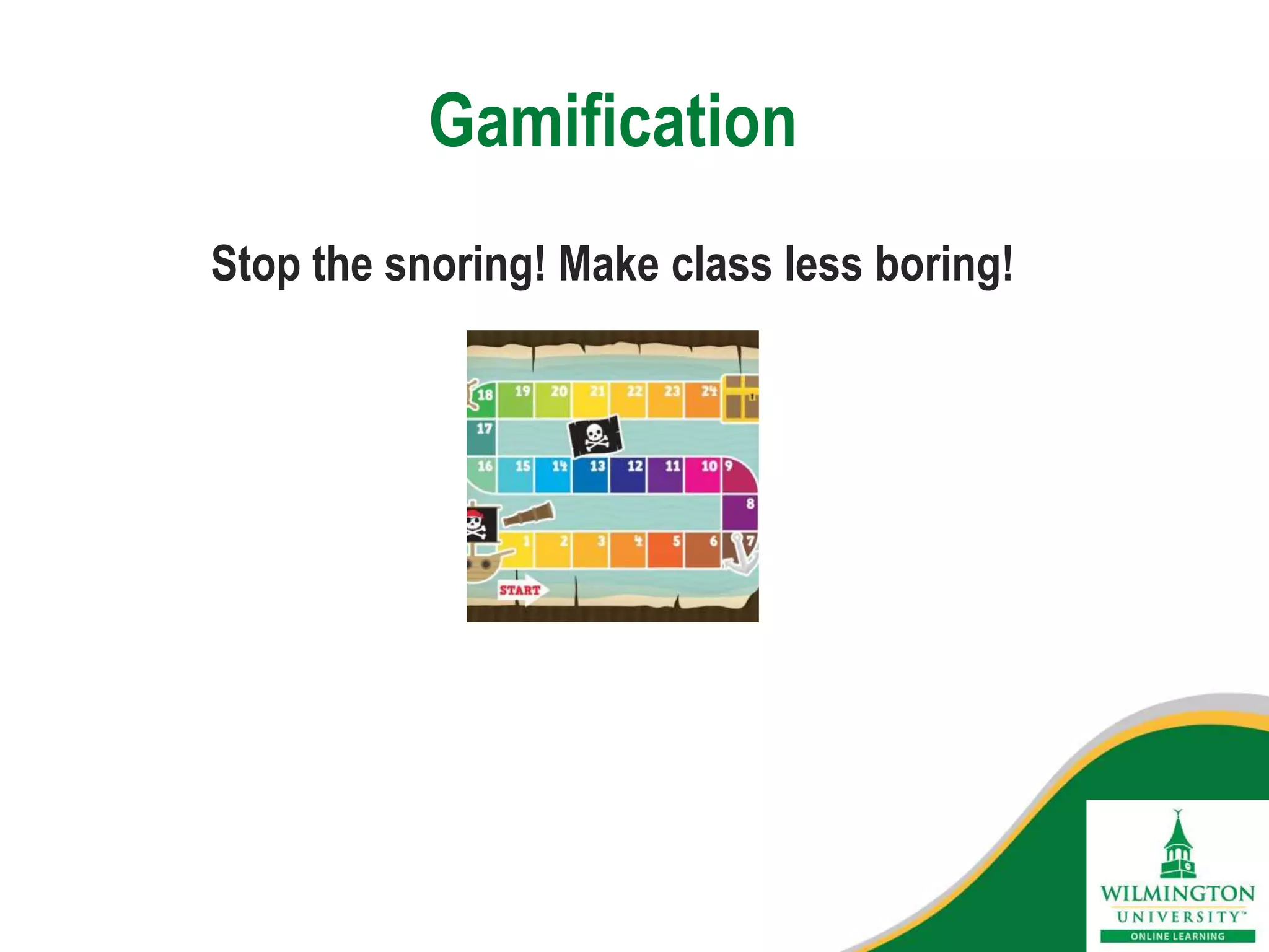
Gamification
Stop the snoring! Make class less boring!
Stephen Scheib
Instructional Designer and Adjunct
1. Objectives
2. What is Gamification? (and what is not)
3. Why Gamify?
4. The Learners
5. The Story
6. Game Mechanics
7. Other Tips
Agenda
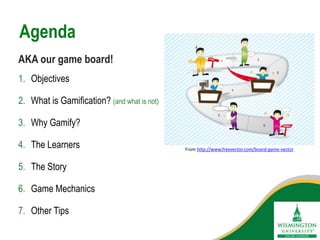
AKA our game board!
From http://www.freevector.com/board-game-vector
1. Identify game mechanics that can be used in a course or
training.
2. Identify different motivators for diverse learners.
3. Develop a plan to integrate game mechanics into a course or
training.
4. Create scenarios, situations, or a story idea to apply to a course
or training.
Objectives
As a result of this training, participants will be able to:
• Using “experience points”
instead of “grades”
• Entices learners by giving
positive feedback
• Builds motivation
What is Gamification?
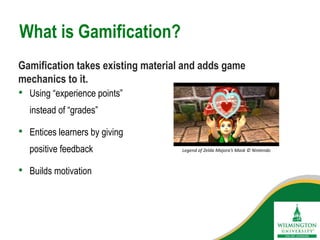
Gamification takes existing material and adds game
mechanics to it.
Legend of Zelda Majora’s Mask © Nintendo
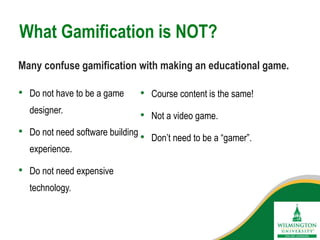
What Gamification is NOT?
• Course content is the same!
• Not a video game.
• Don’t need to be a “gamer”.
• Do not have to be a game
designer.
• Do not need software building
experience.
• Do not need expensive
technology.
Many confuse gamification with making an educational game.
Why Gamify?
• Sports
• Video Games
• Board Games
• Reading
• Puzzles
• Homework
Do any of these interest you?
Why or why not?
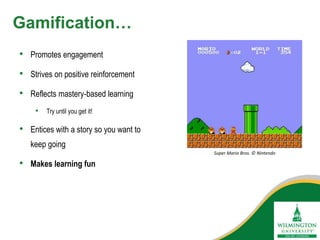
• Promotes engagement
• Strives on positive reinforcement
• Reflects mastery-based learning
• Try until you get it!
• Entices with a story so you want to
keep going
• Makes learning fun
Gamification…
Super Mario Bros. © Nintendo
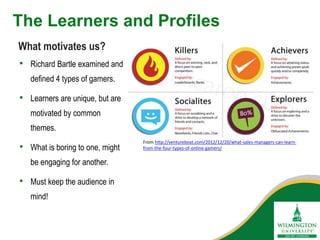
The Learners and Profiles
• Richard Bartle examined and
defined 4 types of gamers.
• Learners are unique, but are
motivated by common
themes.
• What is boring to one, might
be engaging for another.
• Must keep the audience in
mind!
What motivates us?
From http://venturebeat.com/2012/12/20/what-sales-managers-can-learn-
from-the-four-types-of-online-gamers/
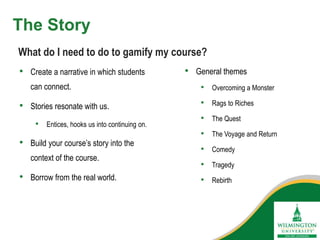
The Story
• Create a narrative in which students
can connect.
• Stories resonate with us.
• Entices, hooks us into continuing on.
• Build your course’s story into the
context of the course.
• Borrow from the real world.
What do I need to do to gamify my course?
• General themes
• Overcoming a Monster
• Rags to Riches
• The Quest
• The Voyage and Return
• Comedy
• Tragedy
• Rebirth
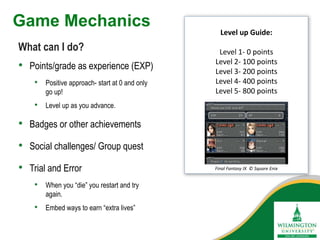
Game Mechanics
Level up Guide:
Level 1- 0 points
Level 2- 100 points
Level 3- 200 points
Level 4- 400 points
Level 5- 800 points
• Points/grade as experience (EXP)
• Positive approach- start at 0 and only
go up!
• Level up as you advance.
• Badges or other achievements
• Social challenges/ Group quest
• Trial and Error
• When you “die” you restart and try
again.
• Embed ways to earn “extra lives”
What can I do?
Final Fantasy IX © Square Enix
Tips for Gamifying
• Make a story/narrative
• Use pop culture or public domain
stories
• Develop characters
• Get a creative buddy or coworker to
help
• Focus on a problem or set of
problems
• Have students make avatars
• Promotes buy-in; gives a sense of
identity
Can be done in all formats (face-to-face, online, etc.)
• Create group assignments (quests)
• Groups = Guilds
• Who will win?
• Use adaptive release and achievements
• Badges
• Unlock extra credit/ make up opportunity
• Bonus questions for bonus points
• Hint for the next assignment or quiz for
getting 100%
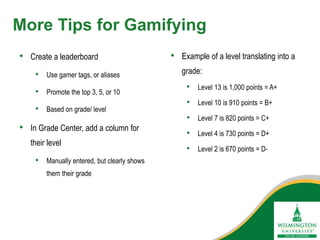
More Tips for Gamifying
• Create a leaderboard
• Use gamer tags, or aliases
• Promote the top 3, 5, or 10
• Based on grade/ level
• In Grade Center, add a column for
their level
• Manually entered, but clearly shows
them their grade
• Example of a level translating into a
grade:
• Level 13 is 1,000 points = A+
• Level 10 is 910 points = B+
• Level 7 is 820 points = C+
• Level 4 is 730 points = D+
• Level 2 is 670 points = D-
Other Recommendations
• Start small! Perfect one thing at a time
• Not every mechanic will apply to every
person
• Killers
• Achievers
• Socialites
• Explorers
• Map out your learning
• Objectives are checkpoints
• Good practice anyway, but now it is a map for
mastery!
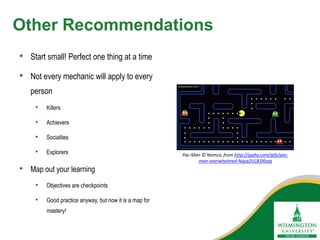
Pac-Man © Namco, from http://giphy.com/gifs/pac-
man-overwhelmed-Nqzq2ULB3Xbqg
Excellent Resources
• The Ultimate Guide to Gamifying Your Classroom By Amanda Ronan via
http://www.edudemic.com/ultimate-guide-gamifying-classroom/
• LMS Gamification: 7 Key Game Mechanics by Jill W. via
https://www.skillbuilderlms.com/lms-gamification-game-mechanics
• How gamification motivates: An experimental study of the effects of specific game
design elements on psychological need satisfaction by Sailer, M. et. Al
https://www.sciencedirect.com/science/article/pii/S074756321630855X
• The Gamification Guide by Chris Aviles (Teched Up Teacher)
http://www.techedupteacher.com/the-gamification-guide/
Questions?
E T O NQ U S ?S

Stop the Snoring! Make Class Less Boring-- Gamify!

  • 1.
    Gamification Stop the snoring!Make class less boring!
  • 2.
  • 3.
    1. Objectives 2. Whatis Gamification? (and what is not) 3. Why Gamify? 4. The Learners 5. The Story 6. Game Mechanics 7. Other Tips Agenda AKA our game board! From http://www.freevector.com/board-game-vector
  • 4.
    1. Identify gamemechanics that can be used in a course or training. 2. Identify different motivators for diverse learners. 3. Develop a plan to integrate game mechanics into a course or training. 4. Create scenarios, situations, or a story idea to apply to a course or training. Objectives As a result of this training, participants will be able to:
  • 5.
    • Using “experiencepoints” instead of “grades” • Entices learners by giving positive feedback • Builds motivation What is Gamification? Gamification takes existing material and adds game mechanics to it. Legend of Zelda Majora’s Mask © Nintendo
  • 6.
    What Gamification isNOT? • Course content is the same! • Not a video game. • Don’t need to be a “gamer”. • Do not have to be a game designer. • Do not need software building experience. • Do not need expensive technology. Many confuse gamification with making an educational game.
  • 7.
    Why Gamify? • Sports •Video Games • Board Games • Reading • Puzzles • Homework Do any of these interest you? Why or why not?
  • 8.
    • Promotes engagement •Strives on positive reinforcement • Reflects mastery-based learning • Try until you get it! • Entices with a story so you want to keep going • Makes learning fun Gamification… Super Mario Bros. © Nintendo
  • 9.
    The Learners andProfiles • Richard Bartle examined and defined 4 types of gamers. • Learners are unique, but are motivated by common themes. • What is boring to one, might be engaging for another. • Must keep the audience in mind! What motivates us? From http://venturebeat.com/2012/12/20/what-sales-managers-can-learn- from-the-four-types-of-online-gamers/
  • 10.
    The Story • Createa narrative in which students can connect. • Stories resonate with us. • Entices, hooks us into continuing on. • Build your course’s story into the context of the course. • Borrow from the real world. What do I need to do to gamify my course? • General themes • Overcoming a Monster • Rags to Riches • The Quest • The Voyage and Return • Comedy • Tragedy • Rebirth
  • 11.
    Game Mechanics Level upGuide: Level 1- 0 points Level 2- 100 points Level 3- 200 points Level 4- 400 points Level 5- 800 points • Points/grade as experience (EXP) • Positive approach- start at 0 and only go up! • Level up as you advance. • Badges or other achievements • Social challenges/ Group quest • Trial and Error • When you “die” you restart and try again. • Embed ways to earn “extra lives” What can I do? Final Fantasy IX © Square Enix
  • 12.
    Tips for Gamifying •Make a story/narrative • Use pop culture or public domain stories • Develop characters • Get a creative buddy or coworker to help • Focus on a problem or set of problems • Have students make avatars • Promotes buy-in; gives a sense of identity Can be done in all formats (face-to-face, online, etc.) • Create group assignments (quests) • Groups = Guilds • Who will win? • Use adaptive release and achievements • Badges • Unlock extra credit/ make up opportunity • Bonus questions for bonus points • Hint for the next assignment or quiz for getting 100%
  • 13.
    More Tips forGamifying • Create a leaderboard • Use gamer tags, or aliases • Promote the top 3, 5, or 10 • Based on grade/ level • In Grade Center, add a column for their level • Manually entered, but clearly shows them their grade • Example of a level translating into a grade: • Level 13 is 1,000 points = A+ • Level 10 is 910 points = B+ • Level 7 is 820 points = C+ • Level 4 is 730 points = D+ • Level 2 is 670 points = D-
  • 14.
    Other Recommendations • Startsmall! Perfect one thing at a time • Not every mechanic will apply to every person • Killers • Achievers • Socialites • Explorers • Map out your learning • Objectives are checkpoints • Good practice anyway, but now it is a map for mastery! Pac-Man © Namco, from http://giphy.com/gifs/pac- man-overwhelmed-Nqzq2ULB3Xbqg
  • 15.
    Excellent Resources • TheUltimate Guide to Gamifying Your Classroom By Amanda Ronan via http://www.edudemic.com/ultimate-guide-gamifying-classroom/ • LMS Gamification: 7 Key Game Mechanics by Jill W. via https://www.skillbuilderlms.com/lms-gamification-game-mechanics • How gamification motivates: An experimental study of the effects of specific game design elements on psychological need satisfaction by Sailer, M. et. Al https://www.sciencedirect.com/science/article/pii/S074756321630855X • The Gamification Guide by Chris Aviles (Teched Up Teacher) http://www.techedupteacher.com/the-gamification-guide/
  • 16.