DEVELOPMENTAL
ANATOMY
Primordial Germ Cells
Primordial germ cells (PGCs) forms the male and
female Gametes.
they are formed in the epiblast during the second
week and move to the wall of the yolk sac.
in the 4th week they migrate from the yolk sac to
developing gonads, where they arrive by the end of
the 5th week and begins mitotic devisions.
In preparation for fertilization, germ cells undergo
gametogenesis, which includes meiosis, to reduce
the number of chromosomes and cytodifferentiation
to complete their maturation.
The Chromosome Theory of Inheritance
Humans have approximately 35,000 genes on 46
chromosomes. Genes on the same chromosome
tend to be inherited together and so are known as
linked genes.
In somatic cells, chromosomes appear as 23
homologous pairs to form the diploid number of 46.
There are 22 pairs of matching chromosomes, the
autosomes, and one pair of sex chromosomes.
If these x pair is XX, the individual is genetically
female;
if the pair is XY, the individual is genetically male.
One chromosome of each pair is derived from
the maternal gamete, the oocyte, and one from
the paternal gamete, the sperm. Thus each
gamete contains a haploid number of 23
chromosomes, and the union of the gametes at
fertilization restores the diploid number of 46.
MITOSIS is the process whereby one cell divides, giving rise
to two daughter cells that are genetically identical to the
parent cell
Each daughter cell receives the complete complement of
46chromosomes. Before a cell enters mitosis, each
chromosome replicates its deoxyribonucleic acid (DNA).
During this replication phase the chromosomes are
extremely long, they are spread diffusely through the
nucleus, and they cannot be recognized with the light
microscope. With the onset of mitosis the chromosomes
begin to coil, contract, and condense; these events mark
the beginning of prophase. Each chromosome now
consists of two parallel subunits, chromatids, that are
joined at a narrow region common to both called the
centromere.
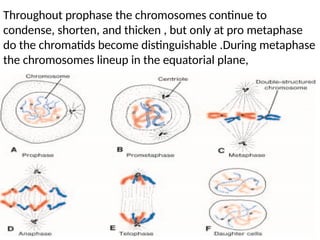
Throughout prophase the chromosomes continue to
condense, shorten, and thicken , but only at pro metaphase
do the chromatids become distinguishable .During metaphase
the chromosomes lineup in the equatorial plane,
MEIOSIS
1. is the cell division that takes place in the germ cells to
generate male and female gametes .
2. in mitosis one male and female germ cells 46
chromosomes each
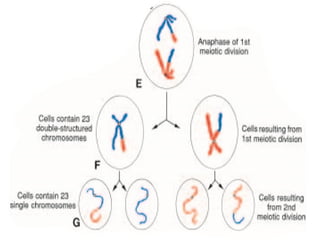
3. Meiosis occurs in two phases, meiosis I and meiosis II,
to reduce the number of chromosomes to the haploid
number of 23.
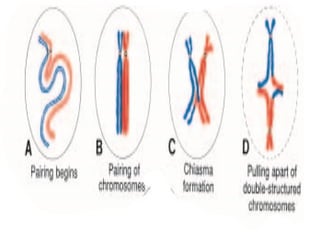
4. homologous chromosomes then align themselves in
pairs, a process called synapsis.
5. Homologous pairs then separate into two daughter
cells.
6. meiosis II separates sister chromatids. Each gamete
then contains 23 chromosomes.
Crossover
1. Interchange of chromatid segments between paired
homologous chromosomes .
2. Result of meiotic divisions are
 Genetic variability
 Redistributes genetic material
 Each germ cell forms a 23 haploid number of
chromosome
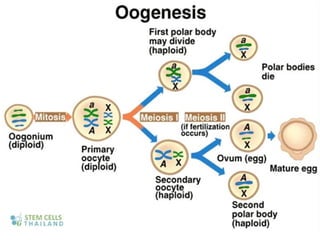
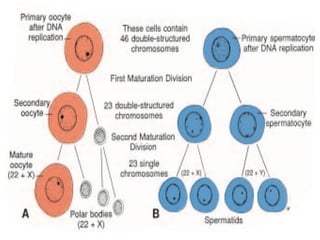
 one primary oocyte gives rise to four daughter cells,
each with22 plus X chromosomes and only one of these
develops into a mature gamete, the oocyte
Polar Bodies
is a small haploid cell that is formed at the same time as an
egg cell during oogenesis but generally does not have the
ability to be fertilized.
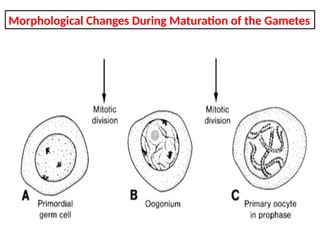
Morphological Changes During Maturation of the Gametes
OOGENESIS
1. Maturation of Oocytes Begins Before Birth Once
2. Primordial germ cells differentiate into oogonia and
undergo a number of mitotic divisions
3. By the end of the third month, are arranged in clusters
surrounded by a layer of flat epithelial
4. Oogonia in one cluster are probably derived from a
single cell.
5. The flat epithelial cells, known as follicular cells,
originate from surface epithelium covering the ovary.
1. The majority of oogonia continue to divide by mitosis,
but some of them arrest their cell division in prophase
and form primary oocytes.
2. During the next few months, oogonia increase rapidly
in number.
3. By the fifth month of prenatal development, the total
number of germ cells in the ovary reaches its
maximum, estimated at 7 million.
4. At this time, cell death begins, and many oogonia as
well as primary oocytes become atretic.
5. By the seventh month, the majority of oogonia have
degenerated except for a few near the surface.
1. All surviving primary oocytes have entered prophase of
meiosis I, and most of them are individually surrounded
by a layer of flat epithelial cells.
2. A primary oocyte, together with its surrounding flat
epithelial cells, is known as a primordial follicle.
3. Maturation of Oocytes Continues at Puberty Near the
time of birth, all primary oocytes have started prophase
of meiosis I, but instead of proceeding into metaphase,
they enter the diplotene stage, a resting stage during
prophase that is characterized by a lacy network of
chromatin
4. Primary oocytes remain in prophase and do not finish
their first meiotic division before puberty is reached,
5. apparently because of oocyte maturation
inhibitor(OMI),a substance secreted by follicular cells.
1. The total number of primary oocytes at birth is
estimated to vary from 700,000 to 2 million.
2. During childhood most oocytes become atretic; only
approximately 400,000 are present by the beginning of
puberty, and fewer than 500 will be ovulated.
3. Some oocytes that reach maturity late in life have been
dormant in the diplotene stage of the first meiotic
division for 40 years or more before ovulation.
4. the risk of having children with chromosomal
abnormalities increases with maternal age indicates
that primary oocytes are vulnerable to damage as they
age.
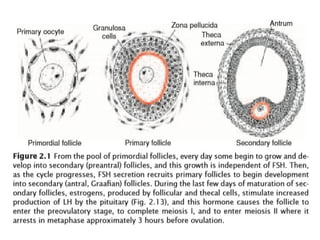
1. At puberty, a pool of growing follicles is established and
continuously maintained from the supply of primordial
follicles. Each month, 15 to 20 follicles selected from
this pool begin to mature, passing through three stages:
1) primary or preantral
2) secondary or antral (also called vesicular or Graafian);
3) preovulatory.
2: The antral stage is occurs 37 hours before ovulation
and primary oocyte begins to grow, surrounding follicular
cells change from flat to cuboidal and proliferate to
produce a stratified epithelium of granulosa cells, and the
unit is called a primary follicle .
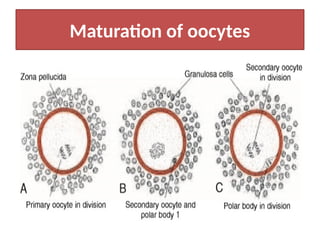
Maturation of oocytes
1. Oocyte secrete a layer of glycoproteins on the surface
of the oocyte, forming the zona pellucida .
2. Each ovarian cycle, a number of follicles begin to
develop, but usually only one reaches full maturity.
3. When the secondary follicle is mature, a surge in
luteinizing hormone (LH) induces the preovulatory
growth phase. Meiosis I is completed, resulting
information of two daughter cells of unequal size, each
with23double structured chromosomes and one cell,
the secondary oocyte, receives most of the cytoplasm
1. The cell then enters meiosis II but arrests in
metaphase approximately 3 hours before ovulation.
Meiosis II is completed only if the oocyte is fertilized;
otherwise, the cell degenerates approximately 24
hours after ovulation.
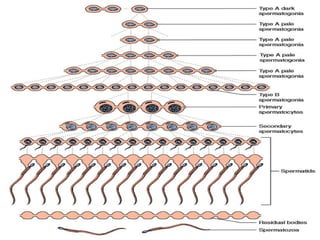
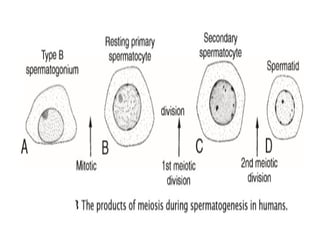
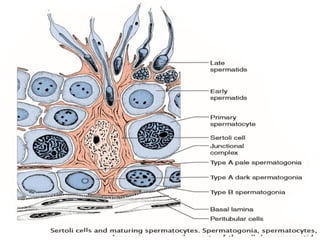
Spermatogenesis is the process by which haploid spermatozoa
develop from germ cells in the seminiferous tubules of the testicle .
This process starts with the mitotic division of the stem cells
located close to the basement membrane of the tubules. These
cells are called spermatogonial stem cells . The mitotic division of
these produces two types of cells. Type A cells replenish the stem
cells, and type B cells differentiate into primary spermatocytes . The
primary spermatocyte divides meiotically (Meiosis I) into two
secondary spermatocytes; each secondary spermatocyte divides
into two equal haploid spermatids by Meiosis II. The spermatids are
transformed into spermatozoa (sperm) by the process of
spermiogenesis . These develop into mature spermatozoa, also
known as sperm cells .[
Thus, the primary spermatocyte gives rise to
two cells, the secondary spermatocytes, and the two secondary
spermatocytes by their subdivision produce four spermatozoa and
four haploid cells
Spermatogenesis is regulated by luteinizing hormone (LH)
production by the pituitary. LH binds to receptors on Leydig
cells and stimulates testosterone production, which in turn
binds to Sertoli cells to promote spermatogenesis. Follicle
stimulating hormone (FSH) is also essential because its
binding to Sertoli cells stimulates testicular fluid production
and synthesis of intracellular androgen receptor proteins.
Duration
For humans, the entire process of spermatogenesis is
variously estimated as taking 74 days and approximately
120 days (according to DNA clock measurements).
Including the transport on ductal system, it takes 3 months.
Testes produce 200 to 300 million spermatozoa daily.
However, only about half or 100 million of these become
viable sperm
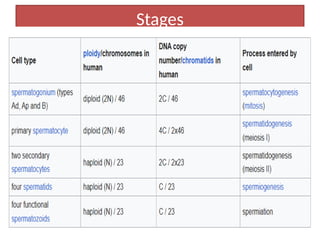
Stages
First Week of Development: Ovulation to Implantation
Ovarian Cycle
At puberty, the female begins to undergo regular monthly
cycles. These sexual cycles are controlled by the
hypothalamus. Gonadotropin-releasing hormone (GnRH)
produced by the hypothalamus acts on cells of the anterior
pituitary gland, which in turn secrete gonadotropins. These
hormones, follicle-stimulating hormone (FSH) and luteinizing
hormone (LH), stimulate and control cyclic changes in the
ovary.
At the beginning of each ovarian cycle, 15 to 20 primary
(preantral) stage follicles are stimulated to grow under the
influence of FSH. (The hormone is not necessary to
promote development of primordial follicles to the
primary follicle stage, but without it, these primary
follicles die and become atretic.) Thus, FSH rescues 15 to
20 of these cells from a pool of continuously forming
primary follicles . Under normal conditions, only one of
these follicles reaches full maturity, and only one oocyte is
discharged; the others degenerate and become atretic.
In the next cycle, another group of primary follicles is
recruited, and again, only one follicle reaches maturity.
Consequently, most follicles degenerate without ever
reaching full maturity. When a follicle becomes atretic, the
oocyte and surrounding follicular cells degenerate and are
replaced by connective tissue, forming a corpus atreticum.
FSH also stimulates maturation of follicular (granulosa)
cells surrounding the oocyte
granulosa and thecal cells produce estrogens that (a)
cause the uterine endometrium to enter the follicular or
proliferative phase; (b) cause thinning of the cervical
mucus to allow passage of sperm; and (c) stimulate the
pituitary gland to secrete LH. At mid-cycle, there is an LH
surge that (a) elevates concentrations of maturation-
promoting factor, causing oocytes to complete meiosis I
and initiate meiosis II; (b) stimulates production of
progesterone by follicular stromal cells (luteinization); and
(c) causes follicular rupture and ovulation.
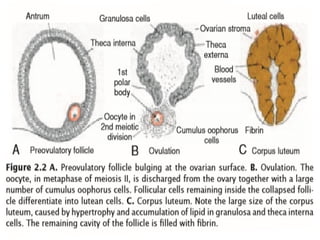
OVULATION
In the days immediately preceding ovulation, under the
influence of FSH and LH, the secondary follicle grows
rapidly to a diameter of 25 mm. Coincident with final
development of the secondary follicle, there is an abrupt
increase in LH that causes the primary oocyte to complete
meiosisI and the follicle to enter the preovulatory stage.
Meiosis II is also initiated, but the oocyte is arrested in
metaphase approximately 3 hours before ovulation. In the
meantime, the surface of the ovary begins to bulge locally,
and at the apex, an avascular spot,
The high concentration of LH increases collagenase
activity, resulting in digestion of collagen fibers
surrounding the follicle. Prostaglandin levels also increase
in response to the LH surge and cause local muscular
contractions in the ovarian wall. Those contractions
extrude the oocyte, which together with its surrounding
granulosa cells from the region of the cumulus oophorus,
breaks free (ovulation) and floats out of the ovary. Some
of the cumulus oophorus cells then rearrange themselves
around the zona pellucida to form the corona radiata
CORPUS LUTEUM
After ovulation, granulosa cells remaining in the wall of
the ruptured follicle, together with cells from the theca
interna, a revascularized by surrounding vessels. Under
the influence of LH, these cells develop a yellowish
pigment and change into lutean cells, which form the
corpus luteum and secrete the hormone progesterone .
Progesterone, together with estrogenic hormones, causes
the uterine mucosa to enter the progestational or
secretory stage in preparation for implantation of the
embryo.
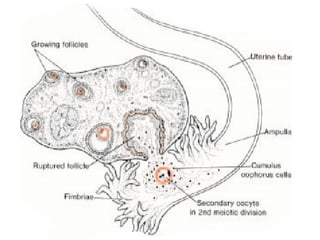
OOCYTE TRANSPORT
Shortly before ovulation, fimbriae of the oviduct begin to
sweep over the surface of the ovary, and the tube it self
begins to contract rhythmically. It is thought that the
oocyte surrounded by some granulosa cells is carried into
the tube by these sweeping movements of the fimbriae
and by motion of cilia on the epithelial lining. Once in the
tube, cumulus cells withdraw their cytoplasmic processes
from the zona pellucida and lose contact with the oocyte.
Once the oocyte is in the uterine tube, it is propelled by
cilia with the rate of transport regulated by the endocrine
status during and after ovulation. In humans, the fertilized
oocyte reaches the uterine lumen in approximately 3 to 4
days.
CORPUS ALBICANS (Latin for "whitening body"; also
known as atretic corpus luteum)
If fertilization does not occur, the corpus luteum reaches
maximum development approximately 9 days after
ovulation. It can easily be recognized as a yellowish
projection on the surface of the ovary. Subsequently, the
corpus luteum shrinks because of degeneration of lutean
cells and forms a mass of fibrotic the corpus albicans.
Simultaneously, progesterone production decreases,
precipitating menstrual bleeding.
If the oocyte is fertilized, degeneration of the corpus luteum
is prevented by human chorionic gonadotropin (hCG), a
hormone secreted by the syncytiotrophoblast of the
developing embryo. The corpus luteum continues to grow
and forms the corpus luteum of pregnancy (corpus luteum
graviditatis). By the end of the third month, this structure
may be one-third to one-half of the total size of the ovary.
Yellowish luteal cells continue to secrete progesterone until
the end of the fourth month; there after,they regress slowly
as secretion of progesterone by the trophoblastic
component of the placenta becomes adequate for
maintenance of pregnancy. Removal of the corpus luteum
of pregnancy before the fourth month usually leads to
abortion.
Fertilization
The process by which male and female gametes fuse,
occurs in the ampullary region of the uterine tube. This is
the widest part of the tube and is close to the ovary .
Spermatozoa may remain viable in the female reproductive
tract for several days. Only 1% of sperm deposited in the
vagina enter the cervix, where they may survive for many
hours. Movement of sperm from the cervix to the oviduct
is accomplished primarily by their own propulsion,
although they may be assisted by movements of fluids
created by uterine cilia. The trip from cervix to oviduct
requires a minimum of 2 to 7 hours, and after reaching the
isthmus, sperm become less motile and cease their
migration.
At ovulation, sperm again become motile, perhaps
because of chemo attractants produced by cumulus cells
surrounding the egg, and swim to the ampulla where
fertilization usually occurs. Spermatozoa are not able to
fertilize the oocyte immediately upon arrival in the female
genital tract but must undergo (a) capacitation and (b) the
acrosome reaction to acquire this capability.
Capacitation is a period of conditioning in the female
reproductive tract that in the human lasts approximately 7
hours. Much of this conditioning, which occurs in the
uterine tube, entails epithelial interactions between the
sperm and mucosal surface of the tube. During this time a
glycoprotein coat and seminal plasma proteins are
removed from the plasma membrane that overlies the
acrosomal region of the spermatozoa. Only capacitated
sperm can pass through the corona cells and undergo the
acrosome reaction.
The acrosome reaction, which occurs after binding to the
zona pellucida, is induced by zona proteins.This reaction
culminates in the release of enzymes needed to penetrate
the zona pellucida, including acrosin and trypsin-like
substances .
The phases of fertilization include
phase 1: Penetration of the corona radiata
phase 2: Penetration of the zona pellucida
phase 3: Fusion of the oocyte and sperm cell membranes.
PHASE 1:
PENETRATION OF THE CORONA RADIATA Of the 200 to
300 million spermatozoa deposited in the female genital
tract, only 300 to 500 reach the site of fertilization. Only
one of these fertilizes the egg. It is thought that the
others aid the fertilizing sperm in penetrating the barriers
protecting the female gamete. Capacitated sperm pass
freely through corona cells .
PHASE 2:
PENETRATION OF THE ZONA PELLUCIDA
The zona is a glycoprotein shell surrounding the egg that
facilitates and maintains sperm binding and induces the
acrosome reaction. Both binding and the acrosome
reaction are mediated by the ligand ZP3, a zona protein.
Release of acrosomal enzymes (acrosin) allows sperm to
penetrate the zona, thereby coming in contact with the
plasma membrane of the oocyte . Permeability of the
zona pellucida changes when the head of the sperm
comes in contact with the oocyte surface. This contact
results in release of lysosomal
enzymes from cortical granules lining the plasma
membrane of the oocyte. In turn, these enzymes alter
properties of the zona pellucida (zona reaction) to prevent
sperm penetration and inactivate species-specific receptor
sites for spermatozoa on the zona surface.Other
spermatozoa have been found embedded in the zona
pellucida,but only one seems tobe able to penetrate the
oocyte.
PHASE 3: FUSION OF THE OOCYTE AND SPERM CELL
MEMBRANES
The initial adhesion of sperm to the oocyte is mediated in
part by the interaction of integrins on the oocyte and their
ligands, disintegrins , on sperm. After adhesion, the plasma
membranes of the sperm and egg fuse. Because the plasma
membrane covering the acrosomal head cap disappears
during the acrosome reaction, actual fusion is accomplished
between the oocyte membrane and the membrane that
covers the posterior region of the sperm head . In the
human, both the head and tail of the spermatozoon enter
the cytoplasm of the oocyte, but the plasma membrane is
left behind on the oocyte surface. As soon as the
spermatozoon has entered the oocyte, the egg responds in
three ways:
1. Cortical and zona reactions .
As a result of the release of cortical oocyte granules, which
contain lysosomal enzymes,
(a) the oocyte membrane becomes impenetrable to other
spermatozoa,
(b) the zona pellucida alters its structure and composition
to prevent sperm binding and penetration. These reactions
prevent polyspermy (penetration of more than one
spermatozoon into the oocyte).
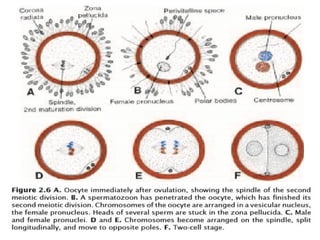
2. Resumption of the second meiotic division.
The oocyte finishes its second meiotic division immediately
after entry of the spermatozoon. One of the daughter cells,
which receives hardly any cytoplasm, is known as the
second polar body; the other daughter cell is the definitive
oocyte. Its chromosomes (22+X) arrange themselves in a
vesicular nucleus known as the female pronucleus
3. Metabolic activation of the egg. The activating factor is
probably carried by the spermatozoon. Post fusion
activation may be considered to encompass the initial
cellular and molecular events associated with early
embryogenesis.
The spermatozoon, meanwhile, moves forward until it lies
close to the female pronucleus. Its nucleus becomes
swollen and forms the male pronucleus the tail detaches
and degenerates. Morphologically, the male and female
pronuclei are indistinguishable, and eventually, they come
into close contact and lose their nuclear envelopes .
During growth of male and female pronuclei (both
haploid), each pronucleus must replicate its DNA. If it
does not, each cell of the two-cell zygote has only half of
the normal amount of DNA. Immediately after DNA
synthesis, chromosomes organize on
the spindle in preparation for a normal mitotic division.
The 23 maternal and 23 paternal (double) chromosomes
split longitudinally at the centromere, and sister
chromatids move to opposite poles, providing each cell of
the zygote with the normal diploid number of
chromosomes and DNA . As sister chromatids move to
opposite poles, a deep furrow appears on the surface of
the cell, gradually dividing the cytoplasm into two parts
The main results of fertilization are as follows:
Restoration of the diploid number of chromosomes, half
from the father and half from the mother. Hence, the
zygote contains a new combination of chromosomes
different from both parents.
Determination of the sex of the new individual. An X-
carrying sperm produces a female(XX) embryo , and a Y-
carrying sperm produces a male (XY) embryo. Hence, the
chromosomal sex of the embryo is determined at
fertilization.
Initiation of cleavage. Without fertilization, the oocyte
usually degenerates 24 hours after ovulation.
END OF THE LECTURE

DEVELOPMENTAL ANATOMY.pptx by Abdalla Muktar

  • 1.
  • 2.
    Primordial Germ Cells Primordialgerm cells (PGCs) forms the male and female Gametes. they are formed in the epiblast during the second week and move to the wall of the yolk sac. in the 4th week they migrate from the yolk sac to developing gonads, where they arrive by the end of the 5th week and begins mitotic devisions. In preparation for fertilization, germ cells undergo gametogenesis, which includes meiosis, to reduce the number of chromosomes and cytodifferentiation to complete their maturation.
  • 3.
    The Chromosome Theoryof Inheritance Humans have approximately 35,000 genes on 46 chromosomes. Genes on the same chromosome tend to be inherited together and so are known as linked genes. In somatic cells, chromosomes appear as 23 homologous pairs to form the diploid number of 46. There are 22 pairs of matching chromosomes, the autosomes, and one pair of sex chromosomes.
  • 4.
    If these xpair is XX, the individual is genetically female; if the pair is XY, the individual is genetically male. One chromosome of each pair is derived from the maternal gamete, the oocyte, and one from the paternal gamete, the sperm. Thus each gamete contains a haploid number of 23 chromosomes, and the union of the gametes at fertilization restores the diploid number of 46.
  • 5.
    MITOSIS is theprocess whereby one cell divides, giving rise to two daughter cells that are genetically identical to the parent cell Each daughter cell receives the complete complement of 46chromosomes. Before a cell enters mitosis, each chromosome replicates its deoxyribonucleic acid (DNA). During this replication phase the chromosomes are extremely long, they are spread diffusely through the nucleus, and they cannot be recognized with the light microscope. With the onset of mitosis the chromosomes begin to coil, contract, and condense; these events mark the beginning of prophase. Each chromosome now consists of two parallel subunits, chromatids, that are joined at a narrow region common to both called the centromere.
  • 6.
    Throughout prophase thechromosomes continue to condense, shorten, and thicken , but only at pro metaphase do the chromatids become distinguishable .During metaphase the chromosomes lineup in the equatorial plane,
  • 8.
    MEIOSIS 1. is thecell division that takes place in the germ cells to generate male and female gametes . 2. in mitosis one male and female germ cells 46 chromosomes each 3. Meiosis occurs in two phases, meiosis I and meiosis II, to reduce the number of chromosomes to the haploid number of 23. 4. homologous chromosomes then align themselves in pairs, a process called synapsis. 5. Homologous pairs then separate into two daughter cells. 6. meiosis II separates sister chromatids. Each gamete then contains 23 chromosomes.
  • 9.
    Crossover 1. Interchange ofchromatid segments between paired homologous chromosomes . 2. Result of meiotic divisions are  Genetic variability  Redistributes genetic material  Each germ cell forms a 23 haploid number of chromosome  one primary oocyte gives rise to four daughter cells, each with22 plus X chromosomes and only one of these develops into a mature gamete, the oocyte Polar Bodies is a small haploid cell that is formed at the same time as an egg cell during oogenesis but generally does not have the ability to be fertilized.
  • 13.
    Morphological Changes DuringMaturation of the Gametes
  • 14.
    OOGENESIS 1. Maturation ofOocytes Begins Before Birth Once 2. Primordial germ cells differentiate into oogonia and undergo a number of mitotic divisions 3. By the end of the third month, are arranged in clusters surrounded by a layer of flat epithelial 4. Oogonia in one cluster are probably derived from a single cell. 5. The flat epithelial cells, known as follicular cells, originate from surface epithelium covering the ovary.
  • 15.
    1. The majorityof oogonia continue to divide by mitosis, but some of them arrest their cell division in prophase and form primary oocytes. 2. During the next few months, oogonia increase rapidly in number. 3. By the fifth month of prenatal development, the total number of germ cells in the ovary reaches its maximum, estimated at 7 million. 4. At this time, cell death begins, and many oogonia as well as primary oocytes become atretic. 5. By the seventh month, the majority of oogonia have degenerated except for a few near the surface.
  • 16.
    1. All survivingprimary oocytes have entered prophase of meiosis I, and most of them are individually surrounded by a layer of flat epithelial cells. 2. A primary oocyte, together with its surrounding flat epithelial cells, is known as a primordial follicle. 3. Maturation of Oocytes Continues at Puberty Near the time of birth, all primary oocytes have started prophase of meiosis I, but instead of proceeding into metaphase, they enter the diplotene stage, a resting stage during prophase that is characterized by a lacy network of chromatin 4. Primary oocytes remain in prophase and do not finish their first meiotic division before puberty is reached, 5. apparently because of oocyte maturation inhibitor(OMI),a substance secreted by follicular cells.
  • 17.
    1. The totalnumber of primary oocytes at birth is estimated to vary from 700,000 to 2 million. 2. During childhood most oocytes become atretic; only approximately 400,000 are present by the beginning of puberty, and fewer than 500 will be ovulated. 3. Some oocytes that reach maturity late in life have been dormant in the diplotene stage of the first meiotic division for 40 years or more before ovulation. 4. the risk of having children with chromosomal abnormalities increases with maternal age indicates that primary oocytes are vulnerable to damage as they age.
  • 18.
    1. At puberty,a pool of growing follicles is established and continuously maintained from the supply of primordial follicles. Each month, 15 to 20 follicles selected from this pool begin to mature, passing through three stages: 1) primary or preantral 2) secondary or antral (also called vesicular or Graafian); 3) preovulatory. 2: The antral stage is occurs 37 hours before ovulation and primary oocyte begins to grow, surrounding follicular cells change from flat to cuboidal and proliferate to produce a stratified epithelium of granulosa cells, and the unit is called a primary follicle .
  • 19.
  • 20.
    1. Oocyte secretea layer of glycoproteins on the surface of the oocyte, forming the zona pellucida . 2. Each ovarian cycle, a number of follicles begin to develop, but usually only one reaches full maturity. 3. When the secondary follicle is mature, a surge in luteinizing hormone (LH) induces the preovulatory growth phase. Meiosis I is completed, resulting information of two daughter cells of unequal size, each with23double structured chromosomes and one cell, the secondary oocyte, receives most of the cytoplasm
  • 21.
    1. The cellthen enters meiosis II but arrests in metaphase approximately 3 hours before ovulation. Meiosis II is completed only if the oocyte is fertilized; otherwise, the cell degenerates approximately 24 hours after ovulation.
  • 22.
    Spermatogenesis is theprocess by which haploid spermatozoa develop from germ cells in the seminiferous tubules of the testicle . This process starts with the mitotic division of the stem cells located close to the basement membrane of the tubules. These cells are called spermatogonial stem cells . The mitotic division of these produces two types of cells. Type A cells replenish the stem cells, and type B cells differentiate into primary spermatocytes . The primary spermatocyte divides meiotically (Meiosis I) into two secondary spermatocytes; each secondary spermatocyte divides into two equal haploid spermatids by Meiosis II. The spermatids are transformed into spermatozoa (sperm) by the process of spermiogenesis . These develop into mature spermatozoa, also known as sperm cells .[ Thus, the primary spermatocyte gives rise to two cells, the secondary spermatocytes, and the two secondary spermatocytes by their subdivision produce four spermatozoa and four haploid cells
  • 23.
    Spermatogenesis is regulatedby luteinizing hormone (LH) production by the pituitary. LH binds to receptors on Leydig cells and stimulates testosterone production, which in turn binds to Sertoli cells to promote spermatogenesis. Follicle stimulating hormone (FSH) is also essential because its binding to Sertoli cells stimulates testicular fluid production and synthesis of intracellular androgen receptor proteins. Duration For humans, the entire process of spermatogenesis is variously estimated as taking 74 days and approximately 120 days (according to DNA clock measurements). Including the transport on ductal system, it takes 3 months. Testes produce 200 to 300 million spermatozoa daily. However, only about half or 100 million of these become viable sperm
  • 24.
  • 28.
    First Week ofDevelopment: Ovulation to Implantation Ovarian Cycle At puberty, the female begins to undergo regular monthly cycles. These sexual cycles are controlled by the hypothalamus. Gonadotropin-releasing hormone (GnRH) produced by the hypothalamus acts on cells of the anterior pituitary gland, which in turn secrete gonadotropins. These hormones, follicle-stimulating hormone (FSH) and luteinizing hormone (LH), stimulate and control cyclic changes in the ovary.
  • 29.
    At the beginningof each ovarian cycle, 15 to 20 primary (preantral) stage follicles are stimulated to grow under the influence of FSH. (The hormone is not necessary to promote development of primordial follicles to the primary follicle stage, but without it, these primary follicles die and become atretic.) Thus, FSH rescues 15 to 20 of these cells from a pool of continuously forming primary follicles . Under normal conditions, only one of these follicles reaches full maturity, and only one oocyte is discharged; the others degenerate and become atretic.
  • 30.
    In the nextcycle, another group of primary follicles is recruited, and again, only one follicle reaches maturity. Consequently, most follicles degenerate without ever reaching full maturity. When a follicle becomes atretic, the oocyte and surrounding follicular cells degenerate and are replaced by connective tissue, forming a corpus atreticum. FSH also stimulates maturation of follicular (granulosa) cells surrounding the oocyte
  • 32.
    granulosa and thecalcells produce estrogens that (a) cause the uterine endometrium to enter the follicular or proliferative phase; (b) cause thinning of the cervical mucus to allow passage of sperm; and (c) stimulate the pituitary gland to secrete LH. At mid-cycle, there is an LH surge that (a) elevates concentrations of maturation- promoting factor, causing oocytes to complete meiosis I and initiate meiosis II; (b) stimulates production of progesterone by follicular stromal cells (luteinization); and (c) causes follicular rupture and ovulation.
  • 33.
    OVULATION In the daysimmediately preceding ovulation, under the influence of FSH and LH, the secondary follicle grows rapidly to a diameter of 25 mm. Coincident with final development of the secondary follicle, there is an abrupt increase in LH that causes the primary oocyte to complete meiosisI and the follicle to enter the preovulatory stage. Meiosis II is also initiated, but the oocyte is arrested in metaphase approximately 3 hours before ovulation. In the meantime, the surface of the ovary begins to bulge locally, and at the apex, an avascular spot,
  • 34.
    The high concentrationof LH increases collagenase activity, resulting in digestion of collagen fibers surrounding the follicle. Prostaglandin levels also increase in response to the LH surge and cause local muscular contractions in the ovarian wall. Those contractions extrude the oocyte, which together with its surrounding granulosa cells from the region of the cumulus oophorus, breaks free (ovulation) and floats out of the ovary. Some of the cumulus oophorus cells then rearrange themselves around the zona pellucida to form the corona radiata
  • 36.
    CORPUS LUTEUM After ovulation,granulosa cells remaining in the wall of the ruptured follicle, together with cells from the theca interna, a revascularized by surrounding vessels. Under the influence of LH, these cells develop a yellowish pigment and change into lutean cells, which form the corpus luteum and secrete the hormone progesterone . Progesterone, together with estrogenic hormones, causes the uterine mucosa to enter the progestational or secretory stage in preparation for implantation of the embryo.
  • 38.
    OOCYTE TRANSPORT Shortly beforeovulation, fimbriae of the oviduct begin to sweep over the surface of the ovary, and the tube it self begins to contract rhythmically. It is thought that the oocyte surrounded by some granulosa cells is carried into the tube by these sweeping movements of the fimbriae and by motion of cilia on the epithelial lining. Once in the tube, cumulus cells withdraw their cytoplasmic processes from the zona pellucida and lose contact with the oocyte. Once the oocyte is in the uterine tube, it is propelled by cilia with the rate of transport regulated by the endocrine status during and after ovulation. In humans, the fertilized oocyte reaches the uterine lumen in approximately 3 to 4 days.
  • 39.
    CORPUS ALBICANS (Latinfor "whitening body"; also known as atretic corpus luteum) If fertilization does not occur, the corpus luteum reaches maximum development approximately 9 days after ovulation. It can easily be recognized as a yellowish projection on the surface of the ovary. Subsequently, the corpus luteum shrinks because of degeneration of lutean cells and forms a mass of fibrotic the corpus albicans. Simultaneously, progesterone production decreases, precipitating menstrual bleeding.
  • 40.
    If the oocyteis fertilized, degeneration of the corpus luteum is prevented by human chorionic gonadotropin (hCG), a hormone secreted by the syncytiotrophoblast of the developing embryo. The corpus luteum continues to grow and forms the corpus luteum of pregnancy (corpus luteum graviditatis). By the end of the third month, this structure may be one-third to one-half of the total size of the ovary. Yellowish luteal cells continue to secrete progesterone until the end of the fourth month; there after,they regress slowly as secretion of progesterone by the trophoblastic component of the placenta becomes adequate for maintenance of pregnancy. Removal of the corpus luteum of pregnancy before the fourth month usually leads to abortion.
  • 41.
    Fertilization The process bywhich male and female gametes fuse, occurs in the ampullary region of the uterine tube. This is the widest part of the tube and is close to the ovary . Spermatozoa may remain viable in the female reproductive tract for several days. Only 1% of sperm deposited in the vagina enter the cervix, where they may survive for many hours. Movement of sperm from the cervix to the oviduct is accomplished primarily by their own propulsion, although they may be assisted by movements of fluids created by uterine cilia. The trip from cervix to oviduct requires a minimum of 2 to 7 hours, and after reaching the isthmus, sperm become less motile and cease their migration.
  • 42.
    At ovulation, spermagain become motile, perhaps because of chemo attractants produced by cumulus cells surrounding the egg, and swim to the ampulla where fertilization usually occurs. Spermatozoa are not able to fertilize the oocyte immediately upon arrival in the female genital tract but must undergo (a) capacitation and (b) the acrosome reaction to acquire this capability.
  • 43.
    Capacitation is aperiod of conditioning in the female reproductive tract that in the human lasts approximately 7 hours. Much of this conditioning, which occurs in the uterine tube, entails epithelial interactions between the sperm and mucosal surface of the tube. During this time a glycoprotein coat and seminal plasma proteins are removed from the plasma membrane that overlies the acrosomal region of the spermatozoa. Only capacitated sperm can pass through the corona cells and undergo the acrosome reaction.
  • 44.
    The acrosome reaction,which occurs after binding to the zona pellucida, is induced by zona proteins.This reaction culminates in the release of enzymes needed to penetrate the zona pellucida, including acrosin and trypsin-like substances . The phases of fertilization include phase 1: Penetration of the corona radiata phase 2: Penetration of the zona pellucida phase 3: Fusion of the oocyte and sperm cell membranes.
  • 45.
    PHASE 1: PENETRATION OFTHE CORONA RADIATA Of the 200 to 300 million spermatozoa deposited in the female genital tract, only 300 to 500 reach the site of fertilization. Only one of these fertilizes the egg. It is thought that the others aid the fertilizing sperm in penetrating the barriers protecting the female gamete. Capacitated sperm pass freely through corona cells .
  • 46.
    PHASE 2: PENETRATION OFTHE ZONA PELLUCIDA The zona is a glycoprotein shell surrounding the egg that facilitates and maintains sperm binding and induces the acrosome reaction. Both binding and the acrosome reaction are mediated by the ligand ZP3, a zona protein. Release of acrosomal enzymes (acrosin) allows sperm to penetrate the zona, thereby coming in contact with the plasma membrane of the oocyte . Permeability of the zona pellucida changes when the head of the sperm comes in contact with the oocyte surface. This contact results in release of lysosomal
  • 47.
    enzymes from corticalgranules lining the plasma membrane of the oocyte. In turn, these enzymes alter properties of the zona pellucida (zona reaction) to prevent sperm penetration and inactivate species-specific receptor sites for spermatozoa on the zona surface.Other spermatozoa have been found embedded in the zona pellucida,but only one seems tobe able to penetrate the oocyte.
  • 48.
    PHASE 3: FUSIONOF THE OOCYTE AND SPERM CELL MEMBRANES The initial adhesion of sperm to the oocyte is mediated in part by the interaction of integrins on the oocyte and their ligands, disintegrins , on sperm. After adhesion, the plasma membranes of the sperm and egg fuse. Because the plasma membrane covering the acrosomal head cap disappears during the acrosome reaction, actual fusion is accomplished between the oocyte membrane and the membrane that covers the posterior region of the sperm head . In the human, both the head and tail of the spermatozoon enter the cytoplasm of the oocyte, but the plasma membrane is left behind on the oocyte surface. As soon as the spermatozoon has entered the oocyte, the egg responds in three ways:
  • 49.
    1. Cortical andzona reactions . As a result of the release of cortical oocyte granules, which contain lysosomal enzymes, (a) the oocyte membrane becomes impenetrable to other spermatozoa, (b) the zona pellucida alters its structure and composition to prevent sperm binding and penetration. These reactions prevent polyspermy (penetration of more than one spermatozoon into the oocyte).
  • 50.
    2. Resumption ofthe second meiotic division. The oocyte finishes its second meiotic division immediately after entry of the spermatozoon. One of the daughter cells, which receives hardly any cytoplasm, is known as the second polar body; the other daughter cell is the definitive oocyte. Its chromosomes (22+X) arrange themselves in a vesicular nucleus known as the female pronucleus 3. Metabolic activation of the egg. The activating factor is probably carried by the spermatozoon. Post fusion activation may be considered to encompass the initial cellular and molecular events associated with early embryogenesis.
  • 51.
    The spermatozoon, meanwhile,moves forward until it lies close to the female pronucleus. Its nucleus becomes swollen and forms the male pronucleus the tail detaches and degenerates. Morphologically, the male and female pronuclei are indistinguishable, and eventually, they come into close contact and lose their nuclear envelopes . During growth of male and female pronuclei (both haploid), each pronucleus must replicate its DNA. If it does not, each cell of the two-cell zygote has only half of the normal amount of DNA. Immediately after DNA synthesis, chromosomes organize on
  • 52.
    the spindle inpreparation for a normal mitotic division. The 23 maternal and 23 paternal (double) chromosomes split longitudinally at the centromere, and sister chromatids move to opposite poles, providing each cell of the zygote with the normal diploid number of chromosomes and DNA . As sister chromatids move to opposite poles, a deep furrow appears on the surface of the cell, gradually dividing the cytoplasm into two parts
  • 53.
    The main resultsof fertilization are as follows: Restoration of the diploid number of chromosomes, half from the father and half from the mother. Hence, the zygote contains a new combination of chromosomes different from both parents. Determination of the sex of the new individual. An X- carrying sperm produces a female(XX) embryo , and a Y- carrying sperm produces a male (XY) embryo. Hence, the chromosomal sex of the embryo is determined at fertilization. Initiation of cleavage. Without fertilization, the oocyte usually degenerates 24 hours after ovulation.
  • 55.
    END OF THELECTURE