GAME DEVELOPMENT LIFE CYCLE
Prepared by Sarah Alazab
Acknowledgment
 This presentation is based on a document titled
“Lifecycle for Game Development to Ensure Enhanced
Productivity”
by K. Subhash Babu1 and R.Maruthi2
 Professor & Head, Dept. of MCA, SSN college of Engineering, Chennai,
Tamilnadu, India1
 Associate Professor, Dept. of MCA, SSN college of Engineering, Chennai,
Tamilnadu, India2
Index
I. Introduction
II. Game Development Life Cycle
III. Conclusion
IV. References
I. Introduction
Many researchers described GDLC according to different software development
models.
Based on all these models, the most important phases are
 The idea
 Proposal
 Design phases [2]
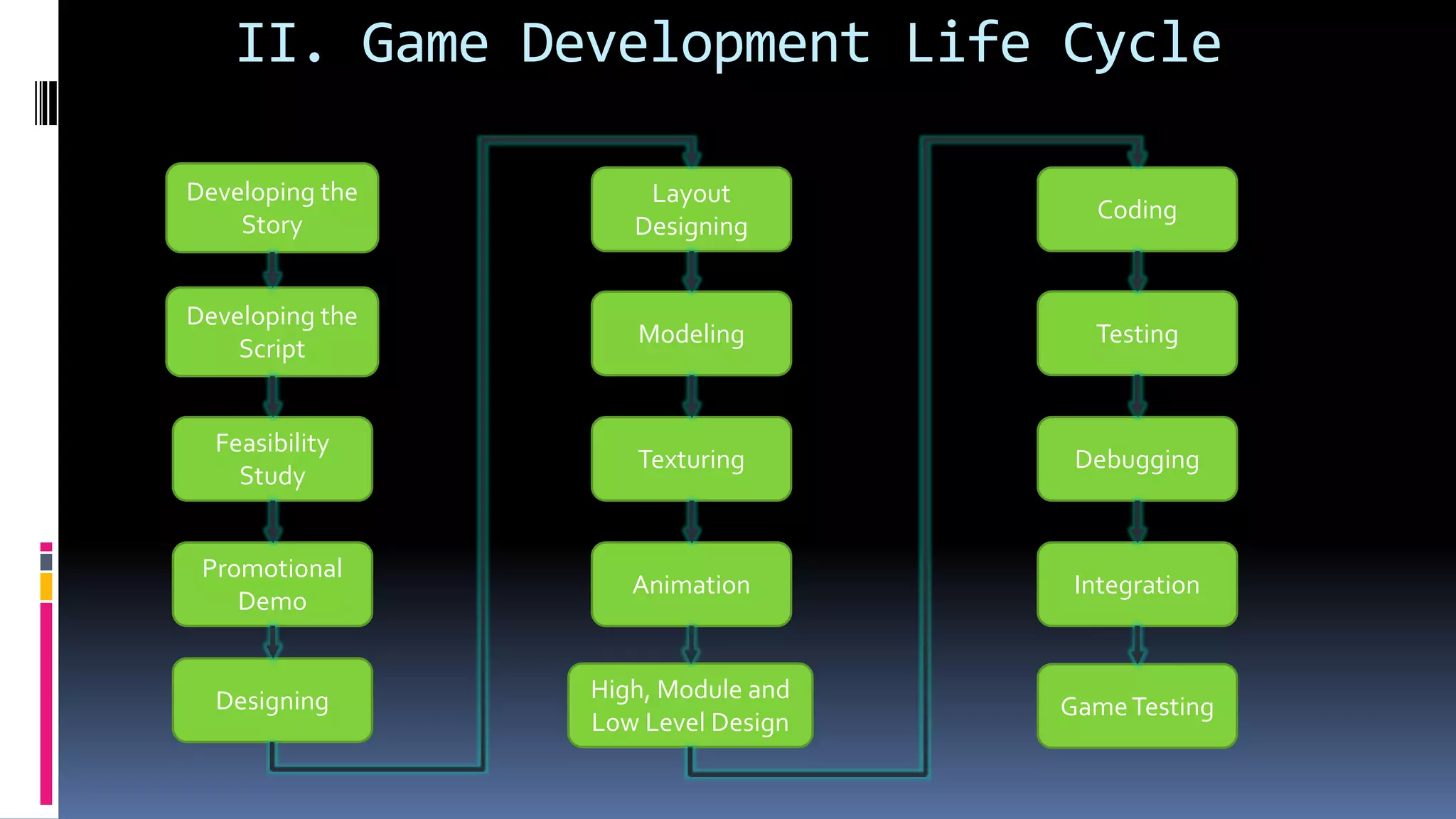
II. Game Development Life Cycle
Developing the
Story
Developing the
Script
Feasibility
Study
Promotional
Demo
Designing
Layout
Designing
Modeling
Texturing
Animation
High, Module and
Low Level Design
Coding
Testing
Debugging
Integration
GameTesting
A. DEVELOPING THE STORY
 A core theme with a well defined story line
 Target a specific age group
 Story starts with an idea then develops further
 Characters, situations, events and places, relationships are determined
 Conflict and resolution scenarios are added
The translation of a story into a game is a mere conflict resolution.
B. DEVELOPING THE SCRIPT
 The story is refined to obtain a tight script that ensures a seamless flow between
levels.
 Script writing needs a great deal of imagination and creativity.
 The key is to capture the imagination of the audience.
 Characters and backdrops are created and decided during this phase.
The better the script the better will be the game.
C. FEASIBIBLITY STUDY
 Assess the feasibility of a game.
 Helps to freeze the requirements, the scope, profitability and other conclusions of the
proposed game [4].
The areas to be analyzed in the feasibility study are:
 Requirements
 Pricing
 Technical, organizational, cultural and legal issues
 Schedule of the project
C. FEASIBIBLITY STUDY
In this phase project leaders, project design and development personnel and research
group will be working together to create a game as a complete product [5].
Programmers analyze and explain the programming limitations to the project managers.
The outcome of the feasibility study is the feasibility study report, which contains :
 Management summary
 Technical specification [4]
 The findings and recommendation
D. PROMOTIONAL DEMO
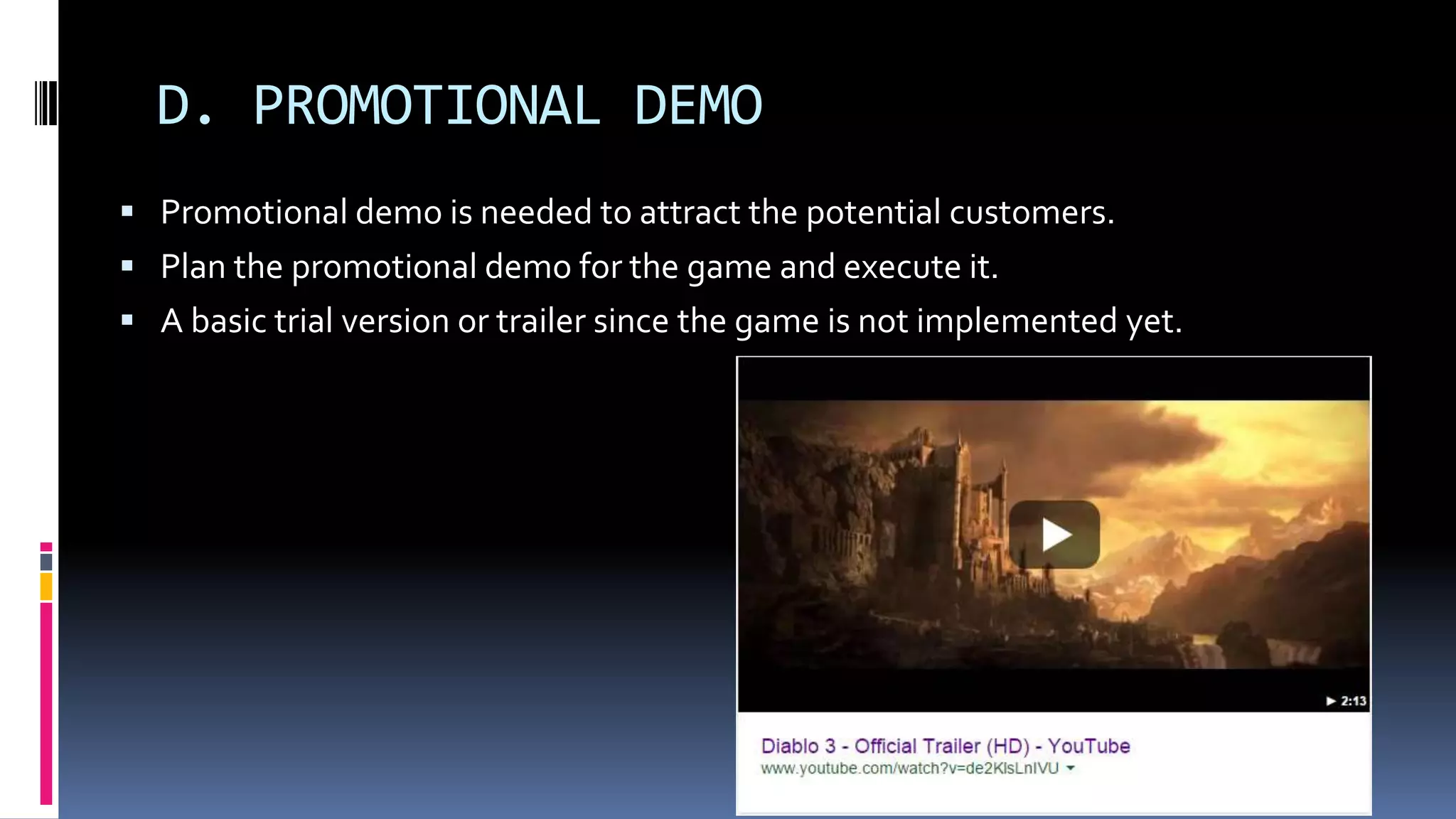
 Promotional demo is needed to attract the potential customers.
 Plan the promotional demo for the game and execute it.
 A basic trial version or trailer since the game is not implemented yet.
E. DESIGNING
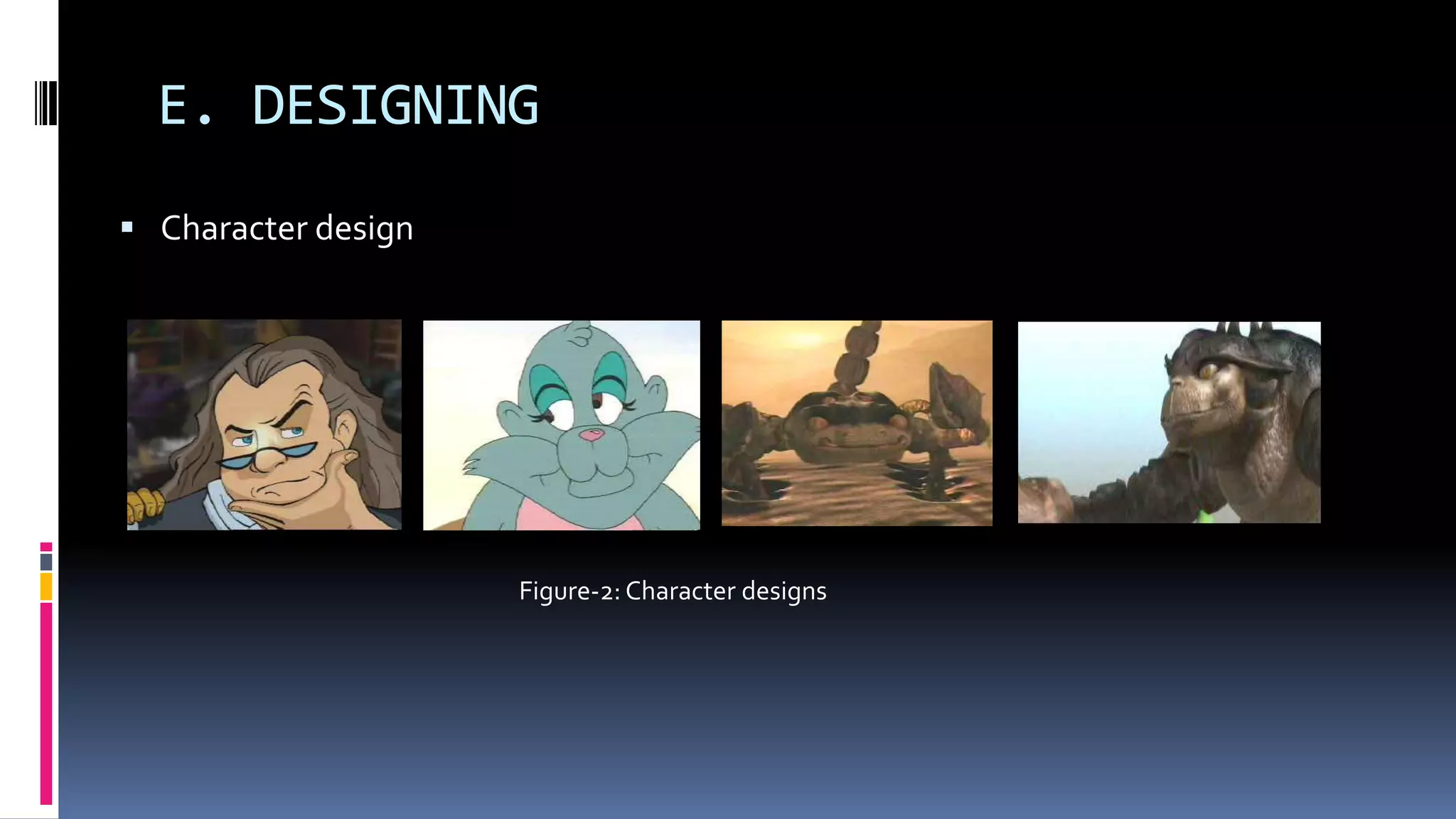
 Character design
Figure-2: Character designs
E. DESIGNING
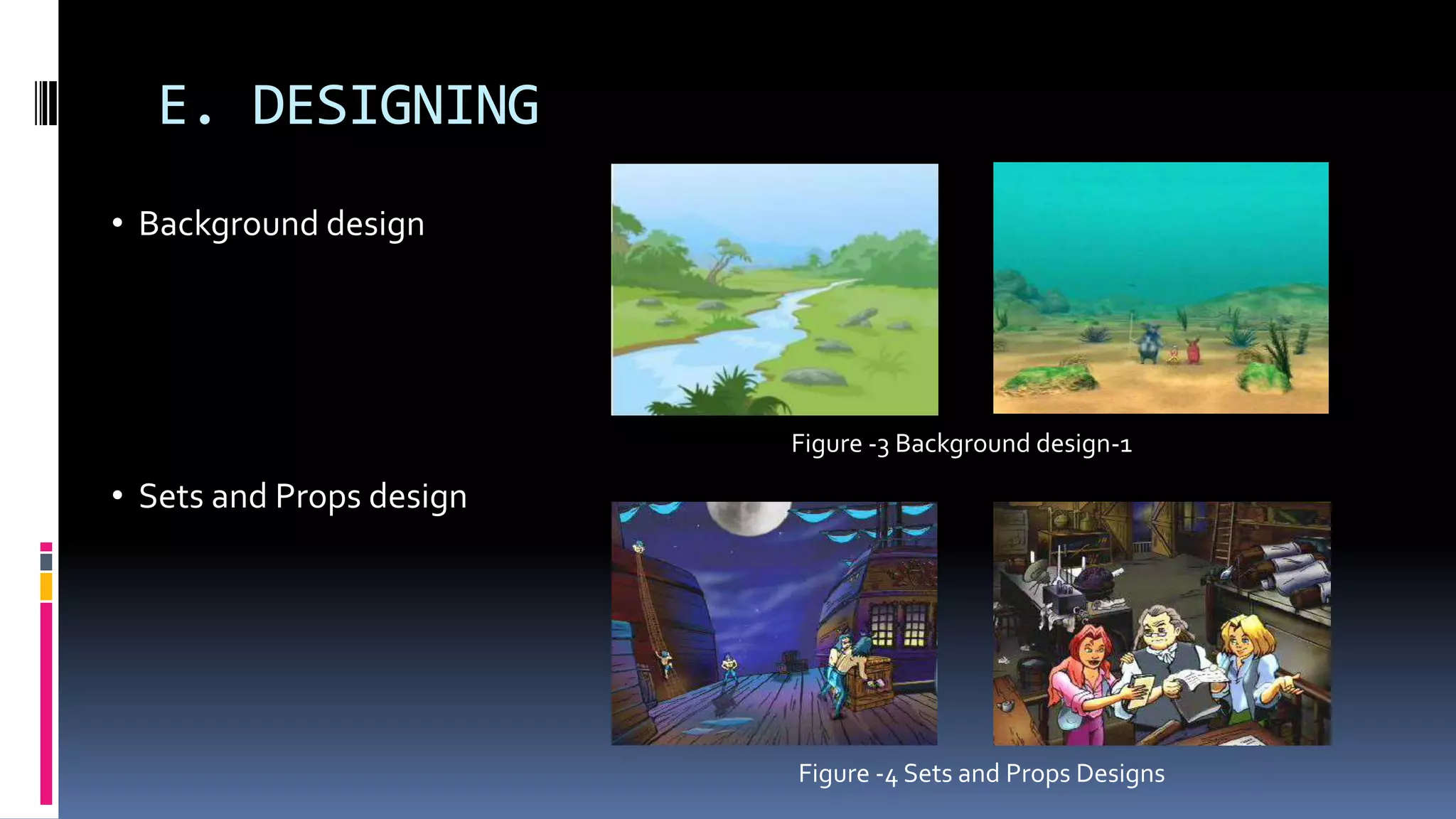
Figure -3 Background design-1
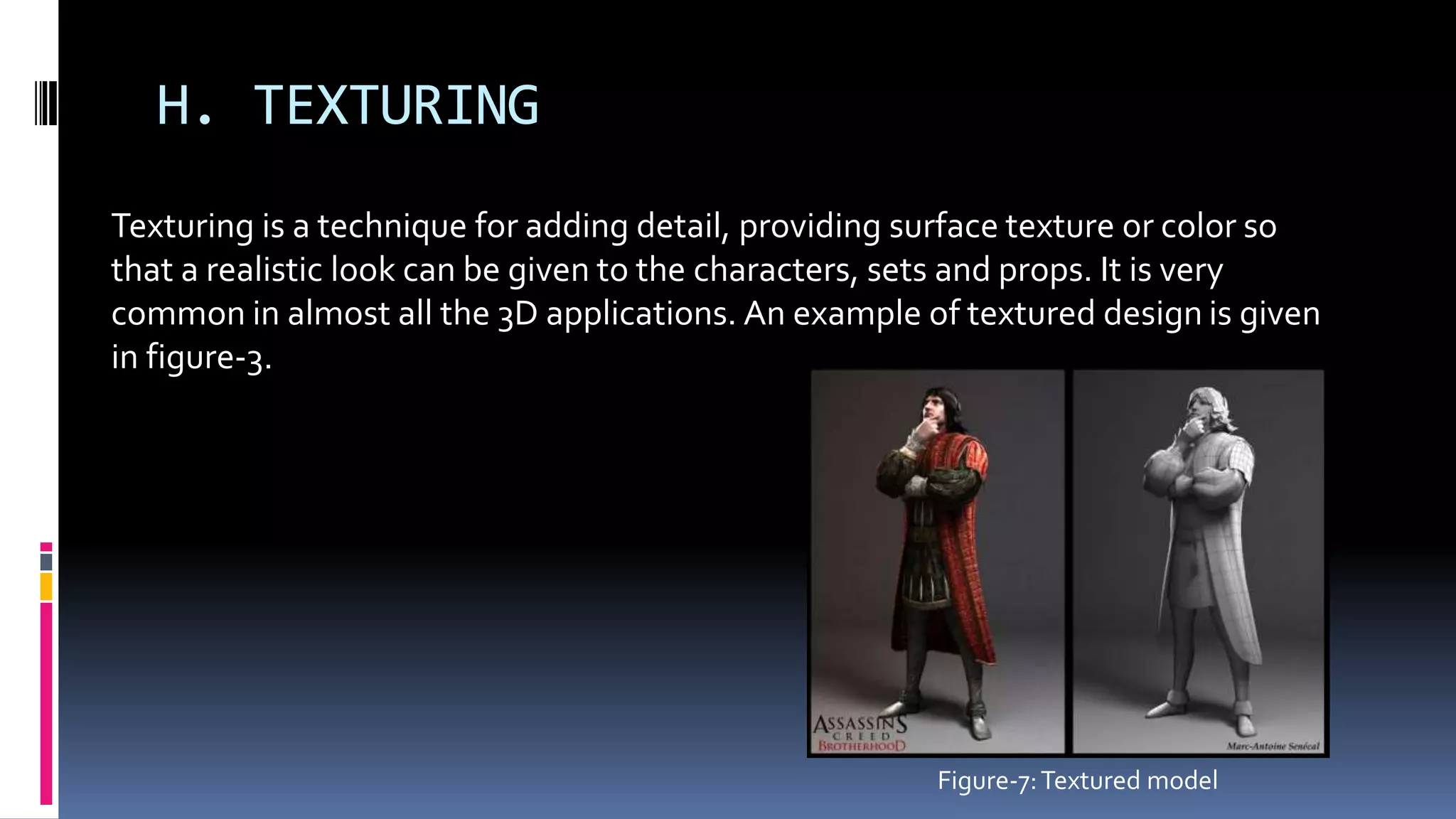
Figure -4 Sets and Props Designs
• Background design
• Sets and Props design
F. LAYOUT DESIGNING
 Layout for the entire game and for all the levels.
 The layout represents the various sets and passage ways with hurdles
 Every type of game have certain constraints. Covering all is quite challenging [9].
Figure-5: Layout Design
G. MODELING
 Character modeling, sets modeling and props modeling.
 Models have to provide enough data so the finer details can be rendered in an
effective manner.
 Advanced techniques like the use of normal mapping[10].
Figure- 6 Props Modeling
H. TEXTURING
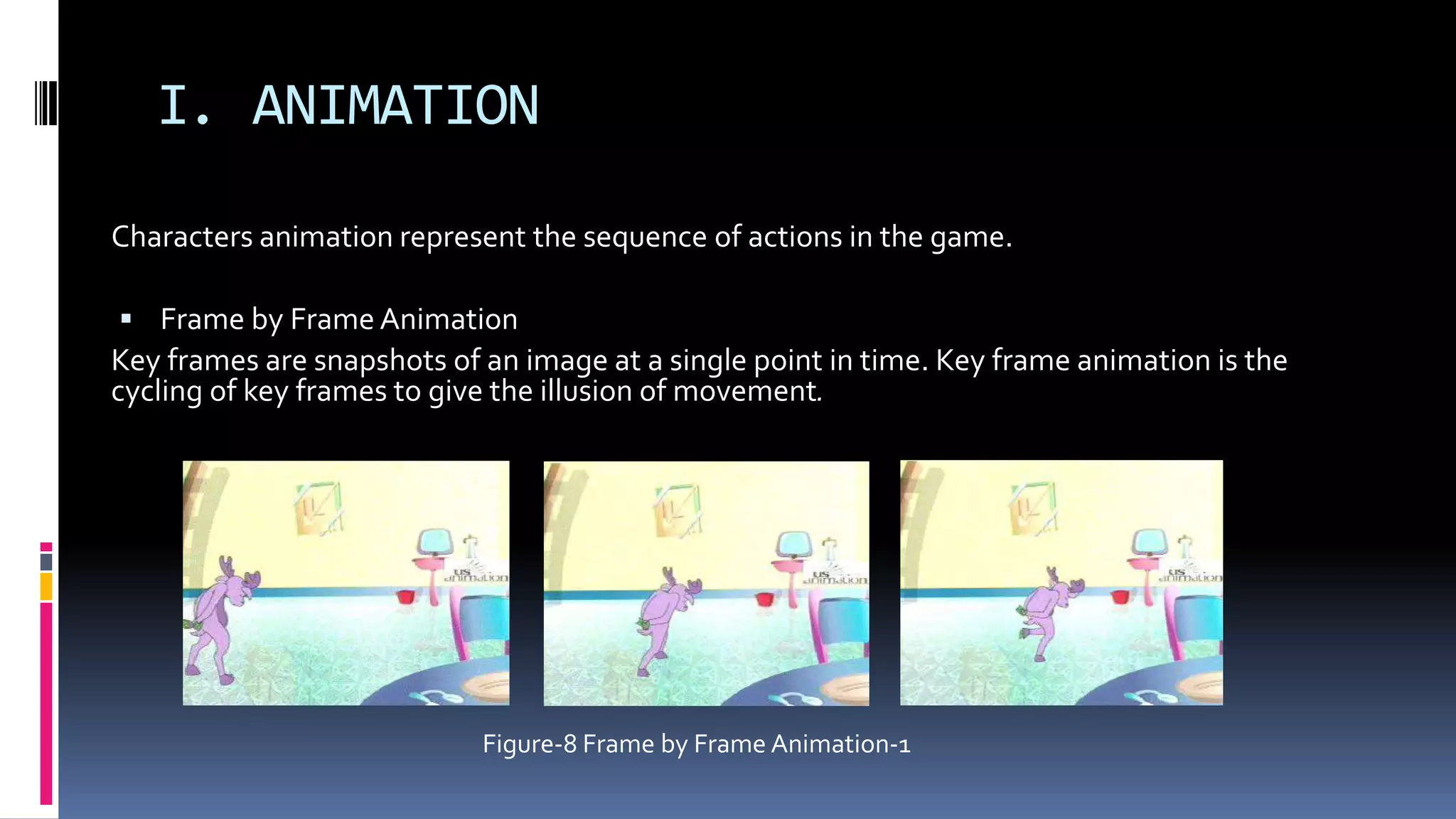
Texturing is a technique for adding detail, providing surface texture or color so
that a realistic look can be given to the characters, sets and props. It is very
common in almost all the 3D applications. An example of textured design is given
in figure-3.
Figure-7:Textured model
I. ANIMATION
Characters animation represent the sequence of actions in the game.
 Frame by Frame Animation
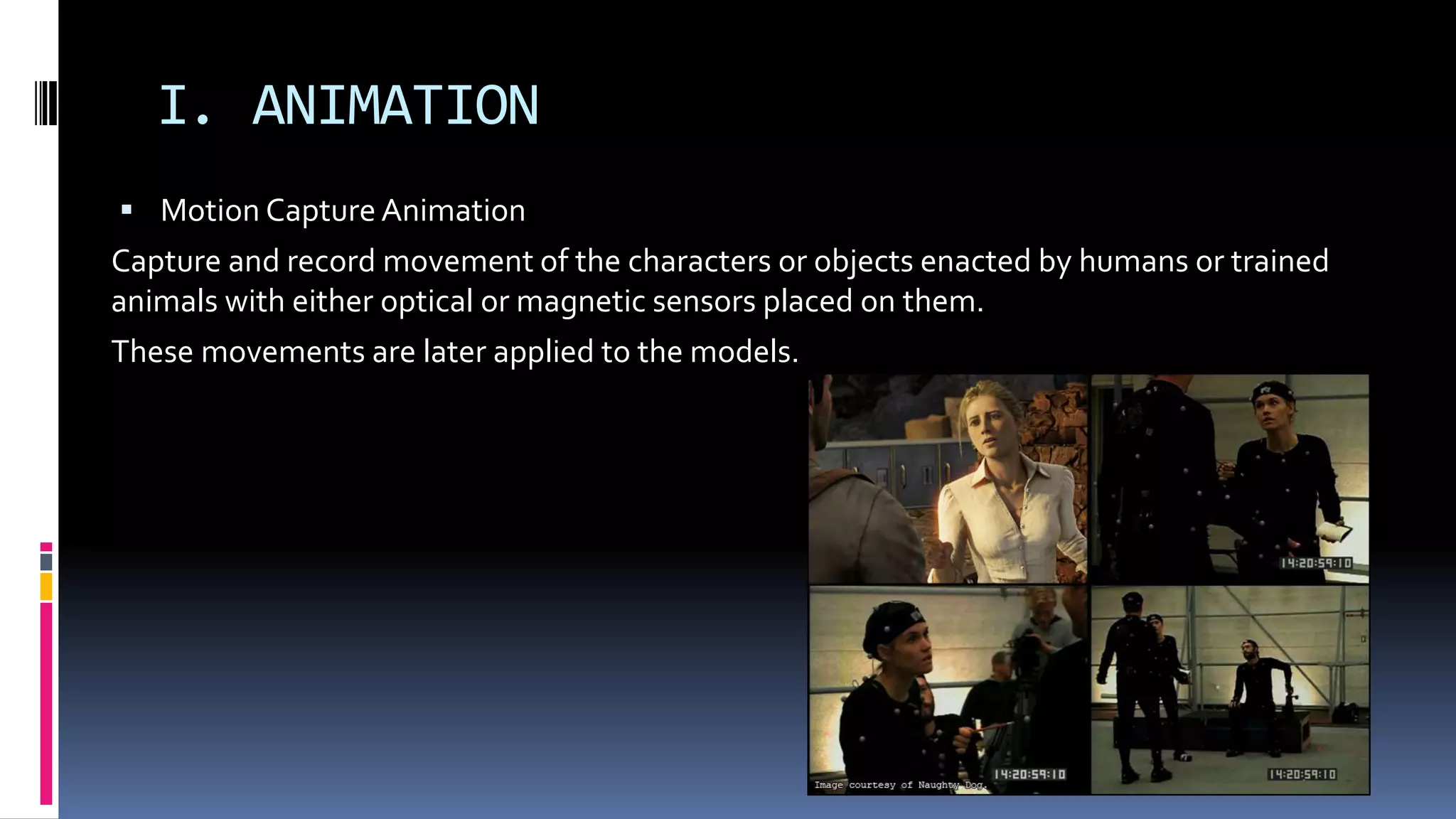
Key frames are snapshots of an image at a single point in time. Key frame animation is the
cycling of key frames to give the illusion of movement.
Figure-8 Frame by Frame Animation-1
I. ANIMATION
 Motion Capture Animation
Capture and record movement of the characters or objects enacted by humans or trained
animals with either optical or magnetic sensors placed on them.
These movements are later applied to the models.
Requires expensive camera/magnetic
systems and very specific hardware and
software.
I. ANIMATION
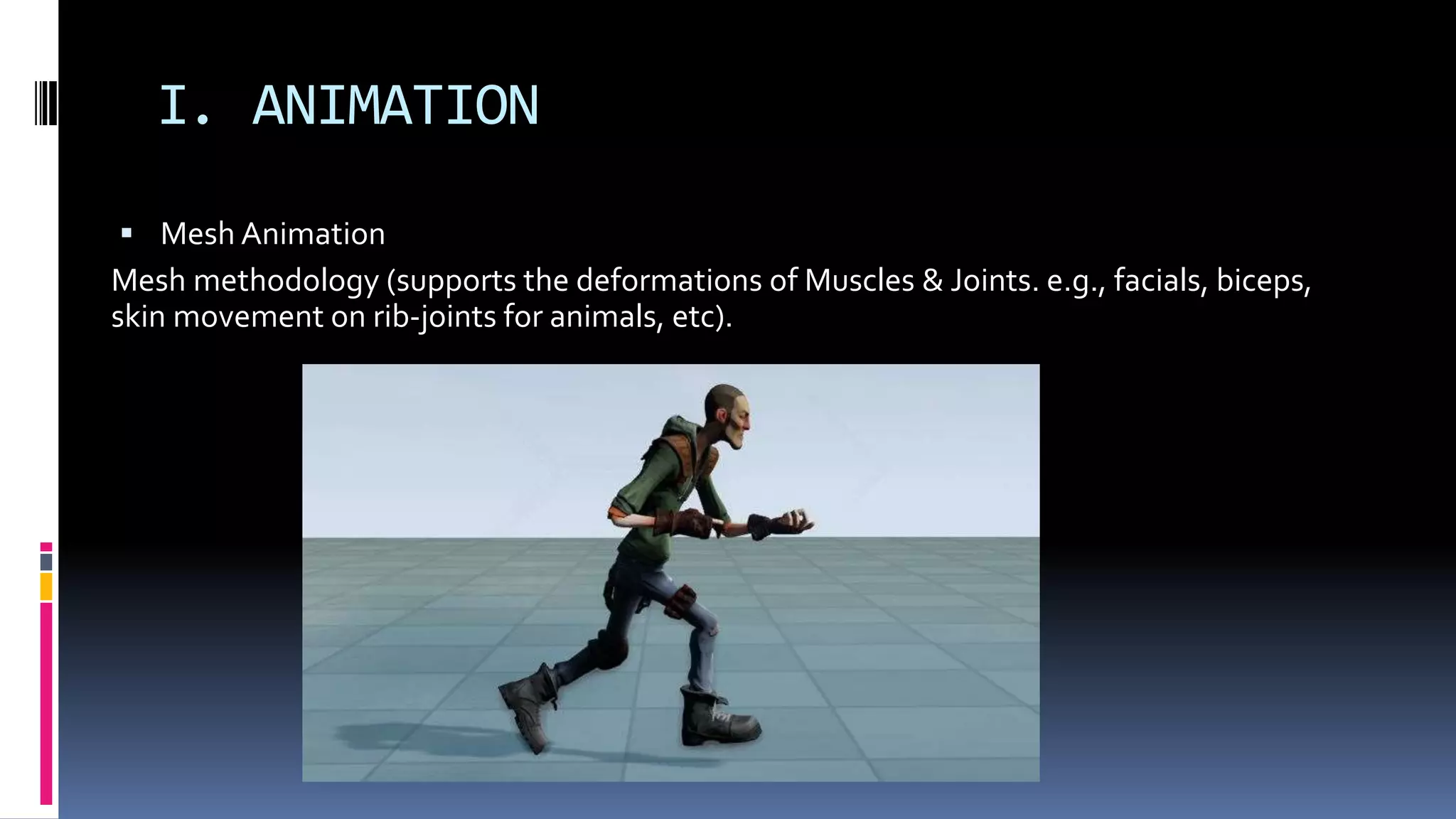
 Mesh Animation
Mesh methodology (supports the deformations of Muscles & Joints. e.g., facials, biceps,
skin movement on rib-joints for animals, etc).
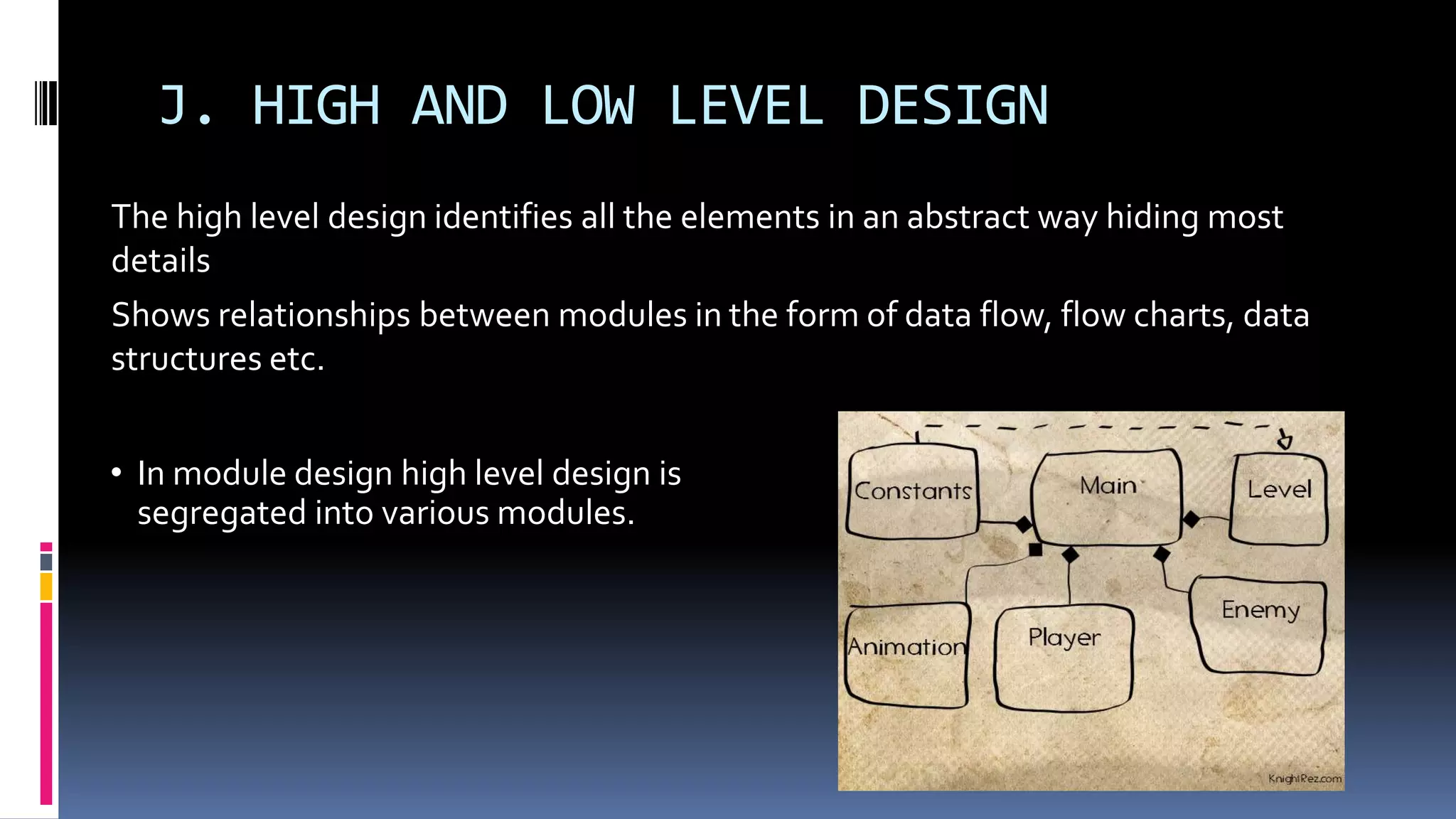
J. HIGH AND LOW LEVEL DESIGN
The high level design identifies all the elements in an abstract way hiding most
details
Shows relationships between modules in the form of data flow, flow charts, data
structures etc.
• In module design high level design is
segregated into various modules.
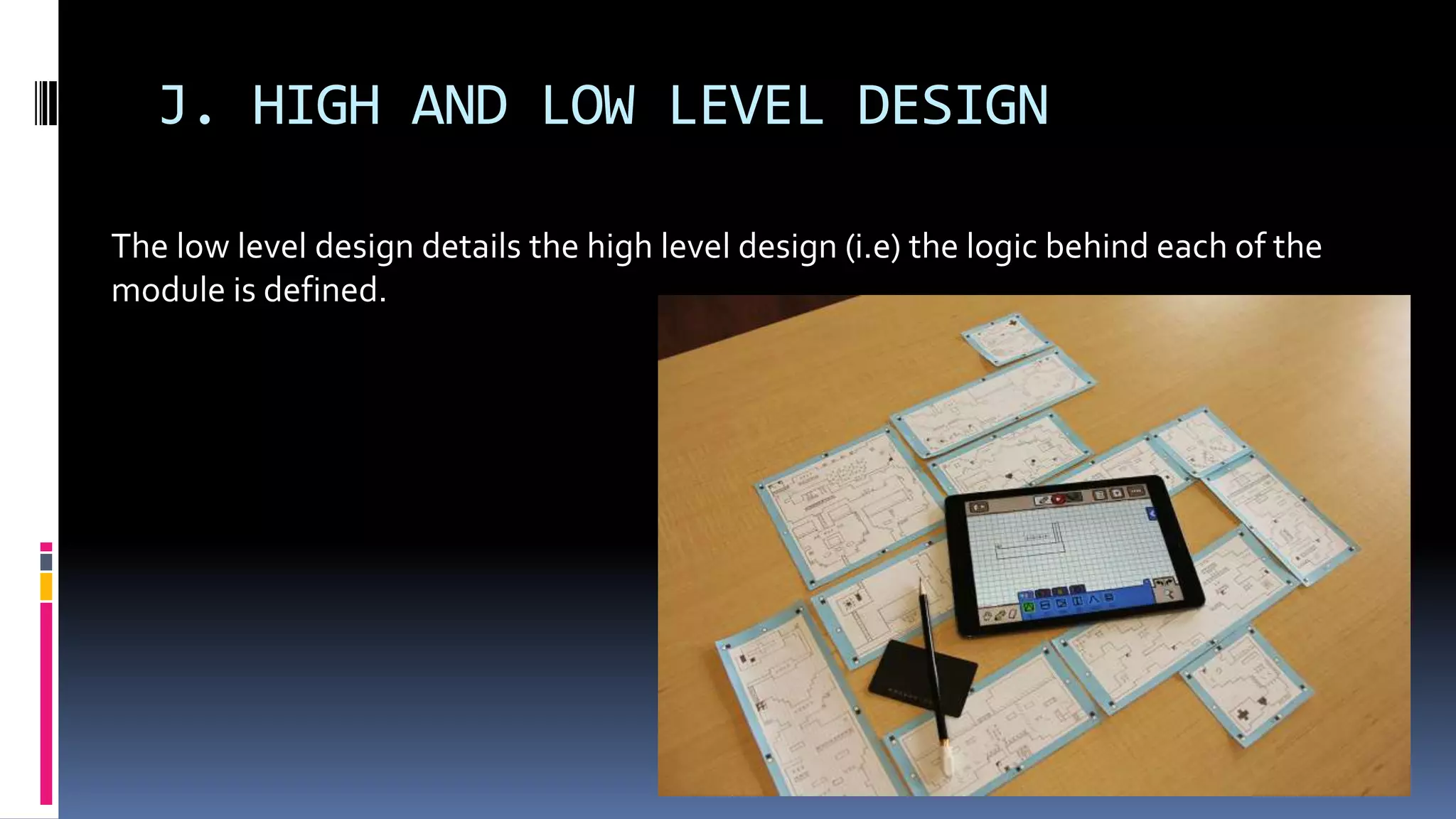
J. HIGH AND LOW LEVEL DESIGN
The low level design details the high level design (i.e) the logic behind each of the
module is defined.
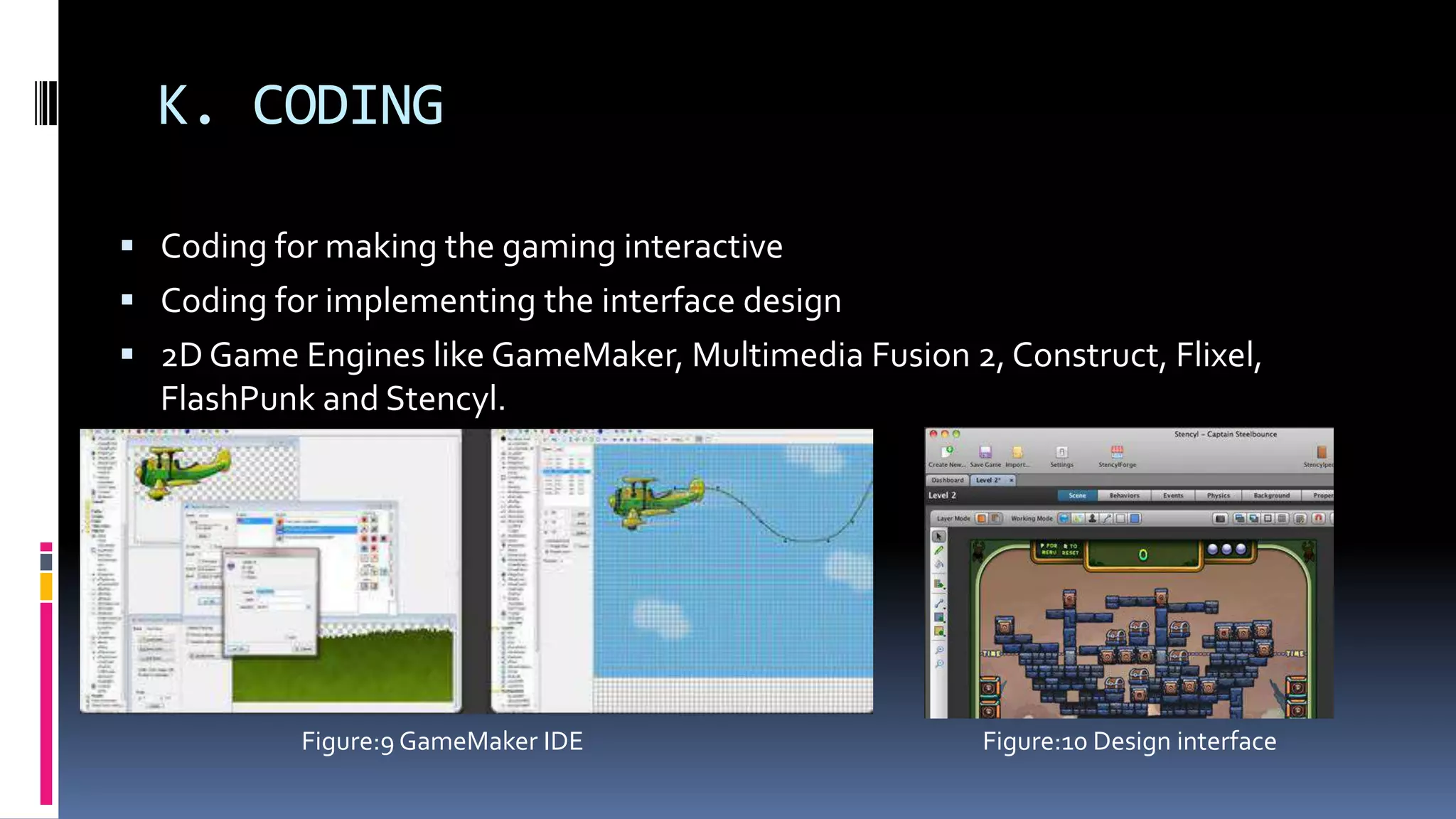
K. CODING
 Coding for making the gaming interactive
 Coding for implementing the interface design
 2D Game Engines like GameMaker, Multimedia Fusion 2, Construct, Flixel,
FlashPunk and Stencyl.
Figure:10 Design interfaceFigure:9 GameMaker IDE
K. CODING
 3D Game Engines are Unity , UDK , XNA , BlitzMax , jMonkeyEngine andTorque
to name a few[11].
Figure:11 Unity Game Engine Figure:12 Unreal Development Kit
L. TESTING AND DEBUGGING
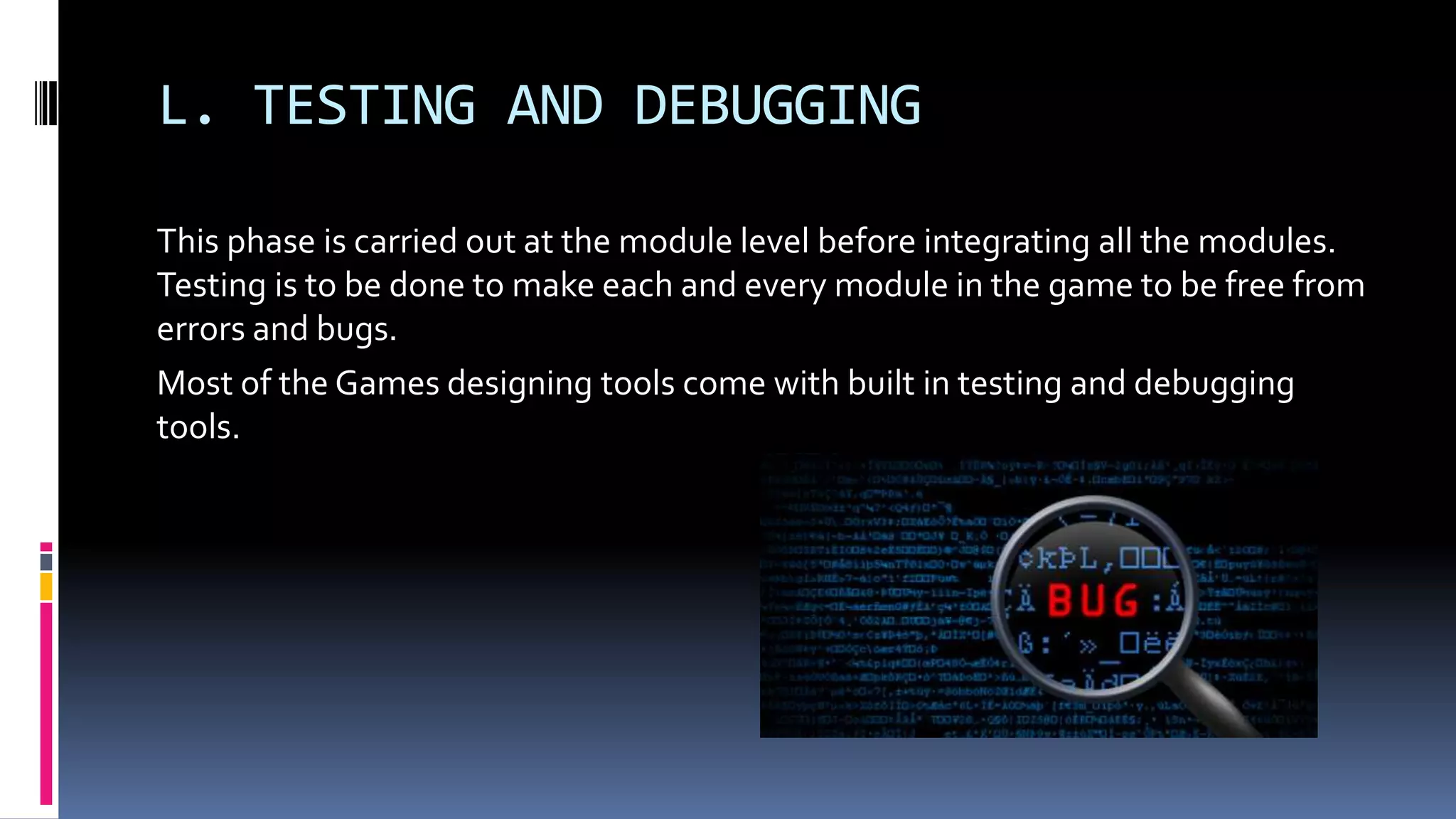
This phase is carried out at the module level before integrating all the modules.
Testing is to be done to make each and every module in the game to be free from
errors and bugs.
Most of the Games designing tools come with built in testing and debugging
tools.
M. INTEGRATION
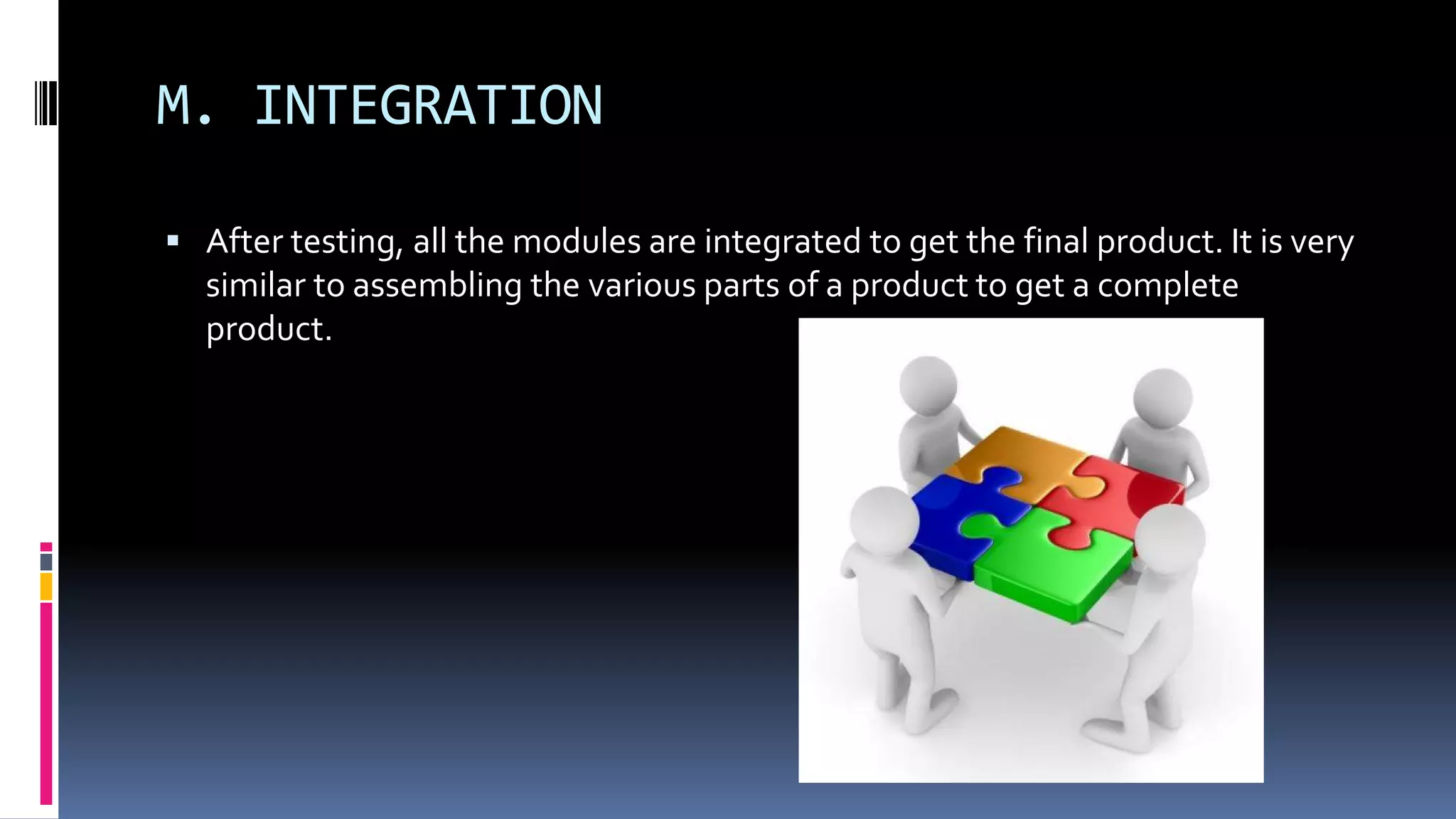
 After testing, all the modules are integrated to get the final product. It is very
similar to assembling the various parts of a product to get a complete
product.
N. GAME TESTING
 The game is tested for the complete flow from the beginning to the end
 Identify bugs and fix them
 Since it is a complex task which involves twists and turns, it is tested thoroughly
to meet the expectations of the users.
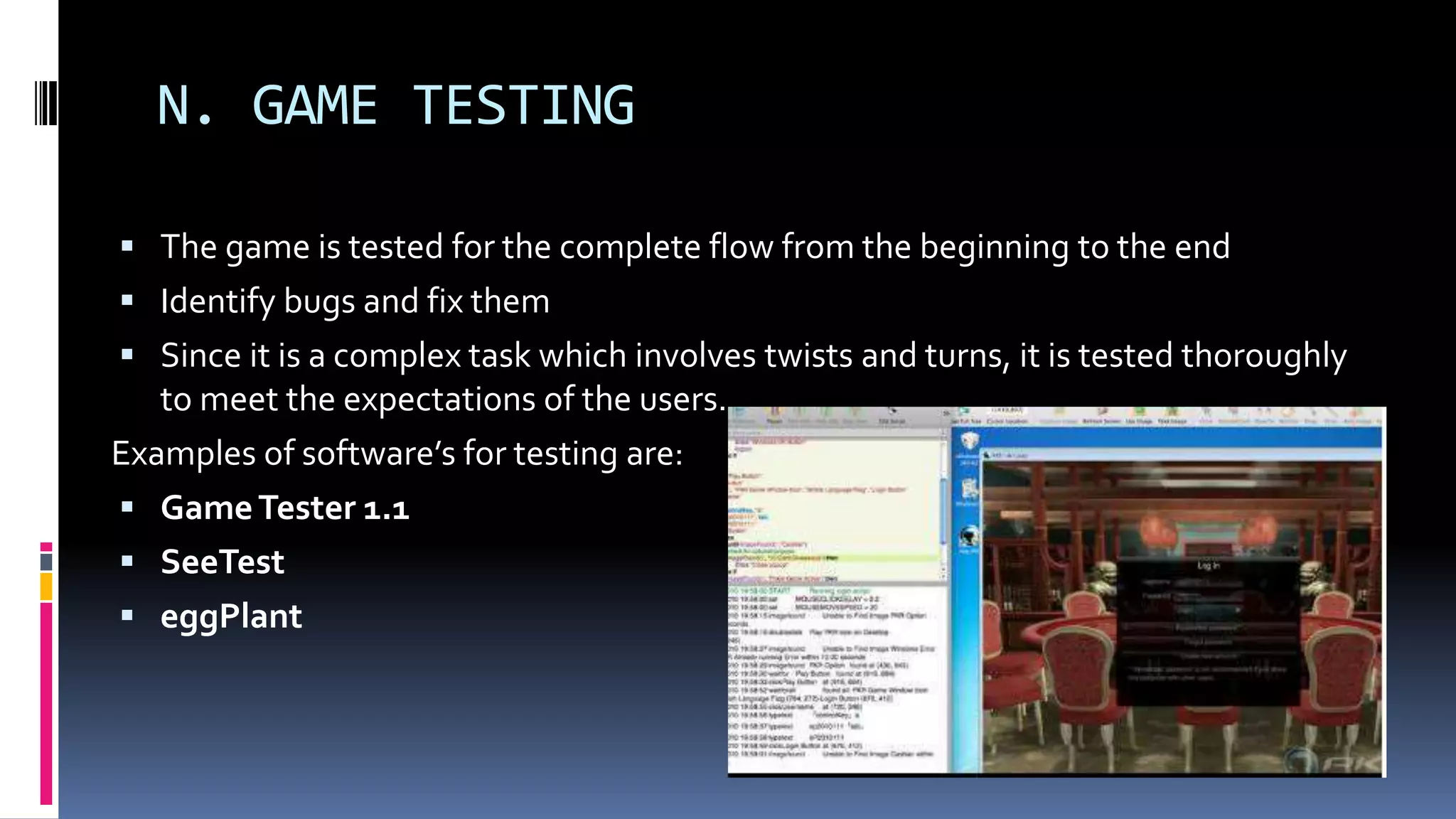
Examples of software’s for testing are:
 GameTester 1.1
 SeeTest
 eggPlant
III. CONCLUSION
 This paper gives an outline of the phases involved in the game development
process and briefly discusses each of them
 Following these phases can benefit all the team included in the game
development to proceed in their game development process without
worrying about any defects and shortcomings.
IV . REFERENCES
 [1] http://game.ezinemark.com/the-life-cycle-of-a-game-7d2d85a67203.html
 [1] http://www.docstoc.com/docs/39557145/The-Game-Development Process_ PowerPoint_---The-Game-Development.
 [2] http://www.rpgrevolution.com/tutorial/developing-a-game-storygame writing_3.html
 [3] http://www.ogcio.gov.hk/en/infrastructure/methodology/software_life_cycle/
 [4] http://www.techbaba.com/q/196feasibility+study+software+development+life+cycle.aspx
 [5] http://www.cgmwonline.com/character-design-for-games.html
 [6] Petri Lankoski, Character-Driven Game Design: Characters, Conflict, and Game play more
 [7] http://www.creativeskillset.org/games/careers/article_4724_1.asp
 [8] http://www.raphkoster.com/2009/03/10/some-zone-design-lessons/
 [9] James Dargie, Modeling Techniques: Movies vs. Games
 [10] http://www.pixelprospector.com/the-big-list-of-game-making-tools/
 [11] http://www.yoyogames.com/gamemaker/windows
 [12] http://www.clickteam.com/website/world/multimedia-fusion-2
 [13] ww.flixel.org
 [14] http://www.stencyl.com/
 [15] http://www.unrealengine.com/udk/
 [16] http://www.blitzbasic.com/Products/blitzmax.php
 [17] http://jmonkeyengine.com/engine/
 [18] http://experitest.com/web-test-automation-seetest/gaming-test-automation/
 [19] http://www.testplant.com/solutions/media-and-gaming/
 [20] http://www.adventuregamestudio.co.uk/site/ags/
 [21] http://stratagus.com/
 [22] https://play.google.com/store/apps/details?id=com.drodin.stratagus&hl=en
Thank you 

Game development life cycle

  • 1.
    GAME DEVELOPMENT LIFECYCLE Prepared by Sarah Alazab
  • 2.
    Acknowledgment  This presentationis based on a document titled “Lifecycle for Game Development to Ensure Enhanced Productivity” by K. Subhash Babu1 and R.Maruthi2  Professor & Head, Dept. of MCA, SSN college of Engineering, Chennai, Tamilnadu, India1  Associate Professor, Dept. of MCA, SSN college of Engineering, Chennai, Tamilnadu, India2
  • 3.
    Index I. Introduction II. GameDevelopment Life Cycle III. Conclusion IV. References
  • 4.
    I. Introduction Many researchersdescribed GDLC according to different software development models. Based on all these models, the most important phases are  The idea  Proposal  Design phases [2]
  • 5.
    II. Game DevelopmentLife Cycle Developing the Story Developing the Script Feasibility Study Promotional Demo Designing Layout Designing Modeling Texturing Animation High, Module and Low Level Design Coding Testing Debugging Integration GameTesting
  • 6.
    A. DEVELOPING THESTORY  A core theme with a well defined story line  Target a specific age group  Story starts with an idea then develops further  Characters, situations, events and places, relationships are determined  Conflict and resolution scenarios are added The translation of a story into a game is a mere conflict resolution.
  • 7.
    B. DEVELOPING THESCRIPT  The story is refined to obtain a tight script that ensures a seamless flow between levels.  Script writing needs a great deal of imagination and creativity.  The key is to capture the imagination of the audience.  Characters and backdrops are created and decided during this phase. The better the script the better will be the game.
  • 8.
    C. FEASIBIBLITY STUDY Assess the feasibility of a game.  Helps to freeze the requirements, the scope, profitability and other conclusions of the proposed game [4]. The areas to be analyzed in the feasibility study are:  Requirements  Pricing  Technical, organizational, cultural and legal issues  Schedule of the project
  • 9.
    C. FEASIBIBLITY STUDY Inthis phase project leaders, project design and development personnel and research group will be working together to create a game as a complete product [5]. Programmers analyze and explain the programming limitations to the project managers. The outcome of the feasibility study is the feasibility study report, which contains :  Management summary  Technical specification [4]  The findings and recommendation
  • 10.
    D. PROMOTIONAL DEMO Promotional demo is needed to attract the potential customers.  Plan the promotional demo for the game and execute it.  A basic trial version or trailer since the game is not implemented yet.
  • 11.
    E. DESIGNING  Characterdesign Figure-2: Character designs
  • 12.
    E. DESIGNING Figure -3Background design-1 Figure -4 Sets and Props Designs • Background design • Sets and Props design
  • 13.
    F. LAYOUT DESIGNING Layout for the entire game and for all the levels.  The layout represents the various sets and passage ways with hurdles  Every type of game have certain constraints. Covering all is quite challenging [9]. Figure-5: Layout Design
  • 14.
    G. MODELING  Charactermodeling, sets modeling and props modeling.  Models have to provide enough data so the finer details can be rendered in an effective manner.  Advanced techniques like the use of normal mapping[10]. Figure- 6 Props Modeling
  • 15.
    H. TEXTURING Texturing isa technique for adding detail, providing surface texture or color so that a realistic look can be given to the characters, sets and props. It is very common in almost all the 3D applications. An example of textured design is given in figure-3. Figure-7:Textured model
  • 16.
    I. ANIMATION Characters animationrepresent the sequence of actions in the game.  Frame by Frame Animation Key frames are snapshots of an image at a single point in time. Key frame animation is the cycling of key frames to give the illusion of movement. Figure-8 Frame by Frame Animation-1
  • 17.
    I. ANIMATION  MotionCapture Animation Capture and record movement of the characters or objects enacted by humans or trained animals with either optical or magnetic sensors placed on them. These movements are later applied to the models. Requires expensive camera/magnetic systems and very specific hardware and software.
  • 18.
    I. ANIMATION  MeshAnimation Mesh methodology (supports the deformations of Muscles & Joints. e.g., facials, biceps, skin movement on rib-joints for animals, etc).
  • 19.
    J. HIGH ANDLOW LEVEL DESIGN The high level design identifies all the elements in an abstract way hiding most details Shows relationships between modules in the form of data flow, flow charts, data structures etc. • In module design high level design is segregated into various modules.
  • 20.
    J. HIGH ANDLOW LEVEL DESIGN The low level design details the high level design (i.e) the logic behind each of the module is defined.
  • 21.
    K. CODING  Codingfor making the gaming interactive  Coding for implementing the interface design  2D Game Engines like GameMaker, Multimedia Fusion 2, Construct, Flixel, FlashPunk and Stencyl. Figure:10 Design interfaceFigure:9 GameMaker IDE
  • 22.
    K. CODING  3DGame Engines are Unity , UDK , XNA , BlitzMax , jMonkeyEngine andTorque to name a few[11]. Figure:11 Unity Game Engine Figure:12 Unreal Development Kit
  • 23.
    L. TESTING ANDDEBUGGING This phase is carried out at the module level before integrating all the modules. Testing is to be done to make each and every module in the game to be free from errors and bugs. Most of the Games designing tools come with built in testing and debugging tools.
  • 24.
    M. INTEGRATION  Aftertesting, all the modules are integrated to get the final product. It is very similar to assembling the various parts of a product to get a complete product.
  • 25.
    N. GAME TESTING The game is tested for the complete flow from the beginning to the end  Identify bugs and fix them  Since it is a complex task which involves twists and turns, it is tested thoroughly to meet the expectations of the users. Examples of software’s for testing are:  GameTester 1.1  SeeTest  eggPlant
  • 26.
    III. CONCLUSION  Thispaper gives an outline of the phases involved in the game development process and briefly discusses each of them  Following these phases can benefit all the team included in the game development to proceed in their game development process without worrying about any defects and shortcomings.
  • 27.
    IV . REFERENCES [1] http://game.ezinemark.com/the-life-cycle-of-a-game-7d2d85a67203.html  [1] http://www.docstoc.com/docs/39557145/The-Game-Development Process_ PowerPoint_---The-Game-Development.  [2] http://www.rpgrevolution.com/tutorial/developing-a-game-storygame writing_3.html  [3] http://www.ogcio.gov.hk/en/infrastructure/methodology/software_life_cycle/  [4] http://www.techbaba.com/q/196feasibility+study+software+development+life+cycle.aspx  [5] http://www.cgmwonline.com/character-design-for-games.html  [6] Petri Lankoski, Character-Driven Game Design: Characters, Conflict, and Game play more  [7] http://www.creativeskillset.org/games/careers/article_4724_1.asp  [8] http://www.raphkoster.com/2009/03/10/some-zone-design-lessons/  [9] James Dargie, Modeling Techniques: Movies vs. Games  [10] http://www.pixelprospector.com/the-big-list-of-game-making-tools/  [11] http://www.yoyogames.com/gamemaker/windows  [12] http://www.clickteam.com/website/world/multimedia-fusion-2  [13] ww.flixel.org  [14] http://www.stencyl.com/  [15] http://www.unrealengine.com/udk/  [16] http://www.blitzbasic.com/Products/blitzmax.php  [17] http://jmonkeyengine.com/engine/  [18] http://experitest.com/web-test-automation-seetest/gaming-test-automation/  [19] http://www.testplant.com/solutions/media-and-gaming/  [20] http://www.adventuregamestudio.co.uk/site/ags/  [21] http://stratagus.com/  [22] https://play.google.com/store/apps/details?id=com.drodin.stratagus&hl=en
  • 28.