

GAMIFICATION
- to enhance learning and motivation,
getting the customer hooked and the brain
involved
Magnus Sjögren, MD, PhD, Associate Professor
Edubrain AB
magnus@edubrain.se
Edubrain AB www.edubrain.se
• Consultancy services in Brain/Neuroscience, Psychiatry and Leadership
• MEASURES of BRAIN FUNCTIONS
• Review, analysis, knowledge on Apps, Online tools/websites and Smartwear that
measure e.g. emotions, memory, learning, motivation.
• Advice on design/set-up for health/wellness products in TECH Industry
• Quantified Psychiatry (quantified self brain health)
• MOTIVATION, RETENTION and FEEDBACK Strategies
• Lectures and Advice
• More than 20 years of Clinical/Medical and Scientific Experience
• More than 10 years of Executive and Leadership Experience
• BRAIN SCIENCE
• Education
• Advisor, Reviewer in Clinical Neuroscience to EU (e.g. IMI and H2020)
• Author of the book ”The Non-Stop Lover – and other stories from my practice as a Psychiatrist”
http://goo.gl/iWkHmA
magnus@edubrain.se
Consultancy provided to:
Gamification - definition
• Gamification is using game mechanics in non-game contexts to
engage users.
• Learning
• Innovation
• Productivity
• Loyalty
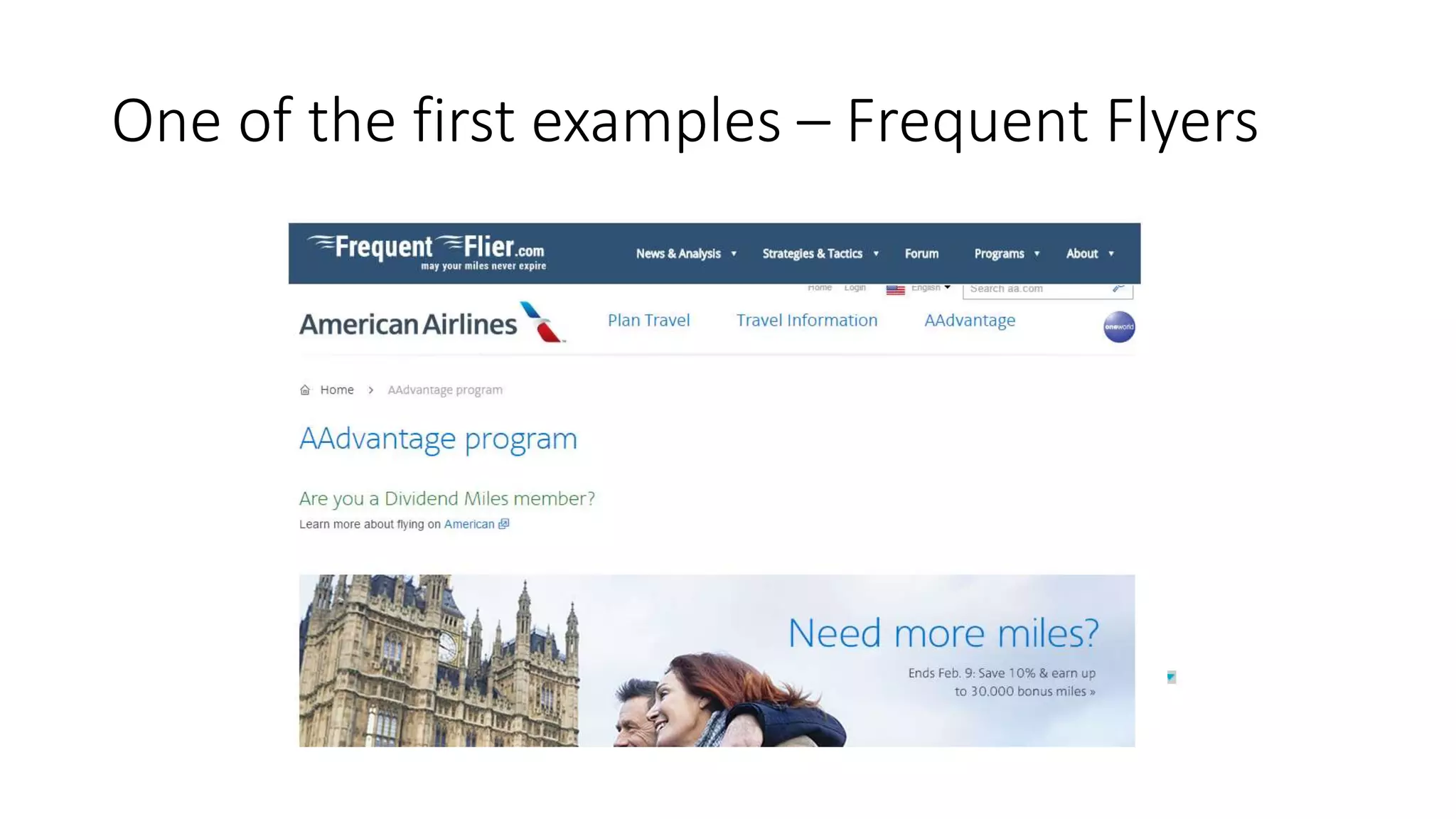
One of the first examples – Frequent Flyers
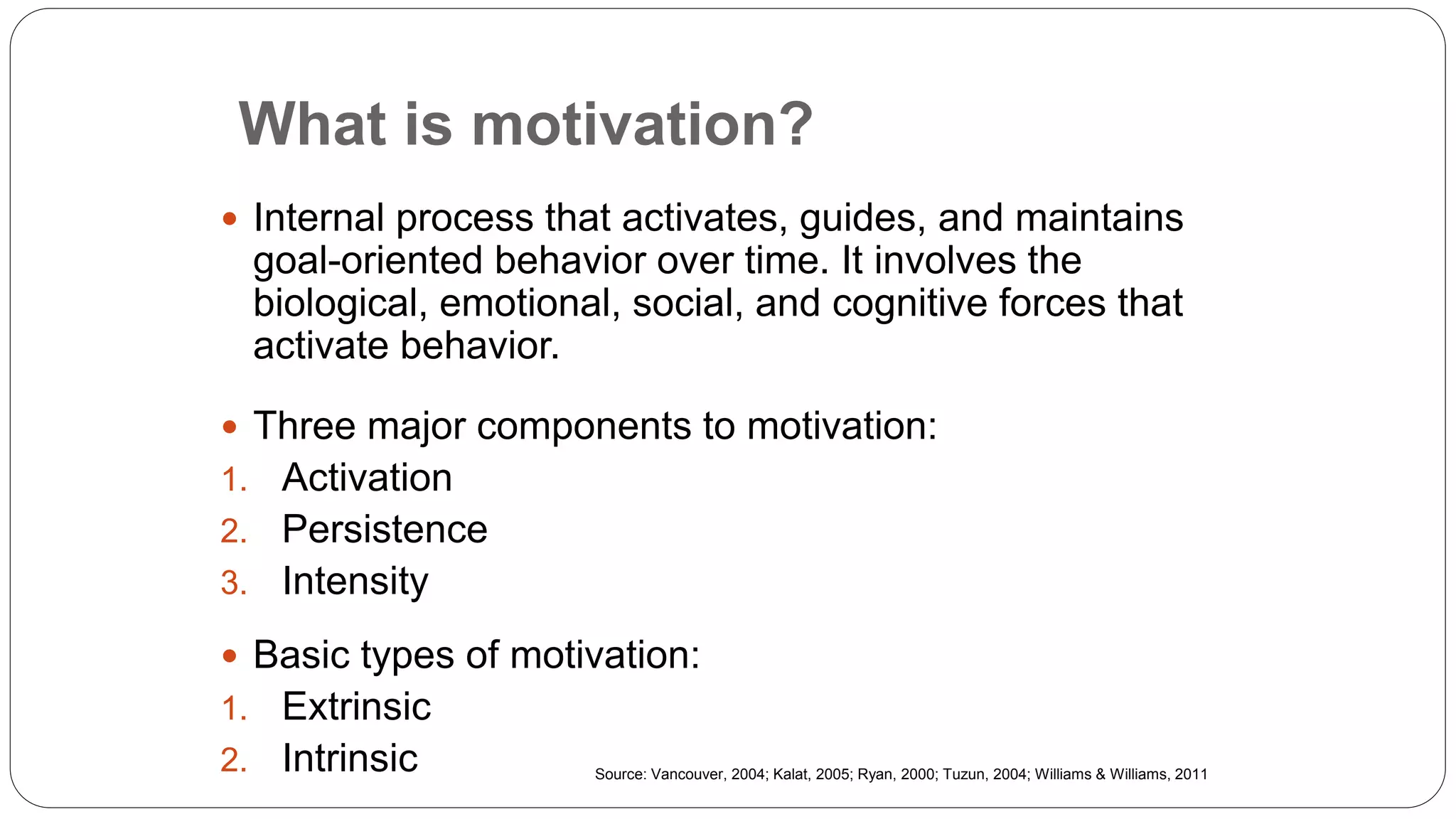
What is motivation?
 Internal process that activates, guides, and maintains
goal-oriented behavior over time. It involves the
biological, emotional, social, and cognitive forces that
activate behavior.
 Three major components to motivation:
1. Activation
2. Persistence
3. Intensity
 Basic types of motivation:
1. Extrinsic
2. Intrinsic Source: Vancouver, 2004; Kalat, 2005; Ryan, 2000; Tuzun, 2004; Williams & Williams, 2011
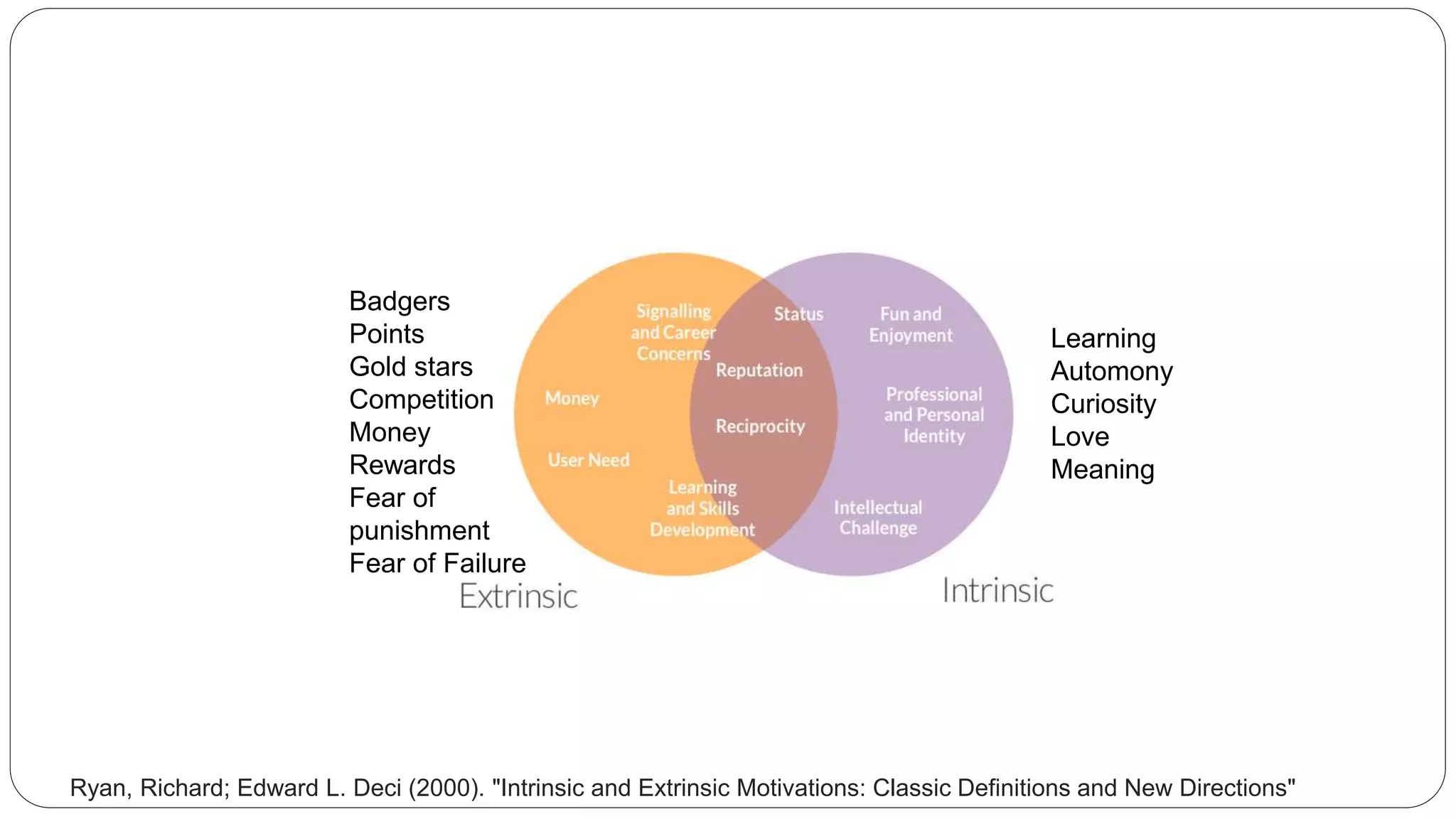
Learning
Automony
Curiosity
Love
Meaning
Badgers
Points
Gold stars
Competition
Money
Rewards
Fear of
punishment
Fear of Failure
Ryan, Richard; Edward L. Deci (2000). "Intrinsic and Extrinsic Motivations: Classic Definitions and New Directions"
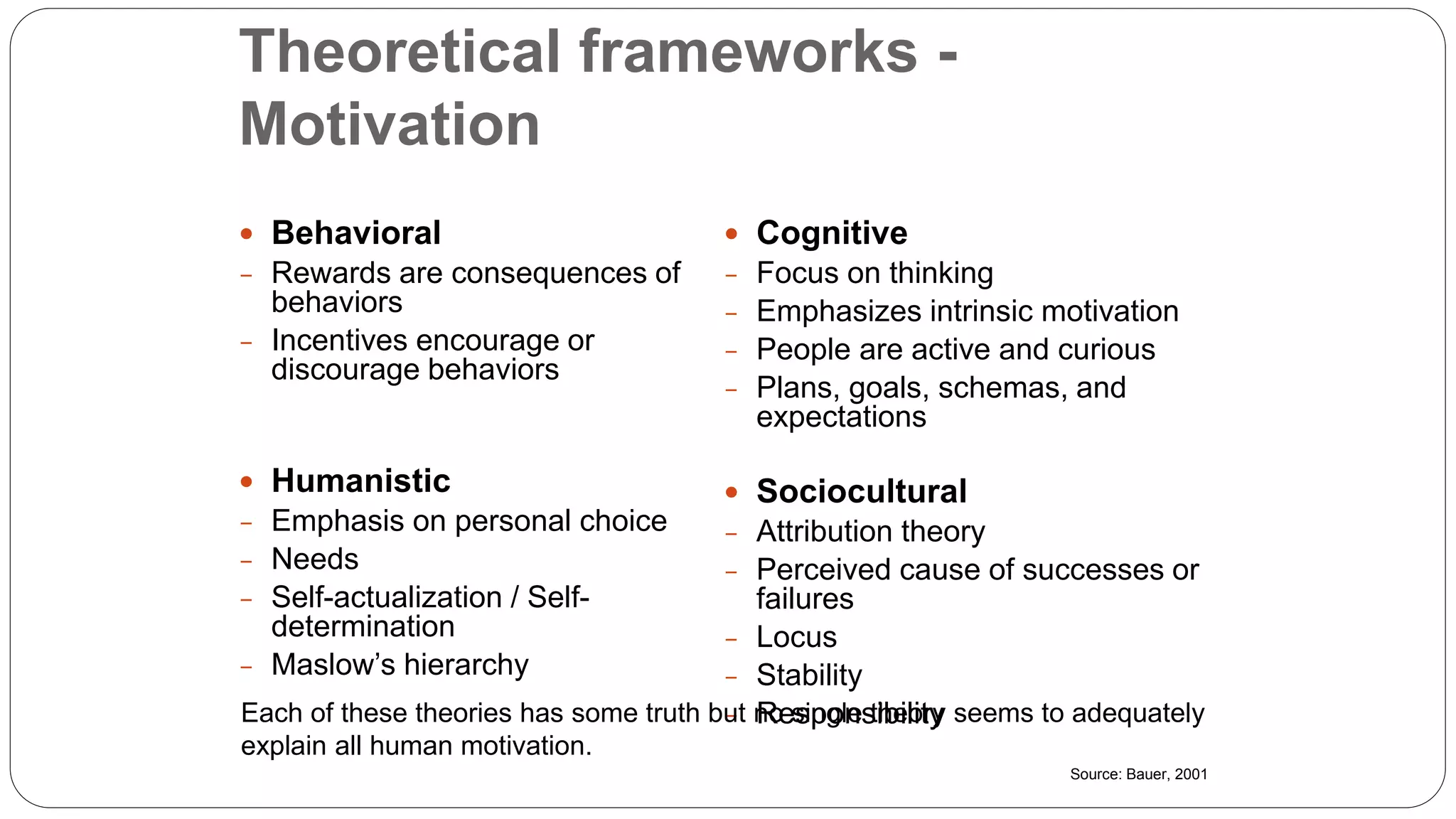
Theoretical frameworks -
Motivation
 Behavioral
- Rewards are consequences of
behaviors
- Incentives encourage or
discourage behaviors
 Humanistic
- Emphasis on personal choice
- Needs
- Self-actualization / Self-
determination
- Maslow’s hierarchy
 Cognitive
- Focus on thinking
- Emphasizes intrinsic motivation
- People are active and curious
- Plans, goals, schemas, and
expectations
 Sociocultural
- Attribution theory
- Perceived cause of successes or
failures
- Locus
- Stability
- ResponsibilityEach of these theories has some truth but no single theory seems to adequately
explain all human motivation.
Source: Bauer, 2001
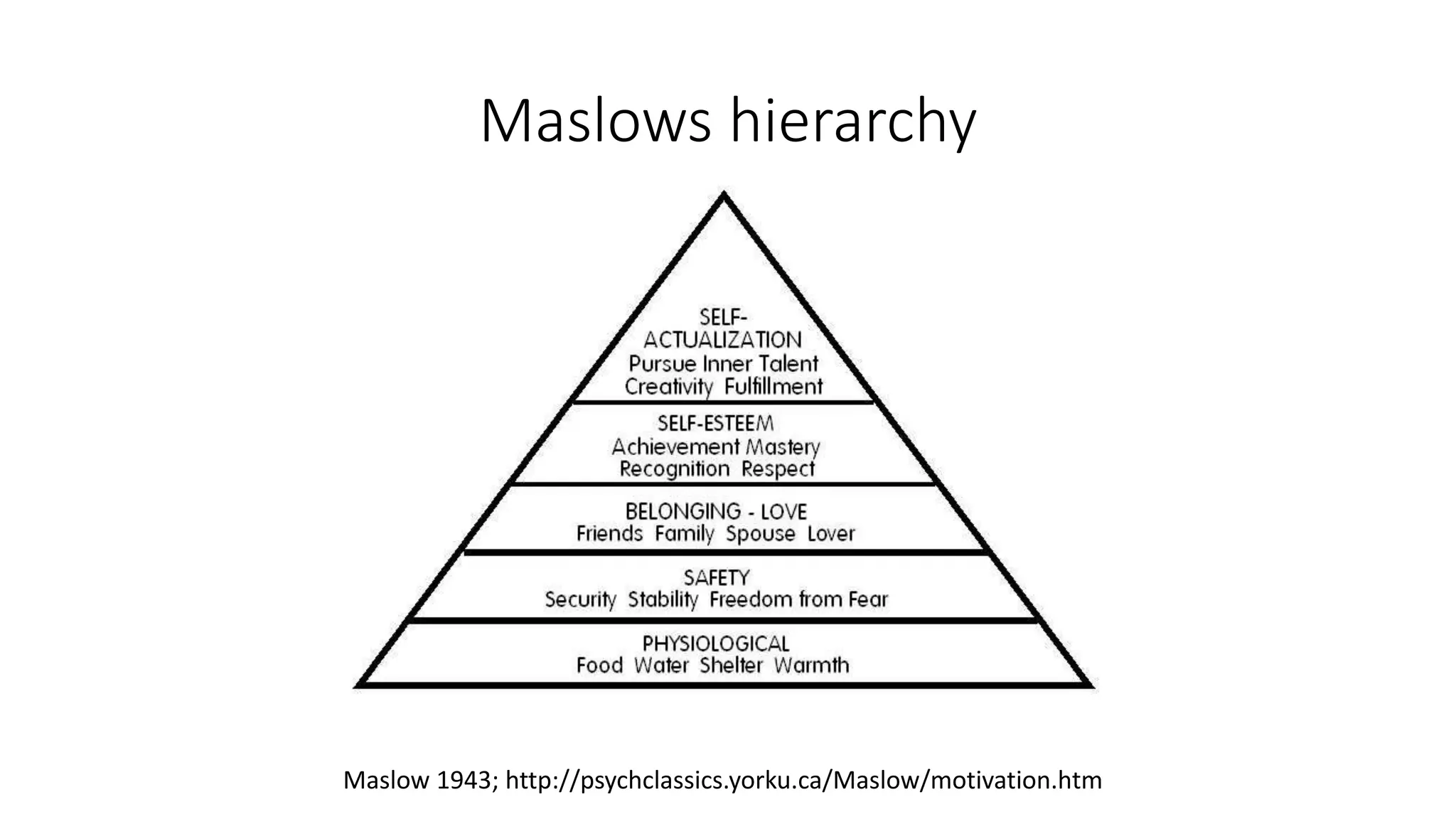
Maslows hierarchy
Maslow 1943; http://psychclassics.yorku.ca/Maslow/motivation.htm
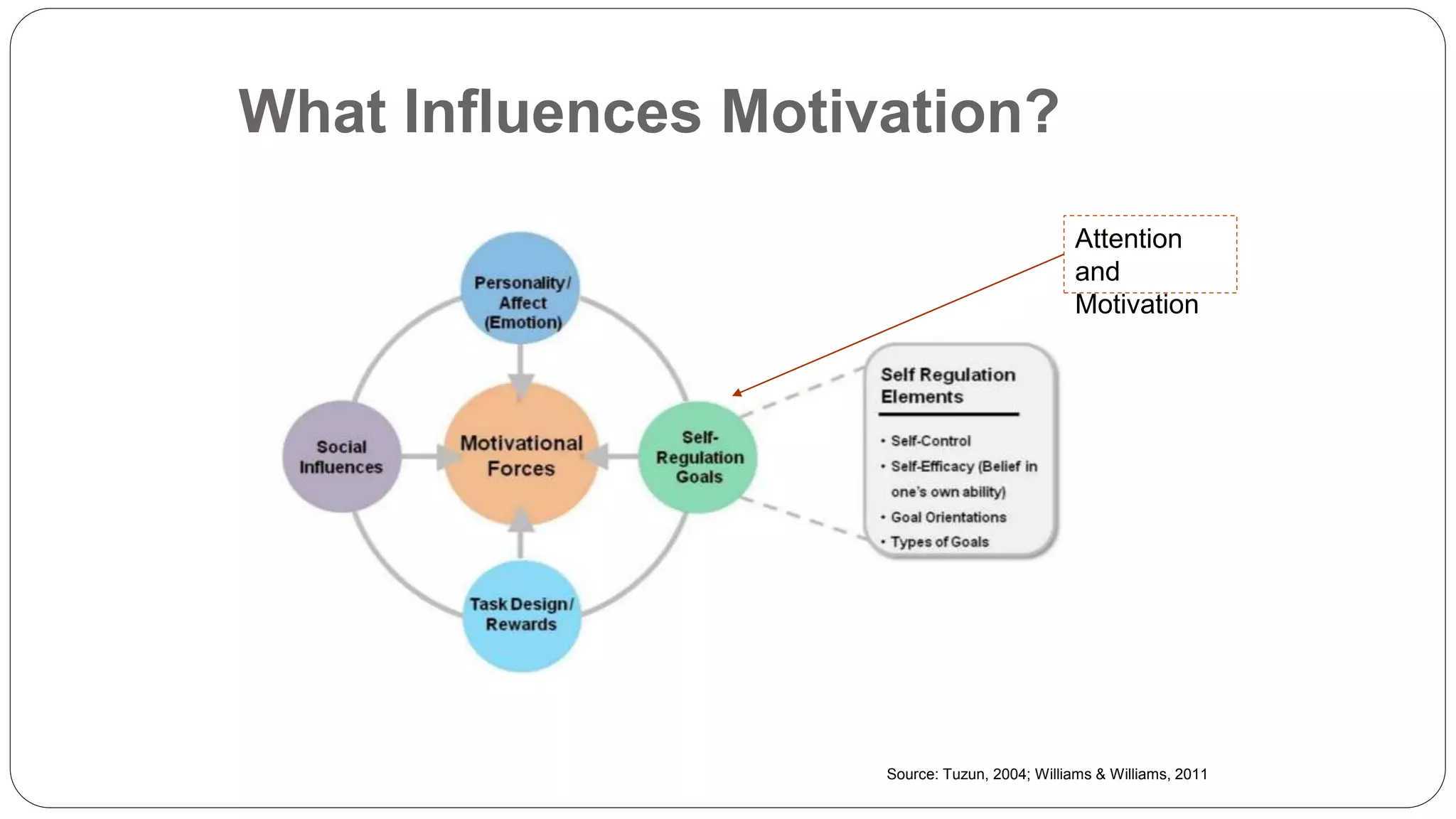
What Influences Motivation?
Source: Tuzun, 2004; Williams & Williams, 2011
Attention
and
Motivation
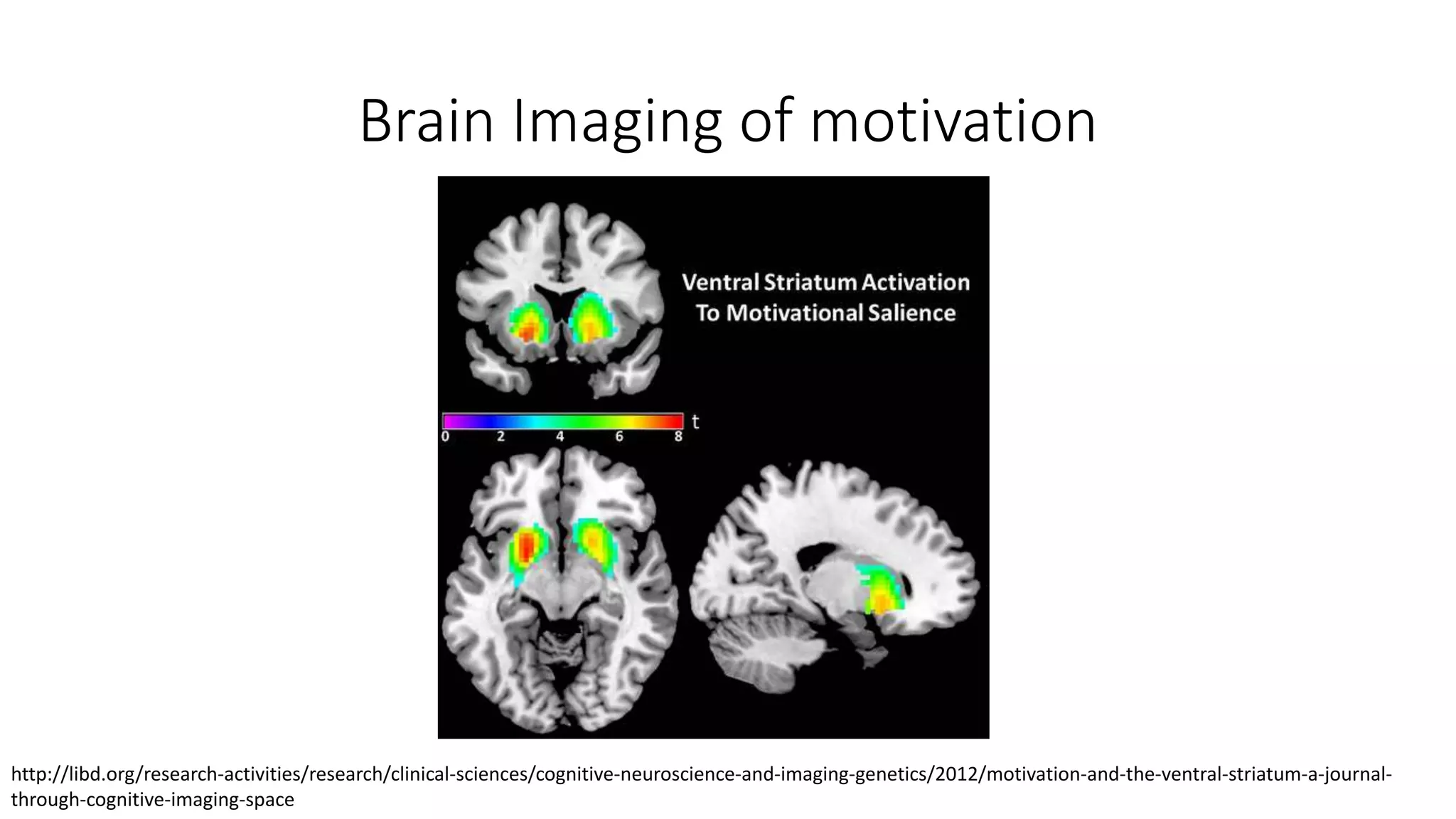
Brain Imaging of motivation
http://libd.org/research-activities/research/clinical-sciences/cognitive-neuroscience-and-imaging-genetics/2012/motivation-and-the-ventral-striatum-a-journal-
through-cognitive-imaging-space
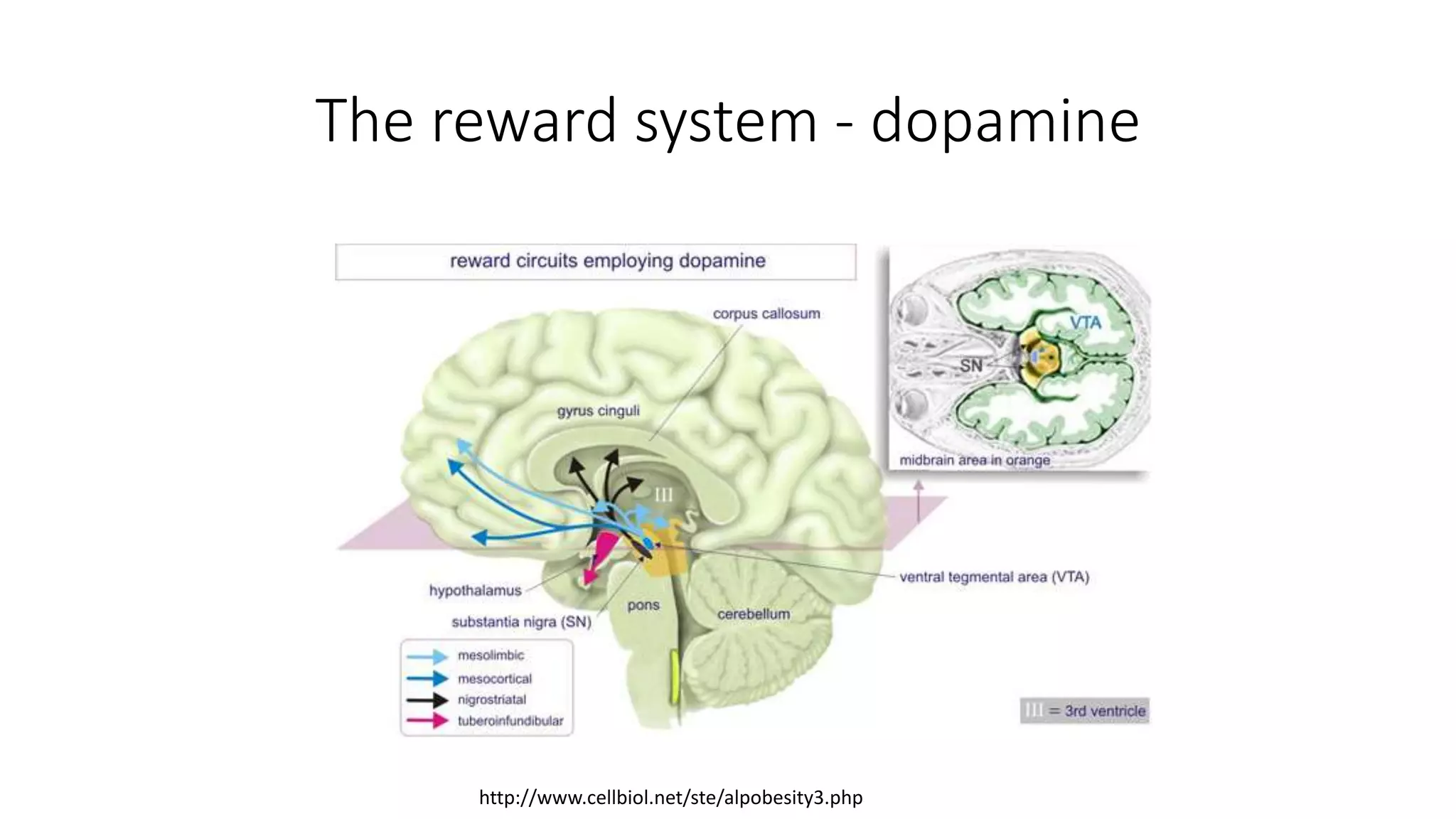
The reward system - dopamine
http://www.cellbiol.net/ste/alpobesity3.php
GAMIFICATION
Gamification - definition
• Gamification is using game mechanics in non-game contexts to
engage users.
• Learning
• Innovation
• Productivity
• Loyalty
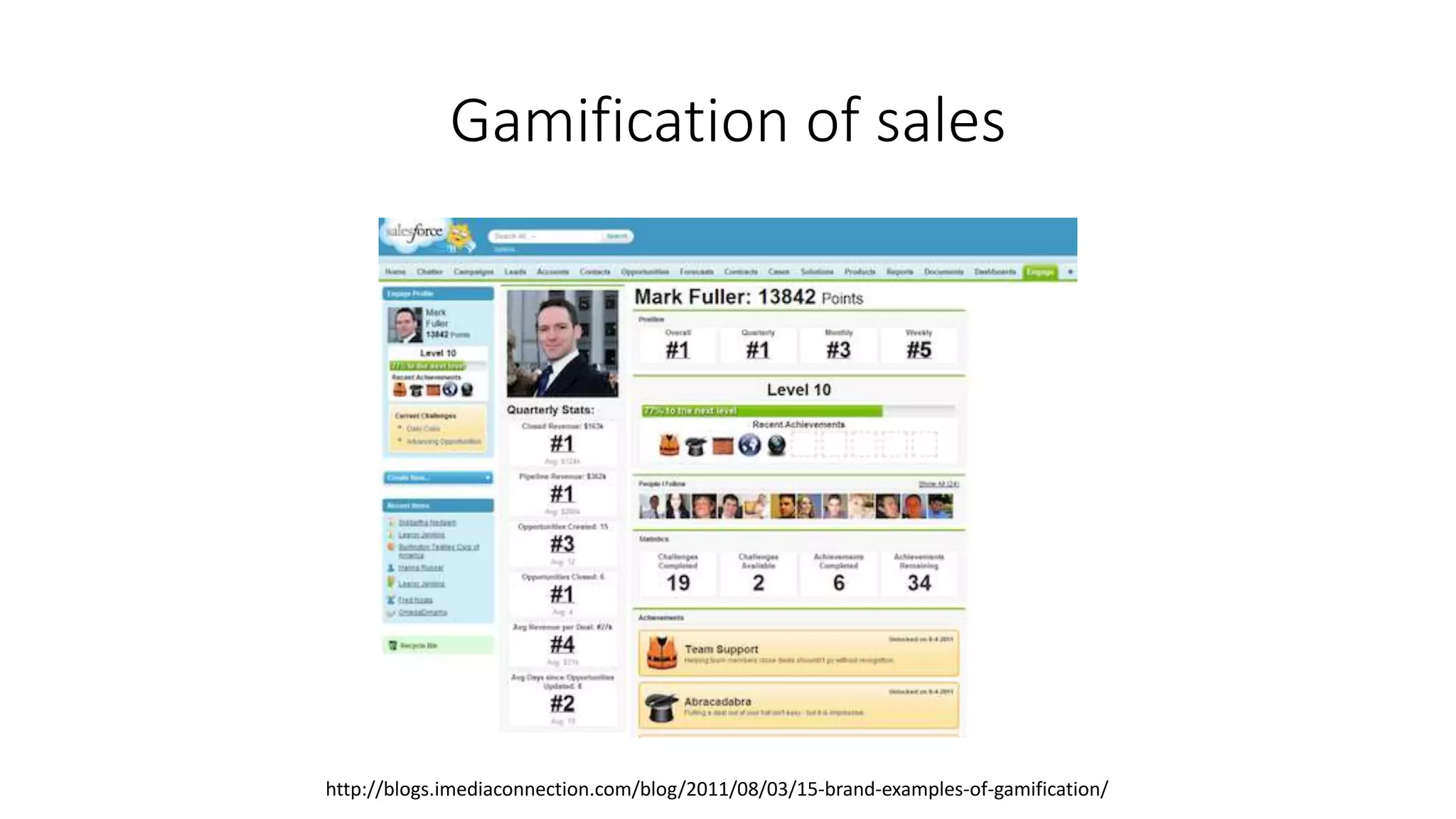
Gamification of sales
http://blogs.imediaconnection.com/blog/2011/08/03/15-brand-examples-of-gamification/
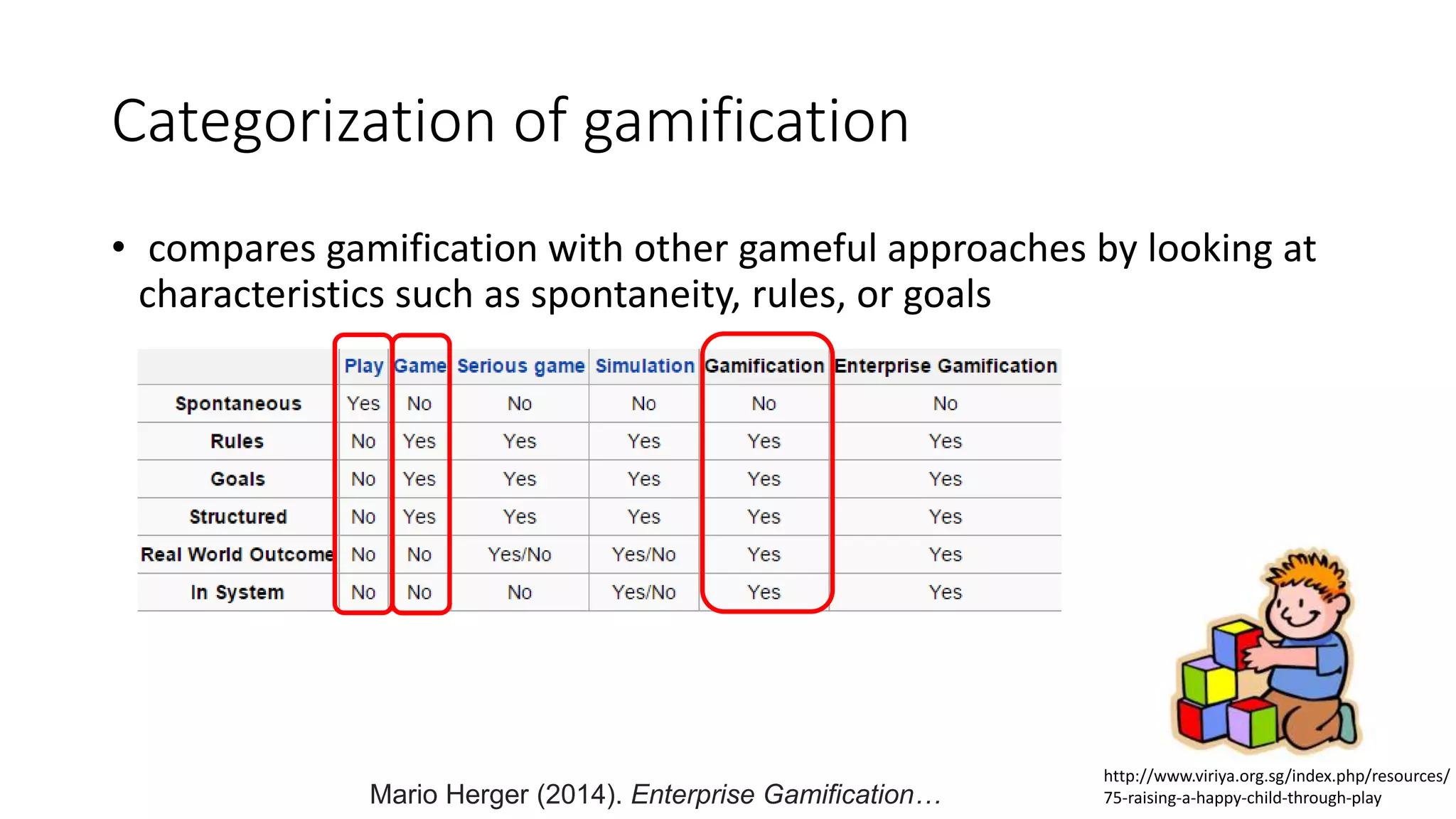
• compares gamification with other gameful approaches by looking at
characteristics such as spontaneity, rules, or goals
Categorization of gamification
Mario Herger (2014). Enterprise Gamification…
http://www.viriya.org.sg/index.php/resources/
75-raising-a-happy-child-through-play
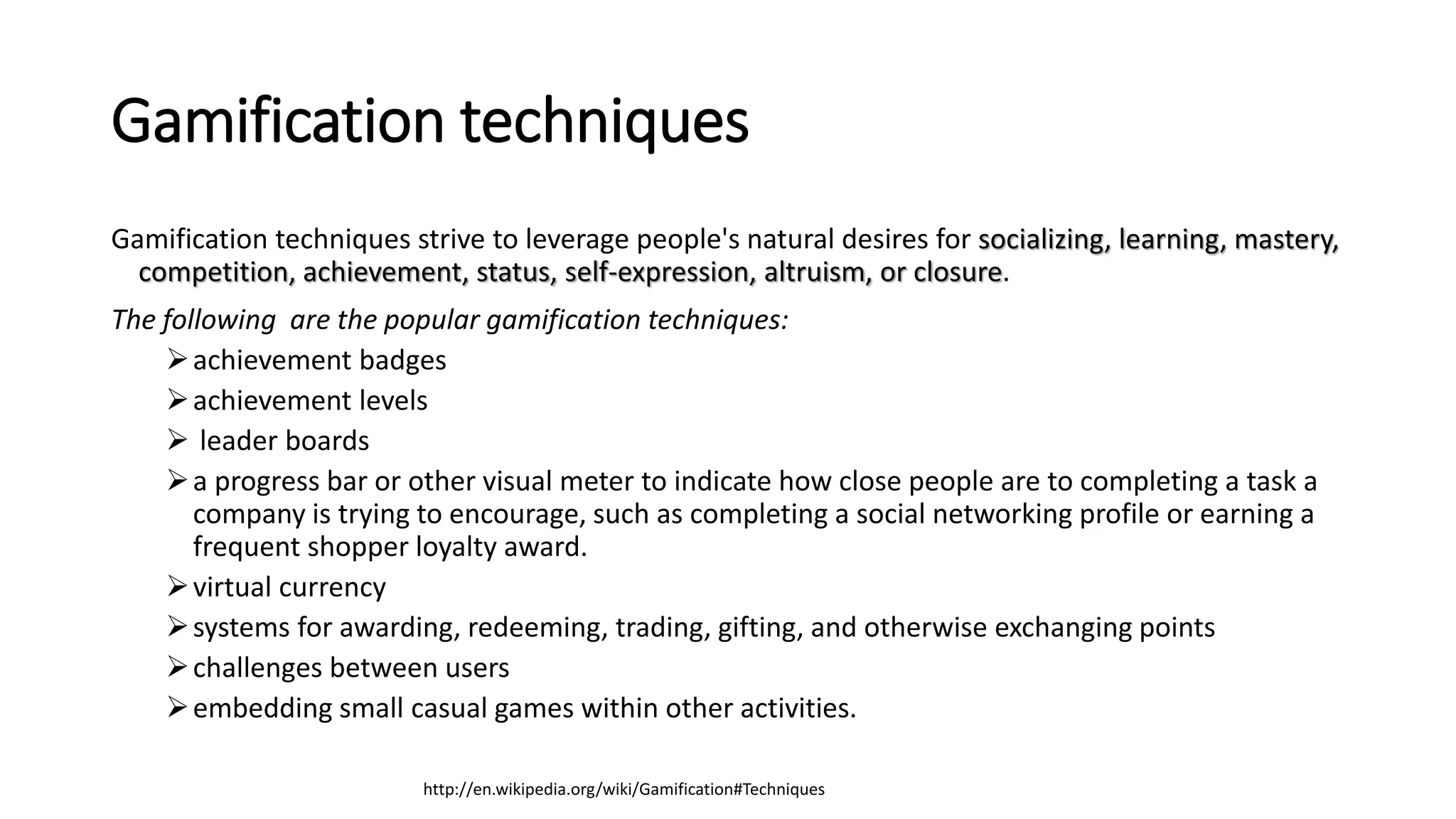
Gamification techniques
Gamification techniques strive to leverage people's natural desires for socializing, learning, mastery,
competition, achievement, status, self-expression, altruism, or closure.
The following are the popular gamification techniques:
achievement badges
achievement levels
 leader boards
a progress bar or other visual meter to indicate how close people are to completing a task a
company is trying to encourage, such as completing a social networking profile or earning a
frequent shopper loyalty award.
virtual currency
systems for awarding, redeeming, trading, gifting, and otherwise exchanging points
challenges between users
embedding small casual games within other activities.
http://en.wikipedia.org/wiki/Gamification#Techniques
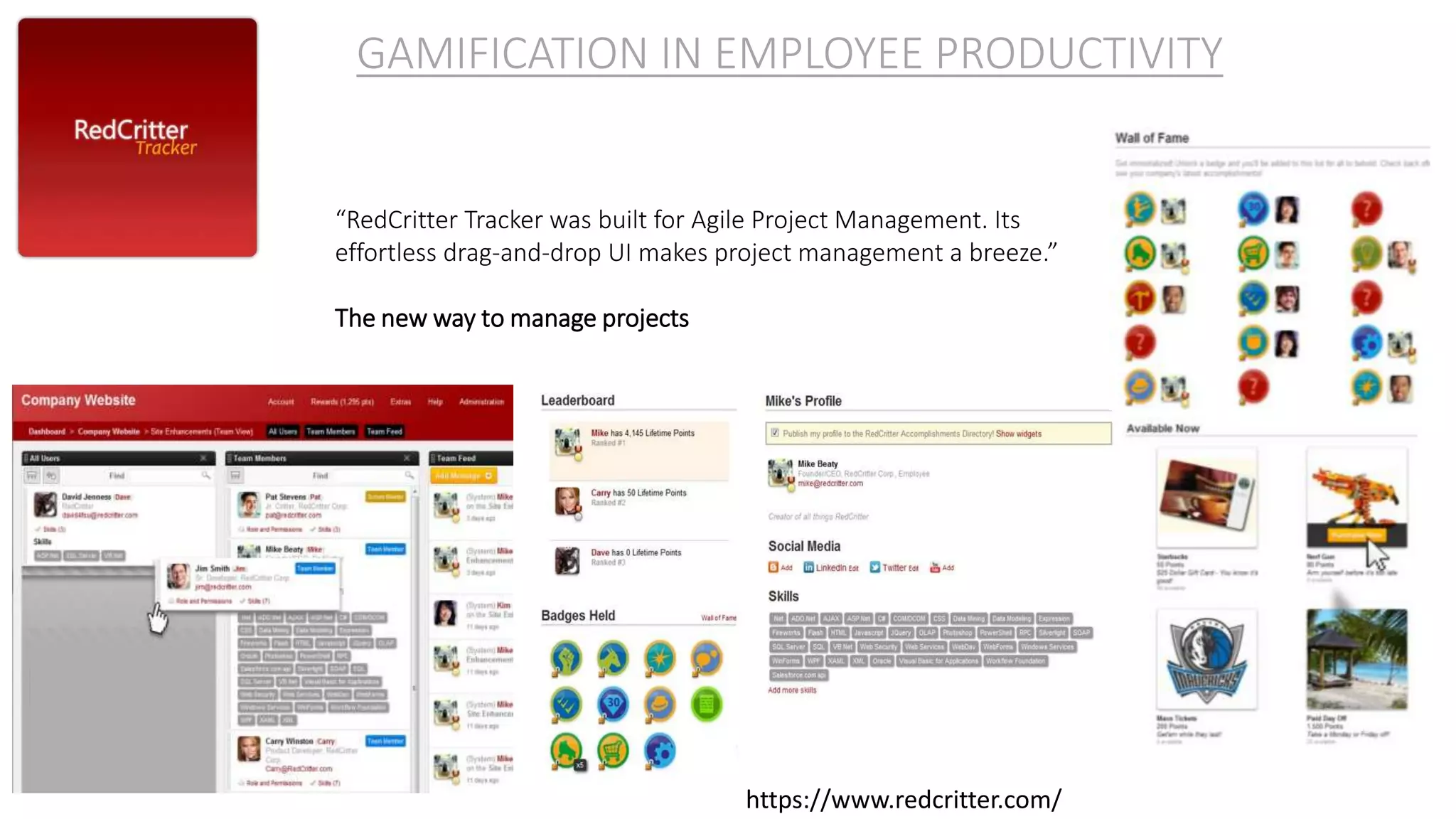
“RedCritter Tracker was built for Agile Project Management. Its
effortless drag-and-drop UI makes project management a breeze.”
The new way to manage projects
GAMIFICATION IN EMPLOYEE PRODUCTIVITY
https://www.redcritter.com/
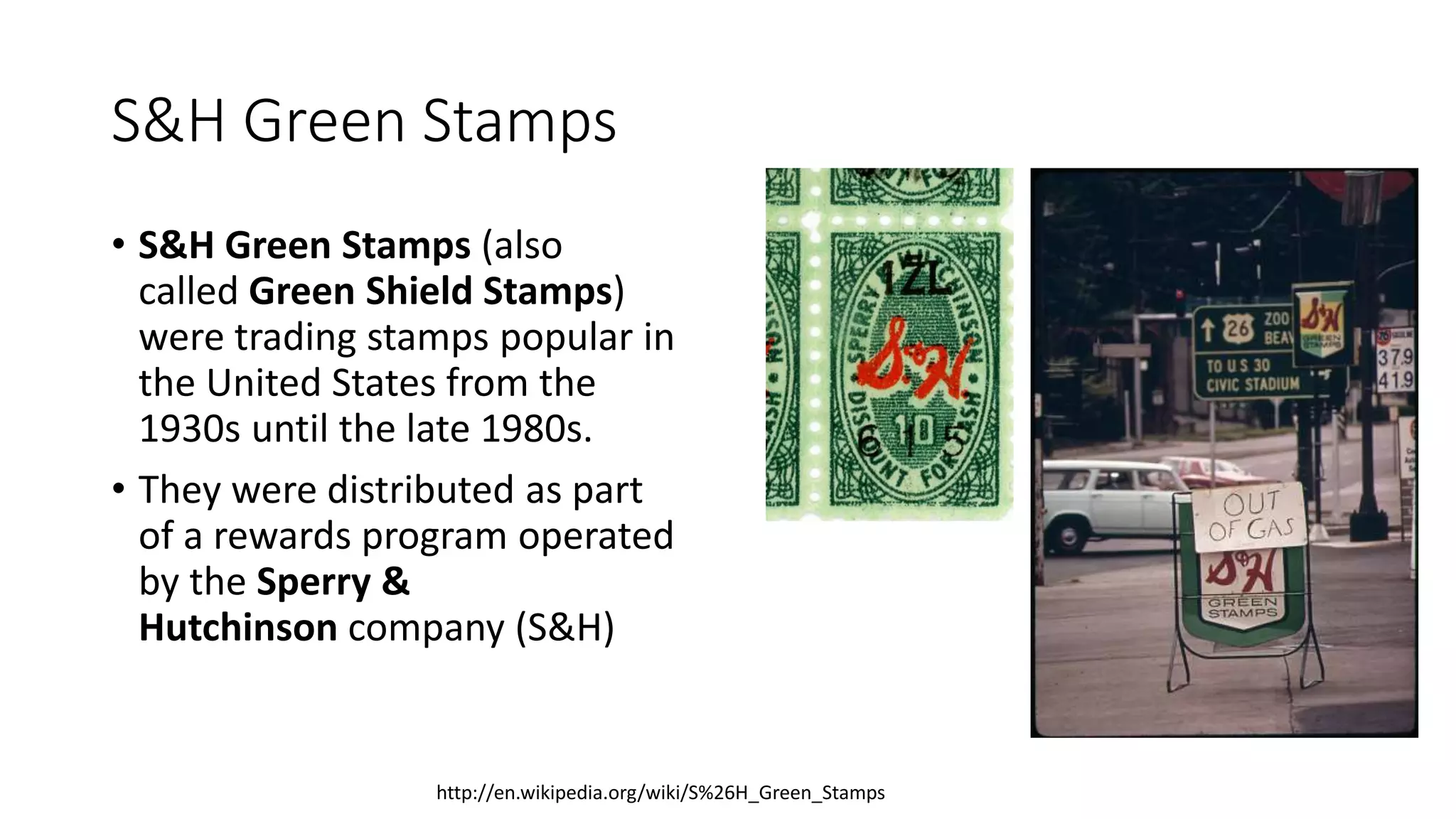
S&H Green Stamps
• S&H Green Stamps (also
called Green Shield Stamps)
were trading stamps popular in
the United States from the
1930s until the late 1980s.
• They were distributed as part
of a rewards program operated
by the Sperry &
Hutchinson company (S&H)
http://en.wikipedia.org/wiki/S%26H_Green_Stamps
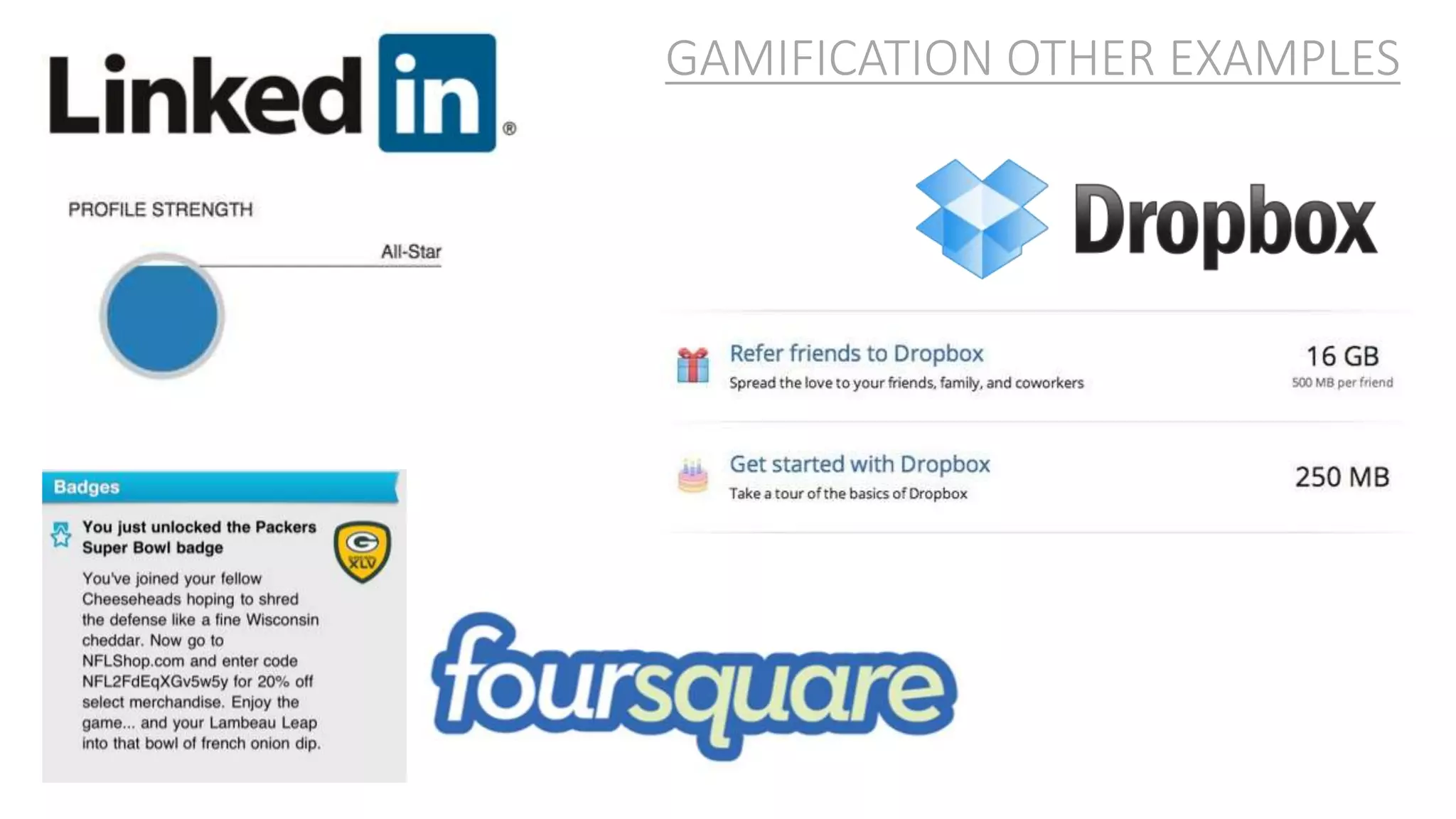
GAMIFICATION OTHER EXAMPLES
Future of Gamification
• Over 70% of Forbes Global 2000 companies surveyed in 2013 said
they planned to use gamification for the purposes of marketing and
customer retention.
• Organisations will allocate 2.8 billion USD (1.7 billion GBP) in direct
spending on gamification by 2015
http://collabor8now.com/knowledge-management/gamification-making-work-fun-or-making-fun-of-work/
Legal restrictions
• Compliance with Privacy laws
• Labour law
• Ownership and control of Intellectual Property (data)
• The use of virtual currencies and virtual assets
• The virtual currency schemes might be used by criminals, fraudsters
and money launderers to perform their illegal activities.
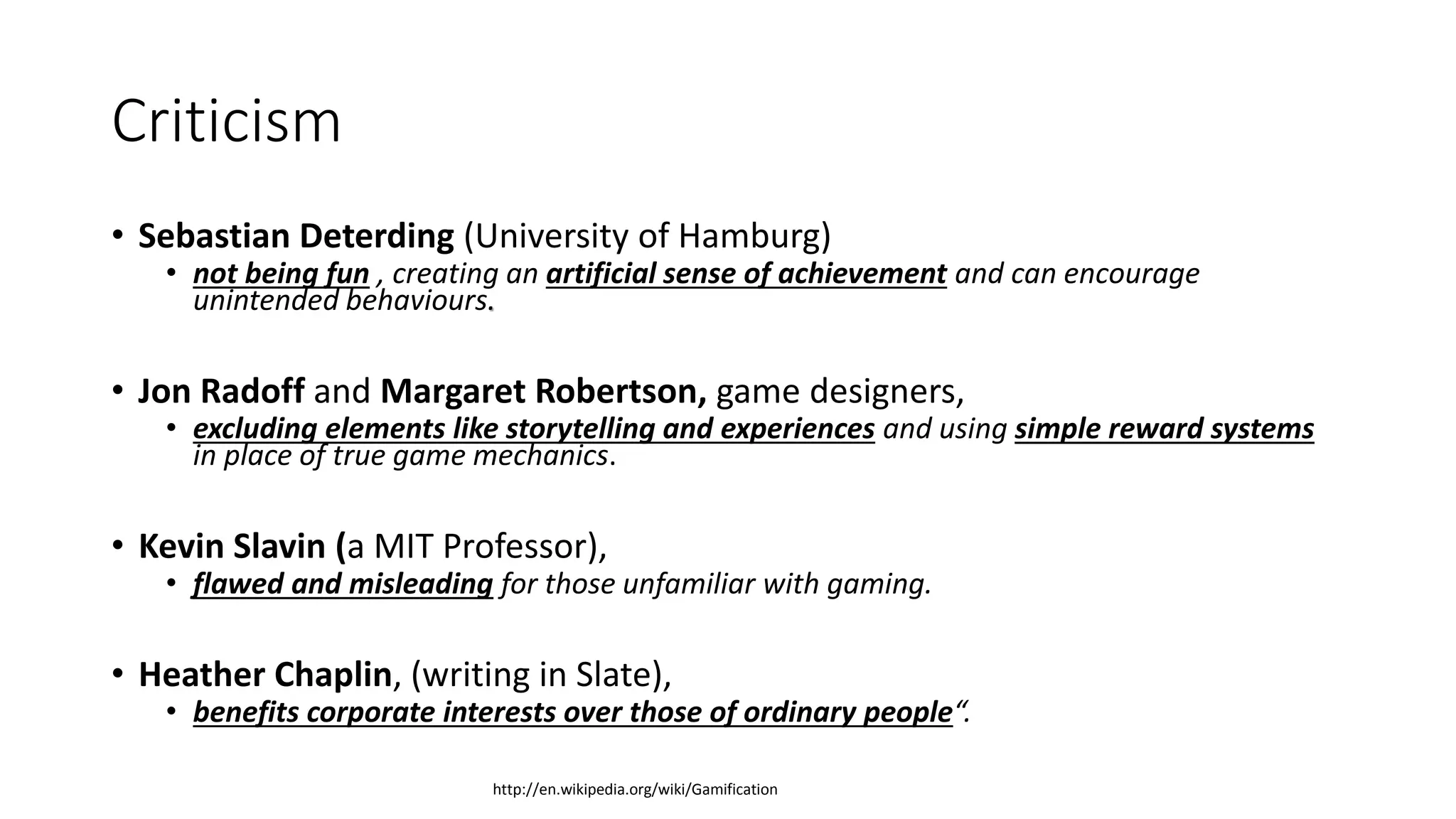
Criticism
• Sebastian Deterding (University of Hamburg)
• not being fun , creating an artificial sense of achievement and can encourage
unintended behaviours.
• Jon Radoff and Margaret Robertson, game designers,
• excluding elements like storytelling and experiences and using simple reward systems
in place of true game mechanics.
• Kevin Slavin (a MIT Professor),
• flawed and misleading for those unfamiliar with gaming.
• Heather Chaplin, (writing in Slate),
• benefits corporate interests over those of ordinary people“.
http://en.wikipedia.org/wiki/Gamification
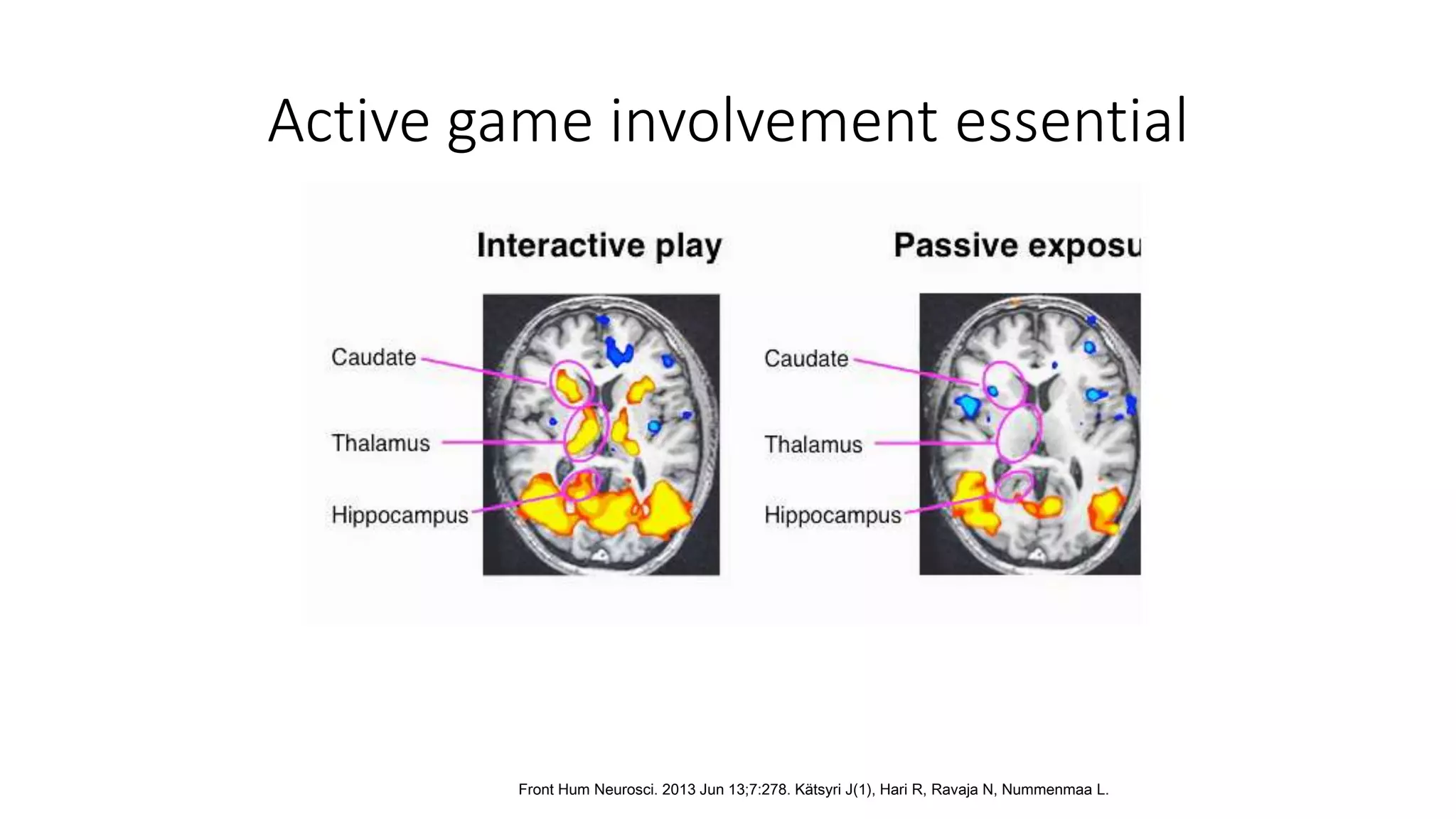
Front Hum Neurosci. 2013 Jun 13;7:278. Kätsyri J(1), Hari R, Ravaja N, Nummenmaa L.
Active game involvement essential
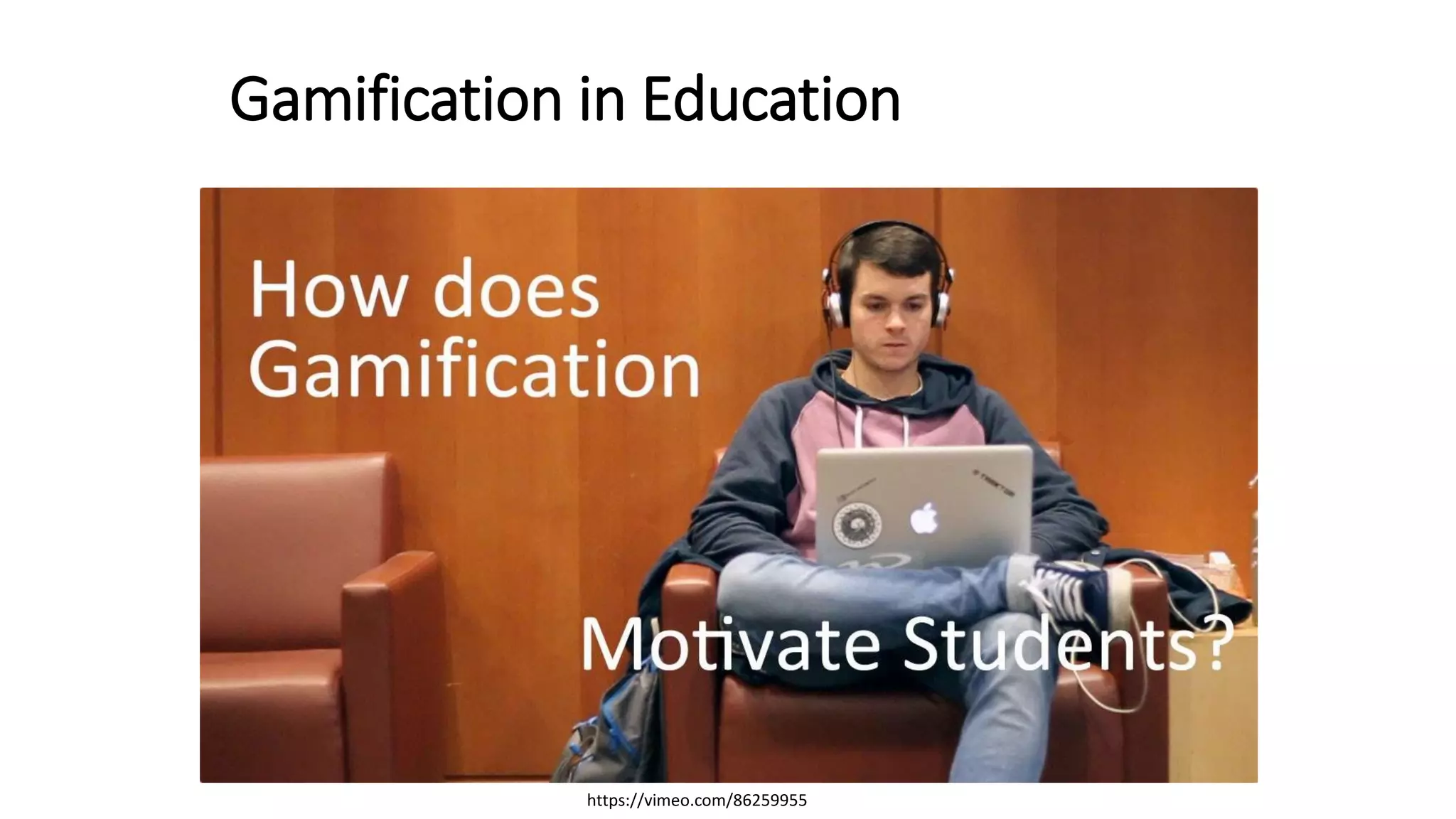
Gamification in Education
https://vimeo.com/86259955
Gamification of learning
• The gamification of learning is an educational approach
• to motivate students to learn
• using video game design and game elements in learning environments.
• The goal is to maximize enjoyment and engagement while learning.
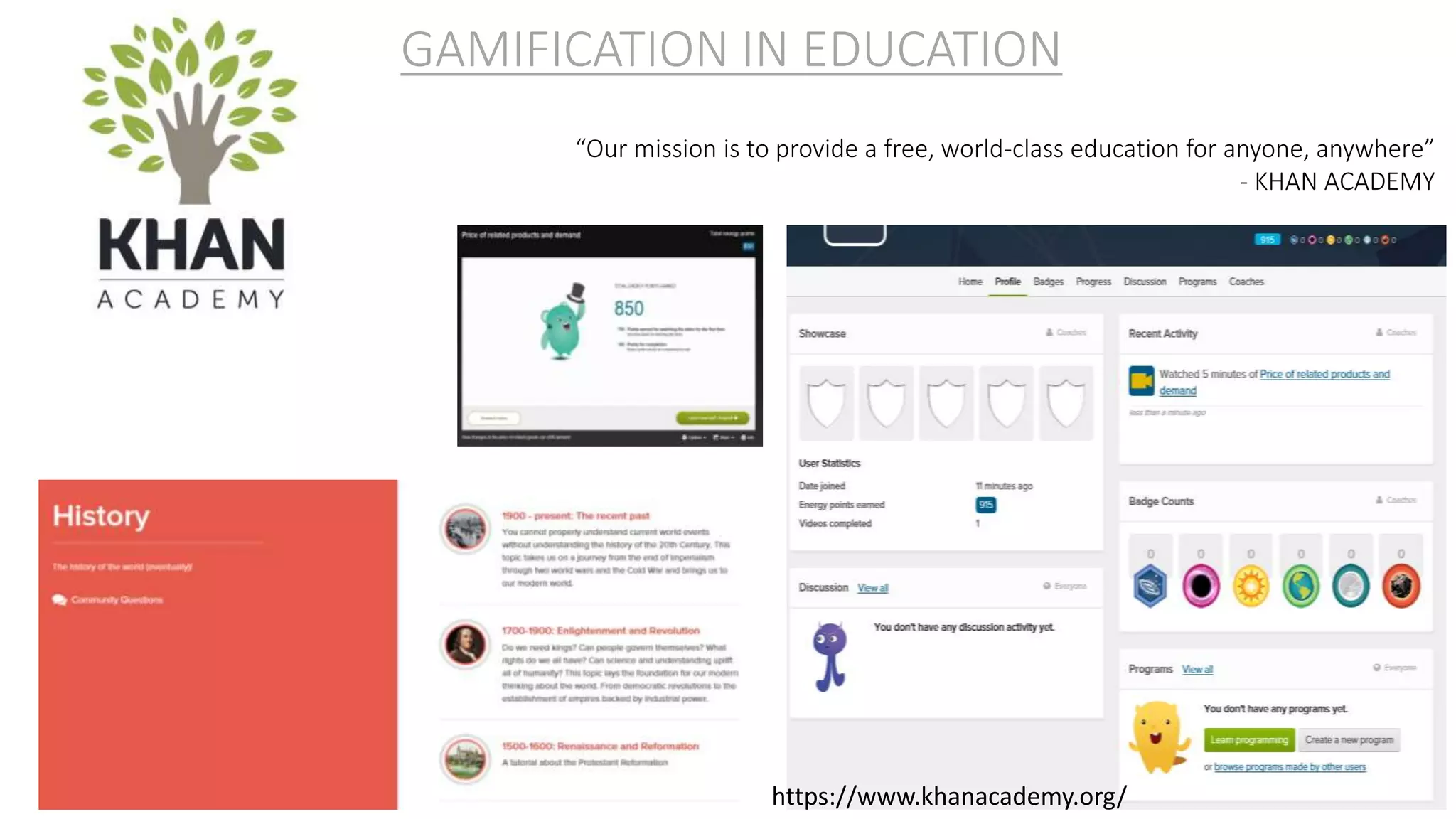
“Our mission is to provide a free, world-class education for anyone, anywhere”
- KHAN ACADEMY
GAMIFICATION IN EDUCATION
https://www.khanacademy.org/
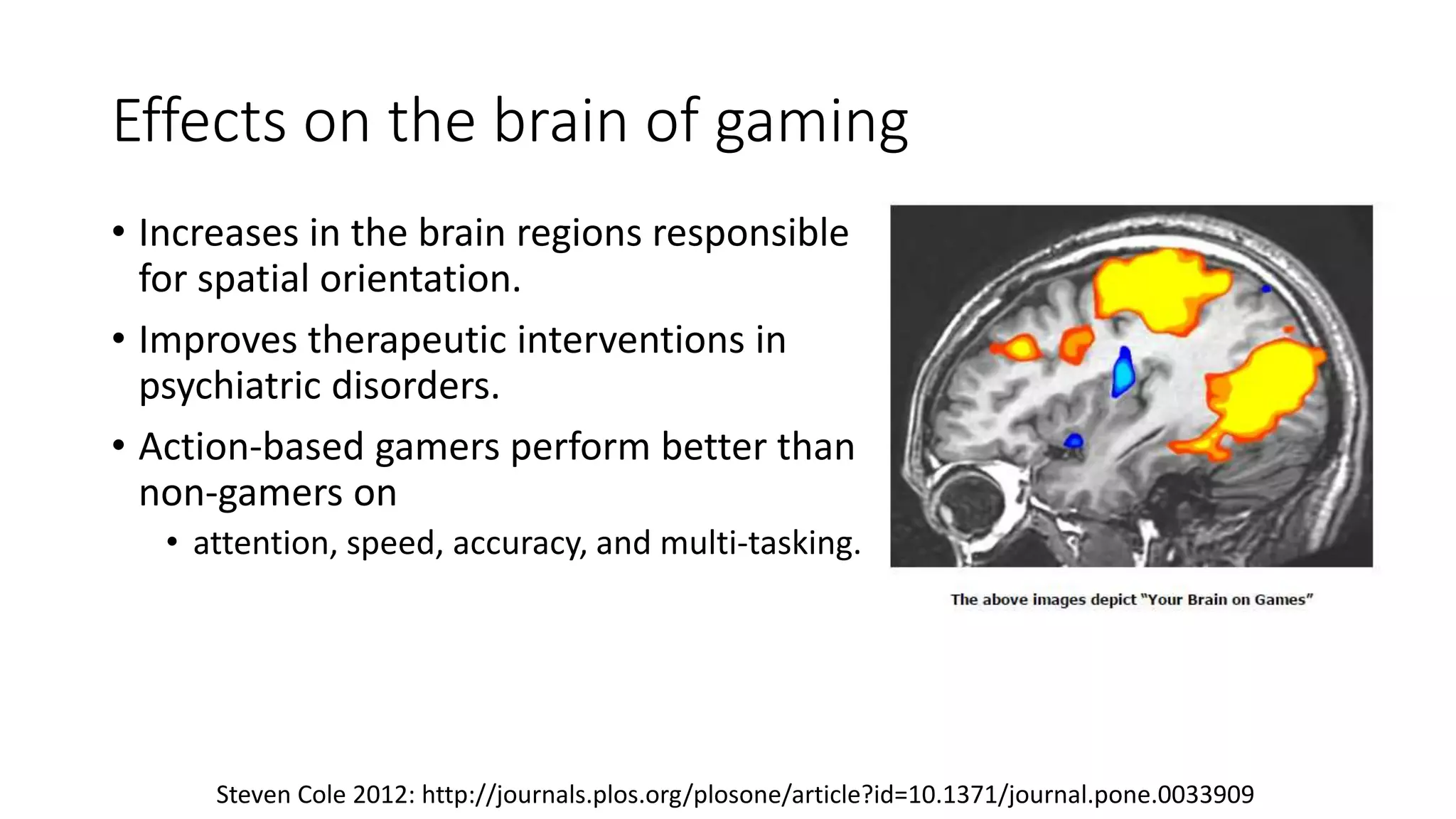
Effects on the brain of gaming
• Increases in the brain regions responsible
for spatial orientation.
• Improves therapeutic interventions in
psychiatric disorders.
• Action-based gamers perform better than
non-gamers on
• attention, speed, accuracy, and multi-tasking.
Steven Cole 2012: http://journals.plos.org/plosone/article?id=10.1371/journal.pone.0033909
Game elements that can facilitate learning
Some elements of games that may be used to motivate learners and
facilitate learning include:
 Progress mechanics (points/badges/leader boards, or PBL's)
 Narrative
 Player control
 Immediate feedback
 Opportunities for collaborative problem solving
 Scaffold learning with increasing challenges
 Opportunities for mastery, and leveling up
 Social connection
http://en.wikipedia.org/wiki/Gamification_of_learning#Game_elements_that_can_facilitate_learning
http://static.podcastcms.de/images/Feed/Channel/46342/2/46342.png
The role of a gamified learning environment may
be structured by providing an overarching
narrative which functions as a context for all the
learning activities
http://myweb.wssu.edu/dichevc/Research/CIT-2014-Dichev.pdf
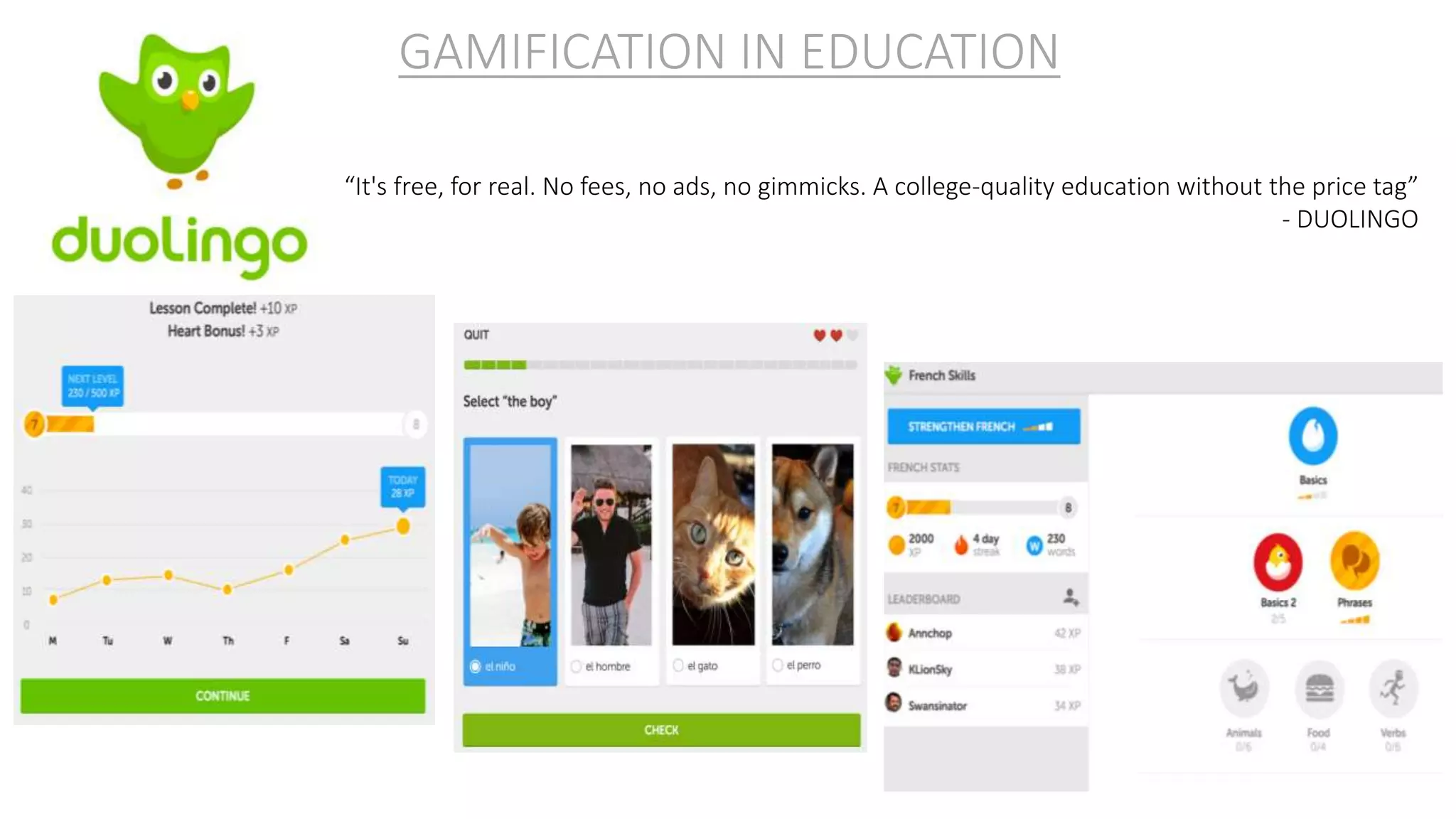
“It's free, for real. No fees, no ads, no gimmicks. A college-quality education without the price tag”
- DUOLINGO
GAMIFICATION IN EDUCATION
Does it work?
Recent reviews of research: right now, there is
inconclusive and insufficient evidence to make any
strong claims about the efficacy of video games
Recommendation
games are cultural and educational tools with
unique strengths. In order to achieve maximum
benefit, like any tool games need to be used at the
right time in the right way.
Source: Morris, Croker, Zimmerman, Gill, & Romig, 2013
http://pixabay.com/sv/grafikkort-video-game-controller-336657/
Benefits – gamification of learning
Some of the potential benefits of successful
gamification initiatives in the classroom include:
 Giving students ownership of their learning
 Opportunities for identity work through taking on
alternate selves
 Freedom to fail and try again without negative
repercussions
 Chances to increase fun and joy in the classroom
 Opportunities for differentiated instruction
 Making learning visible
 Providing a manageable set of subtasks and tasks
 Inspiring students to discover intrinsic motivators for
learning
Also making use of extrinsic motivators in games
Pavlus, John (2010). "The Game of Life". Scientific American
Klopfer, E., Osterweil, S., & Salen, K. (2009).
Lee, J.; Hammer, J. (2011).
Criticism – gamification of learning
• Daniel Pink criticized gamification for its use of extrinsic motivators that cause to
decrease intrinsic motivation for learning.
• Some teachers may criticize gamification for taking a less than serious approach
to education and not worth their time to implement gaming initiatives.
• Ian Bogost has criticized gamification for its tendency of simplistic which does not
reflect the real quality of motivational games.
http://en.wikipedia.org/wiki/Gamification_of_learning#Criticism
Retention
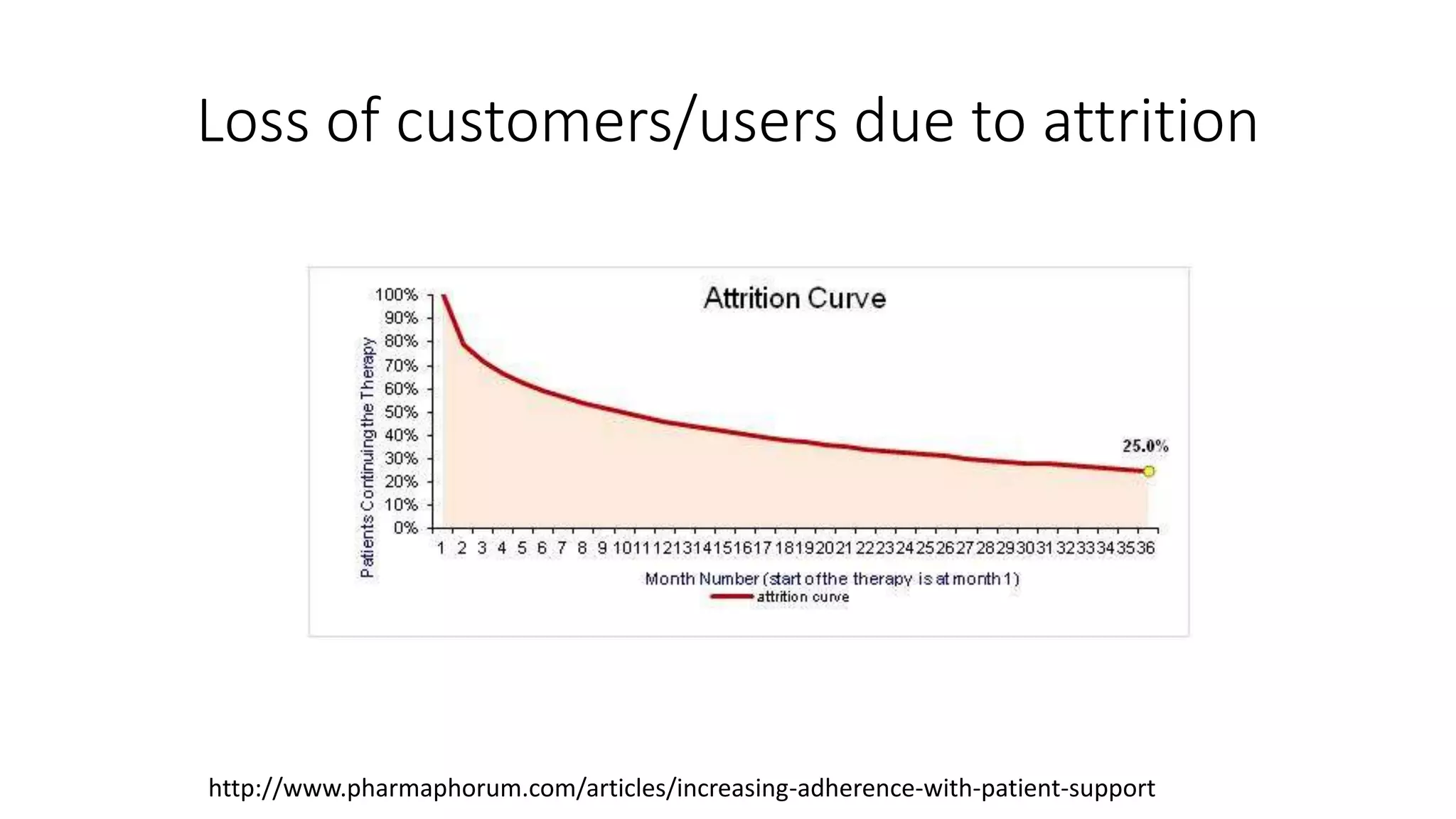
Loss of customers/users due to attrition
http://www.pharmaphorum.com/articles/increasing-adherence-with-patient-support
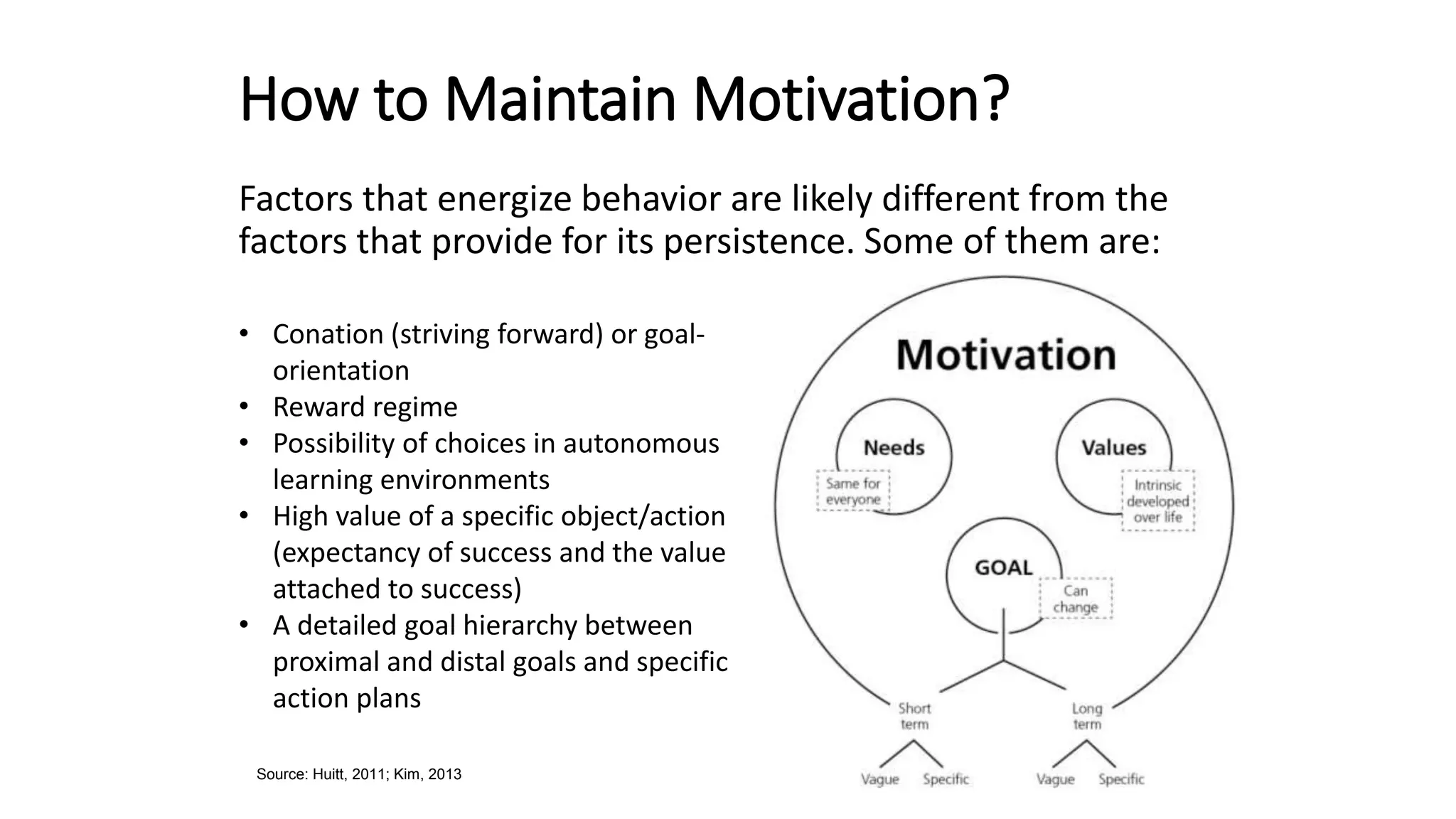
How to Maintain Motivation?
Factors that energize behavior are likely different from the
factors that provide for its persistence. Some of them are:
Source: Huitt, 2011; Kim, 2013
• Conation (striving forward) or goal-
orientation
• Reward regime
• Possibility of choices in autonomous
learning environments
• High value of a specific object/action
(expectancy of success and the value
attached to success)
• A detailed goal hierarchy between
proximal and distal goals and specific
action plans
Some Ideas and Strategies
1. Encourage diversity in learning styles
2. Encourage creativity
3. Ensure success with small achievable steps
4. Provide feedback to students about their own personal
progress
5. Learners need to believe in their own abilities
6. Acknowledge the individual styles of learners
7. Use group work effectively
8. Encourage self-assessment
9. Develop student responsibility
10. Focus on learning as well as teaching
Source: Reid, 2008; Lai, 2011; Hornstra, Veen, Peetsma, & Volman, 2014; Huitt, 2011
Thank you for your attention
Any questions?
Magnus Sjögren
magnus@edubrain.se
https://stratecutionstories.files.wordpress.com/2011/12/question1.jpg
http://psdhunter.com/psd/4545-a-
big-thumbs-up-by-eric-e-anderson

Gamification - to enhance learning and motivation

  • 1.
    GAMIFICATION - to enhancelearning and motivation, getting the customer hooked and the brain involved Magnus Sjögren, MD, PhD, Associate Professor Edubrain AB magnus@edubrain.se
  • 2.
    Edubrain AB www.edubrain.se •Consultancy services in Brain/Neuroscience, Psychiatry and Leadership • MEASURES of BRAIN FUNCTIONS • Review, analysis, knowledge on Apps, Online tools/websites and Smartwear that measure e.g. emotions, memory, learning, motivation. • Advice on design/set-up for health/wellness products in TECH Industry • Quantified Psychiatry (quantified self brain health) • MOTIVATION, RETENTION and FEEDBACK Strategies • Lectures and Advice • More than 20 years of Clinical/Medical and Scientific Experience • More than 10 years of Executive and Leadership Experience • BRAIN SCIENCE • Education • Advisor, Reviewer in Clinical Neuroscience to EU (e.g. IMI and H2020) • Author of the book ”The Non-Stop Lover – and other stories from my practice as a Psychiatrist” http://goo.gl/iWkHmA magnus@edubrain.se Consultancy provided to:
  • 3.
    Gamification - definition •Gamification is using game mechanics in non-game contexts to engage users. • Learning • Innovation • Productivity • Loyalty
  • 4.
    One of thefirst examples – Frequent Flyers
  • 5.
    What is motivation? Internal process that activates, guides, and maintains goal-oriented behavior over time. It involves the biological, emotional, social, and cognitive forces that activate behavior.  Three major components to motivation: 1. Activation 2. Persistence 3. Intensity  Basic types of motivation: 1. Extrinsic 2. Intrinsic Source: Vancouver, 2004; Kalat, 2005; Ryan, 2000; Tuzun, 2004; Williams & Williams, 2011
  • 6.
    Learning Automony Curiosity Love Meaning Badgers Points Gold stars Competition Money Rewards Fear of punishment Fearof Failure Ryan, Richard; Edward L. Deci (2000). "Intrinsic and Extrinsic Motivations: Classic Definitions and New Directions"
  • 7.
    Theoretical frameworks - Motivation Behavioral - Rewards are consequences of behaviors - Incentives encourage or discourage behaviors  Humanistic - Emphasis on personal choice - Needs - Self-actualization / Self- determination - Maslow’s hierarchy  Cognitive - Focus on thinking - Emphasizes intrinsic motivation - People are active and curious - Plans, goals, schemas, and expectations  Sociocultural - Attribution theory - Perceived cause of successes or failures - Locus - Stability - ResponsibilityEach of these theories has some truth but no single theory seems to adequately explain all human motivation. Source: Bauer, 2001
  • 8.
    Maslows hierarchy Maslow 1943;http://psychclassics.yorku.ca/Maslow/motivation.htm
  • 9.
    What Influences Motivation? Source:Tuzun, 2004; Williams & Williams, 2011 Attention and Motivation
  • 10.
    Brain Imaging ofmotivation http://libd.org/research-activities/research/clinical-sciences/cognitive-neuroscience-and-imaging-genetics/2012/motivation-and-the-ventral-striatum-a-journal- through-cognitive-imaging-space
  • 11.
    The reward system- dopamine http://www.cellbiol.net/ste/alpobesity3.php
  • 12.
  • 13.
    Gamification - definition •Gamification is using game mechanics in non-game contexts to engage users. • Learning • Innovation • Productivity • Loyalty
  • 14.
  • 15.
    • compares gamificationwith other gameful approaches by looking at characteristics such as spontaneity, rules, or goals Categorization of gamification Mario Herger (2014). Enterprise Gamification… http://www.viriya.org.sg/index.php/resources/ 75-raising-a-happy-child-through-play
  • 16.
    Gamification techniques Gamification techniquesstrive to leverage people's natural desires for socializing, learning, mastery, competition, achievement, status, self-expression, altruism, or closure. The following are the popular gamification techniques: achievement badges achievement levels  leader boards a progress bar or other visual meter to indicate how close people are to completing a task a company is trying to encourage, such as completing a social networking profile or earning a frequent shopper loyalty award. virtual currency systems for awarding, redeeming, trading, gifting, and otherwise exchanging points challenges between users embedding small casual games within other activities. http://en.wikipedia.org/wiki/Gamification#Techniques
  • 17.
    “RedCritter Tracker wasbuilt for Agile Project Management. Its effortless drag-and-drop UI makes project management a breeze.” The new way to manage projects GAMIFICATION IN EMPLOYEE PRODUCTIVITY https://www.redcritter.com/
  • 18.
    S&H Green Stamps •S&H Green Stamps (also called Green Shield Stamps) were trading stamps popular in the United States from the 1930s until the late 1980s. • They were distributed as part of a rewards program operated by the Sperry & Hutchinson company (S&H) http://en.wikipedia.org/wiki/S%26H_Green_Stamps
  • 19.
  • 20.
    Future of Gamification •Over 70% of Forbes Global 2000 companies surveyed in 2013 said they planned to use gamification for the purposes of marketing and customer retention. • Organisations will allocate 2.8 billion USD (1.7 billion GBP) in direct spending on gamification by 2015 http://collabor8now.com/knowledge-management/gamification-making-work-fun-or-making-fun-of-work/
  • 21.
    Legal restrictions • Compliancewith Privacy laws • Labour law • Ownership and control of Intellectual Property (data) • The use of virtual currencies and virtual assets • The virtual currency schemes might be used by criminals, fraudsters and money launderers to perform their illegal activities.
  • 22.
    Criticism • Sebastian Deterding(University of Hamburg) • not being fun , creating an artificial sense of achievement and can encourage unintended behaviours. • Jon Radoff and Margaret Robertson, game designers, • excluding elements like storytelling and experiences and using simple reward systems in place of true game mechanics. • Kevin Slavin (a MIT Professor), • flawed and misleading for those unfamiliar with gaming. • Heather Chaplin, (writing in Slate), • benefits corporate interests over those of ordinary people“. http://en.wikipedia.org/wiki/Gamification
  • 23.
    Front Hum Neurosci.2013 Jun 13;7:278. Kätsyri J(1), Hari R, Ravaja N, Nummenmaa L. Active game involvement essential
  • 24.
  • 25.
    Gamification of learning •The gamification of learning is an educational approach • to motivate students to learn • using video game design and game elements in learning environments. • The goal is to maximize enjoyment and engagement while learning.
  • 26.
    “Our mission isto provide a free, world-class education for anyone, anywhere” - KHAN ACADEMY GAMIFICATION IN EDUCATION https://www.khanacademy.org/
  • 27.
    Effects on thebrain of gaming • Increases in the brain regions responsible for spatial orientation. • Improves therapeutic interventions in psychiatric disorders. • Action-based gamers perform better than non-gamers on • attention, speed, accuracy, and multi-tasking. Steven Cole 2012: http://journals.plos.org/plosone/article?id=10.1371/journal.pone.0033909
  • 28.
    Game elements thatcan facilitate learning Some elements of games that may be used to motivate learners and facilitate learning include:  Progress mechanics (points/badges/leader boards, or PBL's)  Narrative  Player control  Immediate feedback  Opportunities for collaborative problem solving  Scaffold learning with increasing challenges  Opportunities for mastery, and leveling up  Social connection http://en.wikipedia.org/wiki/Gamification_of_learning#Game_elements_that_can_facilitate_learning http://static.podcastcms.de/images/Feed/Channel/46342/2/46342.png
  • 29.
    The role ofa gamified learning environment may be structured by providing an overarching narrative which functions as a context for all the learning activities http://myweb.wssu.edu/dichevc/Research/CIT-2014-Dichev.pdf
  • 30.
    “It's free, forreal. No fees, no ads, no gimmicks. A college-quality education without the price tag” - DUOLINGO GAMIFICATION IN EDUCATION
  • 31.
    Does it work? Recentreviews of research: right now, there is inconclusive and insufficient evidence to make any strong claims about the efficacy of video games Recommendation games are cultural and educational tools with unique strengths. In order to achieve maximum benefit, like any tool games need to be used at the right time in the right way. Source: Morris, Croker, Zimmerman, Gill, & Romig, 2013 http://pixabay.com/sv/grafikkort-video-game-controller-336657/
  • 32.
    Benefits – gamificationof learning Some of the potential benefits of successful gamification initiatives in the classroom include:  Giving students ownership of their learning  Opportunities for identity work through taking on alternate selves  Freedom to fail and try again without negative repercussions  Chances to increase fun and joy in the classroom  Opportunities for differentiated instruction  Making learning visible  Providing a manageable set of subtasks and tasks  Inspiring students to discover intrinsic motivators for learning Also making use of extrinsic motivators in games Pavlus, John (2010). "The Game of Life". Scientific American Klopfer, E., Osterweil, S., & Salen, K. (2009). Lee, J.; Hammer, J. (2011).
  • 33.
    Criticism – gamificationof learning • Daniel Pink criticized gamification for its use of extrinsic motivators that cause to decrease intrinsic motivation for learning. • Some teachers may criticize gamification for taking a less than serious approach to education and not worth their time to implement gaming initiatives. • Ian Bogost has criticized gamification for its tendency of simplistic which does not reflect the real quality of motivational games. http://en.wikipedia.org/wiki/Gamification_of_learning#Criticism
  • 34.
  • 35.
    Loss of customers/usersdue to attrition http://www.pharmaphorum.com/articles/increasing-adherence-with-patient-support
  • 36.
    How to MaintainMotivation? Factors that energize behavior are likely different from the factors that provide for its persistence. Some of them are: Source: Huitt, 2011; Kim, 2013 • Conation (striving forward) or goal- orientation • Reward regime • Possibility of choices in autonomous learning environments • High value of a specific object/action (expectancy of success and the value attached to success) • A detailed goal hierarchy between proximal and distal goals and specific action plans
  • 37.
    Some Ideas andStrategies 1. Encourage diversity in learning styles 2. Encourage creativity 3. Ensure success with small achievable steps 4. Provide feedback to students about their own personal progress 5. Learners need to believe in their own abilities 6. Acknowledge the individual styles of learners 7. Use group work effectively 8. Encourage self-assessment 9. Develop student responsibility 10. Focus on learning as well as teaching Source: Reid, 2008; Lai, 2011; Hornstra, Veen, Peetsma, & Volman, 2014; Huitt, 2011
  • 38.
    Thank you foryour attention Any questions? Magnus Sjögren magnus@edubrain.se https://stratecutionstories.files.wordpress.com/2011/12/question1.jpg http://psdhunter.com/psd/4545-a- big-thumbs-up-by-eric-e-anderson