Prof. Pier Luca Lanzi
Classification: Other Methods
Data Mining andText Mining (UIC 583 @ Politecnico di Milano)
Prof. Pier Luca Lanzi
Study Material
•  Mining of Massive Datasets Section 12.3, 12.4
•  Data Mining and Analysis: Fundamental Concepts and Algorithms
- Chapter 18  19
2
Prof. Pier Luca Lanzi
What is Instance-Based Learning?
Prof. Pier Luca Lanzi
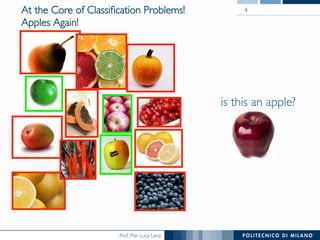
At the Core of Classification Problems!
Apples Again!
4
is this an apple?
Prof. Pier Luca Lanzi
Instance-Based Learning
•  To decide the label for an unseen example, consider the k
examples from the training data that are more similar to the
unknown one
•  Classify the unknown example using the most frequent class
5
Prof. Pier Luca Lanzi
Instance-Based Learning in Action
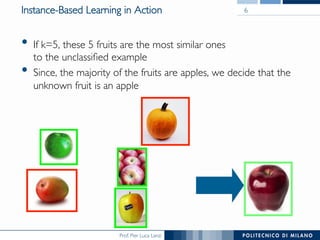
•  If k=5, these 5 fruits are the most similar ones
to the unclassified example
•  Since, the majority of the fruits are apples, we decide that the
unknown fruit is an apple
6
Prof. Pier Luca Lanzi
Instance-Based Learning in General
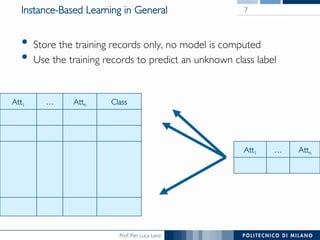
•  Store the training records only, no model is computed
•  Use the training records to predict an unknown class label
7
Att1 … Attn Class
Att1 … Attn
Prof. Pier Luca Lanzi
Instance-Based Methods
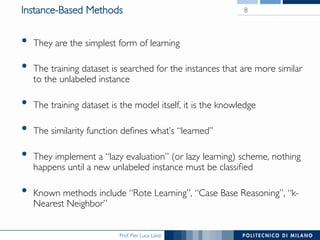
•  They are the simplest form of learning
•  The training dataset is searched for the instances that are more similar
to the unlabeled instance
•  The training dataset is the model itself, it is the knowledge
•  The similarity function defines what’s “learned”
•  They implement a “lazy evaluation” (or lazy learning) scheme, nothing
happens until a new unlabeled instance must be classified
•  Known methods include “Rote Learning”, “Case Base Reasoning”, “k-
Nearest Neighbor”
8
Prof. Pier Luca Lanzi
K-Nearest-Neighbor Classifiers
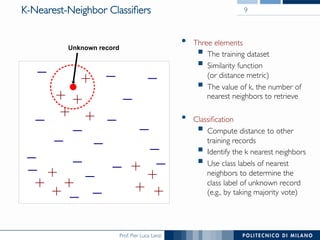
•  Three elements
§ The training dataset
§ Similarity function 
(or distance metric)
§ The value of k, the number of
nearest neighbors to retrieve
•  Classification
§ Compute distance to other
training records
§ Identify the k nearest neighbors
§ Use class labels of nearest
neighbors to determine the
class label of unknown record
(e.g., by taking majority vote)
9
Unknown record
Prof. Pier Luca Lanzi
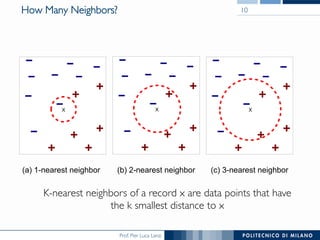
How Many Neighbors? 10
X X X
(a) 1-nearest neighbor (b) 2-nearest neighbor (c) 3-nearest neighbor
K-nearest neighbors of a record x are data points that have
the k smallest distance to x
Prof. Pier Luca Lanzi
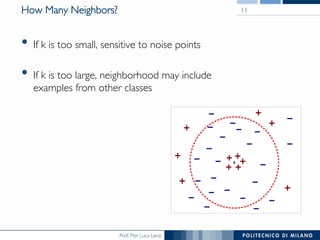
How Many Neighbors?
•  If k is too small, sensitive to noise points
•  If k is too large, neighborhood may include 
examples from other classes
11
X
Prof. Pier Luca Lanzi
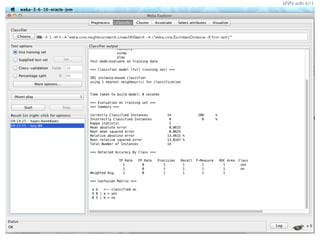
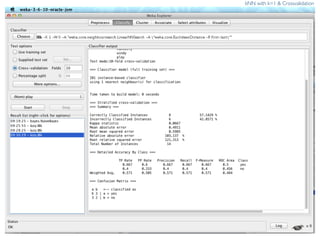
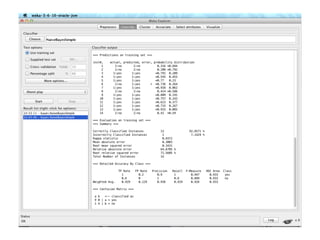
kNN with k=1
Prof. Pier Luca Lanzi
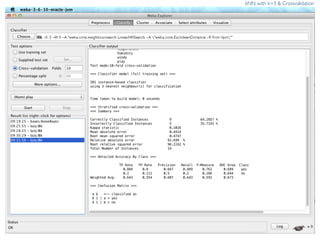
kNN with k=3
Prof. Pier Luca Lanzi
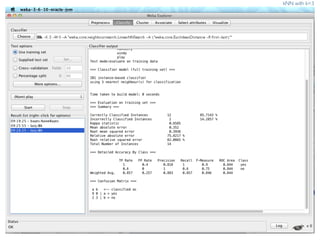
kNN with k=1  Crossvalidation
Prof. Pier Luca Lanzi
kNN with k=3  Crossvalidation
Prof. Pier Luca Lanzi
What Similarity Measure?
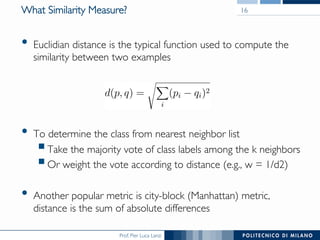
•  Euclidian distance is the typical function used to compute the
similarity between two examples
•  To determine the class from nearest neighbor list
§ Take the majority vote of class labels among the k neighbors
§ Or weight the vote according to distance (e.g., w = 1/d2)
•  Another popular metric is city-block (Manhattan) metric, 
distance is the sum of absolute differences
16
Prof. Pier Luca Lanzi
Normalization and Other Issues
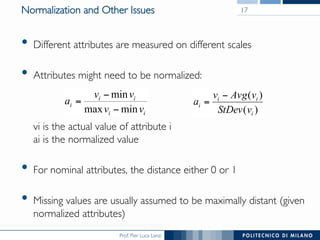
•  Different attributes are measured on different scales
•  Attributes might need to be normalized:


vi is the actual value of attribute i
ai is the normalized value
•  For nominal attributes, the distance either 0 or 1
•  Missing values are usually assumed to be maximally distant (given
normalized attributes)
17
ii
ii
i
vv
vv
a
minmax
min
−
−
=
)(
)(
i
ii
i
vStDev
vAvgv
a
−
=
Prof. Pier Luca Lanzi
Discussion
•  K-Nearest Neighbor is often very accurate but slow, since simple
version scans entire training data to derive a prediction
•  Assumes all attributes are equally important, thus may need
attribute selection or weights
•  Statisticians have used k-NN since early 1950s,
If n → ∞ and k/n → 0, error approaches minimum
18
Prof. Pier Luca Lanzi
Naïve Bayes
Prof. Pier Luca Lanzi
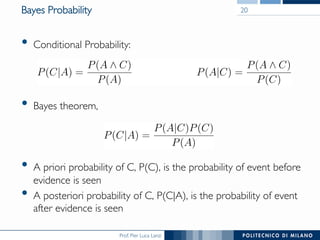
Bayes Probability
•  Conditional Probability:
•  Bayes theorem,
•  A priori probability of C, P(C), is the probability of event before
evidence is seen
•  A posteriori probability of C, P(C|A), is the probability of event
after evidence is seen
20
Prof. Pier Luca Lanzi
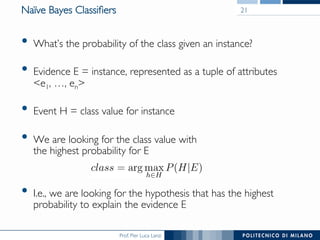
Naïve Bayes Classifiers
•  What’s the probability of the class given an instance?
•  Evidence E = instance, represented as a tuple of attributes 
e1, …, en
•  Event H = class value for instance
•  We are looking for the class value with 
the highest probability for E
•  I.e., we are looking for the hypothesis that has the highest
probability to explain the evidence E
21
Prof. Pier Luca Lanzi
Naïve Bayes Classifiers
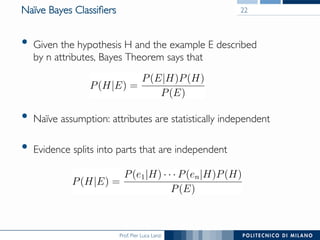
•  Given the hypothesis H and the example E described 
by n attributes, Bayes Theorem says that
•  Naïve assumption: attributes are statistically independent
•  Evidence splits into parts that are independent
22
Prof. Pier Luca Lanzi
Naïve Bayes for Classification
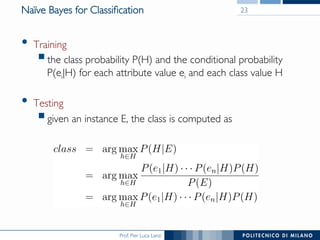
•  Training
§ the class probability P(H) and the conditional probability 
P(ei|H) for each attribute value ei and each class value H
•  Testing
§ given an instance E, the class is computed as
23
Prof. Pier Luca Lanzi
Naïve Bayes Classifier
•  It is the “opposite” of OneRule as it uses all the attributes
•  Two assumptions
§ Attributes are equally important
§ Attribute are statistically independent
•  Statistically independent means that knowing the value of one
attribute says nothing about the value of another (if the class is
known)
•  Independence assumption is almost never correct! But the
scheme works well in practice
24
Prof. Pier Luca Lanzi
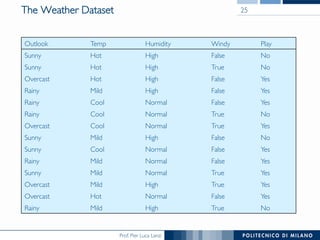
The Weather Dataset
Outlook Temp Humidity Windy Play
Sunny Hot High False No
Sunny Hot High True No
Overcast Hot High False Yes
Rainy Mild High False Yes
Rainy Cool Normal False Yes
Rainy Cool Normal True No
Overcast Cool Normal True Yes
Sunny Mild High False No
Sunny Cool Normal False Yes
Rainy Mild Normal False Yes
Sunny Mild Normal True Yes
Overcast Mild High True Yes
Overcast Hot Normal False Yes
Rainy Mild High True No
25
Prof. Pier Luca Lanzi
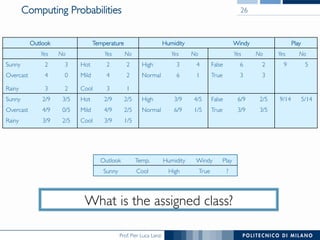
Computing Probabilities 26
Outlook Temperature Humidity Windy Play
Yes No Yes No Yes No Yes No Yes No
Sunny 2 3 Hot 2 2 High 3 4 False 6 2 9 5
Overcast 4 0 Mild 4 2 Normal 6 1 True 3 3
Rainy 3 2 Cool 3 1
Sunny 2/9 3/5 Hot 2/9 2/5 High 3/9 4/5 False 6/9 2/5 9/14 5/14
Overcast 4/9 0/5 Mild 4/9 2/5 Normal 6/9 1/5 True 3/9 3/5
Rainy 3/9 2/5 Cool 3/9 1/5
Outlook Temp. Humidity Windy Play
Sunny Cool High True ?
What is the assigned class?
Prof. Pier Luca Lanzi
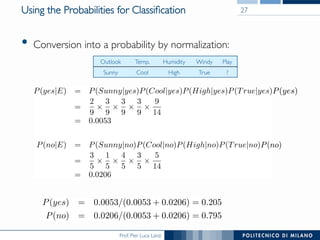
Using the Probabilities for Classification
•  Conversion into a probability by normalization:
27
Outlook Temp. Humidity Windy Play
Sunny Cool High True ?
Prof. Pier Luca Lanzi
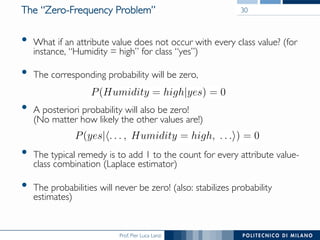
The “Zero-Frequency Problem”
•  What if an attribute value does not occur with every class value? (for
instance, “Humidity = high” for class “yes”)
•  The corresponding probability will be zero,
•  A posteriori probability will also be zero!
(No matter how likely the other values are!)
•  The typical remedy is to add 1 to the count for every attribute value-
class combination (Laplace estimator)
•  The probabilities will never be zero! (also: stabilizes probability
estimates)
30
Prof. Pier Luca Lanzi
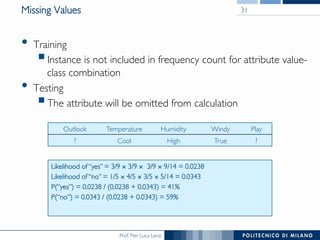
Missing Values
•  Training
§ Instance is not included in frequency count for attribute value-
class combination
•  Testing
§ The attribute will be omitted from calculation
31
Outlook Temperature Humidity Windy Play
? Cool High True ?
Likelihood of “yes” = 3/9 × 3/9 × 3/9 × 9/14 = 0.0238
Likelihood of “no” = 1/5 × 4/5 × 3/5 × 5/14 = 0.0343
P(“yes”) = 0.0238 / (0.0238 + 0.0343) = 41%
P(“no”) = 0.0343 / (0.0238 + 0.0343) = 59%
Prof. Pier Luca Lanzi
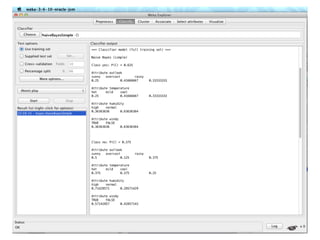
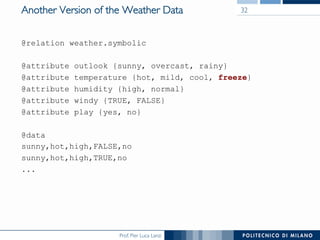
Another Version of the Weather Data
@relation weather.symbolic
@attribute outlook {sunny, overcast, rainy}
@attribute temperature {hot, mild, cool, freeze}
@attribute humidity {high, normal}
@attribute windy {TRUE, FALSE}
@attribute play {yes, no}
@data
sunny,hot,high,FALSE,no
sunny,hot,high,TRUE,no
...
32
Prof. Pier Luca Lanzi
Numeric Attributes
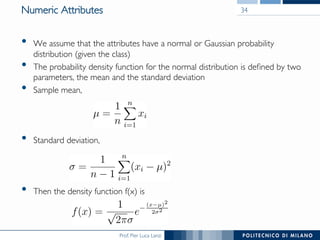
•  We assume that the attributes have a normal or Gaussian probability
distribution (given the class)
•  The probability density function for the normal distribution is defined by two
parameters, the mean and the standard deviation
•  Sample mean,
•  Standard deviation,
•  Then the density function f(x) is
34
Prof. Pier Luca Lanzi
Statistics for Weather data
with numeric temperature
35
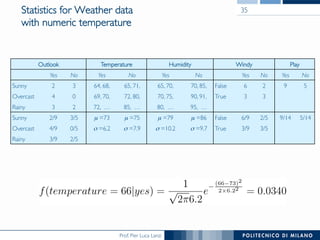
Outlook Temperature Humidity Windy Play
Yes No Yes No Yes No Yes No Yes No
Sunny 2 3 64, 68, 65, 71, 65, 70, 70, 85, False 6 2 9 5
Overcast 4 0 69, 70, 72, 80, 70, 75, 90, 91, True 3 3
Rainy 3 2 72, … 85, … 80, … 95, …
Sunny 2/9 3/5 µ =73 µ =75 µ =79 µ =86 False 6/9 2/5 9/14 5/14
Overcast 4/9 0/5 σ =6.2 σ =7.9 σ =10.2 σ =9.7 True 3/9 3/5
Rainy 3/9 2/5
Prof. Pier Luca Lanzi
Classifying a new day
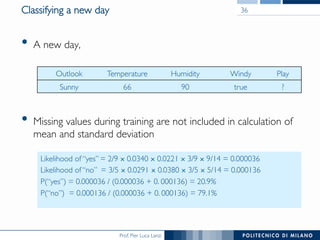
•  A new day,
•  Missing values during training are not included in calculation of
mean and standard deviation
36
Outlook Temperature Humidity Windy Play
Sunny 66 90 true ?
Likelihood of “yes” = 2/9 × 0.0340 × 0.0221 × 3/9 × 9/14 = 0.000036
Likelihood of “no” = 3/5 × 0.0291 × 0.0380 × 3/5 × 5/14 = 0.000136
P(“yes”) = 0.000036 / (0.000036 + 0. 000136) = 20.9%
P(“no”) = 0.000136 / (0.000036 + 0. 000136) = 79.1%
Prof. Pier Luca Lanzi
Discussion
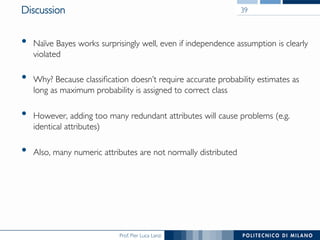
•  Naïve Bayes works surprisingly well, even if independence assumption is clearly
violated
•  Why? Because classification doesn’t require accurate probability estimates as
long as maximum probability is assigned to correct class
•  However, adding too many redundant attributes will cause problems (e.g.
identical attributes)
•  Also, many numeric attributes are not normally distributed
39
Prof. Pier Luca Lanzi
Logistic Regression
Prof. Pier Luca Lanzi
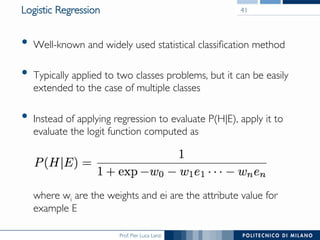
Logistic Regression
•  Well-known and widely used statistical classification method
•  Typically applied to two classes problems, but it can be easily
extended to the case of multiple classes
•  Instead of applying regression to evaluate P(H|E), apply it to
evaluate the logit function computed as 


where wi are the weights and ei are the attribute value for
example E
41
Prof. Pier Luca Lanzi
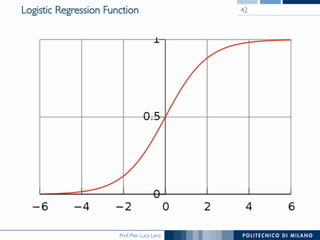
Logistic Regression Function 42
Prof. Pier Luca Lanzi
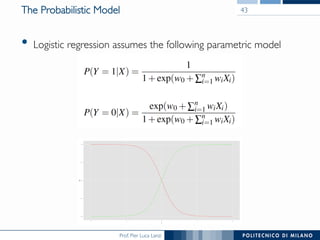
The Probabilistic Model
•  Logistic regression assumes the following parametric model
43
Prof. Pier Luca Lanzi
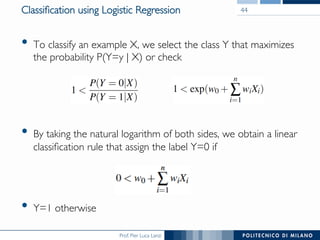
Classification using Logistic Regression
•  To classify an example X, we select the class Y that maximizes
the probability P(Y=y | X) or check
or
•  By taking the natural logarithm of both sides, we obtain a linear
classification rule that assign the label Y=0 if
•  Y=1 otherwise
44
Prof. Pier Luca Lanzi
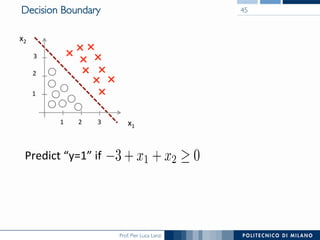
Decision Boundary 45
Predict	
  “y=1”	
  if	
  
x1	
  
x2	
  
1	
   2	
   3	
  
1	
  
2	
  
3	
  
Prof. Pier Luca Lanzi
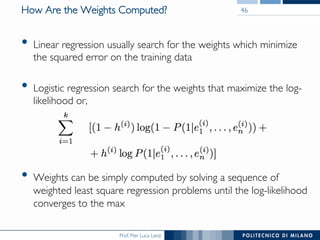
How Are the Weights Computed?
•  Linear regression usually search for the weights which minimize
the squared error on the training data
•  Logistic regression search for the weights that maximize the log-
likelihood or,
•  Weights can be simply computed by solving a sequence of
weighted least square regression problems until the log-likelihood
converges to the max
46
Prof. Pier Luca Lanzi
Bayesian Belief Networks
Prof. Pier Luca Lanzi
Bayesian Belief Networks
•  The conditional independence assumption,
§ makes computation possible
§ yields optimal classifiers when satisfied
§ but is seldom satisfied in practice, as attributes (variables) are
often correlated
•  Bayesian Belief Networks (BBN) allows us to specify which pair of
attributes are conditionally independent
•  They provide a graphical representation of probabilistic
relationships among a set of random variables
50
Prof. Pier Luca Lanzi
Bayesian Belief Networks
•  Describe the probability distribution governing a set of variables
by specifying
§ Conditional independence assumptions that apply on subsets
of the variables
§ A set of conditional probabilities
•  Two key elements
§ A direct acyclic graph, encoding the dependence relationships
among variables
§ A probability table associating each node to its immediate
parents node
51
Prof. Pier Luca Lanzi
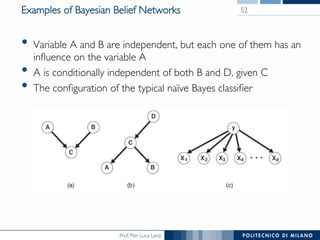
•  Variable A and B are independent, but each one of them has an
influence on the variable A
•  A is conditionally independent of both B and D, given C
•  The configuration of the typical naïve Bayes classifier
Examples of Bayesian Belief Networks 52
Prof. Pier Luca Lanzi
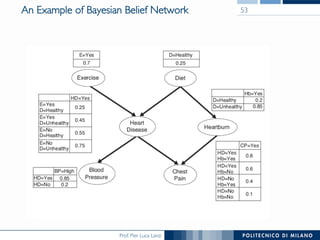
An Example of Bayesian Belief Network 53
Prof. Pier Luca Lanzi
Probability Tables
•  The network topology imposes conditions regarding the variable
conditional independence
•  Each node is associated with a probability table
§ If a node X does not have any parents, then
the table contains only the prior probability P(X)
§ If a node X has only one any parent Y, then
the table contains only the conditional probability P(X|Y)
§ If a node X has multiple parents, Y1, …, Yk the
the table contains the conditional probability P(X|Y1…Yk)
54
Prof. Pier Luca Lanzi
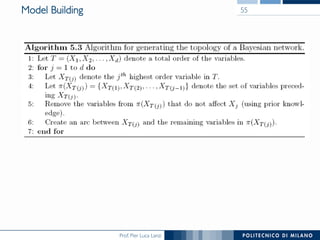
Model Building 55
Prof. Pier Luca Lanzi
Bayesian Belief Networks
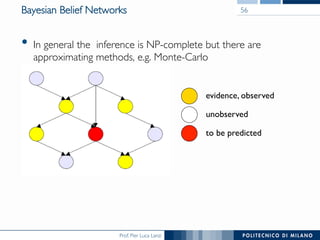
•  In general the inference is NP-complete but there are
approximating methods, e.g. Monte-Carlo
56
evidence, observed
unobserved
to be predicted
Prof. Pier Luca Lanzi
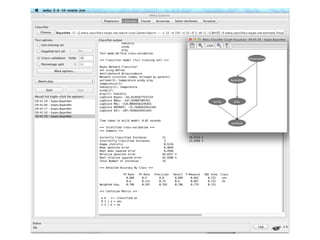
http://www.cs.waikato.ac.nz/~remco/weka.bn.pdf
Prof. Pier Luca Lanzi
Bayesian Belief Networks
•  Bayesian belief network allows a subset of the variables
conditionally independent
•  A graphical model of causal relationships
•  Several cases of learning Bayesian belief networks
§ Given both network structure and 
all the variables is easy
§ Given network structure but only some variables
§ When the network structure is not known in advance
59
Prof. Pier Luca Lanzi
Bayesian Belief Networks
•  BBN provides an approach for capturing prior knowledge of a
particular domain using a graphical model
•  Building the network is time consuming, but 
adding variables to a network is straightforward
•  They can encode causal dependencies among variables
•  They are well suited to dealing with incomplete data
•  They are robust to overfitting
60
Prof. Pier Luca Lanzi
SupportVector Machines
Prof. Pier Luca Lanzi
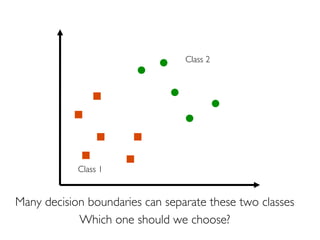
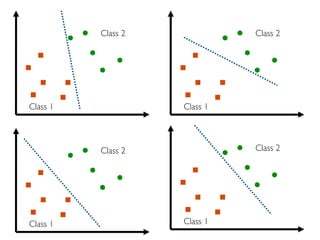
Many decision boundaries can separate these two classes
Which one should we choose?
Class 1
Class 2
Prof. Pier Luca Lanzi
Class 1
Class 2
Class 1
Class 2
Class 1
Class 2
Class 1
Class 2
Prof. Pier Luca Lanzi
γ
Prof. Pier Luca Lanzi
γ A
C
B
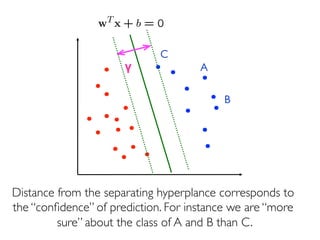
Distance from the separating hyperplance corresponds to
the “confidence” of prediction. For instance we are “more
sure” about the class of A and B than C.
Prof. Pier Luca Lanzi
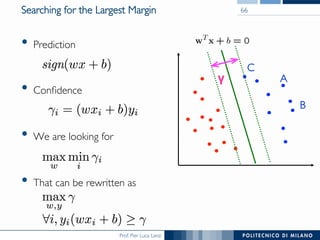
Searching for the Largest Margin
•  Prediction
•  Confidence
•  We are looking for
•  That can be rewritten as
66
γ A
C
B
Prof. Pier Luca Lanzi
γ A
C
B
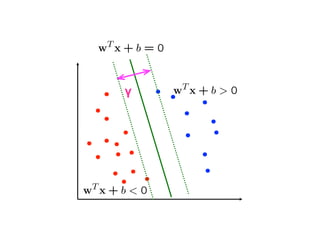
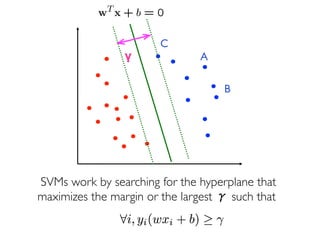
SVMs work by searching for the hyperplane that
maximizes the margin or the largest γ such that
Prof. Pier Luca Lanzi
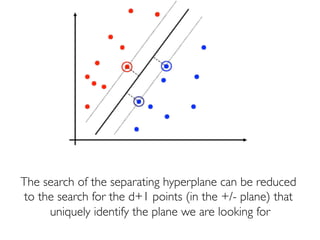
The search of the separating hyperplane can be reduced
to the search for the d+1 points (in the +/- plane) that
uniquely identify the plane we are looking for
Prof. Pier Luca Lanzi
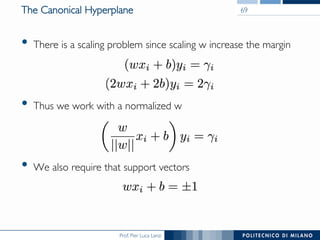
•  There is a scaling problem since scaling w increase the margin
•  Thus we work with a normalized w
•  We also require that support vectors
The Canonical Hyperplane 69
Prof. Pier Luca Lanzi
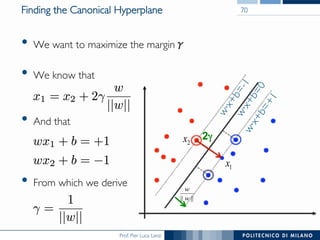
Finding the Canonical Hyperplane
•  We want to maximize the marginγ
•  We know that
•  And that
•  From which we derive
70
2γ2x
1x
|||| w
w
Prof. Pier Luca Lanzi
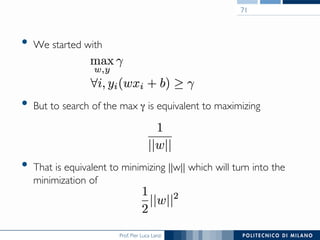
•  We started with
•  But to search of the max γ is equivalent to maximizing
•  That is equivalent to minimizing ||w|| which will turn into the
minimization of
71
Prof. Pier Luca Lanzi
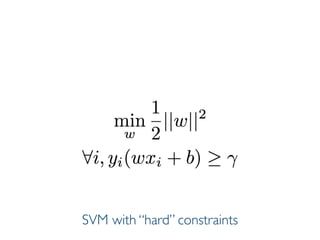
SVM with “hard” constraints
Prof. Pier Luca Lanzi
Soft-Margin SVMs
Prof. Pier Luca Lanzi
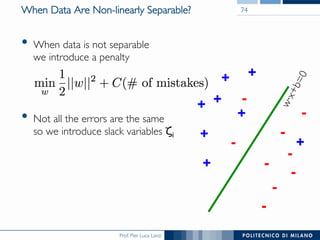
When Data Are Non-linearly Separable?
•  When data is not separable
we introduce a penalty
•  Not all the errors are the same 
so we introduce slack variables ζi
74
+
+
+
+
+
+
+
-
-
-
-
-
-
-
+-
-
Prof. Pier Luca Lanzi
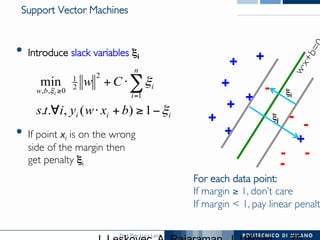
Support Vector Machines
•  Introduce slack variables ξi
•  If point xi is on the wrong 
side of the margin then 
get penalty ξi
iii
n
i
i
bw
bxwyits
Cw
i
ξ
ξ
ξ
−≥+⋅∀
⋅+ ∑=
≥
1)(,..
min
1
2
2
1
0,,
+
+
+
+
+
+
+ -
-
--
-
For each data point:
If margin ≥ 1, don’t care
If margin  1, pay linear penalt
+
ξj
- ξi
Prof. Pier Luca Lanzi
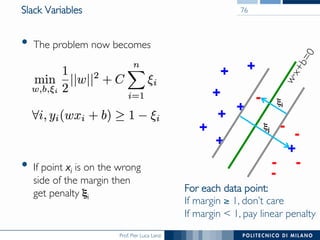
Slack Variables
•  The problem now becomes
•  If point xi is on the wrong 
side of the margin then 
get penalty ξi
76
+
+
+
+
+
+
+ -
-
--
-
For each data point:
If margin ≥ 1, don’t care
If margin  1, pay linear penalty
+
ξj
- ξi
Prof. Pier Luca Lanzi
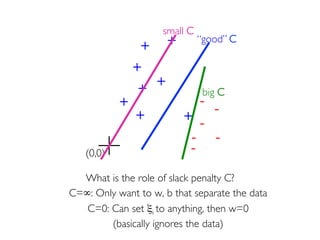
What is the role of slack penalty C?
C=∞: Only want to w, b that separate the data
C=0: Can set ξi to anything, then w=0
(basically ignores the data)
+
+
+
+
+
+
+ -
-
--
-
+ -
big C
“good” C
small C
(0,0)
Prof. Pier Luca Lanzi
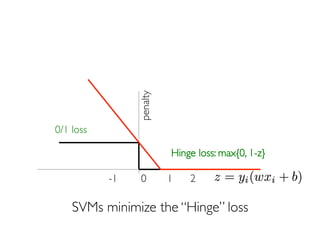
-1 0 1 2
0/1 loss
penalty
Hinge loss: max{0, 1-z}
SVMs minimize the “Hinge” loss
Prof. Pier Luca Lanzi
How to Estimate w?
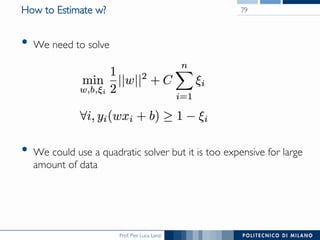
•  We need to solve
•  We could use a quadratic solver but it is too expensive for large
amount of data
79
Prof. Pier Luca Lanzi
Alternative Approach
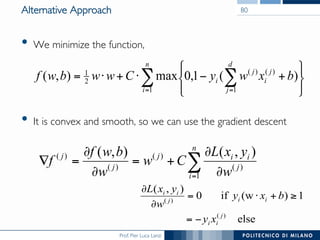
•  We minimize the function,
•  It is convex and smooth, so we can use the gradient descent
80
∑ ∑= = ⎭
⎬
⎫
⎩
⎨
⎧
+−⋅+⋅=
n
i
d
j
j
i
j
i bxwyCwwbwf
1 1
)()(
2
1
)(1,0max),(
∑= ∂
∂
+=
∂
∂
=∇
n
i
j
iij
j
j
w
yxL
Cw
w
bwf
f
1
)(
)(
)(
)( ),(),(
else
1)(wif0
),(
)(
)(
j
ii
iij
ii
xy
bxy
w
yxL
−=
≥+⋅=
∂
∂
Prof. Pier Luca Lanzi
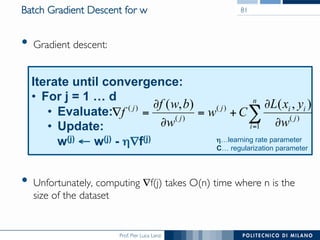
•  Gradient descent:
•  Unfortunately, computing ∇f(j) takes O(n) time where n is the
size of the dataset
Iterate until convergence:
•  For j = 1 … d
•  Evaluate:
•  Update:
w(j) ← w(j) - η∇f(j)
Batch Gradient Descent for w 81
∑= ∂
∂
+=
∂
∂
=∇
n
i
j
iij
j
j
w
yxL
Cw
w
bwf
f
1
)(
)(
)(
)( ),(),(
η…learning rate parameter
C… regularization parameter
Prof. Pier Luca Lanzi
Stochastic Gradient Descent
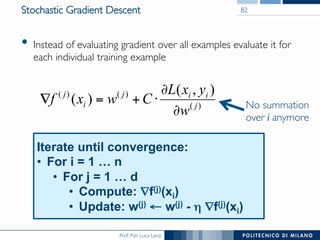
•  Instead of evaluating gradient over all examples evaluate it for
each individual training example
82
)(
)()( ),(
)( j
iij
i
j
w
yxL
Cwxf
∂
∂
⋅+=∇
Iterate until convergence:
•  For i = 1 … n
•  For j = 1 … d
•  Compute: ∇f(j)(xi)
•  Update: w(j) ← w(j) - η ∇f(j)(xi)
No summation
over i anymore
Prof. Pier Luca Lanzi
The KernelTrick
Prof. Pier Luca Lanzi
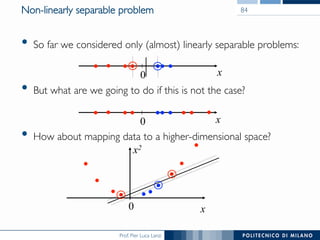
•  So far we considered only (almost) linearly separable problems:
•  But what are we going to do if this is not the case?
•  How about mapping data to a higher-dimensional space?
0 x
0 x
0 x
x2
Non-linearly separable problem 84
Prof. Pier Luca Lanzi
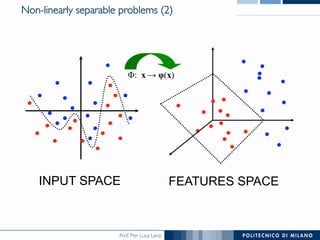
Non-linearly separable problems (2)
Φ: x → φ(x)
INPUT SPACE FEATURES SPACE
Prof. Pier Luca Lanzi
SVMs for Regression
Prof. Pier Luca Lanzi
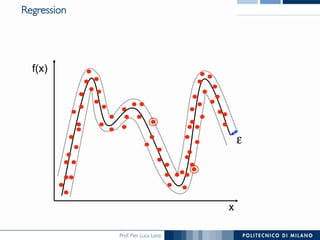
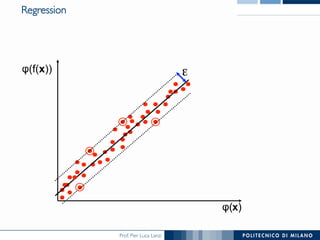
Regression
f(x)
x
ε
Prof. Pier Luca Lanzi
Regression
x
ε
φ(x)
φ(f(x))

DMTM 2015 - 13 Naive bayes, Nearest Neighbours and Other Methods

  • 1.
    Prof. Pier LucaLanzi Classification: Other Methods Data Mining andText Mining (UIC 583 @ Politecnico di Milano)
  • 2.
    Prof. Pier LucaLanzi Study Material •  Mining of Massive Datasets Section 12.3, 12.4 •  Data Mining and Analysis: Fundamental Concepts and Algorithms - Chapter 18 19 2
  • 3.
    Prof. Pier LucaLanzi What is Instance-Based Learning?
  • 4.
    Prof. Pier LucaLanzi At the Core of Classification Problems! Apples Again! 4 is this an apple?
  • 5.
    Prof. Pier LucaLanzi Instance-Based Learning •  To decide the label for an unseen example, consider the k examples from the training data that are more similar to the unknown one •  Classify the unknown example using the most frequent class 5
  • 6.
    Prof. Pier LucaLanzi Instance-Based Learning in Action •  If k=5, these 5 fruits are the most similar ones to the unclassified example •  Since, the majority of the fruits are apples, we decide that the unknown fruit is an apple 6
  • 7.
    Prof. Pier LucaLanzi Instance-Based Learning in General •  Store the training records only, no model is computed •  Use the training records to predict an unknown class label 7 Att1 … Attn Class Att1 … Attn
  • 8.
    Prof. Pier LucaLanzi Instance-Based Methods •  They are the simplest form of learning •  The training dataset is searched for the instances that are more similar to the unlabeled instance •  The training dataset is the model itself, it is the knowledge •  The similarity function defines what’s “learned” •  They implement a “lazy evaluation” (or lazy learning) scheme, nothing happens until a new unlabeled instance must be classified •  Known methods include “Rote Learning”, “Case Base Reasoning”, “k- Nearest Neighbor” 8
  • 9.
    Prof. Pier LucaLanzi K-Nearest-Neighbor Classifiers •  Three elements § The training dataset § Similarity function (or distance metric) § The value of k, the number of nearest neighbors to retrieve •  Classification § Compute distance to other training records § Identify the k nearest neighbors § Use class labels of nearest neighbors to determine the class label of unknown record (e.g., by taking majority vote) 9 Unknown record
  • 10.
    Prof. Pier LucaLanzi How Many Neighbors? 10 X X X (a) 1-nearest neighbor (b) 2-nearest neighbor (c) 3-nearest neighbor K-nearest neighbors of a record x are data points that have the k smallest distance to x
  • 11.
    Prof. Pier LucaLanzi How Many Neighbors? •  If k is too small, sensitive to noise points •  If k is too large, neighborhood may include examples from other classes 11 X
  • 12.
    Prof. Pier LucaLanzi kNN with k=1
  • 13.
    Prof. Pier LucaLanzi kNN with k=3
  • 14.
    Prof. Pier LucaLanzi kNN with k=1 Crossvalidation
  • 15.
    Prof. Pier LucaLanzi kNN with k=3 Crossvalidation
  • 16.
    Prof. Pier LucaLanzi What Similarity Measure? •  Euclidian distance is the typical function used to compute the similarity between two examples •  To determine the class from nearest neighbor list § Take the majority vote of class labels among the k neighbors § Or weight the vote according to distance (e.g., w = 1/d2) •  Another popular metric is city-block (Manhattan) metric, distance is the sum of absolute differences 16
  • 17.
    Prof. Pier LucaLanzi Normalization and Other Issues •  Different attributes are measured on different scales •  Attributes might need to be normalized: vi is the actual value of attribute i ai is the normalized value •  For nominal attributes, the distance either 0 or 1 •  Missing values are usually assumed to be maximally distant (given normalized attributes) 17 ii ii i vv vv a minmax min − − = )( )( i ii i vStDev vAvgv a − =
  • 18.
    Prof. Pier LucaLanzi Discussion •  K-Nearest Neighbor is often very accurate but slow, since simple version scans entire training data to derive a prediction •  Assumes all attributes are equally important, thus may need attribute selection or weights •  Statisticians have used k-NN since early 1950s, If n → ∞ and k/n → 0, error approaches minimum 18
  • 19.
    Prof. Pier LucaLanzi Naïve Bayes
  • 20.
    Prof. Pier LucaLanzi Bayes Probability •  Conditional Probability: •  Bayes theorem, •  A priori probability of C, P(C), is the probability of event before evidence is seen •  A posteriori probability of C, P(C|A), is the probability of event after evidence is seen 20
  • 21.
    Prof. Pier LucaLanzi Naïve Bayes Classifiers •  What’s the probability of the class given an instance? •  Evidence E = instance, represented as a tuple of attributes e1, …, en •  Event H = class value for instance •  We are looking for the class value with the highest probability for E •  I.e., we are looking for the hypothesis that has the highest probability to explain the evidence E 21
  • 22.
    Prof. Pier LucaLanzi Naïve Bayes Classifiers •  Given the hypothesis H and the example E described by n attributes, Bayes Theorem says that •  Naïve assumption: attributes are statistically independent •  Evidence splits into parts that are independent 22
  • 23.
    Prof. Pier LucaLanzi Naïve Bayes for Classification •  Training § the class probability P(H) and the conditional probability P(ei|H) for each attribute value ei and each class value H •  Testing § given an instance E, the class is computed as 23
  • 24.
    Prof. Pier LucaLanzi Naïve Bayes Classifier •  It is the “opposite” of OneRule as it uses all the attributes •  Two assumptions § Attributes are equally important § Attribute are statistically independent •  Statistically independent means that knowing the value of one attribute says nothing about the value of another (if the class is known) •  Independence assumption is almost never correct! But the scheme works well in practice 24
  • 25.
    Prof. Pier LucaLanzi The Weather Dataset Outlook Temp Humidity Windy Play Sunny Hot High False No Sunny Hot High True No Overcast Hot High False Yes Rainy Mild High False Yes Rainy Cool Normal False Yes Rainy Cool Normal True No Overcast Cool Normal True Yes Sunny Mild High False No Sunny Cool Normal False Yes Rainy Mild Normal False Yes Sunny Mild Normal True Yes Overcast Mild High True Yes Overcast Hot Normal False Yes Rainy Mild High True No 25
  • 26.
    Prof. Pier LucaLanzi Computing Probabilities 26 Outlook Temperature Humidity Windy Play Yes No Yes No Yes No Yes No Yes No Sunny 2 3 Hot 2 2 High 3 4 False 6 2 9 5 Overcast 4 0 Mild 4 2 Normal 6 1 True 3 3 Rainy 3 2 Cool 3 1 Sunny 2/9 3/5 Hot 2/9 2/5 High 3/9 4/5 False 6/9 2/5 9/14 5/14 Overcast 4/9 0/5 Mild 4/9 2/5 Normal 6/9 1/5 True 3/9 3/5 Rainy 3/9 2/5 Cool 3/9 1/5 Outlook Temp. Humidity Windy Play Sunny Cool High True ? What is the assigned class?
  • 27.
    Prof. Pier LucaLanzi Using the Probabilities for Classification •  Conversion into a probability by normalization: 27 Outlook Temp. Humidity Windy Play Sunny Cool High True ?
  • 28.
  • 29.
  • 30.
    Prof. Pier LucaLanzi The “Zero-Frequency Problem” •  What if an attribute value does not occur with every class value? (for instance, “Humidity = high” for class “yes”) •  The corresponding probability will be zero, •  A posteriori probability will also be zero! (No matter how likely the other values are!) •  The typical remedy is to add 1 to the count for every attribute value- class combination (Laplace estimator) •  The probabilities will never be zero! (also: stabilizes probability estimates) 30
  • 31.
    Prof. Pier LucaLanzi Missing Values •  Training § Instance is not included in frequency count for attribute value- class combination •  Testing § The attribute will be omitted from calculation 31 Outlook Temperature Humidity Windy Play ? Cool High True ? Likelihood of “yes” = 3/9 × 3/9 × 3/9 × 9/14 = 0.0238 Likelihood of “no” = 1/5 × 4/5 × 3/5 × 5/14 = 0.0343 P(“yes”) = 0.0238 / (0.0238 + 0.0343) = 41% P(“no”) = 0.0343 / (0.0238 + 0.0343) = 59%
  • 32.
    Prof. Pier LucaLanzi Another Version of the Weather Data @relation weather.symbolic @attribute outlook {sunny, overcast, rainy} @attribute temperature {hot, mild, cool, freeze} @attribute humidity {high, normal} @attribute windy {TRUE, FALSE} @attribute play {yes, no} @data sunny,hot,high,FALSE,no sunny,hot,high,TRUE,no ... 32
  • 33.
  • 34.
    Prof. Pier LucaLanzi Numeric Attributes •  We assume that the attributes have a normal or Gaussian probability distribution (given the class) •  The probability density function for the normal distribution is defined by two parameters, the mean and the standard deviation •  Sample mean, •  Standard deviation, •  Then the density function f(x) is 34
  • 35.
    Prof. Pier LucaLanzi Statistics for Weather data with numeric temperature 35 Outlook Temperature Humidity Windy Play Yes No Yes No Yes No Yes No Yes No Sunny 2 3 64, 68, 65, 71, 65, 70, 70, 85, False 6 2 9 5 Overcast 4 0 69, 70, 72, 80, 70, 75, 90, 91, True 3 3 Rainy 3 2 72, … 85, … 80, … 95, … Sunny 2/9 3/5 µ =73 µ =75 µ =79 µ =86 False 6/9 2/5 9/14 5/14 Overcast 4/9 0/5 σ =6.2 σ =7.9 σ =10.2 σ =9.7 True 3/9 3/5 Rainy 3/9 2/5
  • 36.
    Prof. Pier LucaLanzi Classifying a new day •  A new day, •  Missing values during training are not included in calculation of mean and standard deviation 36 Outlook Temperature Humidity Windy Play Sunny 66 90 true ? Likelihood of “yes” = 2/9 × 0.0340 × 0.0221 × 3/9 × 9/14 = 0.000036 Likelihood of “no” = 3/5 × 0.0291 × 0.0380 × 3/5 × 5/14 = 0.000136 P(“yes”) = 0.000036 / (0.000036 + 0. 000136) = 20.9% P(“no”) = 0.000136 / (0.000036 + 0. 000136) = 79.1%
  • 37.
  • 38.
  • 39.
    Prof. Pier LucaLanzi Discussion •  Naïve Bayes works surprisingly well, even if independence assumption is clearly violated •  Why? Because classification doesn’t require accurate probability estimates as long as maximum probability is assigned to correct class •  However, adding too many redundant attributes will cause problems (e.g. identical attributes) •  Also, many numeric attributes are not normally distributed 39
  • 40.
    Prof. Pier LucaLanzi Logistic Regression
  • 41.
    Prof. Pier LucaLanzi Logistic Regression •  Well-known and widely used statistical classification method •  Typically applied to two classes problems, but it can be easily extended to the case of multiple classes •  Instead of applying regression to evaluate P(H|E), apply it to evaluate the logit function computed as where wi are the weights and ei are the attribute value for example E 41
  • 42.
    Prof. Pier LucaLanzi Logistic Regression Function 42
  • 43.
    Prof. Pier LucaLanzi The Probabilistic Model •  Logistic regression assumes the following parametric model 43
  • 44.
    Prof. Pier LucaLanzi Classification using Logistic Regression •  To classify an example X, we select the class Y that maximizes the probability P(Y=y | X) or check or •  By taking the natural logarithm of both sides, we obtain a linear classification rule that assign the label Y=0 if •  Y=1 otherwise 44
  • 45.
    Prof. Pier LucaLanzi Decision Boundary 45 Predict  “y=1”  if   x1   x2   1   2   3   1   2   3  
  • 46.
    Prof. Pier LucaLanzi How Are the Weights Computed? •  Linear regression usually search for the weights which minimize the squared error on the training data •  Logistic regression search for the weights that maximize the log- likelihood or, •  Weights can be simply computed by solving a sequence of weighted least square regression problems until the log-likelihood converges to the max 46
  • 47.
  • 48.
  • 49.
    Prof. Pier LucaLanzi Bayesian Belief Networks
  • 50.
    Prof. Pier LucaLanzi Bayesian Belief Networks •  The conditional independence assumption, § makes computation possible § yields optimal classifiers when satisfied § but is seldom satisfied in practice, as attributes (variables) are often correlated •  Bayesian Belief Networks (BBN) allows us to specify which pair of attributes are conditionally independent •  They provide a graphical representation of probabilistic relationships among a set of random variables 50
  • 51.
    Prof. Pier LucaLanzi Bayesian Belief Networks •  Describe the probability distribution governing a set of variables by specifying § Conditional independence assumptions that apply on subsets of the variables § A set of conditional probabilities •  Two key elements § A direct acyclic graph, encoding the dependence relationships among variables § A probability table associating each node to its immediate parents node 51
  • 52.
    Prof. Pier LucaLanzi •  Variable A and B are independent, but each one of them has an influence on the variable A •  A is conditionally independent of both B and D, given C •  The configuration of the typical naïve Bayes classifier Examples of Bayesian Belief Networks 52
  • 53.
    Prof. Pier LucaLanzi An Example of Bayesian Belief Network 53
  • 54.
    Prof. Pier LucaLanzi Probability Tables •  The network topology imposes conditions regarding the variable conditional independence •  Each node is associated with a probability table § If a node X does not have any parents, then the table contains only the prior probability P(X) § If a node X has only one any parent Y, then the table contains only the conditional probability P(X|Y) § If a node X has multiple parents, Y1, …, Yk the the table contains the conditional probability P(X|Y1…Yk) 54
  • 55.
    Prof. Pier LucaLanzi Model Building 55
  • 56.
    Prof. Pier LucaLanzi Bayesian Belief Networks •  In general the inference is NP-complete but there are approximating methods, e.g. Monte-Carlo 56 evidence, observed unobserved to be predicted
  • 57.
    Prof. Pier LucaLanzi http://www.cs.waikato.ac.nz/~remco/weka.bn.pdf
  • 58.
  • 59.
    Prof. Pier LucaLanzi Bayesian Belief Networks •  Bayesian belief network allows a subset of the variables conditionally independent •  A graphical model of causal relationships •  Several cases of learning Bayesian belief networks § Given both network structure and all the variables is easy § Given network structure but only some variables § When the network structure is not known in advance 59
  • 60.
    Prof. Pier LucaLanzi Bayesian Belief Networks •  BBN provides an approach for capturing prior knowledge of a particular domain using a graphical model •  Building the network is time consuming, but adding variables to a network is straightforward •  They can encode causal dependencies among variables •  They are well suited to dealing with incomplete data •  They are robust to overfitting 60
  • 61.
    Prof. Pier LucaLanzi SupportVector Machines
  • 62.
    Prof. Pier LucaLanzi Many decision boundaries can separate these two classes Which one should we choose? Class 1 Class 2
  • 63.
    Prof. Pier LucaLanzi Class 1 Class 2 Class 1 Class 2 Class 1 Class 2 Class 1 Class 2
  • 64.
  • 65.
    Prof. Pier LucaLanzi γ A C B Distance from the separating hyperplance corresponds to the “confidence” of prediction. For instance we are “more sure” about the class of A and B than C.
  • 66.
    Prof. Pier LucaLanzi Searching for the Largest Margin •  Prediction •  Confidence •  We are looking for •  That can be rewritten as 66 γ A C B
  • 67.
    Prof. Pier LucaLanzi γ A C B SVMs work by searching for the hyperplane that maximizes the margin or the largest γ such that
  • 68.
    Prof. Pier LucaLanzi The search of the separating hyperplane can be reduced to the search for the d+1 points (in the +/- plane) that uniquely identify the plane we are looking for
  • 69.
    Prof. Pier LucaLanzi •  There is a scaling problem since scaling w increase the margin •  Thus we work with a normalized w •  We also require that support vectors The Canonical Hyperplane 69
  • 70.
    Prof. Pier LucaLanzi Finding the Canonical Hyperplane •  We want to maximize the marginγ •  We know that •  And that •  From which we derive 70 2γ2x 1x |||| w w
  • 71.
    Prof. Pier LucaLanzi •  We started with •  But to search of the max γ is equivalent to maximizing •  That is equivalent to minimizing ||w|| which will turn into the minimization of 71
  • 72.
    Prof. Pier LucaLanzi SVM with “hard” constraints
  • 73.
    Prof. Pier LucaLanzi Soft-Margin SVMs
  • 74.
    Prof. Pier LucaLanzi When Data Are Non-linearly Separable? •  When data is not separable we introduce a penalty •  Not all the errors are the same so we introduce slack variables ζi 74 + + + + + + + - - - - - - - +- -
  • 75.
    Prof. Pier LucaLanzi Support Vector Machines •  Introduce slack variables ξi •  If point xi is on the wrong side of the margin then get penalty ξi iii n i i bw bxwyits Cw i ξ ξ ξ −≥+⋅∀ ⋅+ ∑= ≥ 1)(,.. min 1 2 2 1 0,, + + + + + + + - - -- - For each data point: If margin ≥ 1, don’t care If margin 1, pay linear penalt + ξj - ξi
  • 76.
    Prof. Pier LucaLanzi Slack Variables •  The problem now becomes •  If point xi is on the wrong side of the margin then get penalty ξi 76 + + + + + + + - - -- - For each data point: If margin ≥ 1, don’t care If margin 1, pay linear penalty + ξj - ξi
  • 77.
    Prof. Pier LucaLanzi What is the role of slack penalty C? C=∞: Only want to w, b that separate the data C=0: Can set ξi to anything, then w=0 (basically ignores the data) + + + + + + + - - -- - + - big C “good” C small C (0,0)
  • 78.
    Prof. Pier LucaLanzi -1 0 1 2 0/1 loss penalty Hinge loss: max{0, 1-z} SVMs minimize the “Hinge” loss
  • 79.
    Prof. Pier LucaLanzi How to Estimate w? •  We need to solve •  We could use a quadratic solver but it is too expensive for large amount of data 79
  • 80.
    Prof. Pier LucaLanzi Alternative Approach •  We minimize the function, •  It is convex and smooth, so we can use the gradient descent 80 ∑ ∑= = ⎭ ⎬ ⎫ ⎩ ⎨ ⎧ +−⋅+⋅= n i d j j i j i bxwyCwwbwf 1 1 )()( 2 1 )(1,0max),( ∑= ∂ ∂ += ∂ ∂ =∇ n i j iij j j w yxL Cw w bwf f 1 )( )( )( )( ),(),( else 1)(wif0 ),( )( )( j ii iij ii xy bxy w yxL −= ≥+⋅= ∂ ∂
  • 81.
    Prof. Pier LucaLanzi •  Gradient descent: •  Unfortunately, computing ∇f(j) takes O(n) time where n is the size of the dataset Iterate until convergence: •  For j = 1 … d •  Evaluate: •  Update: w(j) ← w(j) - η∇f(j) Batch Gradient Descent for w 81 ∑= ∂ ∂ += ∂ ∂ =∇ n i j iij j j w yxL Cw w bwf f 1 )( )( )( )( ),(),( η…learning rate parameter C… regularization parameter
  • 82.
    Prof. Pier LucaLanzi Stochastic Gradient Descent •  Instead of evaluating gradient over all examples evaluate it for each individual training example 82 )( )()( ),( )( j iij i j w yxL Cwxf ∂ ∂ ⋅+=∇ Iterate until convergence: •  For i = 1 … n •  For j = 1 … d •  Compute: ∇f(j)(xi) •  Update: w(j) ← w(j) - η ∇f(j)(xi) No summation over i anymore
  • 83.
    Prof. Pier LucaLanzi The KernelTrick
  • 84.
    Prof. Pier LucaLanzi •  So far we considered only (almost) linearly separable problems: •  But what are we going to do if this is not the case? •  How about mapping data to a higher-dimensional space? 0 x 0 x 0 x x2 Non-linearly separable problem 84
  • 85.
    Prof. Pier LucaLanzi Non-linearly separable problems (2) Φ: x → φ(x) INPUT SPACE FEATURES SPACE
  • 86.
    Prof. Pier LucaLanzi SVMs for Regression
  • 87.
    Prof. Pier LucaLanzi Regression f(x) x ε
  • 88.
    Prof. Pier LucaLanzi Regression x ε φ(x) φ(f(x))