Different Random Stuff on
Information Technology
Sayed Ahmed
BSc. Eng. in Computer Science & Engineering
MSc in Computer Science
Business Analysis: An Overview
• Before 19th century no one systematically studied the effectiveness
o f the different approaches of management
• Business Analysis - is a very recent profession. Due to the radical
change in information management and communication businesses
needed a new way of analysis - hence, the profession came into
play
• The profession came into existence during the information
technology boom in 1980 - 1990
• When businesses created a new profession to serve the purpose
that a System Analyst does in IT - the profession became the
business analyst
• Though, nothing can guarantee success, understanding the core
concepts of the Business Analysis area will help you to work more
effectively as a business analyst
Knowledge Areas of BA
• Six knowledge areas of Business Analysis:
– Enterprise Analysis
– Requirements Planning and Management
– Requirements Elicitation
– Requirements Analysis and Documentation
– Requirements Communication
– Solution Assessment and Validation
Responsibilities of a BA
• Responsibilities of a Business Analyst
– Identify Business Problems and Opportunities
– Eliciting, Analyzing, Communicating, and
validating requirements for changes to business
processes
– Recommending solutions to help businesses
achieve their goals
Analysts and Project Managers
• The role of the project managers and business
analysts may seem similar. Really, there are
some overlapping areas such as, identifying
goals and requirements, risk analysis, and
finding strategies for project success.
However, the project manager is responsible
for the timely completion of the project within
the budget. The business analyst ensures that
the project is completed correctly with the
defined requirements.
Core Skills in Business Analysis
• Knowledg e Skills:
– Analysis knowledge skill set,
– Business knowledge skill set,
– IT knowledge skill set
• Collaboration Skills:
• Interpersonal skills collaboration skill set,
• Diplomacy collaboration skill set,
• Organizational development collaboration skill set
• Leadership Skills:
– Mentoring leadership skill set,
– Forward-thinking leadership skill set,
– Elicitation and analysis leadership skill set,
– Designation leadership skill set
The Areas of Business Analysis
Knowledge
• Six Areas
– enterprise analysis: the environment of the
organization at large
– requirements planning and management:
– requirements gathering areas : requirements
elicitation, requirements analysis and
documentation, and solution assessment and
validation.
– requirements communication
Enterprise Analysis and Making a
Business Case
• The Zachman framework: A formal, highly
structured way to define intricate systems.
Allows the business analyst to organize
collected data and analyze it effectively The
Zachman framework: A six by five matrix.
rows: the different perspectives of the
enterprise, columns: questions to be asked to
design a business entity Example:
POLDAT Framework
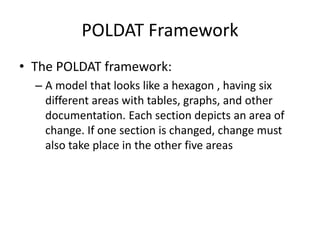
• The POLDAT framework:
– A model that looks like a hexagon , having six
different areas with tables, graphs, and other
documentation. Each section depicts an area of
change. If one section is changed, change must
also take place in the other five areas
Related Skills
• Related Skills/Activities
– Enterprise Analysis
– Creating the Business Architecture
– Feasibility Study Techniques
– Defining Project Scope
– Developing a Business Case
– The Risk Assessment
– Project Decision Making
– Supporting the Project
Resources
• http://en.wikipedia.org/wiki/Systems_analysis
• http://en.wikipedia.org/wiki/Systems_design
Resources
• http://en.wikipedia.org/wiki/Structured_Syste
ms_Analysis_and_Design_Method
• http://en.wikipedia.org/wiki/Structured_Anal
ysis_and_Design_Technique
• http://en.wikipedia.org/wiki/Object_oriented
_analysis_and_design
• http://en.wikipedia.org/wiki/Service-
oriented_analysis_and_design
Resources:
A program on Systems Analyst
• Computer Systems Technology - Systems
Analyst
– http://www.sheridancollege.ca/programs-and-
courses/full-time-programs/programs-a-z-
index/computer-systems-technology-systems-
analyst-co-op.aspx
Tools
• http://www.sparxsystems.com/products/ea/in
dex.html
• http://www.sparxsystems.com/
• http://uml-
tutorials.trireme.com/uml_tutorial_5.htm
Books: System Analysis and Design
• http://books.google.ca/books?id=XiJTWMRPZi
4C&pg=PA658&lpg=PA658&dq=System+Archit
ect+CASE+Tool&source=bl&ots=fpnqYsRG_r&s
ig=9wsWRYpU9dpVFX10mjAsRPoXdbs&hl=en
&sa=X&ei=aI18UemXOND_4AOmmYHQCA&ve
d=0CGMQ6AEwBw#v=onepage&q=System%2
0Architect%20CASE%20Tool&f=false
Tutorial Systems Architect: How to
model
• http://highered.mcgraw-
hill.com/sites/dl/free/0073052337/315745/Sy
stems_Architect_Tutorial.pdf
CASE Tools
• Eclipse Plugin for Systems Architect Case tool
– http://www.antepedia.com/detail/p/230168.html
;jsessionid=7F11D9B39896EA8E42F13AEFBD7713
9B
• A list of case tools
– http://www.unl.csi.cuny.edu/faqs/software-
enginering/tools.html
Overview on System Analysis and
Design
• http://www.ddegjust.ac.in/studymaterial/pgd
ca/ms-04.pdf
Structured System Analysis and Design
• http://en.wikipedia.org/wiki/Structured_syste
ms_analysis_and_design_method
Tool: Enterprise Architect
• http://en.wikipedia.org/wiki/Enterprise_Archi
tect_%28program%29

System analysis and_design

  • 1.
    Different Random Stuffon Information Technology Sayed Ahmed BSc. Eng. in Computer Science & Engineering MSc in Computer Science
  • 2.
    Business Analysis: AnOverview • Before 19th century no one systematically studied the effectiveness o f the different approaches of management • Business Analysis - is a very recent profession. Due to the radical change in information management and communication businesses needed a new way of analysis - hence, the profession came into play • The profession came into existence during the information technology boom in 1980 - 1990 • When businesses created a new profession to serve the purpose that a System Analyst does in IT - the profession became the business analyst • Though, nothing can guarantee success, understanding the core concepts of the Business Analysis area will help you to work more effectively as a business analyst
  • 3.
    Knowledge Areas ofBA • Six knowledge areas of Business Analysis: – Enterprise Analysis – Requirements Planning and Management – Requirements Elicitation – Requirements Analysis and Documentation – Requirements Communication – Solution Assessment and Validation
  • 4.
    Responsibilities of aBA • Responsibilities of a Business Analyst – Identify Business Problems and Opportunities – Eliciting, Analyzing, Communicating, and validating requirements for changes to business processes – Recommending solutions to help businesses achieve their goals
  • 5.
    Analysts and ProjectManagers • The role of the project managers and business analysts may seem similar. Really, there are some overlapping areas such as, identifying goals and requirements, risk analysis, and finding strategies for project success. However, the project manager is responsible for the timely completion of the project within the budget. The business analyst ensures that the project is completed correctly with the defined requirements.
  • 6.
    Core Skills inBusiness Analysis • Knowledg e Skills: – Analysis knowledge skill set, – Business knowledge skill set, – IT knowledge skill set • Collaboration Skills: • Interpersonal skills collaboration skill set, • Diplomacy collaboration skill set, • Organizational development collaboration skill set • Leadership Skills: – Mentoring leadership skill set, – Forward-thinking leadership skill set, – Elicitation and analysis leadership skill set, – Designation leadership skill set
  • 7.
    The Areas ofBusiness Analysis Knowledge • Six Areas – enterprise analysis: the environment of the organization at large – requirements planning and management: – requirements gathering areas : requirements elicitation, requirements analysis and documentation, and solution assessment and validation. – requirements communication
  • 8.
    Enterprise Analysis andMaking a Business Case • The Zachman framework: A formal, highly structured way to define intricate systems. Allows the business analyst to organize collected data and analyze it effectively The Zachman framework: A six by five matrix. rows: the different perspectives of the enterprise, columns: questions to be asked to design a business entity Example:
  • 9.
    POLDAT Framework • ThePOLDAT framework: – A model that looks like a hexagon , having six different areas with tables, graphs, and other documentation. Each section depicts an area of change. If one section is changed, change must also take place in the other five areas
  • 10.
    Related Skills • RelatedSkills/Activities – Enterprise Analysis – Creating the Business Architecture – Feasibility Study Techniques – Defining Project Scope – Developing a Business Case – The Risk Assessment – Project Decision Making – Supporting the Project
  • 11.
  • 12.
    Resources • http://en.wikipedia.org/wiki/Structured_Syste ms_Analysis_and_Design_Method • http://en.wikipedia.org/wiki/Structured_Anal ysis_and_Design_Technique •http://en.wikipedia.org/wiki/Object_oriented _analysis_and_design • http://en.wikipedia.org/wiki/Service- oriented_analysis_and_design
  • 13.
    Resources: A program onSystems Analyst • Computer Systems Technology - Systems Analyst – http://www.sheridancollege.ca/programs-and- courses/full-time-programs/programs-a-z- index/computer-systems-technology-systems- analyst-co-op.aspx
  • 14.
  • 15.
    Books: System Analysisand Design • http://books.google.ca/books?id=XiJTWMRPZi 4C&pg=PA658&lpg=PA658&dq=System+Archit ect+CASE+Tool&source=bl&ots=fpnqYsRG_r&s ig=9wsWRYpU9dpVFX10mjAsRPoXdbs&hl=en &sa=X&ei=aI18UemXOND_4AOmmYHQCA&ve d=0CGMQ6AEwBw#v=onepage&q=System%2 0Architect%20CASE%20Tool&f=false
  • 16.
    Tutorial Systems Architect:How to model • http://highered.mcgraw- hill.com/sites/dl/free/0073052337/315745/Sy stems_Architect_Tutorial.pdf
  • 17.
    CASE Tools • EclipsePlugin for Systems Architect Case tool – http://www.antepedia.com/detail/p/230168.html ;jsessionid=7F11D9B39896EA8E42F13AEFBD7713 9B • A list of case tools – http://www.unl.csi.cuny.edu/faqs/software- enginering/tools.html
  • 18.
    Overview on SystemAnalysis and Design • http://www.ddegjust.ac.in/studymaterial/pgd ca/ms-04.pdf
  • 19.
    Structured System Analysisand Design • http://en.wikipedia.org/wiki/Structured_syste ms_analysis_and_design_method
  • 20.
    Tool: Enterprise Architect •http://en.wikipedia.org/wiki/Enterprise_Archi tect_%28program%29