The natural environment encompasses all living and non-living things 
occurring naturally on Earth or some region thereof. It is an 
environment that encompasses the interaction of all living species. The 
concept of the natural environment can be distinguished by 
components: 
Complete ecological units that function as natural systems without 
massive human intervention, including 
all vegetation, microorganisms, soil, rocks, atmosphere, and natural 
phenomena that occur within their boundaries. 
Universal natural resources and physical phenomena that lack clear-cut 
boundaries, such as air, water, and climate, as well 
as energy, radiation, electric charge, and magnetism, not originating 
from human activity.
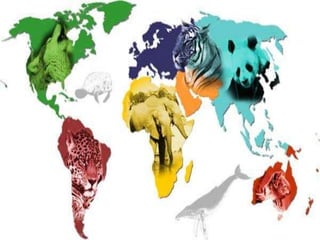
Our Wildlife 
Wildlife can be found in all ecosystems. Deserts, 
forests, rain forests, plains, grasslands, and other areas 
including the most developed urban sites, all have 
distinct forms of wildlife. While the term in popular 
culture usually refers to animals that are untouched by 
human factors, most scientists agree that wildlife 
around the world is impacted by human activities.
Animals Destruction 
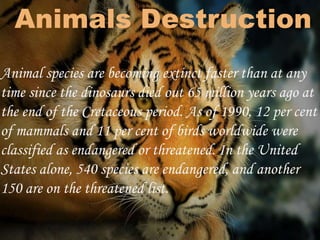
Animal species are becoming extinct faster than at any 
time since the dinosaurs died out 65 million years ago at 
the end of the Cretaceous period. As of 1990, 12 per cent 
of mammals and 11 per cent of birds worldwide were 
classified as endangered or threatened. In the United 
States alone, 540 species are endangered, and another 
150 are on the threatened list.
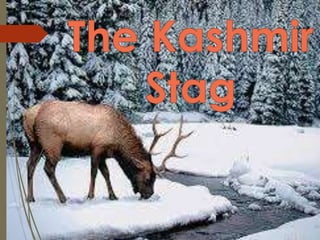
The Kashmir stag (Cervus elaphus 
hanglu), also called hangul, is 
a subspecies of Red Deer native 
to India, especially in Jammu and 
Kashmir where it is the state animal. 
Kashmir Stag is listed as critically 
endangered by IUCN as population is 
counted 160 mature individuals in 
2008 census.
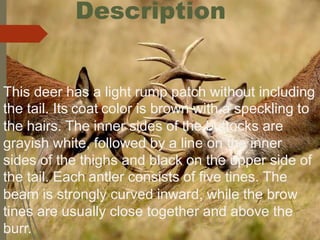
Description 
This deer has a light rump patch without including 
the tail. Its coat color is brown with a speckling to 
the hairs. The inner sides of the buttocks are 
grayish white, followed by a line on the inner 
sides of the thighs and black on the upper side of 
the tail. Each antler consists of five tines. The 
beam is strongly curved inward, while the brow 
tines are usually close together and above the 
burr.
Threats And Conservation 
These deer once numbered from about 5,000 animals in the 
beginning of the 20th century. Unfortunately, they were 
threatened, due to habitat destruction, over-grazing by domestic 
livestock, and poaching. This dwindled to as low as 150 animals 
it is the only surviving race of the Red Deer family of Europe in 
the sub-continent. The animal is battling for its survival in its last 
bastion: they are now scattered within 141 km² of the Dachigam 
National Park located on foothills of Zabarwan range on the 
outskirts of Srinagar. Known for its magnificent antlers with 11 
to 16 points, hangul was once distributed widely in the mountains 
of Kashmir. During 1940's, their number was believed to be about 
3,000-5,000. As per the latest census in 2008, only around 160 
exist.
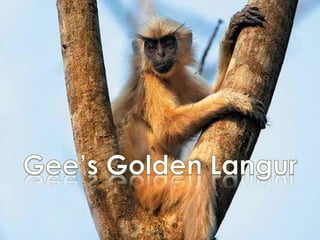
Gee's golden langur or simply the golden 
langur, is an Old World monkey found in a 
small region of western Assam, India and in 
the neighboring foothills of the Black 
Mountains of Bhutan. It is one of the most 
endangered primate species of India. Long 
considered sacred by many Himalayan 
people
Golden langurs have long been 
considered sacred by Himalayan 
peoples. However, they only came to 
the attention of scientists as a distinct 
species in the 1950s so little is known 
about their behaviour. Named after 
their gorgeously coloured coats, golden 
langurs spend most of the day in the 
forest tree tops, rarely descending to 
the ground. These secretive leaf-eating 
monkeys are one of India's most 
endangered primates. They are also 
found in the foothills of Bhutan's 
Black Mountains. 
Facts 
Genus-Lutung 
Kingdom-animal 
Order-primate 
Phylum-chordate 
Found In-India, Asia 
Attributes-endangered 
Scientific 
name:Trachypithecus gee 
Common names : Gee's 
golden langur , Golden leaf 
monkey
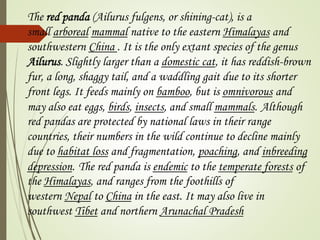
The red panda (Ailurus fulgens, or shining-cat), is a 
small arboreal mammal native to the eastern Himalayas and 
southwestern China . It is the only extant species of the genus 
Ailurus. Slightly larger than a domestic cat, it has reddish-brown 
fur, a long, shaggy tail, and a waddling gait due to its shorter 
front legs. It feeds mainly on bamboo, but is omnivorous and 
may also eat eggs, birds, insects, and small mammals. Although 
red pandas are protected by national laws in their range 
countries, their numbers in the wild continue to decline mainly 
due to habitat loss and fragmentation, poaching, and inbreeding 
depression. The red panda is endemic to the temperate forests of 
the Himalayas, and ranges from the foothills of 
western Nepal to China in the east. It may also live in 
southwest Tibet and northern Arunachal Pradesh
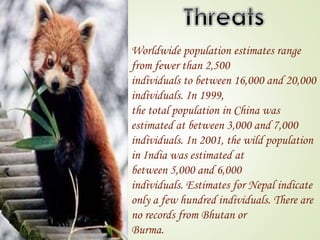
Worldwide population estimates range 
from fewer than 2,500 
individuals to between 16,000 and 20,000 
individuals. In 1999, 
the total population in China was 
estimated at between 3,000 and 7,000 
individuals. In 2001, the wild population 
in India was estimated at 
between 5,000 and 6,000 
individuals. Estimates for Nepal indicate 
only a few hundred individuals. There are 
no records from Bhutan or 
Burma.
Conservation 
The red panda is protected in all range countries, and hunting is illegal. 
Beyond this, conservation efforts are highly variable between countries 
•China has 35 protected areas covering about 42.4% of red panda 
habitat. 
•India has 20 protected areas with known or possible red panda 
populations in Sikkim,Arunachal Pradesh and West Bengal such 
as Khangchendzonga National Park,Namdapha National Park and 
singalila National Park, and a coordinated conservation policy for the 
red panda. 
•Bhutan has five protected areas that support red panda populations. 
•Burma has 26 protected areas, of which at least one hosts red panda 
• populations.
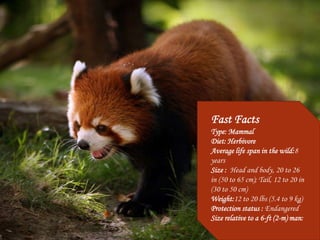
Fast Facts 
Type: Mammal 
Diet: Herbivore 
Average life span in the wild:8 
years 
Size : Head and body, 20 to 26 
in (50 to 65 cm); Tail, 12 to 20 in 
(30 to 50 cm) 
Weight:12 to 20 lbs (5.4 to 9 kg) 
Protection status : Endangered 
Size relative to a 6-ft (2-m) man:
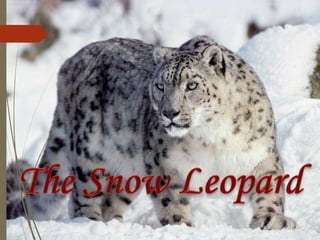
Snow Leopard 
The snow leopard is a moderately large cat native to the mountain ranges 
of Central Asia Eurasia is the ol Facts about snow leopard 
Status: Endangered 
Description: Soft grey coat, white on belly. Head and limbs are marked 
with solid black or brown spots; body is covered with brown blotches 
ringed with black, and a black streak runs down the back. Tail is heavy 
with fur and the bottom of the paws are covered with fur -- for protection 
against snow and cold. The winter coat is lighter in color 
Size: Head and body length is 47-59 inches, while the tail is 31-39 inches 
long. 
Habitat: Mountain steppes and coniferous (pine/evergreen) forest scrub at 
high altitudes (5900-18000 feet). Prefer mountain regions in the winter, 
moving to meadows and rocky areas during the summer months.
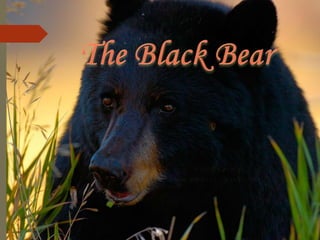
The Asian black bear 
The Asian black bear also known as the moon bear or 
white- chested bear , is a medium-sized specie of bear, 
largely adapted for Arboreal life, seen across much of 
the Himalayas and the northern parts of the 
Indian Subcontinent . The species 
is morphologically very similar to some prehistoric 
bears, and is thought by some scientists to be the 
ancestor of other extant bear species . Though 
largely herbivorous Asian black bears can be very 
aggressive toward humans, and have frequently 
attacked people without provocation. The species was 
described by Rudyard Kipling as "the most bizarre of 
the ursine species.
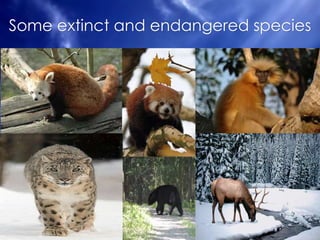
Some extinct and endangered species
Living beings are equal, So protect 
Wildlife to preserve equality!!!!!!!!

Extinct and Endangered species

  • 2.
    The natural environmentencompasses all living and non-living things occurring naturally on Earth or some region thereof. It is an environment that encompasses the interaction of all living species. The concept of the natural environment can be distinguished by components: Complete ecological units that function as natural systems without massive human intervention, including all vegetation, microorganisms, soil, rocks, atmosphere, and natural phenomena that occur within their boundaries. Universal natural resources and physical phenomena that lack clear-cut boundaries, such as air, water, and climate, as well as energy, radiation, electric charge, and magnetism, not originating from human activity.
  • 3.
    Our Wildlife Wildlifecan be found in all ecosystems. Deserts, forests, rain forests, plains, grasslands, and other areas including the most developed urban sites, all have distinct forms of wildlife. While the term in popular culture usually refers to animals that are untouched by human factors, most scientists agree that wildlife around the world is impacted by human activities.
  • 4.
    Animals Destruction Animalspecies are becoming extinct faster than at any time since the dinosaurs died out 65 million years ago at the end of the Cretaceous period. As of 1990, 12 per cent of mammals and 11 per cent of birds worldwide were classified as endangered or threatened. In the United States alone, 540 species are endangered, and another 150 are on the threatened list.
  • 7.
    The Kashmir stag(Cervus elaphus hanglu), also called hangul, is a subspecies of Red Deer native to India, especially in Jammu and Kashmir where it is the state animal. Kashmir Stag is listed as critically endangered by IUCN as population is counted 160 mature individuals in 2008 census.
  • 8.
    Description This deerhas a light rump patch without including the tail. Its coat color is brown with a speckling to the hairs. The inner sides of the buttocks are grayish white, followed by a line on the inner sides of the thighs and black on the upper side of the tail. Each antler consists of five tines. The beam is strongly curved inward, while the brow tines are usually close together and above the burr.
  • 9.
    Threats And Conservation These deer once numbered from about 5,000 animals in the beginning of the 20th century. Unfortunately, they were threatened, due to habitat destruction, over-grazing by domestic livestock, and poaching. This dwindled to as low as 150 animals it is the only surviving race of the Red Deer family of Europe in the sub-continent. The animal is battling for its survival in its last bastion: they are now scattered within 141 km² of the Dachigam National Park located on foothills of Zabarwan range on the outskirts of Srinagar. Known for its magnificent antlers with 11 to 16 points, hangul was once distributed widely in the mountains of Kashmir. During 1940's, their number was believed to be about 3,000-5,000. As per the latest census in 2008, only around 160 exist.
  • 11.
    Gee's golden languror simply the golden langur, is an Old World monkey found in a small region of western Assam, India and in the neighboring foothills of the Black Mountains of Bhutan. It is one of the most endangered primate species of India. Long considered sacred by many Himalayan people
  • 12.
    Golden langurs havelong been considered sacred by Himalayan peoples. However, they only came to the attention of scientists as a distinct species in the 1950s so little is known about their behaviour. Named after their gorgeously coloured coats, golden langurs spend most of the day in the forest tree tops, rarely descending to the ground. These secretive leaf-eating monkeys are one of India's most endangered primates. They are also found in the foothills of Bhutan's Black Mountains. Facts Genus-Lutung Kingdom-animal Order-primate Phylum-chordate Found In-India, Asia Attributes-endangered Scientific name:Trachypithecus gee Common names : Gee's golden langur , Golden leaf monkey
  • 14.
    The red panda(Ailurus fulgens, or shining-cat), is a small arboreal mammal native to the eastern Himalayas and southwestern China . It is the only extant species of the genus Ailurus. Slightly larger than a domestic cat, it has reddish-brown fur, a long, shaggy tail, and a waddling gait due to its shorter front legs. It feeds mainly on bamboo, but is omnivorous and may also eat eggs, birds, insects, and small mammals. Although red pandas are protected by national laws in their range countries, their numbers in the wild continue to decline mainly due to habitat loss and fragmentation, poaching, and inbreeding depression. The red panda is endemic to the temperate forests of the Himalayas, and ranges from the foothills of western Nepal to China in the east. It may also live in southwest Tibet and northern Arunachal Pradesh
  • 15.
    Worldwide population estimatesrange from fewer than 2,500 individuals to between 16,000 and 20,000 individuals. In 1999, the total population in China was estimated at between 3,000 and 7,000 individuals. In 2001, the wild population in India was estimated at between 5,000 and 6,000 individuals. Estimates for Nepal indicate only a few hundred individuals. There are no records from Bhutan or Burma.
  • 16.
    Conservation The redpanda is protected in all range countries, and hunting is illegal. Beyond this, conservation efforts are highly variable between countries •China has 35 protected areas covering about 42.4% of red panda habitat. •India has 20 protected areas with known or possible red panda populations in Sikkim,Arunachal Pradesh and West Bengal such as Khangchendzonga National Park,Namdapha National Park and singalila National Park, and a coordinated conservation policy for the red panda. •Bhutan has five protected areas that support red panda populations. •Burma has 26 protected areas, of which at least one hosts red panda • populations.
  • 17.
    Fast Facts Type:Mammal Diet: Herbivore Average life span in the wild:8 years Size : Head and body, 20 to 26 in (50 to 65 cm); Tail, 12 to 20 in (30 to 50 cm) Weight:12 to 20 lbs (5.4 to 9 kg) Protection status : Endangered Size relative to a 6-ft (2-m) man:
  • 19.
    Snow Leopard Thesnow leopard is a moderately large cat native to the mountain ranges of Central Asia Eurasia is the ol Facts about snow leopard Status: Endangered Description: Soft grey coat, white on belly. Head and limbs are marked with solid black or brown spots; body is covered with brown blotches ringed with black, and a black streak runs down the back. Tail is heavy with fur and the bottom of the paws are covered with fur -- for protection against snow and cold. The winter coat is lighter in color Size: Head and body length is 47-59 inches, while the tail is 31-39 inches long. Habitat: Mountain steppes and coniferous (pine/evergreen) forest scrub at high altitudes (5900-18000 feet). Prefer mountain regions in the winter, moving to meadows and rocky areas during the summer months.
  • 21.
    The Asian blackbear The Asian black bear also known as the moon bear or white- chested bear , is a medium-sized specie of bear, largely adapted for Arboreal life, seen across much of the Himalayas and the northern parts of the Indian Subcontinent . The species is morphologically very similar to some prehistoric bears, and is thought by some scientists to be the ancestor of other extant bear species . Though largely herbivorous Asian black bears can be very aggressive toward humans, and have frequently attacked people without provocation. The species was described by Rudyard Kipling as "the most bizarre of the ursine species.
  • 22.
    Some extinct andendangered species
  • 23.
    Living beings areequal, So protect Wildlife to preserve equality!!!!!!!!