Dr-Abdul Jabbar
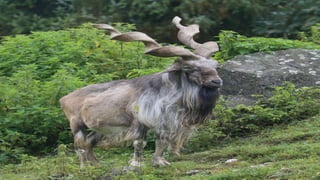
Markhor Capra falconeri
Distribution
A large species of wild goat that is found in
 Northeastern Afghanistan
 Northern and central Pakistan
 India (only Jammu & Kashmir)
 Southern Tajikistan
 Eastern Turkmenistan
 Southern Uzbekistan
 Himalayas
Description
Length:
132 to 186 centimetres (52 to 73 in)
Weigh:
Weigh from 32 to 110 kilograms (71 to 243 lb)
Behavior
Markhor are adapted to mountainous terrain, and can be found between 600 and 3,600 meters
in elevation. They typically inhabit scrub forests made up primarily of oaks (Quercus
ilex), pines (Pinus gerardiana), and junipers (Juniperus macropoda).They are dirunal, and are
mainly active in the early morning and late afternoon. Their diets shift seasonally: in the
spring and summer periods they graze, but turn to browsing in winter, sometimes standing on
their hind legs to reach high branches. The mating season takes place in winter, during which
the males fight each other by lunging, locking horns and attempting to push each other off
balance. The gestation period lasts 135–170 days, and usually results in the birth of one or two
kids, though rarely three. Markhor live in flocks, usually numbering nine animals, composed of
adult females and their young. Adult males are largely solitary. Adult females and kids
comprise most of the markhor population, with adult females making up 32% of the population
and kids making up 31%. Adult males comprise 19%, while subadults (males aged 2–3 years)
make up 12%, and yearlings (females aged 12–24 months) make up 9% of the population. Their
alarm call closely resembles the bleating of domestic goats. Early in the season the males and
females may be found together on the open grassy patches and clear slopes among the forest.
During the summer, the males remain in the forest, while the females generally climb to the
highest rocky ridges above.
Predation
Humans are the primary predators on markhor. Because markhor inhabit
very steep and inaccessible mountainous habitat, several strongholds of
markhor populations have been rarely approached by man. Golden eagles
(Aquila chrysaetos) have been reported preying upon young markhor.
Among wild carnivores, Himalayan lynx (Lynx lynx), leopard cats
(Prionailurus bengalensis), snow leopards (Panthera uncia), wolves (Canis
lupus), and black bears (Ursus thibetanus) are the main predators of
markhor. Because of these threats, the markhor possess keen eyesight and
a strong sense of smell to detect nearby predators. Markhor are very
aware of their surroundings and are on high alert for predators. In exposed
areas, they are quick to spot and flee from predators.
Threats
Markhor are potential prey for snow leopards, brown bears, lynx, jackals, and golden
eagles. While not directly causing their endangerment, the already small population of
markhor is further threatened by their predation. Hunting for meat as a means of
subsistence or trade in wildlife parts adds to the growing problem for wildlife
managers in many countries. Poaching, with its indirect impacts as disturbance,
increasing fleeing distances and resulting reduction of effective habitat size, is by far
the most important factor threatening the survival of the markhor population. The
most important types of poachers seem to be local inhabitants, state border guards,
the latter usually relying on local hunting guides, and Afghans, illegally crossing the
border. Poaching causes fragmentation of the population. into small islands where the
remaining subpopulations are prone to extinction. The markhor is a valued trophy
hunting prize for its incredibly rare spiral horns which became a threat to their
species. The continuing declines of markhor populations finally caught the
international community and became a concern.
Hunting
In British India, markhor were considered to be among the most challenging game
species, due to the danger involved in stalking and pursuing them in high, mountainous
terrain.According to Arthur Brinckman, in his The Rifle in Cashmere, "a man who is a
good walker will never wish for any finer sport than ibex or markhoor shooting". Elliot
Roosevelt wrote of how he shot two markhor in 1881, his first on 8 July, his second on
1 August. Although it is illegal to hunt markhor in Afghanistan, they have been
traditionally hunted in Nuristan and Laghman Provinces, and this may have intensified
during the War in Afghanistan. In Pakistan, hunting markhor is legal as part of a
conservation process, expensive hunting licenses are available from the Pakistani
government which allow for the hunting of old markhors which are no longer good for
breeding purposes. In India, it is illegal to hunt markhor but they are poached for food
and for their horns, which are thought to have medicinal properties. Markhor have also
been successfully introduced to private game ranches in Texas. Unlike
the aoudad, blackbuck, nilgai, ibex, and axis deer, however, markhor have not escaped
in sufficient numbers to establish free-range wild populations in Texas.
Conservation status
The International Union for the Conservation of Nature and Natural Resources currently
classifies the markhor as a near to threat species, due to a relatively small population
(2013 estimate: ~5,800 individuals), the absence of a projected total population
decline, and relying on ongoing conservation efforts to keep this population level.There
are reservations in Tajikistan to protect the markhors. In 1973, two reservations were
established. The Dashtijum Strict Reserve (also called the Zapovednik in Russian) offers
markhor protect across 20,000 ha. The Dashtijum Reserve (called the Zakasnik in
Russian) covers 53,000 ha. Though these reserves exist to protect and conserve the
markhor population, the regulations are poorly enforced making poaching common as
well as habitat destruction. The two organizations expect that their conversations will
not only protect, but allow them to sustainability use the markhor species. This
approach has been very effective compared to the protect lands that lack enforcement
and security. In India, the markhor is a fully protected (Schedule I) species under
Jammu and Kashmir's Wildlife (Protection) Act of 1978.
In culture
• The markhor is the national animal of Pakistan. It was one of the 72 animals featured
on the WWF Conservation Coin Collection in 1976. Markhor marionettes are used in
the Afghan puppet shows known as buz-baz. The markhor has also been mentioned in
a Pakistani computer-animated film known as Allahyar and the Legend of Markhor.
• In 2018, Pakistan's flag carrier Pakistan International Airlines adopted the markhor on
its new revised livery.
• The Markhor is also present on the logo of the Inter-Services Intelligence.

Markhor

  • 2.
  • 3.
  • 5.
    Distribution A large speciesof wild goat that is found in  Northeastern Afghanistan  Northern and central Pakistan  India (only Jammu & Kashmir)  Southern Tajikistan  Eastern Turkmenistan  Southern Uzbekistan  Himalayas
  • 6.
    Description Length: 132 to 186centimetres (52 to 73 in) Weigh: Weigh from 32 to 110 kilograms (71 to 243 lb)
  • 7.
    Behavior Markhor are adaptedto mountainous terrain, and can be found between 600 and 3,600 meters in elevation. They typically inhabit scrub forests made up primarily of oaks (Quercus ilex), pines (Pinus gerardiana), and junipers (Juniperus macropoda).They are dirunal, and are mainly active in the early morning and late afternoon. Their diets shift seasonally: in the spring and summer periods they graze, but turn to browsing in winter, sometimes standing on their hind legs to reach high branches. The mating season takes place in winter, during which the males fight each other by lunging, locking horns and attempting to push each other off balance. The gestation period lasts 135–170 days, and usually results in the birth of one or two kids, though rarely three. Markhor live in flocks, usually numbering nine animals, composed of adult females and their young. Adult males are largely solitary. Adult females and kids comprise most of the markhor population, with adult females making up 32% of the population and kids making up 31%. Adult males comprise 19%, while subadults (males aged 2–3 years) make up 12%, and yearlings (females aged 12–24 months) make up 9% of the population. Their alarm call closely resembles the bleating of domestic goats. Early in the season the males and females may be found together on the open grassy patches and clear slopes among the forest. During the summer, the males remain in the forest, while the females generally climb to the highest rocky ridges above.
  • 8.
    Predation Humans are theprimary predators on markhor. Because markhor inhabit very steep and inaccessible mountainous habitat, several strongholds of markhor populations have been rarely approached by man. Golden eagles (Aquila chrysaetos) have been reported preying upon young markhor. Among wild carnivores, Himalayan lynx (Lynx lynx), leopard cats (Prionailurus bengalensis), snow leopards (Panthera uncia), wolves (Canis lupus), and black bears (Ursus thibetanus) are the main predators of markhor. Because of these threats, the markhor possess keen eyesight and a strong sense of smell to detect nearby predators. Markhor are very aware of their surroundings and are on high alert for predators. In exposed areas, they are quick to spot and flee from predators.
  • 9.
    Threats Markhor are potentialprey for snow leopards, brown bears, lynx, jackals, and golden eagles. While not directly causing their endangerment, the already small population of markhor is further threatened by their predation. Hunting for meat as a means of subsistence or trade in wildlife parts adds to the growing problem for wildlife managers in many countries. Poaching, with its indirect impacts as disturbance, increasing fleeing distances and resulting reduction of effective habitat size, is by far the most important factor threatening the survival of the markhor population. The most important types of poachers seem to be local inhabitants, state border guards, the latter usually relying on local hunting guides, and Afghans, illegally crossing the border. Poaching causes fragmentation of the population. into small islands where the remaining subpopulations are prone to extinction. The markhor is a valued trophy hunting prize for its incredibly rare spiral horns which became a threat to their species. The continuing declines of markhor populations finally caught the international community and became a concern.
  • 10.
    Hunting In British India,markhor were considered to be among the most challenging game species, due to the danger involved in stalking and pursuing them in high, mountainous terrain.According to Arthur Brinckman, in his The Rifle in Cashmere, "a man who is a good walker will never wish for any finer sport than ibex or markhoor shooting". Elliot Roosevelt wrote of how he shot two markhor in 1881, his first on 8 July, his second on 1 August. Although it is illegal to hunt markhor in Afghanistan, they have been traditionally hunted in Nuristan and Laghman Provinces, and this may have intensified during the War in Afghanistan. In Pakistan, hunting markhor is legal as part of a conservation process, expensive hunting licenses are available from the Pakistani government which allow for the hunting of old markhors which are no longer good for breeding purposes. In India, it is illegal to hunt markhor but they are poached for food and for their horns, which are thought to have medicinal properties. Markhor have also been successfully introduced to private game ranches in Texas. Unlike the aoudad, blackbuck, nilgai, ibex, and axis deer, however, markhor have not escaped in sufficient numbers to establish free-range wild populations in Texas.
  • 11.
    Conservation status The InternationalUnion for the Conservation of Nature and Natural Resources currently classifies the markhor as a near to threat species, due to a relatively small population (2013 estimate: ~5,800 individuals), the absence of a projected total population decline, and relying on ongoing conservation efforts to keep this population level.There are reservations in Tajikistan to protect the markhors. In 1973, two reservations were established. The Dashtijum Strict Reserve (also called the Zapovednik in Russian) offers markhor protect across 20,000 ha. The Dashtijum Reserve (called the Zakasnik in Russian) covers 53,000 ha. Though these reserves exist to protect and conserve the markhor population, the regulations are poorly enforced making poaching common as well as habitat destruction. The two organizations expect that their conversations will not only protect, but allow them to sustainability use the markhor species. This approach has been very effective compared to the protect lands that lack enforcement and security. In India, the markhor is a fully protected (Schedule I) species under Jammu and Kashmir's Wildlife (Protection) Act of 1978.
  • 12.
    In culture • Themarkhor is the national animal of Pakistan. It was one of the 72 animals featured on the WWF Conservation Coin Collection in 1976. Markhor marionettes are used in the Afghan puppet shows known as buz-baz. The markhor has also been mentioned in a Pakistani computer-animated film known as Allahyar and the Legend of Markhor. • In 2018, Pakistan's flag carrier Pakistan International Airlines adopted the markhor on its new revised livery. • The Markhor is also present on the logo of the Inter-Services Intelligence.