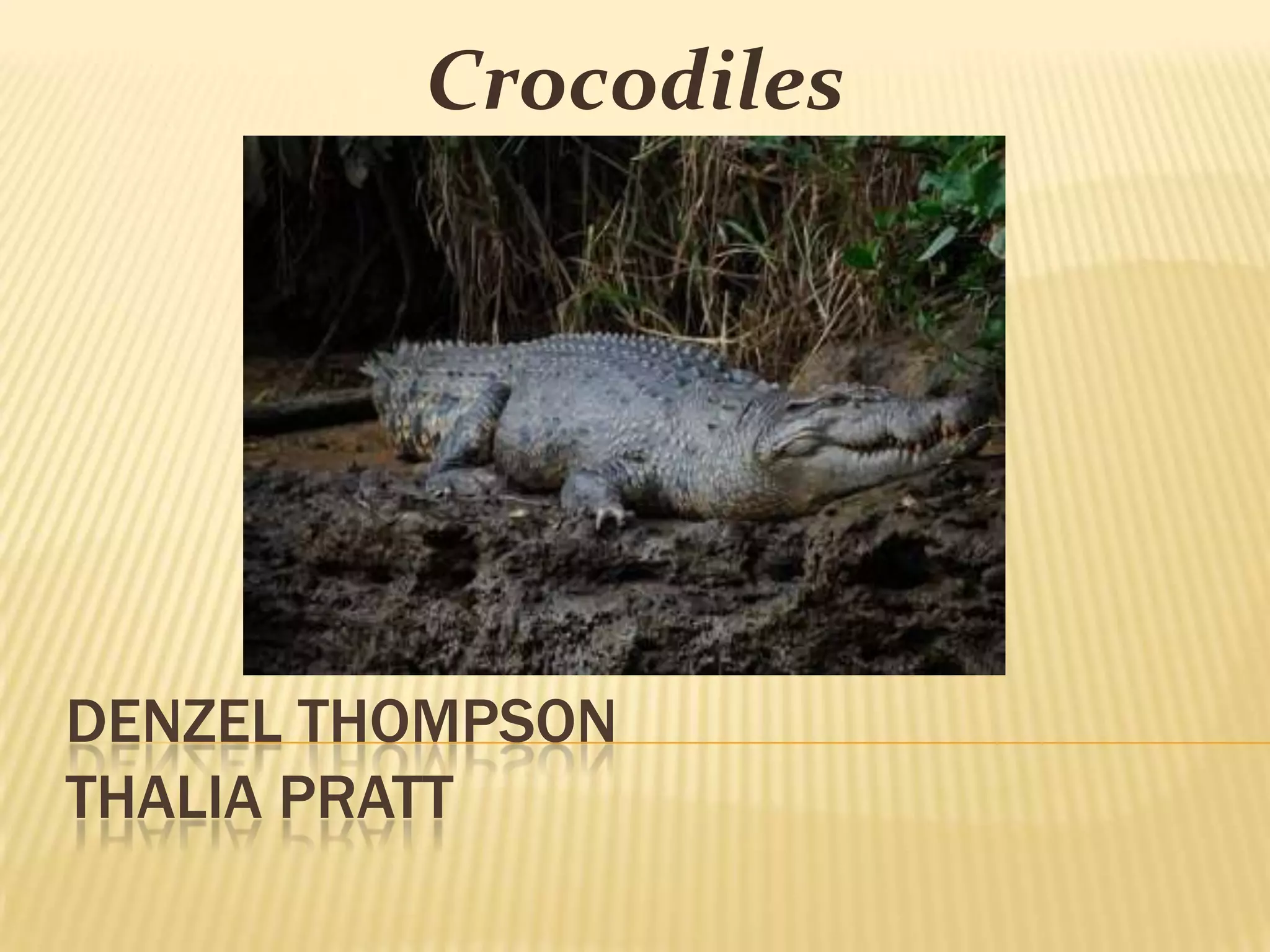
Crocodiles


DENZEL THOMPSON
THALIA PRATT
THE CROCODILIAN DIET

 Opportunistic killers
 Essentially, croc’s eat whatever they can
  come by or is most plentiful in thier habitat
  range.
 Known to eat mammals, birds, reptiles and
  fish; they are also known to eat each other
  (given the rare occasion). (Bob
  Strauss, Sept, 29 2011)
CONTINUED...

 Young Croc’s diet consists solely of
  fish, crabs and small birds.
 Primarily consume predatory fish

 Infrequent hunter of larger mammals and
  even less frequent is it's killing of humans.
THE HUNT CONTINUES...

 Most crocs hunt fish by herding them towards
  the shallower banks of a river using it's body
  and tail, then consume then with quick jerking
  sideways jestures of the head.
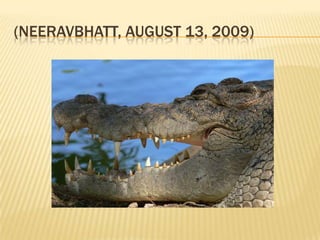
 Typically crocodiles have between 64-68 cone
  shaped teeth. However they are not able to
  chew due to the prehistoric arrangement of thier
  teeth.(Supersize Crocs, Nov. 2008)
 http://youtu.be/Wog-piUEWc0
(NEERAVBHATT, AUGUST 13, 2009)
THE HUNT CONTINUES
 Swallows their prey whole, or with larger
  victims it bites through them and then eats
  them in chunks.
 Hence the reason croc’s hunt fish and
  smallers animals primarily becasue it is less
  work to digest.
 Crocodiles are also scavengers and will feast
  on an easy meal (already dead prey) given
  the chance.
THE CROCODILIAN ANATOMY

 Unlike most vertebrates, Croc’s have a four
  chambered heart similar to birds and
  mammals.
 Also, they have a two chambered stomach.
  In one chamber food is grinded up and
  digested, and the other is used to remove
  nutrients from the food.(Tom Meding, Oct, 19
  2010)
CONTINUED...

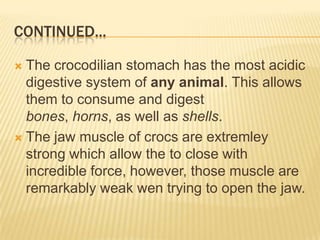
 The crocodilian stomach has the most acidic
  digestive system of any animal. This allows
  them to consume and digest
  bones, horns, as well as shells.
 The jaw muscle of crocs are extremley
  strong which allow the to close with
  incredible force, however, those muscle are
  remarkably weak wen trying to open the jaw.
CONTINUED...

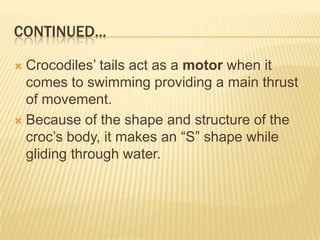
 Crocodiles’ tails act as a motor when it
  comes to swimming providing a main thrust
  of movement.
 Because of the shape and structure of the
  croc’s body, it makes an ―S‖ shape while
  gliding through water.
CONTINUED...

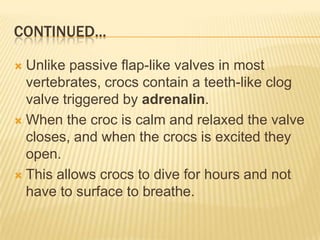
 Unlike passive flap-like valves in most
  vertebrates, crocs contain a teeth-like clog
  valve triggered by adrenalin.
 When the croc is calm and relaxed the valve
  closes, and when the crocs is excited they
  open.
 This allows crocs to dive for hours and not
  have to surface to breathe.
...CONTINUED...

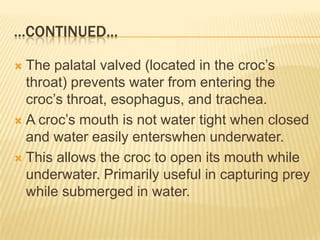
 The palatal valved (located in the croc’s
  throat) prevents water from entering the
  croc’s throat, esophagus, and trachea.
 A croc’s mouth is not water tight when closed
  and water easily enterswhen underwater.
 This allows the croc to open its mouth while
  underwater. Primarily useful in capturing prey
  while submerged in water.
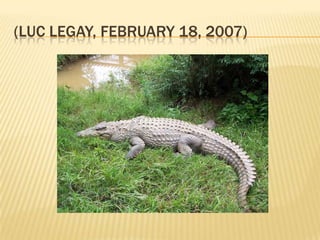
(LUC LEGAY, FEBRUARY 18, 2007)
THE CROCODILIAN RANGE
 Crocodiles are found mainly in the
  lowland, humid tropics of the Northern and
  Southern hemispheres.
 Occur in most of Africa south of the
  Sahara, Madagascar, India, Sri
  Lanka, Southeast Asia, the East
  Indie, Northern Australia, Mexico and Central
  America, the West Indies, and Northern
  South America.(Adam Britton, Aug 1 2001)
THE RANGE CONTINUED...

 Throughout their range, crocodile
  populations have declined as human
  occupation and land use change has
  reduced their habitat.
 Many crocodilian species have been greatly
  reduced by overhunting for their valuable
  skins—which provide leather for
  handbags, shoes, belts, and other articles.
THE CROCODILIAN BEHAVIOR

 Crocodiles are mostly nocturnal animals.
 They are predators and spend most of their
  time in the water occasionally making trips
  above water and over land.
 Many crocodiles vocalize to communicate.
  Young croc’s use squeaking and grunting
  sounds, and adults typically use
  grunts, growls, and hiss sounds.
CONTINUED...

 Crocodiles can attack very quickly when
  attempting to catch their prey. There have
  been cases, in fact, where crocodiles have
  attacked and killed sharks in the water.
 Although on rare occasions crocodiles have
  encounterd and devoured humans, it has
  occured with such infrequency that we
  cannot identify the species as ―man-eaters‖.
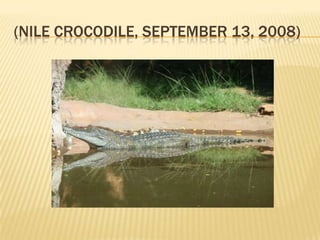
(NILE CROCODILE, SEPTEMBER 13, 2008)
THE CROCODILIAN ECOLOGY

   The crocodilian form is adapted to an
    amphibious way of life.

   Crocodiles are inhabitants of
    swamps, lakes, and rivers. Some species
    (The estuarine or ―saltwater crocodile‖) make
    their way to brackish water or to the sea.
THE CROCODILIAN REPRODUCTION

   Crocodiles are sexually dimorphic, and
    adult males are larger than females.

   Croc’s signal each other using changes in
    body profile,as well as, touch, and
    vocalization.

   Copulation happens in the water.
CONTINUED...

 All crocodiles lay hard-shelled eggs, which
  may weigh 50–160 grams individually.
 A female lays typically between 12–48 eggs
  per nest, depending upon her age, size, and
  species.
 There are two main types of nesting known
  to be used by crocodiles.
CONTINUED...

 Some croc’s dig a hole in the ground, place
  the eggs in, and re-fill it with dirt. (The Nile
  Crocodile Region)
 Others build a mound of plant material and
  soil, deposit the eggs into the mound, and
  use the suns heat and the decaying
  vegitation to help aid the development of the
  embryo.
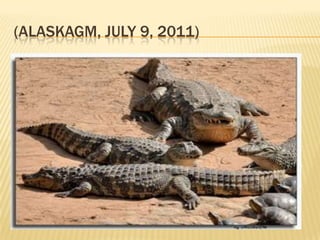
(ALASKAGM, JULY 9, 2011)
WORKS CITED
   Britton, Adam. "Crocodilians: Natural History & Conversation." Crocodilian
    Biology Database. 1 Aug. 2001. Web. 28 Sept. 2011.
    <http://crocodilian.com/cnhc/cbd.html>.
   Linsell, Paul. "The Diet and Feeding Habits of the Nile Crocodile - by Paul Linsell
    - Helium." Helium - Where Knowledge Rules. 16 Nov. 2007. Web. 01 Nov. 2011.
    <http://www.helium.com/items/702423-the-diet-and-feeding-habits-of-the-nile-
    crocodile>.
   Meding, Tom. "Crocodile Specialist Group - Crocodile Biology - Evolution."
    Crocodile Specialist Group. 19 Oct. 2010. Web. 20 Sept. 2011.
    <http://www.iucncsg.org/ph1/modules/Crocodilians/crocfacts.html>.
   Salemo, Antoinetta. "Australian Saltwater Crocodile Diet: Feeding Habits of
    Crocodiles | Suite101.com." Reptiles and Amphibian | Suite101.com. 31 May
    2009. Web. 28 Sept. 2011. <http://antonietta-salerno.suite101.com/australian-
    saltwater-crocodile-diet-a121536>.
   Strauss, Bob. "Crocodile Evolution - The Story of Prehistoric Crocodiles and
    Crocodile Evolution." About.com. 2011. Web. 29 Sept. 2011.
    <http://dinosaurs.about.com/od/typesofdinosaurs/a/crocodilians.htm>.
WORKS CITED (CONTINUED)
   Huds, Dirk.―A Crocodileds’s Natural Habitat.Ehow.com.How to
    videos, Articles & More- Discover the Expert in You Web. 02
    Nov.2011.<http://www.ehow.com/about_6737818_crocodile_snat
    ural-habitat.html>.
   ―Crocodile.‖ Encyclopedia Britannica. Encyclopedia Britannica
    Online. Encyclopedia Britannica Inc., 2011. Web.01 Nov.
    2011.http://britannica.com/EBchecked/topic/143679/crocodile>.
    ―Supersize Crocs- Interactive Crocodile Anatomy.Nature. PBS.‖
    PBS: Public Broadcasting Service. Nov. 2008 Web Nov.
    2011http://wwwpbs.org/wnet/nature/episodes/supersize-
    crocs/interactive-crocodile-anatomy/1747/>.
WORK CITED (PICTURES)
   CrocodileNorthernTerritory|Flickr-PhotoSharing!Digitalimage.WelcometoFlickr-PhotoSharing.We
    b.27Nov.2011
   AlbinoCrocodile|Flickr-PhotoSharing!Digitalimage.WelcometoFlickr-PhotoSharing.Web.27Nov.20
    11
   Nile Crocodile at
    ―LaFermeauxcrocodiles‖|Flickr-PhotoSharing!Digitalimage.WelcometoFlickr-PhotoSharing.Web.
    27Nov.2011
   Langkawi Crocodile
    Farm|Flickr-PhotoSharing!Digitalimage.WelcometoFlickr-PhotoSharing.Web.27Nov.2011
   DSC09397 Nile
    Crocodiles|Flickr-PhotoSharing!Digitalimage.WelcometoFlickr-PhotoSharing.Web.27Nov.2011
   Crocodile
    Smile|Flickr-PhotoSharing!Digitalimage.WelcometoFlickr-PhotoSharing.Web.27Nov.2011
   Crocodiles Skin at the Puerto Princesa Crocodile
    Farm|Flickr-PhotoSharing!Digitalimage.WelcometoFlickr-PhotoSharing.Web.27Nov.2011
   Crocodile South
    Africa|Flickr-PhotoSharing!Digitalimage.WelcometoFlickr-PhotoSharing.Web.27Nov.2011
   Crocodile
    Sunset|Flickr-PhotoSharing!Digitalimage.WelcometoFlickr-PhotoSharing.Web.27Nov.2011
   Crocodile |Flickr-PhotoSharing!Digitalimage.WelcometoFlickr-PhotoSharing.Web.27Nov.2011
   Nile Crocodile at
    ―LaFermeauxcrocodiles‖|Flickr-PhotoSharing!Digitalimage.WelcometoFlickr-PhotoSharing.Web.
    27Nov.2011
EXPECT THE UNEXPECTED!

   http://youtu.be/ySP246gqn8E
Thanks for Listening!

Crocodiles project

  • 1.
  • 2.
    THE CROCODILIAN DIET Opportunistic killers  Essentially, croc’s eat whatever they can come by or is most plentiful in thier habitat range.  Known to eat mammals, birds, reptiles and fish; they are also known to eat each other (given the rare occasion). (Bob Strauss, Sept, 29 2011)
  • 3.
    CONTINUED...  Young Croc’sdiet consists solely of fish, crabs and small birds.  Primarily consume predatory fish  Infrequent hunter of larger mammals and even less frequent is it's killing of humans.
  • 4.
    THE HUNT CONTINUES... Most crocs hunt fish by herding them towards the shallower banks of a river using it's body and tail, then consume then with quick jerking sideways jestures of the head.  Typically crocodiles have between 64-68 cone shaped teeth. However they are not able to chew due to the prehistoric arrangement of thier teeth.(Supersize Crocs, Nov. 2008)  http://youtu.be/Wog-piUEWc0
  • 5.
  • 6.
    THE HUNT CONTINUES Swallows their prey whole, or with larger victims it bites through them and then eats them in chunks.  Hence the reason croc’s hunt fish and smallers animals primarily becasue it is less work to digest.  Crocodiles are also scavengers and will feast on an easy meal (already dead prey) given the chance.
  • 7.
    THE CROCODILIAN ANATOMY Unlike most vertebrates, Croc’s have a four chambered heart similar to birds and mammals.  Also, they have a two chambered stomach. In one chamber food is grinded up and digested, and the other is used to remove nutrients from the food.(Tom Meding, Oct, 19 2010)
  • 8.
    CONTINUED...  The crocodilianstomach has the most acidic digestive system of any animal. This allows them to consume and digest bones, horns, as well as shells.  The jaw muscle of crocs are extremley strong which allow the to close with incredible force, however, those muscle are remarkably weak wen trying to open the jaw.
  • 9.
    CONTINUED...  Crocodiles’ tailsact as a motor when it comes to swimming providing a main thrust of movement.  Because of the shape and structure of the croc’s body, it makes an ―S‖ shape while gliding through water.
  • 10.
    CONTINUED...  Unlike passiveflap-like valves in most vertebrates, crocs contain a teeth-like clog valve triggered by adrenalin.  When the croc is calm and relaxed the valve closes, and when the crocs is excited they open.  This allows crocs to dive for hours and not have to surface to breathe.
  • 11.
    ...CONTINUED...  The palatalvalved (located in the croc’s throat) prevents water from entering the croc’s throat, esophagus, and trachea.  A croc’s mouth is not water tight when closed and water easily enterswhen underwater.  This allows the croc to open its mouth while underwater. Primarily useful in capturing prey while submerged in water.
  • 12.
  • 13.
    THE CROCODILIAN RANGE Crocodiles are found mainly in the lowland, humid tropics of the Northern and Southern hemispheres.  Occur in most of Africa south of the Sahara, Madagascar, India, Sri Lanka, Southeast Asia, the East Indie, Northern Australia, Mexico and Central America, the West Indies, and Northern South America.(Adam Britton, Aug 1 2001)
  • 14.
    THE RANGE CONTINUED... Throughout their range, crocodile populations have declined as human occupation and land use change has reduced their habitat.  Many crocodilian species have been greatly reduced by overhunting for their valuable skins—which provide leather for handbags, shoes, belts, and other articles.
  • 15.
    THE CROCODILIAN BEHAVIOR Crocodiles are mostly nocturnal animals.  They are predators and spend most of their time in the water occasionally making trips above water and over land.  Many crocodiles vocalize to communicate. Young croc’s use squeaking and grunting sounds, and adults typically use grunts, growls, and hiss sounds.
  • 16.
    CONTINUED...  Crocodiles canattack very quickly when attempting to catch their prey. There have been cases, in fact, where crocodiles have attacked and killed sharks in the water.  Although on rare occasions crocodiles have encounterd and devoured humans, it has occured with such infrequency that we cannot identify the species as ―man-eaters‖.
  • 17.
  • 18.
    THE CROCODILIAN ECOLOGY  The crocodilian form is adapted to an amphibious way of life.  Crocodiles are inhabitants of swamps, lakes, and rivers. Some species (The estuarine or ―saltwater crocodile‖) make their way to brackish water or to the sea.
  • 19.
    THE CROCODILIAN REPRODUCTION  Crocodiles are sexually dimorphic, and adult males are larger than females.  Croc’s signal each other using changes in body profile,as well as, touch, and vocalization.  Copulation happens in the water.
  • 20.
    CONTINUED...  All crocodileslay hard-shelled eggs, which may weigh 50–160 grams individually.  A female lays typically between 12–48 eggs per nest, depending upon her age, size, and species.  There are two main types of nesting known to be used by crocodiles.
  • 21.
    CONTINUED...  Some croc’sdig a hole in the ground, place the eggs in, and re-fill it with dirt. (The Nile Crocodile Region)  Others build a mound of plant material and soil, deposit the eggs into the mound, and use the suns heat and the decaying vegitation to help aid the development of the embryo.
  • 22.
  • 23.
    WORKS CITED  Britton, Adam. "Crocodilians: Natural History & Conversation." Crocodilian Biology Database. 1 Aug. 2001. Web. 28 Sept. 2011. <http://crocodilian.com/cnhc/cbd.html>.  Linsell, Paul. "The Diet and Feeding Habits of the Nile Crocodile - by Paul Linsell - Helium." Helium - Where Knowledge Rules. 16 Nov. 2007. Web. 01 Nov. 2011. <http://www.helium.com/items/702423-the-diet-and-feeding-habits-of-the-nile- crocodile>.  Meding, Tom. "Crocodile Specialist Group - Crocodile Biology - Evolution." Crocodile Specialist Group. 19 Oct. 2010. Web. 20 Sept. 2011. <http://www.iucncsg.org/ph1/modules/Crocodilians/crocfacts.html>.  Salemo, Antoinetta. "Australian Saltwater Crocodile Diet: Feeding Habits of Crocodiles | Suite101.com." Reptiles and Amphibian | Suite101.com. 31 May 2009. Web. 28 Sept. 2011. <http://antonietta-salerno.suite101.com/australian- saltwater-crocodile-diet-a121536>.  Strauss, Bob. "Crocodile Evolution - The Story of Prehistoric Crocodiles and Crocodile Evolution." About.com. 2011. Web. 29 Sept. 2011. <http://dinosaurs.about.com/od/typesofdinosaurs/a/crocodilians.htm>.
  • 24.
    WORKS CITED (CONTINUED)  Huds, Dirk.―A Crocodileds’s Natural Habitat.Ehow.com.How to videos, Articles & More- Discover the Expert in You Web. 02 Nov.2011.<http://www.ehow.com/about_6737818_crocodile_snat ural-habitat.html>.  ―Crocodile.‖ Encyclopedia Britannica. Encyclopedia Britannica Online. Encyclopedia Britannica Inc., 2011. Web.01 Nov. 2011.http://britannica.com/EBchecked/topic/143679/crocodile>.  ―Supersize Crocs- Interactive Crocodile Anatomy.Nature. PBS.‖ PBS: Public Broadcasting Service. Nov. 2008 Web Nov. 2011http://wwwpbs.org/wnet/nature/episodes/supersize- crocs/interactive-crocodile-anatomy/1747/>.
  • 25.
    WORK CITED (PICTURES)  CrocodileNorthernTerritory|Flickr-PhotoSharing!Digitalimage.WelcometoFlickr-PhotoSharing.We b.27Nov.2011  AlbinoCrocodile|Flickr-PhotoSharing!Digitalimage.WelcometoFlickr-PhotoSharing.Web.27Nov.20 11  Nile Crocodile at ―LaFermeauxcrocodiles‖|Flickr-PhotoSharing!Digitalimage.WelcometoFlickr-PhotoSharing.Web. 27Nov.2011  Langkawi Crocodile Farm|Flickr-PhotoSharing!Digitalimage.WelcometoFlickr-PhotoSharing.Web.27Nov.2011  DSC09397 Nile Crocodiles|Flickr-PhotoSharing!Digitalimage.WelcometoFlickr-PhotoSharing.Web.27Nov.2011  Crocodile Smile|Flickr-PhotoSharing!Digitalimage.WelcometoFlickr-PhotoSharing.Web.27Nov.2011  Crocodiles Skin at the Puerto Princesa Crocodile Farm|Flickr-PhotoSharing!Digitalimage.WelcometoFlickr-PhotoSharing.Web.27Nov.2011  Crocodile South Africa|Flickr-PhotoSharing!Digitalimage.WelcometoFlickr-PhotoSharing.Web.27Nov.2011  Crocodile Sunset|Flickr-PhotoSharing!Digitalimage.WelcometoFlickr-PhotoSharing.Web.27Nov.2011  Crocodile |Flickr-PhotoSharing!Digitalimage.WelcometoFlickr-PhotoSharing.Web.27Nov.2011  Nile Crocodile at ―LaFermeauxcrocodiles‖|Flickr-PhotoSharing!Digitalimage.WelcometoFlickr-PhotoSharing.Web. 27Nov.2011
  • 26.
    EXPECT THE UNEXPECTED!  http://youtu.be/ySP246gqn8E
  • 27.