
MARKHOR
We will Discuss about its,
 Introduction
 Distribution
 Food & Breeding
Threats & present status
2
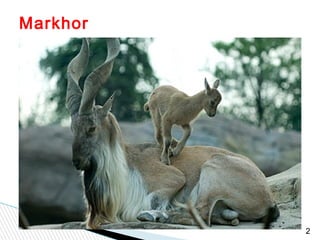
Markhor
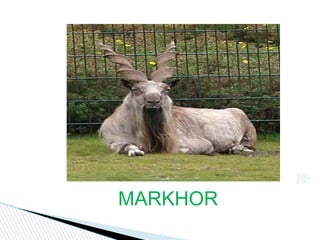
MARKHOR
4
Markhor stands 26 to 45 inches in shoulder,
and 52 to 73 inches in length.
weighs from 32 to 110 kilograms.
The markhor is a large species of wild goat.
The coat is of a grizzled, light brown to black
colour, and is smooth and short in summer,
while growing longer and thicker in winter.
Both sexes have tightly curled, corkscrew-like
horns.
INTRODUCTION
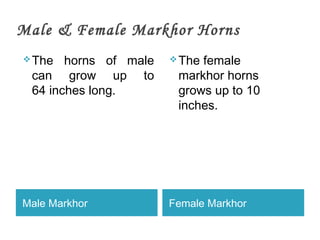
Male & Female Markhor Horns
Male Markhor Female Markhor
The horns of male
can grow up to
64 inches long.
The female
markhor horns
grows up to 10
inches.
6
 Kingdom: Animalia
 Phylum: Chordata
 Class: Mammalia
 Order: Artiodactyla
 Family: Bovidae
 Subfamily: Caprinae
 Genus: Capra
 Species: C. falconeri
TAXONOMIC POSITION
 Persian, Punjabi, Urdu and Kashmiri:
markhor.
 Pashto: marǧūmay.
BIOLOGICAL NAME:
Capra falconeri
LOCAL NAMES
o The Markhor is a large goat that is found in
o Northeastern Afghanistan.
o Northern Pakistan.
o Some parts of Azad Kashmir & Indian Kashmir.
o southern Tajikistan and southern Uzbekistan.
DISTRIBUTION
 The Markhor is the National animal of
Pakistan.
In Pakistan markhor are mostly
Present in
Balochistan
Chitral
Swat
Ghizar
Hunza regions.
Distribution in Pakistan
 In Chitral markhor are found around the
border areas with Afghanistan, where it
inhabits a number of valleys along the
Kunar River (Chitral District), from Arandu
on the west bank and Drosh on the east
bank, up to Shoghor along the Lutkho
River, and as far as Barenis along the
Mastuj River.
Distribution in Chitral
 Markhor are herbivores.
 Primarily grazes on a variety of vegetation
including grasses, leaves, herbs, fruits and
flowers.
 Their diets shift seasonally.
 In the spring and summer periods they graze.
 But turn to browsing in winter.
FooD
The mating takes place in winter.
During mating season the males fight each other
by lunging, locking horns and attempting to push
each other off balance.
The gestation period lasts 135–170 days and
usually results in the birth of one or two kids,
though rarely three.
The markhor kids remain safe and looked after
by their mother until they are able to eat solid
food.
brEEDinG
The markhor is an endangered
species of wild goat.
Main threats are:
o Hunting: People hunt markhor for
food.
o For their horns which are thought
to have medicinal properties, in
Tajikistan, Turkmenistan, and
Uzbekistan.
THREATS AND STATUS
 Second threat is Predation. Markhor are
important prey species for top carnivores like
wolves and snow leopards.
Deforestation resulting in the loss of their native
habitats.
Markhor are subject to threats such as illegal
hunting, habitat destruction and competition with
domestic goats and sheep. As a result, they
have been listed as Endangered by IUCN since
1994.
Threats & Status
Conservation Strategies
Ban on hunting
Tropy hunting
Prepared By:
Farman Ullah
&
Mehran Khan
BS Zoology 6th semester.
University Of Peshawar.
THANKS

Markhor

  • 1.
    MARKHOR We will Discussabout its,  Introduction  Distribution  Food & Breeding Threats & present status
  • 2.
  • 3.
  • 4.
    4 Markhor stands 26to 45 inches in shoulder, and 52 to 73 inches in length. weighs from 32 to 110 kilograms. The markhor is a large species of wild goat. The coat is of a grizzled, light brown to black colour, and is smooth and short in summer, while growing longer and thicker in winter. Both sexes have tightly curled, corkscrew-like horns. INTRODUCTION
  • 5.
    Male & FemaleMarkhor Horns Male Markhor Female Markhor The horns of male can grow up to 64 inches long. The female markhor horns grows up to 10 inches.
  • 6.
    6  Kingdom: Animalia Phylum: Chordata  Class: Mammalia  Order: Artiodactyla  Family: Bovidae  Subfamily: Caprinae  Genus: Capra  Species: C. falconeri TAXONOMIC POSITION
  • 7.
     Persian, Punjabi,Urdu and Kashmiri: markhor.  Pashto: marǧūmay. BIOLOGICAL NAME: Capra falconeri LOCAL NAMES
  • 8.
    o The Markhoris a large goat that is found in o Northeastern Afghanistan. o Northern Pakistan. o Some parts of Azad Kashmir & Indian Kashmir. o southern Tajikistan and southern Uzbekistan. DISTRIBUTION
  • 9.
     The Markhoris the National animal of Pakistan. In Pakistan markhor are mostly Present in Balochistan Chitral Swat Ghizar Hunza regions. Distribution in Pakistan
  • 10.
     In Chitralmarkhor are found around the border areas with Afghanistan, where it inhabits a number of valleys along the Kunar River (Chitral District), from Arandu on the west bank and Drosh on the east bank, up to Shoghor along the Lutkho River, and as far as Barenis along the Mastuj River. Distribution in Chitral
  • 11.
     Markhor areherbivores.  Primarily grazes on a variety of vegetation including grasses, leaves, herbs, fruits and flowers.  Their diets shift seasonally.  In the spring and summer periods they graze.  But turn to browsing in winter. FooD
  • 12.
    The mating takesplace in winter. During mating season the males fight each other by lunging, locking horns and attempting to push each other off balance. The gestation period lasts 135–170 days and usually results in the birth of one or two kids, though rarely three. The markhor kids remain safe and looked after by their mother until they are able to eat solid food. brEEDinG
  • 13.
    The markhor isan endangered species of wild goat. Main threats are: o Hunting: People hunt markhor for food. o For their horns which are thought to have medicinal properties, in Tajikistan, Turkmenistan, and Uzbekistan. THREATS AND STATUS
  • 14.
     Second threatis Predation. Markhor are important prey species for top carnivores like wolves and snow leopards. Deforestation resulting in the loss of their native habitats. Markhor are subject to threats such as illegal hunting, habitat destruction and competition with domestic goats and sheep. As a result, they have been listed as Endangered by IUCN since 1994. Threats & Status
  • 15.
    Conservation Strategies Ban onhunting Tropy hunting
  • 16.
    Prepared By: Farman Ullah & MehranKhan BS Zoology 6th semester. University Of Peshawar. THANKS