Navigation solutions powered by Europe
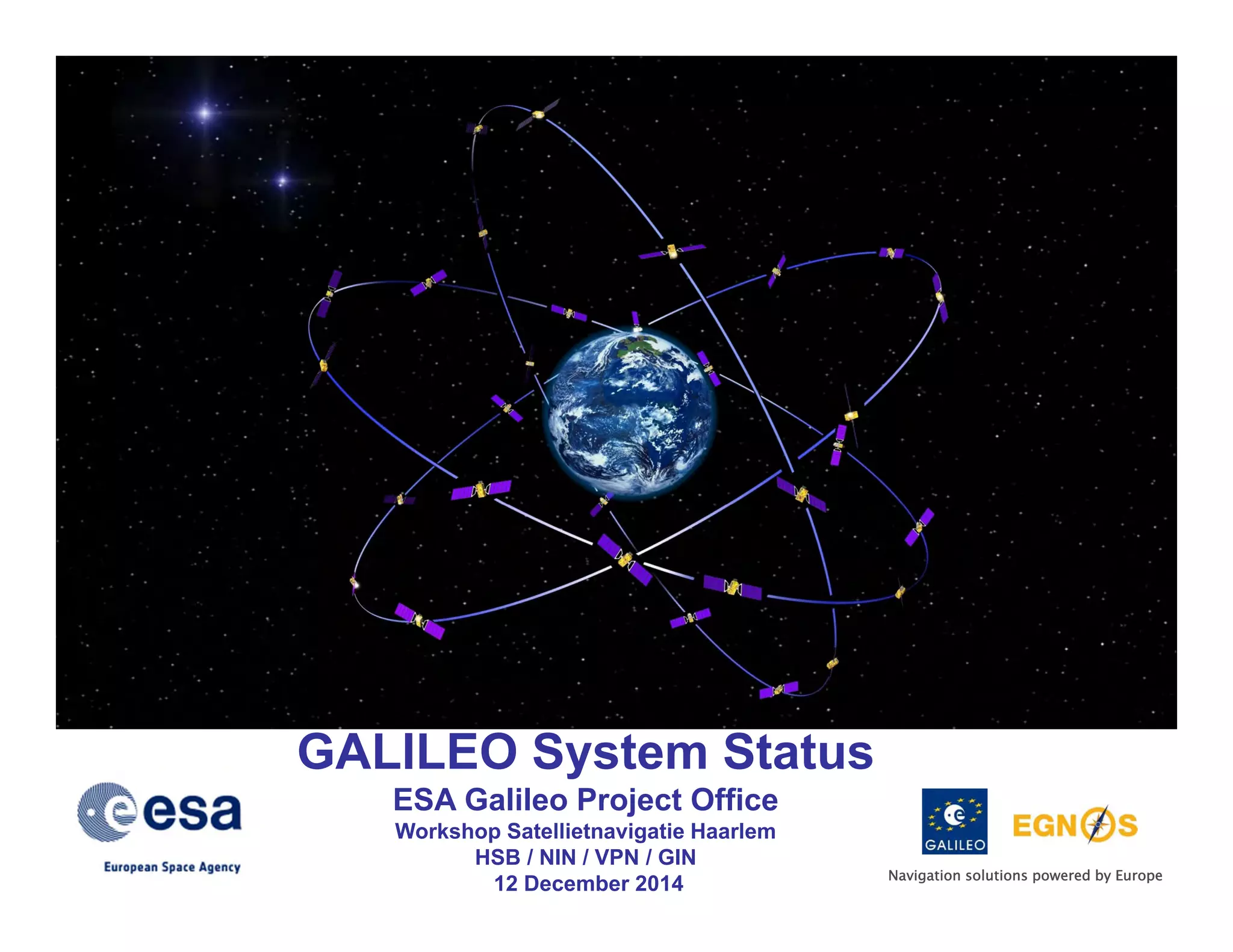
GALILEO System Status
ESA Galileo Project Office
Workshop Satellietnavigatie Haarlem
HSB / NIN / VPN / GIN
12 December 2014
12 December 2014 The European GNSS Programmes 2
Galileo
European Global Navigation Satellite System
with 30 satellites
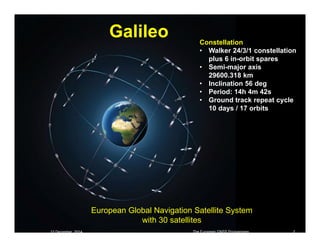
Constellation
• Walker 24/3/1 constellation
plus 6 in-orbit spares
• Semi-major axis
29600.318 km
• Inclination 56 deg
• Period: 14h 4m 42s
• Ground track repeat cycle
10 days / 17 orbits
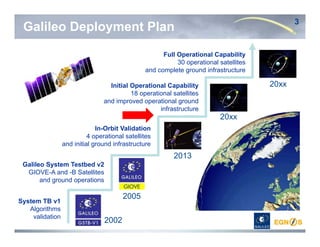
Galileo Deployment Plan
System TB v1
Algorithms
validation
Galileo System Testbed v2
GIOVE-A and -B Satellites
and ground operations
In-Orbit Validation
4 operational satellites
and initial ground infrastructure
Full Operational Capability
30 operational satellites
and complete ground infrastructure
Initial Operational Capability
18 operational satellites
and improved operational ground
infrastructure
3
2002
2005
2013
20xx
20xx
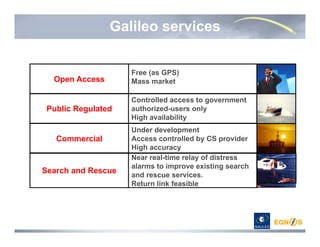
Galileo services
Open Access
Commercial
Search and Rescue
Public Regulated
Free (as GPS)
Mass market
Under development
Access controlled by CS provider
High accuracy
Near real-time relay of distress
alarms to improve existing search
and rescue services.
Return link feasible
Controlled access to government
authorized-users only
High availability
GPS L1GPS L5 GPS L2 Glonass G2
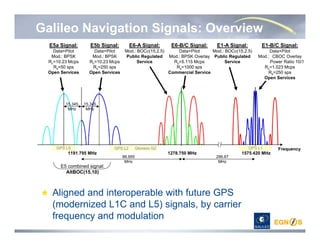
Galileo Navigation Signals: Overview
E5a Signal:
Data+Pilot
Mod.: BPSK
Rc=10.23 Mcps
Rs=50 sps
Open Services
E5b Signal:
Data+Pilot
Mod.: BPSK
Rc=10.23 Mcps
Rs=250 sps
Open Services
E6-A Signal:
Mod.: BOCc(15,2.5)
Public Regulated
Service
E6-B/C Signal:
Data+Pilot
Mod.: BPSK Overlay
Rc=5.115 Mcps
Rs=1000 sps
Commercial Service
E1-A Signal:
Mod.: BOCc(15,2.5)
Public Regulated
Service
E1-B/C Signal:
Data+Pilot
Mod.: CBOC Overlay
Power Ratio 10/1
Rc=1.023 Mcps
Rs=250 sps
Open Services
1278.750 MHz 1575.420 MHz1191.795 MHz
86.955
MHz
15.345
MHz
296.67
MHz
15.345
MHz
E5 combined signal:
AltBOC(15,10)
Frequency
Aligned and interoperable with future GPS
(modernized L1C and L5) signals, by carrier
frequency and modulation
12 December, 2014
Document Title 6
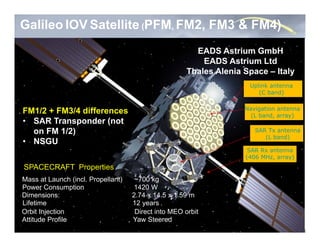
Galileo IOV Satellite (PFM, FM2, FM3 & FM4)
SPACECRAFT Properties
Mass at Launch (incl. Propellant)
Power Consumption
Dimensions:
Lifetime
Orbit Injection
Attitude Profile
~700 kg
1420 W
2.74 x 14.5 x 1.59 m
12 years
Direct into MEO orbit
Yaw Steered
EADS Astrium GmbH
EADS Astrium Ltd
Thales Alenia Space – Italy
SAR Rx antenna
(406 MHz, array)
SAR Tx antenna
(L band)
Navigation antenna
(L band, array)
Uplink antenna
(C band)
FM1/2 + FM3/4 differences
• SAR Transponder (not
on FM 1/2)
• NSGU
12 December 2014 The European GNSS Programmes 7
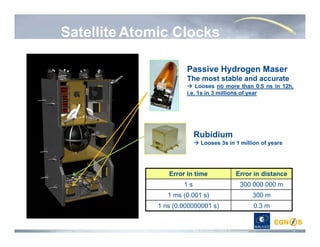
Satellite Atomic Clocks
Passive Hydrogen Maser
The most stable and accurate
 Looses no more than 0.5 ns in 12h,
i.e. 1s in 3 millions of year
Rubidium
 Looses 3s in 1 million of years
Error in time Error in distance
1 s 300 000 000 m
1 ms (0.001 s) 300 m
1 ns (0.000000001 s) 0.3 m
12 December 2014 The European GNSS Programmes 8
Noumea
ULS/GSS
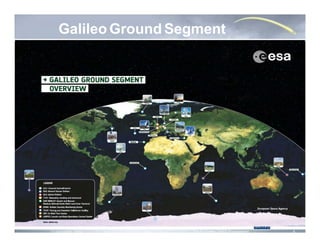
Galileo Ground Segment
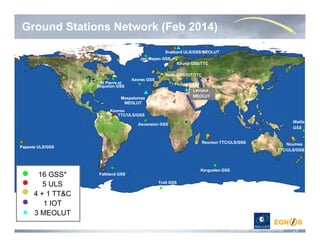
9| The European GNSS Programmes 9
Troll GSSTroll GSS
Svalbard ULS/GSS/MEOLUTSvalbard ULS/GSS/MEOLUT
Kiruna GSS/TTCKiruna GSS/TTC
Redu GSS/IOT/TTCRedu GSS/IOT/TTC
Fucino GSSFucino GSS
Reunion TTC/ULS/GSSReunion TTC/ULS/GSS
Kourou
TTC/ULS/GSS
Kourou
TTC/ULS/GSS
Noumea
TTC/ULS/GSS
Noumea
TTC/ULS/GSS
16 GSS*
5 ULS
4 + 1 TT&C
1 IOT
3 MEOLUT
Jan Mayen GSSJan Mayen GSS
Kerguelen GSSKerguelen GSS
Falkland GSSFalkland GSS
St Pierre et
Miquelon GSS
St Pierre et
Miquelon GSS
Ground Stations Network (Feb 2014)
Papeete ULS/GSSPapeete ULS/GSS
Larnaca
MEOLUT
Larnaca
MEOLUT
Wallis
GSS
Wallis
GSS
Azores GSSAzores GSS
Ascension GSSAscension GSS
Maspalomas
MEOLUT
Maspalomas
MEOLUT
12 December 2014 The European GNSS Programmes 1
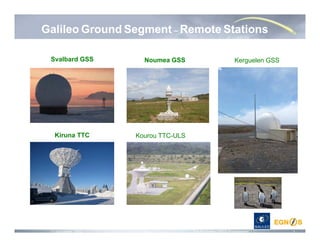
Galileo Ground Segment – Remote Stations
Kerguelen GSSSvalbard GSS
Kiruna TTC
Noumea GSS
Kourou TTC-ULS
12 December 2014 The European GNSS Programmes 1
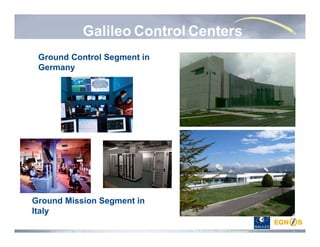
Galileo Control Centers
Ground Mission Segment in
Italy
Ground Control Segment in
Germany
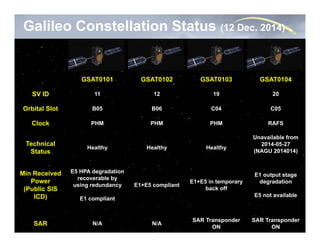
Galileo Constellation Status (12 Dec. 2014)
GSAT0101 GSAT0102 GSAT0103 GSAT0104
SV ID 11 12 19 20
Orbital Slot B05 B06 C04 C05
Clock PHM PHM PHM RAFS
Technical
Status
Healthy Healthy Healthy
Unavailable from
2014-05-27
(NAGU 2014014)
Min Received
Power
(Public SIS
ICD)
E5 HPA degradation
recoverable by
using redundancy
E1 compliant
E1+E5 compliant
E1+E5 in temporary
back off
E1 output stage
degradation
E5 not available
SAR N/A N/A
SAR Transponder
ON
SAR Transponder
ON
Signal and Message Availability
Availability
[%]
Ranging
Signal
Healthy
Message
GSAT0101 93.5 63.4
GSAT0102 92.6 75.3
GSAT0103 99.9 94.3
GSAT0104 30.9 28.1
Availability affected by
GSAT0104 off since 27/5
GSAT0101/2 ASW update
SHS OK since Dec 3rd
nav msg reports healthy
status when satellites are
healthy
Ranging Accuracy
Ranging Accuracy impacted by
Satellite maintenance operations
Sporadic infrastructure events: e.g.
GSS tracking anomalies, PTF
outage/re-configuration
Significant improvement in the last
months
Satellite 67% [m]
GSAT0101 0.98
GSAT0102 0.85
GSAT0103 1.07
GSAT0104 1.4
Overall ranging accuracy (67 percentiles)
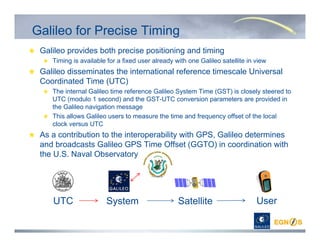
Galileo for Precise Timing
Galileo provides both precise positioning and timing
Timing is available for a fixed user already with one Galileo satellite in view
Galileo disseminates the international reference timescale Universal
Coordinated Time (UTC)
The internal Galileo time reference Galileo System Time (GST) is closely steered to
UTC (modulo 1 second) and the GST-UTC conversion parameters are provided in
the Galileo navigation message
This allows Galileo users to measure the time and frequency offset of the local
clock versus UTC
As a contribution to the interoperability with GPS, Galileo determines
and broadcasts Galileo GPS Time Offset (GGTO) in coordination with
the U.S. Naval Observatory
UTC System Satellite User
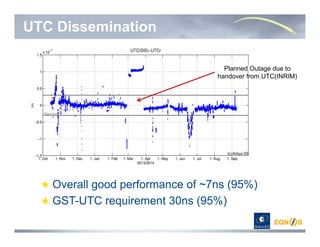
UTC Dissemination
Planned Outage due to
handover from UTC(INRIM)
Overall good performance of ~7ns (95%)
GST-UTC requirement 30ns (95%)
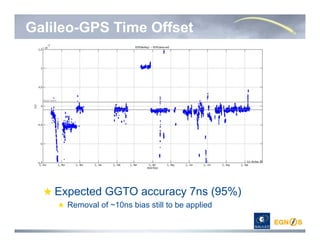
Galileo-GPS Time Offset
Expected GGTO accuracy 7ns (95%)
Removal of ~10ns bias still to be applied
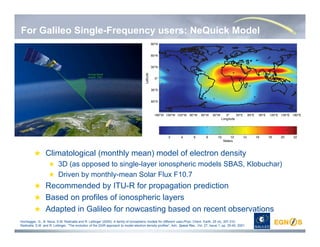
For Galileo Single-Frequency users: NeQuick Model
Climatological (monthly mean) model of electron density
3D (as opposed to single-layer ionospheric models SBAS, Klobuchar)
Driven by monthly-mean Solar Flux F10.7
Recommended by ITU-R for propagation prediction
Based on profiles of ionospheric layers
Adapted in Galileo for nowcasting based on recent observations
Hochegger, G., B. Nava, S.M. Radicella and R. Leitinger (2000): A family of ionospheric models for different uses,Phys. Chem. Earth, 25 (4), 307-310.
Radicella, S.M. and R. Leitinger, “The evolution of the DGR approach to model electron density profiles”, Adv. Space Res., Vol. 27, Issue 1, pp. 35-40, 2001.
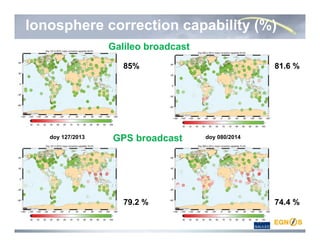
Ionosphere correction capability (%)
doy 127/2013 doy 080/2014
85%
79.2 %
81.6 %
74.4 %
GPS broadcast
Galileo broadcast
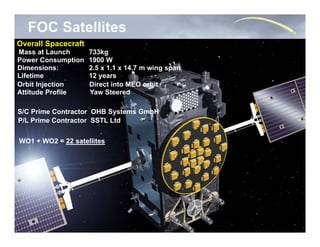
FOC Satellites
Overall Spacecraft
Mass at Launch
Power Consumption
Dimensions:
Lifetime
Orbit Injection
Attitude Profile
733kg
1900 W
2.5 x 1.1 x 14.7 m wing span
12 years
Direct into MEO orbit
Yaw Steered
S/C Prime Contractor OHB Systems GmbH
P/L Prime Contractor SSTL Ltd
WO1 + WO2 = 22 satellites
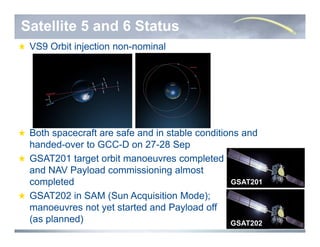
Both spacecraft are safe and in stable conditions and
handed-over to GCC-D on 27-28 Sep
GSAT201 target orbit manoeuvres completed
and NAV Payload commissioning almost
completed
GSAT202 in SAM (Sun Acquisition Mode);
manoeuvres not yet started and Payload off
(as planned)
Satellite 5 and 6 Status
GSAT201
GSAT202
VS9 Orbit injection non-nominal
New orbit: Resonant 20 days/ 37 rev
20 days repeat cycle, easy insertion in routine planning (!)
Ground track first 10 days sat 5 = second 10 days sat 6
37 revolutions, good global coverage, similar to 19/10
Higher Perigee than other resonant candidates
Reference Current Target
Semi-major axis [km] 29599.80 26180.99 27977.9
Eccentricity 0.0001 0.2326 0.1544
Inclination [deg] 56 49.8 49.8
Apogee height [km] 23224.624 25892.55 25919.55
Perigee height [km] 23218.704 13713.29 17280.11
Nominal ground track (10days/17revs)
SAT 5/6 ground track (20days/37revs)
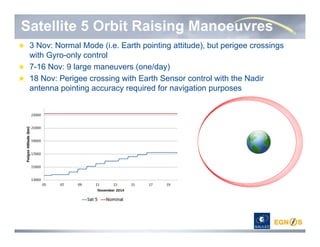
3 Nov: Normal Mode (i.e. Earth pointing attitude), but perigee crossings
with Gyro-only control
7-16 Nov: 9 large maneuvers (one/day)
18 Nov: Perigee crossing with Earth Sensor control with the Nadir
antenna pointing accuracy required for navigation purposes
Satellite 5 Orbit Raising Manoeuvres
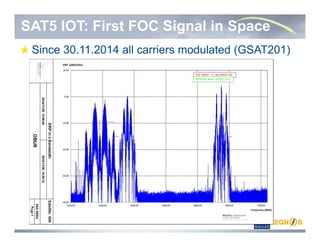
SAT5 IOT: First FOC Signal in Space
Since 30.11.2014 all carriers modulated (GSAT201)
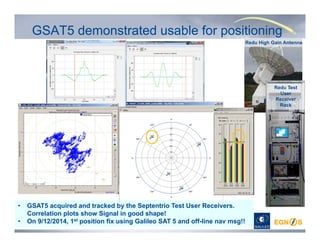
GSAT5 demonstrated usable for positioning
• GSAT5 acquired and tracked by the Septentrio Test User Receivers.
Correlation plots show Signal in good shape!
• On 9/12/2014, 1st position fix using Galileo SAT 5 and off-line nav msg!!
Redu High Gain Antenna
Redu Test
User
Receiver
Rack
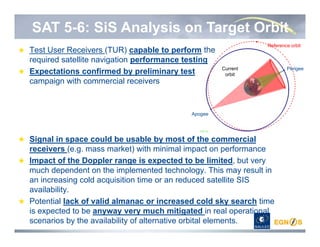
SAT 5-6: SiS Analysis on Target Orbit
Test User Receivers (TUR) capable to perform the
required satellite navigation performance testing
Expectations confirmed by preliminary test
campaign with commercial receivers
Signal in space could be usable by most of the commercial
receivers (e.g. mass market) with minimal impact on performance
Impact of the Doppler range is expected to be limited, but very
much dependent on the implemented technology. This may result in
an increasing cold acquisition time or an reduced satellite SIS
availability.
Potential lack of valid almanac or increased cold sky search time
is expected to be anyway very much mitigated in real operational
scenarios by the availability of alternative orbital elements.
Reference orbit
Current
orbit
Apogee
Perigee
SAT5-6 Outlook
In-Orbit-Testing in the target orbit almost completed
Preparation of Programme Decision to provide
Navigation and SAR services, after completion of In-
Orbit-Testing.
Target scenario:
Nominal RF signals,
Dummy Navigation Msg broadcast
Ephemerides and Clocks prediction via GNSS Service
Centre
Assisted Positioning and Navigation
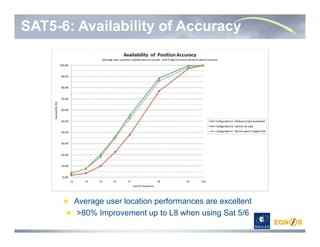
SAT5-6: Availability of Accuracy
Average user location performances are excellent
>80% Improvement up to L8 when using Sat 5/6
FOC Satellites Production at OHB Bremen
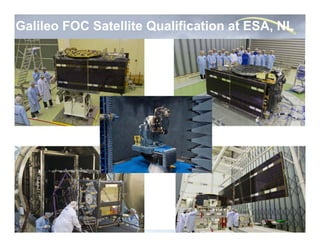
Galileo FOC Satellite Qualification at ESA, NL
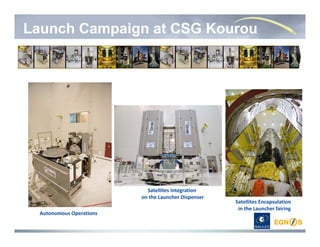
Launch Campaign at CSG Kourou
Autonomous Operations
Satellites Integration 
on the Launcher Dispenser
Satellites Encapsulation 
in the Launcher fairing
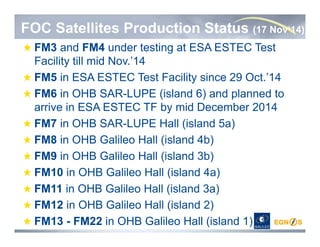
FOC Satellites Production Status (17 Nov‘14)
FM3 and FM4 under testing at ESA ESTEC Test
Facility till mid Nov.’14
FM5 in ESA ESTEC Test Facility since 29 Oct.’14
FM6 in OHB SAR-LUPE (island 6) and planned to
arrive in ESA ESTEC TF by mid December 2014
FM7 in OHB SAR-LUPE Hall (island 5a)
FM8 in OHB Galileo Hall (island 4b)
FM9 in OHB Galileo Hall (island 3b)
FM10 in OHB Galileo Hall (island 4a)
FM11 in OHB Galileo Hall (island 3a)

FM12 in OHB Galileo Hall (island 2)
FM13 - FM22 in OHB Galileo Hall (island 1)
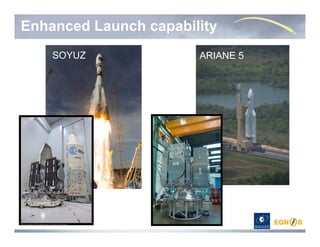
Enhanced Launch capability
SOYUZ ARIANE 5
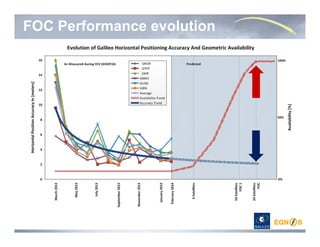
FOC Performance evolution
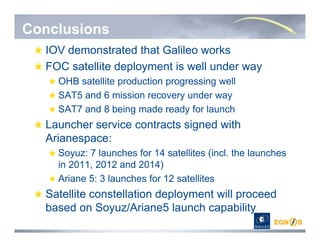
IOV demonstrated that Galileo works
FOC satellite deployment is well under way
OHB satellite production progressing well
SAT5 and 6 mission recovery under way
SAT7 and 8 being made ready for launch
Launcher service contracts signed with
Arianespace:
Soyuz: 7 launches for 14 satellites (incl. the launches
in 2011, 2012 and 2014)
Ariane 5: 3 launches for 12 satellites
Satellite constellation deployment will proceed
based on Soyuz/Ariane5 launch capability
Conclusions

Galileo 6 satellieten gelanceerd. Een statusoverzicht.

  • 1.
    Navigation solutions poweredby Europe GALILEO System Status ESA Galileo Project Office Workshop Satellietnavigatie Haarlem HSB / NIN / VPN / GIN 12 December 2014
  • 2.
    12 December 2014The European GNSS Programmes 2 Galileo European Global Navigation Satellite System with 30 satellites Constellation • Walker 24/3/1 constellation plus 6 in-orbit spares • Semi-major axis 29600.318 km • Inclination 56 deg • Period: 14h 4m 42s • Ground track repeat cycle 10 days / 17 orbits
  • 3.
    Galileo Deployment Plan SystemTB v1 Algorithms validation Galileo System Testbed v2 GIOVE-A and -B Satellites and ground operations In-Orbit Validation 4 operational satellites and initial ground infrastructure Full Operational Capability 30 operational satellites and complete ground infrastructure Initial Operational Capability 18 operational satellites and improved operational ground infrastructure 3 2002 2005 2013 20xx 20xx
  • 4.
    Galileo services Open Access Commercial Searchand Rescue Public Regulated Free (as GPS) Mass market Under development Access controlled by CS provider High accuracy Near real-time relay of distress alarms to improve existing search and rescue services. Return link feasible Controlled access to government authorized-users only High availability
  • 5.
    GPS L1GPS L5GPS L2 Glonass G2 Galileo Navigation Signals: Overview E5a Signal: Data+Pilot Mod.: BPSK Rc=10.23 Mcps Rs=50 sps Open Services E5b Signal: Data+Pilot Mod.: BPSK Rc=10.23 Mcps Rs=250 sps Open Services E6-A Signal: Mod.: BOCc(15,2.5) Public Regulated Service E6-B/C Signal: Data+Pilot Mod.: BPSK Overlay Rc=5.115 Mcps Rs=1000 sps Commercial Service E1-A Signal: Mod.: BOCc(15,2.5) Public Regulated Service E1-B/C Signal: Data+Pilot Mod.: CBOC Overlay Power Ratio 10/1 Rc=1.023 Mcps Rs=250 sps Open Services 1278.750 MHz 1575.420 MHz1191.795 MHz 86.955 MHz 15.345 MHz 296.67 MHz 15.345 MHz E5 combined signal: AltBOC(15,10) Frequency Aligned and interoperable with future GPS (modernized L1C and L5) signals, by carrier frequency and modulation
  • 6.
    12 December, 2014 DocumentTitle 6 Galileo IOV Satellite (PFM, FM2, FM3 & FM4) SPACECRAFT Properties Mass at Launch (incl. Propellant) Power Consumption Dimensions: Lifetime Orbit Injection Attitude Profile ~700 kg 1420 W 2.74 x 14.5 x 1.59 m 12 years Direct into MEO orbit Yaw Steered EADS Astrium GmbH EADS Astrium Ltd Thales Alenia Space – Italy SAR Rx antenna (406 MHz, array) SAR Tx antenna (L band) Navigation antenna (L band, array) Uplink antenna (C band) FM1/2 + FM3/4 differences • SAR Transponder (not on FM 1/2) • NSGU
  • 7.
    12 December 2014The European GNSS Programmes 7 Satellite Atomic Clocks Passive Hydrogen Maser The most stable and accurate  Looses no more than 0.5 ns in 12h, i.e. 1s in 3 millions of year Rubidium  Looses 3s in 1 million of years Error in time Error in distance 1 s 300 000 000 m 1 ms (0.001 s) 300 m 1 ns (0.000000001 s) 0.3 m
  • 8.
    12 December 2014The European GNSS Programmes 8 Noumea ULS/GSS Galileo Ground Segment
  • 9.
    9| The EuropeanGNSS Programmes 9 Troll GSSTroll GSS Svalbard ULS/GSS/MEOLUTSvalbard ULS/GSS/MEOLUT Kiruna GSS/TTCKiruna GSS/TTC Redu GSS/IOT/TTCRedu GSS/IOT/TTC Fucino GSSFucino GSS Reunion TTC/ULS/GSSReunion TTC/ULS/GSS Kourou TTC/ULS/GSS Kourou TTC/ULS/GSS Noumea TTC/ULS/GSS Noumea TTC/ULS/GSS 16 GSS* 5 ULS 4 + 1 TT&C 1 IOT 3 MEOLUT Jan Mayen GSSJan Mayen GSS Kerguelen GSSKerguelen GSS Falkland GSSFalkland GSS St Pierre et Miquelon GSS St Pierre et Miquelon GSS Ground Stations Network (Feb 2014) Papeete ULS/GSSPapeete ULS/GSS Larnaca MEOLUT Larnaca MEOLUT Wallis GSS Wallis GSS Azores GSSAzores GSS Ascension GSSAscension GSS Maspalomas MEOLUT Maspalomas MEOLUT
  • 10.
    12 December 2014The European GNSS Programmes 1 Galileo Ground Segment – Remote Stations Kerguelen GSSSvalbard GSS Kiruna TTC Noumea GSS Kourou TTC-ULS
  • 11.
    12 December 2014The European GNSS Programmes 1 Galileo Control Centers Ground Mission Segment in Italy Ground Control Segment in Germany
  • 12.
    Galileo Constellation Status(12 Dec. 2014) GSAT0101 GSAT0102 GSAT0103 GSAT0104 SV ID 11 12 19 20 Orbital Slot B05 B06 C04 C05 Clock PHM PHM PHM RAFS Technical Status Healthy Healthy Healthy Unavailable from 2014-05-27 (NAGU 2014014) Min Received Power (Public SIS ICD) E5 HPA degradation recoverable by using redundancy E1 compliant E1+E5 compliant E1+E5 in temporary back off E1 output stage degradation E5 not available SAR N/A N/A SAR Transponder ON SAR Transponder ON
  • 13.
    Signal and MessageAvailability Availability [%] Ranging Signal Healthy Message GSAT0101 93.5 63.4 GSAT0102 92.6 75.3 GSAT0103 99.9 94.3 GSAT0104 30.9 28.1 Availability affected by GSAT0104 off since 27/5 GSAT0101/2 ASW update SHS OK since Dec 3rd nav msg reports healthy status when satellites are healthy
  • 14.
    Ranging Accuracy Ranging Accuracyimpacted by Satellite maintenance operations Sporadic infrastructure events: e.g. GSS tracking anomalies, PTF outage/re-configuration Significant improvement in the last months Satellite 67% [m] GSAT0101 0.98 GSAT0102 0.85 GSAT0103 1.07 GSAT0104 1.4 Overall ranging accuracy (67 percentiles)
  • 15.
    Galileo for PreciseTiming Galileo provides both precise positioning and timing Timing is available for a fixed user already with one Galileo satellite in view Galileo disseminates the international reference timescale Universal Coordinated Time (UTC) The internal Galileo time reference Galileo System Time (GST) is closely steered to UTC (modulo 1 second) and the GST-UTC conversion parameters are provided in the Galileo navigation message This allows Galileo users to measure the time and frequency offset of the local clock versus UTC As a contribution to the interoperability with GPS, Galileo determines and broadcasts Galileo GPS Time Offset (GGTO) in coordination with the U.S. Naval Observatory UTC System Satellite User
  • 16.
    UTC Dissemination Planned Outagedue to handover from UTC(INRIM) Overall good performance of ~7ns (95%) GST-UTC requirement 30ns (95%)
  • 17.
    Galileo-GPS Time Offset ExpectedGGTO accuracy 7ns (95%) Removal of ~10ns bias still to be applied
  • 18.
    For Galileo Single-Frequencyusers: NeQuick Model Climatological (monthly mean) model of electron density 3D (as opposed to single-layer ionospheric models SBAS, Klobuchar) Driven by monthly-mean Solar Flux F10.7 Recommended by ITU-R for propagation prediction Based on profiles of ionospheric layers Adapted in Galileo for nowcasting based on recent observations Hochegger, G., B. Nava, S.M. Radicella and R. Leitinger (2000): A family of ionospheric models for different uses,Phys. Chem. Earth, 25 (4), 307-310. Radicella, S.M. and R. Leitinger, “The evolution of the DGR approach to model electron density profiles”, Adv. Space Res., Vol. 27, Issue 1, pp. 35-40, 2001.
  • 19.
    Ionosphere correction capability(%) doy 127/2013 doy 080/2014 85% 79.2 % 81.6 % 74.4 % GPS broadcast Galileo broadcast
  • 20.
    FOC Satellites Overall Spacecraft Massat Launch Power Consumption Dimensions: Lifetime Orbit Injection Attitude Profile 733kg 1900 W 2.5 x 1.1 x 14.7 m wing span 12 years Direct into MEO orbit Yaw Steered S/C Prime Contractor OHB Systems GmbH P/L Prime Contractor SSTL Ltd WO1 + WO2 = 22 satellites
  • 21.
    Both spacecraft aresafe and in stable conditions and handed-over to GCC-D on 27-28 Sep GSAT201 target orbit manoeuvres completed and NAV Payload commissioning almost completed GSAT202 in SAM (Sun Acquisition Mode); manoeuvres not yet started and Payload off (as planned) Satellite 5 and 6 Status GSAT201 GSAT202 VS9 Orbit injection non-nominal
  • 22.
    New orbit: Resonant20 days/ 37 rev 20 days repeat cycle, easy insertion in routine planning (!) Ground track first 10 days sat 5 = second 10 days sat 6 37 revolutions, good global coverage, similar to 19/10 Higher Perigee than other resonant candidates Reference Current Target Semi-major axis [km] 29599.80 26180.99 27977.9 Eccentricity 0.0001 0.2326 0.1544 Inclination [deg] 56 49.8 49.8 Apogee height [km] 23224.624 25892.55 25919.55 Perigee height [km] 23218.704 13713.29 17280.11 Nominal ground track (10days/17revs) SAT 5/6 ground track (20days/37revs)
  • 23.
    3 Nov: NormalMode (i.e. Earth pointing attitude), but perigee crossings with Gyro-only control 7-16 Nov: 9 large maneuvers (one/day) 18 Nov: Perigee crossing with Earth Sensor control with the Nadir antenna pointing accuracy required for navigation purposes Satellite 5 Orbit Raising Manoeuvres
  • 24.
    SAT5 IOT: FirstFOC Signal in Space Since 30.11.2014 all carriers modulated (GSAT201)
  • 25.
    GSAT5 demonstrated usablefor positioning • GSAT5 acquired and tracked by the Septentrio Test User Receivers. Correlation plots show Signal in good shape! • On 9/12/2014, 1st position fix using Galileo SAT 5 and off-line nav msg!! Redu High Gain Antenna Redu Test User Receiver Rack
  • 26.
    SAT 5-6: SiSAnalysis on Target Orbit Test User Receivers (TUR) capable to perform the required satellite navigation performance testing Expectations confirmed by preliminary test campaign with commercial receivers Signal in space could be usable by most of the commercial receivers (e.g. mass market) with minimal impact on performance Impact of the Doppler range is expected to be limited, but very much dependent on the implemented technology. This may result in an increasing cold acquisition time or an reduced satellite SIS availability. Potential lack of valid almanac or increased cold sky search time is expected to be anyway very much mitigated in real operational scenarios by the availability of alternative orbital elements. Reference orbit Current orbit Apogee Perigee
  • 27.
    SAT5-6 Outlook In-Orbit-Testing inthe target orbit almost completed Preparation of Programme Decision to provide Navigation and SAR services, after completion of In- Orbit-Testing. Target scenario: Nominal RF signals, Dummy Navigation Msg broadcast Ephemerides and Clocks prediction via GNSS Service Centre Assisted Positioning and Navigation
  • 28.
    SAT5-6: Availability ofAccuracy Average user location performances are excellent >80% Improvement up to L8 when using Sat 5/6
  • 29.
  • 30.
    Galileo FOC SatelliteQualification at ESA, NL
  • 31.
    Launch Campaign atCSG Kourou Autonomous Operations Satellites Integration  on the Launcher Dispenser Satellites Encapsulation  in the Launcher fairing
  • 32.
    FOC Satellites ProductionStatus (17 Nov‘14) FM3 and FM4 under testing at ESA ESTEC Test Facility till mid Nov.’14 FM5 in ESA ESTEC Test Facility since 29 Oct.’14 FM6 in OHB SAR-LUPE (island 6) and planned to arrive in ESA ESTEC TF by mid December 2014 FM7 in OHB SAR-LUPE Hall (island 5a) FM8 in OHB Galileo Hall (island 4b) FM9 in OHB Galileo Hall (island 3b) FM10 in OHB Galileo Hall (island 4a) FM11 in OHB Galileo Hall (island 3a)
 FM12 in OHB Galileo Hall (island 2) FM13 - FM22 in OHB Galileo Hall (island 1)
  • 33.
  • 34.
  • 35.
    IOV demonstrated thatGalileo works FOC satellite deployment is well under way OHB satellite production progressing well SAT5 and 6 mission recovery under way SAT7 and 8 being made ready for launch Launcher service contracts signed with Arianespace: Soyuz: 7 launches for 14 satellites (incl. the launches in 2011, 2012 and 2014) Ariane 5: 3 launches for 12 satellites Satellite constellation deployment will proceed based on Soyuz/Ariane5 launch capability Conclusions